air condition Acura Integra 2000 Sedan Owner's Guide
[x] Cancel search | Manufacturer: ACURA, Model Year: 2000, Model line: Integra, Model: Acura Integra 2000Pages: 273, PDF Size: 4.4 MB
Page 237 of 273

Brak
e Syste m Indicato r
The Brake System indicator light should normally come on only when
the parking brake is not fully
released.
If it comes on at any other time, it
indicates a problem with the car's
brake system. In most cases, the problem is a low fluid level in the
brake fluid reservoir. Press lightly on the brake pedal to see if it feelsnormal. If it does, check the brake
fluid level the next time you stop at a service station (see page 179). If the
fluid level is low, take the car to your dealer and have the brake system
inspected for leaks or worn brake
pads.
However, if the brake pedal does not
feel normal, you should take immediate action. Because of the
brake system's dual-circuit design, a
problem in one part of the system
will still give you braking at two
wheels. You will feel the brake pedal go down much farther before the car
begins to slow down, and you will have to press harder on the pedal.
The distance needed to stop will be much longer. Slow down by shifting to a lower
gear, and pull to the side of the road
when it is safe. Because of the longer distance needed to stop, it is
hazardous to drive the car. You should have it towed, and repaired as
soon as possible. (See Emergenc y
Towin g on page 241.)
If you must drive the car a short
distance in this condition, drive slowly and cautiously.
Takin g Car e o f th e Unexpecte d
BRAK
E SYSTE M INDICATO R
BRAK E
Page 255 of 273

Emission
s Control s
The burning of gasoline in your car's engine produces several byproducts.
Some of these are carbon monoxide (CO), oxides of nitrogen (NOx) and
hydrocarbons (HC). Gasoline evaporating from the tank also
produces hydrocarbons. Controlling
the production of NOx, CO, and HC is important to the environment.
Under certain conditions of sunlight
and climate, NOx and HC react to
form photochemical "smog." Carbon monoxide does not contribute to
smog creation, but it is a poisonous
gas.
Th
e Clea n Ai r Ac t
The United States Clean Air Act sets standards for automobile emissions.
It also requires that automobile
manufacturers explain to owners
how their emissions controls work
and what to do to maintain them.
This section summarizes how the emissions controls work. Scheduled
maintenance is on page 156.
Crankcas e Emission s Contro l
Syste m
Your car has a Positive Crankcase Ventilation System. This keepsgasses that build up in the engine'scrankcase from going into the
atmosphere. The Positive Crankcase
Ventilation valve routes them from the crankcase back to the intake
manifold. They are then drawn into
the engine and burned. Evaporativ
e Emission s Contro l
Syste m
As gasoline evaporates in the fuel tank, an evaporative emissionscontrol canister filled with charcoaladsorbs the vapor. It is stored in this
canister while the engine is off. After
the engine is started and warmed up, the vapor is drawn into the engine
and burned during driving.
Onboar d Refuelin g Vapo r
Recover y
The Onboard Refueling Vapor Recovery (ORVR) system captures
the fuel vapors during refueling. The
vapors are adsorbed in a canister filled with activated carbon. While driving, the fuel vapors are drawn
into the engine and burned off.
Technica l Informatio n
Page 256 of 273

Emission
s Control s
Exhaus t Emission s Control s
The exhaust emissions controls include three systems: PGM-FI,
Ignition Timing Control and Three
Way Catalytic Converter. These three systems work together to
control the engine's combustion and
minimize the amount of HC, CO, and
NOx that comes out the tailpipe. The
exhaust emissions control systemsare separate from the crankcase and
evaporative emissions control
systems.
PGM-FI System
The PGM-FI System uses sequential multiport fuel injection.
It has three subsystems: Air Intake,
Engine Control, and Fuel Control.
The Engine Control Module (ECM) uses various sensors to determine
how much air is going into the engine. It then controls how much
fuel to inject under all operating conditions.
Ignition Timing Control System
This system constantly adjusts the ignition timing, reducing the amount
of HC, CO and NOx produced.
Three Way Catalytic Converter
The three way catalytic converter is in the exhaust system. Throughchemical reactions, it converts HC,CO, and NOx in the engine's exhaust
to carbon dioxide (CO 2), dinitrogen
(N 2), and water vapor. Replacemen
t Part s
The emissions control systems are designed and certified to work to-
gether in reducing emissions to
levels that comply with the Clean Air
Act. To make sure the emissions remain low, you should use only new
Genuine Acura replacement parts or
their equivalent for repairs. Using
lower quality parts may increase the emissions from your car.
The emissions control systems are covered by warranties separate from
the rest of your car. Read your
warranty manual for more informa- tion.
Technical Informatio n
Page 264 of 273

Inde
x
Accessories and Modifications.... 125 Accessories................................. 125
Additional Safety Precaution.... 126 Modifications............................. 126
ACCESSORY (Ignition Key Position)........................................ 71
Adding Automatic Transmission
Fluid........................................ 178
Brake Fluid................................. 179 Clutch Fluid................................ 181
Engine Coolant........................... 172
Engine Oil................................... 167
Manual Transmission Fluid..... 179
Power Steering Fluid................. 181
Windshield Washer Fluid......... 177
Additional Information About Your Seat Belts........................ 42
Lap Belt......................................... 43
Lap/Shoulder Belt....................... 42 Seat Belt Maintenance................ 44
Seat Belt System Components... 42
Additional Information About
Your SRS................................... 45
Additional Safety Precautions.... 48
How the SRS Indicator Light
Works........................................ 47
How Your Airbags Work............ 45
SRS Components......................... 45
Additives, Engine Oil..................... 169
Adjustments
Headlights.................................. 200
Head Restraints........................... 76
Mirrors.......................................... 81
Seats.............................................. 76
Steering Wheel............................ 65
Airbag (SRS)...................................... 9
Air Cleaner Element...................... 182
Air Conditioning............................... 90 Maintenance............................... 190
Usage............................................. 90
Air Outlets (Vents).......................... 92
Air Pressure, Tires........................ 192
Alcohol in Gasoline........................ 250
Aluminum Wheels, Cleaning........ 213 Antifreeze....................................... 172
Anti-lock Brakes (ABS) Indicator Light.................... 55, 144 Operation.................................... 142
Anti-theft Steering Column
Lock............................................... 71
Appearance Care........................... 211
Ashtrays............................................ 86
Audio System................................... 98
Automatic Speed Control................ 66 Automatic Transmission............... 136
Capacity, Fluid........................... 247
Checking Fluid Level................ 178
Shifting........................................ 136
Shift Lever Position Indicator.. 136
Shift Lever Positions................. 136
Shift Lock Release..................... 139
Battery Charging System Indicator........................... 54, 232
Jump Starting............................. 227
Maintenance............................... 186
Specifications............................. 247
Before Driving............................... 117
CONTINUED
Page 265 of 273
Index
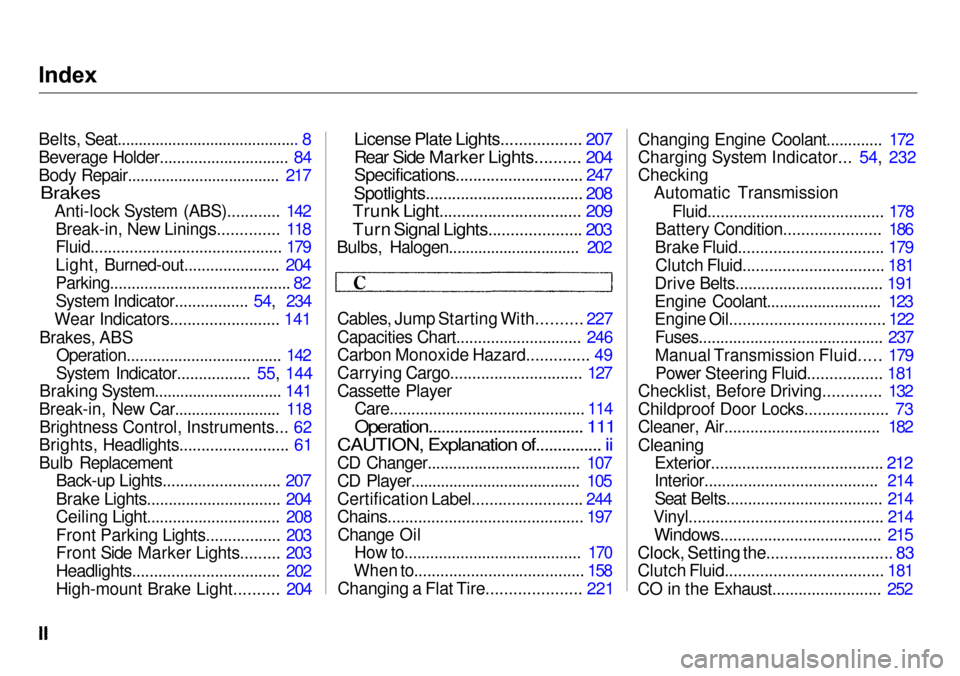
Belts, Seat........................................... 8
Beverage Holder.............................. 84
Body Repair.................................... 217
Brakes
Anti-lock System (ABS)............ 142
Break-in, New Linings.............. 118
Fluid............................................ 179
Light, Burned-out...................... 204
Parking.......................................... 82
System Indicator................. 54, 234
Wear Indicators......................... 141
Brakes, ABS Operation.................................... 142
System Indicator................. 55, 144
Braking System.............................. 141
Break-in, New Car......................... 118 Brightness Control, Instruments... 62
Brights, Headlights......................... 61
Bulb Replacement Back-up Lights........................... 207
Brake Lights............................... 204
Ceiling Light............................... 208
Front Parking Lights................. 203
Front Side Marker Lights......... 203
Headlights.................................. 202
High-mount Brake Light.......... 204
License Plate Lights.................. 207
Rear Side Marker Lights.......... 204
Specifications............................. 247
Spotlights.................................... 208
Trunk Light................................ 209
Turn Signal Lights..................... 203
Bulbs, Halogen............................... 202
Cables, Jump Starting With.......... 227
Capacities Chart............................. 246
Carbon Monoxide Hazard.............. 49
Carrying Cargo.............................. 127
Cassette Player Care............................................. 114
Operation.................................... 111
CAUTION, Explanation of............... ii
CD Changer.................................... 107
CD Player........................................ 105
Certification Label......................... 244
Chains............................................. 197 Change Oil
How to......................................... 170
When to....................................... 158
Changing a Flat Tire..................... 221 Changing Engine Coolant............. 172
Charging System Indicator... 54, 232
Checking
Automatic Transmission
Fluid........................................ 178
Battery Condition...................... 186
Brake Fluid................................. 179 Clutch Fluid................................ 181
Drive Belts.................................. 191
Engine Coolant........................... 123
Engine Oil................................... 122
Fuses........................................... 237
Manual Transmission Fluid..... 179Power Steering Fluid................. 181
Checklist, Before Driving............. 132
Childproof Door Locks................... 73
Cleaner, Air.................................... 182
Cleaning
Exterior....................................... 212
Interior........................................ 214
Seat Belts.................................... 214
Vinyl............................................ 214
Windows..................................... 215
Clock, Setting the............................ 83
Clutch Fluid.................................... 181
CO in the Exhaust......................... 252