low oil pressure Acura Integra 2000 Sedan Owner's Manual
[x] Cancel search | Manufacturer: ACURA, Model Year: 2000, Model line: Integra, Model: Acura Integra 2000Pages: 273, PDF Size: 4.4 MB
Page 148 of 273
Drivin
g in Ba d Weathe r
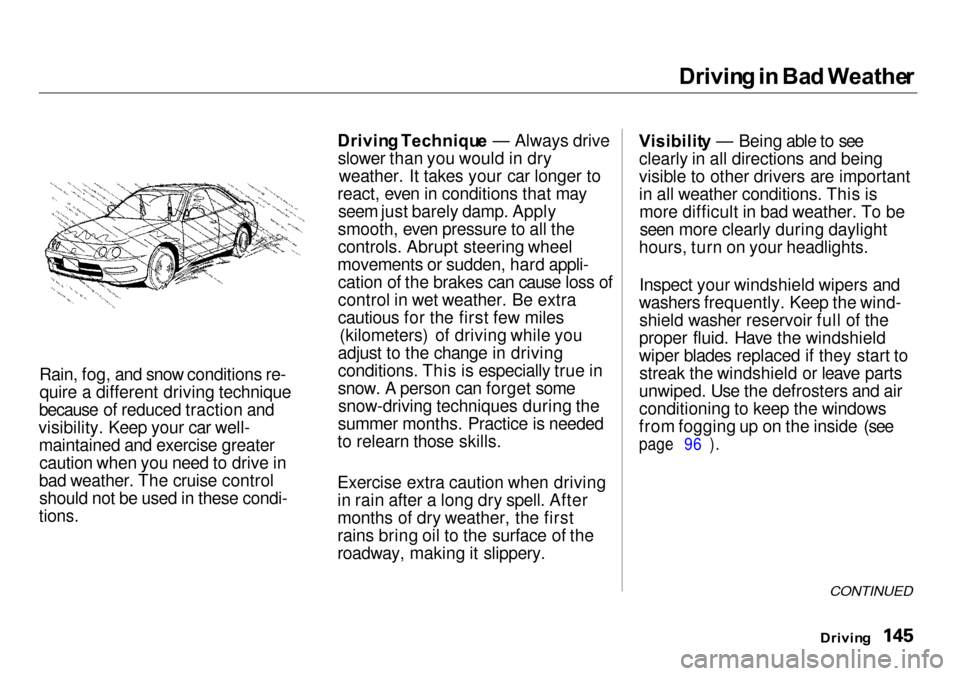
Rain, fog, and snow conditions re- quire a different driving technique
because of reduced traction and
visibility. Keep your car well- maintained and exercise greatercaution when you need to drive in
bad weather. The cruise control should not be used in these condi-
tions.
Drivin
g Techniqu e — Always drive
slower than you would in dry weather. It takes your car longer to
react, even in conditions that may seem just barely damp. Apply
smooth, even pressure to all the
controls. Abrupt steering wheel
movements or sudden, hard appli- cation of the brakes can cause loss of
control in wet weather. Be extra
cautious for the first few miles (kilometers) of driving while you
adjust to the change in driving
conditions. This is especially true in
snow. A person can forget some snow-driving techniques during the
summer months. Practice is needed
to relearn those skills.
Exercise extra caution when driving
in rain after a long dry spell. After
months of dry weather, the first
rains bring oil to the surface of the
roadway, making it slippery. Visibilit
y — Being able to see
clearly in all directions and being
visible to other drivers are important
in all weather conditions. This is more difficult in bad weather. To beseen more clearly during daylight
hours, turn on your headlights.
Inspect your windshield wipers and
washers frequently. Keep the wind- shield washer reservoir full of the
proper fluid. Have the windshield
wiper blades replaced if they start to streak the windshield or leave parts
unwiped. Use the defrosters and air
conditioning to keep the windows
from fogging up on the inside (see
page 96 ).
CONTINUED
Drivin g
Page 168 of 273

Owne
r Maintenanc e Check s
You should check the following items at the specified intervals. If
you are unsure of how to perform any check, turn to the page given. Engine oil level — Check every
time you fill the fuel tank. See
page 122.
Engine coolant level — Check the
radiator reserve tank every time
you fill the fuel tank. See page 123 , Windshield washer fluid — Check
the level in the reservoir monthly.
If weather conditions cause you to
use the washers frequently, check
the reservoir each time you stop
for fuel. See page 177. Automatic transmission — Check
the fluid level monthly. See page
178.
Brakes — Check the fluid level
monthly. See page 179 . Tires — Check the tire pressure
monthly. Examine the tread for
wear and foreign objects. See page 192. Lights — Check the operation of
the headlights, parking lights,
taillights, high-mount brake light, turn signals, brake lights, and
license plate lights monthly. See
page 198.
Maintenance
Page 193 of 273

Ai
r Conditionin g Syste m
Your car's air conditioning is a sealed system. Any major maintenance,
such as recharging, should be done
by a qualified mechanic. You can do a couple of things to make sure theair conditioning works efficiently. Periodically check the engine's
radiator and air conditioning
condenser for leaves, insects, and
dirt stuck to the front surface. These
block the air flow and reduce cooling efficiency. Use a light spray from a
hose or a soft brush to remove them.
The condenser and radiator fins bend
easily. Only use a low-pressure, spray
or soft-bristle brush to clean them.
Run the air conditioning at least once a week during the cold weather
months. Run it for at least ten
minutes while you are driving at a steady speed with the engine at
normal operating temperature. This
circulates the lubricating oil con-
tained in the refrigerant. If the air conditioning does not get as
cold as before, have your dealer
check the system. Recharge the
system with Refrigerant HFC-134a (R-134a). (See Specifications on page 246.)
Whenever you have the air conditioning
system serviced, make sure the service
facility uses a refrigerant recycling
system. This system captures the
refrigerant for reuse. Releasing
refrigerant into the atmosphere can
damage the environment.
Maintenanc e
AI
R CONDITIONIN G
CONDENSE R
NOTICE NOTIC
E
Page 222 of 273

Takin
g Car e o f th e Unexpecte d
This section covers the more- common problems that motoristsexperience with their vehicles. It
gives you information about how to safely evaluate the problem and what
to do to correct it. If the problem has stranded you on the side of the road,
you may be able to get going again. If not, you will also find instructionson getting your car towed. Compact Spare Tire....................... 220
Changing a Flat Tire..................... 221
If Your Engine Won't Start........... 226
Nothing Happens or theStarter Motor OperatesVery Slowly......................... 226
The Starter Operates Normally................................. 227
Jump Starting................................. 227
If Your Engine Overheats............. 229Low Oil Pressure Indicator.......... 231
Charging System Indicator........... 232
Malfunction Indicator Lamp........ 233
Brake System Indicator................ 234
Closing the Moonroof................... 235
Fuses............................................... 236 Checking and Replacing........... 237
Emergency Towing...................... 241
Takin g Car e o f th e Unexpecte d
Page 234 of 273

Lo
w Oi l Pressur e Indicato r
This indicator should light when the ignition switch is ON (II), and go out
after the engine starts. It should
never come on when the engine is
running. If it starts flashing, it
indicates that the oil pressuredropped very low for a moment, then
recovered. If the indicator stays on
with the engine running, it shows
that the engine has lost oil pressure and serious engine damage is
possible. In either case, you should
take immediate action.
Running the engine with low oil
pressure can cause serious mechanical damage almost immediately. Turn offthe engine as soon as you can safely get
the car stopped.
1. Safely pull off the road and shut off the engine. Turn on the hazard
warning indicators.
2. Let the car sit for a minute. Open the hood and check the oil level(see page 122 ). Although oil level
and oil pressure are not directly
connected, an engine that is very
low on oil can lose pressure during cornering and other driving
maneuvers.
3. If necessary, add oil to bring the level back to the full mark on the
dipstick (see page 167).
4. Start the engine and watch the oil pressure indicator. If the light
does not go out within ten seconds,
turn off the engine. There is a mechanical problem that needs to
be repaired before you can
continue driving. (See Emergenc y
Towin g on page 241.)
Takin g Car e o f th e Unexpecte d
NOTIC
E
LO W OI L PRESSUR E INDICATO R
Page 266 of 273
Inde
x
Cold Weather, Starting in............. 133 Compact Spare............................... 220
Console Compartment.................... 85
Consumer Information *................ 256
Controls, Instruments and.............. 51
Coolant
Adding......................................... 172
Checking..................................... 123
Proper Solution.......................... 172
Replacing.................................... 174
Temperature Gauge.................... 58
Corrosion Protection..................... 216
Crankcase Emissions Control
System......................................... 252
Cruise Control Operation............... 66 Customer Relations Office........... 256
DANGER, Explanation of................. ii
Dashboard........................................ 52 Dead Battery, What to Do............ 227
Defects, Reporting Safety............. 258
Defog and Defrost........................... 96
Defogger, Rear Window................. 64
Defrosting the Windows................. 96 DEXRON
®
III Automatic
Transmission Fluid.................... 178
Dimensions..................................... 246
Dimming the Headlights................ 61
Dipstick Automatic Transmission........... 178
Engine Oil................................... 122
Directional Signals........................... 62
Disabled, Towing Your Car If...... 241
Disc Brake Wear Indicators......... 141
Disposal of Used Oil...................... 171 Doors Locking and Unlocking............... 72
Open Indicator............................. 55
Power Door Locks....................... 72
DOT Tire Quality Grading........... 248
Downshifting, 5-speed Manual Transmission.............................. 134
Driver and Passenger Safety............ 5 Drive Belts...................................... 191
Driving............................................ 131 Economy.....................................
124
In Ba
d Weather..........................
145
In Foreig
n Countries................. 251
Economy, Fuel............................... 124
Emergencies on the Road............. 219
Battery, Jump Starting.............. 227
Brake System Indicator............ 234
Changing a Flat Tire................. 221
Charging System Indicator ...... 232
Checking the Fuses................... 237
Low Oil Pressure Indicator...... 231
Malfunction Indicator Lamp.... 233
Manually Closing Moonroof.... 235 Overheated Engine................... 229
Emergency Brake............................ 82 Emergency Flashers....................... 64
Emissions Controls........................ 252
Engine Coolant Temperature Gauge ..... 58
Malfunction Indicator
Lamp................................ 55, 233
Oil Pressure Indicator........ 54, 231
Oil, What Kind to Use............... 167
Overheating................................ 229
Specifications............................. 246
Speed Limit........................ 135, 138
CONTINUED
Page 268 of 273

Inde
x
Turning on.................................... 61
Head Restraints............................... 77
Heating and Cooling........................ 90
High Altitude, Starting at.............. 133
High-Low Beam Switch.................. 61
High-mount Brake Light............... 204
Hood Latch..................................... 183
Hood, Opening the........................ 120
Horn................................................... 60
Hot Coolant, Warning about........ 172
Hydraulic Clutch............................ 181
Hydroplaning.................................. 146
Identification Number, Vehicle.... 244If Your Car Has to be Towed....... 241
Ignition Keys............................................... 69
Switch............................................ 69
Immobilizer System......................... 69 Important Safety Precautions.......... 6
Indicator Lights, Instrument Panel.............................................. 53
Infant Restraint................................ 29
Inflation, Proper Tire .................... 192 Jacking up the Car......................... 222
Jack, Tire........................................ 221
Jump Starting................................. 227
Lights
Bulb Replacement..................... 202
Indicator........................................ 53
Parking.......................................... 61
Turn Signal................................... 62
LOCK (Ignition Key Position)....... 71
Locks
Anti-theft Steering Column........ 71
Fuel Fill Door............................. 119
Glove Box..................................... 75
Power Door.................................. 72
Trunk............................................ 73
Low Coolant Level......................... 123
Low Fuel Indicator.......................... 55
Lower Gear, Downshifting to a.... 134
Low Oil Pressure Indicator... 54, 231
Lubricant Specifications Chart.... 246
Luggage.......................................... 127
Maintenance................................... 153 Owner Maintenance Checks.... 165
Record................................. 163-164
CONTINUED
Inside Mirror.................................... 81
Inspection, Tire.............................. 192
Instrument Panel............................. 52
Instrument Panel Brightness......... 62
Interior Cleaning............................ 214
Interior Light.................................... 87
Introduction......................................... i
Keys................................................... 69
Label, Certification........................ 244
Lane Change, Signaling.................. 62
Lap Belt............................................. 43
Lap/Shoulder Belts......................... 42
Leaking of Exhaust into Car.......... 49
Leather, Cleaning.......................... 214