power steering fluid ACURA TL 1995 Service Repair Manual
[x] Cancel search | Manufacturer: ACURA, Model Year: 1995, Model line: TL, Model: ACURA TL 1995Pages: 1771, PDF Size: 62.49 MB
Page 28 of 1771
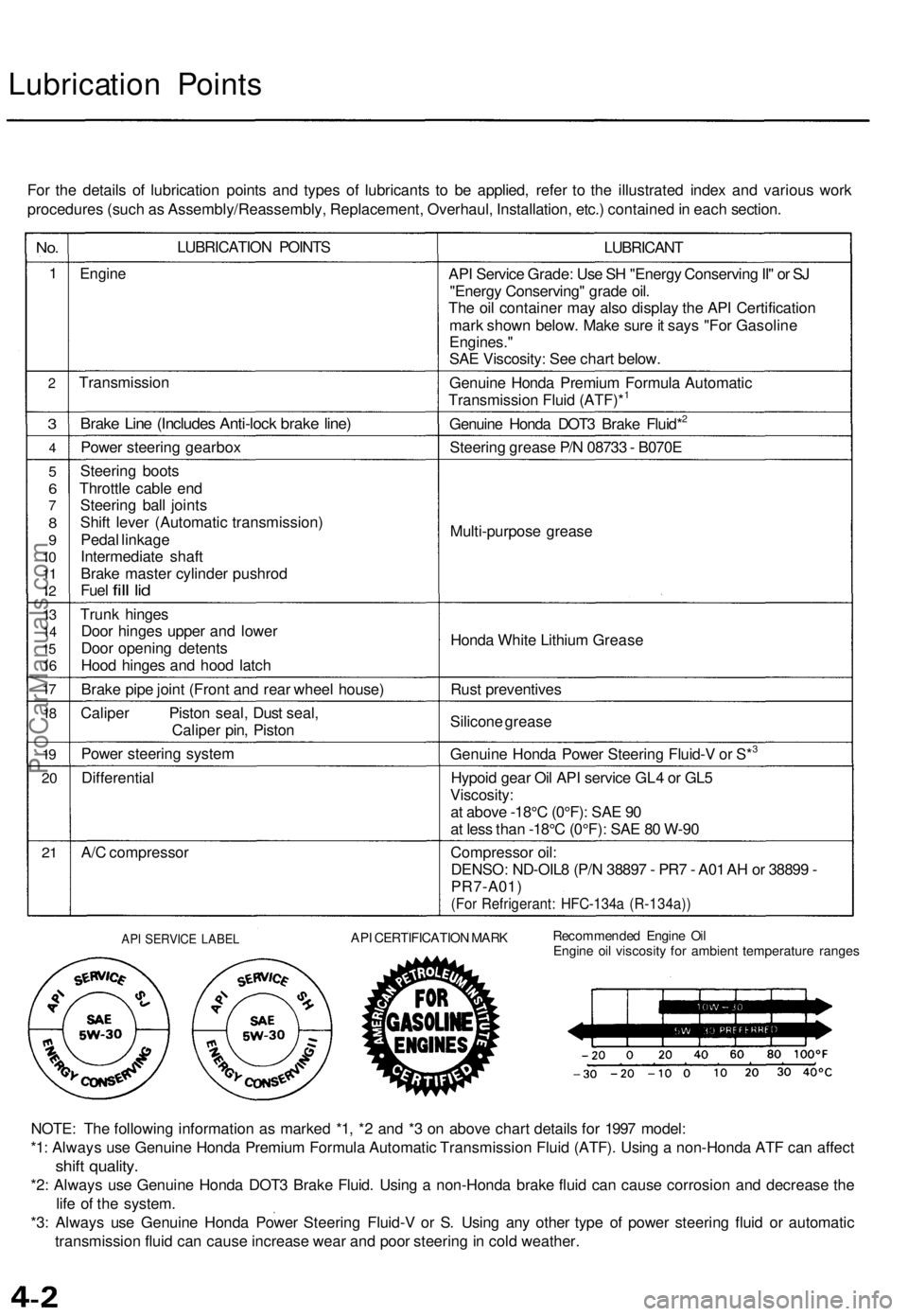
Lubrication Points
For the details of lubrication points and types of lubricants to be applied, refer to the illustrated index and various work
procedures (such as Assembly/Reassembly, Replacement, Overhaul, Installation, etc.) contained in each section.
No.
1
2
3
4
5
6
7
8
9
10
11
12
13
14
15
16
17
18
19
20
21
LUBRICATION POINTS
Engine
Transmission
Brake Line (Includes Anti-lock brake line)
Power steering gearbox
Steering boots
Throttle cable end
Steering ball joints
Shift lever (Automatic transmission)
Pedal linkage
Intermediate shaft
Brake master cylinder pushrod
Fuel
fill
lid
Trunk hinges
Door hinges upper and lower
Door opening detents
Hood hinges and hood latch
Brake pipe joint (Front and rear wheel house)
Caliper Piston seal, Dust seal,
Caliper pin, Piston
Power steering system
Differential
A/C compressor
LUBRICANT
API Service Grade: Use SH "Energy Conserving II" or SJ
"Energy Conserving" grade oil.
The oil container may also display the API Certification
mark shown below. Make sure it says "For Gasoline
Engines."
SAE Viscosity: See chart below.
Genuine Honda Premium Formula Automatic
Transmission Fluid (ATF)*1
Genuine Honda DOT3 Brake Fluid*2
Steering grease P/N 08733 - B070E
Multi-purpose grease
Honda White Lithium Grease
Rust preventives
Silicone grease
Genuine Honda Power Steering Fluid-V or S*3
Hypoid gear Oil API service GL4 or GL5
Viscosity:
at above -18°C (0°F): SAE 90
at less than -18°C (0°F): SAE 80 W-90
Compressor oil:
DENSO: ND-OIL8 (P/N 38897 - PR7 - A01 AH or 38899 -
PR7-A01)
(For Refrigerant: HFC-134a (R-134a))
API SERVICE LABEL
API CERTIFICATION MARK
Recommended Engine Oil
Engine oil viscosity for ambient temperature ranges
NOTE: The following information as marked *1, *2 and *3 on above chart details for 1997 model:
*1: Always use Genuine Honda Premium Formula Automatic Transmission Fluid (ATF). Using a non-Honda ATF can affect
shift quality.
*2: Always use Genuine Honda DOT3 Brake Fluid. Using a non-Honda brake fluid can cause corrosion and decrease the
life of the system.
*3: Always use Genuine Honda Power Steering Fluid-V or S. Using any other type of power steering fluid or automatic
transmission fluid can cause increase wear and poor steering in cold weather.ProCarManuals.com
Page 45 of 1771
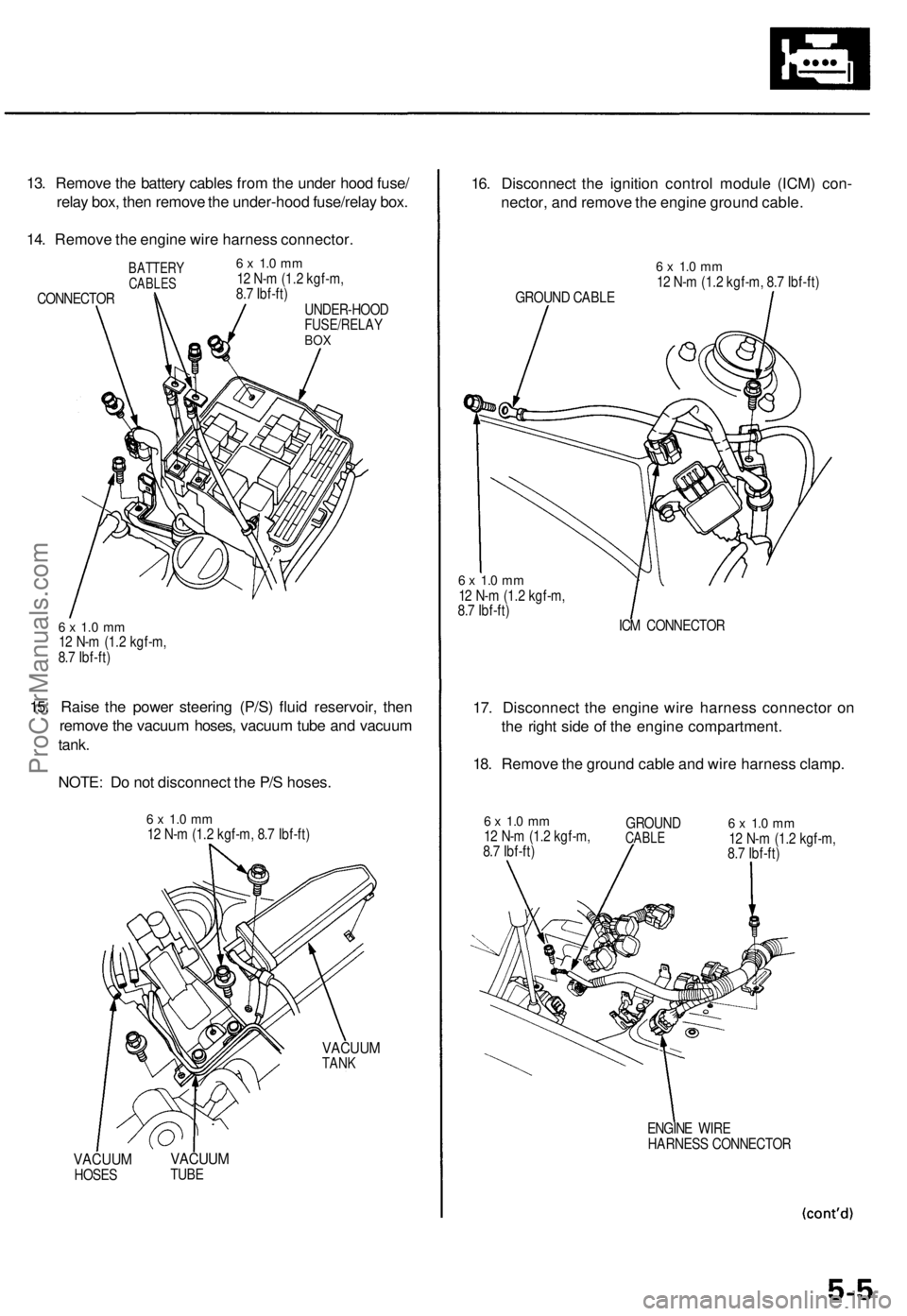
13. Remove the battery cables from the under hood fuse/
relay box, then remove the under-hood fuse/relay box.
14. Remove the engine wire harness connector.
BATTERY
CABLES
CONNECTOR
6 x 1.0 mm
12 N-m (1.2 kgf-m,
8.7 Ibf-ft)
UNDER-HOOD
FUSE/RELAY
BOX
6 x 1.0 mm
12 N-m (1.2 kgf-m,
8.7 Ibf-ft)
15. Raise the power steering (P/S) fluid reservoir, then
remove the vacuum hoses, vacuum tube and vacuum
tank.
NOTE: Do not disconnect the P/S hoses.
6 x 1.0 mm
12 N-m (1.2 kgf-m, 8.7 Ibf-ft)
VACUUM
TANK
VACUUM
HOSES
VACUUM
TUBE
16. Disconnect the ignition control module (ICM) con-
nector, and remove the engine ground cable.
GROUND CABLE
6 x 1.0 mm
12 N-m (1.2 kgf-m, 8.7 Ibf-ft)
6 x 1.0 mm
12 N-m (1.2 kgf-m,
8.7 Ibf-ft)
ICM CONNECTOR
17. Disconnect the engine wire harness connector on
the right side of the engine compartment.
18. Remove the ground cable and wire harness clamp.
6 x 1.0 mm
12 N-m (1.2 kgf-m,
8.7 Ibf-ft)
GROUND
CABLE
6 x 1.0 mm
12 N-m (1.2 kgf-m,
8.7 Ibf-ft)
ENGINE WIRE
HARNESS CONNECTORProCarManuals.com
Page 49 of 1771
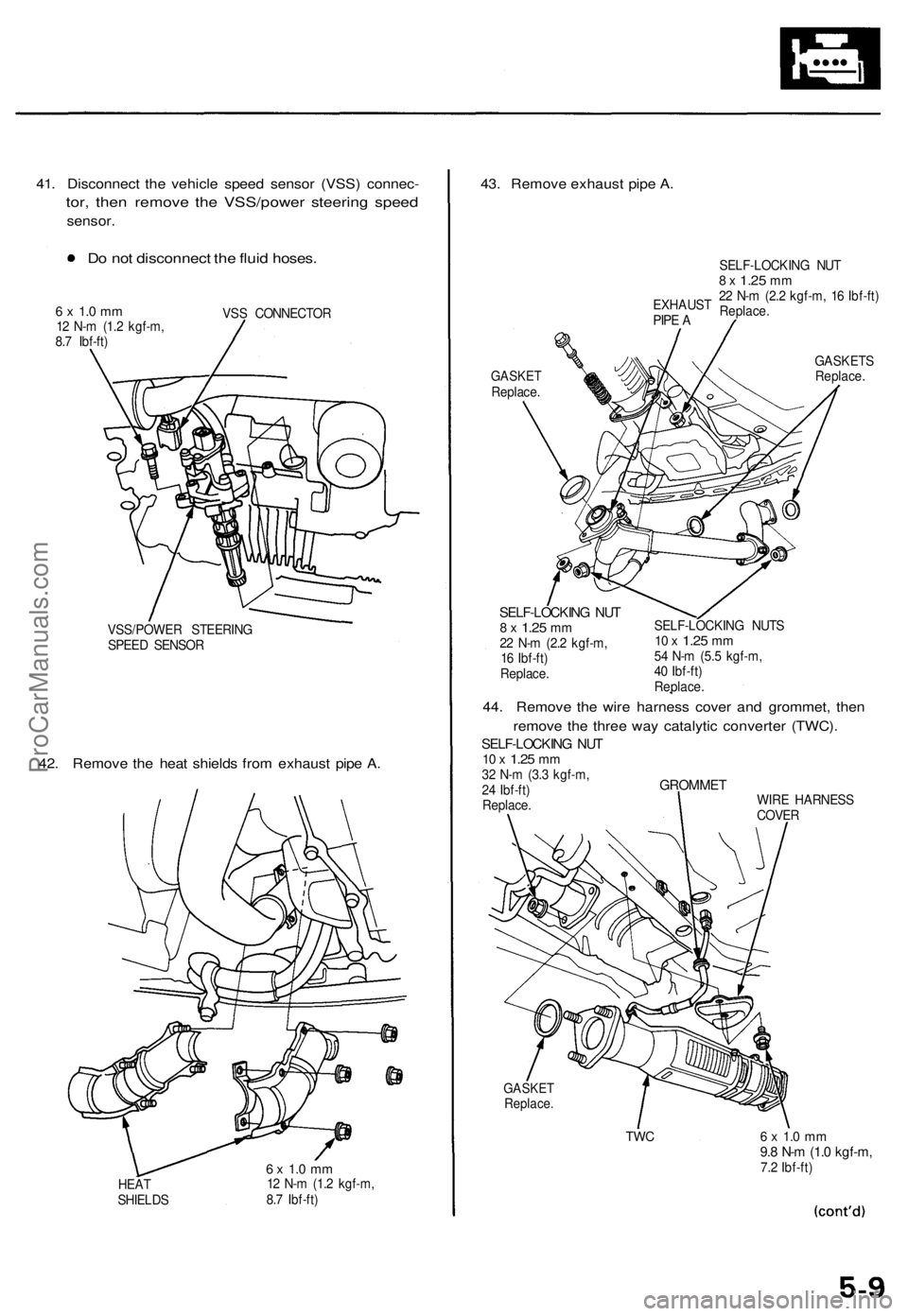
41. Disconnect the vehicle speed sensor (VSS) connec-
tor, then remove the VSS/power steering speed
sensor.
Do not disconnect the fluid hoses.
6 x 1.0 mm
12 N-m (1.2 kgf-m,
8.7 Ibf-ft)
VSS CONNECTOR
VSS/POWER STEERING
SPEED SENSOR
42. Remove the heat shields from exhaust pipe A.
HEAT
SHIELDS
6 x 1.0 mm
12 N-m (1.2 kgf-m,
8.7 Ibf-ft)
43. Remove exhaust pipe A.
EXHAUST
PIPE A
GASKET
Replace.
SELF-LOCKING NUT
8 x
1.25
mm
22 N-m (2.2 kgf-m, 16 Ibf-ft)
Replace.
GASKETS
Replace.
GASKET
Replace.
TWC
6 x 1.0 mm
9.8 N-m (1.0 kgf-m,
7.2 Ibf-ft)
SELF-LOCKING NUT
8 x
1.25
mm
22 N-m (2.2 kgf-m,
16 Ibf-ft)
Replace.
SELF-LOCKING NUTS
10 x
1.25
mm
54 N-m (5.5 kgf-m,
40 Ibf-ft)
Replace.
44. Remove the wire harness cover and grommet, then
remove the three way catalytic converter (TWC).
SELF-LOCKING NUT
10 x
1.25
mm
32 N-m (3.3 kgf-m,
24 Ibf-ft)
Replace.
GROMMET
WIRE HARNESS
COVERProCarManuals.com
Page 471 of 1771
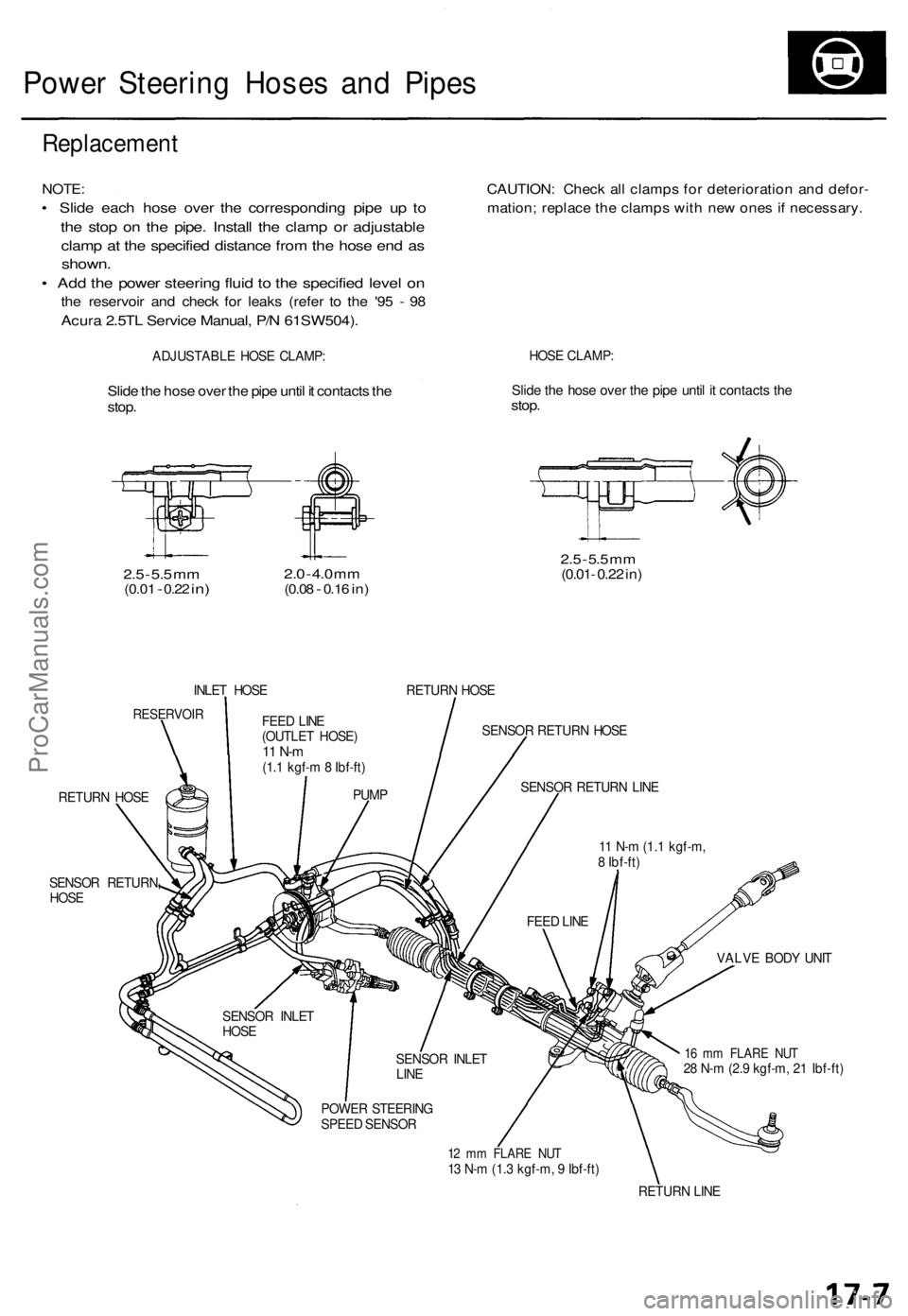
Power Steering Hoses and Pipes
Replacement
NOTE:
• Slide each hose over the corresponding pipe up to
the stop on the pipe. Install the clamp or adjustable
clamp at the specified distance from the hose end as
shown.
• Add the power steering fluid to the specified level on
the reservoir and check for leaks (refer to the '95 - 98
Acura 2.5TL Service Manual, P/N 61SW504).
CAUTION: Check all clamps for deterioration and defor-
mation; replace the clamps with new ones if necessary.
ADJUSTABLE HOSE CLAMP:
HOSE CLAMP:
Slide the hose over the pipe until it contacts the
stop.
Slide the hose over the pipe until it contacts the
stop.
2.5
-
5.5
mm
(0.01
-
0.22
in)
2.0
-
4.0
mm
(0.08
-
0.16
in)
2.5
-
5.5
mm
(0.01- 0.22 in)
INLET HOSE
RETURN HOSE
RESERVOIR
SENSOR RETURN HOSE
RETURN HOSE
SENSOR RETURN
HOSE
VALVE BODY UNIT
16 mm FLARE NUT
28 N-m (2.9 kgf-m, 21 Ibf-ft)
12 mm FLARE NUT
13 N-m (1.3 kgf-m, 9 Ibf-ft)
RETURN LINE
FEED LINE
(OUTLET HOSE)
11 N-m
(1.1 kgf-m 8 Ibf-ft)
PUMP
SENSOR INLET
HOSE
SENSOR INLET
LINE
POWER STEERING
SPEED SENSOR
FEED LINE
11 N-m (1.1 kgf-m,
8 Ibf-ft)
SENSOR RETURN LINEProCarManuals.com
Page 479 of 1771
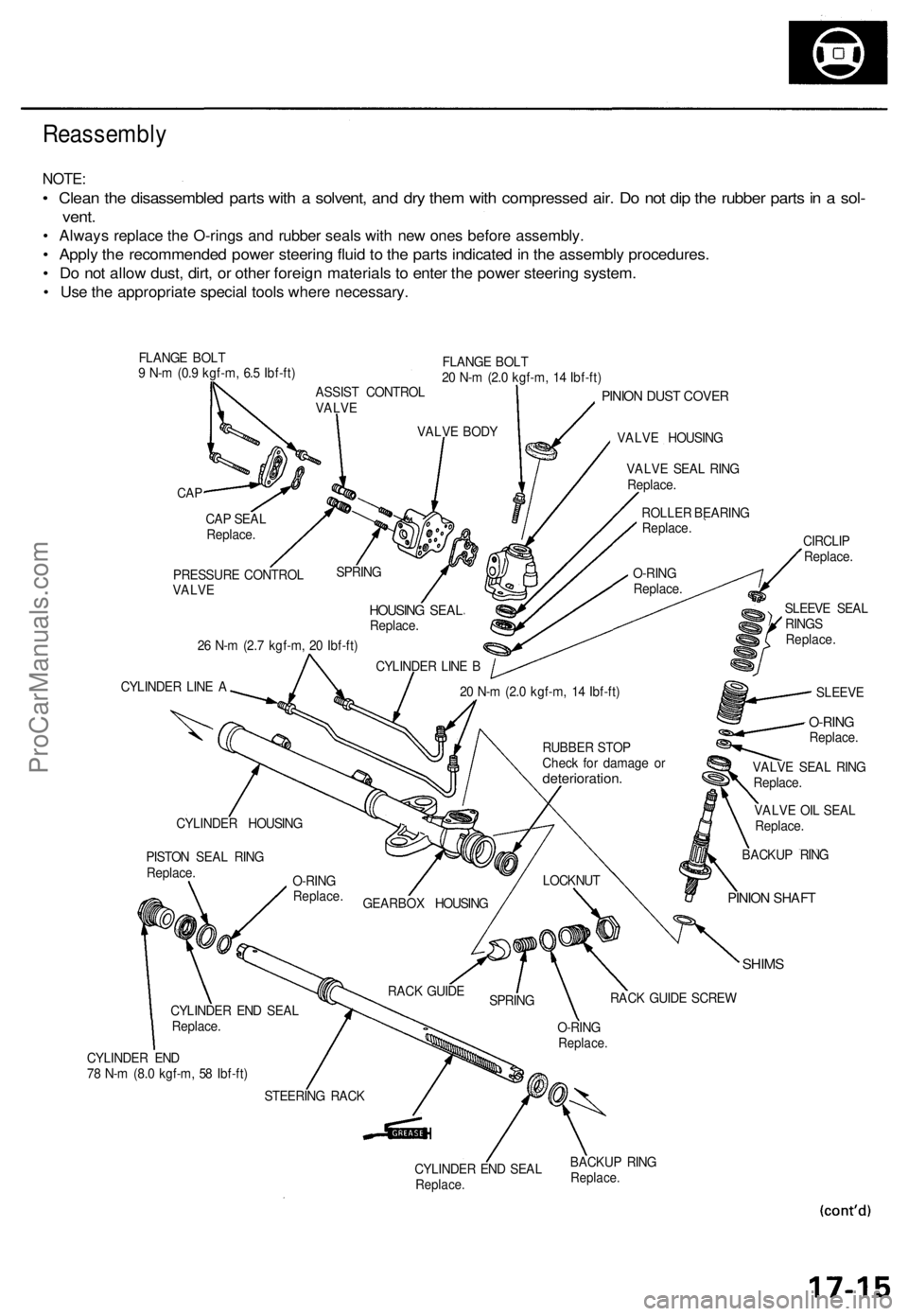
Reassembly
NOTE:
• Clean the disassembled parts with a solvent, and dry them with compressed air. Do not dip the rubber parts in a sol-
vent.
• Always replace the O-rings and rubber seals with new ones before assembly.
• Apply the recommended power steering fluid to the parts indicated in the assembly procedures.
• Do not allow dust, dirt, or other foreign materials to enter the power steering system.
• Use the appropriate special tools where necessary.
FLANGE BOLT
9 N-m (0.9 kgf-m, 6.5 Ibf-ft)
FLANGE BOLT
20 N-m (2.0 kgf-m, 14 Ibf-ft)
CAP
PINION DUST COVER
VALVE HOUSING
26 N-m (2.7 kgf-m, 20 Ibf-ft)
CYLINDER LINE A
VALVE OIL SEAL
Replace.
SHIMS
CYLINDER END
78 N-m (8.0 kgf-m, 58 Ibf-ft)
CYLINDER END SEAL
Replace.
BACKUP RING
Replace.
CAP SEAL
Replace.
PRESSURE CONTROL
VALVE
SPRING
HOUSING SEAL
Replace.
CYLINDER LINE B
VALVE BODY
ASSIST CONTROL
VALVE
VALVE SEAL RING
Replace.
ROLLER BEARING
Replace.
O-RING
Replace.
SLEEVE SEAL
RINGS
Replace.
CIRCLIP
Replace.
SLEEVE
20 N-m (2.0 kgf-m, 14 Ibf-ft)
BACKUP RING
PINION SHAFT
LOCKNUT
RACK GUIDE SCREW
O-RING
Replace.
SPRING
RACK GUIDE
STEERING RACK
CYLINDER END SEAL
Replace.
PISTON SEAL RING
Replace.
CYLINDER HOUSING
GEARBOX HOUSING
O-RING
Replace.
RUBBER STOP
Check for damage or
deterioration.
VALVE SEAL RING
Replace.
O-RING
Replace.ProCarManuals.com
Page 482 of 1771
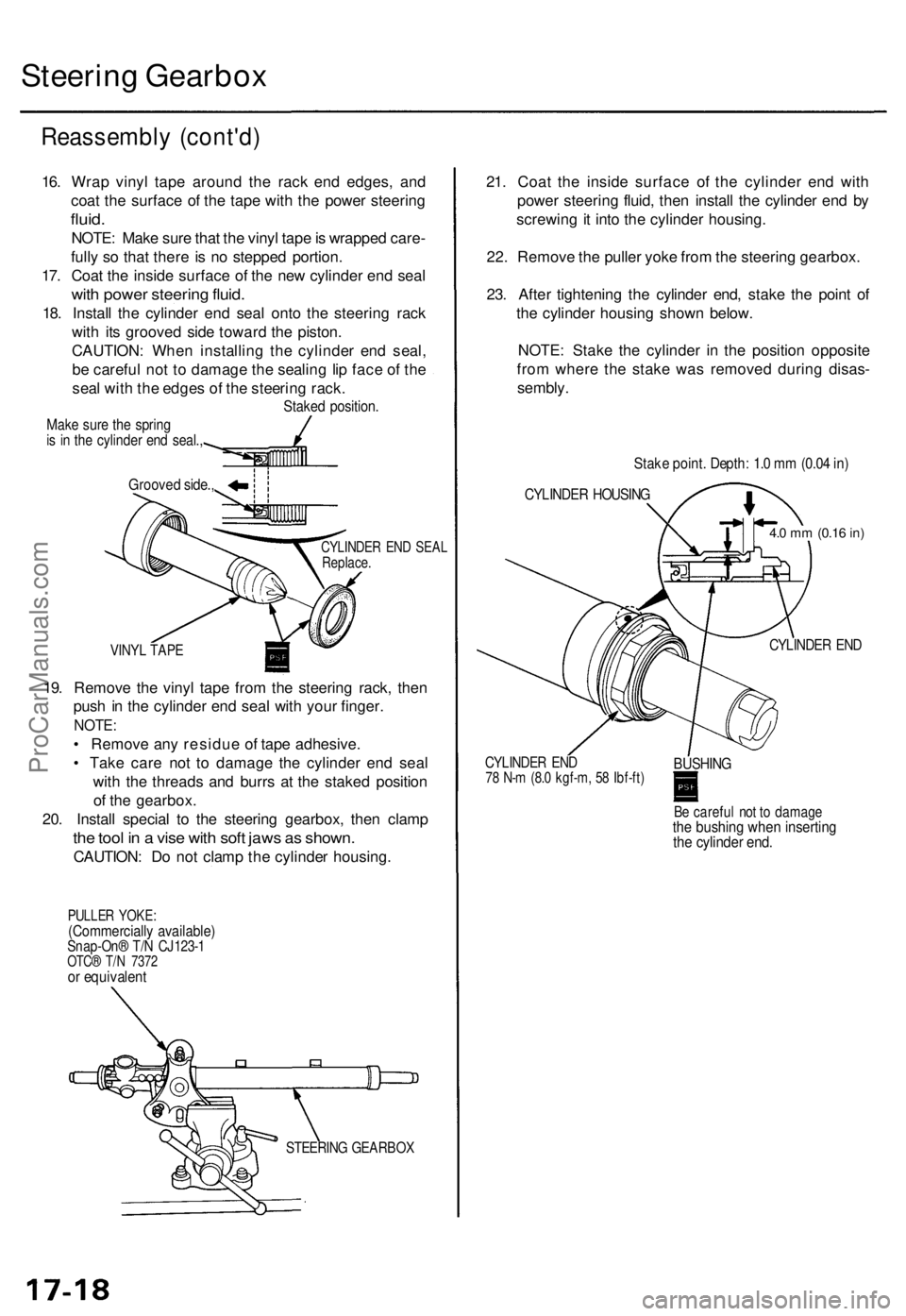
Steering Gearbox
Reassembly (cont'd)
CYLINDER END SEAL
Replace.
VINYL TAPE
19. Remove the vinyl tape from the steering rack, then
push in the cylinder end seal with your finger.
NOTE:
• Remove any residue of tape adhesive.
• Take care not to damage the cylinder end seal
with the threads and burrs at the staked position
of the gearbox.
20. Install special to the steering gearbox, then clamp
the tool in a vise with soft jaws as shown.
CAUTION: Do not clamp the cylinder housing.
PULLER YOKE:
(Commercially available)
Snap-On® T/N CJ123-1
OTC® T/N 7372
or equivalent
21. Coat the inside surface of the cylinder end with
power steering fluid, then install the cylinder end by
screwing it into the cylinder housing.
22. Remove the puller yoke from the steering gearbox.
23. After tightening the cylinder end, stake the point of
the cylinder housing shown below.
NOTE: Stake the cylinder in the position opposite
from where the stake was removed during disas-
sembly.
CYLINDER END
CYLINDER END
78 N-m (8.0 kgf-m, 58 Ibf-ft)
BUSHING
Be careful not to damage
the bushing when inserting
the cylinder end.
Grooved side.,
Stake point. Depth: 1.0 mm (0.04 in)
CYLINDER HOUSING
4.0 mm
(0.16
in)
STEERING GEARBOX
16. Wrap vinyl tape around the rack end edges, and
coat the surface of the tape with the power steering
fluid.
NOTE: Make sure that the vinyl tape is wrapped care-
fully so that there is no stepped portion.
17. Coat the inside surface of the new cylinder end seal
with power steering fluid.
18. Install the cylinder end seal onto the steering rack
with its grooved side toward the piston.
CAUTION: When installing the cylinder end seal,
be careful not to damage the sealing lip face of the
seal with the edges of the steering rack.
Staked position.
Make sure the spring
is in the cylinder end seal.,ProCarManuals.com
Page 1145 of 1771
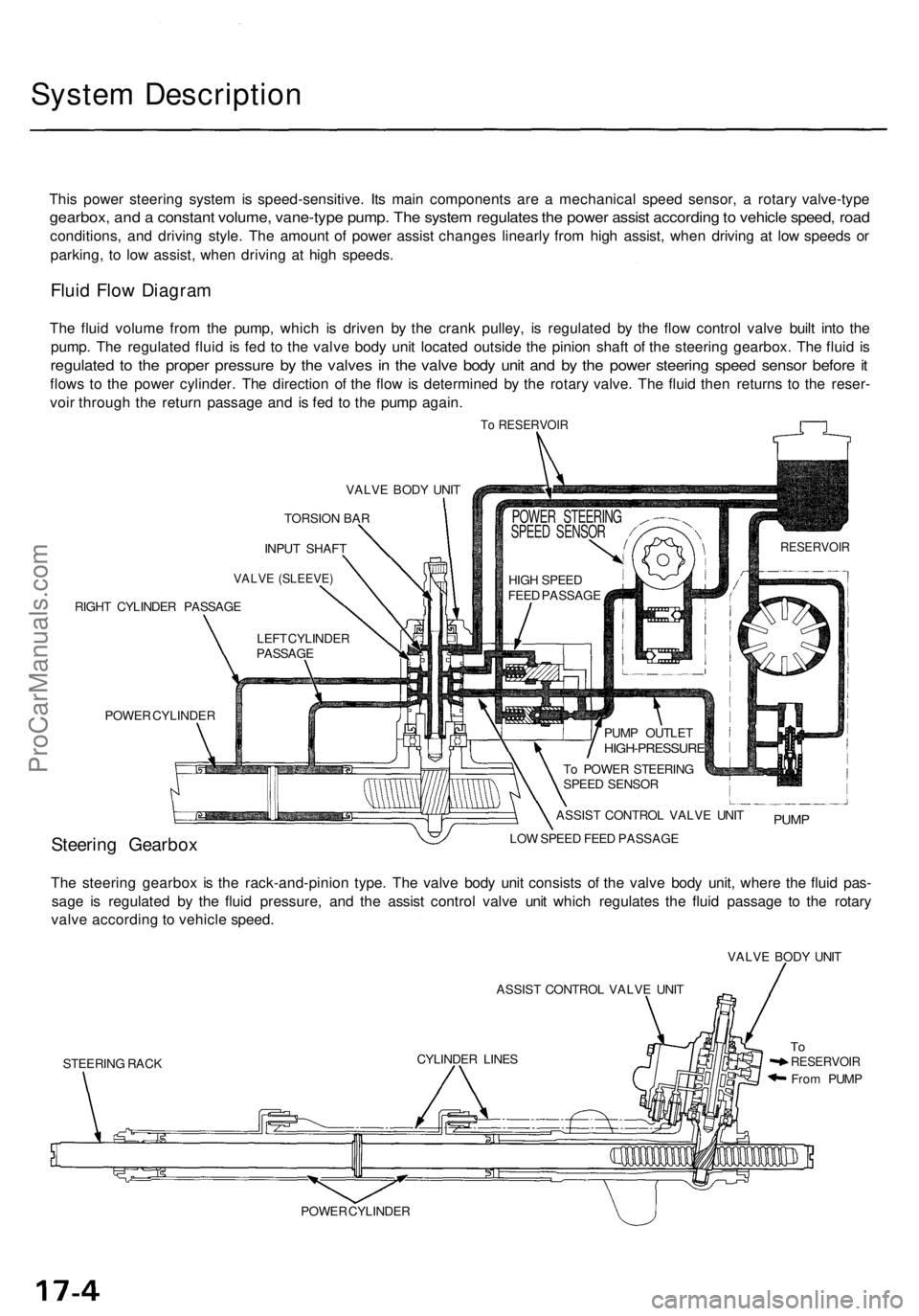
System Descriptio n
This powe r steerin g syste m is speed-sensitive . It s mai n component s ar e a mechanica l spee d sensor , a rotar y valve-typ e
gearbox, an d a constan t volume , vane-typ e pump . Th e syste m regulate s th e powe r assis t accordin g to vehicl e speed , roa d
conditions , an d drivin g style . Th e amoun t o f powe r assis t change s linearl y fro m hig h assist , whe n drivin g a t lo w speed s o r
parking , t o lo w assist , whe n drivin g a t hig h speeds .
Fluid Flo w Diagra m
The flui d volum e fro m th e pump , whic h i s drive n b y th e cran k pulley , i s regulate d b y th e flo w contro l valv e buil t int o th e
pump . Th e regulate d flui d i s fe d t o th e valv e bod y uni t locate d outsid e th e pinio n shaf t o f th e steerin g gearbox . Th e flui d i s
regulate d t o th e prope r pressur e b y th e valve s i n th e valv e bod y uni t an d b y th e powe r steerin g spee d senso r befor e it
flow s t o th e powe r cylinder . Th e directio n o f th e flo w is determine d b y th e rotar y valve . Th e flui d the n returns to th e reser -
voi r throug h th e retur n passag e an d i s fe d t o th e pum p again .
To RESERVOI R
VALVE BOD Y UNI T
TORSIO N BA R
INPU T SHAF T
VALVE (SLEEVE )
RIGHT CYLINDE R PASSAG E
POWE R CYLINDE R
Steering Gearbo xLOW SPEE D FEE D PASSAG E
The steerin g gearbo x i s th e rack-and-pinio n type . Th e valv e bod y uni t consist s o f th e valv e bod y unit , wher e th e flui d pas -
sag e i s regulate d b y th e flui d pressure , an d th e assis t contro l valv e uni t whic h regulate s th e flui d passag e t o th e rotar y
valv e accordin g t o vehicl e speed .
ASSIST CONTRO L VALV E UNI T
STEERIN G RAC K VALV
E BOD Y UNI T
ToRESERVOI R
From PUM P
POWE R CYLINDE RCYLINDE
R LINE S ASSIS
T CONTRO L VALV E UNI T
PUM P
To POWE R STEERIN G
SPEE D SENSO R
PUM
P OUTLE T
HIGH-PRESSUR E
HIGH SPEE D
FEE D PASSAG E
POWER STEERIN G
SPEE D SENSO R
RESERVOI R
LEFT CYLINDE R
PASSAG E
ProCarManuals.com
Page 1149 of 1771

One-way Valve (In Power Steering Speed
Sensor)
When the vehicle is moving at high speed, negative
pressure develops at the sensor inlet because the power
steering speed sensor is pumping faster than the fluid
can be supplied. To compensate for this, the outlet and
inlet ports are connected internally by a passage con-
taining a one-way valve that lets output fluid recirculate
to the inlet port to equalize pressure.
Driving at High Speed:
ONE-WAY VALVE
RESERVOIR
ROTORS
Relief Valve (In Power Steering Speed Sensor)
When the vehicle is moving in reverse, the power steer-
ing speed sensor also turns backward and pumps fluid
in the opposite direction. To avoid building up pressure
in the reaction chambers that would increase steering
effort while driving in reverse, the inlet and outlet-ports
are connected by a second internal passage containing a
relief valve that allows the fluid to recirculate.
Driving in Reverse:
RESERVOIR
RELIEF VALVEProCarManuals.com
Page 1152 of 1771
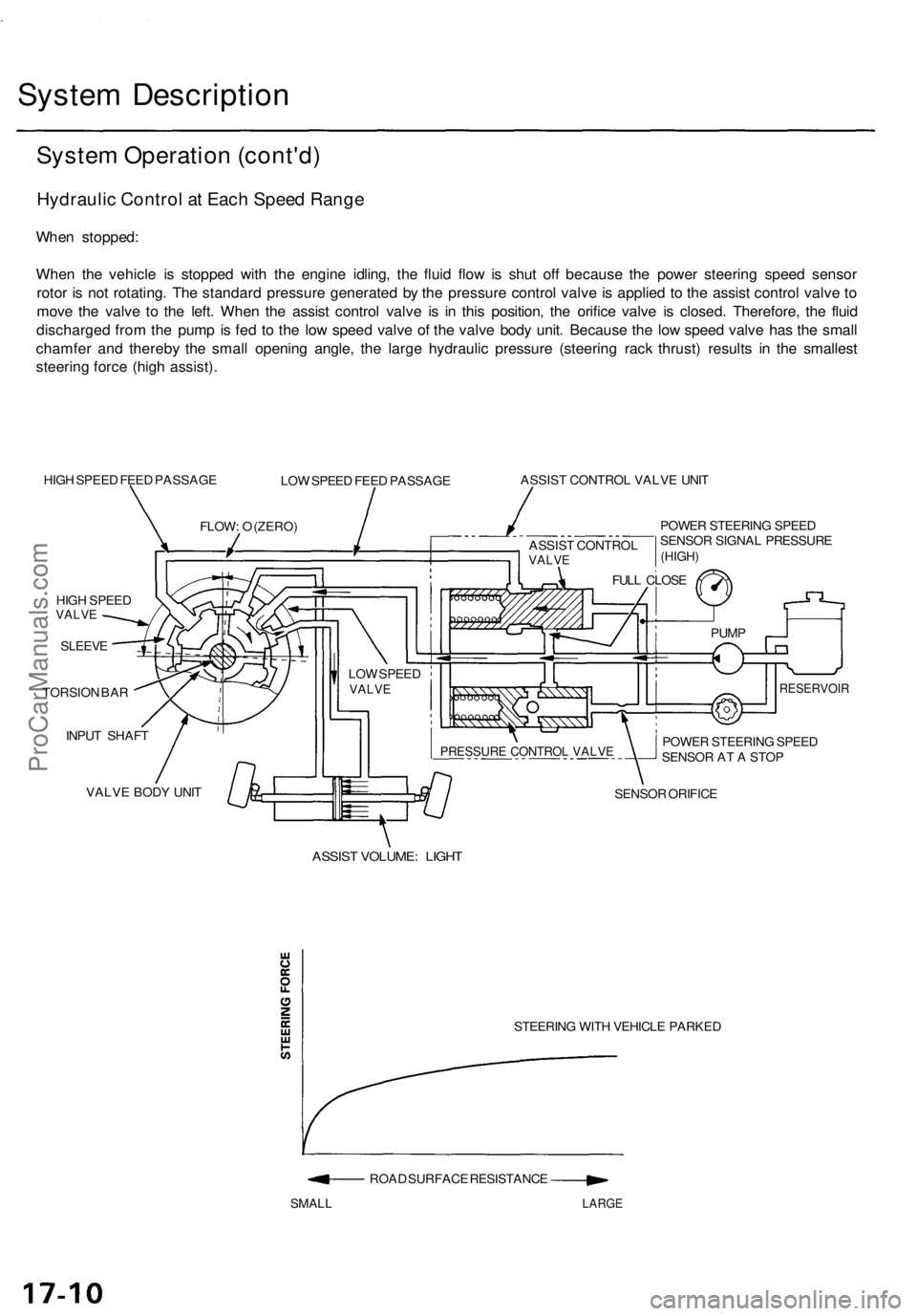
System Description
System Operation (cont'd)
Hydraulic Control at Each Speed Range
When stopped:
When the vehicle is stopped with the engine idling, the fluid flow is shut off because the power steering speed sensor
rotor is not rotating. The standard pressure generated by the pressure control valve is applied to the assist control valve to
move the valve to the left. When the assist control valve is in this position, the orifice valve is closed. Therefore, the fluid
discharged from the pump is fed to the low speed valve of the valve body unit. Because the low speed valve has the small
chamfer and thereby the small opening angle, the large hydraulic pressure (steering rack thrust) results in the smallest
steering force (high assist).
HIGH SPEED FEED PASSAGE
LOW SPEED FEED PASSAGE
ASSIST CONTROL VALVE UNIT
POWER STEERING SPEED
SENSOR SIGNAL PRESSURE
HIGH SPEED
VALVE
SLEEVE
TORSION BAR
INPUT SHAFT
VALVE BODY UNIT
SENSOR ORIFICE
ASSIST VOLUME: LIGHT
STEERING WITH VEHICLE PARKED
ROAD SURFACE RESISTANCE
SMALL
LARGE
FLOW: O (ZERO)
LOW SPEED
VALVE
POWER STEERING SPEED
SENSOR AT A STOP
RESERVOIR
PUMP
FULL CLOSE
PRESSURE CONTROL VALVE
(HIGH)
ASSIST CONTROL
VALVEProCarManuals.com
Page 1153 of 1771
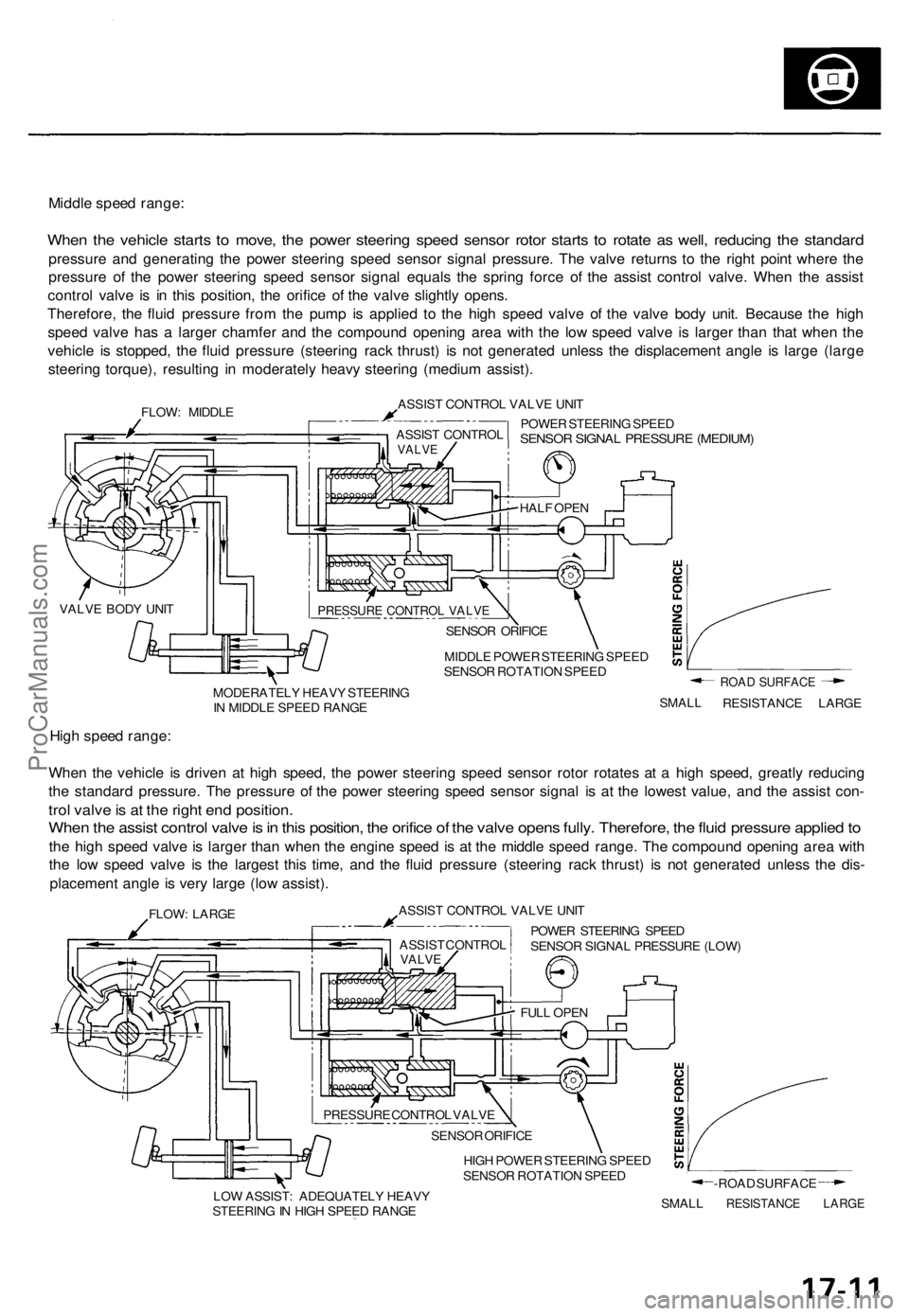
Middle speed range:
When the vehicle starts to move, the power steering speed sensor rotor starts to rotate as well, reducing the standard
pressure and generating the power steering speed sensor signal pressure. The valve returns to the right point where the
pressure of the power steering speed sensor signal equals the spring force of the assist control valve. When the assist
control valve is in this position, the orifice of the valve slightly opens.
Therefore, the fluid pressure from the pump is applied to the high speed valve of the valve body unit. Because the high
speed valve has a larger chamfer and the compound opening area with the low speed valve is larger than that when the
vehicle is stopped, the fluid pressure (steering rack thrust) is not generated unless the displacement angle is large (large
steering torque), resulting in moderately heavy steering (medium assist).
FLOW: MIDDLE
ASSIST CONTROL VALVE UNIT
POWER STEERING SPEED
SENSOR SIGNAL PRESSURE (MEDIUM)
MIDDLE POWER STEERING SPEED
SENSOR ROTATION SPEED
MODERATELY HEAVY STEERING
IN MIDDLE SPEED RANGE
SMALL
ROAD SURFACE
RESISTANCE LARGE
High speed range:
When the vehicle is driven at high speed, the power steering speed sensor rotor rotates at a high speed, greatly reducing
the standard pressure. The pressure of the power steering speed sensor signal is at the lowest value, and the assist con-
trol valve is at the right end position.
When the assist control valve is in this position, the orifice of the valve opens fully. Therefore, the fluid pressure applied to
the high speed valve is larger than when the engine speed is at the middle speed range. The compound opening area with
the low speed valve is the largest this time, and the fluid pressure (steering rack thrust) is not generated unless the dis-
placement angle is very large (low assist).
FLOW: LARGE
ASSIST CONTROL VALVE UNIT
POWER STEERING SPEED
SENSOR SIGNAL PRESSURE (LOW)
HIGH POWER STEERING SPEED
SENSOR ROTATION SPEED
LOW ASSIST: ADEQUATELY HEAVY
STEERING IN HIGH SPEED RANGE
SMALL
-ROAD SURFACE
RESISTANCE LARGE
PRESSURE CONTROL VALVE
SENSOR ORIFICE
HALF OPEN
ASSIST CONTROL
VALVE
VALVE BODY UNIT
ASSIST CONTROL
VALVE
FULL OPEN
SENSOR ORIFICE
PRESSURE CONTROL VALVEProCarManuals.com