transmission Acura ZDX 2012 User Guide
[x] Cancel search | Manufacturer: ACURA, Model Year: 2012, Model line: ZDX, Model: Acura ZDX 2012Pages: 370, PDF Size: 10.06 MB
Page 271 of 370
269
Maintenance
This chapter discusses basic maintenance.
Before Performing MaintenanceInspection and Mainte nance ............ 270
Safety When Performing Maintenance..... 271Parts and Fluids Used in Maintenance
Service ........................................... 272
Maintenance Minder
TM..................... 273
Maintenance Under the Hood
Maintenance Items Under the Hood ..... 277Opening the Hood ........................... 278
Engine Compartment Covers ........... 279
Recommended Engine Oi l ................ 280
Oil Check ......................................... 281
Adding Engine Oil ............................ 282
Changing the Engine Oil and Oil Filter ..... 283Engine Coolant ................................ 285
Transmission Fluid ............................ 287
Brake Fluid ....................................... 288
Power Steering Fluid Check.............. 289
Refilling Window Washer Fluid......... 290
Replacing Light Bulbs ....................... 291
Checking and Maintaining Wiper
Blades .......................................... 298
Checking and Maintaining Tires
Checking Tires ................................. 300
Tire and Loading Information Label ...... 301Tire Labeling .................................... 301
DOT Tire Quality Grading (U.S. Vehicles) ...... 303Wear Indicators ............................... 305
Tire Service Life ................................ 305
Tire and Wheel Replacement ........... 306
Tire Rotation .................................... 307
Winter Tires ..................................... 308
Battery ............................................... 309
Remote Transmitter Care ................. 310
Climate Control System Maintenance..... 312Cleaning
Interior Care .................................... 313
Exterior Care.................................... 315
Page 277 of 370
275
uuMaintenance MinderTMuTo Use Maintenance MinderTM
Continued
Maintenance
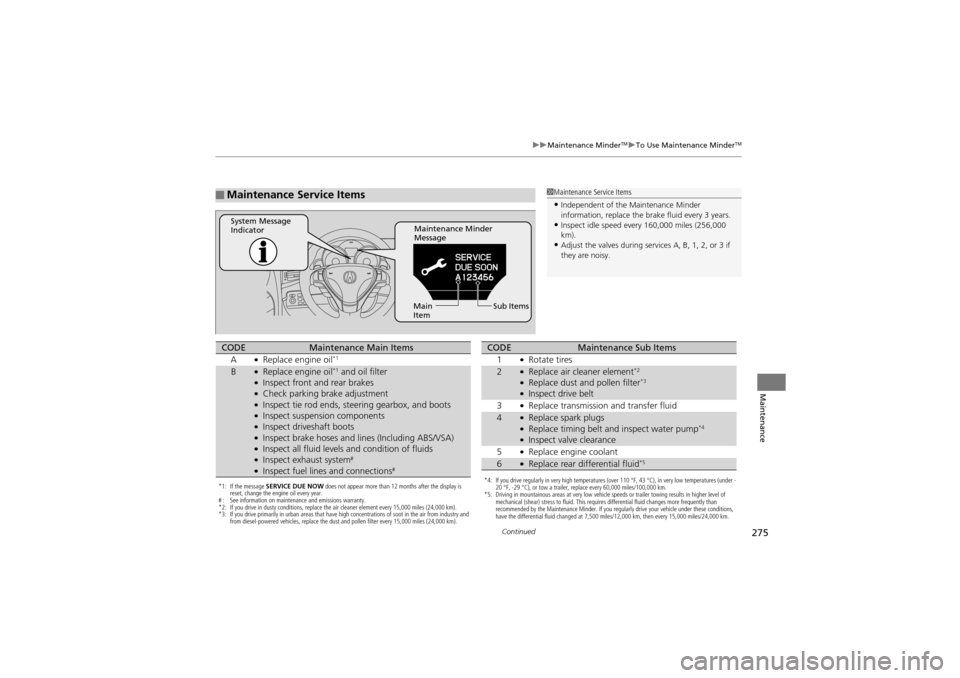
■Maintenance Service Items1Maintenance Service Items
•Independent of the Maintenance Minder
information, replace the brake fluid every 3 years.
•Inspect idle speed every 160,000 miles (256,000
km).
•Adjust the valves during services A, B, 1, 2, or 3 if
they are noisy.
Maintenance Minder
Message
System Message
Indicator
Sub Items
Main
Item
*1: If the message SERVICE DUE NOW does not appear more than 12 months after the display is
reset, change the engine oil every year.
# : See information on maintenance and emissions warranty.
*2: If you drive in dusty conditions, replace the air cleaner element every 15,000 miles (24,000 km).
*3: If you drive primarily in urban areas that have high concentrations of soot in the air from industry and
from diesel-powered vehicles, replace the dust and pollen filter every 15,000 miles (24,000 km).
CODEMaintenance Main Items
A●Replace engine oil*1
B●Replace engine oil*1 and oil filter●Inspect front and rear brakes●Check parking brake adjustment●Inspect tie rod ends, steering gearbox, and boots●Inspect suspension components●Inspect driveshaft boots●Inspect brake hoses and li nes (Including ABS/VSA)●Inspect all fluid levels and condition of fluids●Inspect exhaust system#
●Inspect fuel lines and connections#*4: If you drive regularly in very high temperatures (over 110 °F, 43 °C), in very low temperatures (under -
20 °F, -29 °C), or tow a trailer, replace every 60,000 miles/100,000 km.
*5: Driving in mountainous areas at very low vehicle speeds or trailer towing results in higher level of
mechanical (shear) stress to fluid. This requires differential fluid changes more frequently than
recommended by the Maintenance Minder. If you regularly drive your vehicle under these conditions,
have the differential fluid changed at 7,500 miles/12,000 km, then every 15,000 miles/24,000 km.
CODEMaintenance Sub Items
1●Rotate tires
2●Replace air cleaner element*2
●Replace dust and pollen filter*3
●Inspect drive belt
3●Replace transmission and transfer fluid
4●Replace spark plugs●Replace timing belt an d inspect water pump*4
●Inspect valve clearance
5●Replace engine coolant
6●Replace rear differential fluid*5
Page 279 of 370
277
Maintenance
Maintenance Under the Hood
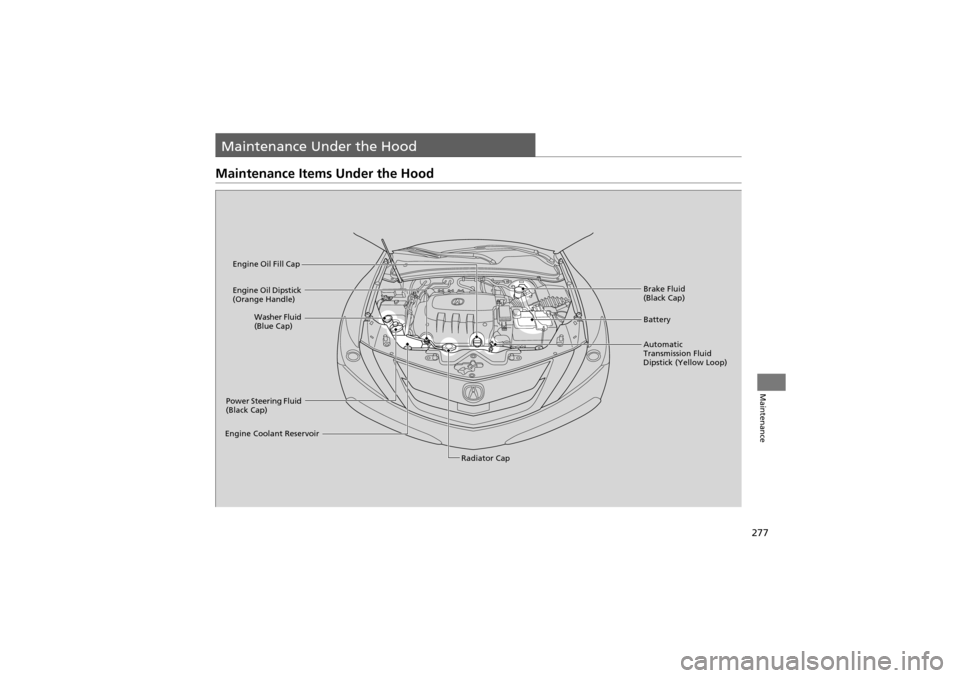
Maintenance Items Under the Hood
Brake Fluid
(Black Cap)
Engine Coolant Reservoir Radiator Cap
Washer Fluid
(Blue Cap)
Engine Oil Dipstick
(Orange Handle)
Engine Oil Fill Cap
Automatic
Transmission Fluid
Dipstick (Yellow Loop)Battery
Power Steering Fluid
(Black Cap)
Page 289 of 370
287
uuMaintenance Under the Hood uTransmission Fluid
Maintenance
Transmission Fluid
Check the fluid level when the engine is at normal operating temperature.
1. Park on level ground, and start the engine.
2. Wait until the radiator fan starts and then
turn off the engine.
u Perform step 3 after waiting for about 60
seconds (less than 90 seconds).
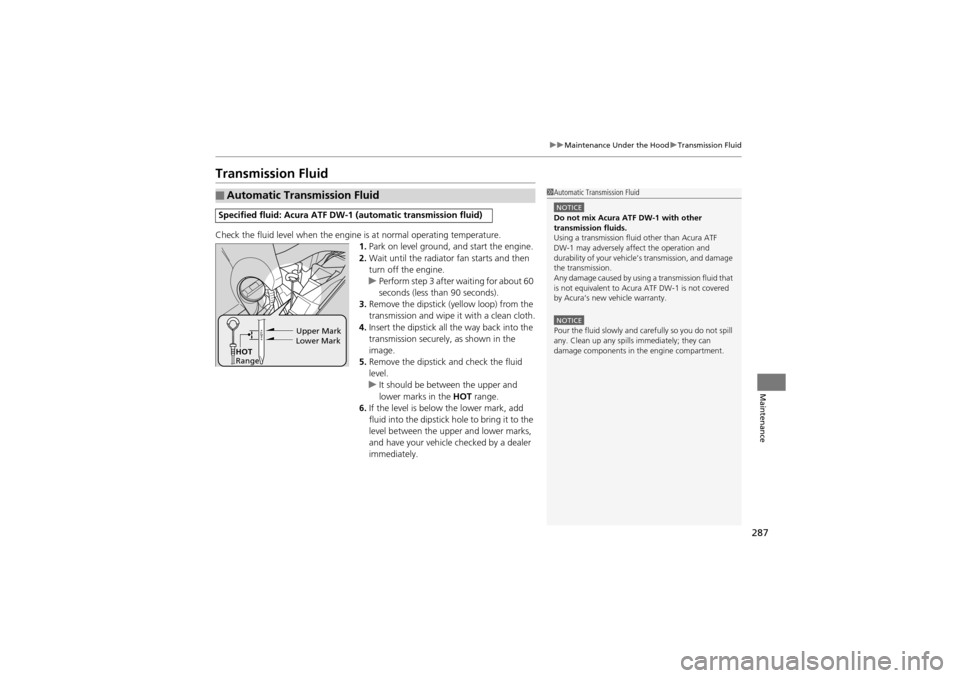
3. Remove the dipstick (yellow loop) from the
transmission and wipe it with a clean cloth.
4. Insert the dipstick all the way back into the
transmission securely , as shown in the
image.
5. Remove the dipstick and check the fluid
level.
u It should be between the upper and
lower marks in the HOT range.
6. If the level is below the lower mark, add
fluid into the dipstick hole to bring it to the
level between the upper and lower marks,
and have your vehicle checked by a dealer
immediately.
■Automatic Transmission Fluid
Specified fluid: Acura ATF DW-1 (automatic transmission fluid)
1 Automatic Transmission Fluid
NOTICEDo not mix Acura ATF DW-1 with other
transmission fluids.
Using a transmission fluid other than Acura ATF
DW-1 may adversely affe ct the operation and
durability of your vehicle’s transmission, and damage
the transmission.
Any damage caused by usin g a transmission fluid that
is not equivalent to Acur a ATF DW-1 is not covered
by Acura’s new vehicle warranty.
NOTICEPour the fluid slowly and carefully so you do not spill
any. Clean up any spills immediately; they can
damage components in the engine compartment.Upper Mark
Lower Mark
HOT
Range
Page 338 of 370
336
uuIndicator, Coming On/Blinking uIf the Brake System Indicator (Red) Comes On
Handling the Unexpected
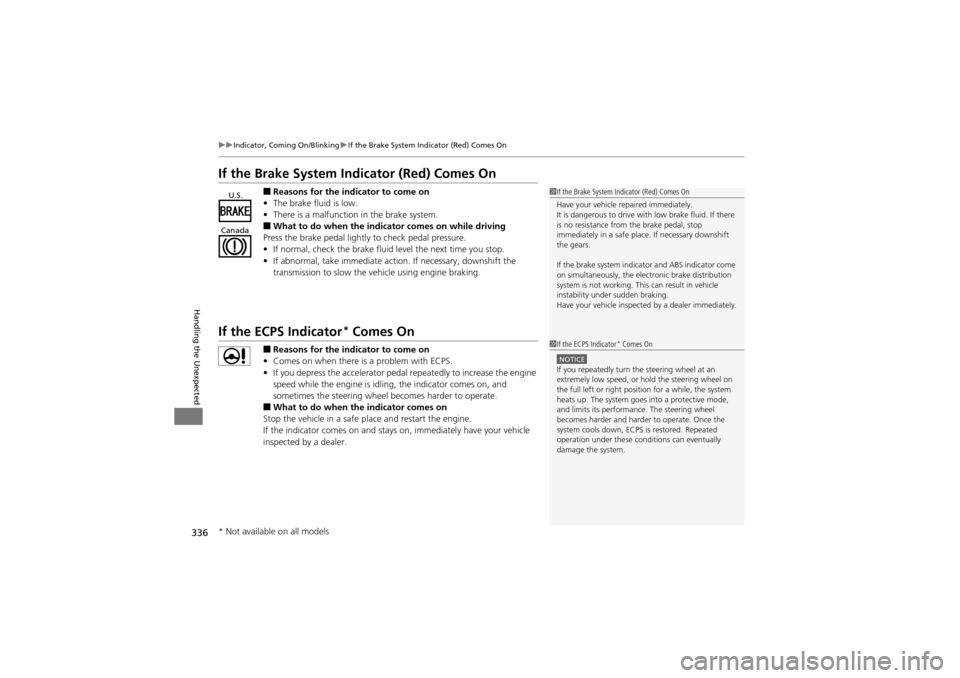
If the Brake System Indicator (Red) Comes On
■Reasons for the indicator to come on
• The brake fluid is low.
• There is a malfunction in the brake system.
■What to do when the indicator comes on while driving
Press the brake pedal lightly to check pedal pressure.
• If normal, check the brake fluid level the next time you stop.
• If abnormal, take immediate action. If necessary, downshift the
transmission to slow the vehicle using engine braking.
If the ECPS Indicator* Comes On
■Reasons for the indicator to come on
• Comes on when there is a problem with ECPS.
• If you depress the accelerator pedal repeatedly to increase the engine
speed while the engine is idling, the indicator comes on, and
sometimes the steering wheel becomes harder to operate.
■What to do when the indicator comes on
Stop the vehicle in a safe place and restart the engine.
If the indicator comes on and stays on, immediately have your vehicle
inspected by a dealer.
1 If the Brake System In dicator (Red) Comes On
Have your vehicle repaired immediately.
It is dangerous to drive with low brake fluid. If there
is no resistance from the brake pedal, stop
immediately in a safe plac e. If necessary downshift
the gears.
If the brake system indica tor and ABS indicator come
on simultaneously, the electronic brake distribution
system is not working. This can result in vehicle
instability under sudden braking.
Have your vehicle inspected by a dealer immediately.U.S.
Canada
1 If the ECPS Indicator* Comes On
NOTICEIf you repeatedly turn the steering wheel at an
extremely low speed, or ho ld the steering wheel on
the full left or right position for a while, the system
heats up. The system goes into a protective mode,
and limits its performance. The steering wheel
becomes harder and harder to operate. Once the
system cools down, ECPS is restored. Repeated
operation under these conditions can eventually
damage the system.
* Not available on all models
Page 346 of 370
344
Handling the Unexpected
Emergency Towing
Call a professional towing service if you need to tow your vehicle.
■Flat bed equipment
The operator loads your vehicle on the back of a truck.
This is the only way you can safely to transport your vehicle.
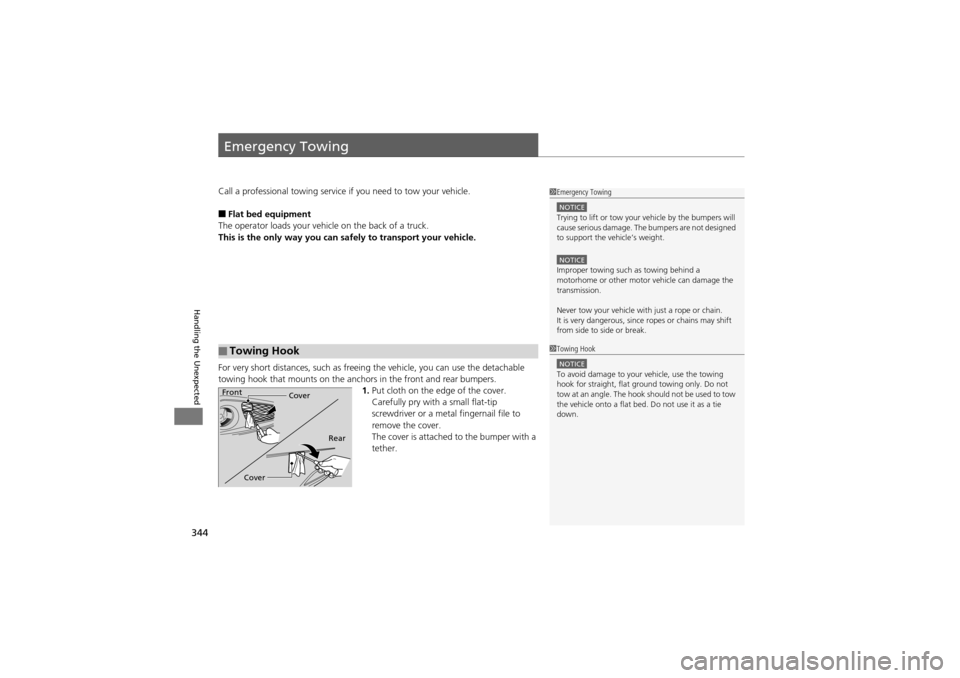
For very short distances, su ch as freeing the vehicle, you can use the detachable
towing hook that mounts on the anchors in the front and rear bumpers. 1.Put cloth on the edge of the cover.
Carefully pry with a small flat-tip
screwdriver or a metal fingernail file to
remove the cover.
The cover is attached to the bumper with a
tether.
■Towing Hook
1Emergency Towing
NOTICETrying to lift or tow your vehicle by the bumpers will
cause serious damage. The bumpers are not designed
to support the vehicle’s weight.
NOTICEImproper towing such as towing behind a
motorhome or other motor vehicle can damage the
transmission.
Never tow your vehicle with just a rope or chain.
It is very dangerous, since ropes or chains may shift
from side to side or break.
1 Towing Hook
NOTICETo avoid damage to your vehicle, use the towing
hook for straight, flat ground towing only. Do not
tow at an angle. The hook should not be used to tow
the vehicle onto a flat bed. Do not use it as a tie
down.
Front
Cover
Cover Rear
Page 351 of 370
349
Information
This chapter includes your vehicle’s specifications, locations of identification numbers, and otherinformation required by regulation.
Specifications.................................... 350
Identification Numbers
Vehicle Identification Number (VIN) ...... 351Engine Number and Transmission Number...................................... 351
Devices that Emit Radio Waves ....... 352
Reporting Safety Defects ................. 353Emissions Testing
Testing of Readiness Codes.............. 354
Warranty Coverages ........................ 356
Authorized Manuals ......................... 358
Client Service Information............... 359
Page 352 of 370
350
Information
Specifications
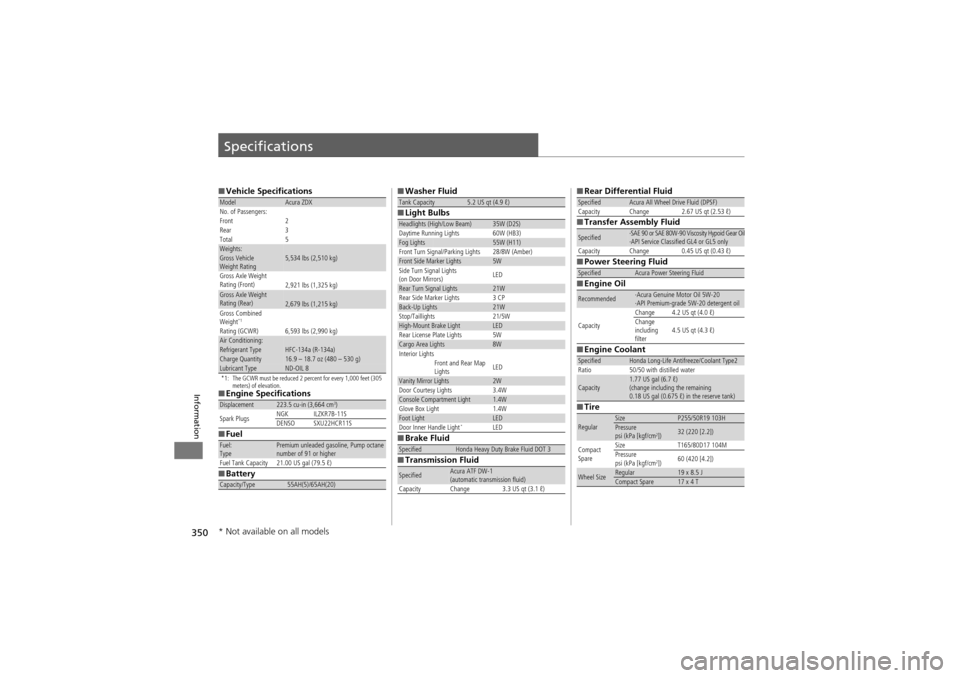
■Vehicle Specifications
*1: The GCWR must be reduced 2 percent for every 1,000 feet (305
meters) of elevation.
■Engine Specifications
■ Fuel
■ Battery
ModelAcura ZDX
No. of Passengers:
Front 2
Rear 3
Total 5
Weights:Gross Vehicle
Weight Rating 5,534 lbs (2,510 kg)
Gross Axle Weight
Rating (Front)2,921 lbs (1,325 kg)Gross Axle Weight
Rating (Rear)2,679 lbs (1,215 kg)
Gross Combined
Weight
*1
Rating (GCWR) 6,593 lbs (2,990 kg)
Air Conditioning:Refrigerant Type HFC-134a (R-134a)Charge Quantity16.9 – 18.7 oz (480 – 530 g)Lubricant TypeND-OIL 8
Displacement223.5 cu-in (3,664 cm3)
Spark Plugs NGK ILZKR7B-11S
DENSO SXU22HCR11S
Fuel:
TypePremium unleaded gasoline, Pump octane
number of 91 or higher
Fuel Tank Capacity 21.00 US gal (79.5 ℓ)
Capacity/Type55AH(5)/65AH(20)
■ Washer Fluid
■ Light Bulbs
■ Brake Fluid
■ Transmission FluidTank Capacity5.2 US qt (4.9 ℓ)
Headlights (High/Low Beam)35W (D2S)
Daytime Running Lights 60W (HB3)
Fog Lights55W (H11)
Front Turn Signal/Parking Lights 28/8W (Amber)
Front Side Marker Lights5W
Side Turn Signal Lights
(on Door Mirrors) LED
Rear Turn Signal Lights21W
Rear Side Marker Lights 3 CP
Back-Up Lights21W
Stop/Taillights 21/5W
High-Mount Brake LightLED
Rear License Plate Lights 5W
Cargo Area Lights8W
Interior Lights
Front and Rear Map
LightsLED
Vanity Mirror Lights2WDoor Courtesy Lights3.4WConsole Compartment Light1.4WGlove Box Light1.4WFoot LightLEDDoor Inner Handle Light*LED
SpecifiedHonda Heavy Duty Brake Fluid DOT 3
SpecifiedAcura ATF DW-1
(automatic transmission fluid)
Capacity Change 3.3 US qt (3.1 ℓ)
■ Rear Differential Fluid
■ Transfer Assembly Fluid
■ Power Steering Fluid
■ Engine Oil
■ Engine Coolant
■ TireSpecifiedAcura All Wheel Drive Fluid (DPSF)
Capacity Change 2.67 US qt (2.53 ℓ)
Specified·SAE 90 or SAE 80W-90 Viscosity Hypoid Gear Oil
·API Service Classified GL4 or GL5 only
Capacity Change 0.45 US qt (0.43 ℓ)
SpecifiedAcura Power Steering Fluid
Recommended·Acura Genuine Motor Oil 5W-20
·API Premium-grade 5W-20 detergent oil
Capacity Change 4.2 US qt (4.0 ℓ)
Change
including
filter
4.5 US qt (4.3 ℓ)
SpecifiedHonda Long-Life Antifreeze/Coolant Type2
Ratio 50/50 with distilled water
Capacity1.77 US gal (6.7 ℓ)
(change including the remaining
0.18 US gal (0.675 ℓ) in the reserve tank)
RegularSizeP255/50R19 103HPressure
psi (kPa [kgf/cm2])32 (220 [2.2])
Compact
Spare Size T165/80D17 104M
Pressure
psi (kPa [kgf/cm
2])
60 (420 [4.2])
Wheel SizeRegular19 x 8.5 JCompact Spare17 x 4 T
* Not available on all models
Page 353 of 370
351
Information
Identification Numbers
Vehicle Identification Number (VIN)
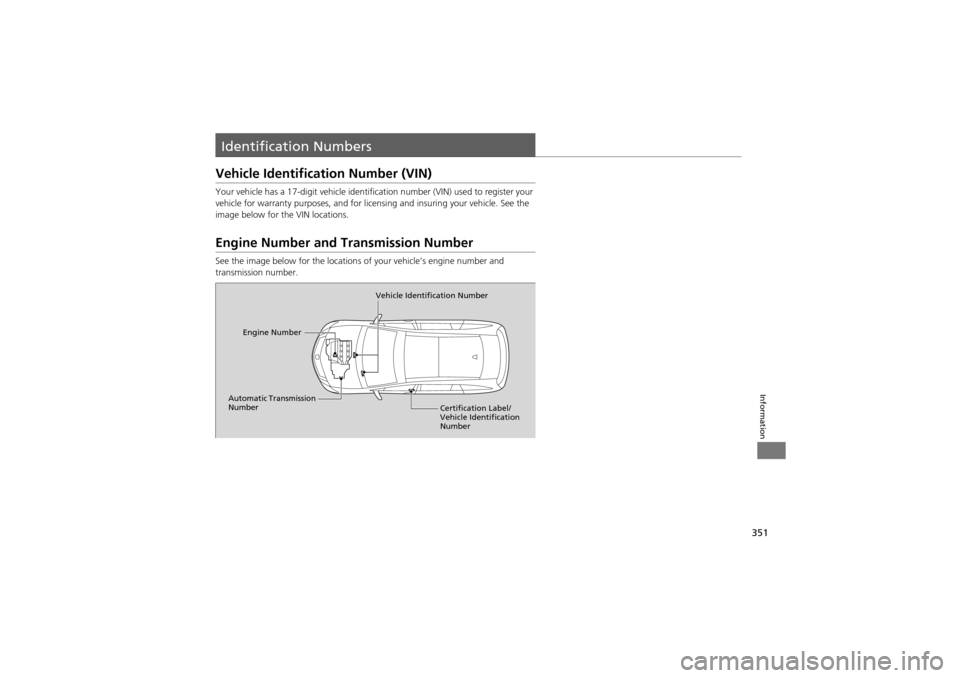
Your vehicle has a 17-digit vehicle identification number (VIN) used to register your
vehicle for warranty purposes, and for licensing and insuring your vehicle. See the
image below for the VIN locations.
Engine Number and Transmission Number
See the image below for the locations of your vehicle’s engine number and
transmission number.
Vehicle Identifi cation Number
Engine Number
Certification Label/
Vehicle Identification
Number
Automatic Transmission
Number
Page 363 of 370
Index
361
Index
A
ABS (Anti-lock Brake System).................. 255
Accessories and Modifications ................ 267
Accessory Power Sockets ......................... 157
Active Head Restraints ............................. 148
Adaptive Cruise Control (ACC) ................ 235
Additives
Coolant .................................................. 285
Engine Oil ............................................... 280
Washer ................................................... 290
Additives, Engine Oil ............................... 280
Adjusting Armrest .................................................. 150
Front Seats.............................................. 143
Head Restraints ....................................... 145
Mirrors.................................................... 141
Rear Seats ............................................... 149
Steering Wheel ....................................... 140
Temperature ............................................. 91
Air Conditioning System (Climate Control System) ...................... 163
Changing the Mode................................ 163
Defrosting the Windshield and Windows................ ....................... 164
Dust and Pollen Filter .............................. 312
Recirculation/Fresh Air Mo de................... 163
Sensor .................................................... 166
Synchronized Mode ................................ 165
Using Automatic Climate Control............ 163
Air Pressure ...................................... 301, 350 Airbags
........................................................ 35
Advanced Airbags ..................................... 41
After a Collision... ................................ 30, 39
Airbag Care ............................................... 49
Event Data Recorder .................................. 19
Front Airbags (SRS) .................................... 38
Indicator ........................................ 46, 72, 75
Passenger Airbag Off Indicator .................. 47
Sensors...................................................... 35
Side Airbag Cutoff System ......................... 44
Side Airbag Off Indicator ........................... 48
Side Airbags .............................................. 42
Side Curtain Airbags .................................. 45
AM/FM Radio ............................................ 173
Anti-lock Brak e System (ABS) .................. 255
Indicator .................................................... 71
Armrest ..................................................... 150
Audio Remote Controls ............................ 190
Audio System ............................................ 168
Adjusting the Sound ................................ 172
Auxiliary Input Jack ........ .......................... 169
Error Messages ........................................ 188
General Information ................................ 191
MP3/WMA/AAC ...................................... 183
Reactivating............................................. 170
Recommended CDs ................................. 192
Recommended Devices ............................ 194
Remote Controls ..................................... 190
Security Code .......................................... 170
Theft Protection....................................... 170
USB Adapter Cable .................................. 169 USB Flash Drives ...................................... 194
Authorized Manuals ................................ 358
Auto Door Locking/Unlocking ................. 113
Automatic Lighting .................................. 132
Automatic Transmission ........................... 227
Creeping ................................................. 227
Fluid ........................................................ 287
Kickdown ................................................ 227
Operating the Shift Lever........... 13, 229, 231
Sequential Shift Mode ............................. 230
Shift Lever Does Not Move ...................... 331
Shifting ................................................... 228
Auxiliary Input Jack .................................. 169
Average Fuel Economy .............................. 91
Average Speed ........................................... 92
B
Battery...................................................... 309
Charging System Indicato r................. 69, 334
Jump Starting .......................................... 329
Maintenance (Checking th e Battery) ........ 309
Maintenance (Replacing) ......................... 310
Belts (Seat) .................................................. 27
Beverage Holders ..................................... 156
Blind Spot Information (BSI) .................... 246
Bluetooth ® HandsFreeLink ®..................... 197
Bluetooth ®Audio ...................................... 186
Booster Seats (For Children) ...................... 63
Brake System ............................................ 253
Anti-lock Brake System (A BS)................... 255