steering wheel Acura ZDX 2012 Service Manual
[x] Cancel search | Manufacturer: ACURA, Model Year: 2012, Model line: ZDX, Model: Acura ZDX 2012Pages: 370, PDF Size: 10.06 MB
Page 257 of 370
255
uuBraking uABS (Anti-lock Brake System)
Driving
ABS (Anti-lock Brake System)
Helps prevent the wheels from locking up, an d helps you retain steering control by
pumping the brakes rapidly, much faster than you.
The electronic brake distribution (EBD) sy stem, which is part of the ABS, also
balances the front-to-rear braking distri bution according to vehicle loading.
You should never pump th e brake pedal. Let the ABS work for you by always
keeping firm, steady pressure on the brake pedal. This is sometimes referred to as
“stomp and steer.”
■ABS operation
The brake pedal may pulsate slightly when the ABS is working. Keep holding the
pedal firmly down. On dry pavement, you will need to press on the brake pedal very
hard before the ABS activates. However, you may feel the ABS activate immediately
if you are trying to stop on snow or ice.
When the vehicle speed goes under 6 mph (10 km/h), the ABS stops.
■ABS1 ABS (Anti-lock Brake System)
NOTICEThe ABS may not function correctly if you use an
incorrect tire type and size.
When the ABS indicator comes on while driving,
there may be a problem with the system.
While normal braking is no t affected, there is a
possibility of the ABS not operating. Have the vehicle
checked by a dealer immediately.
The ABS does not reduce the ti me or distance it takes
to stop the vehicle. It only helps with steering control
during hard braking.
In the following cases, your vehicle may need more
stopping distance than a vehicle without the ABS:
•When driving on rough road surfaces, including
when driving on uneven surfaces, such as gravel or
snow.
•When tire chains are installed.
You may hear a motor sound coming from the
engine compartmen t while system checks are being
performed immediately after starting the engine or
while driving. This is normal.
Page 259 of 370
257
uuBraking uCMBSTM (Collision Mitigation Braking SystemTM)*
Continued
Driving
CMBSTM (Collision Mitigation Braking SystemTM)*
Can assist you when there is a possibility of your vehicle colliding with the vehicle in
front of yours. The CMBSTM is designed to alert you, then reduce your vehicle speed
when a possible collision is likely unavoidable to help minimize collision severity.
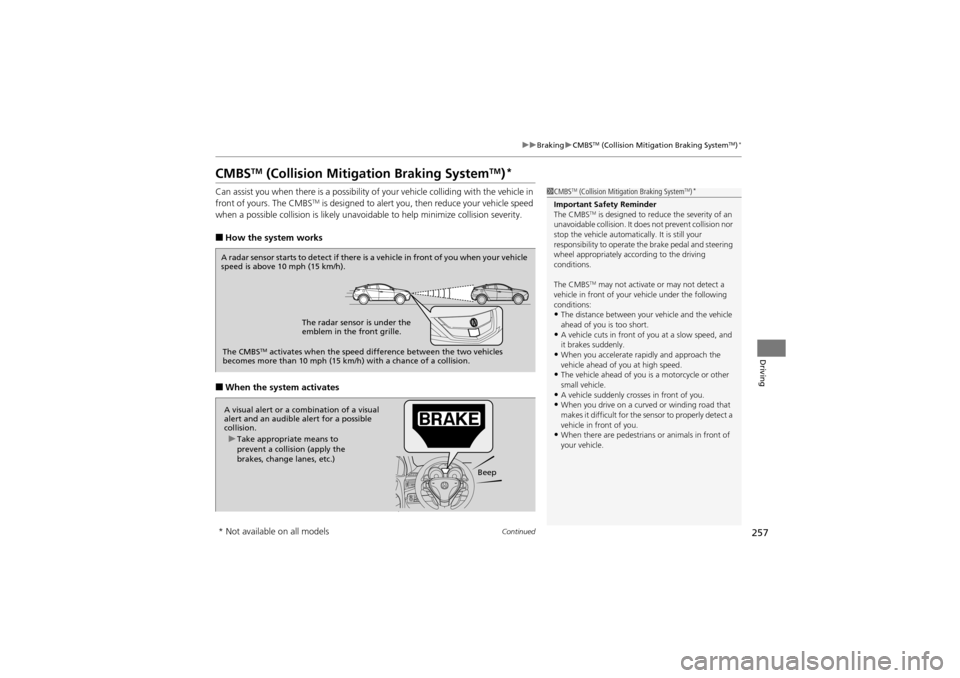
■How the system works
■When the system activates
1 CMBSTM (Collision Mitigation Braking SystemTM)*
Important Safety Reminder
The CMBSTM is designed to reduce the severity of an
unavoidable collision. It do es not prevent collision nor
stop the vehicle automatically. It is still your
responsibility to operate th e brake pedal and steering
wheel appropriately according to the driving
conditions.
The CMBS
TM may not activate or may not detect a
vehicle in front of your vehicle under the following
conditions:
•The distance between your vehicle and the vehicle
ahead of you is too short.
•A vehicle cuts in front of you at a slow speed, and
it brakes suddenly.
•When you accelerate ra pidly and approach the
vehicle ahead of you at high speed.
•The vehicle ahead of you is a motorcycle or other
small vehicle.
•A vehicle suddenly crosses in front of you.•When you drive on a curved or winding road that
makes it difficult for the se nsor to properly detect a
vehicle in front of you.
•When there are pedestrians or animals in front of
your vehicle.
A radar sensor starts to detect if there is a vehicle in front of you when your vehicle
speed is above 10 mph (15 km/h).
The radar sensor is under the
emblem in the front grille.
The CMBS
TM activates when the speed difference betw een the two vehicles
becomes more than 10 mph (15 km/h ) with a chance of a collision.
A visual alert or a combination of a visual
alert and an audible alert for a possible
collision.
Beep
u
Take appropriate means to
prevent a collision (apply the
brakes, change lanes, etc.)
* Not available on all models
Page 271 of 370
269
Maintenance
This chapter discusses basic maintenance.
Before Performing MaintenanceInspection and Mainte nance ............ 270
Safety When Performing Maintenance..... 271Parts and Fluids Used in Maintenance
Service ........................................... 272
Maintenance Minder
TM..................... 273
Maintenance Under the Hood
Maintenance Items Under the Hood ..... 277Opening the Hood ........................... 278
Engine Compartment Covers ........... 279
Recommended Engine Oi l ................ 280
Oil Check ......................................... 281
Adding Engine Oil ............................ 282
Changing the Engine Oil and Oil Filter ..... 283Engine Coolant ................................ 285
Transmission Fluid ............................ 287
Brake Fluid ....................................... 288
Power Steering Fluid Check.............. 289
Refilling Window Washer Fluid......... 290
Replacing Light Bulbs ....................... 291
Checking and Maintaining Wiper
Blades .......................................... 298
Checking and Maintaining Tires
Checking Tires ................................. 300
Tire and Loading Information Label ...... 301Tire Labeling .................................... 301
DOT Tire Quality Grading (U.S. Vehicles) ...... 303Wear Indicators ............................... 305
Tire Service Life ................................ 305
Tire and Wheel Replacement ........... 306
Tire Rotation .................................... 307
Winter Tires ..................................... 308
Battery ............................................... 309
Remote Transmitter Care ................. 310
Climate Control System Maintenance..... 312Cleaning
Interior Care .................................... 313
Exterior Care.................................... 315
Page 291 of 370
289
uuMaintenance Under the Hood uPower Steering Fluid Check
Maintenance
Power Steering Fluid Check
We recommend that you check the power steer ing fluid level every time you refuel.
Check when the engi ne is not running.
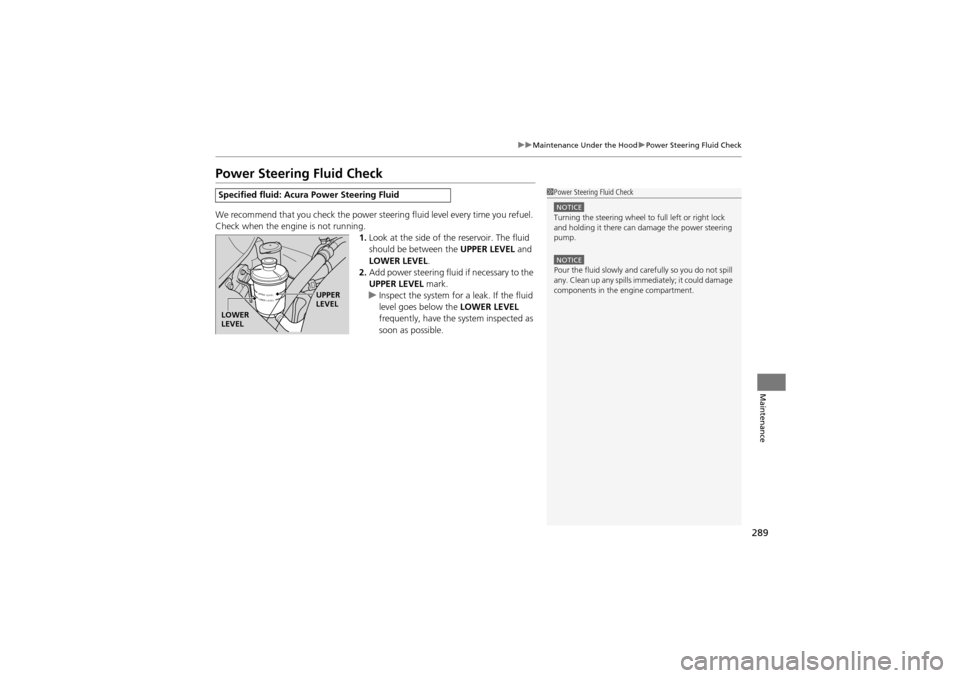
1.Look at the side of the reservoir. The fluid
should be between the UPPER LEVEL and
LOWER LEVEL .
2. Add power steering fluid if necessary to the
UPPER LEVEL mark.
u Inspect the system for a leak. If the fluid
level goes below the LOWER LEVEL
frequently, have the system inspected as
soon as possible.
Specified fluid: Acura Power Steering Fluid1 Power Steering Fluid Check
NOTICETurning the steering wheel to full left or right lock
and holding it there can damage the power steering
pump.
NOTICEPour the fluid slowly and carefully so you do not spill
any. Clean up any spills immediately; it could damage
components in the engine compartment.
UPPER
LEVEL
LOWER
LEVEL
Page 310 of 370
308
uuChecking and Maintaining Tires uWinter Tires
Maintenance
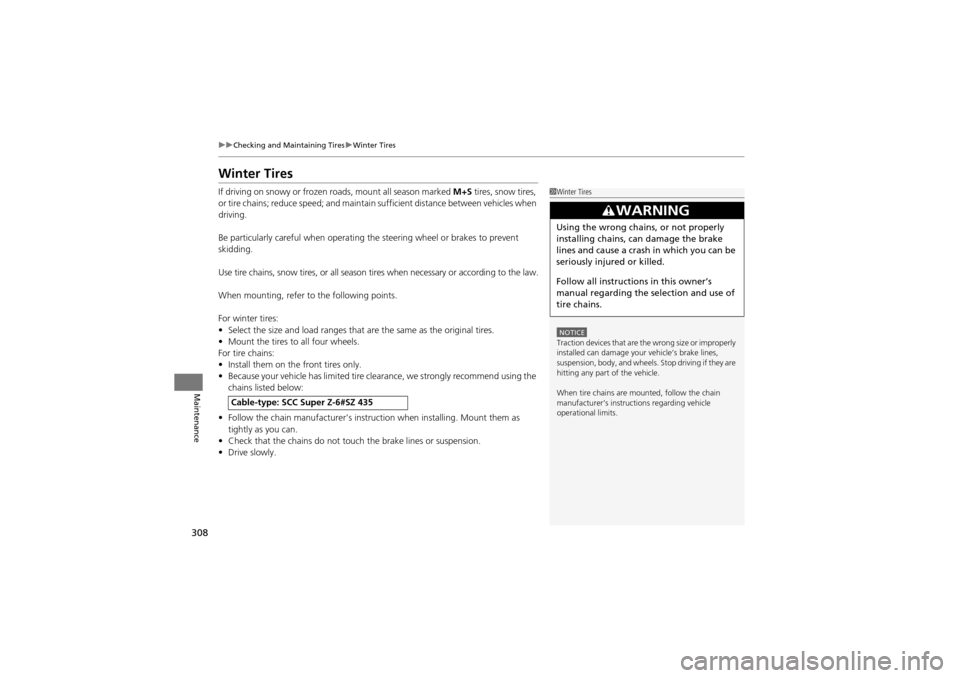
Winter Tires
If driving on snowy or frozen roads, mount all season marked M+S tires, snow tires,
or tire chains; reduce speed ; and maintain sufficient dist ance between vehicles when
driving.
Be particularly careful when operating the steering wheel or brakes to prevent
skidding.
Use tire chains, snow tires, or all season ti res when necessary or according to the law.
When mounting, refer to the following points.
For winter tires:
• Select the size and load ranges that are the same as the original tires.
• Mount the tires to all four wheels.
For tire chains:
• Install them on the front tires only.
• Because your vehicle has limited tire clearance, we strongly recommend using the
chains listed below:
• Follow the chain manufacturer’s instruction when installing. Mount them as
tightly as you can.
• Check that the chains do not to uch the brake lines or suspension.
• Drive slowly.
Cable-type: SCC Super Z-6#SZ 435
1Winter Tires
NOTICETraction devices that are the wrong size or improperly
installed can damage your vehicle’s brake lines,
suspension, body, and wheels. Stop driving if they are
hitting any part of the vehicle.
When tire chains are mounted, follow the chain
manufacturer’s instructio ns regarding vehicle
operational limits.
3WARNING
Using the wrong chains, or not properly
installing chains, can damage the brake
lines and cause a crash in which you can be
seriously injured or killed.
Follow all instructions in this owner’s
manual regarding the selection and use of
tire chains.
Page 321 of 370
319Continued
Handling the Unexpected
If a Tire Goes Flat
Changing a Flat Tire
If a tire goes flat while driving, grasp the steering wheel firmly, and brake gradually
to reduce speed. Then, stop in a safe plac e. Replace the flat tire with a compact
spare tire. Go to a dealer as soon as possible to have the full-size tire repaired or
replaced.
1. Park the vehicle on firm, level, and non-slippery ground.
2. Put the shift lever in
P.
3. Set the parking brake.
4. Turn on the hazard warn ing lights and turn the ignition switch to LOCK
0*1.
*1: Models with the keyless access system have an ENGINE START/STOP button
instead of an ig nition switch.
1Changing a Flat Tire
Periodically check the tire pressure of the compact
spare. It should be set to the specified pressure.
Specified Pressure: 60 psi (420 kPa, 4.2 kgf/cm
2)
When driving with the compact spare tire, keep the
vehicle speed under 50 mph (80 km/h). Replace with
a full-size tire as soon as possible.
The compact spare tire and wheel in your vehicle are
specifically for this model.
Do not use them with another vehicle.
Do not use another type of compact spare tire or
wheel with your vehicle.
Do not mount tire chains on a compact spare tire.
If a chain-mounted front tire goes flat, remove one of
the full-size rear tires and replace it with the compact
spare tire. Remove the flat front tire and replace it
with the full-size tire that was removed from the rear.
Mount the tire chains on the front tire.
Do not use a puncture-repairing agent on a flat tire,
as it can dama ge the tire pressure sensor.
Page 330 of 370
328
uuEngine Does Not Start uEmergency Engine Stop
Handling the Unexpected
Emergency Engine Stop
If you cannot stop the engine by pressing the ENGINE START/STOP button, do
either of the following operations:
• Press and hold the ENGINE START/STOP button for three seconds.
• Firmly press the ENGINE START/STOP button three times.
The steering wheel will not lock. The power mode changes to VEHICLE OFF with the
shift lever in
P, and to ACCESSORY with the shift lever in any position other than
P.
Models with keyless access remote
1Emergency Engine Stop
Do not press the button while driving unless it is
absolutely necessary for th e engine to be switched
off.
Page 338 of 370
336
uuIndicator, Coming On/Blinking uIf the Brake System Indicator (Red) Comes On
Handling the Unexpected
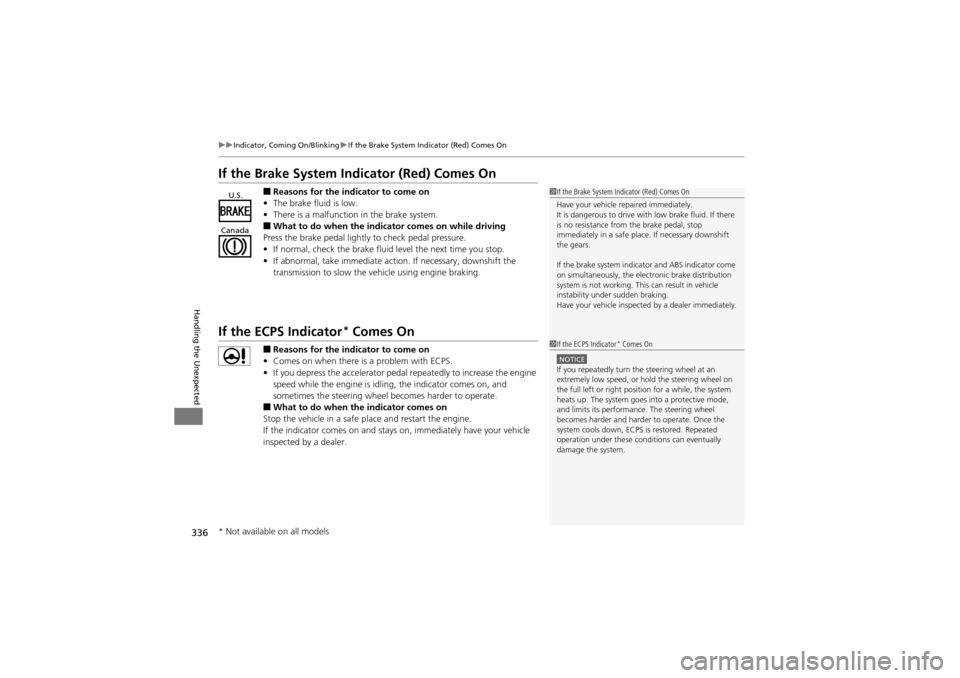
If the Brake System Indicator (Red) Comes On
■Reasons for the indicator to come on
• The brake fluid is low.
• There is a malfunction in the brake system.
■What to do when the indicator comes on while driving
Press the brake pedal lightly to check pedal pressure.
• If normal, check the brake fluid level the next time you stop.
• If abnormal, take immediate action. If necessary, downshift the
transmission to slow the vehicle using engine braking.
If the ECPS Indicator* Comes On
■Reasons for the indicator to come on
• Comes on when there is a problem with ECPS.
• If you depress the accelerator pedal repeatedly to increase the engine
speed while the engine is idling, the indicator comes on, and
sometimes the steering wheel becomes harder to operate.
■What to do when the indicator comes on
Stop the vehicle in a safe place and restart the engine.
If the indicator comes on and stays on, immediately have your vehicle
inspected by a dealer.
1 If the Brake System In dicator (Red) Comes On
Have your vehicle repaired immediately.
It is dangerous to drive with low brake fluid. If there
is no resistance from the brake pedal, stop
immediately in a safe plac e. If necessary downshift
the gears.
If the brake system indica tor and ABS indicator come
on simultaneously, the electronic brake distribution
system is not working. This can result in vehicle
instability under sudden braking.
Have your vehicle inspected by a dealer immediately.U.S.
Canada
1 If the ECPS Indicator* Comes On
NOTICEIf you repeatedly turn the steering wheel at an
extremely low speed, or ho ld the steering wheel on
the full left or right position for a while, the system
heats up. The system goes into a protective mode,
and limits its performance. The steering wheel
becomes harder and harder to operate. Once the
system cools down, ECPS is restored. Repeated
operation under these conditions can eventually
damage the system.
* Not available on all models
Page 343 of 370
341
uuFuses uCircuit Protected and Amps for Each Fuse
Continued
Handling the Unexpected
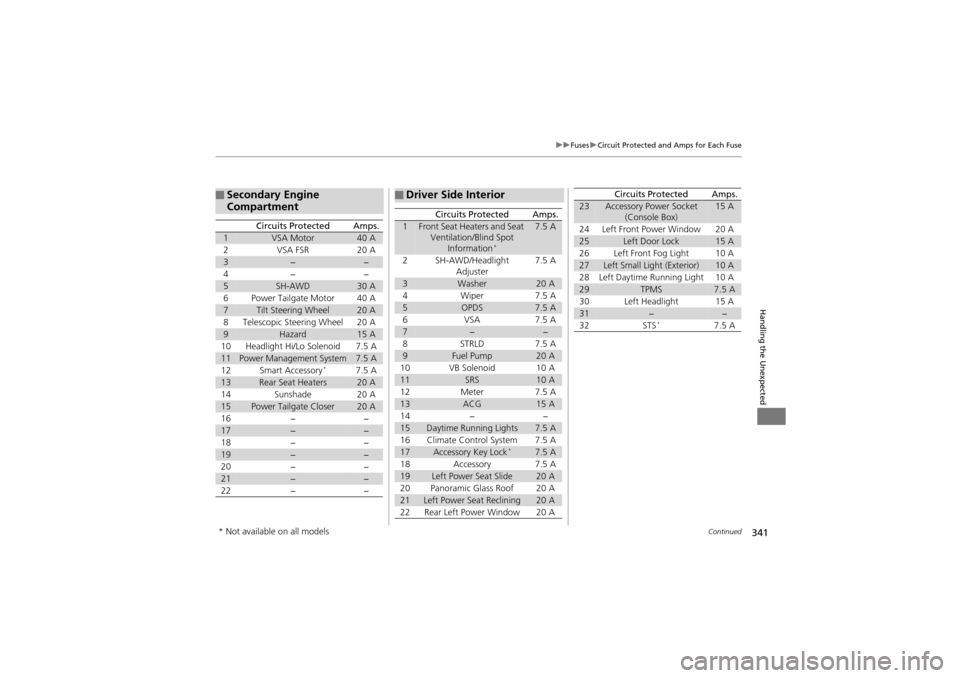
■Secondary Engine
Compartment
Circuits ProtectedAmps.
1VSA Motor40 A
2VSA FSR20 A
3−−
4−−
5SH-AWD30 A
6Power Tailgate Motor40 A
7Tilt Steering Wheel20 A
8Telescopic Steering Wheel20 A
9Hazard15 A
10Headlight Hi/Lo Solenoid7.5 A
11Power Management System7.5 A
12Smart Accessory*7.5 A
13Rear Seat Heaters20 A
14Sunshade20 A
15Power Tailgate Closer20 A
16−−
17−−
18−−
19−−
20−−
21−−
22−−
■Driver Side Interior
Circuits ProtectedAmps.
1Front Seat Heaters and Seat
Ventilation/Blind Spot Information
*
7.5 A
2SH-AWD/Headlight
Adjuster7.5 A
3Washer20 A
4Wiper7.5 A
5OPDS7.5 A
6VSA7.5 A
7−−
8STRLD7.5 A
9Fuel Pump20 A
10VB Solenoid10 A
11SRS10 A
12Meter7.5 A
13ACG15 A
14−−
15Daytime Running Lights7.5 A
16Climate Control System7.5 A
17Accessory Key Lock*7.5 A
18Accessory7.5 A
19Left Power Seat Slide20 A
20Panoramic Glass Roof20 A
21Left Power Seat Reclining20 A
22Rear Left Power Window20 A
23Accessory Power Socket (Console Box)15 A
24Left Front Power Window20 A
25Left Door Lock15 A
26Left Front Fog Light10 A
27Left Small Light (Exterior)10 A
28Left Daytime Running Light10 A
29TPMS7.5 A
30Left Headlight15 A
31−−
32STS*7.5 A
Circuits ProtectedAmps.
* Not available on all models
Page 352 of 370
350
Information
Specifications
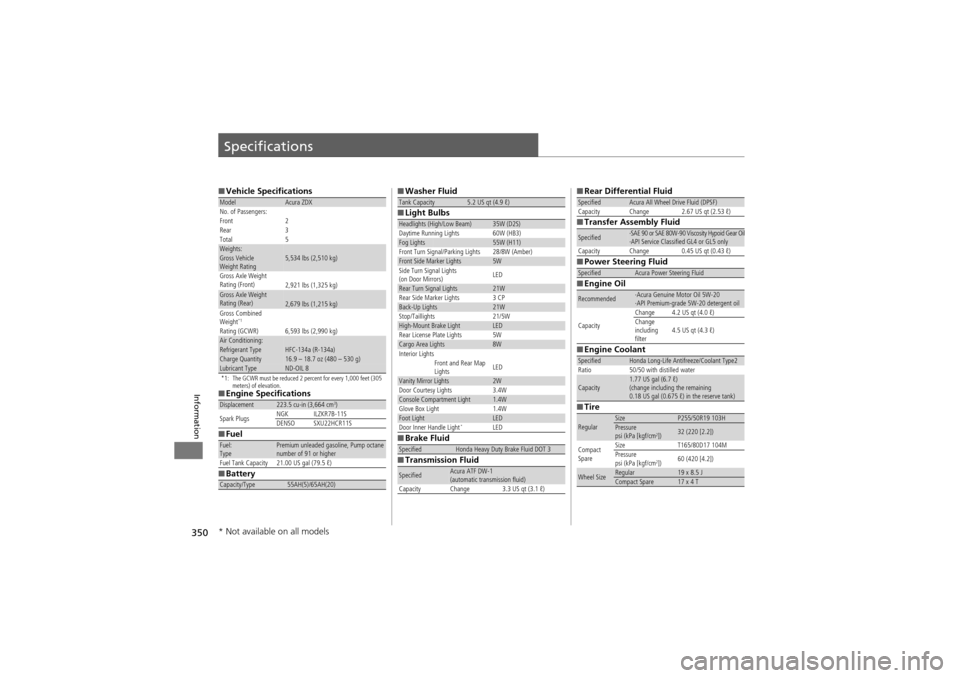
■Vehicle Specifications
*1: The GCWR must be reduced 2 percent for every 1,000 feet (305
meters) of elevation.
■Engine Specifications
■ Fuel
■ Battery
ModelAcura ZDX
No. of Passengers:
Front 2
Rear 3
Total 5
Weights:Gross Vehicle
Weight Rating 5,534 lbs (2,510 kg)
Gross Axle Weight
Rating (Front)2,921 lbs (1,325 kg)Gross Axle Weight
Rating (Rear)2,679 lbs (1,215 kg)
Gross Combined
Weight
*1
Rating (GCWR) 6,593 lbs (2,990 kg)
Air Conditioning:Refrigerant Type HFC-134a (R-134a)Charge Quantity16.9 – 18.7 oz (480 – 530 g)Lubricant TypeND-OIL 8
Displacement223.5 cu-in (3,664 cm3)
Spark Plugs NGK ILZKR7B-11S
DENSO SXU22HCR11S
Fuel:
TypePremium unleaded gasoline, Pump octane
number of 91 or higher
Fuel Tank Capacity 21.00 US gal (79.5 ℓ)
Capacity/Type55AH(5)/65AH(20)
■ Washer Fluid
■ Light Bulbs
■ Brake Fluid
■ Transmission FluidTank Capacity5.2 US qt (4.9 ℓ)
Headlights (High/Low Beam)35W (D2S)
Daytime Running Lights 60W (HB3)
Fog Lights55W (H11)
Front Turn Signal/Parking Lights 28/8W (Amber)
Front Side Marker Lights5W
Side Turn Signal Lights
(on Door Mirrors) LED
Rear Turn Signal Lights21W
Rear Side Marker Lights 3 CP
Back-Up Lights21W
Stop/Taillights 21/5W
High-Mount Brake LightLED
Rear License Plate Lights 5W
Cargo Area Lights8W
Interior Lights
Front and Rear Map
LightsLED
Vanity Mirror Lights2WDoor Courtesy Lights3.4WConsole Compartment Light1.4WGlove Box Light1.4WFoot LightLEDDoor Inner Handle Light*LED
SpecifiedHonda Heavy Duty Brake Fluid DOT 3
SpecifiedAcura ATF DW-1
(automatic transmission fluid)
Capacity Change 3.3 US qt (3.1 ℓ)
■ Rear Differential Fluid
■ Transfer Assembly Fluid
■ Power Steering Fluid
■ Engine Oil
■ Engine Coolant
■ TireSpecifiedAcura All Wheel Drive Fluid (DPSF)
Capacity Change 2.67 US qt (2.53 ℓ)
Specified·SAE 90 or SAE 80W-90 Viscosity Hypoid Gear Oil
·API Service Classified GL4 or GL5 only
Capacity Change 0.45 US qt (0.43 ℓ)
SpecifiedAcura Power Steering Fluid
Recommended·Acura Genuine Motor Oil 5W-20
·API Premium-grade 5W-20 detergent oil
Capacity Change 4.2 US qt (4.0 ℓ)
Change
including
filter
4.5 US qt (4.3 ℓ)
SpecifiedHonda Long-Life Antifreeze/Coolant Type2
Ratio 50/50 with distilled water
Capacity1.77 US gal (6.7 ℓ)
(change including the remaining
0.18 US gal (0.675 ℓ) in the reserve tank)
RegularSizeP255/50R19 103HPressure
psi (kPa [kgf/cm2])32 (220 [2.2])
Compact
Spare Size T165/80D17 104M
Pressure
psi (kPa [kgf/cm
2])
60 (420 [4.2])
Wheel SizeRegular19 x 8.5 JCompact Spare17 x 4 T
* Not available on all models