fuel Alfa Romeo 147 2008 Owner handbook (in English)
[x] Cancel search | Manufacturer: ALFA ROMEO, Model Year: 2008, Model line: 147, Model: Alfa Romeo 147 2008Pages: 291, PDF Size: 5.52 MB
Page 175 of 291
GETTING TO KNOW YOUR CAR
173
REFUELLING
The antipollution devices
on the car oblige the use of
only four-star unleaded
petrol with an octane number
(R.O.N.) of 95 or over.
Never use leaded petrol,
as this would irreversibly
damage the exhaust gas
catalyst. If leaded fuel is added to
the fuel tank, no matter how small
the quantity, DO NOT START THE
ENGINE. Do not attempt to dilute
the fuel in the tank, completely
drain the fuel circuit and tank.
To prevent accidentally filling with leaded
petrol, the diameter of the fuel tank filler
is of such a size as not to accept the noz-
zle of this type of petrol.
An inefficient catalyst
leads to harmful emission
at the exhaust, thus envi-
ronment pollution.
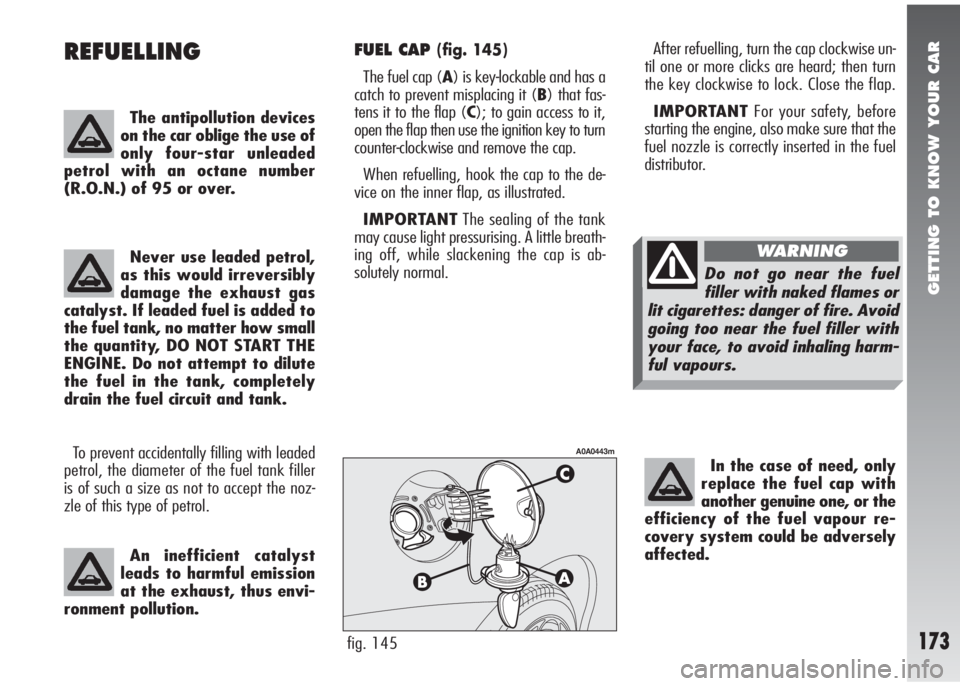
FUEL CAP (fig. 145)
The fuel cap (A) is key-lockable and has a
catch to prevent misplacing it (B) that fas-
tens it to the flap (C); to gain access to it,
open the flap then use the ignition key to turn
counter-clockwise and remove the cap.
When refuelling, hook the cap to the de-
vice on the inner flap, as illustrated.
IMPORTANTThe sealing of the tank
may cause light pressurising. A little breath-
ing off, while slackening the cap is ab-
solutely normal.
fig. 145
A0A0443m
After refuelling, turn the cap clockwise un-
til one or more clicks are heard; then turn
the key clockwise to lock. Close the flap.
IMPORTANTFor your safety, before
starting the engine, also make sure that the
fuel nozzle is correctly inserted in the fuel
distributor.
In the case of need, only
replace the fuel cap with
another genuine one, or the
efficiency of the fuel vapour re-
covery system could be adversely
affected.
Do not go near the fuel
filler with naked flames or
lit cigarettes: danger of fire. Avoid
going too near the fuel filler with
your face, to avoid inhaling harm-
ful vapours.
WARNING
Page 176 of 291

GETTING TO KNOW YOUR CAR
174
EMISSION REDUCING DEVICES
Trivalent catalytic converter
(catalytic silencer)
The exhaust system is fitted with a cata-
lyst formed of alloys of precious metals; it
is housed in a stainless steel container which
is able to withstand the high operating tem-
peratures.
The catalyst converts the unburnt hydro-
carbons, carbon monoxide and nitric oxide
in the exhaust gas (even in minimal quan-
tity owing to the electronic ignition and in-
jection systems) into non polluting com-
pounds.Lambda sensors
Lambda sensors measure the content of
oxygen present in the exhaust gas. The sig-
nal transmitted by the Lambda sensors is
used by the injection and ignition electron-
ic control unit to adjust the air - fuel mixture.
Anti-evaporation system
As it is impossible, even when the engine
is switched off, to prevent the formation of
fuel vapours, a system has been devised
which traps the vapours in a special acti-
vated carbon container.
When the engine is running these vapours
are withdrawn and sent to combustion.
ENVIRONMENTAL
PROTECTION
The design and construction of the vehi-
cle have not only been developed with the
traditional aspects of performance and safe-
ty in mind, but also take into account the in-
creasingly pressing problems tied to pro-
tecting the environment.
The choice of materials, techniques and
particular parts are the result of work which
has made it possible to drastically reduce
the harmful effects on the environment and
guarantee compliance with the most strin-
gent international regulations.
USE OF NON-TOXIC
MATERIALS
None of the components of the vehicle con-
tain asbestos. The padding and the climate
control system do not contain CFCs which
are held responsible for the destruction of
the ozone layer.
The colouring agents and the corrosion in-
hibitors used on the nuts, screws and bolts
do not contain cadmium or chrome which
could pollute the atmosphere or water tables.
Due to the high tempera-
tures reached during oper-
ation of the catalytic silencer the
vehicle should not be parked over
inflammable materials (paper, fu-
el oils, grass, dry leaves etc.).
WARNING
Page 179 of 291
CORRECT USE OF THE CAR
177
EMERGENCY STARTING
If the Alfa Romeo CODE system does not
recognise the code transmitted by the igni-
tion key (
Y)warning light on the instru-
ment cluster on glowing steadily) emer-
gency starting may be carried out using the
code of the CODE card.
For the correct procedure see the chapter
“In an emergency”.
PARKING
When the vehicle is parked, proceed as fol-
lows:
– Switch off the engine.
– Engage the handbrake.
– Engage first gear if the vehicle is fac-
ing uphill or reverse if the vehicle is facing
downhill.
– Turn the front wheels so that the vehi-
cle will immediately come to a halt if the
handbrake slips. Never bump, tow, or
coast start the vehicle as
this would cause fuel to
flow into the catalyst causing irre-
versible damage.
To avoid useless con-
sumption of power and
possibly draining the bat-
tery, never leave the ignition key
in the MAR position when the en-
gine is not running.
Sharp accelerating before
switching the engine off
should be avoided. A
“kick” on the accelerator serves
no purposes and consumes fuel
pointlessly.
IMPORTANT
If the engine turns off with
the vehicle on the move, the next time it
is started, the Alfa Romeo CODE warning
light may turn on (
Y). In this case, check
that switching off and starting the engine
again with the vehicle stationary, the warn-
ing light stays off. If not, contact Alfa Romeo
Authorised Services.
Remember that the servo-
brake and power steering
are not operational until the engine
has been started, therefore much
more effort than usual is required
on the brake pedal and steering
wheel.
WARNING
Never leave children unat-
tended in the vehicle. Al-
ways remove the ignition key
when leaving the vehicle and take
it with you.
WARNING
Page 183 of 291
CORRECT USE OF THE CAR
181
DRIVING ON SNOW AND ICE
Here are a few suggestions for driving in
these conditions:
– Drive very slowly.
– On a snowy road, fit winter tyres or
snow chains; see the related paragraphs in
this chapter.
– Use engine braking where possible and
avoid abrupt braking.
– Braking with a car without ABS, avoid
locking the wheels, modulating the pressure
on the brake pedal.
– Avoid abrupt acceleration and changes
of direction.
– During cold weather even apparently dry
roads may be covered with occasional patch-
es of ice. Pay great attention therefore when
driving on roads which are in the shade, or
where rocks or trees line the road and on
which ice may persist.
– Keep further back from the vehicle in
front.
DRIVING WITH ABS
The ABS is a part of the braking system
which essentially offers 2 advantages:
1) it prevents locking, thus skidding, of the
wheels during emergency braking and es-
pecially under conditions with poor grip;
2) it allows braking and steering at the
same time, to avoid any sudden obstacles
or to direct the car as required when brak-
ing, compatibly with the physical limits of
lateral grip of the tyre.
To make the most of the ABS:
– In emergency braking or when grip is
low, a slight pulsing can be felt on the brake
pedal: this means that the ABS has come in-
to action. Do not release the pedal, but con-
tinue pressing it to give continuity to the
braking action.
– The ABS prevents the wheels from lock-
ing but it does not increase the physical lim-
its of grip between the asphalt and the road.
Therefore, also with a car fitted with ABS,
keep within a safety distance from the ve-
hicle in front and limit speed when ap-
proaching bends.
The ABS serves to increase vehicle con-
trollability not to go faster.
REDUCING RUNNING
COSTS AND
ENVIRONMENT
POLLUTION
By following a few simple guidelines, it
is possible to save vehicle running costs and
reduce harmful emissions.
GENERAL CONSIDERATIONS
Vehicle maintenance
The conditions of the vehicle represent an
important factor which affects fuel con-
sumption as well as travelling tranquillity
and the life of the vehicle. For this reason,
it is wise to take care of its maintenance
have the checks and adjustments carried out
in accordance with the “Scheduled Mainte-
nance Programme” (see... spark plugs, air
cleaner, timing).
Page 184 of 291
CORRECT USE OF THE CAR
182
Tyres
Check the pressure of the tyres routinely at
an interval of no more than 4 weeks: if the
pressure is too low consumption levels in-
crease as resistance to rolling is higher. It
should be underscored that in these condi-
tions tyre wear increases and vehicle per-
formance is lower, therefore also its safety.
Useless loads
Never travel with an overload in the boot.
The weight of the vehicle (especially in ur-
ban traffic), and its geometry heavily affect
consumption levels and stability.
Luggage/ski racks
Remove the luggage rack or ski rack from
the roof as soon as they are no longer used.
These accessories lower air penetration and
adversely affect consumption levels. When
needing to carry particularly voluminous ob-
jects, preferably use a trailer.Electric services
Use electric devices only for the amount of
time needed. Rearscreen heating, addition-
al headlights, windscreen wipers and heater
fan need a considerable amount of energy
therefore, increasing the requirement of cur-
rent increases fuel consumption (up to
+25% in the urban cycle).
Climate control system
The climate control system is a further load
bearing heavily on the engine inducing high-
er consumption levels (up to +20% on av-
erage). Outside temperature permitting,
preferably use the air vents.
Aerodynamic items
The use of non-certified aerodynamic items
may adversely affect air drag and con-
sumption levels.DRIVING STYLE
Starting
Do not warm the engine with the car at a
standstill or at idle or high speed: under
these conditions the engine warms up much
more slowly, increasing electrical consump-
tion and emissions. It is therefore advisable
to move off immediately, slowly, avoiding
high speeds. This way the engine will warm
faster.
Pointless manoeuvres
Avoid accelerating when waiting at traffic
lights or before switching off the engine. This
and also double declutching is absolutely
pointless on modern cars and also increase
consumption and pollution.
Gear shifting
As soon as the conditions of the traffic and
road allow, use a higher gear. Using a low
gear to obtain brilliant performance increases
consumption. In the same way improper use
of a high gear increases consumption, emis-
sions and engine wear.
Page 185 of 291

CORRECT USE OF THE CAR
183
Top speed
Fuel consumption considerably increases
with speed: it is helpful to note that passing
from 90 to 120 km/h consumption in-
creases by about +30%. Also maintain an
even as possible speed, avoiding superflu-
ous braking and accelerating again, which
cost in terms of both fuel and emissions. It
is therefore advisable to adopt a “smooth”
driving style trying to anticipate manoeuvres
to avoid imminent hazards and respect safe-
ty distances to avoid sudden slowing.
Acceleration
Accelerating heavily taking the engine to
a high speed, has a considerably adverse ef-
fect on consumption and emission levels;
it is wise to accelerate gradually and not ex-
ceed the maximum torque.CONDITIONS OF USE
Cold starting
Short journeys and frequent cold starts do
not allow the engine to reach optimum op-
erating temperature. This results in a sig-
nificant increase in consumption levels (from
+15 to +30% on the urban cycle) and emis-
sion of harmful substances.
Traffic situations and
road conditions
Rather high consumption levels are tied to
situations with heavy traffic, for example
in queues with frequent use of the lower
gears or in cities with many traffic lights.
Also winding mountain roads and rough
road surfaces adversely affect consumption.
Stopping in the traffic
During prolonged stops (e.g. level cross-
ings) it is advisable to switch the engine off.
ECONOMY AND
ENVIRONMENT
FRIENDLY DRIVING
Environment protection is one of the prin-
ciples that guided the development of your
Alfa 147 GTA.
It is not merely by chance that its antipol-
lution devices obtain results far beyond those
specified by current regulations.
However, the environment still needs the
utmost care from all of us.
By following a few simple rules it is pos-
sible to avoid damage to the environment
and very often at the same time to limit fu-
el consumption. On this subject we are giv-
ing some helpful suggestions to be added
to those marked with the
#in various points
of this booklet.
Kindly read them all carefully.
Page 186 of 291
CORRECT USE OF THE CAR
184
PROTECTING EMISSION
REDUCING DEVICES
Correct operation of the anti-pollution de-
vices not only guarantees respect for the en-
vironment but also influences vehicle per-
formance. Keeping these devices in good
condition is therefore the first rule for both
environment-friendly and economy driving.
The first precaution is to closely follow the
“Programmed Maintenance Schedule”. Use
only unleaded petrol (95 RON) (Specifica-
tion EN228).
If difficulty with starting is experienced do
not insist with extended attempts. Especially
avoid bump, tow or coast starts: these may
all damage the catalyst. Only use an auxil-
iary battery to start the car in an emergency.If when driving the engine is not running
smoothly, continue, minimising the need for
engine performance and contact Alfa Romeo
Authorised Services as soon as possible.
When the fuel reserve warning light turns
on, fill up as soon as possible. A low fuel lev-
el may cause an irregular supply to the en-
gine with inevitable increase of the exhaust
gas temperature; this would result in serious
damage to the catalyst.
Never run the engine, even as a test, with
one or more spark plugs disconnected. Do
not warm the engine at idle speed before
moving off, unless the outside temperature
is very low and, in this case too, for no more
than 30 seconds.
Do not spray anything on
the catalyst, lamda sensor
and exhaust pipe.
WARNING
The failure to follow these
rules may cause a fire
hazard.
WARNING
Do not install other heat
guards and do not remove
the existing ones on the catalyst
and exhaust pipe.
WARNING
During normal service the
catalyst reaches high tem-
peratures. Do not therefore park
the car over inflammable materials
(grass, dry leaves, pine needles,
etc.): fire hazard.
WARNING
Page 191 of 291
IN AN EMERGENCY
189
STARTING
WITH AN AUXILIARY BATTERY
If the battery is flat, (for battery with op-
tical hydrometer: dark colour without green
area in the centre), it is possible to start the
engine using an auxiliary battery with the
same capacity or a little higher than the flat
one.
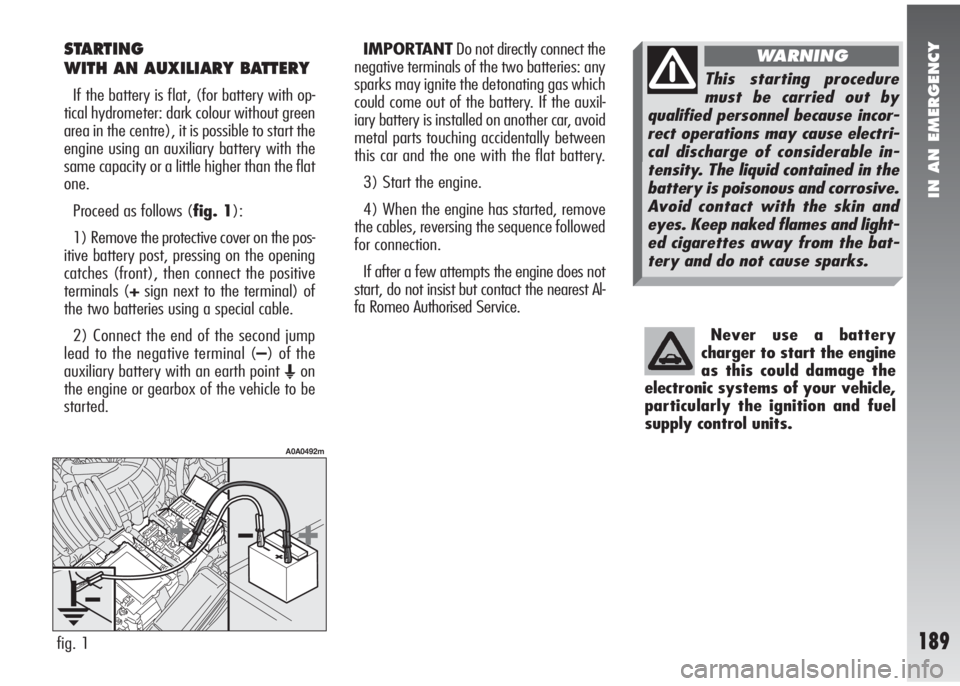
Proceed as follows (fig. 1):
1) Remove the protective cover on the pos-
itive battery post, pressing on the opening
catches (front), then connect the positive
terminals (+sign next to the terminal) of
the two batteries using a special cable.
2) Connect the end of the second jump
lead to the negative terminal (–) of the
auxiliary battery with an earth point
Eon
the engine or gearbox of the vehicle to be
started.IMPORTANTDo not directly connect the
negative terminals of the two batteries: any
sparks may ignite the detonating gas which
could come out of the battery. If the auxil-
iary battery is installed on another car, avoid
metal parts touching accidentally between
this car and the one with the flat battery.
3) Start the engine.
4) When the engine has started, remove
the cables, reversing the sequence followed
for connection.
If after a few attempts the engine does not
start, do not insist but contact the nearest Al-
fa Romeo Authorised Service.
fig. 1
A0A0492m
Never use a battery
charger to start the engine
as this could damage the
electronic systems of your vehicle,
particularly the ignition and fuel
supply control units.
This starting procedure
must be carried out by
qualified personnel because incor-
rect operations may cause electri-
cal discharge of considerable in-
tensity. The liquid contained in the
battery is poisonous and corrosive.
Avoid contact with the skin and
eyes. Keep naked flames and light-
ed cigarettes away from the bat-
tery and do not cause sparks.
WARNING
Page 192 of 291
IN AN EMERGENCY
190
IMPORTANTThe car is equipped with
“Kit for tyre quick repair Fix&Go“, see the
instructions contained in the following chap-
ter.
STARTING BY INERTIAIN THE EVENT OF A PUNCTURE
Never push, tow or coast
start the vehicle. This could
cause fuel to flow into the
catalyst damaging it irreversibly.
Remember that the engine
brake and power steering
are not operational until the engine
is started, therefore, much greater
effort than usual is needed on the
brake pedal and steering wheel.
WARNING
Signal the presence of the
stationary vehicle according
to the current regulations: hazard
warning lights, reflecting triangle,
etc. Any passengersshould leave
the car.
WARNING
Should the type of wheels
used be changed (alloy
rims instead of steel), it is also nec-
essary to replace the complete kit
of fastening bolts with others of
suitable size.
WARNING
Page 217 of 291
IN AN EMERGENCY
215
40
40
40
15
15
25
7.5
15
15
20
15
15
7.5
30
50 A/C (MAXI-FUSE)
FAN1 (MAXI-FUSE)
FAN2 (MAXI-FUSE)
F3
F4
F60 (*)
F11
F61 (*)
F62 (*)
F63 (*)
F46
F10
F12
EFI (MAXI-FUSE)
JB3 (MAXI-FUSE) 54
54
54
53
53
52
53
52
52
52
52
53
53
54
54
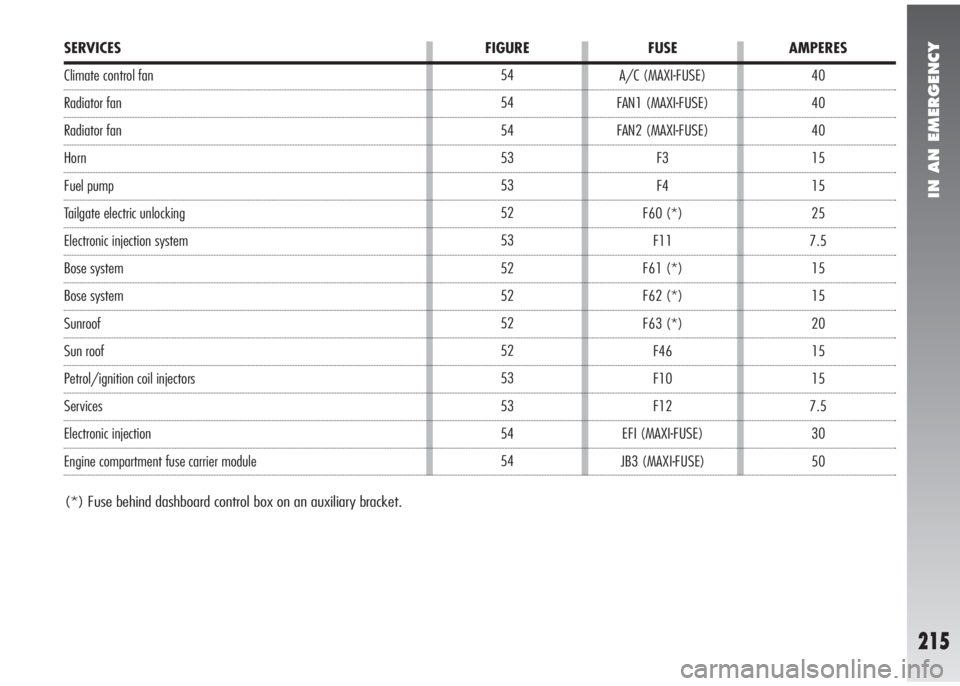
SERVICES FIGURE FUSE AMPERES
(*) Fuse behind dashboard control box on an auxiliary bracket.
Climate control fan
Radiator fan
Radiator fan
Horn
Fuel pump
Tailgate electric unlocking
Electronic injection system
Bose system
Bose system
Sunroof
Sun roof
Petrol/ignition coil injectors
Services
Electronic injection
Engine compartment fuse carrier module