fuel Alfa Romeo 147 2008 Owner handbook (in English)
[x] Cancel search | Manufacturer: ALFA ROMEO, Model Year: 2008, Model line: 147, Model: Alfa Romeo 147 2008Pages: 291, PDF Size: 5.52 MB
Page 218 of 291
IN AN EMERGENCY
216
IN THE EVENT OF A FLAT BATTERY
Before anything else, you are advised to
read the precautions for preventing the bat-
tery from draining and for ensuring long life
in the “Vehicle maintenance” chapter.
CHARGING THE BATTERY
IMPORTANTThe battery charging pro-
cedure is described only for information pur-
poses. This operation should be carried out
by Alfa Romeo Authorised Services.
Charging should be slow at a low amp rat-
ing for 24 hours. Charging for a longer time
may damage the battery.Charge the battery as follows:
– Disconnect the battery negative termi-
nal (–).
– Connect the charger cables to the bat-
tery terminals ensuring that the bias is cor-
rect.
– Turn on the charger.
– After charging, turn off the charger be-
fore disconnecting it from the battery.
– Re-connect the battery negative termi-
nal (–).
STARTING WITH AN
AUXILIARY BATTERY
See “Starting with an auxiliary battery” in
this chapter.
Strictly avoid using a bat-
tery charger to start the
engine: you may damage
the electronic systems, in particu-
lar the ignition and fuel supply con-
trol units.
The liquid contained in the
battery is poisonous and
corrosive. Avoid contact with the
skin or eyes. The battery should be
charged in a well ventilated place,
away from naked flames or pos-
sible sources of sparks: danger of
explosion and fire.
WARNING
Do not attempt to charge a
frozen battery: it must
firstly be thawed, otherwise it
may burst. If freezing has occurred,
the battery should be checked by
skilled personnel to make sure that
the internal elements are not dam-
aged and that the body is not
cracked, with the risk of leaking
poisonous and corrosive acid.
WARNING
Page 221 of 291
IN AN EMERGENCY
219
IN THE EVENT
OF AN ACCIDENT
– It is important to keep calm.
– If you are not directly involved, stop at
least a few dozen metres away from the ac-
cident.
– On motorways, stop without blocking
the emergency lane.
– Turn the engine off and the hazard warn-
ing lights on.
– At night, illuminate the place of the ac-
cident with the headlights.
– Take care, do not risk being run over.– Signal the accident placing the triangle
at regulation distance in a clearly visible
place.
– Call the emergency organisation, giving
the most accurate information possible. On
motorways use the special phones provid-
ed.
– In motorway pileups, especially with
poor visibility, the risk of being involved in
other crashes is high. Leave the car imme-
diately and go beyond the guard-rail.
– If the doors are blocked, do not try to
get out of the car breaking the windscreen
which is stratified. The windows and rear
screen are easier to break.
– Remove the ignition key of the vehi-
cles involved.– If you note a smell of fuel or other chem-
ical products, do not smoke and have ciga-
rettes stubbed out.
– To put out fires, even small ones, use
the extinguisher, blankets, sand, or earth.
Never use water.
– If use of the lighting system is not nec-
essary, disconnect the battery negative ter-
minal (–).
Page 224 of 291
●●●●●●●●●
●●●●●●●●●
●●●●●●●●●
●●●●●●●●●
●●●●●●●●●
●●●●
●●●●●●●●●
●●●●●●●●●
●●
●●●●
●●
●●●●
●●●●●●●●●
●●●●●●●●●
●●
VEHICLE MAINTENANCE
222
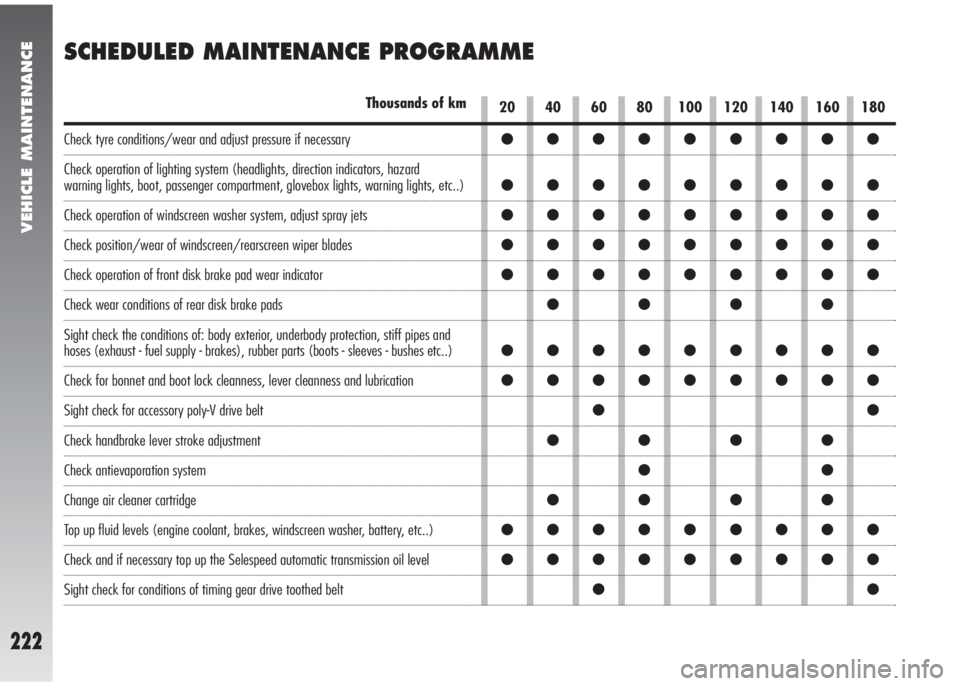
SCHEDULED MAINTENANCE PROGRAMME
20 40 60 80 100 120 140 160 180Thousands of km
Check tyre conditions/wear and adjust pressure if necessary
Check operation of lighting system (headlights, direction indicators, hazard
warning lights, boot, passenger compartment, glovebox lights, warning lights, etc..)
Check operation of windscreen washer system, adjust spray jets
Check position/wear of windscreen/rearscreen wiper blades
Check operation of front disk brake pad wear indicator
Check wear conditions of rear disk brake pads
Sight check the conditions of: body exterior, underbody protection, stiff pipes and
hoses (exhaust - fuel supply - brakes), rubber parts (boots - sleeves - bushes etc..)
Check for bonnet and boot lock cleanness, lever cleanness and lubrication
Sight check for accessory poly-V drive belt
Check handbrake lever stroke adjustment
Check antievaporation system
Change air cleaner cartridge
Top up fluid levels (engine coolant, brakes, windscreen washer, battery, etc..)
Check and if necessary top up the Selespeed automatic transmission oil level
Sight check for conditions of timing gear drive toothed belt
Page 226 of 291
VEHICLE MAINTENANCE
224
ADDITIONAL
OPERATIONS
Every 1000 kmor before long journeys,
check and if necessary top up:
– engine coolant fluid level
– brake/hydraulic clutch control fluid level
– power steering fluid level
– windscreen/rearscreen and headlamp
washer fluid level
– tyre pressure and conditions.
Every 3000 kmcheck and if necessary
top up the engine oil level.
The use of products of the FL Seleniais
recommended which have been designed
and made expressly for Alfa Romeo cars
(see “Refuelling” in the “Technical Specifi-
cations” chapter).
ANNUAL INSPECTION
PROGRAMME
For cars with an annual mileage
of below 20,000 km (for example
about 10,000 km) the following
yearly inspection programme is ad-
vised:
– Check tyre conditions/wear and if nec-
essary adjust the pressure
– Check operation of lighting system
(headlights, direction indicators, hazard
warning lights, boot, passenger compart-
ment, glovebox lights, warning lights )
– Check operation of windscreen wiper
system, spray jet adjustment
– Check position/wear of windscreen/
rearscreen wiper blades
– Check front disk brake pad conditions
and wear
– Check for bonnet and boot lock clean-
ness, lever cleanness and lubrication– Sight check for conditions of: engine,
gearbox, transmission, pipes (exhaust - fu-
el supply - brakes) rubber parts (boots -
sleeves - bushes etc..), brake and fuel sup-
ply system hoses
– Check battery charge
– Sight check for conditions of various dri-
ve belts
– Check and if necessary top up fluid lev-
els (engine coolant, brakes, windscreen
washer, battery, etc...)
– Change engine oil
– Change engine oil filter
– Change pollen filter.
Page 240 of 291
VEHICLE MAINTENANCE
238
WINDSCREEN/
REARSCREEN WIPERS
BLADES
Periodically clean the rubber part using spe-
cial products; TUTELA PROFESSIONAL
SC 35is recommended.
If the rubber blades are bent or worn they
should be replaced. In any case they should
be changed once a year.
A few simple notions can reduce the pos-
sibility of damage to the blades:
– If the temperature falls below zero,
make sure that ice has not frozen the rub-
ber against the glass. If necessary, thaw us-
ing an antifreeze product.
– Remove any snow from the glass: in ad-
dition to protecting the blades, this prevents
effort on the motor and overheating.
– Do not operate the windscreen and
rearscreen wipers on dry glass.
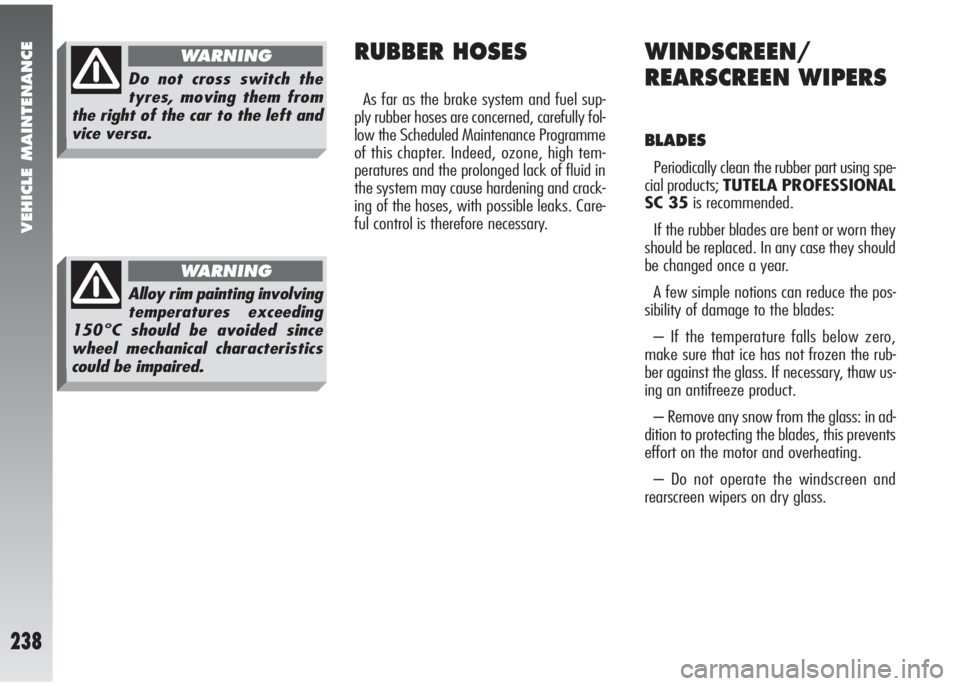
RUBBER HOSES
As far as the brake system and fuel sup-
ply rubber hoses are concerned, carefully fol-
low the Scheduled Maintenance Programme
of this chapter. Indeed, ozone, high tem-
peratures and the prolonged lack of fluid in
the system may cause hardening and crack-
ing of the hoses, with possible leaks. Care-
ful control is therefore necessary.
Do not cross switch the
tyres, moving them from
the right of the car to the left and
vice versa.
WARNING
Alloy rim painting involving
temperatures exceeding
150°C should be avoided since
wheel mechanical characteristics
could be impaired.
WARNING
Page 244 of 291
VEHICLE MAINTENANCE
242
CLEANING LEATHER SEATS
– Remove dried on dirt with a lightly
moistened chamois leather or cloth with-
out pressing too hard.
– Remove liquid and grease stains with
a dry absorbent cloth without rubbing. Then
wipe with a soft cloth or chamois leather
with water and neutral soap. If the stain per-
sists, use specific products, carefully follow-
ing the instructions for use.
IMPORTANTNever use alcohol. Make
sure that cleaning products do not contain
alcohol and alcohol derivatives even at low
strength.
INTERIOR PLASTIC PARTS
Use appropriate products designed to pre-
serve the appearance of components.
IMPORTANTNever use spirit or petro-
leum to clean the instrument cluster. Engine compartment
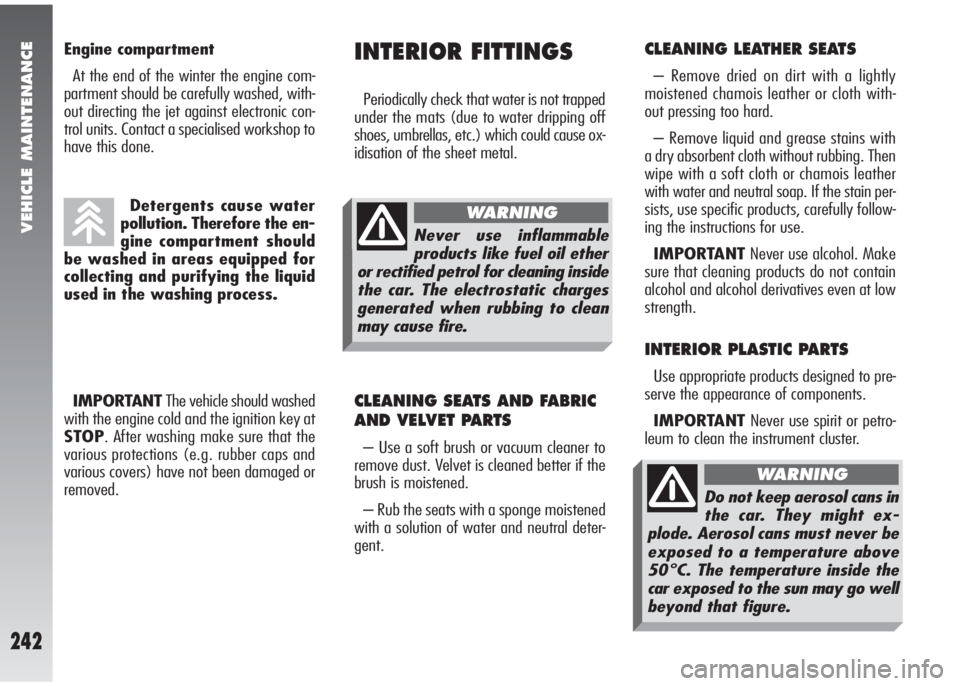
At the end of the winter the engine com-
partment should be carefully washed, with-
out directing the jet against electronic con-
trol units. Contact a specialised workshop to
have this done.
INTERIOR FITTINGS
Periodically check that water is not trapped
under the mats (due to water dripping off
shoes, umbrellas, etc.) which could cause ox-
idisation of the sheet metal.
Detergents cause water
pollution. Therefore the en-
gine compartment should
be washed in areas equipped for
collecting and purifying the liquid
used in the washing process.
IMPORTANTThe vehicle should washed
with the engine cold and the ignition key at
STOP. After washing make sure that the
various protections (e.g. rubber caps and
various covers) have not been damaged or
removed.CLEANING SEATS AND FABRIC
AND VELVET PARTS
– Use a soft brush or vacuum cleaner to
remove dust. Velvet is cleaned better if the
brush is moistened.
– Rub the seats with a sponge moistened
with a solution of water and neutral deter-
gent.
Never use inflammable
products like fuel oil ether
or rectified petrol for cleaning inside
the car. The electrostatic charges
generated when rubbing to clean
may cause fire.
WARNING
Do not keep aerosol cans in
the car. They might ex-
plode. Aerosol cans must never be
exposed to a temperature above
50°C. The temperature inside the
car exposed to the sun may go well
beyond that figure.
WARNING
Page 247 of 291
TECHNICAL SPECIFICATIONS
245
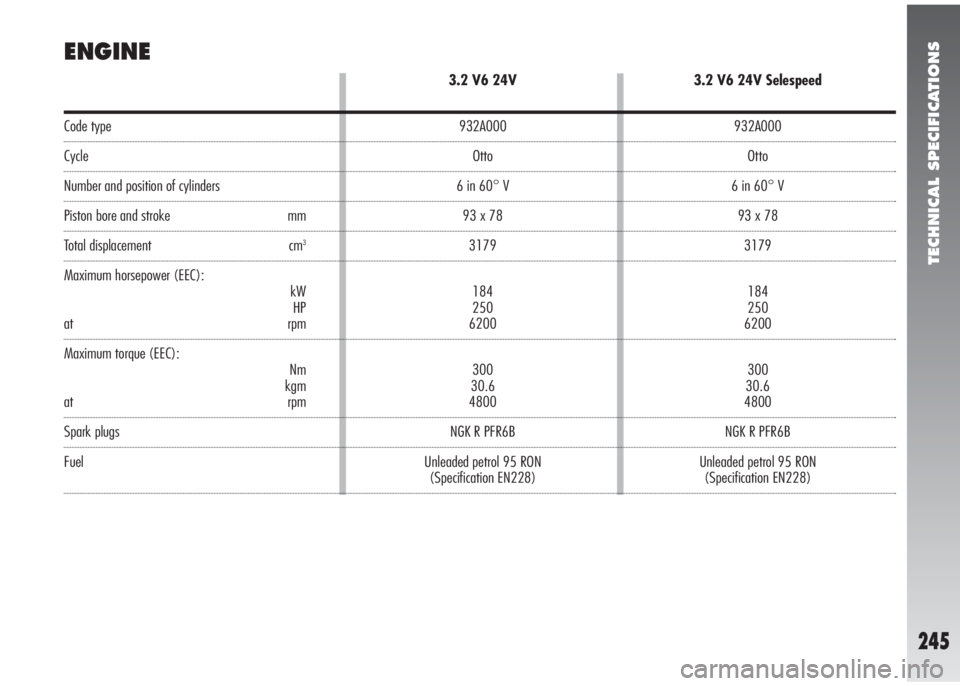
Code type
Cycle
Number and position of cylinders
Piston bore and stroke mm
Total displacement cm3
Maximum horsepower (EEC):
kW
HP
at rpm
Maximum torque (EEC):
Nm
kgm
at rpm
Spark plugs
Fuel
ENGINE
3.2 V6 24V
932A000
Otto
6 in 60° V
93 x 78
3179
184
250
6200
300
30.6
4800
NGK R PFR6B
Unleaded petrol 95 RON
(Specification EN228)
3.2 V6 24V Selespeed
932A000
Otto
6 in 60° V
93 x 78
3179
184
250
6200
300
30.6
4800
NGK R PFR6B
Unleaded petrol 95 RON
(Specification EN228)
Page 248 of 291
TECHNICAL SPECIFICATIONS
246
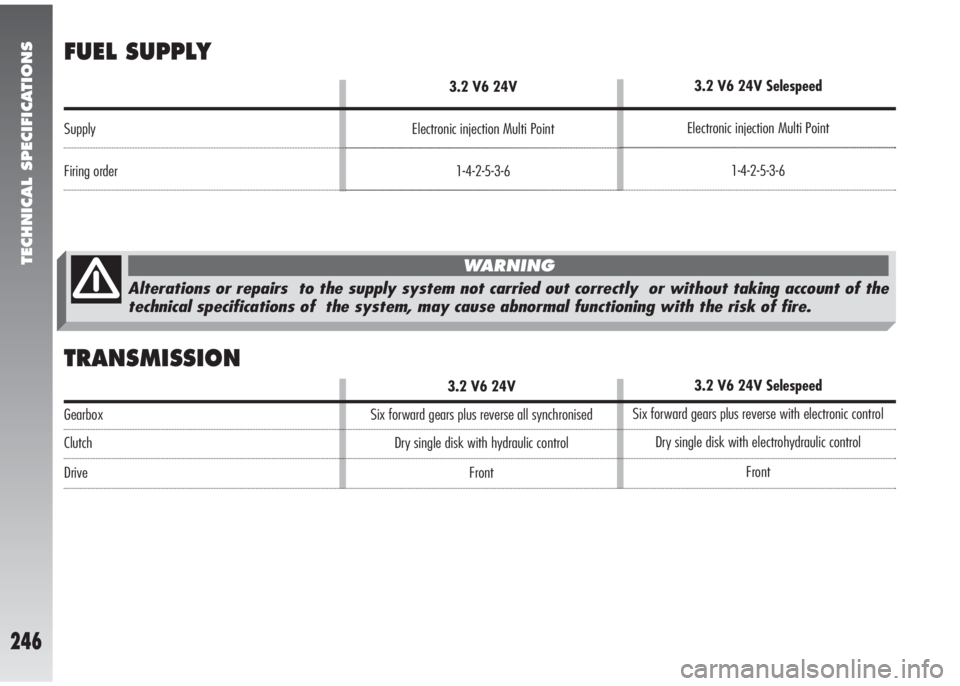
Supply
Firing order
FUEL SUPPLY
TRANSMISSION
3.2 V6 24V
Electronic injection Multi Point
1-4-2-5-3-6
Gearbox
Clutch
Drive
3.2 V6 24V
Six forward gears plus reverse all synchronised
Dry single disk with hydraulic control
Front
3.2 V6 24V Selespeed
Electronic injection Multi Point
1-4-2-5-3-6
3.2 V6 24V Selespeed
Six forward gears plus reverse with electronic control
Dry single disk with electrohydraulic control
Front
Alterations or repairs to the supply system not carried out correctly or without taking account of the
technical specifications of the system, may cause abnormal functioning with the risk of fire.
WARNING
Page 256 of 291
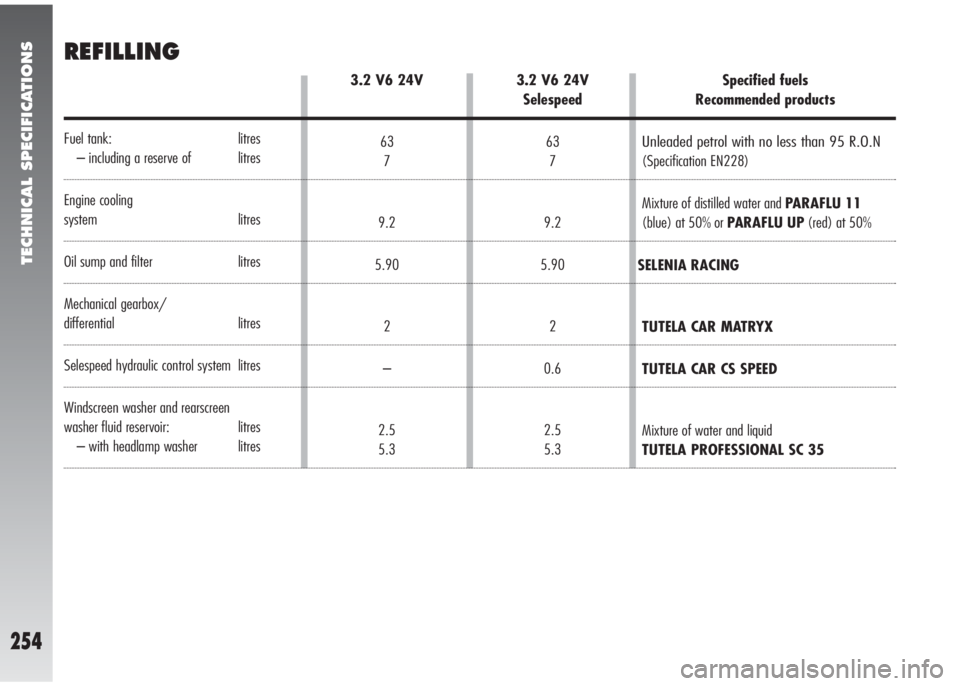
3.2 V6 24V
63
7
9.2
5.90
2
–
2.5
5.3
TECHNICAL SPECIFICATIONS
254
REFILLING
Specified fuels
Recommended products
Unleaded petrol with no less than 95 R.O.N
(Specification EN228)
Mixture of distilled water and PARAFLU 11
(blue) at 50% or PARAFLU UP(red) at 50%
SELENIA RACING
TUTELA CAR MATRYX
TUTELA CAR CS SPEED
Mixture of water and liquid
TUTELA PROFESSIONAL SC 35
3.2 V6 24V
Selespeed
63
7
9.2
5.90
2
0.6
2.5
5.3
Fuel tank: litres
– including a reserve of litres
Engine cooling
system litres
Oil sump and filter litres
Mechanical gearbox/
differential litres
Selespeed hydraulic control system litres
Windscreen washer and rearscreen
washer fluid reservoir: litres
– with headlamp washer litres
Page 259 of 291
TECHNICAL SPECIFICATIONS
257
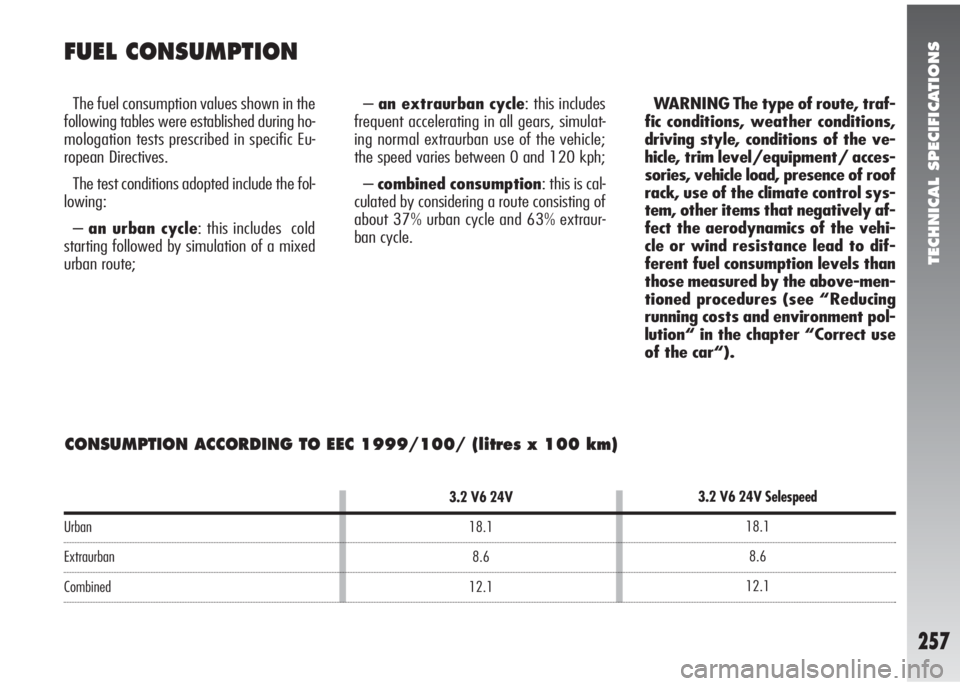
Urban
Extraurban
Combined
3.2 V6 24V
18.1
8.6
12.1
CONSUMPTION ACCORDING TO EEC 1999/100/ (litres x 100 km)
FUEL CONSUMPTION
The fuel consumption values shown in the
following tables were established during ho-
mologation tests prescribed in specific Eu-
ropean Directives.
The test conditions adopted include the fol-
lowing:
–an urban cycle: this includes cold
starting followed by simulation of a mixed
urban route;–an extraurban cycle: this includes
frequent accelerating in all gears, simulat-
ing normal extraurban use of the vehicle;
the speed varies between 0 and 120 kph;
–combined consumption: this is cal-
culated by considering a route consisting of
about 37% urban cycle and 63% extraur-
ban cycle.WARNING The type of route, traf-
fic conditions, weather conditions,
driving style, conditions of the ve-
hicle, trim level/equipment/ acces-
sories, vehicle load, presence of roof
rack, use of the climate control sys-
tem, other items that negatively af-
fect the aerodynamics of the vehi-
cle or wind resistance lead to dif-
ferent fuel consumption levels than
those measured by the above-men-
tioned procedures (see “Reducing
running costs and environment pol-
lution“ in the chapter “Correct use
of the car“).
3.2 V6 24V Selespeed
18.1
8.6
12.1