steering wheel Alfa Romeo 147 2008 Owner handbook (in English)
[x] Cancel search | Manufacturer: ALFA ROMEO, Model Year: 2008, Model line: 147, Model: Alfa Romeo 147 2008Pages: 291, PDF Size: 5.52 MB
Page 181 of 291
CORRECT USE OF THE CAR
179
– Do not drive for long periods without a
break. During breaks get out of the vehicle
and move around a bit to shake off the
drowsiness.
– Make sure the air in the passenger com-
partment is changed constantly.
– Never coast the vehicle downhill with
the engine switched off: this eliminates the
engine braking and power steering effect
thus requiring a greater effort on the pedal
and steering wheel.
NIGHT DRIVING
Here are some suggestions for night dri-
ving.
– Drive with particular care: night driving
involves a greater degree of concentration.
– Reduce speed, especially on unlit roads.
– At the first signs of drowsiness stop the
car: continuing the journey is dangerous for
yourself and others. Continue driving only
after sufficient rest.
– Maintain a greater distance from the ve-
hicle in front than in the day: it is more dif-
ficult to judge the speed of a vehicle when
only the lights can be seen.
– Ensure that the headlights are correctly
aimed: if they are too low, visibility is re-
duced and eyesight is tired. If they are too
high they may cause disturbance to other
road users.
– Use the main beams only outside built-
up areas and only when you are certain that
other drivers are not disturbed by their use.
– When meeting oncoming vehicles,
switch off the main beams and drive with
the dipped-beam headlights on.
– Keep the headlights and light units
clean.
– Outside built-up areas take care of ani-
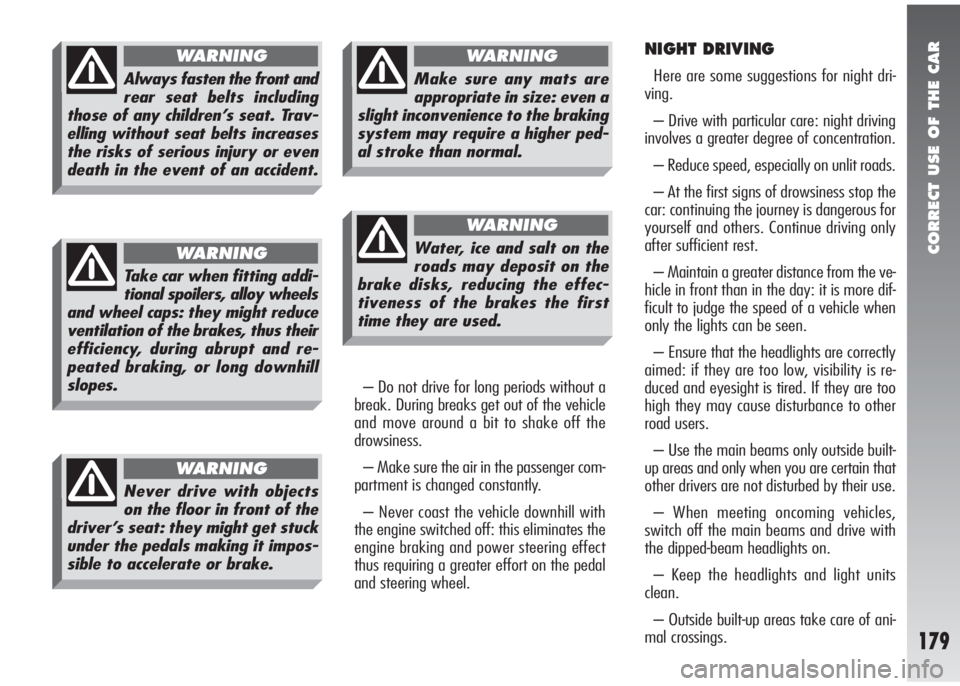
mal crossings.Always fasten the front and
rear seat belts including
those of any children’s seat. Trav-
elling without seat belts increases
the risks of serious injury or even
death in the event of an accident.
WARNING
Take car when fitting addi-
tional spoilers, alloy wheels
and wheel caps: they might reduce
ventilation of the brakes, thus their
efficiency, during abrupt and re-
peated braking, or long downhill
slopes.
WARNING
Never drive with objects
on the floor in front of the
driver’s seat: they might get stuck
under the pedals making it impos-
sible to accelerate or brake.
WARNING
Make sure any mats are
appropriate in size: even a
slight inconvenience to the braking
system may require a higher ped-
al stroke than normal.
WARNING
Water, ice and salt on the
roads may deposit on the
brake disks, reducing the effec-
tiveness of the brakes the first
time they are used.
WARNING
Page 182 of 291

CORRECT USE OF THE CAR
180
DRIVING WITH RAIN
Rain and wet roads can be dangerous.
If the road is wet, the traction between
wheel and asphalt is greatly reduced, thus
increasing the stopping distance and de-
creasing road holding.
Here are a few suggestions in the case of
rain:
– Reduce speed and keep further back
from the vehicle in front.
– Heavy rain also reduces visibility. In
these cases, turn on the headlights even dur-
ing the day to make yourself more visible
to others.
– Do not drive over puddles at high speed
and hold the steering wheel firmly: you may
lose control of the car (aquaplaning).
– Position the ventilation controls for
demisting (as described in the chapter (“Get-
ting to know your car”), to prevent visibili-
ty from worsening.
– Routinely check the conditions of the
windscreen wiper blades.
DRIVING IN FOG
– If fog is very thick, avoid travelling
where possible. If travelling with mist,
ground fog or the possibility of fog banks:
– Drive at moderate speed.
– Also in the day turn on the dipped-beam
headlights, rear fog guards and front fog
lights. Do not use the main-beam headlights.
IMPORTANTIf visibility in some parts
improves, switch off the rear fog guards; the
intense light disturbs the occupants of ve-
hicles behind.
– Remember that fog also involves wet
asphalt, thus greater difficulty in all types of
manoeuvres and longer stopping distances.
– Keep well away from the vehicle in
front.
– Where possible avoid sudden changes
in speed.
– Possibly avoid overtaking other vehicles.
– If the vehicle is forced to stop (faults,
impossibility to continue due to poor visi-
bility, etc.), firstly try to pull off the road.
Then turn on the hazard warning lights and,
if possible the dipped-beam headlights.
Rhythmically sound the horn if you note an-
other car coming.
MOUNTAIN DRIVING
– When travelling down hill use the en-
gine braking by engaging lower gears to pre-
vent the brakes from overheating.
– Never coast down hill with the engine
off or in neutral and especially not with the
ignition key removed.
– Drive at a moderate speed and avoid
cutting corners.
– Remember that overtaking up hill is
slower and therefore requires a greater
length of clear road. If you are being over-
taken on a hill, move over to enable the oth-
er vehicle to pass in safety.
Page 183 of 291
CORRECT USE OF THE CAR
181
DRIVING ON SNOW AND ICE
Here are a few suggestions for driving in
these conditions:
– Drive very slowly.
– On a snowy road, fit winter tyres or
snow chains; see the related paragraphs in
this chapter.
– Use engine braking where possible and
avoid abrupt braking.
– Braking with a car without ABS, avoid
locking the wheels, modulating the pressure
on the brake pedal.
– Avoid abrupt acceleration and changes
of direction.
– During cold weather even apparently dry
roads may be covered with occasional patch-
es of ice. Pay great attention therefore when
driving on roads which are in the shade, or
where rocks or trees line the road and on
which ice may persist.
– Keep further back from the vehicle in
front.
DRIVING WITH ABS
The ABS is a part of the braking system
which essentially offers 2 advantages:
1) it prevents locking, thus skidding, of the
wheels during emergency braking and es-
pecially under conditions with poor grip;
2) it allows braking and steering at the
same time, to avoid any sudden obstacles
or to direct the car as required when brak-
ing, compatibly with the physical limits of
lateral grip of the tyre.
To make the most of the ABS:
– In emergency braking or when grip is
low, a slight pulsing can be felt on the brake
pedal: this means that the ABS has come in-
to action. Do not release the pedal, but con-
tinue pressing it to give continuity to the
braking action.
– The ABS prevents the wheels from lock-
ing but it does not increase the physical lim-
its of grip between the asphalt and the road.
Therefore, also with a car fitted with ABS,
keep within a safety distance from the ve-
hicle in front and limit speed when ap-
proaching bends.
The ABS serves to increase vehicle con-
trollability not to go faster.
REDUCING RUNNING
COSTS AND
ENVIRONMENT
POLLUTION
By following a few simple guidelines, it
is possible to save vehicle running costs and
reduce harmful emissions.
GENERAL CONSIDERATIONS
Vehicle maintenance
The conditions of the vehicle represent an
important factor which affects fuel con-
sumption as well as travelling tranquillity
and the life of the vehicle. For this reason,
it is wise to take care of its maintenance
have the checks and adjustments carried out
in accordance with the “Scheduled Mainte-
nance Programme” (see... spark plugs, air
cleaner, timing).
Page 188 of 291
CORRECT USE OF THE CAR
186
VEHICLE
INACTIVITY
If the vehicle is to be left inactive for long
periods, the following precautions should be
noted:
– House the vehicle under cover in a dry
and possibly ventilated place.
– Engage a gear.
– Check that the handbrake is not en-
gaged.
– Clean and protect the paintwork by pro-
tective wax.
– Cover the rubber windscreen and
rearscreen wiper blades with talcum powder
and raise them off the glass.
– Open the windows slightly.
– Inflate the tyres to a pressure of 0.5 bars
above normal. If possible rest the tyres on
wooden planks and periodically check the
pressure.
– Do not turn on the electronic alarm sys-
tem. Keep you speed
down when snow
chains are fitted.
Do not exceed 50 km/h. Avoid
potholes, steps and pavements to
prevent damaging the tyres, sus-
pension and steering.
Snow chains should only be applied to the
drive wheels (front).
Before purchasing or using snow chains,
you are recommended to contact Alfa
Romeo Authorised Services.
Check the tension of the chain after the
first few metres have been driven.SNOW CHAINS
Use of snow chains should be in compli-
ance with local regulations.
Use snow chains with reduced size with
maximum protrusion beyond the tyre pro-
file of 12 mm.
Snow chains may not be
used on tyres type 225/45
ZR 17”, 235/35 R18”.
Only spider type chains can be used
on tyres type 215/45 R17” and
215/45 ZR17”. SPIKES SPIDER
COMPACT snow chains (17003
compact model) with 9 arms and 16
mm adjustable length and 17"
wheel cover adapter are available
at Lineaccessori Alfa Romeo. Keep
your speed down when this type of
chains is fitted. Do not exceed 50
km/h with this type of chains,
avoid sudden acceleration and de-
activate the ASR system (the warn-
ing light on the button shall be on).
Remember that snow chains make
braking distance longer.
Page 192 of 291
IN AN EMERGENCY
190
IMPORTANTThe car is equipped with
“Kit for tyre quick repair Fix&Go“, see the
instructions contained in the following chap-
ter.
STARTING BY INERTIAIN THE EVENT OF A PUNCTURE
Never push, tow or coast
start the vehicle. This could
cause fuel to flow into the
catalyst damaging it irreversibly.
Remember that the engine
brake and power steering
are not operational until the engine
is started, therefore, much greater
effort than usual is needed on the
brake pedal and steering wheel.
WARNING
Signal the presence of the
stationary vehicle according
to the current regulations: hazard
warning lights, reflecting triangle,
etc. Any passengersshould leave
the car.
WARNING
Should the type of wheels
used be changed (alloy
rims instead of steel), it is also nec-
essary to replace the complete kit
of fastening bolts with others of
suitable size.
WARNING
Page 219 of 291
IN AN EMERGENCY
217
IF THE VEHICLE IS TO BE TOWED
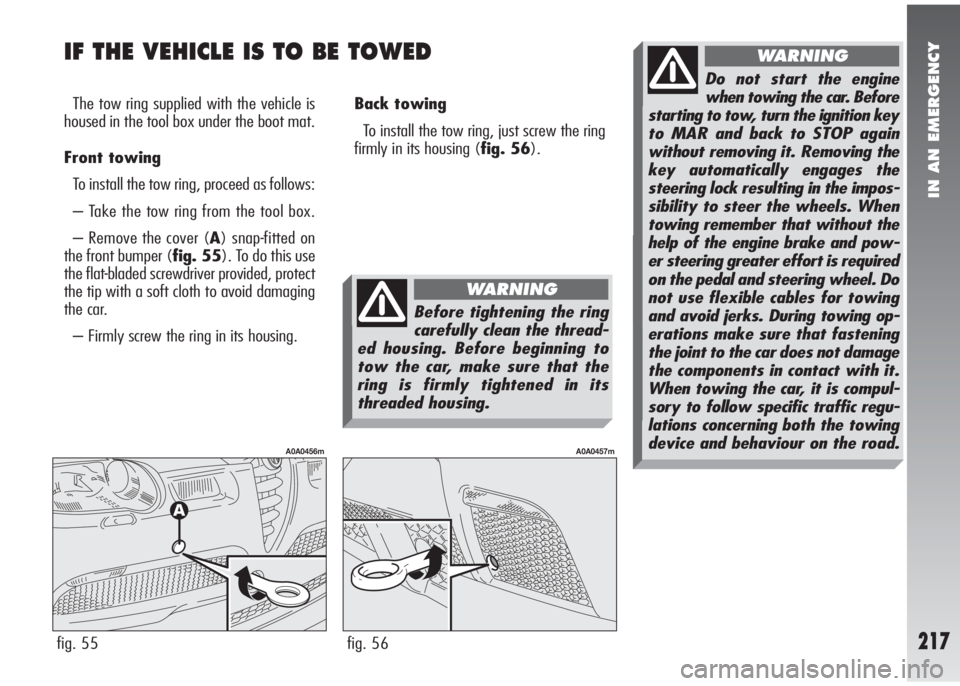
The tow ring supplied with the vehicle is
housed in the tool box under the boot mat.
Front towing
To install the tow ring, proceed as follows:
– Take the tow ring from the tool box.
– Remove the cover (A) snap-fitted on
the front bumper (fig. 55). To do this use
the flat-bladed screwdriver provided, protect
the tip with a soft cloth to avoid damaging
the car.
– Firmly screw the ring in its housing.Back towing
To install the tow ring, just screw the ring
firmly in its housing (fig. 56).
fig. 55
A0A0456m
fig. 56
A0A0457m
Before tightening the ring
carefully clean the thread-
ed housing. Before beginning to
tow the car, make sure that the
ring is firmly tightened in its
threaded housing.
WARNING
Do not start the engine
when towing the car. Before
starting to tow, turn the ignition key
to MAR and back to STOP again
without removing it. Removing the
key automatically engages the
steering lock resulting in the impos-
sibility to steer the wheels. When
towing remember that without the
help of the engine brake and pow-
er steering greater effort is required
on the pedal and steering wheel. Do
not use flexible cables for towing
and avoid jerks. During towing op-
erations make sure that fastening
the joint to the car does not damage
the components in contact with it.
When towing the car, it is compul-
sory to follow specific traffic regu-
lations concerning both the towing
device and behaviour on the road.
WARNING
Page 232 of 291
VEHICLE MAINTENANCE
230
If the oil level in the reservoir is below the
specified one, top up only with one of the
products listed in the “Fluids and lubricants”
table in the “Technical Specifications” chap-
ter proceeding as follows.
– Start the engine and wait for the oil lev-
el in the reservoir to stabilise.
– With the engine running, turn the steer-
ing wheel lock to lock a few times.
– Top up to the MAXlevel notch, then
refit the cap.
Oil consumption is very
low, if topping up again is
needed shortly afterwards,
have the system checked for pos-
sible leaks by Alfa Romeo Autho-
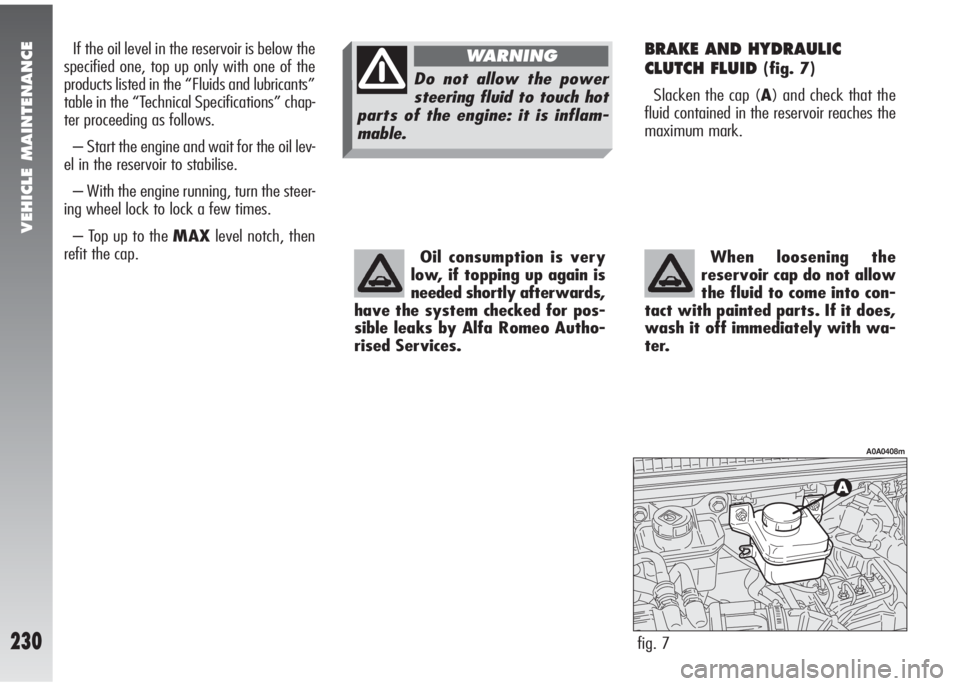
rised Services.BRAKE AND HYDRAULIC
CLUTCH FLUID
(fig. 7)
Slacken the cap (A) and check that the
fluid contained in the reservoir reaches the
maximum mark.
fig. 7
A0A0408m
When loosening the
reservoir cap do not allow
the fluid to come into con-
tact with painted parts. If it does,
wash it off immediately with wa-
ter.
Do not allow the power
steering fluid to touch hot
parts of the engine: it is inflam-
mable.
WARNING
Page 239 of 291
VEHICLE MAINTENANCE
237
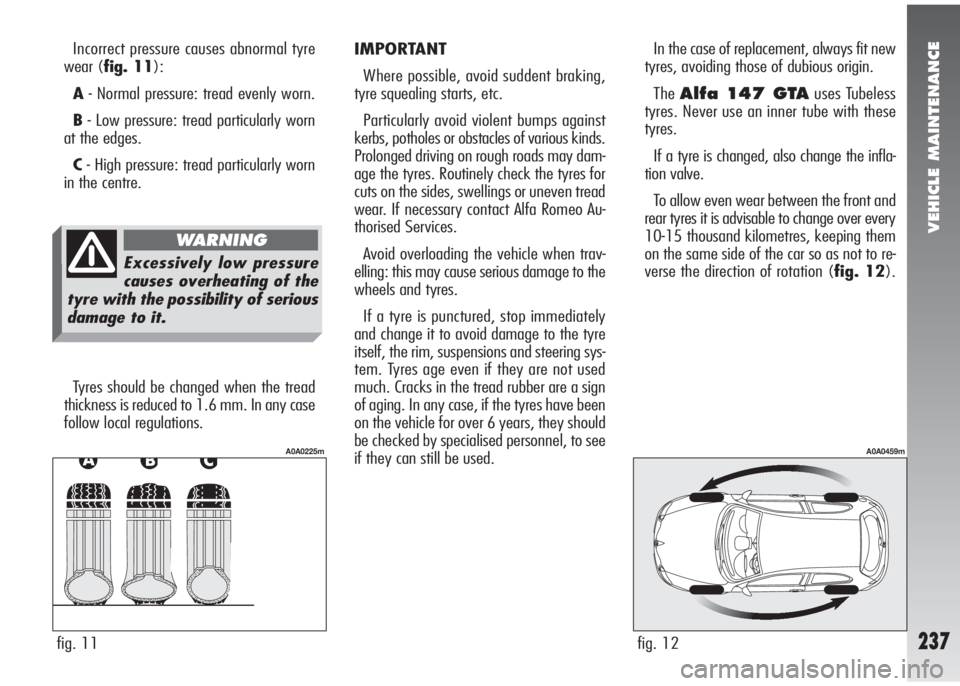
Incorrect pressure causes abnormal tyre
wear (fig. 11):
A- Normal pressure: tread evenly worn.
B- Low pressure: tread particularly worn
at the edges.
C- High pressure: tread particularly worn
in the centre.
Tyres should be changed when the tread
thickness is reduced to 1.6 mm. In any case
follow local regulations.
fig. 11
A0A0225m
IMPORTANT
Where possible, avoid suddent braking,
tyre squealing starts, etc.
Particularly avoid violent bumps against
kerbs, potholes or obstacles of various kinds.
Prolonged driving on rough roads may dam-
age the tyres. Routinely check the tyres for
cuts on the sides, swellings or uneven tread
wear. If necessary contact Alfa Romeo Au-
thorised Services.
Avoid overloading the vehicle when trav-
elling: this may cause serious damage to the
wheels and tyres.
If a tyre is punctured, stop immediately
and change it to avoid damage to the tyre
itself, the rim, suspensions and steering sys-
tem. Tyres age even if they are not used
much. Cracks in the tread rubber are a sign
of aging. In any case, if the tyres have been
on the vehicle for over 6 years, they should
be checked by specialised personnel, to see
if they can still be used.In the case of replacement, always fit new
tyres, avoiding those of dubious origin.
The
Alfa 147 GTAuses Tubeless
tyres. Never use an inner tube with these
tyres.
If a tyre is changed, also change the infla-
tion valve.
To allow even wear between the front and
rear tyres it is advisable to change over every
10-15 thousand kilometres, keeping them
on the same side of the car so as not to re-
verse the direction of rotation (fig. 12).
fig. 12
A0A0459m
Excessively low pressure
causes overheating of the
tyre with the possibility of serious
damage to it.
WARNING
Page 249 of 291
TECHNICAL SPECIFICATIONS
247
SPARK PLUGS
Clean, intact spark plugs are determinant
with regard to engine efficiency and for re-
ducing the emission of pollutants.Spark plugs should be re-
placed at the intervals
specified in the Scheduled
maintenance programme. Only use
spark plugs of the specified type:
if the thermal capacity is inade-
quate or if the envisaged life is not
guaranteed inconveniences may en-
sue.
BRAKES
Service brakes: – front
– rear
Parking brake
If examined by an expert eye, the ap-
pearance of a spark plug is a sound clue
for locating a fault, even if not involving the
ignition system. Therefore if you are expe-
riencing any engine problems, it is impor-
tant to have the spark plugs checked by Al-
fa Romeo Authorized Services.
STEERING
Type
Turning radius (between pavements)
3.2 V6 24V - 3.2 V6 24V Selespeed
Disk self-ventilated
Disk
3.2 V6 24V 3.2 V6 24V Selespeed
Rack and pinion.
Hydraulic power steering with fluid reservoir in engine compartment
12.1 m 12.1 m Wheel anti-look system (ABS) with electronic braking distribution.
Servo-brake. Electronic control with brake pad wear sensors. Gaskets of ecological type.
Controlled by hand lever operating rear brakes.
Page 262 of 291
RIGHT HAND DRIVE VERSION
260
DASHBOARD
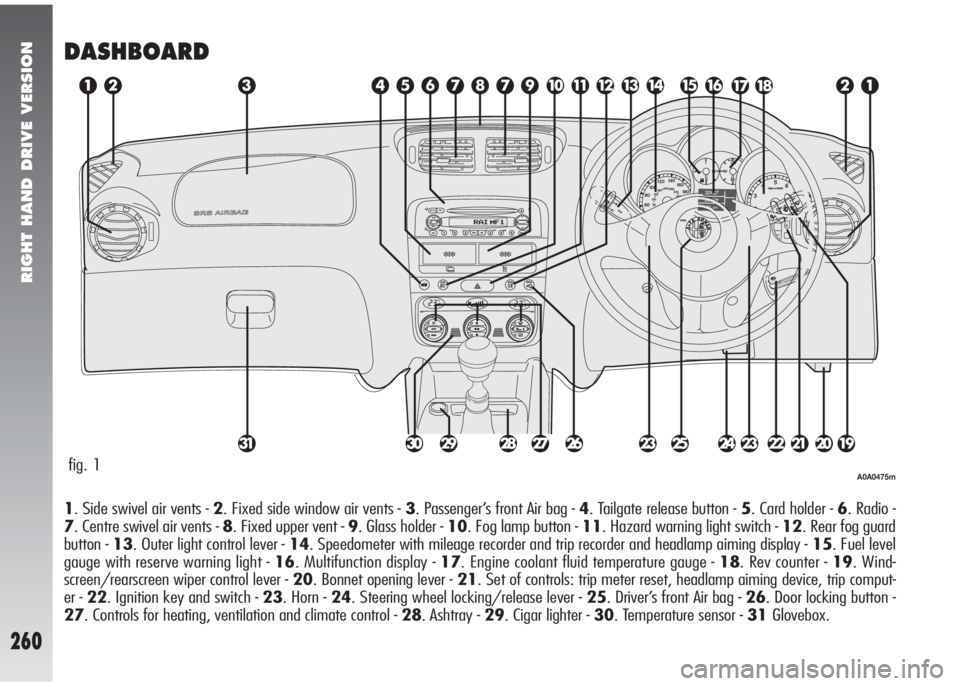
1. Side swivel air vents - 2. Fixed side window air vents - 3. Passenger’s front Air bag - 4. Tailgate release button - 5. Card holder - 6. Radio -
7. Centre swivel air vents - 8. Fixed upper vent - 9. Glass holder - 10. Fog lamp button - 11. Hazard warning light switch - 12. Rear fog guard
button - 13. Outer light control lever - 14. Speedometer with mileage recorder and trip recorder and headlamp aiming display - 15. Fuel level
gauge with reserve warning light - 16. Multifunction display - 17. Engine coolant fluid temperature gauge - 18. Rev counter - 19. Wind-
screen/rearscreen wiper control lever - 20. Bonnet opening lever - 21. Set of controls: trip meter reset, headlamp aiming device, trip comput-
er - 22. Ignition key and switch - 23. Horn - 24. Steering wheel locking/release lever - 25. Driver’s front Air bag - 26. Door locking button -
27. Controls for heating, ventilation and climate control - 28. Ashtray - 29. Cigar lighter - 30. Temperature sensor - 31Glovebox.
fig. 1A0A0475m