lights Alfa Romeo 147 2008 Owner handbook (in English)
[x] Cancel search | Manufacturer: ALFA ROMEO, Model Year: 2008, Model line: 147, Model: Alfa Romeo 147 2008Pages: 291, PDF Size: 5.52 MB
Page 185 of 291

CORRECT USE OF THE CAR
183
Top speed
Fuel consumption considerably increases
with speed: it is helpful to note that passing
from 90 to 120 km/h consumption in-
creases by about +30%. Also maintain an
even as possible speed, avoiding superflu-
ous braking and accelerating again, which
cost in terms of both fuel and emissions. It
is therefore advisable to adopt a “smooth”
driving style trying to anticipate manoeuvres
to avoid imminent hazards and respect safe-
ty distances to avoid sudden slowing.
Acceleration
Accelerating heavily taking the engine to
a high speed, has a considerably adverse ef-
fect on consumption and emission levels;
it is wise to accelerate gradually and not ex-
ceed the maximum torque.CONDITIONS OF USE
Cold starting
Short journeys and frequent cold starts do
not allow the engine to reach optimum op-
erating temperature. This results in a sig-
nificant increase in consumption levels (from
+15 to +30% on the urban cycle) and emis-
sion of harmful substances.
Traffic situations and
road conditions
Rather high consumption levels are tied to
situations with heavy traffic, for example
in queues with frequent use of the lower
gears or in cities with many traffic lights.
Also winding mountain roads and rough
road surfaces adversely affect consumption.
Stopping in the traffic
During prolonged stops (e.g. level cross-
ings) it is advisable to switch the engine off.
ECONOMY AND
ENVIRONMENT
FRIENDLY DRIVING
Environment protection is one of the prin-
ciples that guided the development of your
Alfa 147 GTA.
It is not merely by chance that its antipol-
lution devices obtain results far beyond those
specified by current regulations.
However, the environment still needs the
utmost care from all of us.
By following a few simple rules it is pos-
sible to avoid damage to the environment
and very often at the same time to limit fu-
el consumption. On this subject we are giv-
ing some helpful suggestions to be added
to those marked with the
#in various points
of this booklet.
Kindly read them all carefully.
Page 190 of 291
IN AN EMERGENCY
188
3) Fully depress the accelerator pedal and
keep it pressed. The
Uwarning light will
come on for eight seconds and then go off,
now release the accelerator pedal.
4) The
Uwarning light begins to flash:
after it has flashed the same number of
times as the first digit on the CODE card,
press the accelerator pedal and keep it
pressed until the
Uwarning light turns on
(for four seconds) and then goes off, now
release the accelerator pedal.
5) The
Uwarning light starts to flash: af-
ter the number of flashes corresponding to
the second digit on the CODE card, press the
accelerator pedal and keep it pressed.
6) Repeat this procedure for the remain-
ing digits on the CODE card.
7) After entering the last figure, keep the
accelerator pedal pressed. The
Uwarn-
ing light turns on (for four seconds) and
then goes off; now release the accelera-
tor pedal.8) A quick flash of the
Uwarning light
(for about 4 seconds) confirms that the op-
eration has been carried out correctly.
9) Start the engine turning the ignition key
fromMARtoAV Vwithout returning the
key to the STOPposition.
Conversely, if the
Uwarning light stays
on, turn the key to STOPand repeat the
procedure starting from point 1).
IMPORTANTAfter emergency starting
it is advisable to contact an Alfa Romeo Au-
thorised Service, because the emergency
procedure must be repeated each time the
engine is started.
EMERGENCY
STARTING
If it is not possible to deactivate the engine
inhibitor with the Alfa Romeo CODE system,
the
YandUwarning lights stay on and
the engine will not start. Emergency start-
ing is needed to start the engine.
IMPORTANTYou are advised to care-
fully read the entire procedure before car-
rying it out.
If a mistake is made during the emergency
procedure, the ignition key should be turned
toSTOPand the operations must be re-
peated from the start (point 1).
1) Read the 5-figure electronic code on the
CODE card.
2) Turn the ignition key to MAR.
I I
N N
A A
N N
E E
M M
E E
R R
G G
E E
N N
C C
Y Y
Page 192 of 291
IN AN EMERGENCY
190
IMPORTANTThe car is equipped with
“Kit for tyre quick repair Fix&Go“, see the
instructions contained in the following chap-
ter.
STARTING BY INERTIAIN THE EVENT OF A PUNCTURE
Never push, tow or coast
start the vehicle. This could
cause fuel to flow into the
catalyst damaging it irreversibly.
Remember that the engine
brake and power steering
are not operational until the engine
is started, therefore, much greater
effort than usual is needed on the
brake pedal and steering wheel.
WARNING
Signal the presence of the
stationary vehicle according
to the current regulations: hazard
warning lights, reflecting triangle,
etc. Any passengersshould leave
the car.
WARNING
Should the type of wheels
used be changed (alloy
rims instead of steel), it is also nec-
essary to replace the complete kit
of fastening bolts with others of
suitable size.
WARNING
Page 193 of 291
IN AN EMERGENCY
191
FIX&GO KIT FOR
QUICK TYRE
REPAIRING
The car is equipped with a tyre quick re-
pairing kit called FIX&GO.
fig. 11
A0A0374m
fig. 12
A0A0375m
fig. 13
A0A0376m
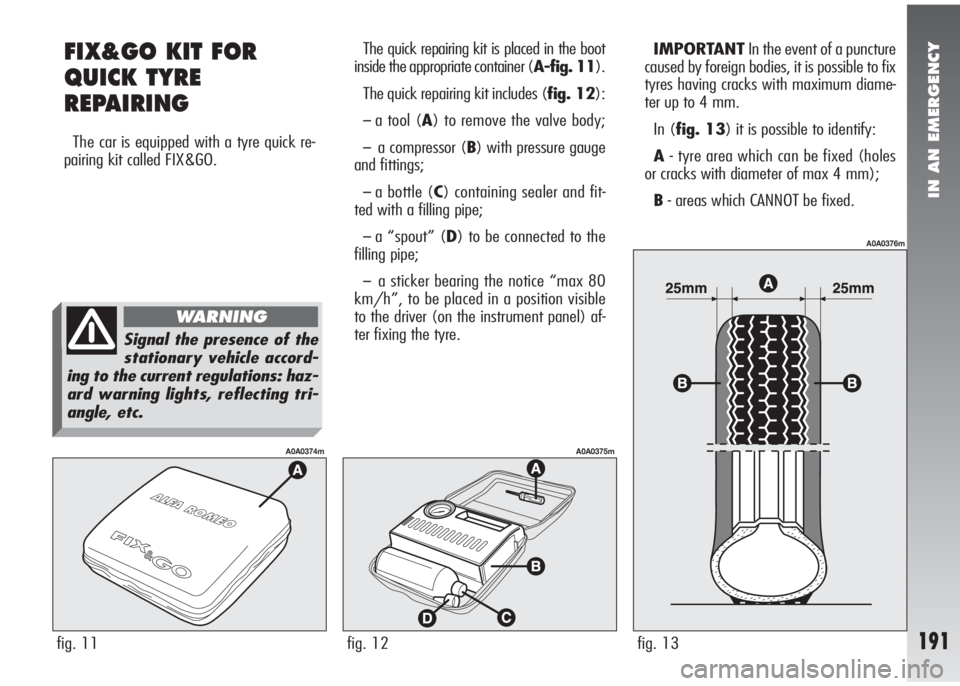
The quick repairing kit is placed in the boot
inside the appropriate container (A-fig. 11).
The quick repairing kit includes (fig. 12):
–a tool (A) to remove the valve body;
–a compressor (B) with pressure gauge
and fittings;
–a bottle (C) containing sealer and fit-
ted with a filling pipe;
–a “spout” (D) to be connected to the
filling pipe;
–a sticker bearing the notice “max 80
km/h”, to be placed in a position visible
to the driver (on the instrument panel) af-
ter fixing the tyre.IMPORTANTIn the event of a puncture
caused by foreign bodies, it is possible to fix
tyres having cracks with maximum diame-
ter up to 4 mm.
In (fig. 13) it is possible to identify:
A- tyre area which can be fixed (holes
or cracks with diameter of max 4 mm);
B- areas which CANNOT be fixed.
Signal the presence of the
stationary vehicle accord-
ing to the current regulations: haz-
ard warning lights, reflecting tri-
angle, etc.
WARNING
Page 197 of 291
IN AN EMERGENCY
195
Drive carefully to the nearest Alfa Romeo
Authorized Service to check the tyre condi-
tions, then have it fixed or replaced.
It is absolutely necessary to communicate
that the tyre has been fixed with the quick
repairing kit.
WHEN NEEDING TO CHANGE A BULB
fig. 20
A0A0491m
Tyres fixed with the quick
repairing kit must be used
only temporarily.
WARNING
Halogen bulbs contain pres-
surised gas, in the case of
breakage they may burst.
WARNING
Alterations or repairs to
the electric system not car-
ried out correctly and without tak-
ing account of the system specifi-
cations may cause failures and the
risk of fire.
WARNING
Where possible, it is ad-
visable to have bulbs
changed c/o Alfa Romeo Autho-
rised Services. The correct opera-
tion and aiming of the outer lights
are vital to the safety of the ve-
hicle and its passengers and the
subject of specific laws.
WARNING
Halogen bulbs must be
handled touching only the
metallic part. If the transparent
bulb is touched with the fingers, its
lighting intensity is reduced and the
life of the bulb may be compro-
mised. If touched accidentally, rub
the bulb with a cloth moistened
with methylated spirit and allow
to dry.
WARNING
Page 199 of 291
IN AN EMERGENCY
197
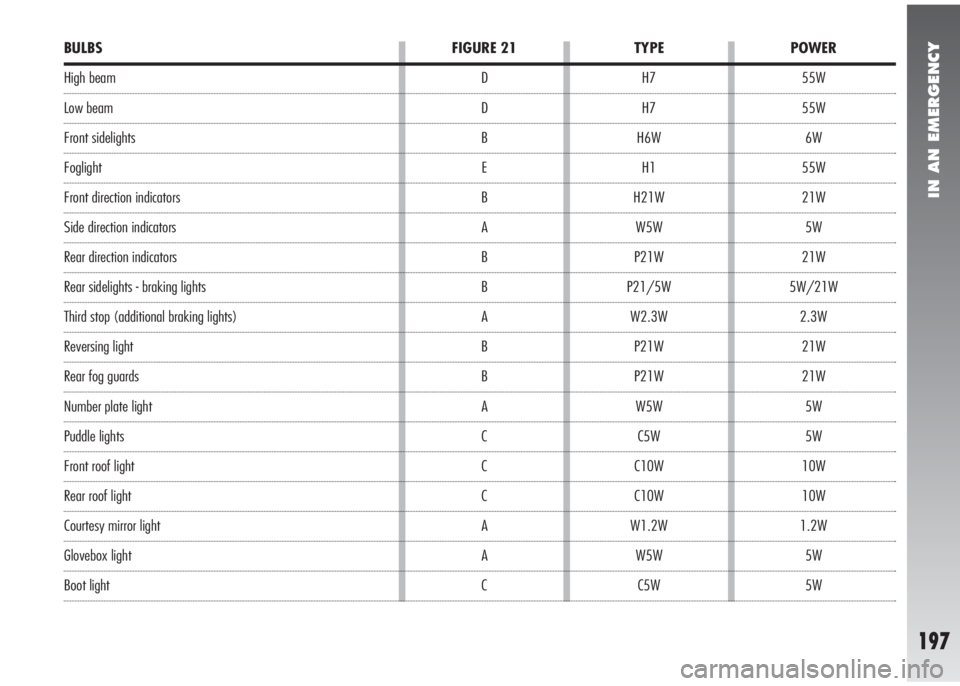
BULBS
High beam
Low beam
Front sidelights
Foglight
Front direction indicators
Side direction indicators
Rear direction indicators
Rear sidelights - braking lights
Third stop (additional braking lights)
Reversing light
Rear fog guards
Number plate light
Puddle lights
Front roof light
Rear roof light
Courtesy mirror light
Glovebox light
Boot lightFIGURE 21
D
D
B
E
B
A
B
B
A
B
B
A
C
C
C
A
A
CPOWER
55W
55W
6W
55W
21W
5W
21W
5W/21W
2.3W
21W
21W
5W
5W
10W
10W
1.2W
5W
5W TYPE
H7
H7
H6W
H1
H21W
W5W
P21W
P21/5W
W2.3W
P21W
P21W
W5W
C5W
C10W
C10W
W1.2W
W5W
C5W
Page 200 of 291
IN AN EMERGENCY
198
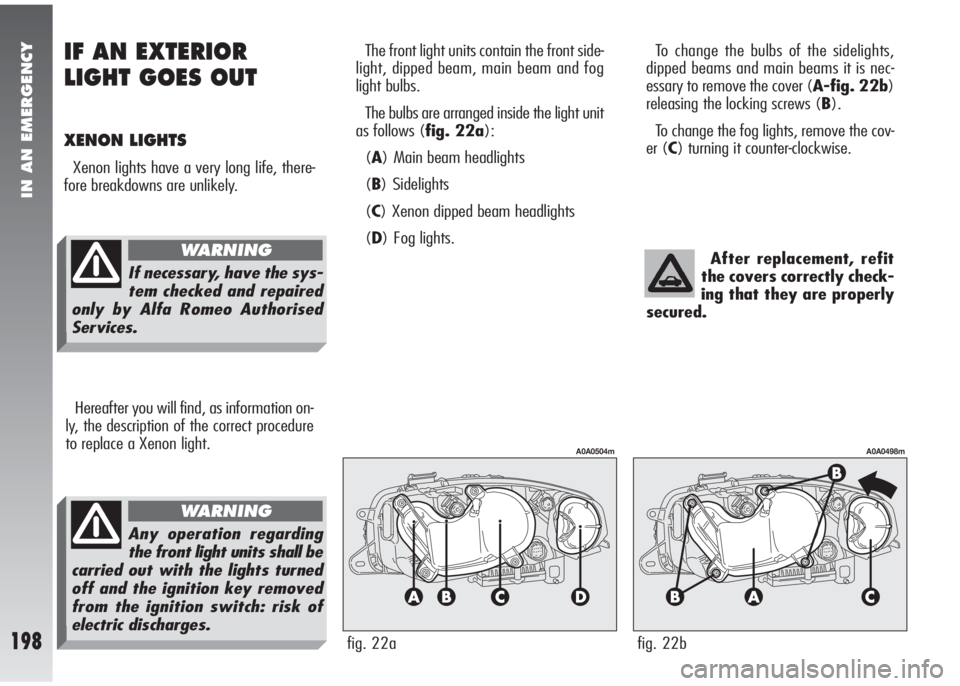
The front light units contain the front side-
light, dipped beam, main beam and fog
light bulbs.
The bulbs are arranged inside the light unit
as follows (fig. 22a):
(A) Main beam headlights
(B) Sidelights
(C) Xenon dipped beam headlights
(D) Fog lights.
Hereafter you will find, as information on-
ly, the description of the correct procedure
to replace a Xenon light.
To change the bulbs of the sidelights,
dipped beams and main beams it is nec-
essary to remove the cover (A-fig. 22b)
releasing the locking screws (B).
To change the fog lights, remove the cov-
er (C) turning it counter-clockwise.
After replacement, refit
the covers correctly check-
ing that they are properly
secured.
IF AN EXTERIOR
LIGHT GOES OUT
XENON LIGHTS
Xenon lights have a very long life, there-
fore breakdowns are unlikely.
fig. 22a
A0A0504m
fig. 22b
A0A0498m
If necessary, have the sys-
tem checked and repaired
only by Alfa Romeo Authorised
Services.
WARNING
Any operation regarding
the front light units shall be
carried out with the lights turned
off and the ignition key removed
from the ignition switch: risk of
electric discharges.
WARNING
Page 201 of 291

IN AN EMERGENCY
199
Front fog lights(fig. 23a)
IMPORTANT When needing to change
the left bulb, the side trim next to the light
itself needs to be removed to facilitate ac-
cess to the engine compartment.
To change the bulb, proceed as follows:
– Remove the protective cover turning it
counter-clockwise.
– Disconnect the electric connector (A).
– Release the bulb catch (B).
– Remove the bulb and replace it.
– Fit a new bulb, making the tab of the
metal part coincide with the one on the
lamp unit, then hook the bulb holder catch
(B).
– Reconnect the electric connector (A).
– Refit the protective cover correctly.Xenon dipped beam
headlights
(fig. 23b)
To change the bulb, proceed as follows:
– Remove the protective cover releasing
the locking screws.
– Disconnect the electric connector (A)
turning it slightly counter-clockwise.
– Remove ring nut (B) turning it slightly
counter-clockwise
– Remove the bulb and replace it.
– Fit a new bulb correctly observing the
grooves on the lamp lens, then refit the ring
nut (B).
– Reconnect the electric connector (A).
– Refit the protective cover correctly.
Front sidelights(fig. 24a)
To change the bulb, proceed as follows:
– Remove the protective cover releasing
the locking screws.
– Using the extension (A), integral with
the bulb holder (B), withdraw the bulb hold-
er itself which is snap-fitted.
– Remove the bulb (C), pushing it gen-
tly and turning it counter-clockwise.
– Change the bulb and refit the bulb hold-
er making sure that it clicks into place; al-
so check that the bulb is in the correct po-
sition looking at the lamp from outside.
– Refit the protective cover correctly.
fig. 23a
A0A0499m
fig. 23b
A0A0500m
fig. 24a
A0A0501m
Page 202 of 291
IN AN EMERGENCY
200
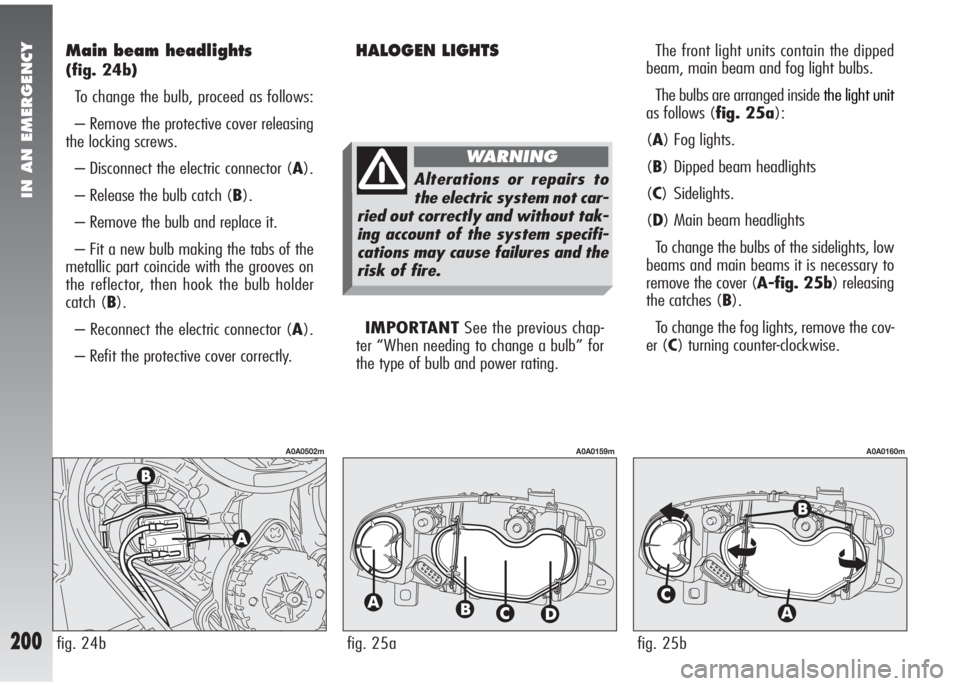
Main beam headlights
(fig. 24b)
To change the bulb, proceed as follows:
– Remove the protective cover releasing
the locking screws.
– Disconnect the electric connector (A).
– Release the bulb catch (B).
– Remove the bulb and replace it.
– Fit a new bulb making the tabs of the
metallic part coincide with the grooves on
the reflector, then hook the bulb holder
catch (B).
– Reconnect the electric connector (A).
– Refit the protective cover correctly.
HALOGEN LIGHTSThe front light units contain the dipped
beam, main beam and fog light bulbs.
The bulbs are arranged inside
the light unit
as follows (fig. 25a):
(A) Fog lights.
(B) Dipped beam headlights
(C) Sidelights.
(D) Main beam headlights
To change the bulbs of the sidelights, low
beams and main beams it is necessary to
remove the cover (A-fig. 25b) releasing
the catches (B).
To change the fog lights, remove the cov-
er (C) turning counter-clockwise.
IMPORTANTSee the previous chap-
ter “When needing to change a bulb” for
the type of bulb and power rating.
fig. 25a
A0A0159m
fig. 25b
A0A0160m
fig. 24b
A0A0502m
Alterations or repairs to
the electric system not car-
ried out correctly and without tak-
ing account of the system specifi-
cations may cause failures and the
risk of fire.
WARNING
Page 203 of 291
IN AN EMERGENCY
201
After replacement, refit
the covers correctly check-
ing that they are properly
secured.
IMPORTANTOn the inside surface of
the headlight there could appear a slight
coat of fogging; this does not show a de-
fect, since it is a natural occurrence due to
low temperature and to the degree of hu-
midity in the air; it will soon disappear as
soon as the lights are turned on. The pres-
ence of drops inside the headlight shows
water seepage, refer to the Alfa Romeo
Dealership.
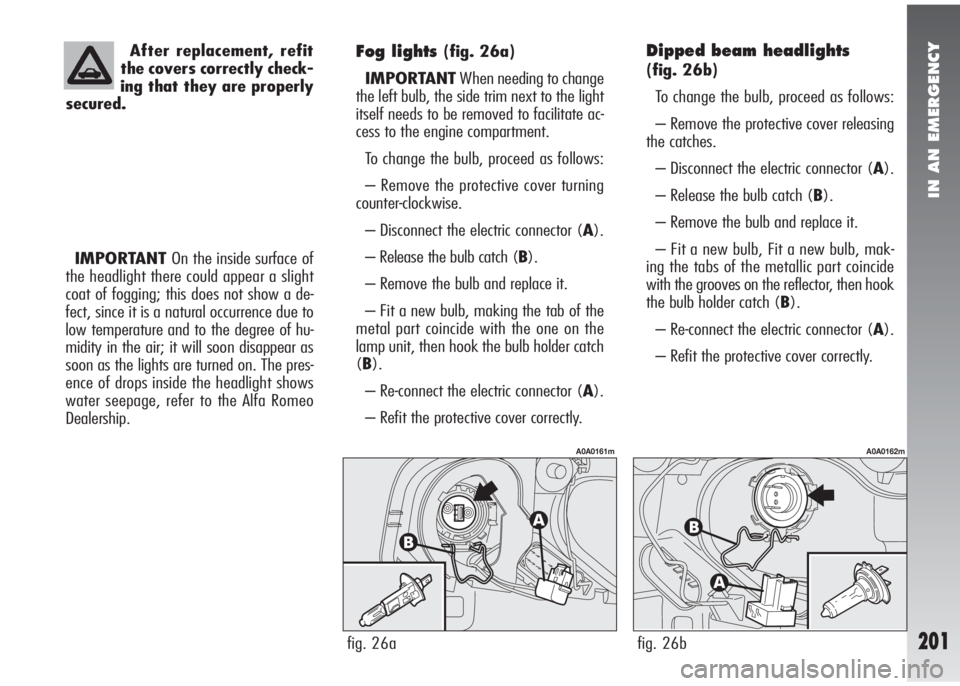
Fog lights(fig. 26a)
IMPORTANTWhen needing to change
the left bulb, the side trim next to the light
itself needs to be removed to facilitate ac-
cess to the engine compartment.
To change the bulb, proceed as follows:
– Remove the protective cover turning
counter-clockwise.
– Disconnect the electric connector (A).
– Release the bulb catch (B).
– Remove the bulb and replace it.
– Fit a new bulb, making the tab of the
metal part coincide with the one on the
lamp unit, then hook the bulb holder catch
(B).
– Re-connect the electric connector (A).
– Refit the protective cover correctly.Dipped beam headlights
(fig. 26b)
To change the bulb, proceed as follows:
– Remove the protective cover releasing
the catches.
– Disconnect the electric connector (A).
– Release the bulb catch (B).
– Remove the bulb and replace it.
– Fit a new bulb, Fit a new bulb, mak-
ing the tabs of the metallic part coincide
with the grooves on the reflector, then hook
the bulb holder catch (B).
– Re-connect the electric connector (A).
– Refit the protective cover correctly.
fig. 26a
A0A0161m
fig. 26b
A0A0162m