ESP Alfa Romeo Brera/Spider 2008 Owner handbook (in English)
[x] Cancel search | Manufacturer: ALFA ROMEO, Model Year: 2008, Model line: Brera/Spider, Model: Alfa Romeo Brera/Spider 2008Pages: 270, PDF Size: 3.93 MB
Page 63 of 270
62
SAFETY
DEVICES
WARNING
LIGHTS AND
MESSAGES
IN AN
EMERGENCY
CAR
MAINTENANCE
TECHNICAL
SPECIFICATIONS
INDEX
DASHBOARD
AND
CONTROLS
CORRECT USE
OF THE CAR
AIR RECIRCULATION AND
AQS FUNCTION
(AIR QUALITY SYSTEM)
ON/OFF (where provided)
Inside air recirculation is controlled ac-
cording to the following operating log-
ics:
❒automatic control, indicated by but-
ton led “A”;
❒forced switching on (inside air recir-
culation always on), indicated by the
turning on of the circular led around
the button;
❒forced switching off (air recirculation
always off with air inlet from the out-
side), indicated by the turning off of
the circular led around the button.
With A.Q.S. (Air Quality System - where
provided), the operating logic is se-
quential when pressing button
v.IMPORTANT The inside air recircula-
tion system makes it possible to reach
the required heating or cooling condi-
tions faster. It is however inadvisable to
use it on rainy/cold days as it would
considerably increase the possibility of
the windows misting inside, especially
if the climate control compressor is off.
It is advisable to turn on the inside air
recirculation system in queues or tunnels
to avoid admitting polluted air from out-
side. The prolonged use of this function
should however be avoided, especially
with several persons on board, to avoid
the possibility of the windows misting
inside and to ensure air change.
In certain weather con-
ditions (e.g. outside
temperature around
0°C) and with automatic air re-
circulation control on, mist may
form on the windows. In this
case press button vto
switch off recirculation and if
necessary press button + to in-
crease the flow of air to the
windscreen.
With the outside tem-
perature below -1°C the
climate control compres-
sor is unable to work. It is
therefore inadvisable to use the
inside air recirculation function
with low outside temperature
as windows may mist over
quickly.
Page 74 of 270
TO INCREASE THE
MEMORISED SPEED
The speed memorised can be increased
in two ways:
❒pressing the accelerator and then
memorising the new speed reached;
or
❒moving the stalk upwards (+).
Each operation of the stalk will corre-
spond to a slight increase in speed
(about 1.5 km/h), while keeping the
stalk upwards will correspond to a con-
tinuous speed increase.
TO REDUCE MEMORISED
SPEED
The speed memorised can be increased
in two ways:
❒disengaging the device and then
memorising the new speed;
or
❒moving the stalk downwards (–) un-
til reaching the new speed which will
be memorised automatically.
Each operation of the stalk will corre-
spond to a slight decrease in speed
(about 1.5 km/h), while keeping the
stalk downwards will correspond to a
continuous speed decrease.
TO RESET THE MEMORISED
SPEED
If the device has been disengaged for
example pressing the brake or clutch
pedal, the memorised speed can be re-
set as follows:
❒accelerate gradually until reaching a
speed approaching the one memo-
rised;
❒engage the gear selected at the time
of speed memorising (4th or high-
er gear);
❒press button RES(set at stalk end).
73
SAFETY
DEVICES
WARNING
LIGHTS AND
MESSAGES
IN AN
EMERGENCY
CAR
MAINTENANCE
TECHNICAL
SPECIFICATIONS
INDEX
DASHBOARD
AND
CONTROLS
CORRECT USE
OF THE CAR
Page 99 of 270
98
SAFETY
DEVICES
WARNING
LIGHTS AND
MESSAGES
IN AN
EMERGENCY
CAR
MAINTENANCE
TECHNICAL
SPECIFICATIONS
INDEX
DASHBOARD
AND
CONTROLS
CORRECT USE
OF THE CARHEADLIGHT AIMING DEVICE
It works with the key fitted into the ig-
nition device and dipped beams on.
When the car is loaded, it slopes back-
wards. This means that the headlight
beam rises. In this case, it is necessary
to return it to the correct position.
In this event, to adjust the headlight
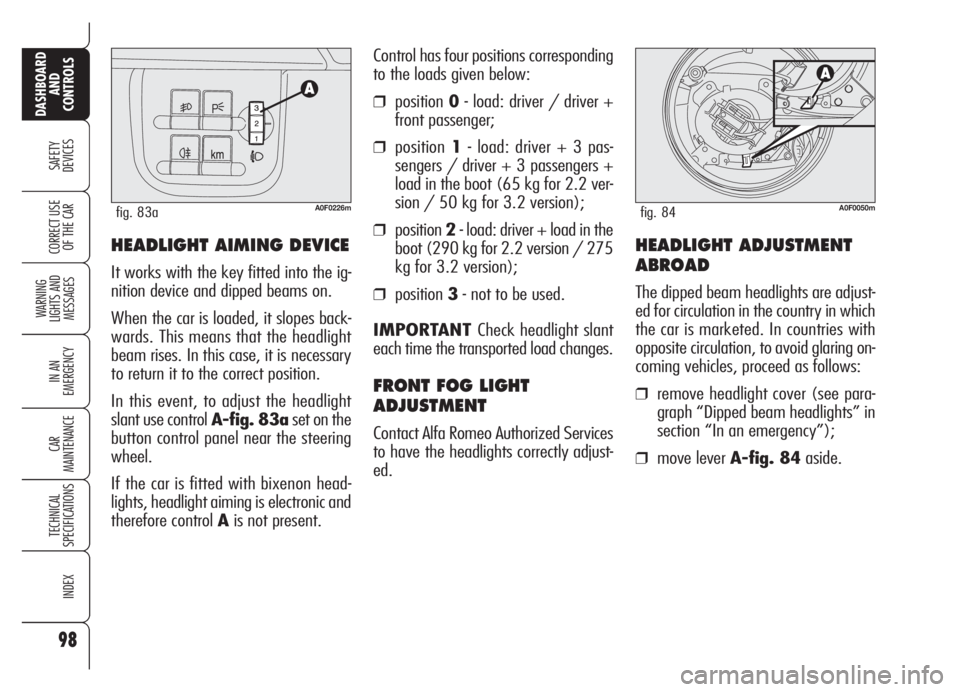
slant use control A-fig. 83aset on the
button control panel near the steering
wheel.
If the car is fitted with bixenon head-
lights, headlight aiming is electronic and
therefore control Ais not present.Control has four positions corresponding
to the loads given below:
❒position0- load: driver / driver +
front passenger;
❒position1- load: driver + 3 pas-
sengers / driver + 3 passengers +
load in the boot (65 kg for 2.2 ver-
sion / 50 kg for 3.2 version);
❒position2- load: driver + load in the
boot (290 kg for 2.2 version / 275
kg for 3.2 version);
❒position3- not to be used.
IMPORTANT Check headlight slant
each time the transported load changes.
FRONT FOG LIGHT
ADJUSTMENT
Contact Alfa Romeo Authorized Services
to have the headlights correctly adjust-
ed.
A0F0226mfig. 83a
HEADLIGHT ADJUSTMENT
ABROAD
The dipped beam headlights are adjust-
ed for circulation in the country in which
the car is marketed. In countries with
opposite circulation, to avoid glaring on-
coming vehicles, proceed as follows:
❒remove headlight cover (see para-
graph “Dipped beam headlights” in
section “In an emergency”);
❒move lever A-fig. 84aside.
A0F0050mfig. 84
Page 102 of 270
101
SAFETY
DEVICES
WARNING
LIGHTS AND
MESSAGES
IN AN
EMERGENCY
CAR
MAINTENANCE
TECHNICAL
SPECIFICATIONS
INDEX
DASHBOARD
AND
CONTROLS
CORRECT USE
OF THE CARTURNING THE VDC SYSTEM
ON/OFF
The VDC system is automatically acti-
vated when the engine is started. When
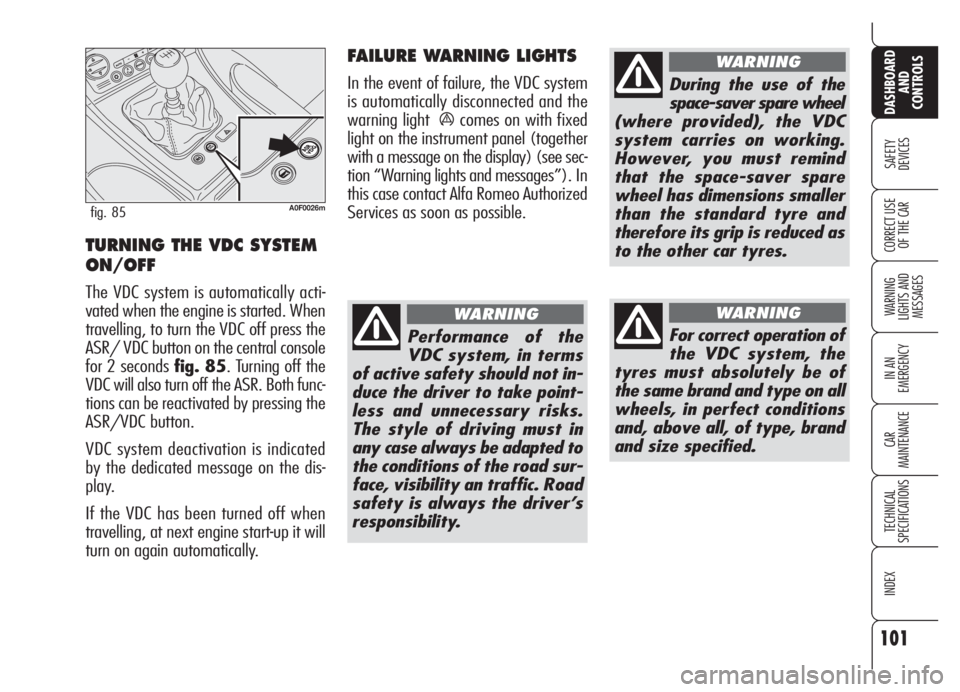
travelling, to turn the VDC off press the
ASR/ VDC button on the central console
for 2 seconds fig. 85. Turning off the
VDC will also turn off the ASR. Both func-
tions can be reactivated by pressing the
ASR/VDC button.
VDC system deactivation is indicated
by the dedicated message on the dis-
play.
If the VDC has been turned off when
travelling, at next engine start-up it will
turn on again automatically.
A0F0026mfig. 85
Performance of the
VDC system, in terms
of active safety should not in-
duce the driver to take point-
less and unnecessary risks.
The style of driving must in
any case always be adapted to
the conditions of the road sur-
face, visibility an traffic. Road
safety is always the driver’s
responsibility.
WARNING
During the use of the
space-saver spare wheel
(where provided), the VDC
system carries on working.
However, you must remind
that the space-saver spare
wheel has dimensions smaller
than the standard tyre and
therefore its grip is reduced as
to the other car tyres.
WARNING
For correct operation of
the VDC system, the
tyres must absolutely be of
the same brand and type on all
wheels, in perfect conditions
and, above all, of type, brand
and size specified.
WARNING
FAILURE WARNING LIGHTS
In the event of failure, the VDC system
is automatically disconnected and the
warning light
ácomes on with fixed
light on the instrument panel (together
with a message on the display) (see sec-
tion “Warning lights and messages”). In
this case contact Alfa Romeo Authorized
Services as soon as possible.
Page 106 of 270
105
SAFETY
DEVICES
WARNING
LIGHTS AND
MESSAGES
IN AN
EMERGENCY
CAR
MAINTENANCE
TECHNICAL
SPECIFICATIONS
INDEX
DASHBOARD
AND
CONTROLS
CORRECT USE
OF THE CAR
RADIO TRANSMITTERS AND
CELLULAR TELEPHONES
Mobile phones and other radio trans-
ceiver equipment (e.g.: HAM radio sys-
tems and the like) shall not be used in-
side the car unless a separate aerial is
mounted.
IMPORTANTThe use of mobile
phones, HAM radio systems or other
similar devices inside the passenger
compartment (without separate aerial)
may cause electronic systems equipping
the car to malfunction. This could com-
promise safety in addition to constitut-
ing a potential hazard for the passen-
gers.
In addition, transmission and reception
of these devices may be affected by the
shielding effect of the car body.
As concerns the use of mobile phones
(GSM, GPRS, UMTS) with homologa-
tion , keep strictly to the mobile
phone manufacturer’s specifications.
ACCESSORIES
PURCHASED
BY THE OWNER
If after buying the car, you decide to in-
stall electrical accessories that require a
permanent electric supply (alarm, satel-
lite antitheft system, etc.) or accessories
that in any case burden the electric sup-
ply, contact Alfa Romeo Authorized Ser-
vices, whose qualified personnel, besides
suggesting the most suitable devices be-
longing to Lineaccessori Alfa Romeo, will
also evaluate the overall electric absorp-
tion, checking whether the car’s electric
system is able to withstand the load re-
quired, or whether it needs to be inte-
grated with a more powerful battery.
Take care when fitting
additional spoilers, al-
loy rims and non-standard
wheel caps: they might reduce
ventilation of the brakes, thus
their efficiency, during abrupt
and repeated braking, or long
downhill slopes. Make sure
that nothing (mats, etc.) gets
in the way of the pedals when
they are pushed down.
WARNING
INSTALLATION OF
ELECTRIC/ELECTRONIC
DEVICES
Electric/electronic devices installed af-
ter buying the car or in aftermarket shall
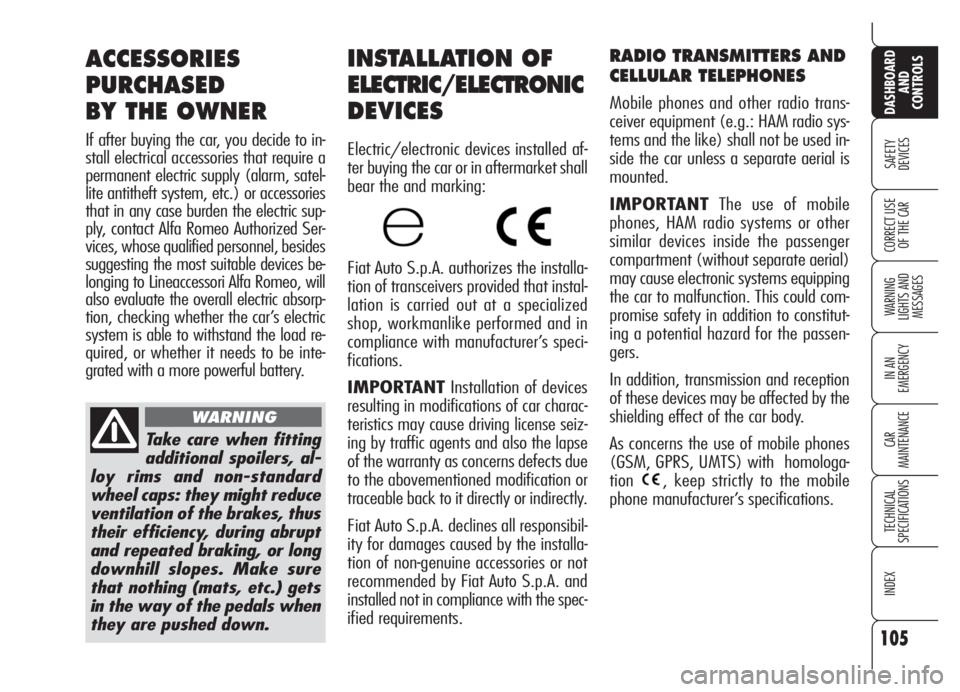
bear the and marking:
Fiat Auto S.p.A. authorizes the installa-
tion of transceivers provided that instal-
lation is carried out at a specialized
shop, workmanlike performed and in
compliance with manufacturer’s speci-
fications.
IMPORTANTInstallation of devices
resulting in modifications of car charac-
teristics may cause driving license seiz-
ing by traffic agents and also the lapse
of the warranty as concerns defects due
to the abovementioned modification or
traceable back to it directly or indirectly.
Fiat Auto S.p.A. declines all responsibil-
ity for damages caused by the installa-
tion of non-genuine accessories or not
recommended by Fiat Auto S.p.A. and
installed not in compliance with the spec-
ified requirements.
Page 107 of 270
106
SAFETY
DEVICES
WARNING
LIGHTS AND
MESSAGES
IN AN
EMERGENCY
CAR
MAINTENANCE
TECHNICAL
SPECIFICATIONS
INDEX
DASHBOARD
AND
CONTROLS
CORRECT USE
OF THE CAR
PARKING SENSORS
(where provided)
Parking sensors inform the driver about
the presence of obstacles behind the car.
This system is therefore an aid for the
driver when parking the car since it de-
tects obstacles out of the driver’s sight
range.
The presence and the distance from the
car of an obstacle is indicated by a warn-
ing buzzer - as the distance from the ob-
stacle decreases, the acoustic alarm be-
comes more frequent.
Parking manoeuvres
however are always
under the driver’s responsibil-
ity that shall always check the
absence of people (specially
children) or animals in the ma-
noeuvre space. This system is
just a help for the driver but
she/he shall never reduce at-
tention during dangerous ma-
noeuvres even if performed at
low speed.
WARNINGACTIVATION
Sensors are activated automatically,
with electronic key fitted into the igni-
tion device, when the reverse gear is en-
gaged.
Sensors will deactivate when exceeding
18 km/h.
When sensors are on, rear indicators will
sound warning signals as soon as an ob-
stacle is detected: as the distance from
the obstacle decreases, the acoustic
alarm becomes more frequent.
When the distance between the car and
the obstacle is less than 30 cm, the
acoustic alarm becomes continuous.
The acoustic alarm will stop immediately
as distance raises. The acoustic alarm is
constant if the distance measured by
central sensors is unvaried, whereas if
this situation takes place for side sen-
sors the acoustic alarm is muted after
about 3 seconds to prevent sound indi-
cations when performing manoeuvres
near walls.
Page 142 of 270
141
SAFETY
DEVICES
WARNING
LIGHTS AND
MESSAGES
IN AN
EMERGENCY
CAR
MAINTENANCE
TECHNICAL
SPECIFICATIONS
INDEX
DASHBOARD
AND
CONTROLS
CORRECT USE
OF THE CAR
STOPPING THE ENGINE
With car stopped press button
START/STOP. When the engine is off
it will be possible to remove the electronic
key from the ignition device.
In an emergency and
also for safety rea-
sons, it is possible to kill the
engine while the car is running
by pressing repeatedly (three
times in 2 seconds) or keeping
pressed the START/STOP but-
ton for a few seconds. In this
case the power steering is no
longer available.
WARNING
IMPORTANTTurning the car off will
deactivate the electronic safety systems
and turn off the external lights.
IMPORTANTKilling the engine while
the car is running, due to safety reasons,
it will not be possible to take the elec-
tronic key out of the ignition device. To
remove it, turn the instrument panel on
and off by pressing button
START/STOPwith brake pedal (or
clutch pedal) released and car stopped. A quick burst on the ac-
celerator before turning
off the engine serves
absolutely no practical purpose,
it wastes fuel and is damaging
especially to turbocharged en-
gines.
IMPORTANTAfter a taxing drive, you
should allow the engine to “catch its
breath” before turning it off by letting it
idle to allow the temperature in the en-
gine compartment to fall.
Page 146 of 270
145
SAFETY
DEVICES
WARNING
LIGHTS AND
MESSAGES
IN AN
EMERGENCY
CAR
MAINTENANCE
TECHNICAL
SPECIFICATIONS
INDEX
DASHBOARD
AND
CONTROLS
CORRECT USE
OF THE CAR
Climate control
The air conditioner is an additional load
which greatly affects the engine leading
to higher consumption. When the tem-
perature outside the car permits it, use
the air vents where possible.
Spoilers
The use of aerodynamic optional extras
which are not certified for the specific
use on the vehicle, may reduce the aero-
dynamic penetration of the vehicle and
increase consumption. Unnecessary loads
Do not travel with too much luggage
stowed in the boot. The weight of the
car (especially when driving in town)
and its trim greatly affects consumption
and stability.
Roof rack/ski rack
Remove the roof rack or the ski rack
from the roof as soon as they are no
longer used. These accessories lower air
penetration and adversely affect con-
sumption levels. When needing to car-
ry particularly voluminous objects, prefer-
ably use a trailer.
Electric devices
Use electric devices only for the amount
of time needed. Rear heated window,
additional headlights, windscreen wipers
and heater fan need a considerable
amount of energy therefore, increasing
the requirement of current increases fu-
el consumption (up to +25% in the ur-
ban cycle).CONTAINING
RUNNING COSTS
Here are some suggestions which may
help you to keep the running costs of
your car down and lower the amount of
toxic emissions released into the at-
mosphere.
GENERAL CONSIDERATIONS
Car maintenance
Have checks and adjustments carried out
in accordance with the “Service sched-
ule”.
Tyres
Check the pressure of the tyres routine-
ly at an interval of no more than 4
weeks: if the pressure is too low, con-
sumption levels increase as resistance
to rolling is higher.
Page 172 of 270
171
SAFETY
DEVICES
WARNING
LIGHTS AND
MESSAGES
IN AN
EMERGENCY
CAR
MAINTENANCE
TECHNICAL
SPECIFICATIONS
INDEX
DASHBOARD
AND
CONTROLS
CORRECT USE
OF THE CAR
IF A TYRE
IS PUNCTURED
The car is equipped with the “Quick tyre
repair kit Fix&Go automatic“. Opera-
tions required to change a wheel are de-
scribed in the following section.
As an alternative to the “Kit Fix & Go
automatic”, the car can be provided (up-
on request) with space-saver spare
wheel: wheel changing and correct use
of the jack call for some precautions as
listed below.
BUMP STARTING
Never bump start the engine (by push-
ing, towing, or coasting downhill) as this
could cause fuel to flow into the catalytic
exhaust system and damage it beyond
repair.
Remember that the
brake booster and the
power steering system are not
operating until the engine is
started, a greater effort will
therefore be required to press
the brake pedal or turn the
steering wheel.
WARNING
Alert other drivers that
the car is stationary in
compliance with local regula-
tions: hazard warning lights,
warning triangle etc. Any pas-
sengers on board should leave
the car, especially if it is heav-
ily laden. Passengers should
stay away from oncoming
traffic while the wheel is be-
ing changed on. If the wheel is
being changed on a steep or
badly surfaced road, place the
wedges or other suitable ma-
terial under the wheel to stop
the car. Never start the engine
when the car is jacked up. If
you were towing a trailer, un-
couple the trailer before jack-
ing the car.
WARNING
Page 181 of 270
❒after reaching the tyre pressure spec-
ified in paragraph “Wheels” in sec-
tion “Technical Specifications”, start
driving immediately;
180
SAFETY
DEVICES
WARNING
LIGHTS AND
MESSAGES
IN AN
EMERGENCY
CAR
MAINTENANCE
TECHNICAL
SPECIFICATIONS
INDEX
DASHBOARD
AND
CONTROLS
CORRECT USE
OF THE CAR
Apply the sticker in a
visible position for the
driver to indicate that the tyre
has been treated with the
quick tyre repair kit. Drive
carefully especially when cor-
nering and do not exceed 80
km/h. Avoid heavy braking
and accelerating.
WARNING
You shall absolutely
communicate that the
tyre has been repaired with
the quick tyre repair kit. Hand
the instruction brochure to the
personnel charged with treat-
ing the tyre repaired with the
kit.
WARNING
If pressure falls below
1.8 bar, stop the car
since the tyre is excessively
damaged and the quick tyre
repair kit Fix & Go automatic
cannot guarantee suitable
sealing. Contact Alfa Romeo
Authorized Services.
WARNING
❒after driving for about 10 minutes
stop and check again the tyre pres-
sure;pull up the handbrake;❒if at least 1.8 bar pressure is read,
restore proper pressure (with engine
running and handbrake on) and
restart;
❒drive with the utmost care to the
nearest Alfa Romeo Authorized
Service.