belt Alfa Romeo Brera/Spider 2008 Owner handbook (in English)
[x] Cancel search | Manufacturer: ALFA ROMEO, Model Year: 2008, Model line: Brera/Spider, Model: Alfa Romeo Brera/Spider 2008Pages: 270, PDF Size: 3.93 MB
Page 123 of 270
122
SAFETY
DEVICES
WARNING
LIGHTS AND
MESSAGES
IN AN
EMERGENCY
CAR
MAINTENANCE
TECHNICAL
SPECIFICATIONS
INDEX
DASHBOARD
AND
CONTROLS
CORRECT USE
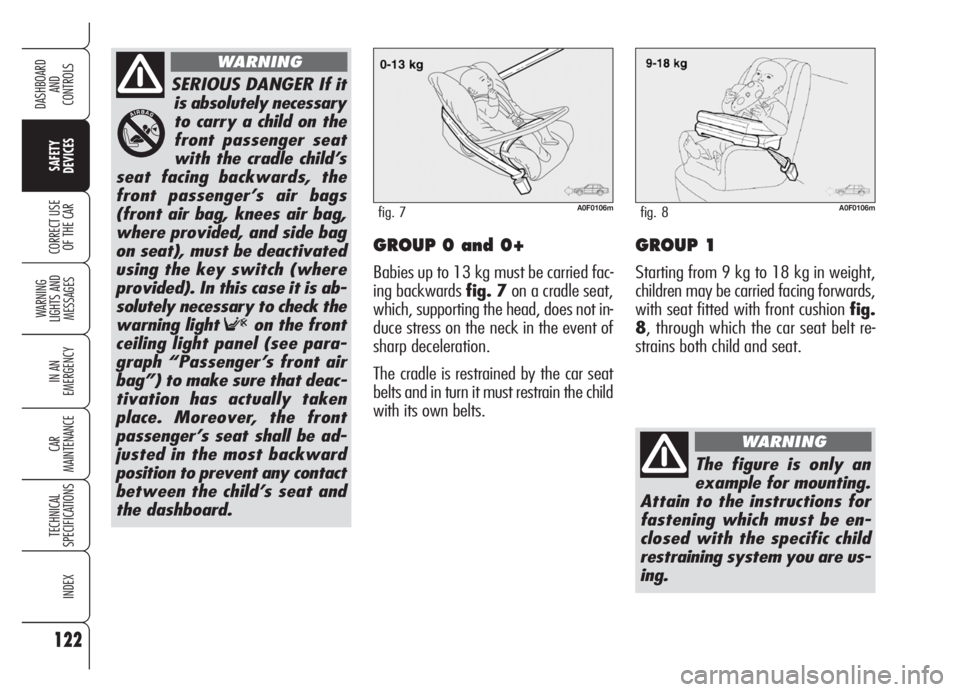
OF THE CARGROUP 0 and 0+
Babies up to 13 kg must be carried fac-
ing backwards fig. 7on a cradle seat,
which, supporting the head, does not in-
duce stress on the neck in the event of
sharp deceleration.
The cradle is restrained by the car seat
belts and in turn it must restrain the child
with its own belts.
SERIOUS DANGER If it
is absolutely necessary
to carry a child on the
front passenger seat
with the cradle child’s
seat facing backwards, the
front passenger’s air bags
(front air bag, knees air bag,
where provided, and side bag
on seat), must be deactivated
using the key switch (where
provided). In this case it is ab-
solutely necessary to check the
warning light
Fon the front
ceiling light panel (see para-
graph “Passenger’s front air
bag”) to make sure that deac-
tivation has actually taken
place. Moreover, the front
passenger’s seat shall be ad-
justed in the most backward
position to prevent any contact
between the child’s seat and
the dashboard.
WARNING
A0F0106mfig. 7
The figure is only an
example for mounting.
Attain to the instructions for
fastening which must be en-
closed with the specific child
restraining system you are us-
ing.
WARNING
A0F0106mfig. 8
GROUP 1
Starting from 9 kg to 18 kg in weight,
children may be carried facing forwards,
with seat fitted with front cushion fig.
8, through which the car seat belt re-
strains both child and seat.
Page 124 of 270
123
Ù
SAFETY
DEVICES
WARNING
LIGHTS AND
MESSAGES
IN AN
EMERGENCY
CAR
MAINTENANCE
TECHNICAL
SPECIFICATIONS
INDEX
DASHBOARD
AND
CONTROLS
CORRECT USE
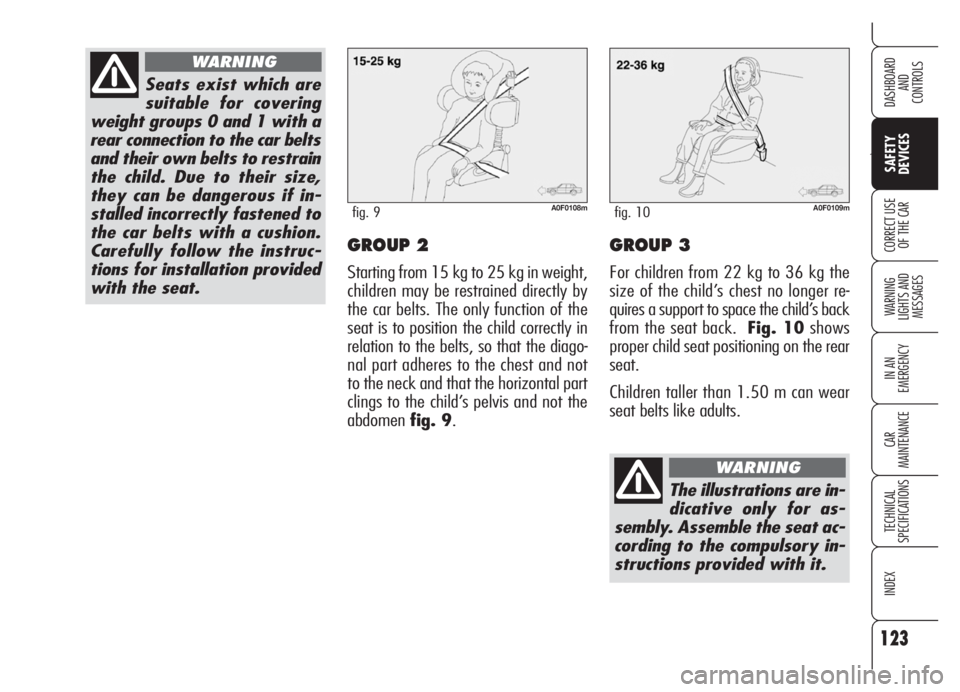
OF THE CARGROUP 2
Starting from 15 kg to 25 kg in weight,
children may be restrained directly by
the car belts. The only function of the
seat is to position the child correctly in
relation to the belts, so that the diago-
nal part adheres to the chest and not
to the neck and that the horizontal part
clings to the child’s pelvis and not the
abdomenfig. 9.
GROUP 3
For children from 22 kg to 36 kg the
size of the child’s chest no longer re-
quires a support to space the child’s back
from the seat back.Fig. 10shows
proper child seat positioning on the rear
seat.
Children taller than 1.50 m can wear
seat belts like adults.
Seats exist which are
suitable for covering
weight groups 0 and 1 with a
rear connection to the car belts
and their own belts to restrain
the child. Due to their size,
they can be dangerous if in-
stalled incorrectly fastened to
the car belts with a cushion.
Carefully follow the instruc-
tions for installation provided
with the seat.
WARNING
A0F0108mfig. 9A0F0109mfig. 10
The illustrations are in-
dicative only for as-
sembly. Assemble the seat ac-
cording to the compulsory in-
structions provided with it.
WARNING
Page 126 of 270
125
Ù
SAFETY
DEVICES
WARNING
LIGHTS AND
MESSAGES
IN AN
EMERGENCY
CAR
MAINTENANCE
TECHNICAL
SPECIFICATIONS
INDEX
DASHBOARD
AND
CONTROLS
CORRECT USE
OF THE CAR
❒always check the seat belt is well
fastened by pulling the webbing;
❒only one child is to be strapped to
each retaining system;
❒always check the seat belts do not
fit around the child’s throat;
❒while travelling, do not let the child
sit incorrectly or release the belts;
❒passengers should never carry chil-
dren on their laps. No-one, howev-
er strong they are, can hold a child
in the event of a crash;
❒in case of an accident, replace the
seat with a new one. Below is a summary of the
rules of safety to be followed
for carrying children:
❒the recommended position for in-
stalling child’s seat is on the rear
seat, as it is the most protected in
the case of a crash;
❒if the passenger’s air bag is deacti-
vatedalwayscheck that the
warning light
Fon the front ceil-
ing light panel is glowing steadily to
indicate that the air bag has been
deactivated;
❒attain to the instructions for fasten-
ing the specific child restraint system
which you are using. These instruc-
tions must be provided by the man-
ufacturer. Keep the child restraint sys-
tem installation instructions with the
car documents and this Handbook.
Never use a child restraint system
without installation instructions;
With passenger’s air
bag active, never place
child’s seats with the cradle
facing backwards since the air
bag activation could cause to
the child serious injuries, even
mortal, regardless of the seri-
ousness of the crash that trig-
gered it. You are advised to
carry children always with
proper restraint systems on
the rear seats, as this is the
most protected position in the
case of a crash.
WARNING
Page 127 of 270
126
SAFETY
DEVICES
WARNING
LIGHTS AND
MESSAGES
IN AN
EMERGENCY
CAR
MAINTENANCE
TECHNICAL
SPECIFICATIONS
INDEX
DASHBOARD
AND
CONTROLS
CORRECT USE
OF THE CAR
Mount the child restraint
system only with the car
stationary. The Universal Isofix
child restraint system is proper-
ly anchored to the mounting
brackets when clicks are heard.
In any case, keep to the instal-
lation instructions that must be
provided by the child restraint
system Manufacturer.
WARNING
PRESETTING FOR
MOUNTING THE
“UNIVERSAL ISOFIX”
CHILD RESTRAINT
SYSTEM
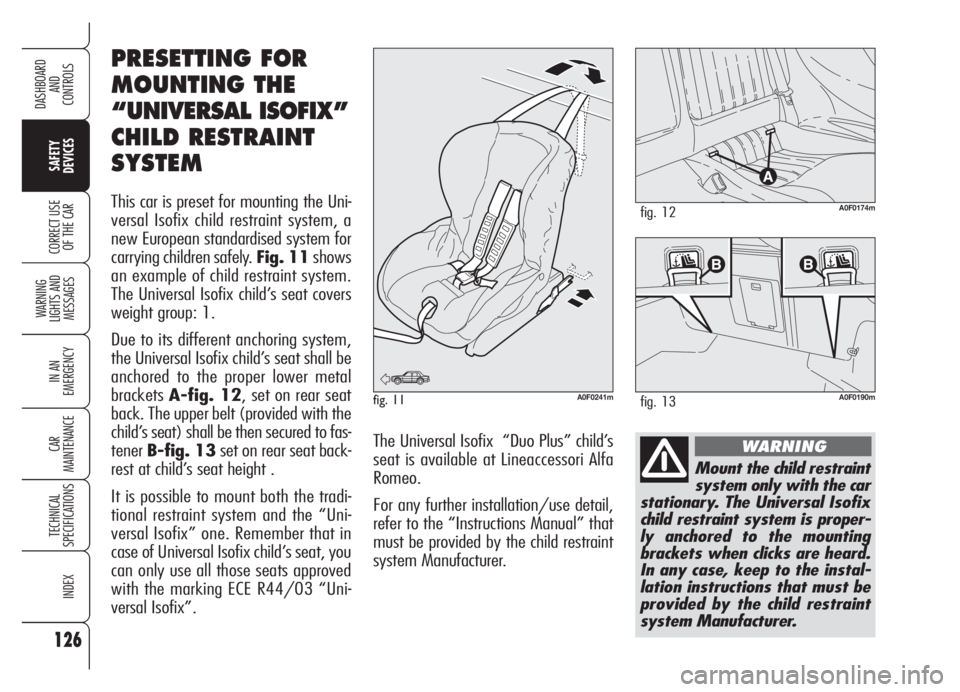
This car is preset for mounting the Uni-
versal Isofix child restraint system, a
new European standardised system for
carrying children safely. Fig. 11shows
an example of child restraint system.
The Universal Isofix child’s seat covers
weight group: 1.
Due to its different anchoring system,
the Universal Isofix child’s seat shall be
anchored to the proper lower metal
bracketsA-fig. 12, set on rear seat
back. The upper belt (provided with the
child’s seat) shall be then secured to fas-
tenerB-fig. 13set on rear seat back-
rest at child’s seat height .
It is possible to mount both the tradi-
tional restraint system and the “Uni-
versal Isofix” one. Remember that in
case of Universal Isofix child’s seat, you
can only use all those seats approved
with the marking ECE R44/03 “Uni-
versal Isofix”.The Universal Isofix “Duo Plus” child’s
seat is available at Lineaccessori Alfa
Romeo.
For any further installation/use detail,
refer to the “Instructions Manual” that
must be provided by the child restraint
system Manufacturer.A0F0174mfig. 12
fig. 11A0F0241mA0F0190mfig. 13
Page 129 of 270
128
SAFETY
DEVICES
WARNING
LIGHTS AND
MESSAGES
IN AN
EMERGENCY
CAR
MAINTENANCE
TECHNICAL
SPECIFICATIONS
INDEX
DASHBOARD
AND
CONTROLS
CORRECT USE
OF THE CAR
FRONT AIR BAGS
The car is fitted with front multistage air
bags (“Smart bags”) for the driver and
the passenger and with knees air bag
for the driver and for the passenger
(where provided).The front air bags (driver and passen-
ger) and knees air bags (driver and pas-
senger) are not a replacement of but
complementary to the use of belts,
which should always be worn, as spec-
ified by law in Europe and most non Eu-
ropean countries.
In case of crash, a person not wearing
the seat belt moves forward and may
come into contact with the cushion while
it is still inflating. Under this circum-
stance the protection offered by the air
bag is reduced.
“SMART BAG” SYSTEM
(FRONT MULTISTAGE AIR
BAGS)
The front air bags (driver and passen-
ger) and knees air bags (driver and pas-
senger) have been designed to protect
the occupants in the event of head-on
crashes of medium-high severity, by plac-
ing cushions between the occupant and
the steering wheel or dashboard.
In case of crash, an electronic control
unit, when required, triggers the infla-
tion of the cushions that inflate, as a pro-
tection, between the body of the front
occupants and the structure that could
cause injuries. Immediately after, the
cushions deflate.
Page 130 of 270
129
Ù
SAFETY
DEVICES
WARNING
LIGHTS AND
MESSAGES
IN AN
EMERGENCY
CAR
MAINTENANCE
TECHNICAL
SPECIFICATIONS
INDEX
DASHBOARD
AND
CONTROLS
CORRECT USE
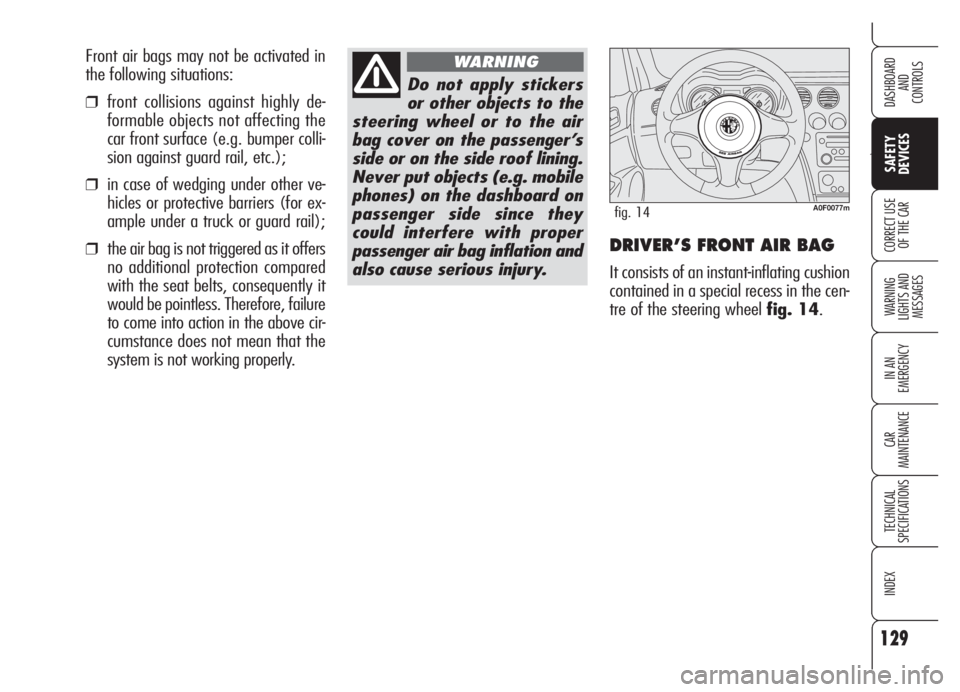
OF THE CARDRIVER’S FRONT AIR BAG
It consists of an instant-inflating cushion
contained in a special recess in the cen-
tre of the steering wheelfig. 14. Front air bags may not be activated in
the following situations:
❒front collisions against highly de-
formable objects not affecting the
car front surface (e.g. bumper colli-
sion against guard rail, etc.);
❒in case of wedging under other ve-
hicles or protective barriers (for ex-
ample under a truck or guard rail);
❒the air bag is not triggered as it offers
no additional protection compared
with the seat belts, consequently it
would be pointless. Therefore, failure
to come into action in the above cir-
cumstance does not mean that the
system is not working properly.
Do not apply stickers
or other objects to the
steering wheel or to the air
bag cover on the passenger’s
side or on the side roof lining.
Never put objects (e.g. mobile
phones) on the dashboard on
passenger side since they
could interfere with proper
passenger air bag inflation and
also cause serious injury.
WARNING
A0F0077mfig. 14
Page 133 of 270
132
SAFETY
DEVICES
WARNING
LIGHTS AND
MESSAGES
IN AN
EMERGENCY
CAR
MAINTENANCE
TECHNICAL
SPECIFICATIONS
INDEX
DASHBOARD
AND
CONTROLS
CORRECT USE
OF THE CAR
❒passenger’s front air bag, knees air
bag (where provided) and side bag
deactivated (positionOFFF):
warning light Fon front ceiling
light panel on; it is possible to carry
a child protected by special restraint
systems on the front seat.
The warning light Fon front ceiling
light panel stays on permanently until
the passenger’s air bags are reactivat-
ed.
Passenger’s air bags deactivation will
not inhibit the operation of the Window
Bag.SIDE AIR BAGS
(Side bag -
Window bag)
The car is fitted with front side bags for
driver and passenger for protecting the
chest and window bags for protecting front
and rear occupant’s head.
Side bags protect car occupants from
side crashes of medium-high severity, by
placing the cushion between the occu-
pant and the internal parts of the side
structure of the car.
Non-activation of side bags in other
types of collisions (front collisions, rear
shunts, roll-overs, etc...) is not a system
malfunction.In case of side crash, an electronic con-
trol unit, when required triggers the in-
flation of the cushion. The cushion im-
mediately inflates, placing itself as a pro-
tection, between the occupant’s body
and the structure that could cause in-
juries. Immediately after, the cushion de-
flates.
Side air bags are not a replacement of
but complementary to the belts, which
you are recommended to always wear,
as specified by law in Europe and most
non-European countries.
Page 134 of 270
133
Ù
SAFETY
DEVICES
WARNING
LIGHTS AND
MESSAGES
IN AN
EMERGENCY
CAR
MAINTENANCE
TECHNICAL
SPECIFICATIONS
INDEX
DASHBOARD
AND
CONTROLS
CORRECT USE
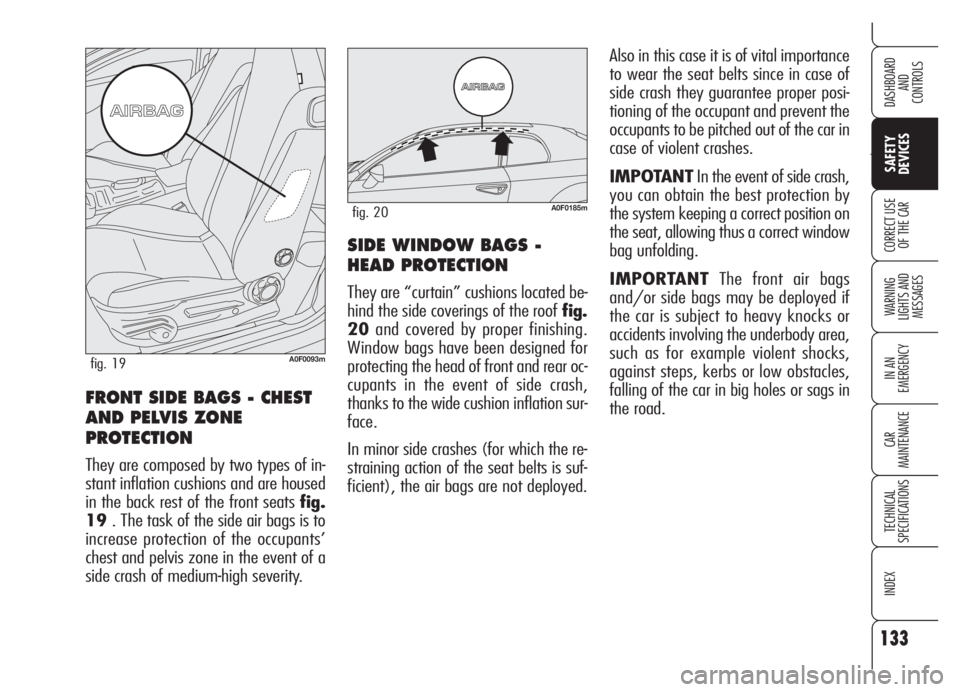
OF THE CARSIDE WINDOW BAGS -
HEAD PROTECTION
They are “curtain” cushions located be-
hind the side coverings of the roof fig.
20and covered by proper finishing.
Window bags have been designed for
protecting the head of front and rear oc-
cupants in the event of side crash,
thanks to the wide cushion inflation sur-
face.
In minor side crashes (for which the re-
straining action of the seat belts is suf-
ficient), the air bags are not deployed.Also in this case it is of vital importance
to wear the seat belts since in case of
side crash they guarantee proper posi-
tioning of the occupant and prevent the
occupants to be pitched out of the car in
case of violent crashes.
IMPOTANTIn the event of side crash,
you can obtain the best protection by
the system keeping a correct position on
the seat, allowing thus a correct window
bag unfolding.
IMPORTANTThe front air bags
and/or side bags may be deployed if
the car is subject to heavy knocks or
accidents involving the underbody area,
such as for example violent shocks,
against steps, kerbs or low obstacles,
falling of the car in big holes or sags in
the road.
FRONT SIDE BAGS - CHEST
AND PELVIS ZONE
PROTECTION
They are composed by two types of in-
stant inflation cushions and are housed
in the back rest of the front seats fig.
19. The task of the side air bags is to
increase protection of the occupants’
chest and pelvis zone in the event of a
side crash of medium-high severity.
A0F0093mfig. 19
A0F0185mfig. 20
Page 137 of 270
136
SAFETY
DEVICES
WARNING
LIGHTS AND
MESSAGES
IN AN
EMERGENCY
CAR
MAINTENANCE
TECHNICAL
SPECIFICATIONS
INDEX
DASHBOARD
AND
CONTROLS
CORRECT USE
OF THE CAR
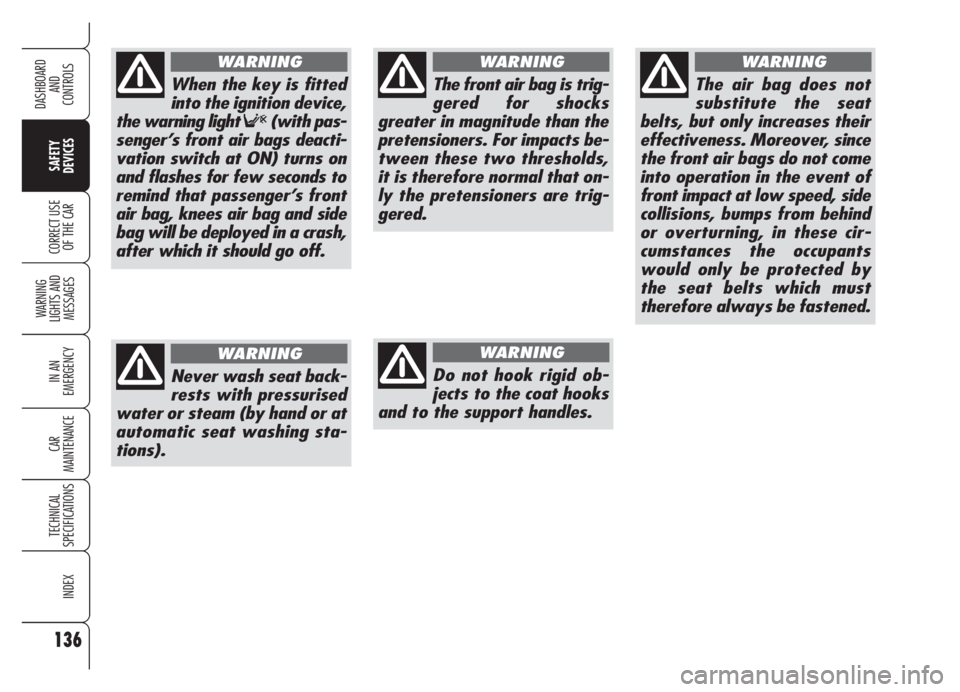
The front air bag is trig-
gered for shocks
greater in magnitude than the
pretensioners. For impacts be-
tween these two thresholds,
it is therefore normal that on-
ly the pretensioners are trig-
gered.
WARNING
Do not hook rigid ob-
jects to the coat hooks
and to the support handles.
WARNING
The air bag does not
substitute the seat
belts, but only increases their
effectiveness. Moreover, since
the front air bags do not come
into operation in the event of
front impact at low speed, side
collisions, bumps from behind
or overturning, in these cir-
cumstances the occupants
would only be protected by
the seat belts which must
therefore always be fastened.
WARNING
Never wash seat back-
rests with pressurised
water or steam (by hand or at
automatic seat washing sta-
tions).
WARNING
When the key is fitted
into the ignition device,
the warning light
F(with pas-
senger’s front air bags deacti-
vation switch at ON) turns on
and flashes for few seconds to
remind that passenger’s front
air bag, knees air bag and side
bag will be deployed in a crash,
after which it should go off.
WARNING
Page 154 of 270
153
SAFETY
DEVICES
WARNING
LIGHTS AND
MESSAGES
IN AN
EMERGENCY
CAR
MAINTENANCE
TECHNICAL
SPECIFICATIONS
INDEX
DASHBOARD
AND
CONTROLS
CORRECT USE
OF THE CAR
W W
A A
R R
N N
I I
N N
G G
L L
I I
G G
H H
T T
S S
A A
N N
D D
M M
E E
S S
S S
A A
G G
E E
S S
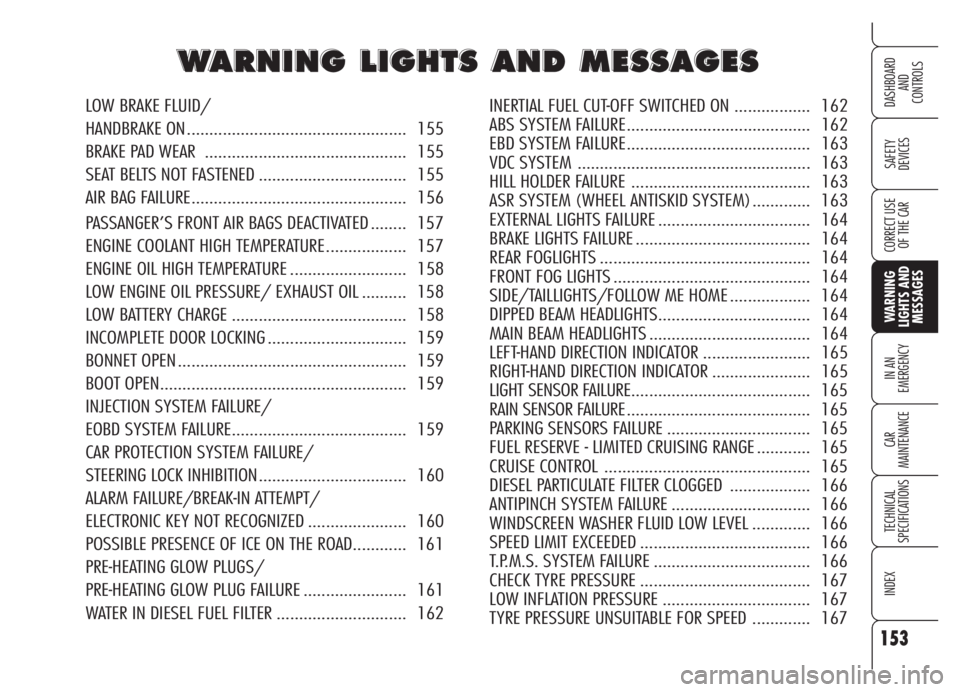
LOW BRAKE FLUID/
HANDBRAKE ON ................................................. 155
BRAKE PAD WEAR ............................................. 155
SEAT BELTS NOT FASTENED ................................. 155
AIR BAG FAILURE................................................ 156
PASSANGER’S FRONT AIR BAGS DEACTIVATED ........ 157
ENGINE COOLANT HIGH TEMPERATURE.................. 157
ENGINE OIL HIGH TEMPERATURE .......................... 158
LOW ENGINE OIL PRESSURE/ EXHAUST OIL .......... 158
LOW BATTERY CHARGE ....................................... 158
INCOMPLETE DOOR LOCKING ............................... 159
BONNET OPEN ................................................... 159
BOOT OPEN....................................................... 159
INJECTION SYSTEM FAILURE/
EOBD SYSTEM FAILURE....................................... 159
CAR PROTECTION SYSTEM FAILURE/
STEERING LOCK INHIBITION................................. 160
ALARM FAILURE/BREAK-IN ATTEMPT/
ELECTRONIC KEY NOT RECOGNIZED ...................... 160
POSSIBLE PRESENCE OF ICE ON THE ROAD............ 161
PRE-HEATING GLOW PLUGS/
PRE-HEATING GLOW PLUG FAILURE ....................... 161
WATER IN DIESEL FUEL FILTER ............................. 162INERTIAL FUEL CUT-OFF SWITCHED ON ................. 162
ABS SYSTEM FAILURE......................................... 162
EBD SYSTEM FAILURE......................................... 163
VDC SYSTEM .................................................... 163
HILL HOLDER FAILURE ........................................ 163
ASR SYSTEM (WHEEL ANTISKID SYSTEM) ............. 163
EXTERNAL LIGHTS FAILURE .................................. 164
BRAKE LIGHTS FAILURE ....................................... 164
REAR FOGLIGHTS ............................................... 164
FRONT FOG LIGHTS ............................................ 164
SIDE/TAILLIGHTS/FOLLOW ME HOME .................. 164
DIPPED BEAM HEADLIGHTS.................................. 164
MAIN BEAM HEADLIGHTS .................................... 164
LEFT-HAND DIRECTION INDICATOR ........................ 165
RIGHT-HAND DIRECTION INDICATOR ...................... 165
LIGHT SENSOR FAILURE........................................ 165
RAIN SENSOR FAILURE......................................... 165
PARKING SENSORS FAILURE ................................ 165
FUEL RESERVE - LIMITED CRUISING RANGE ............ 165
CRUISE CONTROL .............................................. 165
DIESEL PARTICULATE FILTER CLOGGED .................. 166
ANTIPINCH SYSTEM FAILURE ............................... 166
WINDSCREEN WASHER FLUID LOW LEVEL ............. 166
SPEED LIMIT EXCEEDED ...................................... 166
T.P.M.S. SYSTEM FAILURE ................................... 166
CHECK TYRE PRESSURE ...................................... 167
LOW INFLATION PRESSURE ................................. 167
TYRE PRESSURE UNSUITABLE FOR SPEED ............. 167