belt Alfa Romeo GT 2007 Owner handbook (in English)
[x] Cancel search | Manufacturer: ALFA ROMEO, Model Year: 2007, Model line: GT, Model: Alfa Romeo GT 2007Pages: 271, PDF Size: 5.57 MB
Page 36 of 271

GETTING TO KNOW YOUR CAR
34
GROUP 2 (fig. 45)
Starting from 15 to 25 kg in weight, chil-
dren may be restrained directly by the car
seat belts.
Child seats only have the function of po-
sitioning the child correctly in relation to the
belts, so that the diagonal part adheres to
the chest and never to the neck and that the
horizontal part adheres to the child’s pelvis
and not to the abdomen.
GROUP 3 (fig. 46)
For children from 22 up to 36 kg the
child’s chest is thick enough not to need the
spacer back rest anymore.
The figure shows proper child seat posi-
tioning on the rear seat.
Over 1.50 m in height, children may wear
seat belts like adults.The illustration is indica-
tive only for assembly. As-
semble the seat according
to the compulsory instructions pro-
vided with it.
fig. 45
A0A0661b
fig. 46
A0A0662b
Page 38 of 271
GETTING TO KNOW YOUR CAR
36
Below is a summary of the rules
of safety to be followed for car-
rying children:
– The recommended position for installing
a child’s seat is on the rear seat, as it is the
most protected in the event of a crash.
– If the passenger’s air bag is deactivated
alwayscheck warning light
Fon the
cluster to make sure that it has actually been
deactivated.
– Carefully follow the instructions provid-
ed with the child’s seat, which the supplier
is obliged to attach. Keep them in the car
together with the documents and this book-
let. Do not use used seats without the in-
structions for use.
– Always pull the tape to check that belts
are buckled.
Never place cradle child’s
seats facing backwards on
the front passenger seat of
cars fitted with passenger’s air bag
since the air bag activation could
cause serious injuries, even mortal.
You are advised to carry children
always on the rear seat, as this is
the most protected position in the
case of a crash.– All restraint systems are strictly for one
child only: never use for two children at the
same time.
– Always make sure that the belts do not
rest on the child’s neck.
– During the journey, do not allow the
child to stay in abnormal positions or release
the belts.
– Do not carry children in your arms, not
even small babies. No-one, however strong,
can keep hold od them in a crash.
– In the case of accidents, replace the
child’s seat with a new one.
PRESETTING FOR
MOUNTING
“ISOFIX TYPE” CHILD
RESTRAINT SYSTEM
The rear seat of your car is preset for
mounting the Isofix type child restraint sys-
tem, a new European standardised system
for carrying children safely. Isofix type child
restraint system is an additional option that
does not prevent from using traditional child
restraint systems. Isofix type child restraint
system covers three weight groups: 0, 0+
and 1.
Due to its different anchoring system, the
Isofix child’ seat shall be anchored just us-
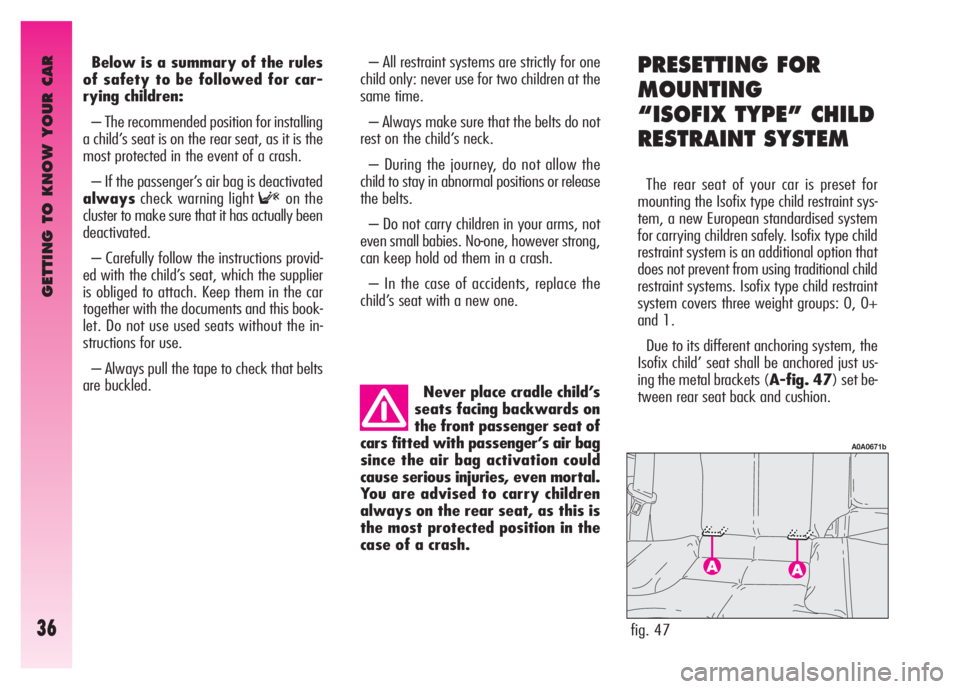
ing the metal brackets (A-fig. 47) set be-
tween rear seat back and cushion.
fig. 47
A0A0671b
Page 39 of 271

GETTING TO KNOW YOUR CAR
37
Mount the child restraint
system only with the car
stationary. The Isofix child
restraint system is properly an-
chored to the mounting brackets
when clicks are heard. In any case,
keep to the installation instructions
that must be provided by the child
restraint system Manufacturer.– push the child restraint system until hear-
ing the locking clicks;
– check proper locking by moving the
child’s seat with force: the built-in safety
mechanism actually inhibits proper coupling
with only one coupling locked.
It is actually possible to mount both the
traditional restraint system and the Isofix
one, e.g. the traditional one on the left and
the Isofix type seat on the right.
Since sizes are different, on the rear seats
it is possible to install just two traditional
child’s seats, or two Isofix type seats. On
the front passenger seat it is only possible
to mount traditional child’s seats.
Only Isofix type child restraint systems de-
signed and tested for this car must be used.
fig. 48
A0A0663b
MOUNTING THE ISOFIX TYPE
CHILD’S SEAT
Groups 0 and 0+
For children of the 0 and 0+ group (ba-
bies up to 13 Kg), the child’s seat is facing
backwards and the child is restrained by the
child’s seat belts(D-fig. 48).
As the child grows, passing to weight group
1, the child’s seat shall be fitted facing for-
wards.
For proper mounting proceed as follows:
– check whether the release lever (B) is
at rest position (inward);
– find the presetting brackets (A), then
position the child restraint system with the
fastening devices (C) aligned with the brack-
ets;
Page 40 of 271

GETTING TO KNOW YOUR CAR
38
Group 1
For proper mounting proceed as follows:
– check whether the release lever (B-
fig. 49) is at rest position (inward);
– find the presetting brackets (A), then
position the child restraint system with fas-
tening devices (C) aligned with the brack-
ets;
– push the child restraint system until hear-
ing the locking clicks;
– check proper locking by moving the
child’s seat with force: the built-in safety
mechanism actually inhibits improper cou-
pling with only one coupling locked.AIR BAG
The car is fitted with front air bags for the
driver and for the passenger (side bags - win-
dow bags).
FRONT AIR BAGS
The front air bag (driver’s and passenger’s)
has been designed to protect the occupants
in the event of head-on crashes of medium-
high severity by placing the cushion between
the occupant and the steering wheel or dash-
board.
Front air bags are designed to protect the
car occupants in front crashes and therefore
non-activation in other types of collisions
(side collisions, rear-end shunts, roll-overs,
etc...) is not a system malfunction.
In the case of a crash, an electronic con-
trol unit, when necessary, triggers inflation
of the cushion.
The cushion inflates instantaneously, set-
ting itself between the body of the front oc-
cupants and the structures that could cause
injury. The cushion then deflates immedi-
ately afterwards. With this configuration, the child is secured
also by the car seat belts and by the upper
belts. To apply car seat belts to child’s seat
refer to the child’s seat handbook.
fig. 49
A0A0664b
Page 41 of 271

GETTING TO KNOW YOUR CAR
39
Do not apply stickers or
other objects on the steer-
ing wheel and on the pas-
senger’s air bag cover. Do not put
objects on the dashboard on the
passenger’s side (e.g. cell phones)
because they may interfere with
the correct passenger’s air bag
opening and seriously injure the oc-
cupants of the car.
The driver’s and passenger’s front air bag
has been designed to improve the protec-
tion of a person wearing a seat belt.
Its volume at maximum inflation fills most
of the space between the steering wheel
and the driver and between the dashboard
and the passenger.
In the event of minor side crashes (for
which the restraining action of the seat belts
is sufficient), the air bags are not deployed.
Also in this case it is of vital importance to
wear the seat belts since in case of side
crash they guarantee proper positioning of
the occupant. DRIVER’S FRONT AIR BAG
It consists of an instant-inflating cushion
contained in a special recess in the centre of
the steering wheel (fig. 50). The front air bag (driver’s and passenger’s)
does not replace but is complementary to
the use of belts, which should always be
worn, as specified by law in Europe and
most non-European countries.
In the event of a crash a person that is not
wearing the seat belt moves forwards and
may come into contact with the cushion
while it is still opening. Under these cir-
cumstances the protection offered by the
cushion is reduced.
Front air bags may not be triggered in the
following conditions:
– collisions against highly deformable ob-
jects which do not concern the car front sur-
face (for example the bumper crashing
against the guard rail);
– wedging under other cars or protective
barriers (for example under a lorry or guard
rail);
as they do not offer any more protection
than the seat belts and therefore activation
would be inappropriate. Therefore the fail-
ure to be triggered does not mean that the
system is not working properly.
fig. 50
A0A0613b
Page 46 of 271

GETTING TO KNOW YOUR CAR
44
STEERING WHEEL
LEVERS
The devices and services controlled by the
levers on the steering wheel can only be ac-
tivated with the ignition key at MAR.
LEFT-HAND LEVER
The left-hand lever controls the outer lights
except for the fog lamps and rear fog
guards.
When the outer lights are switched on, the
various controls on the dashboard are illu-
minated.
Only with the ignition key at PARK, re-
gardless of the position of the knurled ring,
the sidelights and number plate lights stay on.
Position (1or2-fig. 60) of the lever
causes the turning on only of the sidelights
(front and rear), on the right or left respec-
tively.
Lights switched off
(fig. 55)
When the pointer in the knurled ring is op-
posite the symbol O, the outer lights are
switched off. When the ignition key is
turned to MAR, the warn-
ing light
F(with passen-
ger’s front air bag deactivation
switch at ON) turns on and flash-
es for few seconds to remind that
passenger’s air bag will be de-
ployed in a crash, after which it
should go off.The front air bag is trig-
gered for shocks greater in
magnitude than the pre-
tensioners. For impacts between
these two thresholds, it is there-
fore normal that only the preten-
sioners are triggered.
Do not hook rigid objects
to the coat hooks and to
the support handles.
The air bag does not sub-
stitute the seat belts, but
only increases their effec-
tiveness. Moreover, since the front
air bags do not come into operation
in the event of front impact at low
speed, side collisions, bumps from
behind or overturning, in these cir-
cumstances the occupants would
only be protected by the seat belts
which must therefore always be
fastened. Never wash seat back-
rests with pressurised wa-
ter or steam (by hand or at
automatic seat washing stations).
Page 76 of 271
GETTING TO KNOW YOUR CAR
74
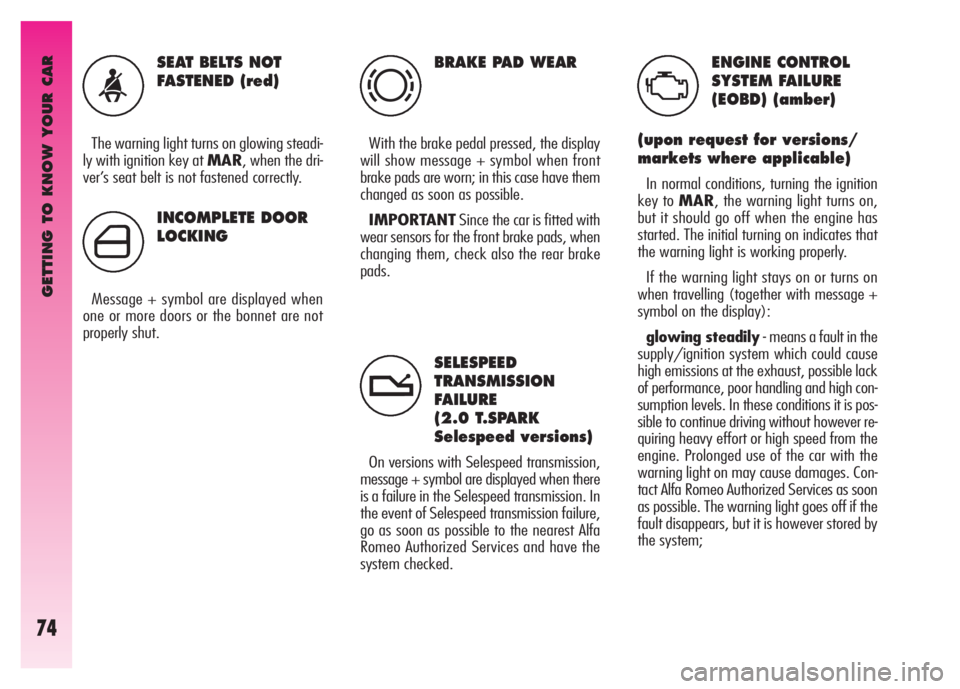
BRAKE PAD WEAR
With the brake pedal pressed, the display
will show message + symbol when front
brake pads are worn; in this case have them
changed as soon as possible.
IMPORTANTSince the car is fitted with
wear sensors for the front brake pads, when
changing them, check also the rear brake
pads.
SELESPEED
TRANSMISSION
FAILURE
(2.0 T.SPARK
Selespeed versions)
On versions with Selespeed transmission,
message + symbol are displayed when there
is a failure in the Selespeed transmission. In
the event of Selespeed transmission failure,
go as soon as possible to the nearest Alfa
Romeo Authorized Services and have the
system checked.
ENGINE CONTROL
SYSTEM FAILURE
(EOBD) (amber)
(upon request for versions/
markets where applicable)
In normal conditions, turning the ignition
key to MAR, the warning light turns on,
but it should go off when the engine has
started. The initial turning on indicates that
the warning light is working properly.
If the warning light stays on or turns on
when travelling (together with message +
symbol on the display):
glowing steadily- means a fault in the
supply/ignition system which could cause
high emissions at the exhaust, possible lack
of performance, poor handling and high con-
sumption levels. In these conditions it is pos-
sible to continue driving without however re-
quiring heavy effort or high speed from the
engine. Prolonged use of the car with the
warning light on may cause damages. Con-
tact Alfa Romeo Authorized Services as soon
as possible. The warning light goes off if the
fault disappears, but it is however stored by
the system;
SEAT BELTS NOT
FASTENED (red)
The warning light turns on glowing steadi-
ly with ignition key at MAR, when the dri-
ver’s seat belt is not fastened correctly.
INCOMPLETE DOOR
LOCKING
Message + symbol are displayed when
one or more doors or the bonnet are not
properly shut.
t
U
Page 217 of 271

IN AN EMERGENCY
215
– In motorways pileups, especially with
poor visibility, the risk of being involved in
other crashes is high. Leave the car imme-
diately and go beyond the guard-rail.
– If doors are blocked, do not try to get
out of the car breaking the windscreen which
is stratified. The windows and rear screen
are easier to break.
– Remove the ignition key of the cars in-
volved.
– If you note a smell of fuel or other chem-
ical products, do not smoke and have a cig-
arette stubbed out.
– To put out fires, even small ones, use
the extinguisher, blankets, sand, or earth.
Never use water.
– If use of the lighting system is not nec-
essary, disconnect the battery negative ter-
minal (–).IN THE EVENT
OF AN ACCIDENT
– It is important to keep calm.
– If you are not directly involved, stop at
least a few dozen metres away from the ac-
cident.
– On motorways, stop without blocking
the emergency lane.
– Turn the engine off and the hazard warn-
ing lights on.
– At night, illuminate the place of the ac-
cident with the headlights.
– Take care, do not risk being run over.
– Signal the accident placing the triangle
at regulation distance in a clearly visible
place.
– Call the emergency organisation, giving
the most accurate information possible. On
motorways use the special phones provid-
ed.
IF PEOPLE ARE INJURED
– An injured person must never be aban-
doned. Helping is compulsory also for per-
sons not directly involved in the accident.
– Do not crowd around injured people.
– Reassure the injured person that help
is on the way, and stay near to overcome
any panic.
– Release or cut the seat belt restraining
injured persons.
– Do not give injured persons anything
to drink.
– An injured person should never be
moved except in the following circum-
stances.
– Remove an injured person from the car
only in danger of fire, sinking or falling.
When removing an injured person: do not
pull the limbs or bend the head and keep
the body as horizontal as possible.
FIRST AID KIT
In addition to the first-aid kit, it is also
wise to keep an extinguisher and a blan-
ket in the car.
Page 219 of 271

CAR MAINTENANCE
217
SCHEDULED MAINTENANCE PROGRAMME
20 40 60 80 100 120 140 160 180Thousands of km
Check tyre conditions/wear and adjust pressure if necessary
Check operation of lighting system (headlights, direction indicators,
hazard warning lights, boot, passenger compartment, glovebox lights, warning lights, etc..)
Check operation of windscreen washer system, adjust spray jets
Check position/wear of windscreen/rearscreen wiper blades
Check operation of front disk brake pad wear indicator
Check wear conditions of rear disk brake pads
Sight check the conditions of: body exterior, underbody protection, stiff pipes
and hoses (exhaust - fuel supply - brakes), rubber parts
(boots - sleeves - bushes etc..)
Check cleanness of locks, bonnet and boot and lever cleanness, and lubrication
Sight inspect accessory drive belt conditions
Check handbrake lever stroke adjustment
Check antievaporation system (petrol versions)
Change air cleaner cartridge (petrol versions)
Change air cleaner cartridge (JTD versions)
Top up fluid levels (engine coolant, brakes, windscreen washer, battery, etc..)
●●●●●●●●●
●●●●●●●●●
●●●●●●●●●
●●●●●●●●●
●●●●●●●●●
●●●●
●●●●●●●●●
●●●●●●●●●
●●
●●●●
●●
●●●●
●●●●●●●●●
●●●●●●●●●
Page 220 of 271
●●●●●●●●●
●●
●●●●
●●●●
●●
●
●●●
●
●
●
●●●●●●●●●
(●)(●)(●)(●)(●)(●)(●)(●)(●)
●●●
●●●●●●●●●
●●●●●●●●●
CAR MAINTENANCE
218
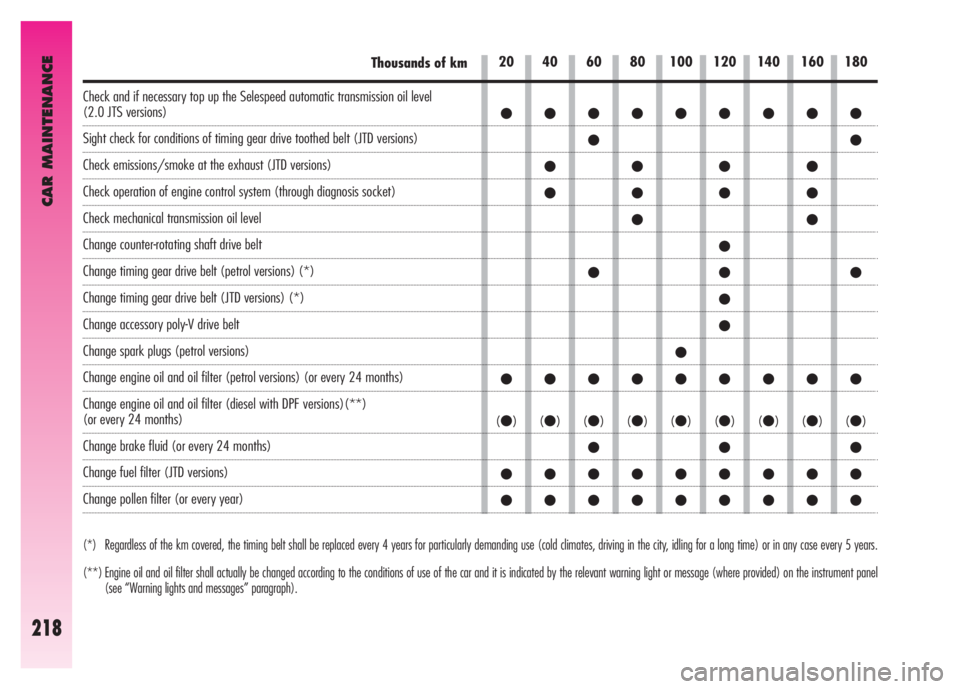
20 40 60 80 100 120 140 160 180Thousands of km
Check and if necessary top up the Selespeed automatic transmission oil level
(2.0 JTS versions)
Sight check for conditions of timing gear drive toothed belt (JTD versions)
Check emissions/smoke at the exhaust (JTD versions)
Check operation of engine control system (through diagnosis socket)
Check mechanical transmission oil level
Change counter-rotating shaft drive belt
Change timing gear drive belt (petrol versions) (*)
Change timing gear drive belt (JTD versions) (*)
Change accessory poly-V drive belt
Change spark plugs (petrol versions)
Change engine oil and oil filter (petrol versions) (or every 24 months)
Change engine oil and oil filter (diesel with DPF versions)(**)
(or every 24 months)
Change brake fluid (or every 24 months)
Change fuel filter (JTD versions)
Change pollen filter (or every year)
(*) Regardless of the km covered, the timing belt shall be replaced every 4 years for particularly demanding use (cold climates, driving in the city, idling for a long time) or in any case every 5 years.
(**) Engine oil and oil filter shall actually be changed according to the conditions of use of the car and it is indicated by the relevant warning light or message (where provided) on the instrument panel
(see “Warning lights and messages” paragraph).