roof Alfa Romeo MiTo 2017 User Guide
[x] Cancel search | Manufacturer: ALFA ROMEO, Model Year: 2017, Model line: MiTo, Model: Alfa Romeo MiTo 2017Pages: 212, PDF Size: 4.36 MB
Page 147 of 212
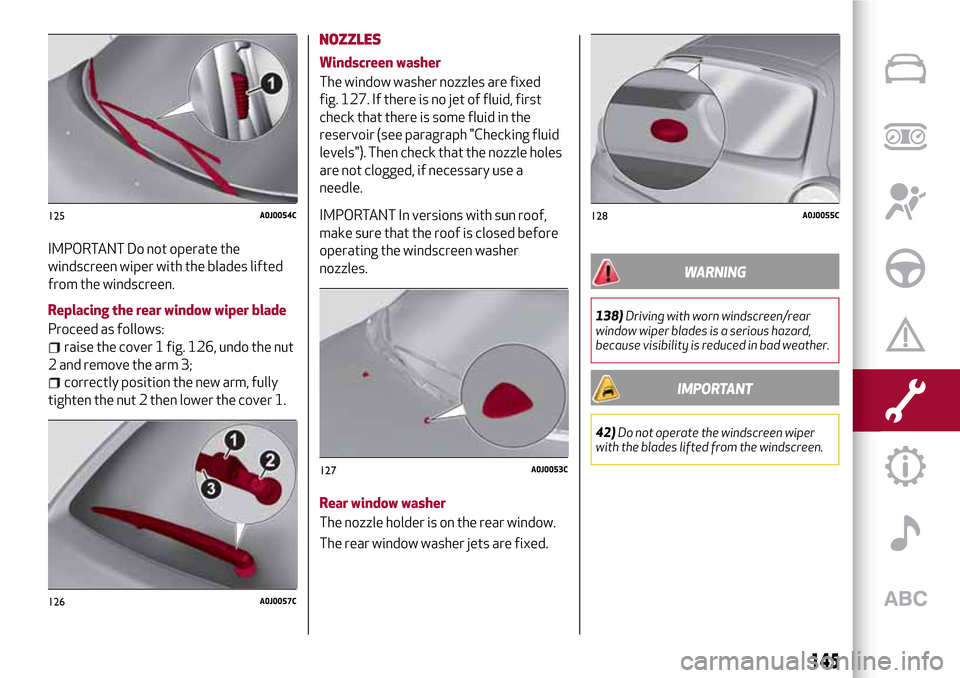
IMPORTANT Do not operate the
windscreen wiper with the blades lifted
from the windscreen.
Replacing the rear window wiper blade
Proceed as follows:
raise the cover 1 fig. 126, undo the nut
2 and remove the arm 3;
correctly position the new arm, fully
tighten the nut 2 then lower the cover 1.
NOZZLES
Windscreen washer
The window washer nozzles are fixed
fig. 127. If there is no jet of fluid, first
check that there is some fluid in the
reservoir (see paragraph "Checking fluid
levels"). Then check that the nozzle holes
are not clogged, if necessary use a
needle.
IMPORTANT In versions with sun roof,
make sure that the roof is closed before
operating the windscreen washer
nozzles.
Rear window washer
The nozzle holder is on the rear window.
The rear window washer jets are fixed.
WARNING
138)Driving with worn windscreen/rear
window wiper blades is a serious hazard,
because visibility is reduced in bad weather.
IMPORTANT
42)Do not operate the windscreen wiper
with the blades lifted from the windscreen.
125A0J0054C
126A0J0057C
127A0J0053C
128A0J0055C
145
Page 148 of 212
BATTERY
The battery 6 (see previous pages) does
not require the electrolyte to be topped
up with distilled water. A periodic check
carried out at an Alfa Romeo Dealership
is, however, necessary to check
efficiency.
INSPECTING THE CHARGE AND THE
ELECTROLYTE LEVEL
139) 140) 141) 142)
43)
4)
If necessary, replace the battery with
another original battery with the same
specifications. Follow the battery
manufacturer's instructions for
maintenance.
USEFUL ADVICE FOR EXTENDING THE
LIFE OF YOUR BATTERY
To avoid draining your battery and make
it last longer, observe the following
instructions:
when you park the car, ensure that the
doors, tailgate and bonnet are closed
properly, to prevent any lights from
remaining on inside the passenger's
compartment;
switch off all roof lights inside the car:
the car is however equipped with a
system which switches all internal lights
off automatically;
do not keep accessories (e.g. radio,
hazard warning lights, etc.) switched on
for a long time when the engine is not
running;
before performing any operation on
the electrical system, disconnect the
negative battery cable.
IMPORTANT If the charge level remains
under 50% for a long time, the battery is
damaged by sulphation, reducing its
capacity and efficiency at start-up.
The battery will also be more at risk of
freezing (this can happen as early as
-10°C). Refer to the "Vehicle inactivity"
paragraph in "Starting and driving"
chapter if the vehicle is left parked for a
long time.
If, after purchasing the car, you wish to
install electrical accessories which
require permanent electrical supply (e.g.
alarm, etc.) or accessories which
influence the electrical supply
requirements, contact an Alfa Romeo
Dealership, whose qualified staff will
evaluate the overall electrical
consumption.
WARNING
139)Battery fluid is poisonous and
corrosive. Avoid contact with the skin and
eyes. Keep open flames away from the
battery and do not use objects that might
create sparks: risk of explosion and fire.
140)Using the battery with insufficient
fluid irreparably damages the battery and
may cause an explosion.
141)If the vehicle must remain unused for a
long time at a very low temperature, remove
the battery and take it to a warm place, to
avoid freezing.
142)When performing any operation on the
battery or near it, always protect your eyes
with special goggles.
IMPORTANT
43)Incorrect installation of electric and
electronic devices may cause severe damage
to your car. After purchasing your vehicle, if
you wish to install any accessories (e.g.
anti-theft, radio phone, etc.), go to an Alfa
Romeo Dealership, which will suggest the
most suitable devices and advise you
whether a higher capacity battery needs to
be installed.
146
SERVICING AND MAINTENANCE
Page 149 of 212
IMPORTANT
4)Batteries contain substances which are
very dangerous for the environment. For
battery replacement, contact an Alfa Romeo
Dealership.
LIFTING THE VEHICLE
If the car needs to be jacked up, go to an
Alfa Romeo Dealership which is equipped
with shop jacks and jack arms.
IMPORTANT Be careful when positioning
the arm of the lift for versions with side
skirts.
BODYWORK
PRESERVING THE BODYWORK
44)
5)
Paint
Touch up abrasions and scratches
immediately to prevent the formation of
rust. Maintenance of paintwork consists
of washing the car: the frequency
depends on the conditions and
environment where the car is used. For
example, it is advisable to wash the
vehicle more often in areas with high
levels of atmospheric pollution or salted
roads.
On some versions the car may be
equipped, on request, with an exclusive
opaque paint on the roof which, in order
to be maintained intact, requires special
care: see the instructions in the warning.
45)
To correctly wash the vehicle, follow
these instructions:
if the vehicle is washed remove the
aerial from the roof;
if high pressure jets or cleaners are
used to wash the car, keep a distance of
at least 40 cm from the bodywork to
avoid damage or alteration. Bear in mind
that a build up of water could cause
damage to the car in the long term;
147
Page 168 of 212
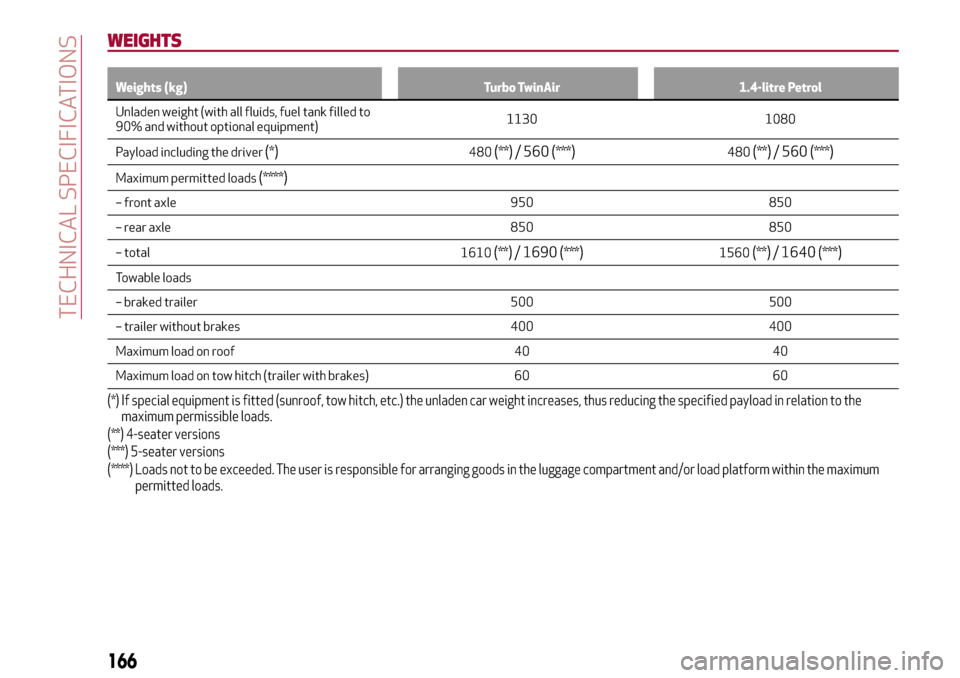
WEIGHTS
Weights (kg) Turbo TwinAir 1.4-litre Petrol
Unladen weight (with all fluids, fuel tank filled to
90% and without optional equipment)1130 1080
Payload including the driver
(*)480(**)/ 560(***)480(**)/ 560(***)
Maximum permitted loads(****)
– front axle 950 850
– rear axle 850 850
– total
1610
(**)/ 1690(***)1560(**)/ 1640(***)
Towable loads
– braked trailer 500 500
– trailer without brakes 400 400
Maximum load on roof 40 40
Maximum load on tow hitch (trailer with brakes) 60 60
(*) If special equipment is fitted (sunroof, tow hitch, etc.) the unladen car weight increases, thus reducing the specified payload in relation to the
maximum permissible loads.
(**) 4-seater versions
(***) 5-seater versions
(****) Loads not to be exceeded. The user is responsible for arranging goods in the luggage compartment and/or load platform within the maximum
permitted loads.
166
TECHNICAL SPECIFICATIONS
Page 169 of 212
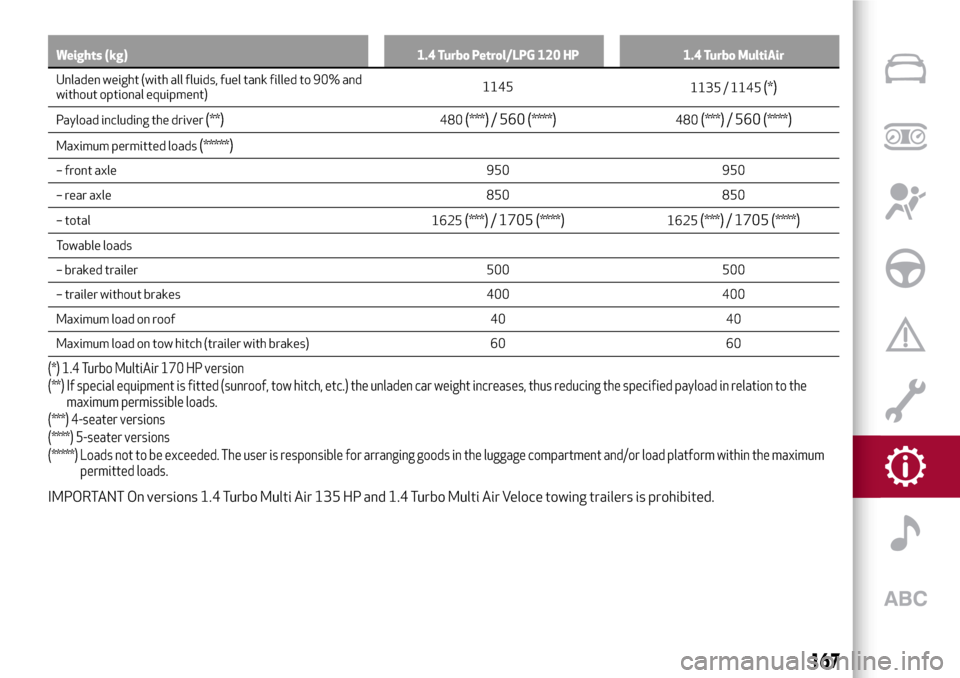
Weights (kg) 1.4 Turbo Petrol/LPG 120 HP 1.4 Turbo MultiAir
Unladen weight (with all fluids, fuel tank filled to 90% and
without optional equipment)1145
1135 / 1145(*)
Payload including the driver(**)480(***)/ 560(****)480(***)/ 560(****)
Maximum permitted loads(*****)
– front axle 950 950
– rear axle 850 850
– total
1625
(***)/ 1705(****)1625(***)/ 1705(****)
Towable loads
– braked trailer 500 500
– trailer without brakes 400 400
Maximum load on roof 40 40
Maximum load on tow hitch (trailer with brakes) 60 60
(*) 1.4 Turbo MultiAir 170 HP version
(**) If special equipment is fitted (sunroof, tow hitch, etc.) the unladen car weight increases, thus reducing the specified payload in relation to the
maximum permissible loads.
(***) 4-seater versions
(****) 5-seater versions
(*****) Loads not to be exceeded. The user is responsible for arranging goods in the luggage compartment and/or load platform within the maximum
permitted loads.
IMPORTANT On versions 1.4 Turbo Multi Air 135 HP and 1.4 Turbo Multi Air Veloce towing trailers is prohibited.
167
Page 170 of 212
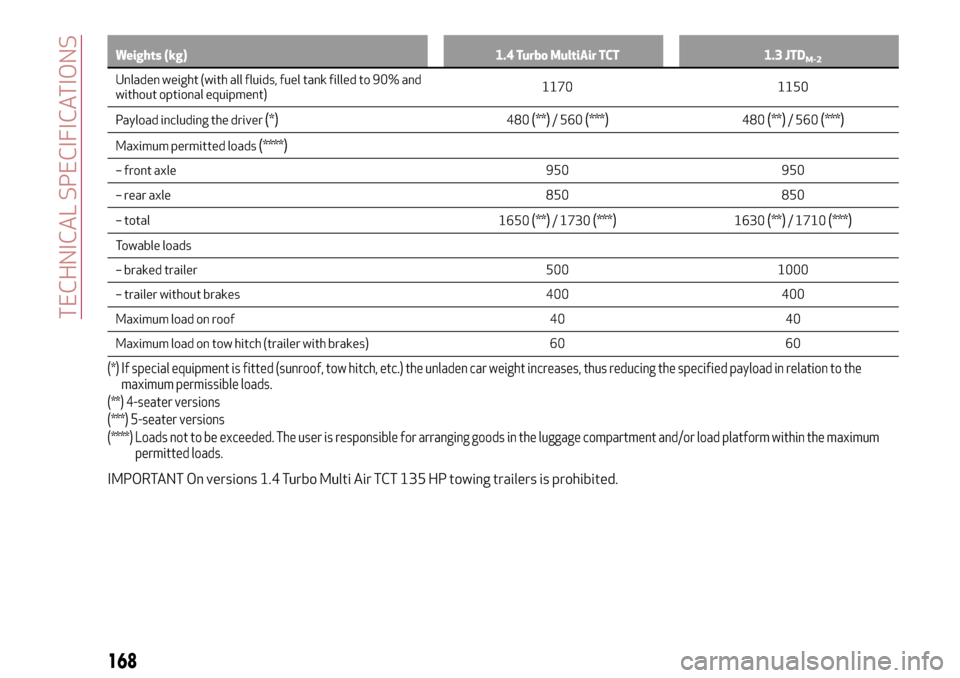
Weights (kg) 1.4 Turbo MultiAir TCT 1.3 JTDM-2
Unladen weight (with all fluids, fuel tank filled to 90% and
without optional equipment)1170 1150
Payload including the driver
(*)480(**)/ 560(***)480(**)/ 560(***)
Maximum permitted loads(****)
– front axle 950 950
– rear axle 850 850
– total
1650
(**)/ 1730(***)1630(**)/ 1710(***)
Towable loads
– braked trailer 500 1000
– trailer without brakes 400 400
Maximum load on roof 40 40
Maximum load on tow hitch (trailer with brakes) 60 60
(*) If special equipment is fitted (sunroof, tow hitch, etc.) the unladen car weight increases, thus reducing the specified payload in relation to the
maximum permissible loads.
(**) 4-seater versions
(***) 5-seater versions
(****) Loads not to be exceeded. The user is responsible for arranging goods in the luggage compartment and/or load platform within the maximum
permitted loads.
IMPORTANT On versions 1.4 Turbo Multi Air TCT 135 HP towing trailers is prohibited.
168
TECHNICAL SPECIFICATIONS
Page 178 of 212
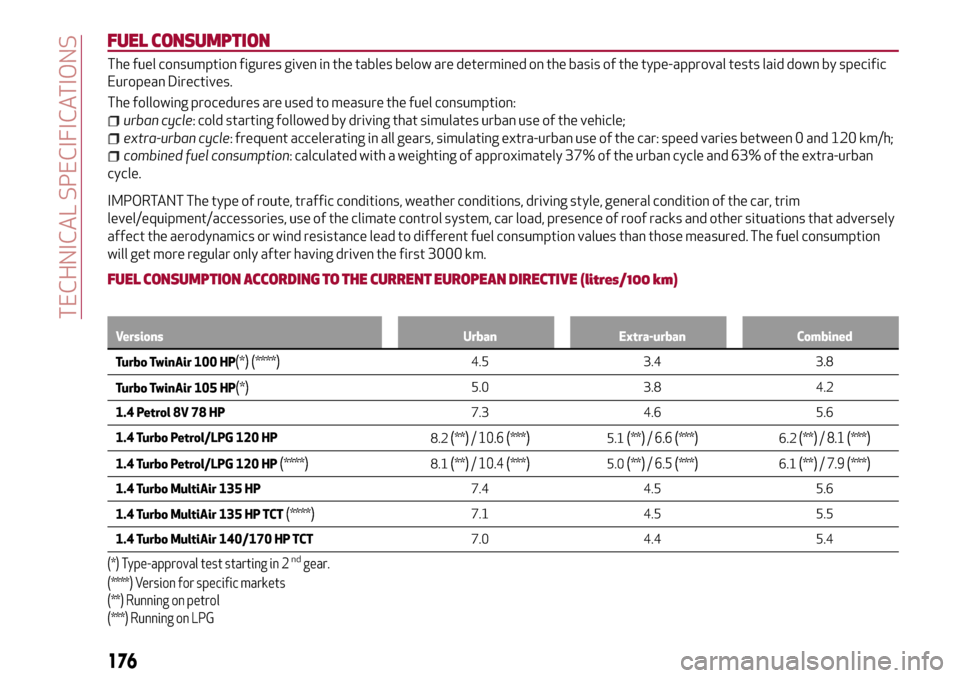
FUEL CONSUMPTION
The fuel consumption figures given in the tables below are determined on the basis of the type-approval tests laid down by specific
European Directives.
The following procedures are used to measure the fuel consumption:
urban cycle: cold starting followed by driving that simulates urban use of the vehicle;
extra-urban cycle: frequent accelerating in all gears, simulating extra-urban use of the car: speed varies between 0 and 120 km/h;
combined fuel consumption: calculated with a weighting of approximately 37% of the urban cycle and 63% of the extra-urban
cycle.
IMPORTANT The type of route, traffic conditions, weather conditions, driving style, general condition of the car, trim
level/equipment/accessories, use of the climate control system, car load, presence of roof racks and other situations that adversely
affect the aerodynamics or wind resistance lead to different fuel consumption values than those measured. The fuel consumption
will get more regular only after having driven the first 3000 km.
FUEL CONSUMPTION ACCORDING TO THE CURRENT EUROPEAN DIRECTIVE (litres/100 km)
Versions Urban Extra-urban Combined
Turbo TwinAir 100 HP(*) (****)4.5 3.4 3.8
Turbo TwinAir 105 HP
(*)5.0 3.8 4.2
1.4 Petrol 8V 78 HP7.3 4.6 5.6
1.4 Turbo Petrol/LPG 120 HP
8.2
(**)/ 10.6(***)5.1(**)/ 6.6(***)6.2(**)/ 8.1(***)
1.4 Turbo Petrol/LPG 120 HP(****)8.1(**)/ 10.4(***)5.0(**)/ 6.5(***)6.1(**)/ 7.9(***)
1.4 Turbo MultiAir 135 HP7.4 4.5 5.6
1.4 Turbo MultiAir 135 HP TCT
(****)7.1 4.5 5.5
1.4 Turbo MultiAir 140/170 HP TCT7.0 4.4 5.4
(*) Type-approval test starting in 2ndgear.
(****) Version for specific markets
(**) Running on petrol
(***) Running on LPG
176
TECHNICAL SPECIFICATIONS
Page 195 of 212
versions, the access toUconnect™LIVE
services enables the use of “Live”
services.
Efficient Drive
(where provided)
The Efficient Drive application allows you
to display your driving behaviour in real
time, in order to help you reach a more
efficient driving style as far as
consumption and emissions are
concerned.
Driving style is evaluated by means of
four indices which monitor the following
parameters: acceleration, deceleration,
gearchange, speed
Display of the Efficient Drive
(where provided)
Press the Efficient Drive button to
interact with the function.
On theUconnect™display, a screen will
appear showing 4 indices: “Acceleration”,
“Deceleration”, “Speed” and “Gear”. These
indices are grey until the system has
enough data to evaluate the driving style.
Once sufficient data are available, the
indices will have 5 colours depending on
the evaluation: dark green (very good),
light green, yellow, orange and red (very
bad).
In the event of extended inactivity the
display will show the average of the
indices up to that moment (“Averageindex”) then the indices will be coloured
again in real time as soon as the vehicle is
restarted.
my:Car
my:Car application allows you to keep the
condition of your vehicle always under
control.
my:Car can detect malfunction in real
time and inform the driver about the
expiry of the servicing interval. Press the
"my:Car" button to interact with the
application.
The display will show a screen with the
"care:Index" section, which provides all
the detailed information about the status
of the vehicle. Press the "Active
warnings" button to show (if present) the
details of the vehicle's faults which
caused a warning light to switch on.
SETTINGS
Press SETTINGS button on the front
panel (versions withUconnect™5” Radio
LIVE) or APPS button and the graphic
button “Settings” (versions with
Uconnect™5” Radio Nav LIVE) on the
display to view the “Settings” main menu
NOTE The menu items displayed vary
according to the versions.
Display;
Voice (where provided);
Measurement unit (where provided);
Clock & Date;
Safety/Assistance (where provided);
Lights (where provided);
Doors and Door lock;
Audio;
Phone/Bluetooth;
Radio;
Restore Default Settings;
Clear personal data;
Restore apps;
DNA messages.
VOICE COMMANDS
Using voice commands
The
button on the steering wheel
activates the “Phone” voice recognition
mode, there is a "beep" and the display
shows a suggestion screen inviting the
user to say a command.
If the
button is pressed during a
system voice message, it activates the
“Radio/Media” voice recognition mode
that controls the radio and he
USB/iPod/CD and MP3 players.
Please follow the suggestions below to
be sure that the voice commands are
always recognised by the system:
speak at a normal volume;
always wait for the "beep" (warning
sound) before speaking;
if possible, try and keep the noise in
the passenger compartment to a
minimum. It is also advisable to close the
windows and sunroof (where provided).
193
Page 196 of 212
for optimum operation, it is advisable
to close the windows and the sun roof
(where provided) to avoid external
interference;
IMPORTANT Voice commands must
always be given in safe driving
conditions, in compliance with the laws in
force in the country where you are driving
and using the mobile phone correctly.
Multiple choice
In a few specific cases the system cannot
unambiguously identify the given voice
command and asks the user to choose
between a maximum of four alternatives.
The system will propose a numbered list
of the available alternatives, asking the
user to say the associated number.
ANTITHEFT PROTECTION
The system is equipped with an anti-theft
protection system based on the
exchange of information with the
electronic control unit (Body Computer)
on the vehicle. This guarantees maximum
safety and prevents the secret code from
being entered after the power supply has
been disconnected. If the check has a
positive outcome, the system will start to
operate.
If the comparison codes are not the same
or if the electronic control unit (Body
Computer) is replaced, the system will
ask the user to enter the secret codeaccording to the procedure described in
the paragraph below.
Entering the secret code
When the system is switched on, if the
code is requested, the display will show
"Please enter Anti-Theft Code" followed
by the screen showing a keypad to enter
the secret code.
The secret code is made up of four digits,
from 1 to 9: to insert the first number of
the code press the corresponding key on
the display. Enter the other code digits in
the same way. After entering the fourth
digit, the system begins operating. If an
incorrect code is entered, the system
displays "Incorrect Code" to notify the
user of the need to enter the correct
code.
After the 3 available attempts to enter
the code, the system displays "Incorrect
Code. Radio locked. Please wait
30 minutes” (the waiting time is
displayed). After the text has
disappeared it is possible to start the
code entering procedure again.
Vehicle radio passport
This document certifies ownership of the
system. The vehicle radio passport shows
the system model, serial number and
secret code.
In the event that the radio passport is
lost, contact an Alfa Romeo Dealership,taking an ID document and the car
ownership documents.
IMPORTANT Keep the vehicle radio
passport in a safe place so that you can
give the information to the relevant
authorities if the system is stolen.
WARNING
150)When inserting a device (USB or iPod)
in the USB port, make sure that it does not
obstruct the operation of the handbrake
lever.
WARNING
151)When inserting a device in the AUX
socket, make sure that it does not obstruct
the operation of the handbrake lever.
194
MULTIMEDIA
Page 197 of 212
IMPORTANT INFORMATION AND RECOMMENDATIONS
WARNING
INTERIOR FITTINGSDo not travel with the storage compartment open: it may injure the front seat occupants in the event of an accident.
The cigar lighter gets extremely hot. Handle it carefully and make sure that children don’t use it: risk of fire and/or burns.
Do not use the ashtray as a waste paper basket: it may catch fire in contact with cigarette stubs.
ROOF RACK/SKI RACKAfter travelling for a few kilometres, check to ensure that the fixing screws for the attachments are well tightened.
Never exceed the maximum permitted loads (see chapter "Technical specifications").
Distribute the load evenly and pay attention to side winds when driving.
ELECTRIC POWER STEERINGBefore starting any servicing operation, stop the engine and remove the key from the ignition switch to operate the steering lock,
particularly when the wheels do not touch the ground. If this is not possible (for example if the key needs to be turned to MAR or the
engine must be running), remove the main fuse that protects the electric power steering.
INTERIORNever use flammable products, such as petrol ether or rectified petrol to clean the inside of the car. The electrostatic charges
which are generated by rubbing during the cleaning operation may cause a fire.
Do not keep aerosol cans in the car: they might explode. Aerosol cans must not be exposed to a temperature exceeding 50°C.
When the vehicle is exposed to sunlight, the internal temperature can greatly exceed this value.