maintenance ASTON MARTIN DB AR1 Q 2003 Owners Guide
[x] Cancel search | Manufacturer: ASTON MARTIN, Model Year: 2003, Model line: DB AR1 Q, Model: ASTON MARTIN DB AR1 Q 2003Pages: 279, PDF Size: 3.77 MB
Page 115 of 279

F - Owner Maintenance
1-F-6
Fluid Level Checks
Engine Bay Component Location (Right Hand Drive Illustrated)
1 Engine Oil Dipstick 2 Engine Coolant Header Tank
3 Engine Oil Filler Cap 4 Power Steering Fluid Reservoir
5 Brake Fluid Reservoir 6 Windscreen Washer Fluid Reservoir
7 Clutch Reservoir (Man) 8 Engine Bay Covers
Note: Items 5 &7 move to the left corner on left hand drive cars.
In the following descriptions, numbers in parenthesis, e.g. (1), refer to the
numbered items in the diagram and list above.
All directions are described as viewed from the driver's seat. Thus the oil filler cap
(item 3) is on the left side of the car, the brake fluid reservoir (item 5) is on the right
side of the car.
Page 116 of 279

F - Owner Maintenance
1-F-7
Engine Oil Level Check
When checking engine oil level, the car should be on level ground. If the
engine has been running immediately prior to the check, wait several
minutes after stopping the engine for the oil to drain back into the sump. The
dipstick (1) (which should be wiped clean before checking the oil level) is
located on the left-hand side of the engine. The oil level should be
maintained at the 'Max' dipstick mark.
Approximately one litre is required to bring the level from Min to Max. The
recommended engine oil should be added through the oil filler (3). Do not
overfill. Replace the filler cap securely.
WARNING: Running the engine with insufficient oil can cause serious damage.
To avoid personal injury and before working in or near the engine compartment,
switch off the engine and let it cool. Engine components are hot and may cause
severe burns. See also the warnings given in SERVICING PRECAUTIONS.
Page 117 of 279
F - Owner Maintenance
1-F-8
Engine Coolant Level Check
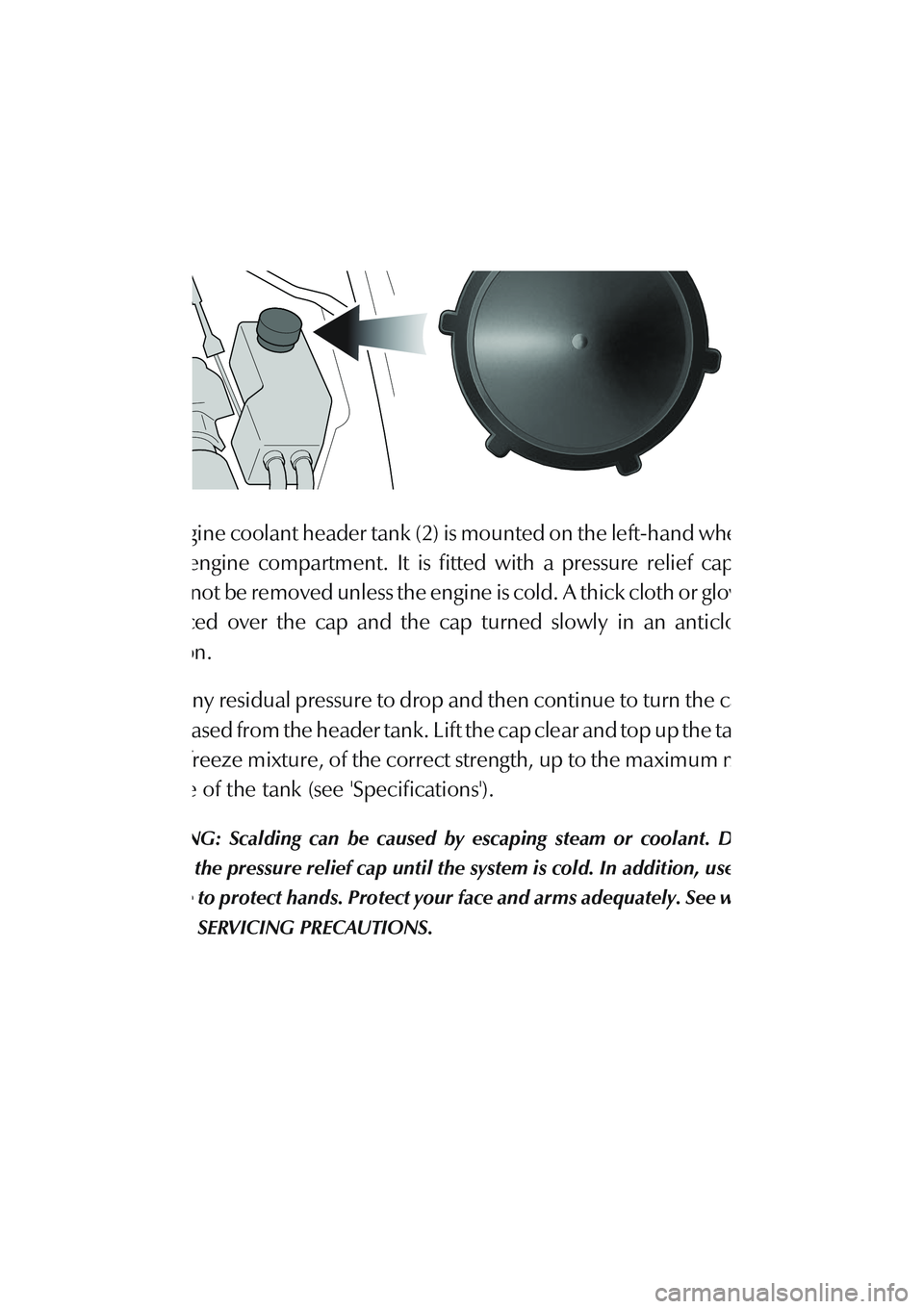
The engine coolant header tank (2) is mounted on the left-hand wheel arch
in the engine compartment. It is fitted with a pressure relief cap which
should not be removed unless the engine is cold. A thick cloth or glove must
be placed over the cap and the cap turned slowly in an anticlockwise
direction.
Allow any residual pressure to drop and then continue to turn the cap until
it is released from the header tank. Lift the cap clear and top up the tank with
an antifreeze mixture, of the correct strength, up to the maximum mark on
the side of the tank (see 'Specifications').
WARNING: Scalding can be caused by escaping steam or coolant. DO NOT
remove the pressure relief cap until the system is cold. In addition, use a cloth
or glove to protect hands. Protect your face and arms adequately. See warnings
given in SERVICING PRECAUTIONS.
Page 118 of 279

F - Owner Maintenance
1-F-9
Clutch Fluid Reservoir
The clutch fluid reservoir (7) is fitted to the drivers side of the engine
bulkhead on manual transmission cars only.
Before removing the filler cap, clean it and the surrounding area to prevent
any ingress of dirt or foreign matter into the system. Top up the reservoir
using only the recommended fluid until the fluid level is at the maximum
mark. (see 'Specifications').
Caution: Take care that hydraulic fluid does not contact the paint work during the
topping up operation. Serious paint work damage can result. If a spillage does occur,
immediately flush the hydraulic fluid from the paint work with clean, fresh water and
then wipe with a clean damp cloth.
Page 119 of 279

F - Owner Maintenance
1-F-10
Power Steering Fluid Level Check
The power steering pump reservoir (4) is situated on the right inner
wing.
The reservoir level should be checked when the engine is cold. The
reservoir cap incorporates a dipstick. Top up the reservoir with clean
fluid of the recommended grade up to the lower mark on the dipstick.
DO NOT OVERFILL.
WARNING: Avoid touching the sides of the engine when working in the engine
compartment. The exhaust system will be hot if the engine has recently been run.
Caution: Take care that hydraulic fluid does not contact the paint work during the
topping up operation. Serious paint work damage can result. If a spillage does occur,
immediately flush the hydraulic fluid from the paint work with clean, fresh water and
then wipe with a clean damp cloth.
Page 120 of 279

F - Owner Maintenance
1-F-11
Brake Fluid Reservoir
The brake fluid reservoir (5) is fitted to the driver's side of the engine
compartment on top of the brake master cylinder assembly.
Before removing the cap, clean the cap and the surrounding area thoroughly
to prevent ingress of dirt and foreign matter. Top up to the indicated level
on the reservoir with the recommended brake fluid (see 'Specifications') and
refit the cap securely.
Brake fluid will absorb water vapour and must be replaced every two years
in order to maintain the efficiency of the hydraulic system.
WARNINGS: Do not drive the vehicle if the brake fluid level is low. Use only new
DOT4 brake fluid from air tight containers.
Avoid touching the sides of the engine when working in the engine compartment.
The exhaust system will be hot if the engine has recently been run.
Caution: Take care that hydraulic fluid does not contact the paint work during the
topping up operation. Serious paint work damage can result. If a spillage does occur,
immediately flush the hydraulic fluid from the paint work with clean, fresh water and
then wipe with a clean damp cloth.
Page 121 of 279

F - Owner Maintenance
1-F-12
Windscreen Wash Fluid Level Check
The washer fluid filler cap (6) is situated in the right rear corner of the engine
bay and should be topped up as required with an appropriate concentration
of screen wash solution. When the level of screen wash fluid is low the
instrument panel warning light will illuminate.
Caution: State or local regulations may restrict the use of volatile organic
compounds (VOCs), which are commonly used as anti-freeze agents in washer
fluid. A washer fluid with limited VOC content should be used only if it provides
adequate freeze resistance for all regions and climates in which the vehicle will
be operated.
Warning: If you operate your vehicle in temperatures below 40°F, use washer
fluid with anti-freeze protection. In cold weather, failure to use washer fluid with
anti-freeze protection could result in impaired windscreen vision and increase
the risk of a vehicle crash.
Page 122 of 279
F - Owner Maintenance
1-F-13
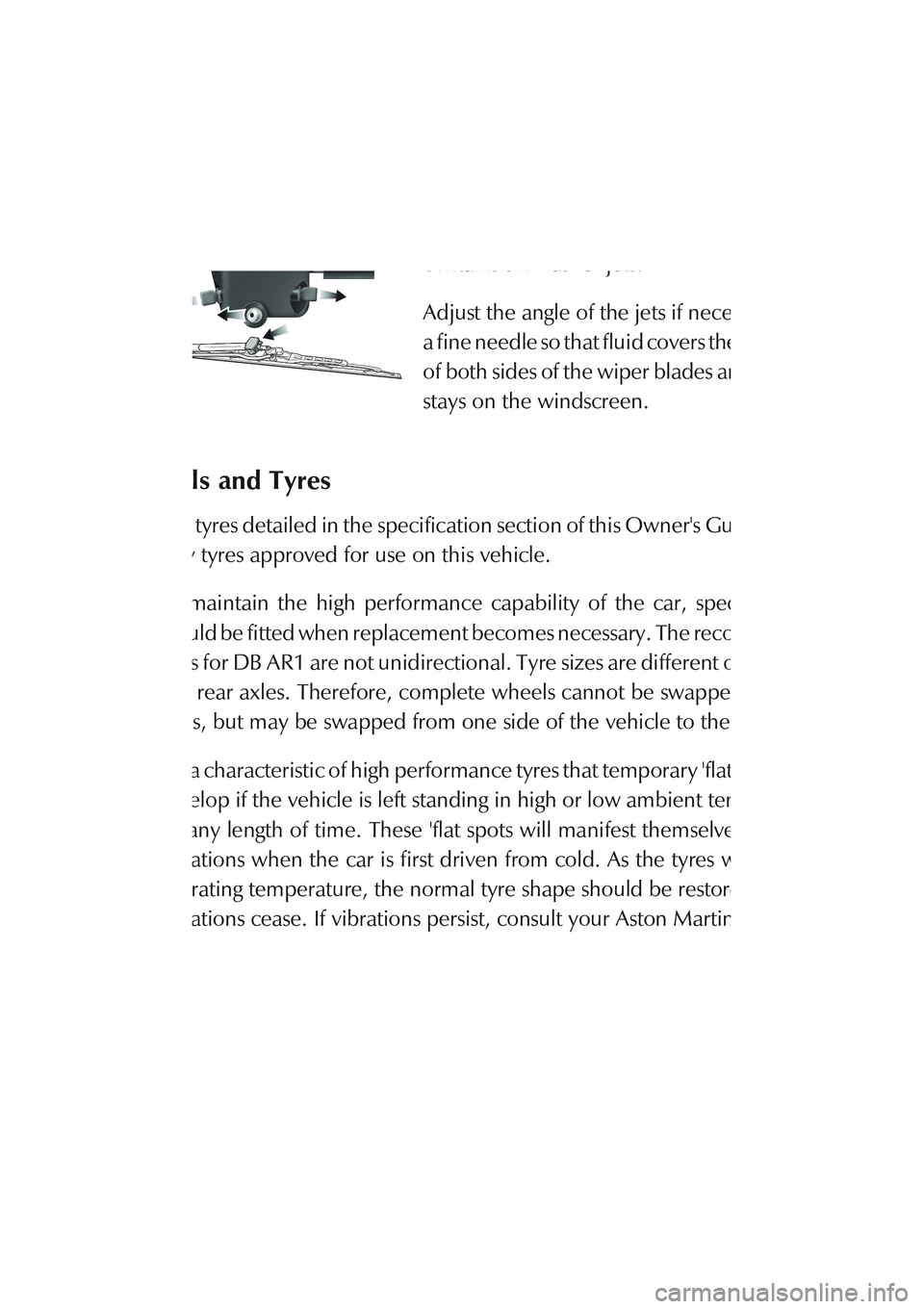
Windscreen Washer Jets
A washer jet housing is located on each of the
two windscreen wiper arms. Each housing
contains six washer jets.
Adjust the angle of the jets if necessary using
a fine needle so that fluid covers the full length
of both sides of the wiper blades and all spray
stays on the windscreen.
Wheels and Tyres
The tyres detailed in the specification section of this Owner's Guide are the
only tyres approved for use on this vehicle.
To maintain the high performance capability of the car, specified tyres
should be fitted when replacement becomes necessary. The recommended
tyres for DB AR1 are not unidirectional. Tyre sizes are different on the front
and rear axles. Therefore, complete wheels cannot be swapped between
axles, but may be swapped from one side of the vehicle to the other.
It is a characteristic of high performance tyres that temporary 'flat spots' may
develop if the vehicle is left standing in high or low ambient temperatures
for any length of time. These 'flat spots will manifest themselves as minor
vibrations when the car is first driven from cold. As the tyres warm up to
operating temperature, the normal tyre shape should be restored and the
vibrations cease. If vibrations persist, consult your Aston Martin dealer.
Page 123 of 279

F - Owner Maintenance
1-F-14
Tyre Pressures
In the interest of safety and tyre life it is important that correct tyre pressures
are carefully maintained (See 'Specifications').
Road holding, steering and braking are especially vulnerable to incorrect
tyre pressures.
Pressures increase slightly when tyres are hot and, for an accurate reading,
pressures should be checked when the tyres are cold.
After checking the pressures ensure that the valve caps are securely replaced
to provide an additional air seal and to prevent the ingress of dirt.
Running-In New Tyres
When new tyres have been fitted, speed should be limited, particularly
during the first 80 km (50 miles) or so of driving. Fast cornering, hard braking,
and harsh acceleration should also be avoided during this period.
Tyre Service
Tyres should be examined at regular intervals for wear and damage. Stones
or other objects which have become lodged in the tyre treads should be
carefully removed.
When new tyres are required, it is advisable to consult an Aston Martin
dealer who will be able to supply tyres to the correct specification.
Page 124 of 279
F - Owner Maintenance
1-F-15 Only fit the specified tyres. These are designed for the potential speed,
acceleration, handling and braking performance of the car
New tyres should not be fitted to the front wheels in combination with worn
rear tyres as rear end stability will be affected. Consult your Aston Martin
dealer for advice if the rear tyres are also worn.
Each wheel and tyre unit must be balanced dynamically to ensure efficient
steering, optimum tyre wear and maximum ride comfort. Because of the
potentially high speeds, it is essential that wheel balancing is carried out
when new tyres are fitted.
WARNING: Because of the high performance potential of your DB AR1, Aston
Martin strongly recommend replacement of any damaged or worn tyre.
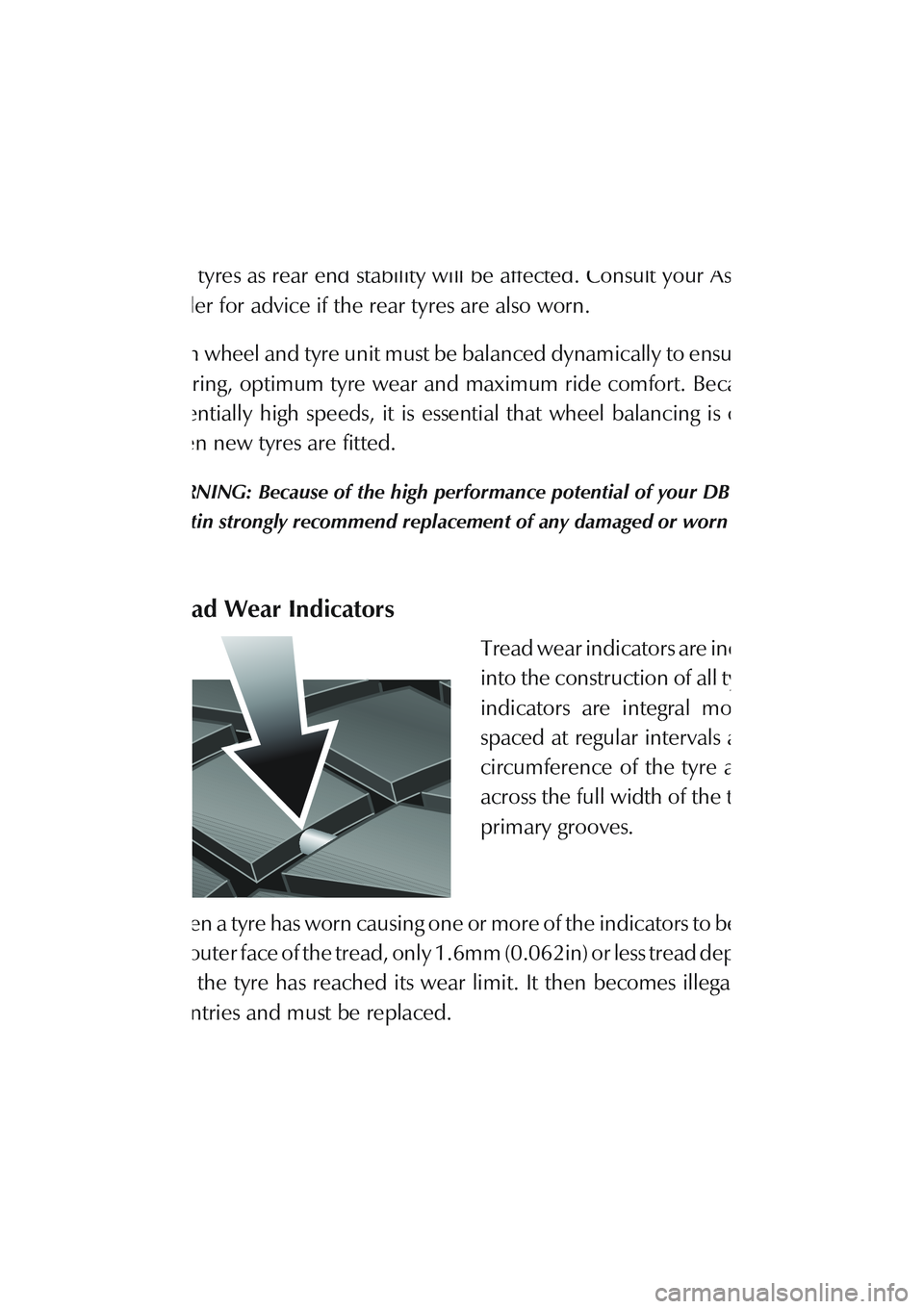
Tread Wear Indicators
Tread wear indicators are incorporated
into the construction of all tyres. These
indicators are integral moulded ribs
spaced at regular intervals around the
circumference of the tyre and extend
across the full width of the tread, in all
primary grooves.
When a tyre has worn causing one or more of the indicators to be flush with
the outer face of the tread, only 1.6mm (0.062in) or less tread depth remains
and the tyre has reached its wear limit. It then becomes illegal in certain
countries and must be replaced.