ignition AUDI A3 2015 Repair Manual
[x] Cancel search | Manufacturer: AUDI, Model Year: 2015, Model line: A3, Model: AUDI A3 2015Pages: 288, PDF Size: 71.46 MB
Page 196 of 288
194 Driving and the environment
Driving through water
on roads
Note the following to avoid vehicle damage
when driving through water, for example on
flooded roads:
- The water must not be any higher than the
bottom of the vehicle body.
- Do not drive faster than wa lking speed.
A WARNING
After driving through water or mud, the
braking effect can be reduced due to mois
ture on the brake discs and brake pads. A
few careful brake applications should dry off the brakes.
@) Note
Vehicle components such as the engine, transmiss ion, suspension or electrical sys
tem can be severely damaged by driving
through water.
- Determ ine the depth before driving
through water.
- Do not stop the vehicle, drive in reverse
or switch the engine off when driving
through water .
- Keep in mind that oncoming vehicles may create waves that raise the water
level and make it too deep for your vehi
cle to drive through safely.
- Avoid dr iving through salt water (corro
s ion).
Catalytic converter
App lies to vehicles: with gasoline engine
It is very important that your emission con
trol system (catalytic converter) is function
ing properly to ensure that your vehicle is run
ning in an environmentally sound manner.
> Always use lead-free gaso line¢ page 206,
Fuel supply .
> Never run the tank down all the way to emp-
ty.
> Never put too much motor o il in your engine
¢ page 215, Adding engine oil
The catalytic converter is an efficient "clean
up" device built into the exhaust system of
the vehicle . The cata lytic converter burns
many of the pollutants in the exhaust gas be
fore they are released into the atmosphere.
The exclusive use of unleaded fuel is critica lly
important for the life of the catalytic convert
er and proper functioning of the engine.
A WARNING
-
The temperature of the exhaust system is high, both when driv ing and after stopping
the eng ine .
- Never touch the exhaust tail pipes once
they have become hot . This could result
in burns.
- Do not park or operate the vehicle in
areas where the hot exhaust system may
come in contact with dry grass, brush,
fue l spill or other material wh ich can
cause a fire.
- Do not app ly additional undercoating or
rustproofing on or near the exhaust manifold, exhaust pipes, catalytic con
verter or heat shields . Dur ing driving, the
substance used for undercoating could
overheat and cause a fire.
(D Note
- Be aware that just one tank filling with
leaded fuel will already seriously de
grade the performance of the catalytic
converter.
- Do not exceed the correct engine oil level
¢page 215.
-Do not drive until the fuel tank becomes
completely empty. The engine could mis
fire . Unburned fuel could also get into
the exhaust system and this cou ld cause
the catalytic converter to overheat.
- Do not switch off the ignition while the
vehicle is moving.
- Do not continue to operate your vehicle
under these conditions, as otherwise fuel
IIJ,,
Page 204 of 288
202 Caring and cle aning
_& WARNING
- Only wash the vehicle when the ignition
is off and follow the instructions from
the car wash operator to reduce t he risk
of accidents.
- To reduce the risk of cuts, protect your
self from sharp meta l components when
wash ing the underbody or the inside of
the wheel housings.
- After washing the vehicle, the braking ef
fect may be de layed due to mo isture on
the brake rotors or ice in the winter. The
brakes must be dried first with a few
careful brake applicat ions .
@ Note
- If you wash t he vehicle in an automatic
ca r wash, you must fold the exterior m ir
r o rs in to reduce the r isk of damage to
t h e m irrors. Power foldi ng exterior m ir
r o rs* must on ly be folded in and o ut us
i ng the p ower folding function.
- To prevent pa int damage, do not wash
t h e ve hicle in direc t sunli ght. -
To reduce the ris k of damage to the sur
face, do not use insect removing spong
es, kitchen sponges or similar items.
- Matte finish painted veh icle compo
nents:
- To reduce the risk of damage to the
surface, do not use polishi ng agents or
h a rd wax.
- Never use protect ive wax. It can de
stroy the matte fi nish effec t.
- Do not place any stickers o r mag net ic
s igns on vehicle parts painted w ith
matte fi nish pa int. The paint cou ld be
d amaged when the sticke rs o r mag nets
ar e removed. @ For the sake of the environment
Only wash the ve hicl e in facilities spec ia lly
de signed for that purpose. This will red uce
the r is k of dirty w ate r contam ina ted with
oi l from entering the sewer sys tem.
Cleaning and care information
When clea ning and ca rin g for individua l vehi
cle components, refer to the fo llow ing tab les.
The informa tion con taine d there is s imp ly rec
ommendations. Fo r quest ions or for compo -nents that ar
e not listed, refer to an author
i z ed Audi dea ler. Also follow the in format io n
f o und in¢ ,&..
Exterior cleaning
Component Situation Solution
Wind shield wip-
Deposi ts ¢ page 47, Cleaning windshield wiper blades
er blades
headlights /
Deposits Soft sponge with a m ild soap solutiona>
Tail lights
Sensors /
Deposits Sensors: soft cloth with a so lvent-free cleaning product
camera lenses Camera lenses: soft cloth with an alcohol-free cleaning
so lution
Snow/ ice Hand brush/solvent -free de -icing spray
Wheels Road sa lt Water
Brake d ust Acid-free special cleaning so lution
E x haust ta il Road sa lt Water, cleaning solut ion suitable fo r sta inless steel, if
pipes necessary
Page 212 of 288
210 Check ing and F illin g
Only pull on the loop until you fee l resist
ance. You will not hear it release . Other
w ise you could damage the emergency re
lease mechanism .
Hood
Working in the engine compartment
Special care is required if you are working in
the engine compartment
F o r w ork in th e engine co mpartm ent such as
c h ec king an d filling fluids, there i s a ri sk of
inj ury, sca lding, a ccid ent s, and b urn s. For
t hi s re ason , fo llow all th e followin g lis te d
warn in gs a nd ge neral safe ty pr eca utions.
Th e e ngine compartment is a d ange rous
area .¢ .& .
&_ WARNING
To reduce the risk of injury, before you
check anyth ing under the hood:
- Turn the engine off.
- Set the parking brake.
- Place the selector leve r in the P position.
- Remove the ignit io n key .
- Let the engine coo l down.
- To reduce the r isk of being burned, never
open the hood if you see or hear steam
or coolant escaping from the engine
compartment . Wait until no steam or
coolant can be seen or hea rd before ca re
fully opening the hood.
- Keep chi ldren away from the engine com
partment .
- Never spill flu ids on a hot engine. These
fluids (such as the freeze protection con
tained in the coolant) can catch fi re.
- Avoid short circuits in the electrical sys
tem, especially the battery.
- When working in the engine compart
ment, remembe r that the radiator fan
can switch on even if the ignition is
switched off, which increases the risk of
persona l injury . -
Never open the cap on the coolant ex
pans ion tank when the eng ine is warm.
The coolant system is under pressure.
- To protect your face, hands, and arms
from hot steam or coolant, cover the cap
with a large cloth when opening.
- Do not remove the engine cover under
any circumstances . This increases the
risk of burns .
- If tests need to be performed with the
engine runn ing , there is add itional dan
ger due to moving components (such as
the ribbed belt, generator and radiator
fan) and from the high voltage ignit ion
system.
- Never touch the rad iator fan . The auxili
ary electric fan is temperature controlled
and can switch on suddenly.
- Pay attention to the fo llow ing warnings
listed when wo rk on the fuel system or
on the e lectr ica l equipment is req uired.
-A lways disconnect the vehicle battery
from the vehicle electr ical system
- Do not smoke
- Never work near open flames
- Always have a wo rk ing fire exting uisher
nearby
- To avo id e lectr ica l sho ck and pe rsonal in
jury whi le the engine is running or being
started, never touch:
- Ign it ion cables
- Other components of the high voltage
electronic ignition system.
- If you must perform a check or repair
with the eng ine running:
- First, fully app ly the parking brake,
move selector lever to P (Park).
- Always use extreme caut io n to prevent
cl othing, jewelry, or long hair from get
ting caught in the radiator fan, V-be lts
o r other moving parts, o r from contact
ing hot parts. Tie back hair before
starting, and do not wear clothing that
will hang or droop into the engine.
- Minimize exposure to emission and
chemical hazards¢,& . ..,.
Page 219 of 288
The cooling system has been filled at the fac
tory with a permanent coolant which does not need to be changed. The coolant consists of a
mixture of spec ia lly conditioned water and the
manufacturer's glycol-based coolant addi-
tive Gl3 antifreeze with anticorros ion addi
tives (50% fo r USA models; 60% for Canadian
models) . This mixture both assures th e neces
sary frost protect ion a nd p rotects me tal com
ponents in the engine 's coo ling system from
corrosion and scaling.
It al so raises the boil
ing po int o f the coo lant .
D o no t reduce the concentration of t he coo l
an t in the summer by ad ding plain w ate r.
The
proportion of coolant additive must be at
lea st 50 % but not more than 60%
to main
tain ant ifreeze protection and cooling efficien
cy. If the coolant frost protect ion is too low ,
the coolant cou ld free ze and damage the veh i
cle heating and eng ine cooling system.
F or yea r-round driv ing, antifreeze is added at
the facto ry for temperatures down to:
- -3 1 °F ( -3 5°C) USA
- -4 0°F ( -4 0°C) Canada.
If you must add coolant, use a m ixture of wa
ter and coolant addit ive. M ixing the coolant
addi tive wi th dist illed wate r is recom mend ed.
_& WARNING
Bef ore yo u check any thing in the e ngine
comp artme nt, alw ays re ad and hee d all
WARN INGS
¢page 210.
(D Note
- B efo re winter sets in, have the coolant
c hec ked to see if the c oolan t ad dit ive i n
you r vehi cle is su fficient t o mee t the cl i
mate cond itions. This is especially impor
tant if yo u live in a region whe re the win
ter is extremely cold. If necessary, in
crease the proport ion of coolant additive
to 60%.
- W hen addi ng coolant additive to your
cooling system, remember:
- We recommend using only coolant ad
ditive Gl2 ++ o r Gl3 ( check t he label)
-
Che cking and Fillin g 21 7
for you r vehi cle. This coolan t additive is
avai lab le at authorize d Audi dea le rs .
Ot her types of antifreeze ca n sig nifi
cantly reduce corros io n protection. The
res ulting corrosion can cause a loss of
coolant and serio us e ngine da mage .
- Do not add any type of rad iator leak seal
ant to you r vehicle's engine coolant .
Add ing radiator repair flu id may adverse
ly affect t he function and performanc e of
yo ur cooling sys tem and co uld resu lt i n
damage not covered by yo ur New Ve hicle
L imi ted W arranty.
Adding coolant
Fi g. 152 En gine co mpa rtment: markin gs on t he coo l
an t e xpan sio n t ank
Befo re you check a nyt hing in the eng ine com
partment ,
alway s read and heed all WARN
INGS ¢ page 210.
Checking the engine coolant level
.,. Park yo ur vehicle o n a level su rf a ce .
.,. Switch t he ignition off.
.,. Read t he coolant leve l on the coo lant expan
sion tank ¢
fig. 152. The coolant leve l must
be between the markings when the engine
in cold. When the engine is warm it can be
slightly above the upper mark ing .
Adding coolant
Req uirement : There m ust be a res idual
amount of coo lant in the expansion tank
c::> Q) .
.,. Le t the engine cool down.
.,. Place a clot h over the coo lant expans ion
tank cap a nd u nscrew the cap co unterclock-
wise
c::> _& . ..,.
Page 220 of 288
218 Check ing and F illin g
• Add coolant mixed in the correct ratio
¢page 216 up to the upper marking.
• Make sure that the fluid level rema ins sta-
ble. Add more coolant if necessary.
• Clove the cap securely.
A coo lant loss suggests a leak. Immediately
drive your vehicle to an authorized repair fa
cility and have the coolant system inspected.
If the coolant system is not leaking, a loss can
come from the coolant cooking through over
heat ing and being pushed out of the coolant
system.
.8, WARNING
The cool ing system is under pressure and
can get very hot. Reduce the risk of scald
ing from hot coolant by following these
steps .
- Do not open the coo lant expansion tank
cap with the engine hot . There is a risk of
burns.
- T urn off the engine and allow it to cool
down .
- Protect your face, hands and arms from
escaping fluid and steam by covering the
cap with a large, thick rag.
- T urn the cap slowly and ve ry carefu lly in
a counter-clockwise direction wh ile ap
plying light, downward pressure on the
top of the cap.
- To avoid being b urned, do not spill anti
freeze or coo lant on the exhaust system
or hot eng ine parts. Under certain condi
t ions, the ethylene g lycol in engine cool
ant can catch fire.
- The coo lant add itive and the coolant can
be dange rous to your hea lth. For th is
reason, keep the coolant in the or ig inal
conta iner away from children. There is a
risk of poisoning.
- Whe n work ing in the engine compart
ment, remembe r that the radiator fan
can swit ch on even if the ignition is
switched off, wh ic h increases the risk of
persona l inju ry .
(D Note
Do not add coo lant if the expansion tank is
empty. Air cou ld enter the cooling system
and damage the engine. If this is the case,
do not continue dr iving. See your author
i zed Audi dealer or qualified repair fac ility .
Radiator fan
The radiator fan switches on automatically by
itself
An a uxiliary electric radiator fan switches on
and off depending on coolant temperature
and other vehicle operat ing condit ions.
After you switch the engine off, the auxi liary
fan can continue running for up to 10 m inutes
- even w ith the ignition off.
It can even switch
on again later by itself¢.&. , if
- the temperature of the engine coo lant rises
due to the heat build- up from the engine in
the engine compartment, or
- the engine compartment heats up because
the vehicle is parked in intense sunlight.
.8, WARNING ,-
- To reduce the risk of personal injury nev-
er touch the radiator fan.
- The a uxiliary electric fan is temperat ure
controlled and can sw itch on suddenly
even when the engine is not ru nning.
- The auxiliary radiator fan sw itches on a u
tomatically when the engine coo lant
reaches a certain temperature and will
continue to run until the coolant temper
ature drops.
Page 222 of 288

220 Checking and Filling
Battery
General information
Under normal operating conditions, the bat
tery in your Audi does not need any mainte
nance. With
high outs ide temperatu res or
long daily drives we recommend that you have
the electro lyte level checked by a service fa
cility. The e lectrolyte level shou ld also be
checked each time the battery is charged
c:>page222.
Have the battery checked when you take your
vehicle in for service. You are well advised to replace a battery that is older than 5 years.
With certain types o f airbag deployment, the
battery is disconnected from the vehicle elec
trica l system for safety reasons
c;, .&. in Re
pair , care and disposal of the airbags on
page 156.
Disconnecting the battery terminals
Some vehicle functions such as power win
dows are unavai lable if the battery termina ls
are d isconnected. These functions have to be
relearned after the battery terminals are con
nected again. To prevent this, the battery
should only be disconnected from the vehicle
electrical system when absolutely necessary
for repairs .
To reprogram the functions, proceed as fol lows:
Function Reprogramming
Power window one-c;, page 40, Correcting
touch up/down power window mal-
function functions
Remote control key If the vehicle does not
or react to the key, it
convenience key must be synchroni zed
c:>page 33
Digital clock c:>page 10
ESC indicator light The indicator light
goes out after driving
a few meters
Vehicles not driven for long periods
If you do not drive your vehicle over a period
of severa l days or weeks, e lectrica l compo
nents are gradually sca led back or switched
off. This reduces energy consumption and
maintains starting capability over a longer pe
riod
c;, page 190. Some of the conven ience
functions may not operate, such as the interi
or lights or power seat adjustment. The con
venience functions will be availab le aga in
when you switch on the ignition and start the
engine.
Winter operation
During the winter months, battery capacity
tends to decrease as temperatures drop. This
is because more power is also consumed wh ile
sta rting, and the headlights, rear window de
fogger, etc. , are used more often.
Avoid unnecessary power consumpt ion, par
ticularly in city traffic or when traveling only
short distances. Let your authorized Aud i
dealer check the capacity of the vehicle bat
tery before winter sets in ~ page 222. A well
charged battery will not on ly prevent starting
problems when the weather is cold, but will
also last longer.
A WARNING -
-Work on the battery requ ires expert
know ledge. Contact your authorized Audi
dealer qualified repair facility for infor
mat ion regarding the vehicle battery.
There is a risk for chemical burns or ex
p losions.
- Never open the vehicle batte ry . Do not
try to change the battery electrolyte lev
el. Otherwise explosive gas will escape
from the battery and increase the risk of
an explosion .
(i) Tips
If your vehicle is left standing for several
weeks at extremely low temperatures, the
vehicle battery should be removed and
stored where it w ill not freeze. This will ..,.
Page 224 of 288
222 Checking and Fill in g
and then the negative cable . Never inter
change the cables -this could start a fire!
- Never charge a frozen or a thawed-out
battery. It could explode! If a battery has
frozen, then it must be replaced. A dead battery can freeze over at 32°F (0°C).
- Make sure the vent hose is always attach
ed to the opening on the side of the bat
tery.
- Never use batteries which are damaged.
There is the danger of an explosion! Al
ways replace a damaged battery.
&_ WARNING
California Propos ition 65 Warning:
- Battery posts, terminals and related ac
cessories contain lead and lead com
pounds, chemicals known to the State of
California to cause cancer and reproduc
t ive p roblems. Wash hands after han
dling.
(D Note
- Do not d isconnect t he veh icle battery
when the ignition is on or when the en
gine is running, otherwise, you will dam
age ele ctron ic componen ts in the elec tri
ca l system.
- If your vehicle is going to stand for a
l ong period of time wi thout being driven,
protect the battery from "freezing", oth
e rwise it w ill be damaged and wi ll then
have to be replaced.
Battery charging
Starting the engine requires a well charged battery.
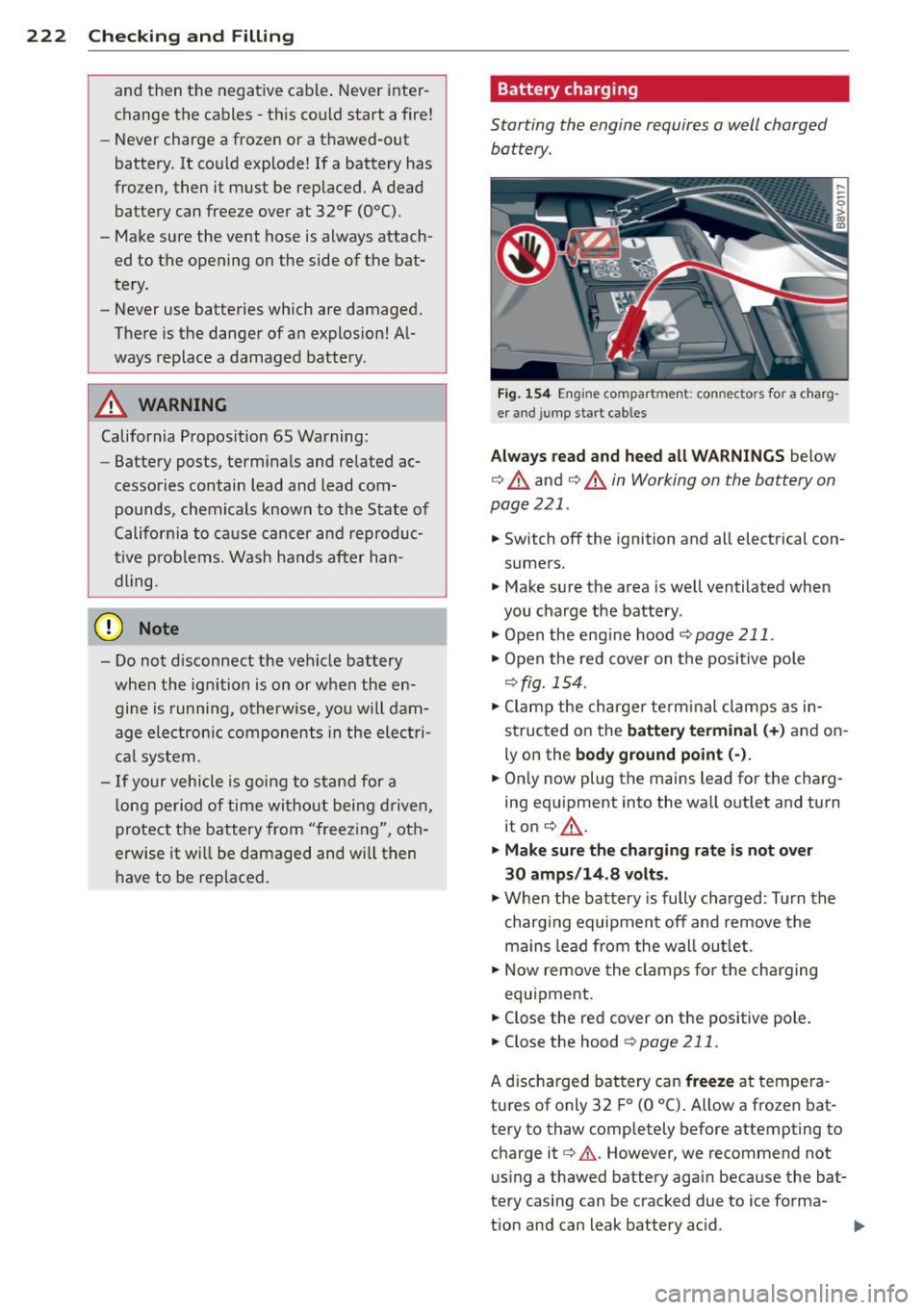
F ig . 1 54 Engine co mpartment : connectors for a charg
er and jump start cab les
Alwa ys read and heed all WARNINGS below
c> &. and c> &. in Working on the battery on
page 221.
.. Switch off the ignition and all electrical con
sumers.
.. Make sure the area is well ventilated when
you charge the battery .
.. Open the eng ine hood
r=;, page 211 .
.. Open the red cover on t he positive pole
r=;, fig. 154 .
.. Clamp the ch arger term inal clamps as in
structed on the
batter y terminal (+ ) and on
ly o n the
body ground po int (-) .
.. On ly now plug the mains lead for the charg
ing equ ipment into the wa ll outlet and turn
iton
c> &, .
.. Make sure th e charging rate is not over
30 amps /14 .8 volts .
.. When the battery is fully charged: Turn the
charg ing equipment off and remove the
mains lead from the wall ou tlet .
.. Now remove the clamps for the cha rging
equipment .
.. Close the red cover on the positive pole .
.. Close the hood
~ page 211.
A d ischarged bat tery can freeze at tempera
tu res of only 32 F
0 (0 °C). Allow a frozen bat
tery to thaw completely before attempting to charge it
r=;, .&, . However, we recommend not
using a thawed battery again because the bat
te ry casing can be cracked due to ice forma-
t ion and can leak battery acid . ..,.
Page 246 of 288
24 4 T ire s and wheel s
signal low tire pressure as intended. TPMS
malfunctions may occur for a variety of rea
sons, includ ing the installat ion of replace
ment or a lternate tires or whee ls on the veh i
cle that prevent the TPMS from funct ioning
properly . Always check the TPMS malfunct ion
telltale after replacing one or more t ires or
wheels on your veh icle to ensure that the re
p lacement or a lternate tires and wheels allow
the TPMS to continue to function properly.
If the Tire Pressure Monitoring System
indicator appears
Applies to vehicles: with tire pressure monitoring system
The tire pressure indicator in the instrument
cluster informs you if the tire pressure is too
low or if there is a system malfunction.
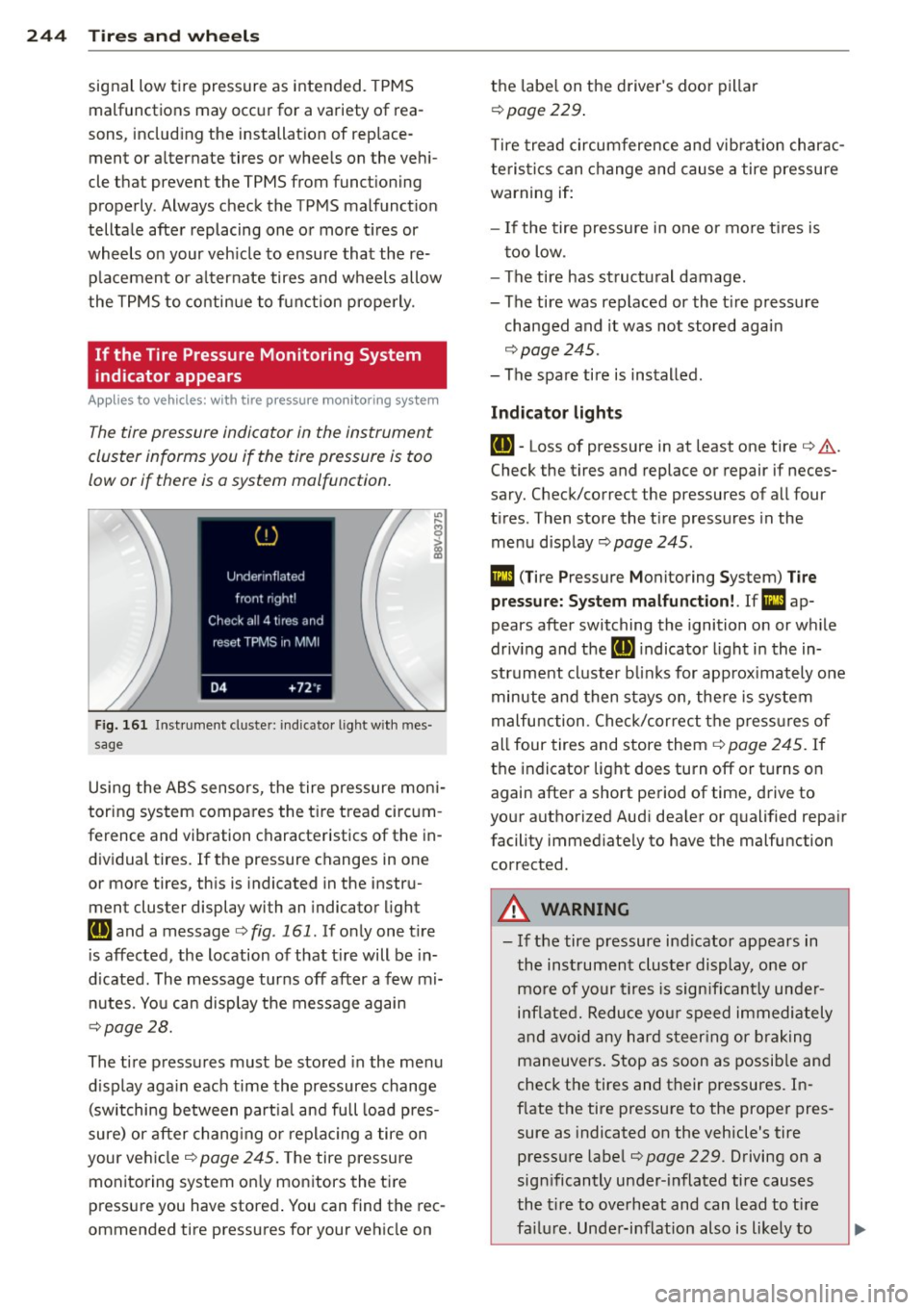
F ig. 161 Ins trumen t cluste r: ind icato r light w it h m es
s age
Using the ABS sensors, the tire pressure moni
toring system compa res the tire tread circum
ference and vibration characteristics of the in
dividual tires .
If the pressure changes in one
or more tires, th is is indicated in the instru
ment cluster display with an indicator light
IE and a message ¢ fig. 161 . If only one t ire
is affected, the location of that t ire will be in
d icated. The message turns off after a few mi
nutes. You can disp lay the message again
¢ page 28.
The tire pressures must be stored in the menu
d isplay aga in each time the pressures change
(switching between part ia l and full load pres
sure) or after chang ing or replac ing a tire on
your ve hicle ¢
page 245. The tire pressure
monitoring system on ly monitors the ti re
press ure you have stored . You can find the rec
ommended tire pressures for your vehicle on the
labe l on the driver's doo r pillar
¢ page 229 .
Tire tread circumference and vib ration charac
teristics can change and cause a tire pressure
warning if:
- I f the tire pressure in one or more ti res is
t oo low.
- The tire has structural damage.
- The tire was replaced or the t ire pressure
changed and it was not stored again
¢ page 245.
-The spare tire is installed .
Indicator lights
IE -Loss of pressure in at least one tire ¢ .&. .
Check the tires and replace or repair if neces
sary. Check/correct the pressures of all four
t ires . Then store the t ire pressures in the
menu display
¢ page 245.
Ill (T ire Pressure Monitoring System) T ire
pre ssure: S ystem mal function!. Ifm:!
ap
pears afte r switching the ignition on or w hile
driv ing and the [ti] indicato r light in the in
strument cluster b links for app rox imately one
minute and then stays on , the re is system
malfu nction . Check/cor rect the p ress ures of
all four tires and store them¢
page 245. If
t h e indicator lig ht does turn off or tu rns on
again after a short pe riod of time, drive to
your authori zed Aud i dea ler or qualified repair
facility immed iately to have the malfunction
corrected .
A WARNING
--- If the tire pressure ind icator appears in
the instrument cluster display , one or
mo re of your t ires is sign ifi cant ly unde r
i n flated. Reduce yo ur speed immedi ately
an d avoid any hard steer ing or b rak ing
maneuvers. Stop as soon as possib le and
check the tires and their pressures. In
f late the tire pressure to the proper pres
sure as indicated on the vehicle's tire
pressure labe l
¢page 229. Driving on a
significantly under-i nflated tire causes
the t ire to overheat and can lead to ti re
fa ilur e. Unde r-inflation also is li kely to
Page 247 of 288
impair the vehicle's handling and stop
ping ability.
- The driver is responsible for maintaining
the correct tire pressures. You must
check the t ire pressures regularly.
- Under certain conditions (such as a spor
ty driving style, w inter condit ions or un
paved roads), the pressure monitor ind i
cator may be de layed.
- Ask your authorized dealer if run-flat
tires may be used on your vehicle. You ve
hicle registrat ion becomes invalid if you
use these tires when not permitted .
Damage to your vehicle or accidents
c ou ld also resu lt.
(0 Tips
- The t ire pressure monitoring system can
also stop work ing when there is an ESC/
ABS malfunction.
- Using snow chains may result in a system malfunction .
- The t ires with the ident ificat ion "AO" or
"RO"¢ page 236 have been matched
with you r A udi tire p ressu re monito ring
system. We recommend that you use
these tires.
- The t ire pressure monitoring system can
on ly mon itor the t ire pressure of the
driving tires . C he ck the tire pressure of
the spare wheel in the luggage compart
ment so that if necessary it is ready for
u se .
Storing tire pressures
Applies to vehicles: with tire pressure monitoring system
A change in tire pressure or a change in tires
must be stored in the system.
The ti re p ress ure is s to red in the M MI.
~ Make sure befo re stor ing that the tire pres
su res of all fou r tires meet the specified val
ues and a re adapted to the load. Otherw ise
the system co uld mal function ~
page 229.
~ Switch the ignition on.
~ Select : Sys tem s control button or Car sy s
tems > Servic e
& control > Tire pressure
Tire s an d wheel s 245
monitor > Store tire pre ssure > Ye s, store
now .
(D Tips
Do not s to re the tire pressures if snow
chains a re installed.
•
•
•
Page 257 of 288
Fuses and bulbs
Electrical fuses
Replacing fuses
Fuses that have blown will have metal strips
that have burned through.
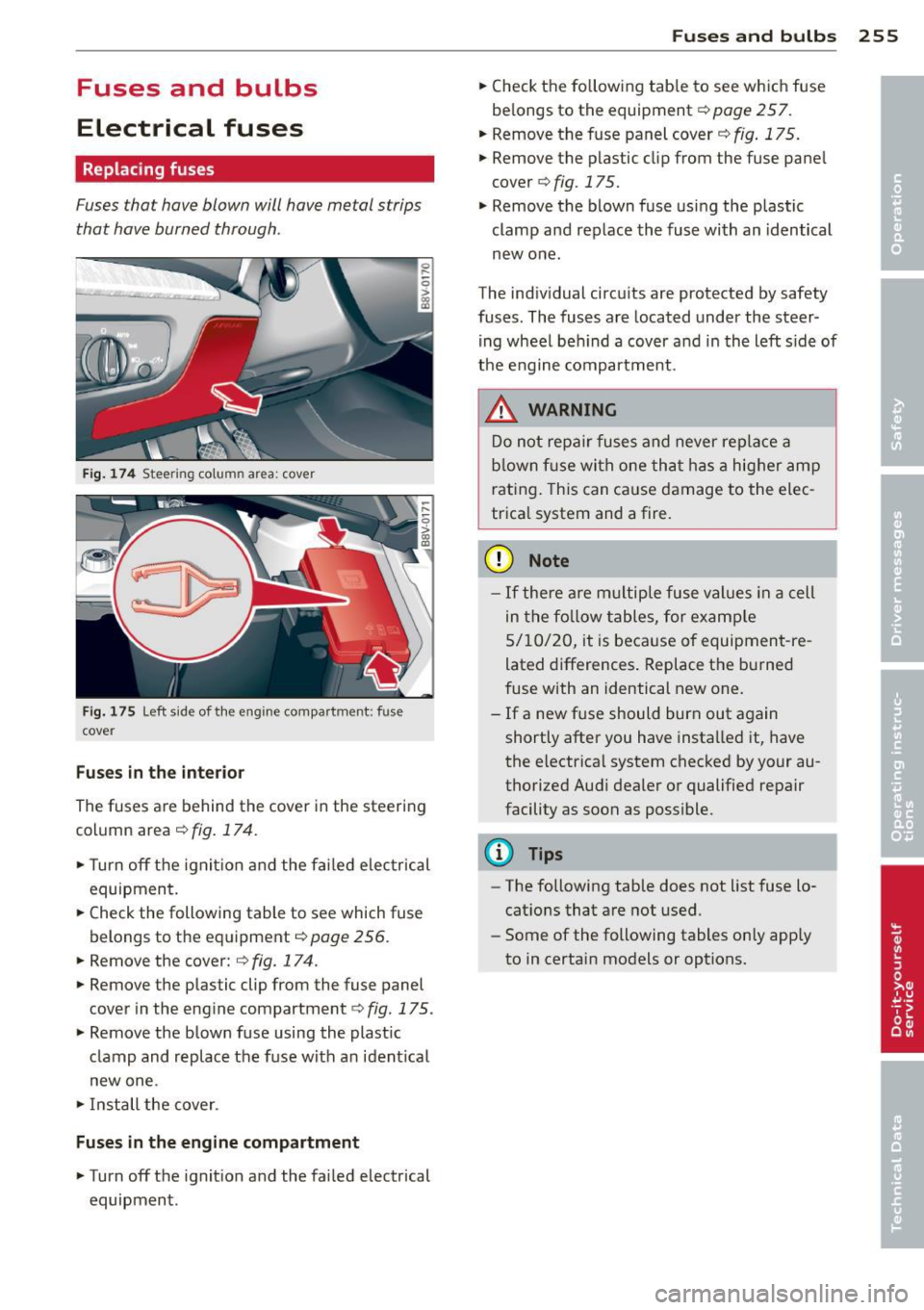
Fig. 17 4 Steering column area: cover
Fig. 175 Left side of the engine compartment: fuse
cover
Fuses i n the interio r
The fuses are behind the cover in the steering
column area
¢fig. 174.
•Turnoff the ignition and the fai led e lectrical
equipment.
• Check the following table to see which fuse
belongs to the equipment¢
page 256.
• Remove the cover: ¢ fig. 174.
• Remove the plastic clip from the fuse panel
cover in the eng ine compartment
c;, fig. 175.
• Remove the blown fuse using the plast ic
clamp and replace the fuse with an ident ica l
new one.
• Install the cover .
Fuse s in th e en gine compar tmen t
•Turnoff the ignition and the failed electrical
equipment .
Fuse s and bulb s 255
• Check the fo llowing tab le to see which fuse
be longs to the equipment
c:;, page 257.
• Remove the fuse panel cover¢ fig. 175.
• Remove the plastic clip from the fuse pane l
cover
c;, fig. 175.
• Remove the blown fuse using the plastic
clamp and replace the fuse with an identical
new one .
The indiv idual circu its are protected by safety
fuses . The fuses are located under the steer
ing wheel beh ind a cover and in the left s ide of
the engine compartment .
.&_ WARNING
-
Do not repair fuses and never replace a
blown f use with one that has a hig her amp
rating. Th is can cause damage to the elec
trica l system and a fire .
(D Note
-If there a re multiple fuse values in a cell
in the fo llow tables, for examp le
5/10/20, it is because of equipment -re
lated differences . Replace the burned
fuse with an identical new one.
- If a new f use should burn out again
shortly after you have installed it, have
the electrical system checked by your au
thorized Aud i dealer or qualified repair
facility as soon as possible.
(!) Tips
- The following tab le does not list fuse lo
cations that are not used .
- Some of the following tables on ly app ly
to in certain models or options.