check engine light AUDI A3 CABRIOLET 2016 Owner's Manual
[x] Cancel search | Manufacturer: AUDI, Model Year: 2016, Model line: A3 CABRIOLET, Model: AUDI A3 CABRIOLET 2016Pages: 272, PDF Size: 67.88 MB
Page 199 of 272
<( co .... N ,.__
N .... 0 ,.__
> co
-Never open the vehicle battery. Do not try to
change the battery electro lyte level. Other
wise explosive gas will escape from the bat
tery and increase the r isk of an explos ion .
(D Tips
If your vehicle is not driven for several weeks
in very cold temperatures, remove the battery
and store it in a place where it will not freeze.
This prevents the battery from being dam
aged and needing to be replaced .
Working on the battery
Be especially careful when working on or near
the battery .
The battery (12 V) is located in the engine com
partment.
Always heed the
safety warnings, when working
on the vehicle battery or the vehicle electrical
system to prevent injury.
The following WARNINGS are very important
when working on the battery:
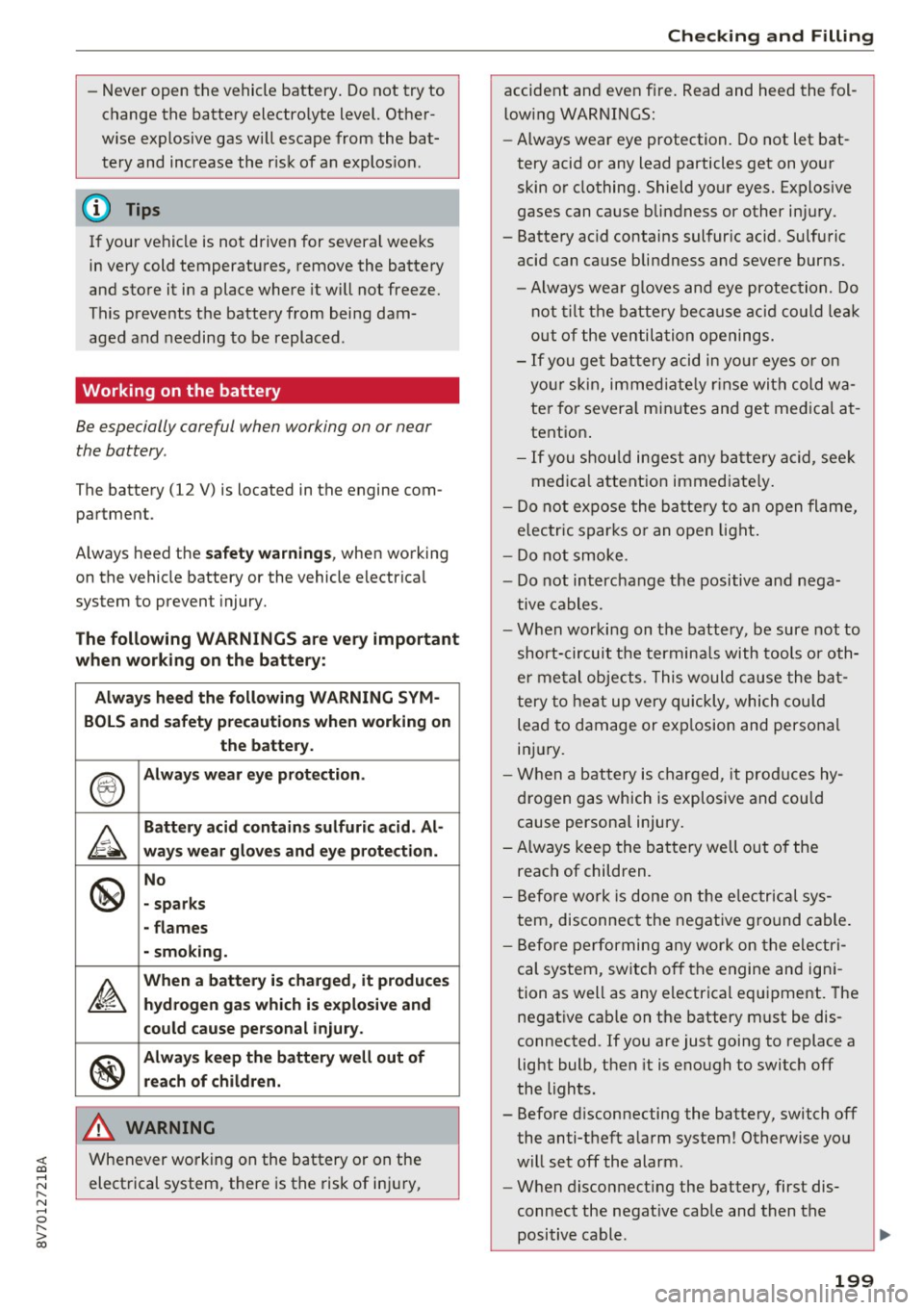
Always heed the following WARNING SYM-
BOLS and safety precautions when working on
the battery.
®
Always wear eye protection.
&
Battery acid contains sulfuric acid. Al-
ways wear gloves and eye protection.
@
No
- sparks
- flames
- smoking.
A
When a battery is charged, it produces
hydrogen gas which is explosive and
.
could cause personal injury .
®
Always keep the battery well out of
reach of children.
A WARNING
Whenever working on the battery or on the
electrical system, there is the risk of injury,
-
Checking and Filling
accident and even fire . Read and heed the fol
low ing WARNINGS:
- Always wear eye protection. Do not let bat
tery acid or any lead particles get on your
skin or clothing. Shield your eyes. Explosive
gases can cause blindness or other injury.
- Battery acid contains sulfur ic acid. Sulfuric
acid can cause blindness and severe burns.
- Always wea r gloves and eye protection. Do
not tilt the battery because acid could lea k
out of the ventilation openings.
- If you get battery acid in yo ur eyes or on
you r skin, immed iate ly r inse with cold wa
ter for severa l min utes and get medical at
tent ion .
- If you shou ld ingest any battery acid, seek
medica l attention immediate ly.
- Do not expose the battery to an open flame,
electric sparks or an open light.
- Do not smoke.
- Do not interchange the positive and nega-
tive cables.
- When working on the battery, be sure not to
short-circuit the termina ls with tools or oth
er metal objects. This would cause the bat
tery to heat up very quickly, which could
lead to damage or exp losion and personal
inj ury.
- When a battery is charged, it produces hy
drogen gas which is explosive and could
cause persona l injury.
- Always keep the battery well out of the
reach of children.
- Before work is done on the e lectrical sys
tem, disconnect the negative ground cable.
- Before performing any work on the electri
cal system, switch off the engine and igni
tion as well as any electrical equipment. The
negat ive cab le on the battery must be dis
connected. If you are just going to replace a
light bulb, then it is enough to switch off
the lights.
- Before disconnecting the battery, switch off
the anti-theft a larm system! Otherwise you
will set off the alarm .
- When disconnecting the battery, first dis
connect the negat ive cable and then the
positive cable.
199
Page 240 of 272
Fuses and bulbs
Fuses and bulbs
Electrical fuses
Replacing fuses
A fuse that has blown will have metal strips that
have burned through.
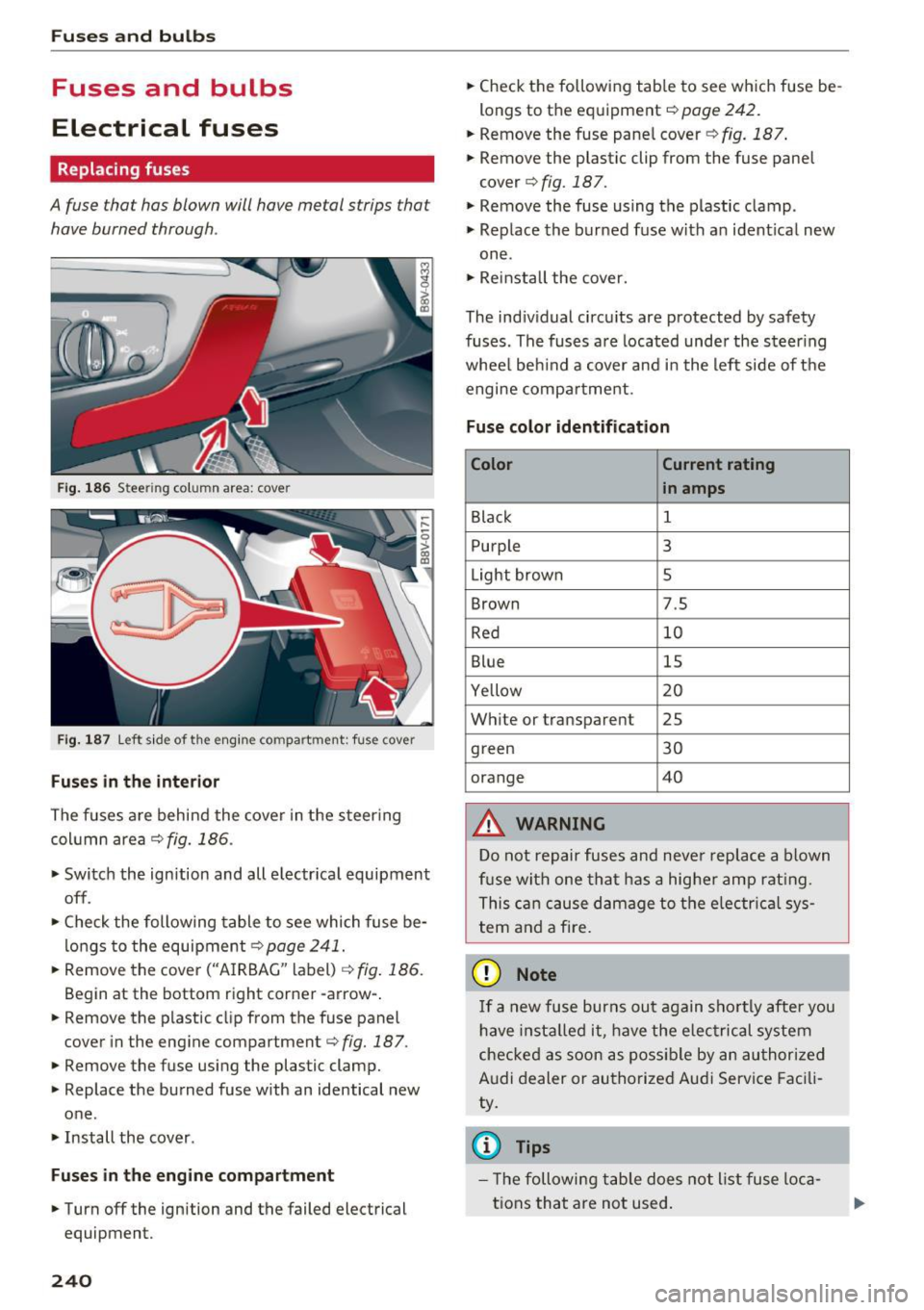
Fig. 18 6 Stee ring column area: cover
F ig. 1 87 Left s ide of the engine compartment: fuse cover
Fuses in the interior
The fuses are behind the cover in the s teer ing
col umn area
¢ fig. 186 .
"Switch the ignition and all e lectr ica l equipment
off.
" Check the following table to see which fuse be
lo ngs to the equipment ¢
page 241.
"Remove the cover ("AIRBAG" label)¢ fig. 186.
Begin at the bottom right corner -arrow-.
" Remove the plastic clip from the fuse panel
cover in the engine compartment¢
fig. 187 .
"Remove the fuse using the plastic clamp.
" Replace the burned fuse with an identical new
one .
" Install the cover .
Fuses in the engine compartment
" Turn off the ignition and the failed electrical
equipment.
240
" Check the following tab le to see wh ich fuse be
longs to the equipment
¢ page 242.
"Remove the fuse pane l cover ¢ fig. 187 .
" Remove the plastic clip from the fuse panel
cover ¢
fig. 187.
"Remove the fuse using the plastic clamp .
" Replace the b urn ed f use w ith a n ident ica l new
one .
" Reinstall the cover.
The ind iv idual circu its are protected by safety
fuses . The fuses a re located under the steer ing
whee l be hind a cover and in the left side of t he
engine compa rtme nt.
Fuse color identification
Color Current rating
in amps
Bla ck 1
Purple 3
Light brown 5
Brown 7.5
Red 10
Blue 15
Yellow 20
Wh ite or transparent 25
green 30
orange 40
&, WARNING
D o not repair fuses and neve r rep lace a blown
f u se w ith one that has a hig he r amp rat ing.
T his ca n ca use damage to the e lectr ic al sys
tem and a fi re.
(D Note
If a new fuse burns ou t again s ho rtly after you
h ave inst alled it , have the electrical system
checke d as soon as possible by an au thor ized
A udi dealer o r au thorized Au di Service Fac ili
ty.
(D Tips
- T he followi ng ta ble does not list fuse loc a
t io ns that are not used .
Page 244 of 272

Emergency situations
Emergency situations
General
This chapter is intended for trained emergency crews and working personnel who have the nec
essary tools and equipment to perform these
operations.
Starting by pushing or
towing
CD Note
Vehicles with an automatic transmission can
not be started by pushing or towing.
Starting with jumper
cables
If necessary, the engine con be started by con
necting it to the battery of another vehicle .
If the engine should fail to start because of a dis
charged or weak battery, the battery can be con
nected to the battery of
another vehicle, using a
pair of jumper cables to start the engine.
Jumper cables
Use only jumper cables of sufficiently large cross
section
to carry the starter current safely. Refer
to the manufacturer's specifications.
Use only jumper cables with
insulated terminal
clamps which are distinctly marked :
plus(+) cable in most cases colored red
minus(-) cable
in most cases colored black .
A WARNING
Batteries contain electricity, acid, and gas.
Any of these can cause very serious or fatal in
jury. Follow the instructions below for safe hand Ling of your vehicle's battery .
-Always shield your eyes and avoid leaning
over the battery whenever possible.
-A discharged battery can freeze at tempera
tures just below 32 °F (0 °C). Before con
necting a jumper cable, you must thaw the
244
frozen battery completely, otherwise it could explode .
- Do not allow battery acid to contact eyes or
skin. Flush any contacted area with water immediately.
- Improper use of a booster battery to start a
vehicle may cause an explosion.
- Vehicle batteries generate explosive gases.
Keep sparks, flame and lighted cigarettes
away from batteries.
- Do not try to jump start any vehicle with a
low acid level in the battery .
- The voltage of the booster battery must also
have a 12-volt rating. The capacity (Ah) of
the booster battery should not be lower
than that of the discharged battery. Use of
batteries of different voltage or substantial
ly different "Ah" rating may cause an explo
sion and personal injury .
- Never charge a frozen battery. Gas trapped in the ice may cause an explosion .
- Never charge or use a battery that has been
frozen . The battery case may have be weak
ened .
- Use of batteries of different voltage or sub stantially different capacity (Ah) rating may
cause an explosion and injury. The capacity
(Ah) of the booster battery should not be
lower than that of the discharged battery.
- Before you check anything in the engine
compartment, always read and heed all
WARNINGS
~page 188.
CD Note
-Applying a higher voltage booster battery
will cause expensive damage to sensitive
electronic components, such as control
units, relays, radio, etc.
- There must be no electrical contact between
the vehicles as otherwise current could al
ready start to flow as soon as the positive
(+) terminals are connected.
@ Tips
The discharged battery must be properly con-
nected to the vehicle's electrical system. .,..
Page 261 of 272
<( co .... N r--N .... 0 r--> co
Electronic Stabilization Control (ESC) . . . . . 116
Emergency assistance . . . . . . . . . . . . . . . . . 230
Emergency flasher . . . . . . . . . . . . . . . . . . . . . 44
E mergency flashe rs
I ndicator light . . . . . . . . . . . . . . . . . . . . . . .
21
Emergency locking the front passenger 's door .3.2
Emergency operat ion
Emergency braking function . . . . . . . . . . . .
75
Front passenger's door . . . . . . . . . . . . . . . . 32
Luggage compartment lid . . . . . . . . . . . . . . 33
Power top . . . . . . . . . . . . . . . . . . . . . . . . . . . 40
with conven ience key . . . . . . . . . . . . . . . . . . 72
Emergency release
Fuel filler door . . . . . . . . . . . . . . . . . . . . . .
187
Selector lever . . . . . . . . . . . . . . . . . . . . . . . . 83
Emergency starting 244
Energy management . . . . . . . . . . . . . . . . . . 121
Indicator light . . . . . . . . . . . . . . . . . . . . . . . 17
Engine
Coolant . . . . . . . . . . . . . . . . . . . . . . . . . . . .
195
Starting with jumper cables . . . . . . . . . . . 244
Starting (button) . . . . . . . . . . . . . . . . . . . . . 70
Starting (key) . . . . . . . . . . . . . . . . . . . . . . . . 68
Starting (messages with conven ience key) . 72
stopping (button) . . . . . . . . . . . . . . . . . . . . 71
stopping (key) . . . . . . . . . . . . . . . . . . . . . . . 69
Engine compartment
C losing the hood . . . . . . . . . . . . . . . . . . . .
190
Opening the hood . . . . . . . . . . . . . . . . . . . 190
Overview ... .................. ..... . 191
Safety precautions . . . . . . . . . . . . . . . . . . . 188
Engine control (indicator light) . . . . . . . . . . . 19
Engine coolant
Radiator fan
196
Engine oil . . . . . . . . . . . . . . . . . . . . . . . . . . . 191
Changing . . . . . . . . . . . . . . . . . . . . . . . . . . 194
Checking oil level . . . . . . . . . . . . . . . . . . . . 193
Consumption . . . . . . . . . . . . . . . . . . . . . . . 193
Dipstick . . . . . . . . . . . . . . . . . . . . . . . . 191, 193
F'll ' I mg . . . . . . . . . . . . . . . . . . . . . . . . . . . . . 193
Indicator light . . . . . . . . . . . . . . . . . . . . . . . 16
Oi l consumption . . . . . . . . . . . . . . . . . . . . . 192
Specification and viscosity . . . . . . . . . . . . . 191
Engine speed limitation (indicator light) . . . 19
Environment
Break-in period . . . . . . . . . . . . . . . . . . . . . . .
65
Catalytic converter . . . . . . . . . . . . . . . . . . . 187
Index
Disposing of your vehicle battery . . . . . . . 201
Driving at high speeds . . . . . . . . . . . . . . . . . 66
Letting the vehicle stand and warm up. . . . 66
Proper disposal of drained brake fluid . . . 197
Proper disposal of drained engine oil . . . . 194
Unleaded gasoline . . . . . . . . . . . . . . . . . . . 184
What should I do with an old battery? . . . 201
EPC (engine control) . . . . . . . . . . . . . . . . . . . . 19
ESC
Automatic post-collision braking system .
116
Electronic stabilization control . . . . . . . . . 116
Sport mode . . . . . . . . . . . . . . . . . . . . . . . . 117
also refer to Electronic Stabilization Control
(ESC) . . . . . . . . . . . . . . . . . . . . . . . . . . . . . .
116
ESP
refer to Electronic Stabilization
Control (ESC) . . . . . . . . . . . . . . . . . . . . . . .
116
Event Data Recorder (EDR) . . . . . . . . . . . . . 122
Exterior lighting . . . . . . . . . . . . . . . . . . . . . . . 43
Exterior mirrors
Adjusting . . . . . . . . . . . . . . . . . . . . . . . . . . .
47
Dimming . . . . . . . . . . . . . . . . . . . . . . . . . . . . 48
folding . . . . . . . . . . . . . . . . . . . . . . . . . . . . . 47
Heating... .. .. .. .. ............... .. . 47
F
Fastening
Booster seats . . . . . . . . . . . . . . . . . . . . . . .
17 4
Convertible child safety seats . . . . . . . . . . 172
Infant seats . . . . . . . . . . . . . . . . . . . . . . . . 171
Floor mats . . . . . . . . . . . . . . . . . . . . . . . . . . . 129
Fog lights/rear fog light(s) . . . . . . . . . . . . . . 43
Folding the exterior mirrors
Center locking . . . . . . . . . . . . . . . . . . . . . . .
31
Folding the rear seats . . . . . . . . . . . . . . . . . . . 58
Foot pedals . . . . . . . . . . . . . . . . . . . . . . . . . . 129
Footwell lighting . . . . . . . . . . . . . . . . . . . . . . 46
For the sake of the env ironment
ear w indow defogger . . . . . . . . . . . . . . . . . .
64
Environmentally-friend ly driving . . . . . . . . 65
Fueling . . . . . . . . . . . . . . . . . . . . . . . . . . . . 186
Leaks..... .... .. ................. .. 189
Freeze protection
Coo lant additive . . . . . . . . . . . . . . . . . . . . .
195
Windshield washer system . . . . . . . . . . . . 202
261