spare tire AUDI A4 CABRIOLET 2009 User Guide
[x] Cancel search | Manufacturer: AUDI, Model Year: 2009, Model line: A4 CABRIOLET, Model: AUDI A4 CABRIOLET 2009Pages: 340, PDF Size: 77.32 MB
Page 285 of 340
__________________________________________________ T_ ir_e_ s_ a_ n_d _ w_ h_ e_ e_l_s _ ...... fflll
•
0 Not e
• For technical reasons, it is not genera lly possible to use the
wheel rims from other vehic les. This can hold true for wheels of the
same vehicle type.
• If the spare tire is different from the tires that you have mounted
on your vehicle (for example winter tires or wide profile t ires), then
use the spare tire for a short period of time only and drive with extra
care. Rep lace the flat tire with the tire matching the others on your
vehic le as soon as possible.
• If you should put different wheels and tires on your vehic le (e.g.
winter wheels and tires), you must be certain that the wheels and
tires are compatib le with the tire pressure monitoring system.
Otherwise the system will register a malfunction and a fault
message will be displayed . For more information, contact your Aud i
dea ler.
0 Note
• When insta lling new tires, be carefu l not to damage the valves or
t ire pressure monitoring system* senso rs.
• Never drive without the va lve stem cap. The va lves could get
damaged.
• If the sensors must be replaced, then the valve must also be
replaced at the same t ime.
Uniform tire quality grading
• Tread wear
• Traction AA A B C
• Temperature A B C Qua
lity grades can be found where applicable on the tire side wall
be tween tread shoulder and maximum section widt h =>
page 279,
fig. 21 1.
For example : Tread wear 200, Traction AA , Temperature A.
All passenger car tires must conform to Federa l Safety Require
ments in addition to these grades.
Tre ad w ear
The tread wear grade is a comparative rating based on the wear rate
of the tire when tested under con trol led conditions on a specified
government test course.
F o r exam ple, a tire g raded 150 would wear one and one half (1 1/2)
times as well on the government course as a tire graded 100 .
The relative performance of tires depends upon the actual condi
tions of the ir use, however, and may depart significantly from the
norm due to variations in driving habits, service practices and differ
ences in road cha racteristics and c limate .
Tra ction
The traction grades, from highest to lowest , are AA, A, Band C.
Those grades represent the tire's ability to stop on wet pavement as
measu red under contro lled conditions on specified government
test surfaces of asphalt and concrete. A tire marked C may have
poor traction performance =>
/.1.
Temperatur e
The temperature grades are A (the highest), B, and C, representing
the tire 's resistance to the generation of heat and its ability to dissi
pate heat when tested under contro lled conditions on a specified
indoor laboratory test wheel.
Sus tained high temperature can cause the material of the ti re to
degenerate and reduce tire life, and excessive temperature can lead
to sudden tire failure=>
/.1.
The grade C corresponds to a level of performance which all
passenger car tires must meet under the Federal Motor Vehicle
Vehic le care
Page 293 of 340
_______________________________________________ W_ h_ a _ t_d_ o_ l _d _o_ n_ o_ w_ ? _ __,_
- Se curely en gage the han dle in th e lu ggage com partm ent
se al as illust rate d to k eep th e flo or panel up.
- Take o ut tool case and/or jack .
- Dise ngage and lower the floo r panel befo re yo u close the
luggage compa rtment lid again .
The onboard tool kit inc ludes:
• Hook for re moving whee l cove rs*
• Plastic hook to remove wheel bolt covers
• Wheel bolt wrench
• Alignment pin for changing wheels
• Screwdriver with reversible b lade
• Tow ing eye
Before storing the jack, make sure it is wound back down as far as it
wi ll g o.
After use , the jack and tools must be put back in place underneath
the floor panel in the luggage compartment .
Note : some o f the o n board i te m s liste d abo ve are provi ded on
certain models on ly or are optional extras .
& WARNING
Improper use of the vehicle ja ck can cause serious personal inju
ries .
• Using a bumpe r jack to raise the vehicle will damage the
bumper system . The jack may slip , causing injury .
• Never support your vehicle on cinder blocks , bricks or other
objects . These may not be able to support the load and could
c ause injury when they fail.
• Never start o r run the engine while the vehicle is supported by
the jack.
& WARNING (continued )
• If you must work under the vehicle, always use safety stands
specifically designed for this purpose .
• Never try and use the hexagonal socket in the handle of the
screwdriver to loosen or tighten the wheel bolts.
• Always make sure the spare tire and even a flat tire are secured
in pla ce and not loose , otherwise they could fly forward , causing
personal injury to passengers in the vehicle in an accident or
s udden maneuver .
• Never use the jack supplied with your Audi on another vehicle,
particularly on a heavier one. The jack i s only suitable for use on
the vehicle it came with. •
App lie s to ve hic les : w ith a reg ular sp are whee l
Spare wheel
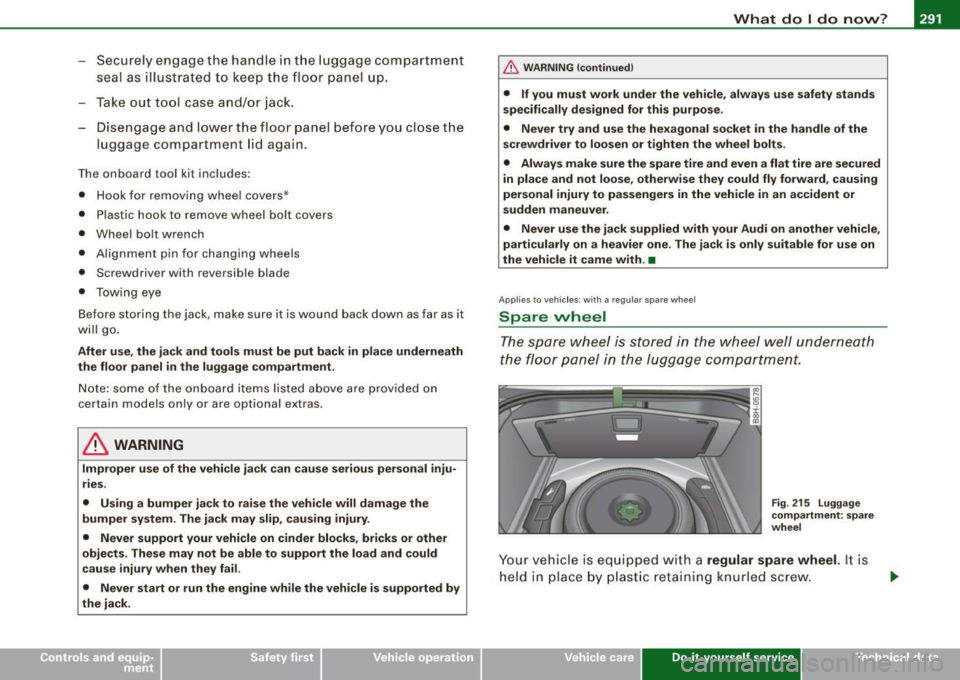
Th e s pare whe el i s stor ed in th e wh eel w ell unde rneath
the fl oor pan el in th e lugg age c omp artme nt.
Fig . 21 5 luggage
compartment: spa re
w heel
Yo ur v ehi cle is equi pped wi th a regular spare wheel. It i s
h eld in pla ce by pla stic re tainin g knur le d sc re w .
~ehicle care Do-it-yourse lf service irechnical data
Page 294 of 340

11111.___W_ h_ a_ t_d_ o_ l _d _o_ n_ o_ w_ ? ______________________________________________ _
Taking out the spare wheel
- Raise the floor panel at the plastic handle.
- Securely engage the handle in the luggage compartment
seal as illustrated to keep the floor panel up.
- Unscrew the knurled retainer bolt in the wheel center
==> page 291, fig. 215. Turn it counter-clockwise.
- Take out the spare wheel.
- Disengage and lower the floor panel before you close the
luggage compartment lid again.
Storing the replaced wheel
-Place the replaced wheel inside the spare wheel well in
the luggage compartment.
- Tighten the knurled retaining screw clockwise to secure
the wheel in place.
- Disengage and lower the floor panel before you close the
luggage compartment lid again.
& WARNING
Loose items in the passenger compartment can cause serious
personal injury during hard braking or in an accident .
• Never store the spare wheel or jack and tools in the passenger
compartment.
• Always store all jacking equipment, tools, and the spare wheel
in the luggage compartment.
• Tighten the knurled retaining screw for the spare wheel
securely.
[ i] Tips
Check the inflation pressure of the spare tire periodically to keep the
tire ready for use. •
Applies to vehic les: w ith a space -saving spare wheel
Space-saving spare wheel
The compact spare wheel is only intended to be used for
a short time.
Using the space-saving spare wheel
The space -saving spare wheel is only intended for emergencies
until you can reach a repair shop. Replace it as quickly as possible
with a normal wheel.
There are some restrictions on the use of the space -saving spare
wheel
=> ,&. . The space-saving spare wheel has been developed
especially for your type of vehicle. It must not be exchanged for the
space-saving spare wheel from another type of vehicle.
Normal summer or winter tires must not be fitted on the space
saving spare wheel rim.
Snow chains
For technical reasons, the use of snow chains on the space-saving
spare wheel
not permitted .
If you do have to drive with snow chains and have a tire failure on a
front wheel, install the space-saving spare wheel in place of a rear
wheel. Install the snow chains on the rear wheel and use it to
replace the defective front wheel.
& WARNING
• After installing the space-saving spare wheel, the tire pressure
must be checked as soon as possible. The tire pressure must be
adapted to the load condition of the vehicle according to the tire .,_
Page 295 of 340

_____________________________________________ W_ h _a_t _ d_ o_ l _d _o _ n_o_ w_ ?_ . _ ..... 19111
•
& WARNING (continued)
pressure table - risk of accident! Use the highest tire pressure in
the table.
• Do not drive faster than 50 mph (80 km/h) - risk of accident!
• Avoid full-throttle acceleration, sharp braking, and fast
cornering - risk of accident!
• Never drive using more than one space-saving spare wheel -
risk of accident!
• Normal summer or winter tires must not be fitted on the space
saving spare wheel rim. •
Wheel change
Before changing a wheel
Follow these points for your own and your passenger's
safety when replacing a wheel.
-After you experience a tire failure, pull the car well away
from moving traffic and try to reach level ground before
you stop => & .
- All passengers should leave the car and move to a safe
location (for instance, behind the guardrail)=>& .
- Apply the parking brake firmly=>&.
- Move selector lever to position Pon an automatic trans-
mission; put manual transmission in first gear =>& .
- If you are towing a trailer: unhitch the trailer from your
vehicle.
- Take the tool case and the spare tire=>
page 290 out of
the luggage compartment.
& WARNING
You or your passengers could be injured while changing a wheel if
you do not follow these safety precautions:
• If you have a flat tire, move a safe distance off the road. Turn off
the engine, turn the emergency flasher on and use other warning devices to alert other motorists .
• Make sure that passengers wait in a safe place away from the
vehicle and well away from the roadway and traffic.
• To help prevent the vehicle from moving suddenly and possibly
slipping off the jack, always fully set the parking brake and block
the wheel diagonally opposite the wheel being changed. When one
front wheel is lifted off the ground, placing the Automatic Trans
mission in "P" (Park), or engaging a gear in a manual transmission
will
not prevent the vehicle from moving .
• Before you change a wheel, be sure the ground is level and firm.
If necessary, use a sturdy board under the jack.
• After installing the spare wheel, make sure that you remount
the flat tire/wheel in its storage area properly and tighten the
knurled retaining screw securely. •
Changing a wheel
When you change a wheel, follow the sequence described
below step-by -step and exactly in that order.
1. Remove the decorative wheel cover*. For more details
see also =>
page 294, "Decorative wheel covers" or
=>
page 295, "Wheels with cap-covered wheel bolts".
2. Loosen the wheel bolts=>
page 295.
3. Locate the proper mounting point for the jack and align
the jack below that point=>
page 296.
4. Lift the car with the jack=> page 296. _,..
Do-it-yourself service
Page 296 of 340

_1.--_W:...:....: h..:.. a=-.: t..:..d= o....:... I .=d .:..;o:......;. n..:.. o.::...;. vv..:....:.. ? ______________________________________________ _
5. Take the flat wheel off and then put the spare on
=> page 297.
6. Tighten all wheel bolts lightly.
7.
Lower the vehicle with the jack.
8. Use the wheel bolt wrench and
firmly tighten all wheel
bolts
=> page 295.
9. Put the decorative wheel cover* back on.
& WARNING
Always read and head all WARNINGS and information ~ & in
"Raising the vehicle" on
page 296 and ~ page 298. •
After changing a wheel
A wheel change is not complete without the following
actions.
- Store and secure the replaced wheel in the spare wheel
well.
- Put the tool case and the jack back in place in the luggage
compartment .
- Check the
tire pressure on the spare wheel immediately
after mounting it.
- As soon as possible , have the
tightening torques on all
wheel bolts checked with a torque wrench. The correct
tightening torque is 90 ft lb (120 Nm).
- Have the flat tire
replaced as soon as possible.
[ i ] Tips
• If you notice while changing a tire that the wheel bolts are
corroded and difficult to turn, then they should be replaced before
you check the tightening torque.
• Drive at reduced speed until you have the tightening torques
checked .•
A pp lies to vehicle s: wi th dec orat ive w heel cove rs
Decorative wheel covers
The decorative wheel covers must be removed first to
access the wheel bolts.
Removing
"' ....
"' 0 ±. .,
"'
Fig. 216 Wheel
change : removing the
wheel cover
- Insert the hook provided with the onboard tool kit into
the hole on the center hub piece.
- Pull off the
decorative wheel cover=> fig. 216. •
Page 300 of 340
1111.___W_ h_ a_ t_d_ o_ l _d _o_ n_ o_ w_ ? ______________________________________________ _
-Screw the threaded end o f the alignment pin from the
tool kit hand -tight into t he now vacant bo lt hole
=>
page 297, fig . 222.
- Then completely unscrew the other wheel bolts as
described above .
- Take off the wheel leaving the alignment p in in the bolt
hole.
Puttin g on th e sp are
- Lift the spare wheel up and carefu lly s lide it over the
alignment pin to gu ide it in place .
- Use t he hexagonal socket in the screwd river handle to
screw in and tighten all w heel bolts
slightly.
- Unscrew the alignment pin and insert and tighten the
remaining w heel bolt slightly like the rest.
- Turn the handle on the jack counter-clockwise to lower
the vehicle until the jack is fully released.
- Use the wheel bo lt wrench to tighten all wheel bo lts
firmly=>
page 295. Tighten crosswise, from one bolt to
the (approx imately) oppos ite one, to keep the wheel
centered.
[ i ] Tip s
Never try and use the hexagona l socket in the handle of the screw
driver to loosen or tighten the wheel bolts.
• Pull the reversible b lade from the screwdriver before you use the
hexagonal socket in the handle to turn the wheel bo lts.
• When mounting tires with
uni dire cti on al tread desig n make sure
the tread pattern is pointed the right way~
page 298.
• The whee l bolts should be clean and easy to turn. Check for dirt
and corrosion on the ma ting surfaces of both the wheel and the
hub. Remove all dirt from these surfaces before remounting the
wheel. •
Tires with unidirectional tread design
Tires with unidirectional tread design must be mounted
with their tread pattern pointed the right direction.
U sin g a spa re tire wit h a tre ad p atte rn int ended for u se
i n a sp ec ific dir ection
When using a spare tire with a tread pattern intended for use in a
specific direction, please note the following:
• The direction of rotation is marked by an arrow on the side of the
tire.
• If the spare tire has to be installed in the incorrect direction in the
event of a flat tire, use the spare tire on ly temporarily since the tire
will not be able to achieve its optimum performance characteristics
with regard to aquaplaning, noise and wear.
• We recommend that particular attention be paid to this fact
dur ing wet weather and that you adjust your speed to match road
conditions.
• Replace the flat tire with a new one and have it instal led on your
vehic le as soon as possible to restore the handling advantages of a
proper ly pointed direction-dependent tire. •
Notes on wheel change
Please read the information~ page 279, "New tires and replacing
tires and whee ls", if you are going to use a spare tire which is
different from the tires on your veh ic le.
After you change a tire: .,_
Page 301 of 340

_____________________________________________ W_ h _a_t _ d_ o_ l _d _o _ n_o_ w_ ?_ . _ .... I'll
•
• Check the tire pressure on the spare immediately after
mounting.
• Have the wheel bolt t ightening torque checked with a torque
wrench as soon a s possible by your authorized Audi dealer or a
qualified se rvice station .
• On steel and alloy wheel rims , the wheel bolts are correctly tight
ened with a torque of 90
ft lb 1120 Nm ).
• If you notice while changing a tire that the wheel bolts are
corroded and diffi cult to turn while changing a tire , they should be
replaced before you check the tightening torque .
• Replace the flat tire with a new one and have it installed on your
vehicle as soon as possible . Remount the wheel cover.
Until then , drive with extra care and at reduced speeds .
& WARNING
• If you are going to equip your vehicle with tires or r ims which
differ from those which were factory installed , then be sure to read
the information
~ page 279 , "New tires and replacing tires and
wheels ".
• Always make sure the damaged wheel or even a flat tire and
the jack and tool kit are properly secured in the luggage compart
ment and are not loose in the passenger compartment .
• In an accident or sudden maneuver they could fly forward ,
injur ing anyone in the vehicle .
• Always store damaged wheel , jack and tools securely in
luggage compartment . Otherwise , in an accident or sudden
maneuver they could fly forward, causing injury to passengers in
the vehicle .
0 Note
Do not use commercially availab le ti re sealants. Otherw ise, the elec
t rica l compo nents of t he tir e pressure mon itor ing sys te m * w ill no longer work properly and the sensor for
the tire pressure moni
t o ring syste m will have to be re placed by a q ual ified work shop.•
Do-it-yourself service
Page 303 of 340
![AUDI A4 CABRIOLET 2009 User Guide _________________________________________________ F_ u_ s_ e_s _ a_n _ d_ b_ u_lb _ s ____ llll
[ i ] Tip s No . Equipm ent Amps
You are wel l adv ised to keep a supply of spare fuses in you](/img/6/57553/w960_57553-302.png "AUDI A4 CABRIOLET 2009 User Guide _________________________________________________ F_ u_ s_ e_s _ a_n _ d_ b_ u_lb _ s ____ llll
[ i ] Tip s No . Equipm ent Amps
You are wel l adv ised to keep a supply of spare fuses in you")
_________________________________________________ F_ u_ s_ e_s _ a_n _ d_ b_ u_lb _ s ____ llll
[ i ] Tip s No . Equipm ent Amps
You are wel l adv ised to keep a supply of spare fuses in your vehic le.
15 Instrument c luster, Navigation system 10
Fuses with the proper ampere ratings are available at your Audi 16 Garage door opener 5
dea ler. •
17 Level , tire pressure control , park assist, 10 light/rain sensor
Fuse list Automatic headlig ht range control, left 5
Fuses which con be replaced. 19 Fog lights 15
Vacant
N o. Equipm ent Amps
21 Vacant
1 Air conditioner 10
22 Doors 15
2 Footwell illumination 5 23 Vacant
3 Heated washer jets 5 Central convenience electrical system 20
Radiator fan 5 25 Heater blower 30
5
Telephone, oil level sensor, multifunction 10 Rear window defogger 30 switch, rear heated seat, shift gate
Air conditioner (air quality sensor), air pressure
27 Socket for tra iler towing (controller) 30
6 5
sensor 28 Fuel pump 20
Electronic Stabil izat ion Program (ESP), bra ke 29 Vacant
7 light switch, clutch peda l switch, steering angle 10
sensor
30 Power top control un it 30
8 Telephone 5 31
Automatic transmission, mirror dimming, diag-15 nosis socket
9 Brake booster (vacuum pump) 15 Towing assembly 15
10
Automatic headl ight beam adjustment, auto -5 33 Cigarette
lighter 20 matic headlight range control, right
34 Electrical socket 20
11
Airbag control unit, front passenge r seat recog -10 nition USA (bladder mat) 35 Luggage compartment socket 20
Diagnosis socket 10 Windshield wiper system 30
13
Steering c olumn module 10
37 Pump for windshie ld an d head light washer* 30
14
Brake lights 10
system
• Do-it-yourself service
Page 320 of 340
___ C_ o_n_ s_ u_m _ e_ r_ ln_ f_o _r_m _ a_ t_ i_o _n ______________________________________________ _
& WARN ING (continued )
• The engine compartment of any motor vehicle is a potentially
hazardous area . Never reach into the area around or touch the
radiator fan . It is temperature controlled and can sw itch on
suddenly -even when the engine is off and the ignition key has
been removed . The radiator fan switches on automatically when
the coolant reaches a certain temperature and will continue to run until the coolant temperature drops .
• Always remove the ignition key before anyone gets under the
vehi cle .
• Always support your vehicle with safety stands if it is neces
sary to work underneath the vehicle . The jack suppl ied with the
vehicle is not adequate for this purpose and could collapse causing serious personal injury .
• If you must work underneath the vehicle with the wheels on
the ground, always make sure the veh icle is on level ground , that
the wheels are always securely blocked and that the engine
cannot be sta rted .
• Always make sure the transmission selector lever (automatic
transmission) is in "P " (Park position ) or Neutral (manual transm is
sion) and the park brake is firmly applied.
W For the sake of the environment
• Cha ng ing t he e ngine sett ings will adverse ly aff ect em iss ion
l eve ls. This is detrimenta l to the environment and increases fuel
co nsu mp tio n .
• Always observe environmental regu lations when disposing of
ol d eng ine oil, u sed br ake fluid , d irty e ngin e coo la nt , spe nt batter ies
or worn out tires.
• Undeployed airba g modu les and prete nsioners might be classi
fied as Perchlorate Material -specia l handling may apply, see
www .dtsc.ca .gov/ hazar douswaste/perc hlorat e. When the vehic le o r
parts of the restraint system including airbag modules safety be lts
w it h pr eten sion ers ar e sc ra p pe d, a ll ap pli cab le la w s and reg ula- tions must be observed. Your authorized Audi dealer is familiar with
t
hese requi re m ents and we re co m mend th at you h ave your dealer
perform this service for you .•
Additional accessories,
modifications and parts replacement
Additional accessories and parts
replacement
Always consult an author ized Audi dealer before
pu rchasin g acc ess ori es.
Your vehicle incorporates the latest safety design features ensuring
a high standa rd o f act ive and passiv e safety .
T his saf ety coul d be compromised by non -approved changes to the
vehic le . F or t his reason, if parts have to be replace d, p lease obse rve
t h e f ollow ing po ints when i nsta lling addi tio na l acc essor ies:
App roved Aud i accessories and genuine Audi pa rts a re avai lab le
fr om autho rize d Aud i dea lers.
T hese dealers also have the necessary fac ilities, tools and trained
spec ia lists t o ins tal l the part s and accessor ie s pr oper ly .
& WARNING
Using the wrong spare parts or using non -approved accessories
can cause serious personal injury.
• Use only accessorie s expressly approved by Audi and genuine
Audi spare parts.
• These parts and accessories have been specially designed to
be used on your vehicle .
• Never install accessories such as telephone cradles or
beverage holders on airbag covers or within the airbag deploy-