tires AUDI A4 CABRIOLET 2009 User Guide
[x] Cancel search | Manufacturer: AUDI, Model Year: 2009, Model line: A4 CABRIOLET, Model: AUDI A4 CABRIOLET 2009Pages: 340, PDF Size: 77.32 MB
Page 223 of 340

- Lack of proper maintenance as wel l as improper use of the
vehic le wi ll impair the function of the emission control system
and could lead to damage.
'£> For the sake of the environm ent
Even when the Emission Control System is operating properly, the
exhaust gas can have a su lfur -like exhaust gas sme ll under some
operating states. This depends on the sulfur content of the fuel
being used. Using a different brand of fue l may help, or filling the
tank with lead-free super grade gasoline. •
Avoid damaging the vehicle
When you are driving on poor roads, or over curbs, steep ramps,
etc., make certain that low- lying parts such as spoilers and exhaust
system parts do not bottom out and get damaged.
This is especially true for vehicles with low -slung chassis (sports
chassis)* and fully loaded vehicles.
a
Operate your vehicle economically
and minimize pollution
General
Your personal style of driving will determine the economy
of your vehicle, as well as exhaust and noise levels.
Fuel economy, environmental impact, and wear on your engine,
brakes and tires largely depend on three factors:
• your personal driving style
• operating cond itions
• technica l limitat ions
Controls and equip
ment Safety first Vehicle operation
Driving
and environm ent
If you anticipate what you need to do next and drive economica lly,
you can easily cut your fuel consumpt ion by 10 -15 percent . This
section wil l give you some tips on how you can help the environ
ment and your pocketbook.
[ i ] Tips
The consumption est imates as published by ENV IRONMENTAL
PROTECTION AGENCY (EPA) and Transport Canada may not corre
spond to your actua l consumption on the road, which will vary
depending upon vehicle load and speed, road and weather condi
tions, trip length, etc. •
Drive smoothly and keep a lookout ahead
Vehicles use the most fuel when they ore accelerating .
-Avoid unnecessary accelerating and brak ing.
Vehicles use the most fue l when they are accelerating . If you antici
pate what is going to happen next, you wi ll need to brake less and,
thus, acce lerate less. Let the vehicle coast whenever possib le - for
examp le when you see that the next traffic light is red. •
Avoid full throttle
Driving at moderate speeds saves fuel and improves your
mileage.
-Try and keep well below your car's maximum speed.
Acce lerating gently reduces fuel consumption, engine wear, and
does not disturb the environment.
Fue l consumption, exhaust emissions and engine noise increase
disproportionately at high speeds . If you drive at approximately
three quarters of top speed, fuel consumption wil l be reduced by •
Vehicle care Do-it-yourself service Technical data
Page 226 of 340
___ T_ r _a_ il_e _r_ t_ o_ vv_ in__... g,_ __________________________________________________ _
Trailer towing
Driving with a trailer
General information
Your Audi was designed primarily for passenger transpor
tation.
If you plan to tow a trailer, please remember that the additional load
will affect durability, economy and performance.
Trailer towing not on ly p laces more stress on the vehicle, it a lso calls
for more concentration from the driver.
For this reasons, always fo llow the operating and driving instruc
tions provided and use common sense. •
Technical requirements
Trailer hitch
Use a weight -carrying hitch conforming to the gross trailer weight.
The hitch must be suitab le for your veh ic le and tra iler and must be
mounted securely on the vehicle's chass is at a technically sound
l ocation. Use only a trailer hitch with removable bal l mount. A lways
check with the trailer hitch manufacturer to make sure that you are
using the correct hitch .
Do not u se a bumper hit ch .
The hitch must be installed in such a way that it does not interfere
with the impact-absorbing bumper system . No modifications
should be made to the vehicle exhaust and brake systems . From
time to time, check that all hitch mount ing bo lts re main securely
fastened.
When you are not towing a trai ler, remove the trailer hitch ball
mount. This prevents the hitch from causing damage shou ld your
vehic le be struck from behind
=:, & .
Tire pre ssur e
When towing a trailer, inflate the tires of your vehic le to the cold tire
pressure listed under "Full load"on the s ticker on the right door
jamb . Inflate trai ler tires to trai ler and tire manufacturers' specifica
tions.
Lights
The head ligh t sett ings should be checked with the trai ler attached
before driving off. Have the head lights adjusted as necessary so
that you can see the road ahead but not blind oncoming traffic.
Check to make sure both vehicle and trailer lights are working prop
erly .
Engine cooling sy stem
Towing a trailer makes the engine work harder. It is important tha t
the cooling system's performance stands up to the additional
strain. Make sure that the coo ling sys tem has enough fluid .
Trailer brakes
If your traile r is equipped wi th a braking system, check to be sure
that it conforms to all regu lations .
The trailer hydraul ic brake system must not be direct ly connected to
the vehic le's hydraulic brake system .
Safety chains
Be sure trailer safety chains are properly connected from the trai ler
to the hitch on the vehicle. Leave enough slack in the chains to
permit turning corners. When you install safety chains, make sure
they will not drag on the road when you are driving.
The chains shou ld cross under the trailer tongue to prevent it from
dropping in case of separation from the hitch.
~
Page 227 of 340
Trailer lights
Trailer lights must meet all regulations. Be sure to check with your autho rized Audi dealer for correct wiring , switches and relays .
Mirrors
If you are unable to see the traffic behind you using the regular
outside mirrors, then you
must install extended mirrors. It is impor
tant that you always have clear vision to the rear .
& WARNING
After removing the trailer hitch, do not store it in your vehicle. In
case of sudden braking, the hitch could fly forward and injure you
or your passengers .
.1
Operating instructions
Maximum trailer weight
A trailer for your vehicle is limited to a typical class 1 or class 2
trailer .
Trailer load distribution
Be sure the load in the trailer is held securely in place to guard
against shifting, be it forward, backward or sideways.
Never allow a passenger to ride in a trailer~&, in "Driving instruc
tions".
Tire pressure
When towing a trailer, inflate the tires of your vehicle to the cold tire
pressure listed under "Full load" on the sticker on the right door
jamb. Inflate trailer tires to trailer and tire manufacturers' specifica
tions.
Controls and equip ment Safety first Vehicle operation
Trailer towing
Lights
The
headlight settings should be checked with the trailer attached
before driving off. Adjust as necessary so that you can see the road
ahead but not blind on -coming traffic.
Check proper working of vehicle and trailer lights .
Safety chains
Be sure trailer safety chains are properly connected from the trailer
to the hitch on the vehicle. Leave enough slack in the chains to
permit turning corners. When you install safety chains, make sure
they will not drag on the road when you are driving.
The chains should cross under the trailer tongue to prevent it from
dropping in case of separation from the hitch .•
Driving instructions
Driving with a trailer always requires extra care and
consideration.
To obtain the best possible handling of vehicle and trailer,
please note the following:
Do not tow a loaded trailer when your car itself is not
loaded.
- Be especially careful when passing other vehicles.
Observe speed limits.
Do not drive at the maximum permissible speed.
- Always apply brakes early.
Monitor the temperature gauge.
Vehicle care Do-it-yourself service Technical data
Page 234 of 340
-Cleaning and protection P':ft':I _______________ _
& WARNING
• Do not clean the underside of the chassis, fenders, wheel
covers, or other hard to reach parts without protecting your hands
and arms. You may cut yourself on sharp-edged metal parts.
• Always read and heed all WARNINGS and other information
~ page 230.
0 Note
• Never try to remove dirt, mud or dust if the surface of the vehicle
is dry. Never use a dry cloth or sponge, since this could scratch your
vehicle's paint or windows.
• Never wash your car in bright sunlight. Drops of water act as
magnifying lenses and may damage your paint .
• When you wash your car in the winter: if you rinse your vehicle
with a hose, be careful not to aim the stream of water directly at
locks, or at door or hatch openings - they can freeze shut.
• Never use sponges designed to remove insects, or any kitchen
scouring sponges or similar products. They can damage your paint
finish .
• Never use a dry cloth or sponge to clean the headlights. Only use
wet cloths or sponges to prevent scratches . It is best to use soapy
water.
<£> For the sake of the environment
In the interest of the environment, the vehicle should only be
washed in special wash bays. •
Washing your vehicle with a power washer
Cleaning the exterior of your car with a high-pressure
power washer is safe as long as you observe a few simple
rules.
- Before using the power washer, make sure you have read
and understood the WARNINGS~
& in "General infor
mation" on
page 230.
Always follow the operating instructions for the power
washer.
Make sure that the jet on the spray hose produces a "fan
shaped spray".
Do
not hold the spray nozzle too close to soft materials.
When cleaning the vehicle with a power washer always follow the
operating instructions. This applies particularly to the
operating
pressure and the spraying distance. Maintain a sufficient distance
to soft materials such as rubber hoses and sound/vibration dead ening materials {particularly on the underside of the engine hood).
Do not use a jet which sprays water in a
direct stream or one that
has a
rotating jet.
Water temperature should not exceed 140
°F (60 °C).
& WARNING
Never wash tires with a jet that sprays water in a direct stream.
This could cause invisible damage to the tires and weaken them,
even if the spray is from a relatively long distance and for a short
time . Damaged and weakened tires can fail and cause accidents
and personal injury.
0 Note
• Never use a power washer to clean the power top itself.
Page 238 of 340
___ C_ le_ a _ n_i_n ~g _ a_ n_ d __ p_r _o _t _e _c_ t_ i_o _n ___________________________________________ _
Never dry windows with the same chamois that you use to dry
painted surfaces. Wa x resi due on the cha mois can impair vision
through the windows .
& WARNING
• The windshield must not be treated with water-repellent mate
rials. They can increase glare under poor visibility conditions such
a s wetne ss, darkness , or when the sun is low o n the horizon . In
addition , they can cause the wind shield wipers to chatter .
• Always read and heed all WARNINGS and other informat ion
~ page 2 30.
0 Note
• Never use war m or hot wa ter to remove snow and ice from
windows and mirrors. Th is could cause the glass to crack.
• To prevent damage to the w ires of the rear defogger, do not p lace
any adhesive stic kers on the inside of the rear window over the
wires.
• To he lp prevent dirt from sc ratching the w indow, a lways scrape
in a forward direction -pushing t he scraper away from you -nev er
back and forth. •
Weatherstrips
Complete c ar ca re includes the wea the rs trips as well .
- App ly a s uitable rubber co ndit ioner to the weat herstr ips
f rom t ime to t ime.
To be able sea l properly, the weatherstrips around the hood, doors,
rear lid , etc. must remain pliable . Spray the weatherstrips with si li
co ne or coat them w ith ta lcum powder or glycer ine to retain the
flexibility of the rubber and to protect them against free zing in the
winter .
& WARNING
Always read and heed all WARNINGS and the infor mation
~ page 2 30 .
[ i ] Tips
K eep si lico ne s prays off the windsh ield to avo id wiper smear in
rain .•
Ap plies to vehic les : w it h s teel whee ls te.g. if ref itt ed with winte r tiresl
Steel wheels
The wheels also have to be cle aned.
Always include the hub caps and wheel rims when
washing yo ur vehicle to remove roa d dirt, sal t sprays and
brake dust.
I f necessary, use a commercial wheel cleaner to remove accumu
la ted brake dust.
The wheel rims a re eas ier to kee p clean i f they are regular ly coated
with liquid wax .
Paint scratches sh ou ld be touc hed u p as so on as possible to p reven t
corrosion~
page 235, "Touch -up paint".
& WARNING
• Moisture and i ce on brakes may affect br aking efficiency -
~ page 215, "General information ". Test the brakes carefully after
ea ch vehicle wa sh .
• Alway s read and heed all WARNINGS and the information
~ page230. •
Page 269 of 340

Tires a nd wh eels BIii ________________________________ :....:.:.....::.=.....::.:..:..:..::..:___:___:..__ __
•
Tires and wheels
Tires
General notes
Tires may be the least appreciated and most abused parts
of a motor vehicle.
Tires may be the least appreciated and most abused parts of a
motor vehicle. Tires are, however, one of the most important parts
of a vehicle, particular ly considering the comparative ly sma ll patch
of rubber on each tire that assures that all -important contact
between you, your vehicle and the road .
Maintaining the correct tire pressure, making sure that your vehicle
and its tires do not have to carry more weight than they can safely
handle, avoiding damage from road hazards and regular ly
inspecting tires for damage inc luding cuts , slashes irregular wear
and overal l condition are the most important things that you can do
to help avoid sudden tire failure including tread separation and
b lowouts .
Avo iding d am age
If you have to drive over a curb or similar obstacle, drive very slowly
and as close as possible at a right angle to the curb.
A lways keep chemica ls including grease, oil, gasoline and brake
flu id off the ti res .
I nspect the tires regularly for damage (cuts, cracks or blisters, etc .!.
Remove any foreign bodies embedded in the treads .
Storing tire s
Mark tires when you remove them to indicate the direction of rota
tion. This ensures you to be ab le to mount them correctly when you
reinstall them. When removed, the whee
ls or tires should be stored in a coo l, dry
and preferably dark place.
Store tires in a vertical position i f they are not mounted on r ims, in
a horizontal position if they are mounted on rims.
N ew tire s
New tires have to be broken in => &.
The tread depth of new tires may vary, according to the type and
make of tire and the tread pattern.
Hidd en d am ag e
Damage to tires and rims is often not readily visible . If you notice
unusua l vibration or the vehic le pul ls to one side, this may indicate
that one of the tires has been damaged . The tires must be checked
immediately by an author ized Audi dealer or qualified workshop .
Uni dir ection al tire s
A unidirect ional tire can be identified by arrows on the sidewa ll, that
point in the direction the tire is designed to rotate. You must fo llow
the specified direction of ro tation . This is necessary so that these
tires can deve lop their optimum characteristics regarding grip, road
noise, wear and hydroplaning resistance . For more information
=> page 298.
Rim s with bolted rim ring *
Light-alloy wheels with a bo lted rim ring consist of several parts .
These parts are screwed together with special bo lts, using a specific
technique. This ensures proper function, seal, safety, and true running of the wheel. For this reason, damaged rims shou ld be
replaced, and you should never repair or dismantle them
=> & .
Rim s with screw -on decorative co vers *
Light-a lloy whee ls can be furnished with interchangeab le decora -
tive covers that are mounted to the rim with se lf -locking bolts. ...
Vehic le care
Page 270 of 340
-~_T_ ir_e_ s_ a_ n_d _ w_ h_ e_e _l_s _________________________________________________ _
Contact a dealership if you would like to replace damaged whee l
cove rs.
& WARNING
Never loo sen the screws on rim s with threaded rim rings* -danger
of accident!
& WARNING
New tires or tires that are old , worn or damaged cannot provide
maximum control and braking abil ity .
• New tires tend to be slippery and must be broken in. To reduce
the risk of losing control , a collision and serious per sonal injurie s,
drive with special care for the first 350 miles (560 km ).
Glossary of tire and loading terminology
Accessory weight
means the co mbined we ig ht (in excess o f those standar d ite ms
which may be rep laced) of automatic transmission, power stee ring,
power b rakes, power win dows, power seats, ra dio, a nd heater, to
the extent that these items are avai lab le as factory- installed equip
m ent (w hether i nstalled or not).
Aspect ratio
means the ratio o f the he ight to t he wid th of the t ire in perce nt.
N umbers of 5 5 or lower indicate a low sidewall for improved
steer ing respo nse and bette r overall handl ing on dry pave ment.
Bead
means the part of the tire that is made of stee l wires, wrapped or
reinforced by p ly cords and that is shaped to fit the rim.
& W ARNING (continued )
• Driving with worn or damaged tires can lead to loss of control,
sudden tire failure, including a blowout and sudden deflat ion ,
crashes and serious personal injuries . Have worn or damaged tires
replaced immediately.
• Tires age even if they are not being used and can fail suddenly,
e specially at high speeds. Tires that are more than 6 years old can
only be used in an emergen cy and then with special care and at
low speed.
• Never mount used tires on your vehicle if you are not sure of
their "p revious history. " Old used tire s may have been damaged
even though the damage cannot be seen that c an lead to sudden
tire failure and lo ss of vehicle control.
• If you notice unusual vibration or if the vehicle pulls to one side
when driv ing , always stop as soon as it is safe to do so and check
the wheels and tires for damage . •
Bead separation
m eans a brea kdow n of the bond be tween compo ne nt s in the bead.
Cord
means the strands forming the plies in the tire .
Cold tire inflation pressure
means the tire pressure recommended by the vehic le manufacturer
fo r a tire of a des ig nated size tha t h as not bee n dr iven for more than
a coup le of mi les (ki lometers) at low speeds in the three hour period
b ef or e the ti re pressu re is mea sured o r adj usted. _,,
Page 271 of 340

__________________________________________________ T_ ir_e_ s_ a_ n_d _ w_ h_ e_ e_l_s _ ...... lJII
•
Curb weight
means the weight of a motor vehicle with standard equipment
including the maximum capacity of fue l, oi l, and coolant, air condi
tioning and additional weight of optional equipment.
Extra load tire
means a tire designed to operate at higher loads and at higher infla
tion pressures then the corresponding standard tire . Extra load tires
my be identified as "XL", "xi", "EXTRA LOAD", or "RF" on the side
wa ll.
Gross Axle Weight Rating ("GAWR")
means the load-carrying capacity of a single axle system, measured
at the tire -ground interfaces.
Gross Vehicle Weight Rating ("GVWR ")
means the maximum total loaded weight of the vehicle.
Groove
means the space between two adjacent tread ribs.
Load rating (code)
means the maximum load that a tire is rated to carry for a given
inflation pressure. You may not find this information on al l tires
because it is not required by law.
Maximum load rating
means the load rating for a tire at the maximum permissible infla
tion pressure for that tire.
Maximum loaded vehicle weight
means the sum of :
(a) Curb weight
(b) Accessory weight
(c) Vehicle capacity we ight, and
(d) Product ion options weight
Maximum (permissible) inflation pressure
means the maximum cold inflat ion pressure to which a tire may be
inflated. Also called "maximum inflation pressure."
Normal occupant weight
means 150 lbs. (68 kilograms) times the number of occupants
seated in the vehicle up to the total seating capacity of your vehicle.
Occupant distribution
means distribution of occupants in a vehicle.
Outer diameter
means the overall diameter of an inflated new tire.
Overall width
means the linear distance between the exteriors of the sidewalls of
an inflated tire, including elevations due to labeling, decorations, or
protective bands or ribs.
Ply
means a layer of rubber -coated para lle l cords .
Production options weight
means the combined weight of those installed regular production
options weighing over 5 lbs. (2 .3 kg) in excess of those standard
items which they replace, not previously considered in curb weight
or accessory weight, including heavy duty brakes, ride levelers,
heavy duty batter y, and special trim.
Radial ply tire
means a pneumatic tire in which the ply cords that extend to the
beads are laid at substantially 90 degrees to the centerline of the
tread.
Recommended inflation pressure
see::;, page 268, "Cold tire inflation pressure".
Ve hic le care
Page 272 of 340
-~_T_ ir_e_ s_ a_ n_d _ w_ h_ e_e _l_s _________________________________________________ _
Rei nf orced tire
means a tire designed to operate at higher loads and at higher inf la
tion pressures then the corresponding standard tire. Reinforced
tires my be identified as "XL",
"xi", "EXTRA LOAD", or "RF" on the
sidewall.
Rim
means a metal support for a tire or a tire and tube assembly upon
which the t ire beads are seated.
R im di am eter
means nomina l diameter o f the bead seat. If you change your wheel
size, you wi ll have to purchase new tires to match the new rim diam
eter.
R im size des ig nati on
means rim diameter and width.
Rim width
means nominal distance between rim flanges .
Sidewall
means that portion of a tire between the tread and bead.
Speed rating (le tter code )
means the speed at which a tire is designed to be driven for
extended periods of time . The ratings range from 93 mph ( 150 km/h)
to 186 mph (298 km/h)~
page 281. You may not find this informa
tion on a ll tires because it is not required by law .
The speed rating letter code, where appl icable, is molded on the tire
sidewal l and indicates the maximum permissible road speeds~
&
in "Winter tires" on page 284 .
Tire pres su re m onitoring s yste m*
means a system that detects when one or more of a vehicle's tires
are underinflated and i lluminates a low tire pressure warning te ll
tale .
Trea d
means that portion of a tire that comes into contact with the road .
Trea d se parati on
means pulling away of the tread from the tire carcass .
Treadw ear indi cato rs (TWI)
means the projections within the princ ipal grooves designed to give
a visual indication of the degrees of wear of the tread. See
~ page 278, "Tread Wear Indicator (TWI)" for more informatio n on
measuring tire wear.
Uniform Tire Q uality Gra ding
is a tire information system developed by the United States National
Highway Traffic Safety Administration (N HTSA) that is designed to
help buyers make relative comparisons among tires. The U TQG is
not a safety rating and not a guarantee that a tire wil l last for a
prescribed number of miles or perform in a certain way. It simply
gives tire buyers additiona l information to combine wit h other
considerations, such as price, brand loyalty and dea ler recommen
dations. Under UTQG, tires are graded by the tire manufacturers in
three areas: treadwear, traction and temperature resistance . The
UTQG information on the tires, molded into the sidewalls.
U.S . D OT T ir e Ident ifi ca tion Num ber (T IN )
This is the tire's "serial number" It begins with the le tters "DOT" and
indicates that the tire meets all federa l standards . The next two
numbers or letters indicate the plant where it was manufactured,
and the last four numbers represent the week and year of manufac
ture. For example,
D OT ... 2 209 ...
means that the tire was produced in the 22th week of 2009 . The
other numbers are marketing codes that may o r may not be used by
the tire manufacturer . This information is used to contact
consumers if a tire defect requires a reca ll. -.,
Page 273 of 340
Tires and wh eels -
--------------------'
Vehicle capac ity wei ght
means the rated cargo and luggage load plus 150 lbs. (68 kilograms)
times the vehicle's tota l seating capacity as listed on the label
located either on the driver's side 8 -pil lar or on the inside of the fuel
filler flap.
V eh ic le max imum load on the tire
means that load on an individual tire that is determined by distrib
uting to each ax le its sha re of the maximum loaded vehicle weight
and dividing by two.
Vehi cle normal load on th e tire
means that load on an ind ividual tire that is determined by distrib
uting to each axle its share of the curb weight, accessory weight,
and normal occupant weight (distributed in accordance with table
below~
page 271) and dividing by two.
O ccup ant loading and di stribution for veh icle normal load for various designated seating capa citi es
Designated seating capa city , num- Vehicle normal load , number of Oc cupant distribution in a normally
loaded vehicle
ber of o
ccup ants occupants
-------------------4 2 2 in fr ont •
Cold tire inflation pressure
Tire pressure a ffects the overall handling, perform ance and safety of a vehicle .
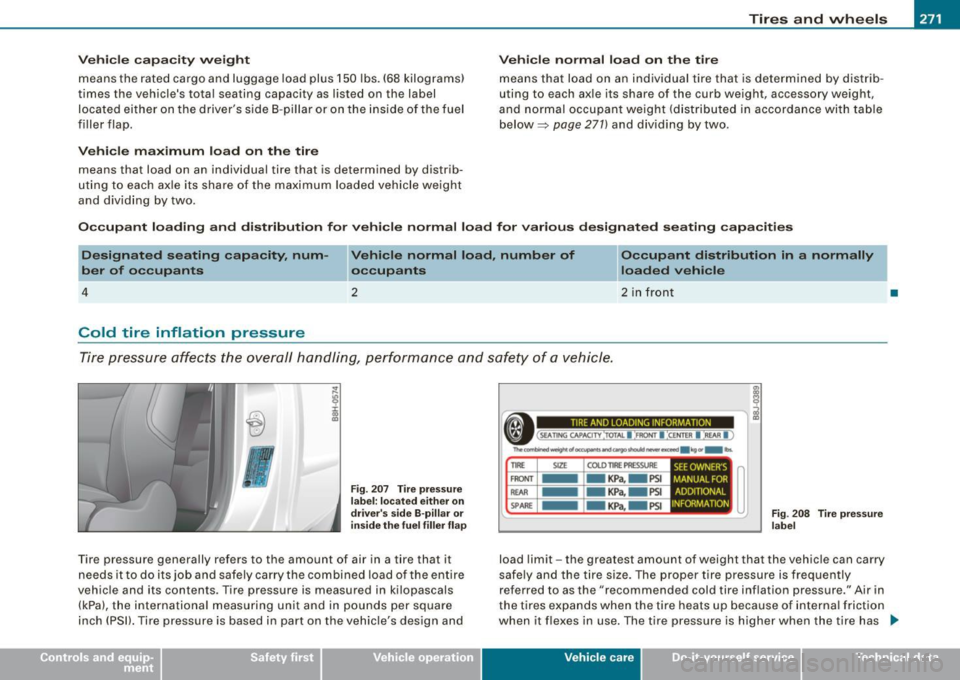
Fig. 207 Tire pr essure
l a b el: loca ted e ithe r o n
driver 's side B- pillar or
in side the fuel fill er flap
Tire pressure generally refers to the amount of air in a tire that it
needs it to do its job and safely carry the combined load of the entire
vehicle and its contents. Tire pressure is measured in kilopascals (kPa), the internationa l measuring unit and in pounds per square
inch (PSI!. Tire pressure is based in part on the vehic le's design and
TIRE AND LOADING INFORMATION
• (SEATING CAPACITY :rorAI. I :FRONT I :CE NTER I :REAR I l
Thea,mthd""'91"~000,-ond""90shoulcl,-u
FRONT -KPa, -PSI
REAR -KPa, - PSI
SPARE -KPa, -PSI
MANUAL FOR
ADDITIONAL
INFORMATION SEE OWNER'S I
Fig . 2 0 8 Tire press ure
l a b el
load limit -the greatest amount of weight that the vehicle can carry
safe ly and the t ire size. The proper t ire pressure is frequently
referred to as the "recommended cold tire inflation pressure." Air in
the tires expands when the tire heats up because of interna l friction
when it flexes in use. The tire pressure is higher when the tire has ...
Vehicle care irechnical data