belt AUDI A5 COUPE 2012 Repair Manual
[x] Cancel search | Manufacturer: AUDI, Model Year: 2012, Model line: A5 COUPE, Model: AUDI A5 COUPE 2012Pages: 316, PDF Size: 78.59 MB
Page 206 of 316
204 Intelligent technology
Intelligent technology
Notice about data
recorded by vehicle
control modules
Your veh icle is not equipped with an Event Da
ta Recorder (EDR), installed by some manu
facturers fo r the express purpose of capturing
data for retrieval after an accident or crash
event. EDR's are sometimes called "crash re
corders".
Some state laws restrict the retrieval or down
loading of data stored by EDR's that were in
stalled in a vehicle for the express purpose of retrieving data after an accident or crash
event without the owner's consent.
Although your vehicle is not equipped with an
EDR, it is equipped with a number of electron
ic control modules for various vehicle systems
such as, for example, engine function, emis
sion control, as well as for the airbags and
safety belts .
These electronic control modules also record
vehicle-related data during normal vehicle op
eration for diagnostic and repair purposes .
The recording capacity of the electronic con
trol modules is limited to data (no sound is re
corded) and only a small amount of data is ac
tually recorded over a very limited pe riod of
time and stored when a system fault or other condition is sensed by a control unit. Some of
the data then stored may relate to vehicle
speed, direction, braking as we ll as restraint
system use and performance in the event of a
crash or other condition. Stored data can only be read and downloaded with special equip
ment .
Electronic stabilization
Program (ESP)
General information
The ESP improves the vehicle stability .
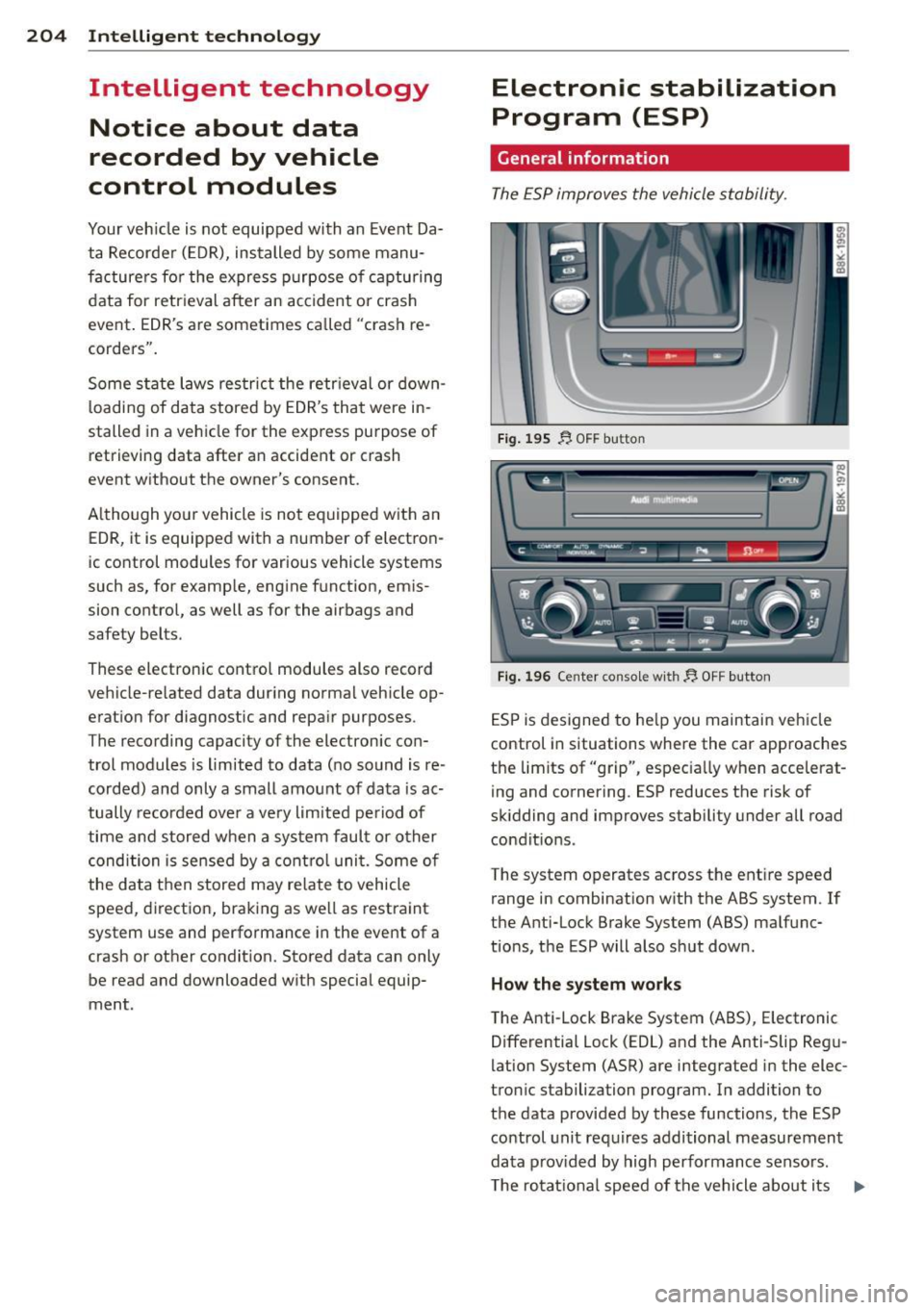
Fig. 195 f;. OFF button
Fig. 196 Center console wit h ~ OFF button
ESP is designed to help you maintain vehicle
control in situations where the car approaches
the limits of "grip", especia lly when accelerat
ing and cornering . ESP reduces the risk of
skidding and improves stability under all road
conditions .
The system operates across the ent ire speed
range in combination with the ABS system . If
the Anti-Lock Brake System (ABS) malfunc
tions, the ESP will also shut down.
How the system works
The Anti -Lock Brake System (ABS), Electronic
Differential Lock (EDL) and the Anti-Slip Regu
lation System (ASR) are integrated in the elec
tronic stabilization program. In addition to
the data provided by these functions, the ESP
control unit requires additional measurement
data provided by high performance sensors.
T he rotational speed of the vehicle about its
II>-
Page 230 of 316
228 Cleaning and protec tio n
8_ WARNING
So lvents can c hange the properties of
some plas tics and ma ke it ha rder for the
a irbag to deploy .
-
-Never clean the instrument panel or the
surface of airbag modules with cleaning
products that contain solvents .
- Products containing solvents w ill make
the surface of th is part porous.
- Serious injur ies can result if plastic parts
come loose when the airbag is deployed.
- Always read and heed all WARNINGS and
other information ¢
page 221.
(D Note
Cleaning agents containing solvents will
attack the mater ial and can change the
way it behaves.
Natural leather
App lies to vehicles: with natura l leather
Audi makes great efforts to maintain the
properties, natural look and feel of interior
leather.
General
We offer many different types of leather on
our veh icles. Most are different types of nappa
l eather, which has a smooth surface and
comes in var ious colors.
The intensity of the color determines the visu a l characteristics and appearance . If the sur
face of the leather has a typical natural look,
then the leather is a nappa leather that has
been left in a relatively natural cond ition. This
leather offers particularly good comfort and
breathes well. F ine veins, closed g rains, insect
b ites, ski n folds , and subtle var iations in co lor
remain visible. These c haracte ris tics demon
stra te that the mater ia l is na tural.
Natural nappa leather is not covered by a col
or finish.
It is therefore more sensitive to soil
ing and wear, w hich is something you need to
conside r if ch ild ren, anim als or othe r fa ctors
might p rove to be particular ly hard on the
leather . By cont
rast, leather types that are covered by
a colo red finish layer are more durab le . T his
has a positive effect on the leather's resist
ance to wear and soiling in dai ly use. On the
other hand, the typical characteristics of natu
ral leather a re barely or not apparent . Howev
er, th is does not mean that the leathe r itself
is of inferior quality .
Care and handling
Because of the exclusive nature of the types of
leather that Audi uses and their unique prop
erties (such as sensit ivity to oils, grease, soil
i ng, etc.), you will need to be somewhat ca re
ful with these leathers, and a ce rtain type of
ca re is req uired. Fo r example , da rk clothing
mater ials can dis co lor le athe r seats (especia l
l y if such clothing is damp and was not dyed
correct ly). Dust and dirt parti cles in pores,
folds, and seams can have an abrasive effect and can damage the leather surface as we ll as
wea ken seams.
The leather should be cleaned regularly as neede d. After having been used for a relatively
l ong time, your leather seats will acq uire a
rich aged fin ish. This is a characteristic of nat
ural leather and a sign of true quality.
In order to maintain the val ue of this nat ural
product over the life of your veh icle, you
shou ld follow the recommendat ions be low:
(D Note
- To keep your leather from b leaching out,
do not allow it to be exposed to b right
sunlight for long periods of time. If you
have to leave the ve hicle parked outside
for long per iods, cover the leather to
pro tect i t from direct expos ure to sun
light.
- Sharp objects o n cloth ing, such as z ip
pers, rivets o r sharp pieces on belts can
leave permanent s cratches or s crape
ma rk s on the s urfa ce o f th e leathe r.
(D Tips
-Aft er each time you clean the leather and
a t regular intervals, use a leathe r
1111>
Page 232 of 316
230 Cleaning and protec tio n
• Dab at the stain . Start at the outside and
work inwards .
• Once the stain is no longer visible, use a
soft dry cloth or t issue to soak up the mois
ture.
Do not use leather cleaning products on Al
cantara ®.
You may use a suitable shampoo for removing
dust and dirt .
Dust and gr it in the pores and seams can
scratch and damage the surface. If the car is
l eft standing in the sun for long periods, the
A lcantara ® should be protected against direct
sunlight to prevent it from fading. Slight color
variations will develop in normal use and are not an indication of material deterioration .
- Never use chemical solvents (e.g . lighter
fluid, turpentine), waxes, shoe polish or
s imilar products on Alcantara ® surfaces .
- To avoid damage, have stubborn stains
removed by a commerc ial cleaning spe
cia list.
- Do not use br ushes, stiff sponges or sim
i larly abrasive cleaning aids.
Safety belts
Only well-maintained safety belts work relia
bly when needed.
• Keep be lts clean.
• For cleaning, use a mild soap and water sol
ution. Let be lts dry thoroughly and away
from direct sunlight.
• Do not allow inertia reel safety belts to re
tract before they are completely dry.
• Check the condition of your safety belts
reg
ularly.
Heavily soiled safety belts may not retract
properly .
A WARNING
Damaged safety belts can b reak in a crash . -
Anything that might damage your safety
be lts could mean that you and your pas
sengers would not be adequately pro
tected in an accident.
- Safety belt performance depends on cor
rect insta llation. Never remove be lts
from the veh icle to clean them .
- Do not use chemical clean ing agents,
bleach or dyes. They have corrosive prop
erties which weaken the webb ing.
- When clean ing your safety belts, inspect
them for damage . If you discover dam
age, see your authorized Audi dealer .
- Always read and heed all WARNINGS and
other information
c> page 221.
' Engine compartment
Be especially careful when cleaning the en
gine comportment.
Alwa ys switch off the ign ition before cle an
i ng the eng ine
c> .&, .
Plenum pan el
Remove leaves from the plenum panel in front
of the windshield under the engine hood . This
prevents the water drain holes from becoming
blocked, and it prevents debris from enter ing
the vehicle interior through the heating and
ventilat ion ducts.
Cor rosi on protec tion
The engine compartment and transmission
have been corrosion -protected at the factory .
Good anti- corrosion treatment is very impor
tant, particu larly in the w inter.
If the vehicle
is frequently driven on salt treated roads, the
entire engine compartment and plenum panel
shou ld be thoroughly cleaned at the end of
winter and retreated to prevent salt damage.
At the same time, the underside of the vehicle
should be washed as well. ..,_
Page 240 of 316
238 Check ing and filling
- Apply the parking brake.
- Move selector lever of automatic trans- mission to "P" (Park); put manual trans
mission in Neutral.
- Always let the engine coo l down . Hot
components will burn skin on contact.
- To reduce the risk o f being burned, never
open the hood if you see or hear steam
or coolant escaping from the engine
compartment. Wait until no steam or
coolant can be seen or heard before care
fully opening the hood.
- Keep children away from the engine com
partment .
- Never spill flu ids on hot engine compo
nents. They can cause a fire.
- Never touch the radiator fan. The auxili
ary electr ic fan is temperature controlled
and can switch on suddenly.
- Never open the coolant reservoir cap when the eng ine is still warm. The cool
ant system is pressur ized and hot coo l
ant could spray out .
-Protect your face, hands and arm from
steam or hot eng ine coolant by placing a
thick rag over the cap when you open the coolant reservoir .
-If work on the fuel system or the electri
cal system is necessary :
- A lways disconnect the battery.
- Never smo ke or work near heaters or
open flames . Fluids in the engine com
partment co uld start a fire.
- Keep an approved fire ext inguisher im
mediately available.
- T o avoid ele ctrical shock and persona l in
jury while the engine is running or being
started, never touch:
- Ignition cables
- Other components of the high voltage
electronic ignition system.
- If you must perform a check or repa ir
with the engine running:
- Fi rst, fully apply the parking bra ke,
move se lec to r l ever o f automat ic trans- mission to
"P" (Park); put manua l
transmission in Neutra l.
- Always use extreme caution to p revent
clothing, jewelry, or long hair from get
ting caught in the radiator fan, V-belts
or other moving parts, or from contact ing hot parts. Tie back hair before
starting, and do not wea r clothing that
will hang o r droop into the engine.
- M inim ize exposure to em iss ion and
chemical hazards
~ &, .
A WARNING
=
Ca lifo rnia Proposition 65 Warning:
- Engine exhaust, some of its const ituents,
and certain vehicle components contain
or emit chemicals known to the State of
California to cause cance r and birt h de
fects and reproductive harm. In addition,
certain fl uids contained in veh icles and
certain products of component wear con
tain or emit chemicals known to the
State of California to cause cancer and
b irth defects or other reproductive harm.
- Battery posts, terminals and related ac
cessories conta in lead and lead com
pounds, chemicals known to the State of
California to cause cancer and reproduc
tive harms. Wash hands after handling.
(D Note
When adding flu ids, always make sure that
they are poured into the proper conta iner
or fil ler opening, otherwise serious dam
age to vehicle systems w ill occur.
@) For the sake of the environment
To detect leaks in time, inspect the vehicle
floor pan from underneath regular ly. If
you see spots from oil or o ther ve hicle flu
i ds, have your vehicle insp ected by a n au
thorized Audi dealer.
Page 248 of 316
246 Checking and filling
sca lding from hot coolant by following
these steps .
- Turn off the engine and allow it to cool
down.
- Protect your face, hands and arms from
escaping flu id and steam by cover ing
the cap with a large, thick rag.
- Turn the cap slowly and very carefully
in a counter-clockwise direction while
applying lig ht, downwa rd pressure on
the top of the cap.
- To avo id being burned, do not spill an
tifreeze or coolant on the exhaust sys
tem or hot engine parts . Under certain
conditions, the ethylene glyco l in en
gine coolant can catch f ire.
- Antifreeze is poisonous . Always store an
tifreeze in its or iginal container and we ll
out of the reach of children.
- If you drain the coolant, it must be
caught and safely stored in a proper con
tainer clear ly marked "poison".
@ Note
- Coolant pollutes the environment and
could cause an engine fire . Excess coo l
ant will be forced out through the pres
sure relief valve in the cap when the en
gine becomes hot.
- If, in an emergency, only water can be
added, the correct ratio between water
and antifreeze
c::> page 244 must be re
stored as soon as possible .
@ For the sake of the environment
Drained coolant should not be reused. Al
ways dispose of used coolant while observ
ing all environmental regulations .
Radiator fan
The radiator fan switches on automatically by
itself
T he radiator fan is driven by the engine via the
V-belt . The viscous clutch regulates the speed
of the fan according to the temperature of the
coolant. An auxiliary electric
radiator fan* switches on
and off depend ing on coolant temperature
and other vehicle operat ing condit ions .
After yo u sw itch the engine off, the auxiliary
f an can continue running for up to 10 minutes
- even with the ignit ion off. It can even switch
on again later by itself
c::> &., if
- the temperature of the engine coolant rises
due to the heat build-up from the engine in
the engine compartment, or
- the engine compa rtment heats up because
the vehicle is parked in i ntense sunlight.
_& WARNING
- To reduce the risk of personal injury nev
er touch the radiator fan.
- The auxiliary electric fan is temperature
controlled and can sw itch on suddenly
even when the engine is not running.
- The auxiliary radiator fan switches on au
tomatically when the engine coo lant
reaches a certain temperature and will
continue to run until the coolant temper
ature drops .
Brake fluid
Checking brake fluid level
The brake fluid level can be checked with a
quick glance.
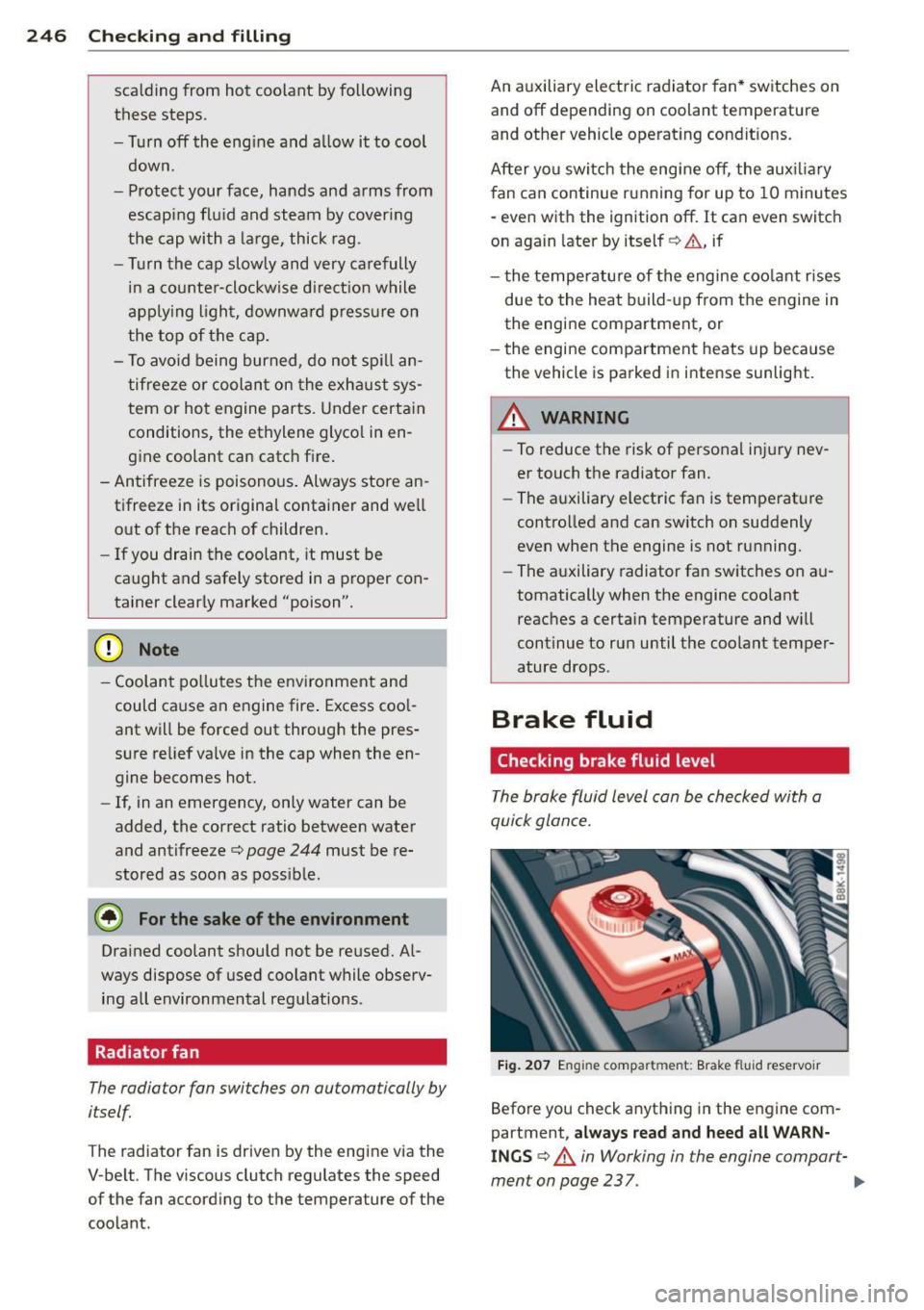
Fig. 207 E ngin e compart men t: B rak e fluid rese rvoir
Before you check anything in the engine com
partment,
always read and heed all WARN
INGS c::> A in Working in the engine compart-
ment on p~e 237.
~
Page 262 of 316
260 Tire s and wheel s
reduced speed to the nearest service sta
t ion to c heck t he tire pressure a nd add
air as required.
Driving without va lve stem caps can cause
damage to the tire va lves. To prevent this,
always make sure that factory installed
valve stem caps on all wheels are secure ly
mounted on the valve .
@I For the sake of the environment
Underinflated tires will also increase the
fue l consumption .
Tires and vehicle load limits
There are limits to the amount of load or
weight that any vehicle and any t ire can carry.
A vehicle that is ove rloaded w ill not ha ndle
well and is more difficult to stop. Over load ing
can no t on ly lead to loss of vehi cle contro l,
but can also damage important pa rts of the
ve hicle and can lead to sudden tire failure, in
cluding a blowout and sudd en deflation that
can cause the veh icle to crash.
Your safety and that of yo ur passenge rs a lso
depends on making s ure that load limits are
not exceeded . Vehicle load includes everybody
and everyth ing in and on the vehicle . These
load limits are techn ically referred to as the
ve hicle's
Gross Veh icle W eight Rat ing
(" GVWR ").
T he "GVWR" incl udes the we ight of the basic
vehicle, all f actory installed accessories, a full
tank of fuel, oil, coolant and other fluids plus maximum load . T he maximum load includes
the number of passengers that the vehicle is in tended to carry ("seating capacity") with a n
assumed weig ht of 150 lbs . (68 kg) for e ach
passenger at a des igna ted seat ing pos ition
and the tota l we ight of any l uggage in the ve
h icle. If you tow a trailer, the weight of the
tra iler hitch and the tong ue weight of the
loaded trailer must be included as part of the
ve hicle load . T
he
Gro ss Axle We ight Rating ("GAWR") is
the maximum load that can be applied at each
of the veh icle's two axles .
T he Gross Vehicle Weigh t Rat ing and the
G ross Ax le Weight Rating are listed on the
safety comp liance sticker label located either
on the dr iver's s ide B-pillar or on the ins ide of
the fuel fi ller flap . Audi has
4 seating pos i
t ions, 2 in the front and 2 in the rear for to tal
seat ing capac ity of 4 . Each seating position
has a seat belt ¢
page 154, Safety belts.
The fact that there is an upper limit to yo ur
vehicle 's Gross Vehicle Weight Rating means
that the total weight of whatever is being car ried in the vehicle ( includ ing t he weight of a
t railer hitch and the tongue weight of the
l oaded tra ile r) is lim ited. The more passen
gers in the vehicle or passengers w ho are
heavier tha n t he standard we ights assumed
mean that less weight can be carried as lug
gage.
T he tire pressure label o n your Aud i also lis ts
the max imum combi ned weight of a ll of the
occupants and luggage or other cargo that
t h e vehicle can carry. Fo r the location of the
label ¢
page 256 , fig. 210.
A WARNING
-Overloading a vehicle can cause loss of ve-
h icle contro l, a crash or other accident, se
rious pe rsonal injury, and even death .
- Carrying more we ight than your veh icle
was des igned to carry will prevent the
veh icle from handling properly and in
crease the risk of the loss of vehicle con
trol.
- The b rakes on a vehicle that has been
overloaded may not be abl e to stop the
veh icle w it hi n a safe distance .
- Tires on a vehicle that has been overload
ed can fail s udden ly, incl uding a blowo ut
a nd sud den defla tion, causing loss of
con trol an d a crash.
- Always make sure that the total load be
i n g tr anspor ted - incl ud ing t he weight o f
a trailer hitch and the tongue we igh t of a
~
Page 297 of 316
-Always make sure the transm ission se
lector lever (automatic transmiss ion) is
in "P" (Park position) or Neutral (manual
transmission) and the park brake is firm
ly appl ied .
® For the sake of the environment
-Changing the eng ine settings w ill ad
versely affect em ission levels. This is det
rimental to the environment and increas
es fuel consumption .
- Always observe env ironmental regula
tions when d ispos ing of old engine oil,
used brake fluid, dirty engine coolant,
spent batter ies or worn out t ires.
- Undeployed airbag modules and p reten
s ioners might be classified as Perchlo
rate Material -special handling may ap
ply, see www.dtsc.ca .gov/hazardous
waste/perch lorate . When the veh icle or
parts of the restraint system including
airbag modules safety belts with preten
s ioners are scrapped, all applicable laws
and regulations must be observed. Your
authorized Audi dealer is familiar w ith
these requirements and we recommend
that you have your dealer perform this
serv ice for you .
Additional accessories,
modifications and
parts replacement
Additional accessories and parts
replacement
Always consult on authorized Audi dealer be
fore purchasing accessories.
Your veh icle incorporates the latest safety de
sign featu res ensu ring a high standard of ac
tive and passive safety.
This safety could be compromised by non-ap
proved changes to the veh icle. For this reason ,
if parts have to be replaced, p lease observe
the following points when installing addition
al accessories:
Con sumer In formation 295
Approved Audi accessories and genuine Audi
parts are available from authorized Audi deal
ers.
T hese dea lers a lso have the necessary facili
ties, tools and trained specialists to install the
parts and accessories proper ly.
A WARNING
Using the wrong spare parts or using non
approved accessories can cause damage to
the vehicle and serious persona l injury.
- Use on ly accessories express ly approved
by Audi and genuine Audi spare parts
- These parts and accessories have been
specially designed to be used on your ve
hicle.
- Never install accessories such as tele
phone cradles or beverage holders on air
bag covers or within the airbag deploy
ment zones . Do ing so will increase the
risk of injury if a irbags are triggered in an
accident!
- Before you check anything in the engine
compartment, always read and heed all
WARNINGS ~
page 230.
(D Note
-If items other than genuine Audi spare
parts, add-on equipment and accessory
items are used or if repair work is not
performed accord ing to specified meth
ods, this can result in severe damage to
your vehicle's engine and body (such as
corrosion) and adversely affect your vehi
cle's warranty .
- If emergency repairs must be performed
elsewhere, have the vehicle examined by
an authorized Audi dealer as soon as
possible.
- The manufacturer cannot be held liable
for damage wh ich occurs due to failure
to comply with these stipulations.
•
•
Page 301 of 316
Audi drive select . ... .... ... .. .. .. ... 124
Adaptiv e dampers ..... ... .. .. .. .. . 124
Descr ipt ion ..... ........ ... .. .. .. . 124
Dynamic steering ......... .. .. .. .. . 124
Se tting the driving mode ... .. .. .. .. . 125
Aud i Service Repair Ma nua ls and Litera-
ture . ..... .. .. .... .. .... ... .. .. ... 293
Auto-Check Control . . . . . . . . . . . . . . . . . . 28
Auto Lock . . . . . . . . . . . . . . . . . . . . . . . . . . 40
Automatic belt retrac tor . ... .. .. .. .. . 15 7
Automatic ca r wash
refer to Wash ing ............ .... .. 222
Automatic climate control A/C mode .. ............. .... .. .... 83
Automatic clima te control p lus ... .. .. .. 83
A/C mode . ... ... ..... ... .. .. .. .... 88
also refer to Deluxe automatic climate
contro l plus . . . . . . . . . . . . . . . . . . . . . . . 83
Automatic clima te control sys tem . .. .. .. 79
also refer to D eluxe automatic clima te
control .... ... .. ..... ... .. .. .. .... 79
Automatic driv ing light contro l ... .. .. .. 49
Automatic S hift Lock (ASL) .. .. .. .. .. . 129
Autom atic t ransmission .. ... .. .. .. .. . 126
Automatic S hift Lock (ASL) . . . . . . . . . . 129
Driving .... .. .... .... ... .. .. .. ... 126
Dynamic shift program . . . . . . . . . . . . . 129
Emergency mode . . . . . . . . . . . . . . . . . . 131
Emergency release ........ .. .. .. .. . 132
Kick-dow n ............ ...... .... .. 129
Manual sh ift program . .... .. .. .. .. . 130
Selector leve r ............... ... ... 128
Shift buttons ............ .. .. .. .. . 13 1
S teer ing whee l w ith tiptronic . .. .. .. . 13 1
Automatic wipe/wash system . . . . . . . . . . 55
Auto Safety Hotline ..... ... .. .. .. .. . 152
Average speed . . . . . . . . . . . . . . . . . . . . . . . 2 2
Avoid damaging the vehicle .. .. .. .. .. . 214
B
Battery ..... .. .. .. .. .... ... .. .. ... 247
Battery locat ion inside the luggage com-
partment .. ............. .... .. ... 248
Cha rging . ................ ... ... .. 250
Impo rtant war nings when wo rking on
the battery . . . . . . . . . . . . . . . . . . . . . . . 248
Inde x 299
Jump start ing . ..... . .. .. ..... ... .. 284
Low . ... .. .. .. .... . ... ...... ... .. 211
Rep lacing the battery .. ..... ... .. .. 251
State of charge . .. ................. 211
Winter operation . ................. 247
Working on the battery ............. 248
Battery vo ltage . ...... .. .. ..... ... .. . 35
Befo re d rivi ng . .. .. .... ........... .. 144
B lended gasoline .. .. ........... .... 232
Body cavity sealing ... . .. ..... ... .. .. 226
Boos ter seats ... .. .. . .. .... .... .. .. 194
Brake assist ... .. .. .. .. .. ...... ... .. 209
B rake booste r ... ...... ............. 208
Brake fluid Changi ng the brake fluid ............ 247
Checking the brake fluid level ........ 246
Rese rvoir . .. .. .. .... ........... .. 246
What is the correct b ra ke fluid level? .. 24 6
Wha t shou ld I do i f the brake flui d war n-
ing ligh t comes on? .. ... .... ... .. .. 246
B rake system .. .. .... ... ....... ..... 246
Anti- lock b rake system .. .... ... .. .. . 16
Br ake fluid .. .. .. ................. 246
Br ake fluid specifications fo r refill and re-
placement . ..... ... .. .. ..... ... .. 2 47
Brake light defective . .. ..... ... .. .. . 35
B rake pads .. .... .. . .. .. ..... ... .. 213
E lectromechanica l parking brake ... .. . 96
General information ............... 207
How does moisture or road salt affect the
brakes? ......... .. ............... 207
Malfunction . . . . . . . . . . . . . . . . . . . . . . . 30
Wa rning/ind icator lights ........ .... . 18
Wor n bra ke pads symbo l . . . . . . . . . . . . . 34
Brak ing guard
refer to Aud i brak ing guard ......... . 113
Break -in period . ...... .. .. ..... ... .. 213
Brake pads .. .. .. .. ............... 213
Tires ..... .. .. .. .. .. ........... .. 213
Bu lbs . ... .. .. .. .... .. .. ...... ... .. 283
C
Cali for nia Pr oposition 65 War ning . .. .. 238
B attery spe cific . . . . . . . . . . . . . . . . . . . 249
Capacities .. .. .. .. .. . .. .... .... .. .. 292
•
•
Page 306 of 316

304 Index
H
Headlig ht
Washer system . .. ..... ... .. .. .... .. 55
H eadlig hts
Adap tive light ............ .... .. .. .. 5 2
H ead lights
Fog lights . . . . . . . . . . . . . . . . . . . . . . . . . SO
Headlig hts
Headlight range control defective ... . . 36
H ead ligh ts
Rear fog lights . . . . . . . . . . . . . . . . . . . . . SO
H eadlig ht was her reservoir ...... .. ... 251
Head restraints .. . ...... ... .. .. .... . 147
Ad justing ................. .. .... . 147
Front seats . . . . . . . . . . . . . . . . . . . . . . . . 67
Rear seats .... ........... ........ .. 67
Removing .. ................ ... .... 67
Heatable Front seats . ............. .. .. .. ... . 91
H ea ted
exterior m irrors ..... ... .. .. .. .... .. 57
Rear window . . . . . . . . . . . . . . . . . . . 83, 88
Washer fluid nozz les . . . . . . . . . . . . . . . . 55
H eater
D eluxe automatic climate con trol . . . . . . 79
H eating
Deluxe automatic climate control plus . . 83
Heavy clothing and safety belts .... ... . 157
H igh beam . .... ............. ...... .. 5 2
War ning/ indicator ligh ts ... .. .. .... .. 16
H igh voltage warn ing label ....... .... 290
H omelink ® universal remote control 140
H ood
Opening . .... ........... .. .. .. .. . 237
Release lever ............ .. .. .. .. . 23 7
H orn ..... .. ................ ... ..... 8
How are ch ild restraint system anchors re -
l ated to child safety ................. 199
H ow many ai rbags does my vehicle have? 169
H ow often should I check my tire pres -
sures? ........... ............. ... . 259
How safety belt pretensioners work . .. . 160
H ydroplan ing ...................... 263
I
Ignit ion key ..... .. ... .. ..... .... . .. . 92
Emergency un lock ing . ... .... ... .. .. . 39
Ig nition lock .. .. .. .. ........ ...... .. 92
Malfunction . . . . . . . . . . . . . . . . . . . 32, 36
Immobilizer ...... ................. . 37
Important things to do before driving . . 144
Improperly worn safety belts .......... 160
Ind icator light
Dynam ic steering . . . . . . . . . . . . . . . 14, 34
Ind icator lights .... .. .... .... ... .. .. . 13
Airbag system . . . . . . . . . . . . . . . . . . . . 173
PASSENGER AIR BAG OF F . . . . . . . . . . . 173
Infan t seats ...... ............. .... 191
Installing child safety seats
Safety be lts . .. .................. . 195
Installing the upper tether strap on the
anchorage .. .. .. .. .. .... .... ... .. .. 202
Instr ument l igh ting ............. .... . 51
Instruments and controls ............. 10
Genera l illustration . . . . . . . . . . . . . . . . . . 8
Interior lights Dimming .. .. .. .. ............. .. .. . 53
Front ..... .... .. .. ............... . 53
Rear . .... .... ................... . 54
Interval wip ing .... .. ... ..... ... .. .. . 55
Rain sensor . . . . . . . . . . . . . . . . . . . . . . . . 55
J
Jump-starting ..... .. .... .... ... .. .. 284
Jumper cables . .. ............ ....... 285
K
Key ................................ 37
Battery replacement . . . . . . . . . . . . . . . . 38
Key replacement . . . . . . . . . . . . . . . . . . . 3 7
Master key with remote contro l . . . . . . . 3 7
Mecha nica l key . .. ... .......... .. .. . 39
K ick-down
t iptron ic .. .. .. .. .. ... ....... ... .. 129
Knee airbags .... .. ... .. ..... .... . .. 177
Description . . . . . . . . . . . . . . . . . . . . . . . 177
How they work . .. ............. .... 178
Important safety instructions ........ 179
Page 308 of 316
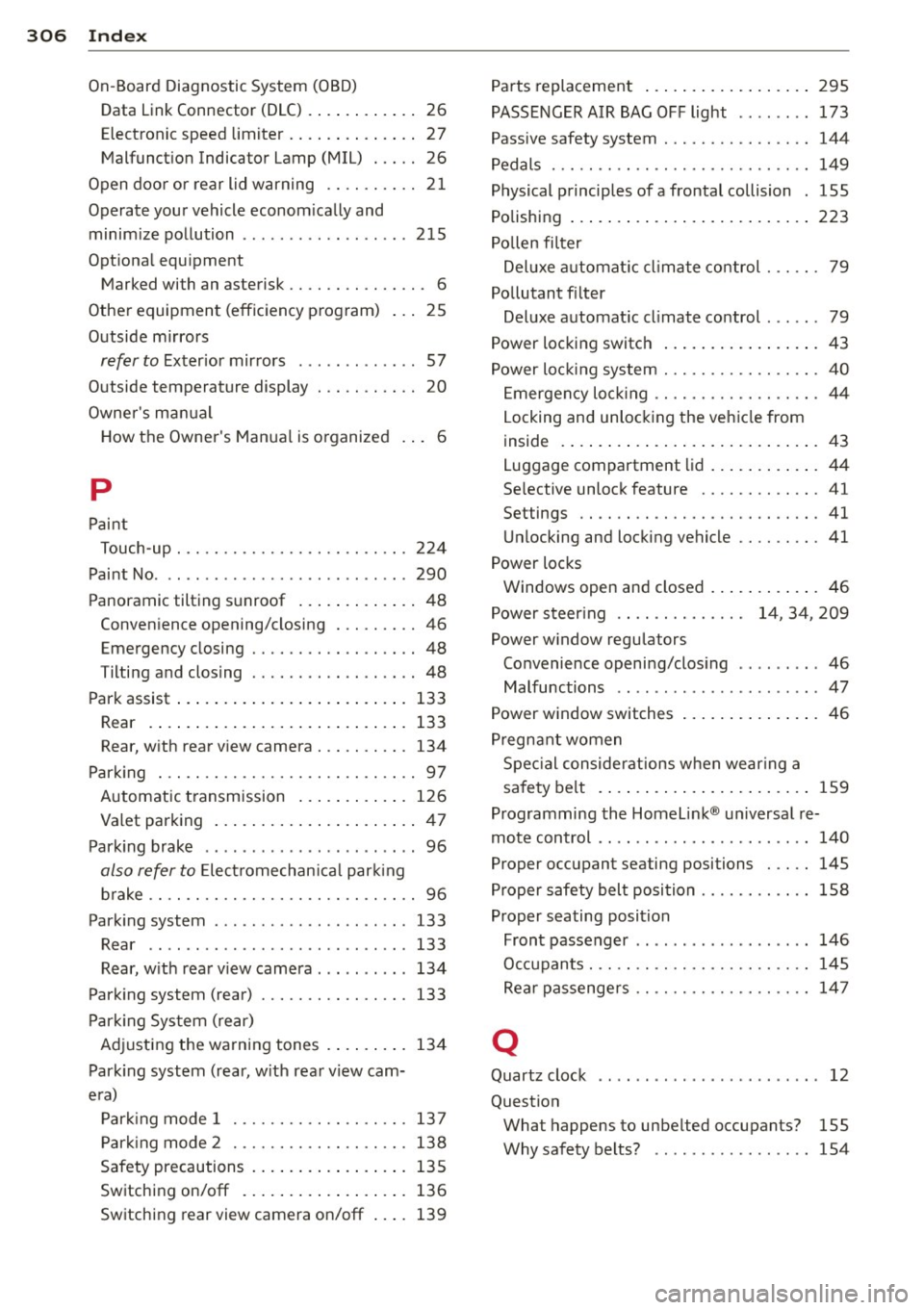
306 Index
------------------------------------
On-Board Diagnostic System (OBD) Data Link Connector (DLC) .. .. ... ... .. 26
Electronic speed limiter ...... .. .... .. 27
Malfunction Indicator Lamp (MIL) . . . . . 26
Open doo r or rear lid warning . . . . . . . . . . 21
Operate your vehicle econom ically and
minimize pollution .......... ... .. ... 215
Optiona l equipment
M arked with an asterisk . . . . . . . . . . . . . . . 6
Other equipment (efficiency program) 25
Outside mirrors
refer to Exterior mirrors ....... .. .. .. 57
Outside temperature display . .. .. .. .. . . 20
Owner 's manual
H ow the Owner's Manual is o rganized . . . 6
p
Paint
Touch-up ....... .. ....... .. .. .. .. . 224
Paint No ..... ................ ... .. . 290
Panoramic tilting sunroof ............. 48
Convenience opening/closing ... .. .. .. 46
Emergency clo sing .......... .. .... .. 48
Tilting and closing ........ .. .. .. .. .. 48
Park assist .................. .. .... . 133
Rear .. .... ................ ..... . 133
Rea r, with rear view camera . .. .. .... . 134
Parking ... ........ ....... .. .. .... .. 97
Automatic transmission ............ 126
Valet parking ................ .... .. 47
Parking brake ................ ... ... . 96
also refer to Electromechan ica l park ing
brake .. .. .. ... .......... .. .. .. .. .. 96
Park ing system .. ... .... ..... .. .. .. . 133
Rear .. .. .. ..... ........... ... .. . 133
Rear, w ith rear v iew camera ..... .. .. . 134
Parking system (rear) ......... .. .. .. . 133
Parking System (rear)
Adjusting the warning tones . ..... .. . 134
Parking system (rear, w ith rear view cam-
era)
Parking mode 1 .............. .... . 137
Parking mode 2 .......... .. .. .... . 138
Safety precautions ......... ... .... . 135
Switching on/off .......... ... .... . 136
Switching rear view camera on/off ... . 139 Parts
replacement .............. .... 295
PASSENGER AIR BAG OFF light ........ 173
Passive safety system . . . . . . . . . . . . . . . . 144
Pedals . .... .... .. ............. .... 149
Physical principles of a frontal collision . 155
Polishing ......... ................ . 223
Pollen filter
Deluxe automatic climate control . .. .. . 79
Pollutant filter Deluxe automat ic climate control ..... . 79
Power locking switch ................. 43
Power locking system ............ .... . 40
Emergency locking .. ........... .. .. . 44
Locking and unlocking the vehicle from
inside ........ .. .................. 43
Luggage compartment lid ........ ... . 44
Se lective unlock feature .......... .. . 41
Settings .. .. .. .. ............. .... . 41
Unlocking and locking vehicle .... .. .. . 41
Power locks Windows open and closed ........ ... . 46
Power steering . . . . . . . . . . . . . . 14, 34, 209
Power window regulators Convenience opening/closing ........ . 46
Malfunctions .. .. ..... ........... .. 47
Power window switches ............... 46
Pregnant women
Special considerations when wear ing a
safety belt . . . . . . . . . . . . . . . . . . . . . . . 159
Programming the Homelink ® un iversal re
mote control . . . . . . . . . . . . . . . . . . . . . . . 140
Proper occupant seating posi tions . .. .. 145
Proper safety belt position .......... .. 158
Proper seating position Front passenger . . . . . . . . . . . . . . . . . . . 146
Occupants . .. .. .. ... ... ... .... .... 145
Rear passengers .. ............. .. .. 147
Q
Quartz clock .. .. .. .......... ...... .. 12
Question Wha t happens to unbelted occupant s? 155
Why safety belts? ....... ...... .. .. 154