ECU AUDI A5 COUPE 2015 User Guide
[x] Cancel search | Manufacturer: AUDI, Model Year: 2015, Model line: A5 COUPE, Model: AUDI A5 COUPE 2015Pages: 264, PDF Size: 66.83 MB
Page 68 of 264

Seats and storage
@ Tips
-You can open the pass-through from the
luggage compartment. Push the release
button down and push the cover forward.
- You can lock or unlock the pass-through us
ing the mechanical key. This prevents any
access to the luggage compartment from
the vehicle interior.
Securing the ski sack
App lies to veh icles: w ith s ki sac k
The ski sack must be secured in the luggage com
partment.
Fig. 72 Luggage compartmen t: Securing t he s ki sack
Fig. 73 Rear bench seat: securing the sk i sack
There are two straps with hooks on the bottom
side of the ski sack
~ fig. 72 @ . There is also a
securing strap@~
fig. 73 on the sack.
.. To secure the ski sack in the luggage compart
ment, hang the hooks in the rear tie-downs
~fig. 72.
.. Tighten the strap on the ski sack to prevent the
objects in the sack from sliding
~ fig. 73.
66
A WARNING
-The ski sack is intended only for the trans
portation of skis and other light objects. To
reduce the risk of serious personal injury,
never transport heavy or pointed objects in
the ski sack.
- When braking rapidly or during an accident,
the load could be displaced and cause injury to occupants.
- Sharp edges on the load must be covered
for protection. Always fasten the belt tightly
around the sack and its contents~
fig. 73.
-For safety reasons, do not transport more
than two pairs of skis in the ski sack.
- You must secure the ski sack with the strap
after loading.
- Make sure that all objects you are transport
ing in the pass-through are secured. Other
wise they could slide around during sudden
braking maneuvers and cause injuries.
(D Tips
- Never stow the ski sack away when it is still
wet or damp (for example, snow melting
from skis). Allow it to dry completely before
stowing it away.
- When transporting skis or snowboards,
tighten the securing strap between the
bindings.
- Position skis in the ski sack with the pointed
ends facing the front and ski poles with the
pointed ends facing the rear.
- You can lock or unlock the pass-through us
ing the mechanical key. This prevents any
access to the luggage compartment from
the vehicle interior.
Parcel shelf
The parcel shelf behind the rear seatback can be
used to carry light items of clothing.
A WARNING
No heavy or hard objects should be placed on
the parcel shelf. They are a hazard to the vehi
cle occupants during sudden braking. The is a risk of injury.
Page 79 of 264
M N
0 loo
engine can only be sta rted w ith the selector in
these positions.
!!I Is the k ey in the vehi cle?
This message appea rs if the maste r key is re
moved from t he vehicle w ith the eng ine running.
If the maste r key is no longer in the vehicle, you
c a nnot swi tch on the ignition after s topping the
e ngine and yo u also cannot start the engine
again. Mo reover, yo u cannot lock the vehicle from
the outside with the key.
Shift to P otherwi se vehicle can roll aw ay. Doors
do not lo ck if lever i s not in P .
This message appears for safety reasons a long
w ith a warn ing signal. It appears if the se lector
l eve r fo r the autom atic transmis sion is not in the
P posi tion when switching off the ign ition. Move
the selector leve r to the P posit ion, otherwise the
ve hicle is not secured against ro lling away. You
a lso cannot lock the vehicle using the locking
button* on the door handle or using the remote
key .
Convenience key defective! Use ignition lock
This mes sage appea rs if the eng ine mus t be
started or s topped using the igni tion key and no t
the
! START ENGINE STOPI b utton.
Electromechanical
parking brake
Operation
The electromechanical parking brake replaces
the hand brake.
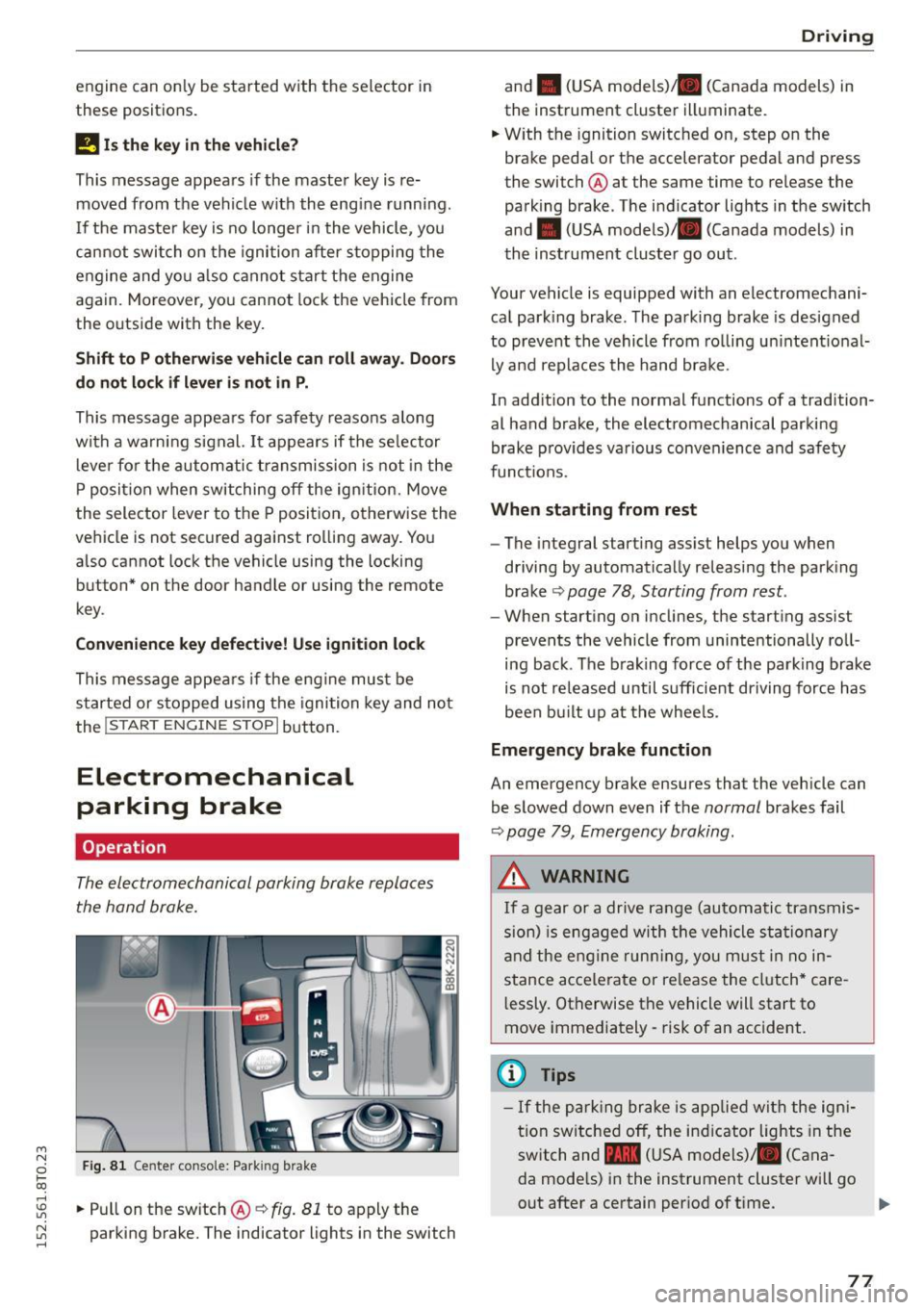
Fig. 81 Ce nter conso le : Park ing bra ke
rl
:5: .. Pull on t he sw itch @¢ fig. 81 to apply the
~ parking b rake. The indicator lights in the switch rl
Driv ing
and . (USA mode ls) . (Canada models) in
the instrument cluste r illuminate.
.. W ith the ignition switched on, step o n the
brake peda l or the accelerator pedal and press
the switch @ at the same time to release the
pa rking brake . The i ndicator lig hts in the sw itch
and . (USA models) . (Canada models) in
th e inst rument cluster go out .
Your vehicle is equipped with an electromechani
ca l park ing brake . T he pa rking brake is designed
to preve nt the vehicle from ro ll in g u nintent ional
ly and replaces the hand brake .
In add ition to the normal functions of a tradition
al hand brake, the electromechanical parki ng
brake p rov ides va rious conve nience and saf ety
funct ions.
When starting from rest
- The integral start ing ass ist helps you when
driving by automatically releasing the park ing
brake
¢ page 78, Starting from rest .
-When starting o n inclines, the starting assist
prevents the vehicle from unintentionally ro ll
ing back . The b rak ing force of the parking brake
i s not re leased until s ufficie nt driving force has
been built up at t he whee ls.
Emergency brake function
An emergency brake ensures that the vehicle can
be s lowed down even if t he
normal brakes fail
¢ page 79, Emergency braking .
A WARNING
If a gear or a drive ra nge (au tomati c tr an smis
s ion) is engaged w ith the vehi cle sta tion ary
a nd the e ng in e runn ing, you m ust in no in
stance ac ce lerate or re lease the cl utch* care
l essly. Otherwise the vehicle will start to
move immediately - risk of an accident.
(1) Tips
- If the p arking br ake is app lied wi th the ign i
tion sw itche d off, the ind icator lights in the
swit ch and -(USA mo dels)/ . (Cana
da mode ls) i n the instrument cluster will go
out after a certain per iod of t i me.
77
Page 87 of 264
M N
i? co ,...., \!) 1.1'1
N 1.1'1 ,....,
~ Wait briefly until the transmission has shifted (you will feel a slight movement) .
~ Remove your foot from the brake pedal and ac
celerate.
Stopp ing tempo raril y
~ Keep the vehicle stationary using the b raking
pedal, for examp le at traffic lights.
~ Do not press the accelerator pedal when doing
this .
~ To prevent the vehicle from rolling when you
start driving , se t the parking brake when stop
ping on steep inclines¢&,. .
~ The parking brake will release automatically
and the vehicle will start moving once you press
the accelerator pedal.
Stopp ing /p ar kin g
If the selector lever is not in the P position when
you open the driver 's door, the veh icle could roll.
The message
Tr ansmi ssion : Car m ay roll ! Shift
t o park!
appears .
~ Press and hold the brake pedal until the vehicle
has come to a complete stop .
~ Apply the parking brake¢ page 78, Parking.
~ Select the P selector lever pos ition ¢ .&_.
Stopp ing on an incline
~ Always press the brake pedal to hold the vehi
cle in place and prevent it from "rolling back"
¢ &,. . Do
not try to prevent the vehicle from
"rolling back" when a gear is engaged by in
creasing the engine speed ¢0 .
Startin g on an incline
~ Activate the parking br ake.
~ With the driving gear selected, press the accel
erator pedal carefully . The parking brake will re
lease automat ically if you r seat belt is fastened.
Under certain circumstances, such as driv ing in
the mountains, it may be useful to switch tempo
rarily to the manual shift program in orde r to ad
just the gears to the d riving conditions by hand
¢ page 86.
On slopes, activate the parking brake first and
then move the selector lever to the P posit ion.
Aut omatic transm issio n
This prevents too much stress from being placed
on the locking mechanism .
A WARNING ,-
-The vehicle can also roll when the engine is
stopped.
- Unintended vehicle movement can cause se
rio us injury.
- Never leave your vehicle with the engine
running while in gear . If you must leave your
veh icle when the engine is running, activate
the park ing brake and move the selector lev
er to P .
- Power is still transmitted to the wheels
when the engine is runn ing at idle . To pre
vent the vehicle from "creep ing", you must
keep your foot on the brake when the eng ine
is running and the se lector lever is in D/S or
R or "tiptronic" mode is selected.
- Do not press the accelerator pedal when
changing the se lector lever position while
the vehicle is stationary and the eng ine is
r u nning .
- Never sh ift into R or P while driving ,
- Before driving down a steep s lope, reduce
your speed and sh ift into a lower gear with
" t ipt ronic ".
- Do not ride the brakes or press the brake pedal too ofte n or too long whe n driving
down a hi ll. Constant brak ing causes the
b rakes to overhea t and substantially re
duces braking performance, increases brak ing distance or causes comp lete fai lure of
the brake system.
- To prevent the vehicle from ro lling back
when stopping on inclines, always ho ld it in
p lace with the brake pedal or parking brake.
- Never hold the vehicle on an incline with a
slipping clutch. The clutch opens automati
cally when it becomes too hot from the
overload. An ind icator lamp@] illuminates
and a driver message appears¢
page 87
when the clutch is overloaded .
-If the engine must remain running, never
have any dr iving posit ion engaged when
checking under the hood . Make sure these
lecto r lever has secu rely engaged and is
locked in P with the parking brake set
85
Page 98 of 264
Audi adaptive cru ise control and b ra king guard
promptly detected or may not be detected
at all.
- Reflective surfaces including crash barriers
or tunnel entrances may impair the function
of the radar sensor.
(D Tips
- You can cance l the braking that is initiated
by the system by braking yourself, by accel
erating noticeably or by swerving.
- Braking g uard error messages ~
page 96.
- Keep in mind that braking guard can brake
unexpected ly . Always secure any cargo or
objects that you are transporting to reduce
the risk of damage or injury.
Settings in the radio/MMI
Applies to veh icles : w ith Audi adaptive cruise control
.,. Select : I CARI funct ion button > Car system s*
control button > Driver assis t> Aud i braking
guard .
Or
.,. Se lect :
~I C-A-R~I funct ion button > Audi braking
guard .
S ys tem -
Sw itch Audi braking guard O n and Off .
When you switch the ignition on, the message
Aud i braking gu ard off appears if the system is
sw itched off.
Ea rly warning -The distance and approach warn
ings in the display can be sw itched
On /Off.
@ Tips
- Your settings are automat ically stored and
assigned to the remote control key being
used at the times the sett ings are made .
- If you restrict or switch off the ESC, the
braking guard also switches itself off
~page 171.
- Switch brak ing guard off when you are load
i ng the veh icle onto a vehicle carr ier, tra in,
sh ip or other type of transportation . Th is
can prevent undesired wa rnings from the
braking guard system.
96
Messages
App lies to vehicles: wi th Audi adap tive c ru ise contro l
Bra king gu ard : Off
This dr iver message appears if the system is
tu rned off via the radio/MM I*. O therwise, if the
system is t urned off, the information appears ev
ery time short ly after the start of the trip.
The driver message a lso appea rs if the system is
not available due to a malfunction or if the ESC is
not sw itched on
~ page 171 . If th is is the case,
the system wi ll not provide warnings abo ut a
possible collision .
Braking guard : A cti vated
This dr ive r message appears if sharp brake pres
sure was applied due to an acute warn ing .
•••
Three white dots appear if a setting cannot be se
l ected with the operating lever. For example, this
happens if you want to raise/ lower the speed
even though there was no prev iously saved
speed .
ACC: D ea ctiv ation
The dr iver message appears in vehicles with man
ual transmission . If the clutch pedal was p ressed
down for too long , the adaptive cruise control
turns off. A chime sounds as a reminder.
A CC: S enso r blo ck e d
This message appears if the sensor v iew is ob
structed, for examp le by leaves, snow, heavy
spray or d irt . Clean the sensor~
page 89, fig. 93.
ACC: not a vailabl e
The driver message appears if there is a malfunc
tion. The adaptive cruise control turns off . A
ch ime sounds as a rem inder . Have the system
checked by an authorized Aud i deale r or author
i zed Audi Serv ice Facility .
ACC : un available
The driver message appears if, for example, the
brake temperature is too high. The adaptive
cruise control is temporarily unavailable . A chime
sounds as a reminder . .,.
Page 114 of 264
Driving safety
Driving safety
Basics
Safe driving habits
Please remember -safe ty first!
This chapter contains important information,
tips, instructions and warnings that you need to
read and observe for your own safety, the safety
of your passengers and others. We have summar ized here what you need to know about safety
belts, airbags, child restraints as well as child
safety. Your safety is for us
priority number 1. Al
ways observe the information and warnings in
this section - for your own safety as well as that
of your passengers .
The information in this section applies to all
model versions of your vehicle . Some of the fea
tures described in this sections may be standard
equipment on some models, or may be optional
equipment on others. If you are not sure, ask
your authorized Audi dealer.
A WARNING
- Always make sure that you follow the in
structions and heed the WARNINGS in this
Manual.
It is in your interest and in the in
terest of your passengers.
- Always keep the complete Owner's Litera
ture in your Audi when you lend or sell your
vehicle so that this important information
will always be available to the driver and
passengers.
-
- Always keep the Owner's literature handy so
that you can find it easily if you have ques
tions .
Safety equipment
The safety features are part of the occupant re
straint system and work together to help reduce
the risk of injury in a wide variety of occident sit
uations.
Your safety and the safety of your passengers
should not be left to chance. Advances in tech
nology have made a variety of features available
to help reduce the risk of injury in an accident.
112
The following is a list of just a few of the safety
features in your Audi:
-sophisticated safety belts for driver and all pas-
senger seating positions,
- belt force limiters for the front seats,
- belt pretensioners for the seats,
- head restraints for each seating position,
- front airbags,
- side airbags in the front seats,
- side curtain airbags,
- special LATCH anchorages for child restraints,
- adjustable steering column.
T hese individual safety features, can work to
gether as a system to help protect you and your
passengers in a wide range of accidents . These
features cannot work as a system if they are not
always correctly adjusted and correctly used.
Safety is everybody's responsibility!
Important things to do before driving
Safety is everybody's job! Vehicle and occupant
safety always depends on the informed and care
ful driver.
For your safety and the safety of your passen
gers,
before driving always:
.,. Make sure that all lights and signals are operat
ing correctly .
.,. Make sure that the tire pressure is correct.
.,. Make sure that all windows are clean and afford
good visibility to the outside .
.,. Secure all luggage and other items carefully
Q page 60.
.,. Make sure that nothing can interfere with the
pedals .
.,. Adjust front seat, head restraint and mirrors
correctly for your height.
.,. Instruct rear seat passengers to adjust the
head restraints according to their height.
.,. Make sure to use the right child restraint cor
rectly to protect ch ildren
c> page 151 , Child
safety .
.,. Sit properly in your seat and make sure that
your passengers do the same
Q page 54, Seats
and storage.
Page 117 of 264
M N
i? co ,...., \!) 1.1'1
N 1.1'1 ,....,
-Each passenger must always sit on a seat of
their own and properly fasten and wear the
safety belt belonging to that seat.
- Before driving, a lways ad just the front pas
senger seat and head restraint properly.
- Always keep your feet on the f loor in front
of the seat. Never rest them on the seat, in
strument panel, out of the window, etc. The
airbag system and safety belt will not be able to protect you properly and can even in
crease the risk of injury in a crash .
- Never drive with the backrest recl ined or
t ilted far back! The farther the backrests are
t il ted back, the greater the risk of injury due
to incorrect pos ition ing of the safety belt
and improper seating posit ion.
- Children must always ride in child safety
seats¢
page 151. Spe cial preca utions ap
ply when installing a ch ild safety sea t on the
front passenger seat¢
page 129.
Proper seating positions for passengers in
rear seats
Rear seat passengers must sit upright with both
feet on the floor consistent with their physical
size and be properly restrained whenever the ve hicle is in use.
To reduce the risk of injury caused by an incorrect
seating position in the event of a sudden braking
maneuver or an accident, yo ur passengers on the
rear bench seat must always observe the follow
in g:
~ Make sure that the seatback is securely latched
in the upright pos ition ¢
page 64.
~ Keep both feet flat in the footwell in front of
the rear seat.
~ Fasten and wear safety belts properly
¢ page 124.
~ Make su re that c hildren are always proper ly re
stra ined in a chi ld restraint that is appropriate
for their size and age¢
page 151 .
A WARNING
Passengers who are improperly seated on the
rear seat can be seriously in jured in a crash .
Drivin g s afet y
-Each passenger must always sit on a seat of
their own and proper ly fasten and wear the
safety belt be long ing to that seat.
- Safety belts only offer maximum protection
when the seatback is secure ly latched in the
upright pos ition and the safety belts are
properly pos itioned on the body . By not sit
ting upright, a rear seat passenger increases
the risk of personal injury from improperly
positioned safety belts!
- Always adjust the head restraint p roperly so
that it can give maximum p rotection.
Proper adjustment of head restraints
Applies to veh icles: w it h adjustable head restraints
Correctly adjusted head restraints are an impor
tant part of your vehicle's occupant restraint sys
tem and can help to reduce the risk of injuries in
accident situations.
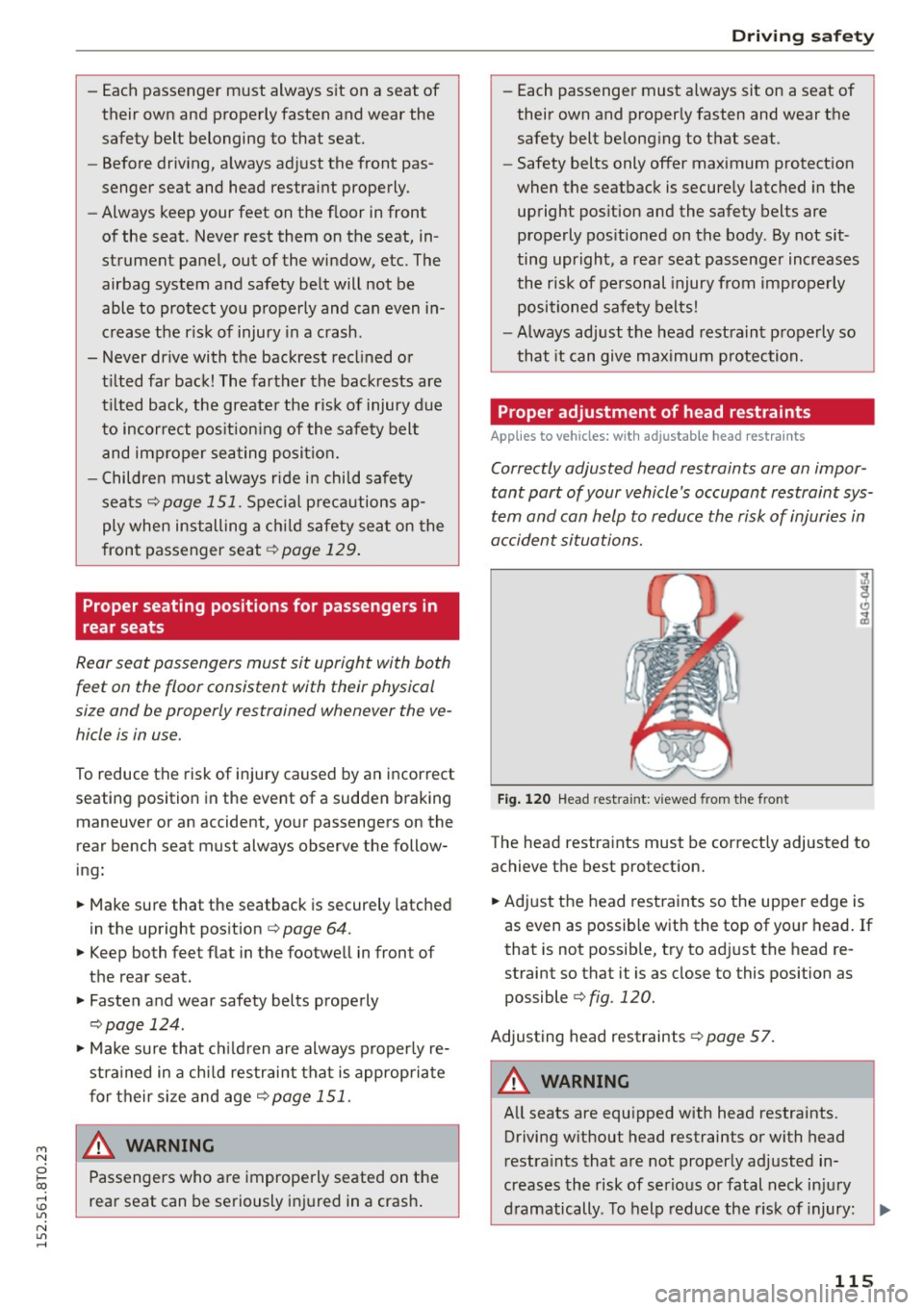
F ig . 1 20 Head restra int: v iewed from t he front
The head restra ints must be cor rectly adjusted to
achieve the best protect ion.
~ Adj ust the head restraints so the upper edge is
as even as possib le w ith the top of your head. If
that is not possible, t ry to ad just the head re
straint so that it is as close to this position as
possible ¢
fig. 120.
Adjusting head restraints ¢page 57.
A WARNING
--
All seats are equ ipped with head restraints.
Driving w ithout head restraints or with head
restra ints that a re not properly adjusted in
creases the risk of serious or fatal neck in ju ry
d ramatically. To help reduce the r isk of injury: ..,.
115
Page 119 of 264
M N
i? co ,...., \!) ..,.,
N ..,., ,....,
proper deployment of the airbag. Small ob
jects can be thrown through the veh icle if
the a irbag deploys and injure you or your
passengers .
Pedal area
Pedals
The pedals must always be free to move and
must never be interfered with by a floor mat or
any other object.
Make sure that all pedals move freely without in
terference and that noth ing prevents them from
returning to their original pos it ions .
Only use floor mats that leave the peda l area free
and can be secured with floor mat fasteners .
If a brake circuit fails, increased brake pedal trav
el is required to bring the vehicle to a full stop.
A WARNING
Pedals that cannot move freely can cause loss
of vehicle control and increase the r is k of seri
ous lnJUry.
- Never place any objects in the driver's foot
we ll. An object could get into the peda l area
and interfere with peda l function . In case of
s udden br aking or an accident, you wou ld
not be able to brake o r acce lerate!
- Always make sure that noth ing can fa ll or
move into the dr iver's foo twe ll.
Floor mats on the driver side
Always use floor mats that can be securely at
tached to the floor mat fasteners and do not in
terfere with the free movement of the pedals.
• Make sure that the floor mats are properly se
cu red and cannot move and i nterfere wit h the
peda ls ~
& -
Use only floor mats that leave the pedal area un
obstructed and that are firm ly secured so that
they cannot slip out of pos it ion. You can obtain
suitab le floo r mats from you r authorized Audi
dealer.
Dr ivin g s afet y
Floor mat fasteners are insta lled in your Audi.
Floor mats used in your vehicle must be attached
to these fasteners. P roperly securing the floor
mats will preven t them from sl iding into posi
t ions that could interfere with the pedals or im
pair safe operation of your vehicle in other ways.
A WARNING
-Pedals that cannot move free ly can result in a
loss of vehicle control and increase the risk of
serious personal injury.
- Always make sure that floor mats are prop
erly secured.
- Never p lace or install floor mats or other
f loor coverings in the vehicle that cannot be
properly secured in p lace to prevent them
from slipp ing and interfering with the ped
als or the ab ility to control the vehicle .
- Never p lace or install floor mats or other
f loor coverings on top of already installed
floor mats . Addit ional floor mats and other
cover ings will red uce the size of the pedal
area and interfe re with the pedals .
- Always prope rly reinstall and secure floo r
mats that have been taken out for cleaning.
- Always make sure that objects cannot fall
into the driver footwell while the vehicle is
mov ing. Objects can become trapped under
the brake pedal and acce lerator pedal caus
ing a loss of vehicle control.
117
Page 120 of 264
Driving safet y
Storing cargo correctly
Loading the luggage compartment
All Luggage and other objects mus t be properly
stowed and secured in the Luggage compart
ment.
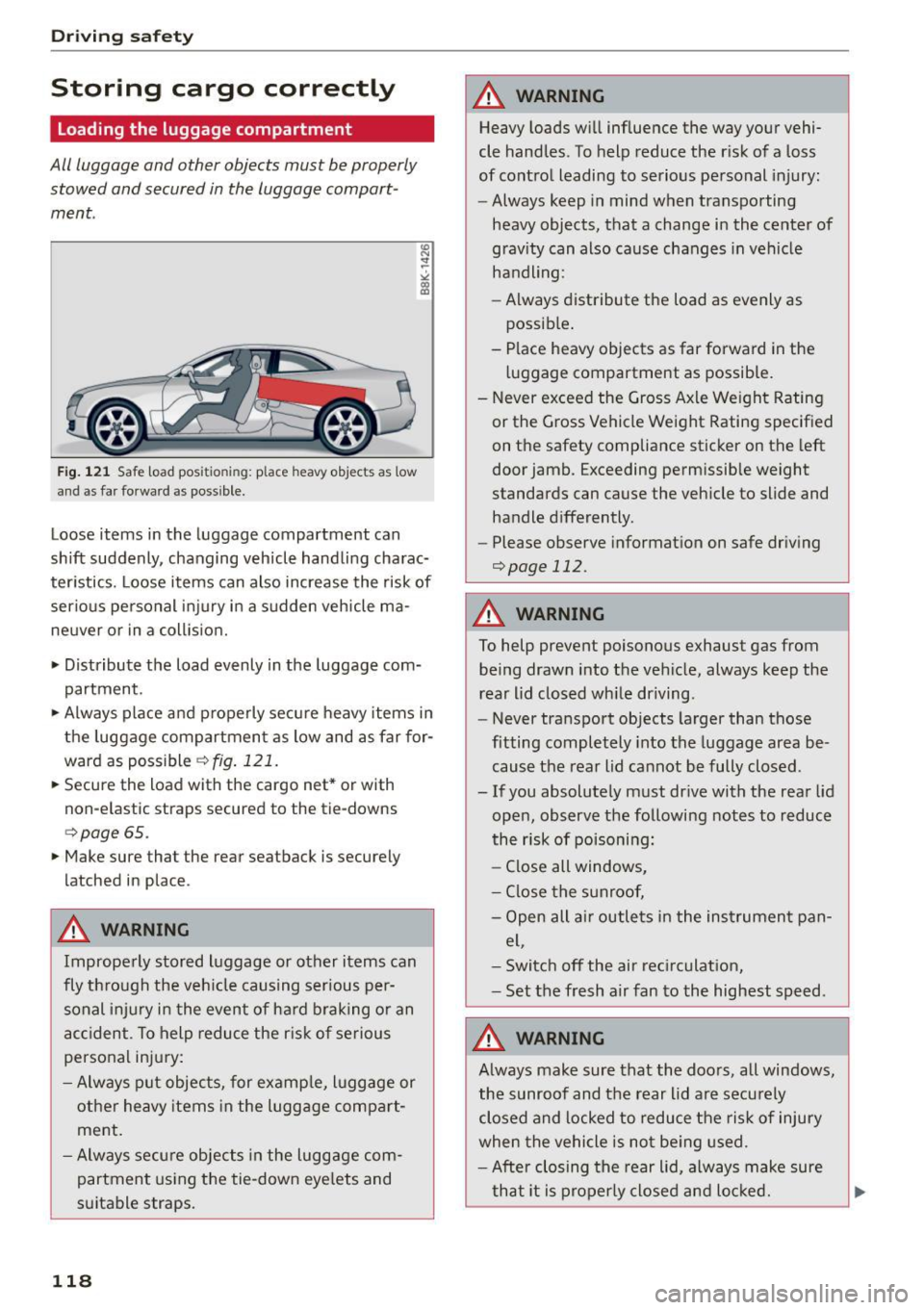
F ig. 121 Saf e load pos itio ning : place heavy objec ts as low
an d a s far forwa rd as possible.
Loose items in the luggage compartment can
shift suddenly, changing vehicle handli ng charac
ter istics. Loose items can also increase the risk of
serious pe rsonal i njury in a s udden vehicle ma
neuver or in a coll is ion.
• Distribute the load evenly in the luggage com
partment.
• Always place and p roperly secu re heavy items in
the luggage compartment as low and as far for
ward as poss ible
c> fig . 121.
• Secure the load with the cargo net* or with
non-e lastic straps secured to the tie-downs
c>page 65.
• Make sure that the rear seatback is securely
latched in place .
A WARNING
Improperly stored luggage or other items can
fly th rough the veh icle caus ing serious per
sonal i njury in the event of ha rd braking o r an
ac cident . To help redu ce the r is k of serious
personal inju ry:
- Always put objec ts, for examp le, l uggage or
other heavy items in the luggage compa rt
ment.
- Always secu re objects in the luggage com
partment using the tie-down eye lets and
s u itable straps.
118
A WARNING
H eavy loads w ill influence the way your vehi
cle handles . To help reduce the r isk of a loss
of control leading to serious personal injury:
- Always keep in mind when transpo rting
heavy objects, that a change i n the center of
grav ity can also cause changes in vehicle
handling:
- Always distribute the load as evenly as
possib le .
- Place heavy objects as far forward in the
luggage compartment as possible.
- Never exceed the Gross Ax le Wei ght Rating
or the Gross Vehicle Weight Rating specified
on the safety compliance sticker on the left
do or jamb. Exceeding permissible weight
standards can cause the vehicle to slide and
handle d ifferently.
- Please observe informat ion on safe driv ing
c>page 112 .
A WARNING
To help prevent poisonous exhaust gas from
being drawn into t he vehicle, always keep the
rear lid closed wh ile driving.
- Never transport objects larger than those
fitting completely into the luggage area be
cause the rear lid cannot be fully closed .
- If you absolutely must dr ive with the rear lid
ope n, observe the following notes to reduce
the risk of poisoni ng :
- Close all windows,
- Close the sunroof,
- Open all air outle ts in the ins trument pan-
el,
- Switch off the air rec irculat ion,
- Set the fresh air fan to the highest speed .
A WARNING
Always make sure that the doo rs, all windows,
the sunroof and the rear lid are secu rely
closed a nd locked to reduce the ris k of injury
whe n the vehicle is no t be ing used.
- After closing the rear lid, always make sure
th at it is p rope rly closed and lo cked.
Page 121 of 264
-Never leave your vehicle unattended espe
cially w ith the rear lid left open. A chi ld
could crawl into the vehicle through the lug
gage compartment and close the rear lid be
coming trapped and unable to get out . Be
ing trapped in a vehicle can lead to serious
persona l inju ry.
- Never let children play in or around the vehi
cle.
- Never let passengers r ide in the luggage
compartment . Veh icle occupants m ust al
ways be properly restrained in one of the ve
hicle's seat ing pos itions.
-Air c irculation helps to reduce window fog
ging . Stale air escapes to the outside
th rough vents in the trim pane l. Be su re to
k eep the se slots free and open.
- The t ire pressure must correspond to the
l oad. The t ire pressure is shown o n the tire
pres sure label. T he tire pressure l abe l is lo
cated on the d river 's side B-pi llar . The t ire
pressure label lists the recommended cold
tire inflation pressures for the vehicle at its
max imum capacity weight and the t ires that
were on your vehicle at the time it was man
ufactured. For recommended tire pressures
for normal load cond it ions, please see chap
te r
c:> page 215.
Tie-downs
App lies to vehicles: wit h tie-downs
The luggage compartment is equipped with four
tie-downs to secure luggage and other items .
Use the tie-downs to secure your cargo proper ly
¢ page 118, Loading the luggage compartment.
In a collision, the laws of phys ics mean that even
sma ller items that are loose in the vehicle w ill
become heavy missiles that can cause serious in
jury. Items in the vehicle possess energy which
va ry w ith vehicle speed and the weight of t he
item . Vehicle speed is the most s ignificant factor .
For example, in a frontal collis ion at a speed of
30 mph (48 km/h), the forces acting on a 10-lb
(4 .5 kg) object are about 20 times the normal
Dr ivin g s afet y
weight o f the item . This means that the weight
of the item would sudden ly be about
200 lbs. (90 kg) . You can imagine the injuries
that a 200 lbs. (90 kg) item flying freely through
the passenger compartment co uld cause in a col
li sion like this .
A WARNING
-Weak, damaged or imprope r straps used to
secure it ems to tie-downs can fail d uring ha rd
b raking o r in a coll is ion and cause seriou s per
son al injury .
- Always use s uitable mount ing straps and
p roperly se cu re i tems to the tie-downs in
the l ugg age compa rtment to he lp prevent
items from sh ifting or flying forward as dan
ge rous missi les.
- W hen the rear seat backrest is folded down,
always use s uita ble mo unting straps an d
properly secu re items to the tie-downs in
the l uggage compa rtment to he lp prevent
items from f ly ing forward as dangerous mis
siles into the passenger compartment.
- Never attach a chi ld safety seat tether strap
to a tie-down.
Reporting Safety Defects
Applicable to U.S.A.
If you belie ve that your vehicle
has a defect which could caus e a
crash or could cause injury or
death, you should immediately in
form the National Highway Traffic
Safet y Adm ini stration (NHTSA) in
addition to notifying Audi of
America, Inc.
If NHTSA re ceives simila r com
pl aint s, it may open an inve stig a
tion , and if it find s that a safety
d efe cts e xis ts in a group of ""
119
Page 126 of 264
Safety belts
_& WARNING
Not wearing safety bel ts or wearing them im
properly increases the risk of serious personal
injury and death . Safety belts can work only
when used correctly .
- Always fasten your safety belts correctly be
fore driv ing off and make sure al l passen
gers are correctly restrained.
- For maximum protection, safety belts must
always be pos itioned properly on the body .
- Never strap more than one person, includ
ing small ch ild ren, into any belt .
- Never place a safety belt over a child sitting
on your lap .
- Always keep feet in the footwell in front of
the seat wh ile the vehicle is be ing driven .
- Never let any person ride with their feet on
the instrument panel or st icking out the
window or on the seat .
- Never
remove a safety belt while the vehicle
is moving . Doing so will increase your risk of
being in jured or killed .
- Never wear belts twisted .
- Never wear belts
over rigid or breakable ob-
jects in or on your cloth ing, such as eye
glasses, pens, keys, etc ., as these may cause
i njury .
- Never allow safety belts to become dam
aged by being caught in door or seat hard
ware.
- Do not wear the shoulder part of the belt
under your arm or otherwise out of position .
- Several layers of heavy clothing may inter
fere w ith correct pos itioning of belts and re
duce the overall effectiveness of the system.
- Always keep belt buckles free of anything
that may prevent the buckle from latching
securely .
- Never use comfort clips or devices that cre
ate slack in the shoulder belt. However, spe
c ial clips may be required for the proper use
of some child restraint systems.
- Torn or frayed safety belts can tear, and
damaged belt hardware can break in an acci
dent . Inspect belts regularly. If webb ing,
bind ings, buckles, or re tractors are dam-
124
aged, have belts replaced by an authorized
Audi dea ler.
- Safety belts that have been worn and loaded
in an accident must be rep laced with the
correct replacement safety belt by an au
thorized Audi dealer. Replacement may be necessary
even if damage cannot be clearly
seen . Anchorages that were loaded must al
so be inspected.
- Never
remove, modify, d isassemble, or try
to repair the safety belts yourself .
-Always keep the belts clean . Dirty belts may
not work properly and can impair the func
tion of the inert ia reel
¢ page 184.
Safety belts
Fastening safety belts
Safety first -everybody buckle up!
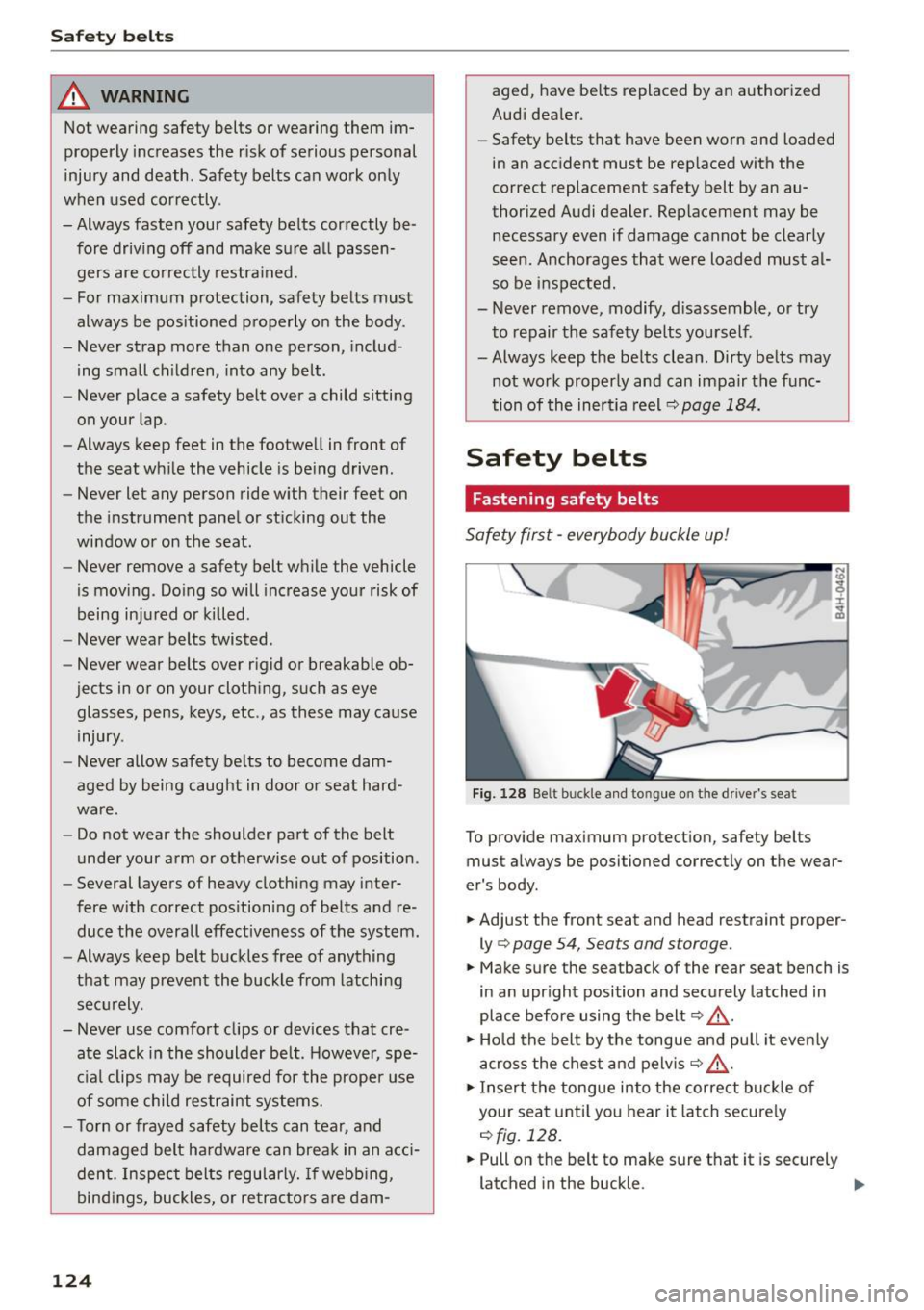
Fig. 128 Belt buckl e and to ngue o n th e dri ver's se at
To provide maximum protection, s afety belts
must a lways be positioned correctly on the wea r
er's body .
... Adjust the front seat and head restra int proper
ly ¢
page 54, Seats and storage.
... Make sure the seatback of the rear seat bench is
in an upr ight position and securely latched in
place before using the belt
q &_ .
.,. Hold the belt by the tongue and pull it even ly
across the chest and pelvis ¢ &_ .
.,. Insert the tongue into the correct buckle of
your seat unt il you hear it latch secure ly
¢ fig. 128.
... Pull on the belt to make sure that it is securely
latched in the buckle .
II>