vent AUDI A7 2012 Owners Manual
[x] Cancel search | Manufacturer: AUDI, Model Year: 2012, Model line: A7, Model: AUDI A7 2012Pages: 294, PDF Size: 73.33 MB
Page 226 of 294
224 Check ing and filling
cold engine, the coo lant level should be be
tween the "min" and "max" markings. When
the engine is warm, the level may be s light ly
above the "max" marking.
The location of the coolant expansion tank
can be seen in the engine compartment illus
tration
c:> page 218.
To obtain an accurate reading, the engine must be switched
off.
The expansion tank in you r vehicle is equipped
with an e lectric coolant level sensor.
When the coolant level is too low, the warning light in the Auto-Check System
c:> page 15 will
i l lum ina te unti l you add coolant and the level
has been restored to normal. Even though
there is an electric coolant level senso r, we
still recommend you check the coolant leve l
from time to time.
Coolant los s
Coolant loss may indicate a leak in the cool ing
system. In the event of coolant loss, the cool
ing system should be inspected immediately
by your authorized Audi dealer. It is not
enough merely to add coolant.
I n a
sea led system, losses can occur only if
the boiling point of the coolant is exceeded as
a result of overheat ing.
A WARNING
The cooling system is under pressure and
can get very hot. Reduce the risk of scald
ing from hot coolant by following these
steps.
- Turn
off the engine and allow it to cool
down.
- Protect yo ur face, hands and arms from
escaping fluid and steam by covering the
cap with a large, thick rag.
- Turn the cap slowly and very carefully in
a counter-clockwise direction wh ile ap
plying light, downward pressure on the
top of the cap.
- To avoid be ing burned, do not spill ant i
freeze or coolant on the exhaust system
'
or hot engine parts. Under certain cond i
tions, the ethylene glycol in engine coo l
ant can catch fire.
(D Note
Do not add any type of radiator leak sea l
ant to your vehicle's engine coolant. Add i ng radiator repa ir fl uid may adverse ly af
fect the funct ion and performance of your
cooling system and could result in damage
not covered by your New Veh icle L imited
War ranty.
Adding coolant
Be very careful when adding engine coolant.
Before you check anyth ing in the eng ine com
partment,
always read and heed all W ARN
INGS c:> A in Working in the engine compart
ment on page 216 .
.. Turn off the engine.
.. Let the engine cool down.
.. Place a thick rag over the coolant expansion
tank
c:> page 223, fig . 172 and carefully
twist the cap co unte r-clockwise c:> .&, .
.,. Add coolant .
.,. Twist the cap on aga in
tightly.
Replacement engine coo lant must conform to
exact spec ificat ions
c:> page 223, Coolant.
E ven in a n emerge ncy, if coolant add i-
t ive G12 ++, G 12+ or G12 is not available, do
not use a d iffe rent addit ive. Use plain water
instead unti l you can get the correct additive
and can restore the correct ratio . This shou ld
be done as soon as possible.
If you have lost a considerab le amount o f
coolant, then you sho uld add cold antifreeze
and co ld water on ly w hen the engine is cold.
Always use
new engine coo la nt whe n refilling.
Do not fill coola nt above the "MAX" mark . Ex
cess coola nt will be fo rced out through the
pressure relief valve in the cap w hen the e n-
gine becomes hot. .,.
Page 229 of 294
Have the battery checked when you take your
vehicle in for service. Yo u are well advised to
replace a battery that is older than 5 years.
W ith certa in types o f airbag deployment, the
battery is disconnec ted from the vehicle elec
trica l system for safety reasons
c::> &. in Re
pair, care and disposal of the airbags on
page 153.
Di sconn ecting the battery t erminal s
Some vehicle functions (power w indow regu
l ators, for example) are lost if the battery ter
minals are disconnected . These functions have
to be re learned after the battery terminals are
connec ted again. To prevent this, the battery
should only be disconnected from the vehicle
e lectrical system when absolutely necessary
for repairs .
Vehicl es not driven for long p eriod s
If you do not drive your vehicle over a period
of several days or weeks, electrical compo
nents are gradually cu t back or switched off .
This reduces energy consumption and main
tains starting capability over a longer per iod
c::> page 190. Some of the convenience func
tions may not operate, s uch as the inte rior
lights o r power seat adjus tme nt. The conven
ience functions will be ava ilable again when
you switch on the ignition and start the en gine.
Winter operation
During the winter months, ba ttery capaci ty
t ends to decrease as tempe rat ures d rop . This
is because more powe r is also consumed while
starting , and the headlights, rear window de
fogger, etc., are used more often.
Avoid unnecessary power cons umption, par
ticularly in c ity t ra ff ic or when t raveling on ly
short distances. Let your a uthorized Audi
dealer check the capac ity of the vehicle bat
tery before winter sets in
c> page 229. A well
charged battery w ill not only prevent starting
problems whe n the weather is cold, but will
also last longer .
Checkin g and fillin g 22 7
(D Tips
If your vehicle is left standing for seve ral
weeks at extremely low temperatures, the
vehicle battery shou ld be removed and
stored where it w ill not freeze. This will
prevent it from be ing damaged and having
to be replaced .
Working on the battery
Be especially careful when working on or near
the battery.
The battery is located in the l uggage compart
ment under the floor. Before you check any
th ing in the luggage compartment,
read and
h eed all WARNINGS
c> &_ .
Always heed the safety warnings , when work
ing on the vehicle battery or the vehicle e lec
trical system to prevent injury.
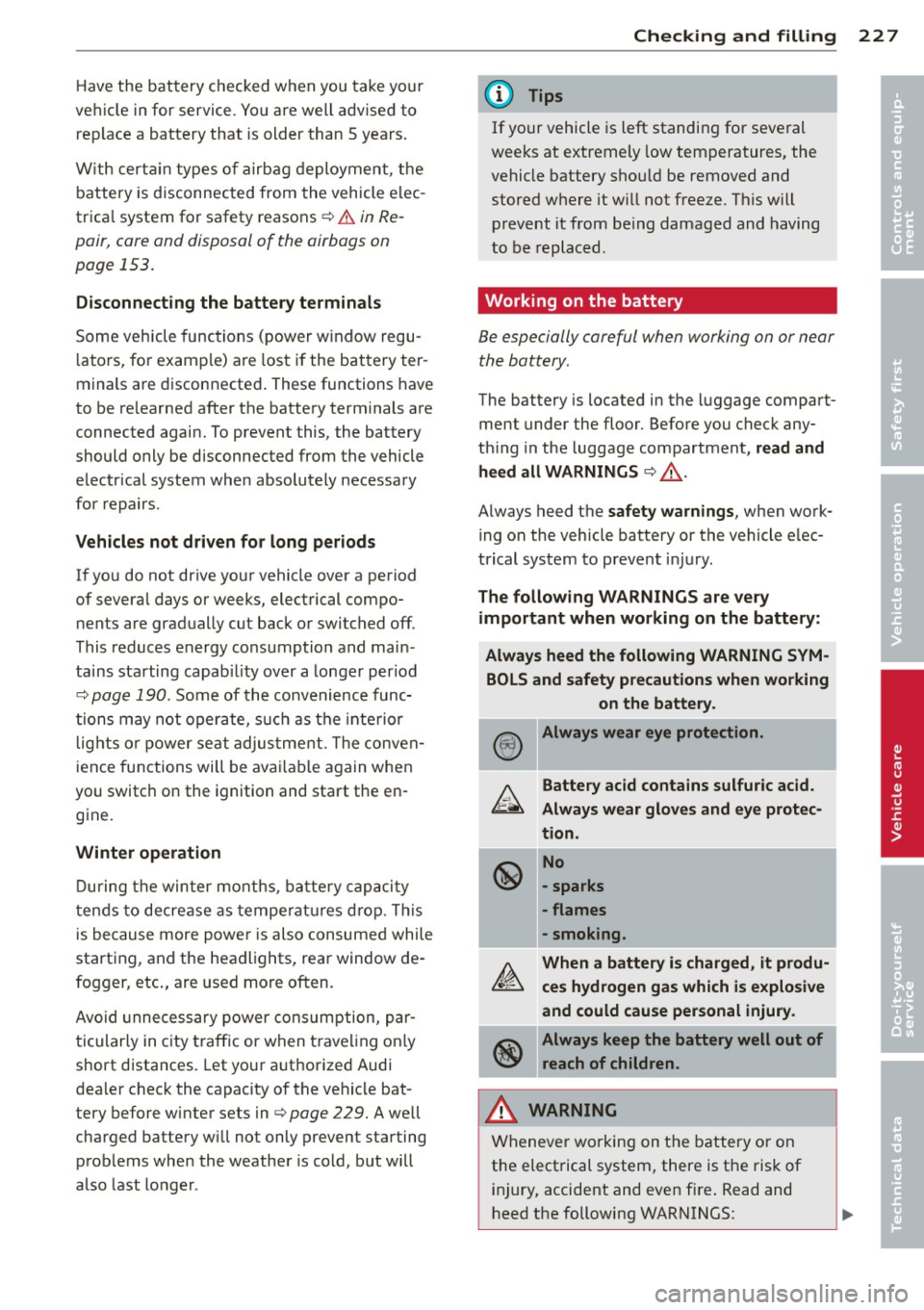
The following WARNINGS are very
important when working on the battery:
Al way s heed the follo wing WARNING SYM
BOLS and safety precautions when working on the battery.
@
®
Always wear eye protection.
Battery acid contains sulfuric acid.
Always w ear glove s and eye prot ec
tion .
No
- sparks
-flames
- smoking .
When a battery i s charged, it produ
ce s hydrogen gas wh ich i s ex plosive
and could cause per sonal injury .
Always keep the battery well out of ]
reach of children .
_& WARNING ~
Whenever working on the battery o r on
the electrical system, there is the risk of injury, accident and even fire . Read and
heed the following WARNINGS:
•
•
Page 230 of 294
228 Check ing and filling
- Always wear eye protection. Do not let
battery acid or any lead particles get on
your sk in or cloth ing . Sh ield your eyes .
Explosive gases can cause blindness or
other injury .
- Battery acid contains sulfur ic acid . Sulfu
ric acid can cause blindness and severe
burns .
- Always wear gloves and eye protection.
Do not t ilt the battery because acid
could leak out of the venti lation open
ings.
- If you get battery acid in yo ur eyes or
on your skin, immediately rinse with
cold water for severa l m inutes and get
medical attention .
- If you should ingest any battery acid,
seek medical attention immediately.
- Do not expose the battery to an open
flame, electric sparks or an open light.
- Do not smoke.
- Do not interchange the posi tive and neg -
ative cab les.
= When wo rking on the battery , be sure
not to short -circuit the termina ls with
tools or other metal objects . This would
cause the battery to heat up very quickly,
which could lead to damage or explosion
and personal injury.
- When a battery is charged, it produces hydrogen gas which is explosive and
cou ld cause personal injury .
- Always keep the battery well out of the
reach of chi ldren .
- Before work is done on the e lectrica l sys
tem, disconnect the negative ground ca ble .
- Before perform ing any work on the elec
trical system, sw itch
off the engine and
ignition as well as any electrical equip
ment . The negative cable on the batte ry
must be disconnected . If you are just go
ing to rep lace a light bu lb, then it is
enough to sw itch
off the ligh ts.
- Before disconnect ing the battery, switc h
off the anti-theft alarm sys tem! Othe r
wise you will set off the alarm. -
When disconnecting the battery, first
disconnect the negat ive cab le and then
the posit ive cab le.
- Before reconnecting the battery, make
sure all e lectr ical consumers are sw itch
ed off. Reconnect the pos it ive cable first
and then the negative cable . Never inter
cha nge the cables - this could start a fi re!
- Never charge a frozen or a thawed-out
battery .
It could explode! If a battery has
frozen , then it must be replaced . A dis
charged batte ry can free ze over at 32 °F
(0 °C) .
-Make sure the vent hose is a lways attach
ed to the opening on the s ide of the ba t
tery .
- Never use batteries which a re damaged.
There is the danger of an explosion! Al
ways rep lace a damaged b attery.
A WARNING
Ca lifornia Proposi tion 6S Warning:
- Battery posts, te rminals and related ac
cesso ries cont ain lead and lead com
pounds, chemica ls known to the Sta te of
California to cause cancer and reproduc
tive problems. Wash hands after han
dling.
(D Note
- Do not disconnect the vehicle battery
when the ignit ion is on or when the en
gine is run ning, otherwise , you will dam
age electronic components in the electr i
cal system.
- If your vehicle is going to stand for a
long period of time without be ing driven,
protect the battery from "freezing", oth
erw ise it will be damaged and will then
have to be replaced .
- When open ing the doors, the windows
lower approximately 10 mm automati
cally. This function is not ava ilable when
the battery is disconnected, which
means there is a risk that the door sea l
o r the window could be damaged.
Page 231 of 294

Battery charging
Starting the engine requires a well charged battery .
Fig. 174 Eng ine compartment : connectors for a charg
er and jump sta rt cab les
A lwa ys re ad and heed all WARNING S below
c:> &. and c:> &. in Working on the battery on
page 227 .
.. Switch off the ignit ion and all electrical con
sumers .
.. Make sure the area is well ventilated when
you charge the battery .
.. Open the engine hood
c:>page 216.
.. Open the red cove r on the posit ive pole
c:>fig. 174.
.. Connect the charger connectors accord ing
to the instructions to the
jump start b olts .
(Bolts under the red cover= "positive", Bolts
with hex head= "negative").
.. Only now plug the mains lead for the charg
ing equipmen t into the wall outlet and turn
it on
c:> 8_ .
.. Ma ke sur e t he charging rat e is not over
30 amp s/14 .8 Vol t.
.. When the batte ry is fully charged: Turn the
charging eq uipment off a nd remove the
ma ins lead from the wall outlet .
.. Now remove the clamps for the charging
equipment.
.. Close the red cover on the positive pole.
.. Close the hood
c:> page 217.
A discharged battery can free ze at tempera
tures of on ly 32 F
0 (0 °C). A llow a frozen bat
tery to thaw completely before attempt ing to
charge it
c:> .&. . However, we recommend not
using a thawed battery again because the bat-
Checkin g and fillin g 229
tery casing can be cracked due to ice forma
tion and can leak battery acid.
Battery charging (Maximum charging rate
of 30 amps /14.8 Volt )
When charging at low voltages (e.g. with a
trickle cha rger ), the battery cables do not
have to be disconnected f irst . The battery
caps should
not be opened when charging a
battery.
It is not necessary to remove the battery from
the luggage compartment, and it is also not
necessary to disconnect the cables.
Fast ch arging the batte ry (charging rat e
a bove 14.8 Volt s)
For technica l reasons do not use a battery
charger that uses voltage greater than 14.8
Volts to charge your vehicle's battery .
A WARNING
-
Charging a battery can be dange rous .
- Always follow the operating instructions
provided by the battery charger manu
facturer when charg ing your battery .
- Never charge a frozen battery. It may ex
plode because of gas trapped in the ice .
Allow a frozen battery to thaw out first.
- Do not reuse batteries wh ic h were fro
zen. The battery housing may have
cracked and weakened when the battery
froze.
- Cha rge the battery in a well ventilated
area . Keep away from open flame or elec
trical spar k. Do not smo ke. Hyd rogen gas
generated by the bat tery is explos ive.
- To reduce the danger of explosion, never
connect or d isconnect charger cab les
while the charger i s ope rat ing.
- Fast cha rging a batte ry is dange rous and
should only be at tempted by a compe
tent techn ician wi th the prope r equip
ment .
- Ba ttery acid that may spi ll dur ing charg
ing should be washed off with a solution
of warm water and baking soda to neu
tralize the ac id.
Page 232 of 294
230 Checking and filling
(D Note
Never use a fast charger as a booster to
start the engine. This will seriously dam
age sensitive electronic components, such
as control units, relays, radio, etc., as well
as the battery charger.
Battery replacement
The new battery must have the same specifi
cations and dimensions as the original equip
ment battery.
Intelligent energy management in your vehi
cle is responsible for distributing the electri
cal energy throughout your vehicle
~ page 190. The intell igent energy manage
ment system will keep the engine battery
charged better than vehicles without this sys
tem. To make sure the additional electrica l en
ergy is available once again after you have
changed the battery, we recommend that you install batteries of the same type and manu
facture only (the same as those installed at
the time your vehicle was delivered). Specifi
cations are listed on the battery housing. Your
author ized dealer must code the battery in
the energy management system to enable you
to use the energy management funct ions cor
rectly after replacing the battery .
The new battery must have the same capacity,
voltage (12 volts), amperage, construct ion
and plug sealing.
When installing the battery, make sure the ig
nition and all electr ical consumers are switch
ed off.
(D Note
Make sure the ventilation hose on the side
of the battery is connected, otherwise
fumes or battery ac id can leak out.
@ For the sake of the environment
Because of the problem of proper disposal
of a battery, we recommend your author
ized Audi dealer change the battery for
you . Batteries contain su lfuric acid and l
ead and must always be disposed of prop
erly in compliance with all environmental
regulations. Disposing of vehicle batter ies
i mproperly is very dangerous to the envi
ronment.
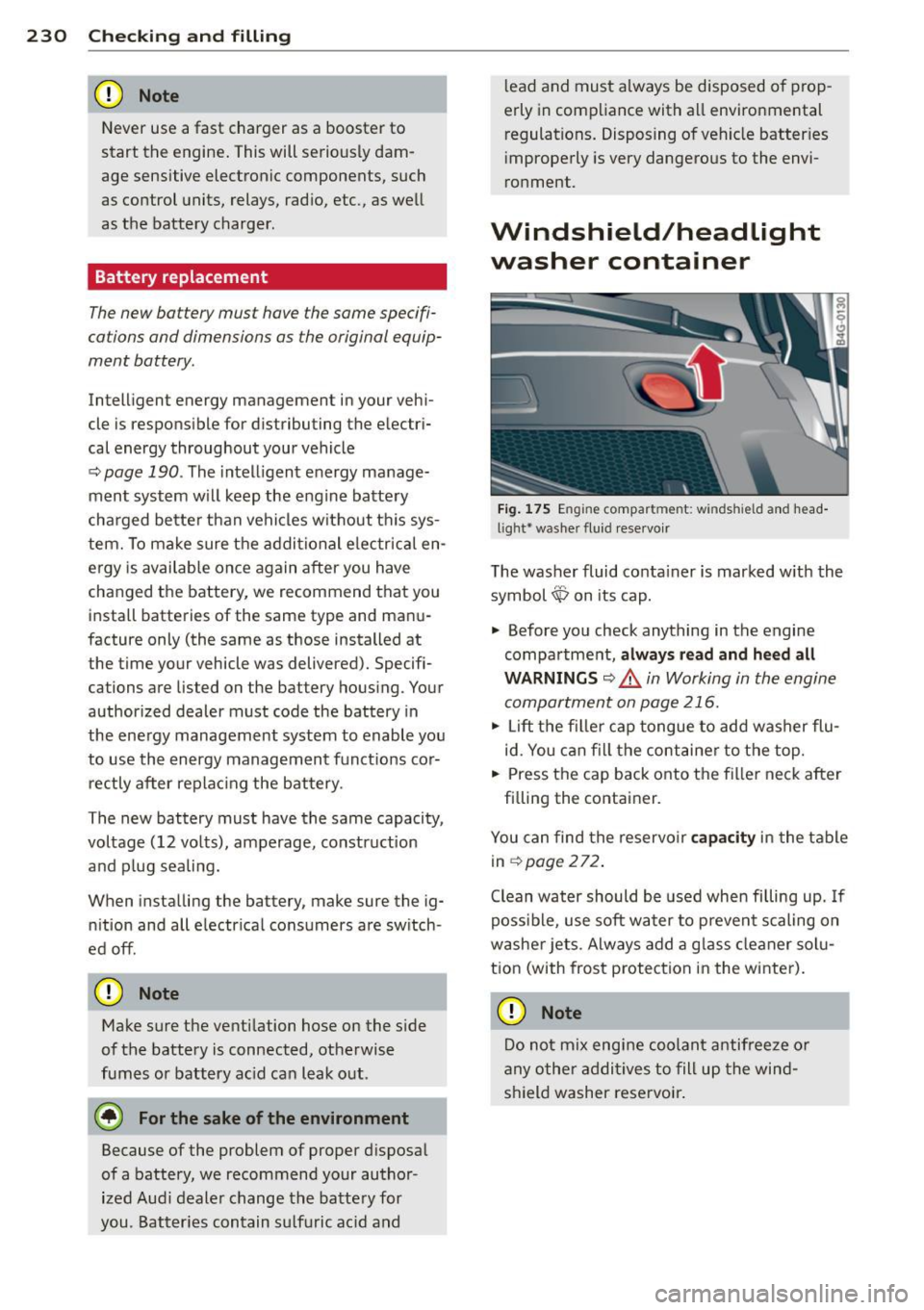
Windshield/head Light
washer container
Fig. 175 En g in e compart men t: w inds hield and head
lighr washer fluid reservoir
The washer fluid conta iner is marked w ith the
symbol~ on its cap.
"' Before you check anything in the engine
compartment,
always read and heed all
WARNINGS ~.&. in Working in the engine
compartment on page 216.
"' Lift the filler cap tongue to add washer flu
id. You can fill the container to the top.
"' Press the cap back onto the filler neck after
fi lling the container.
You can find the reservoir
capacity in the table
in
~ page 272.
Clean water should be used when filling up. If
possible, use soft water to prevent scaling on
washer jets. Always add a glass cleaner solu
tion (with frost protection in the winter).
@ Note
Do not mix engine coolan t ant ifreeze or
any other additives to fill up the wind
shield washer reservoir .
Page 238 of 294
236 Tires and wheels
change. In the event of discrepancies, the tire
pressure labe l is located on the driver's side B
p ill ar a lways takes precedence.
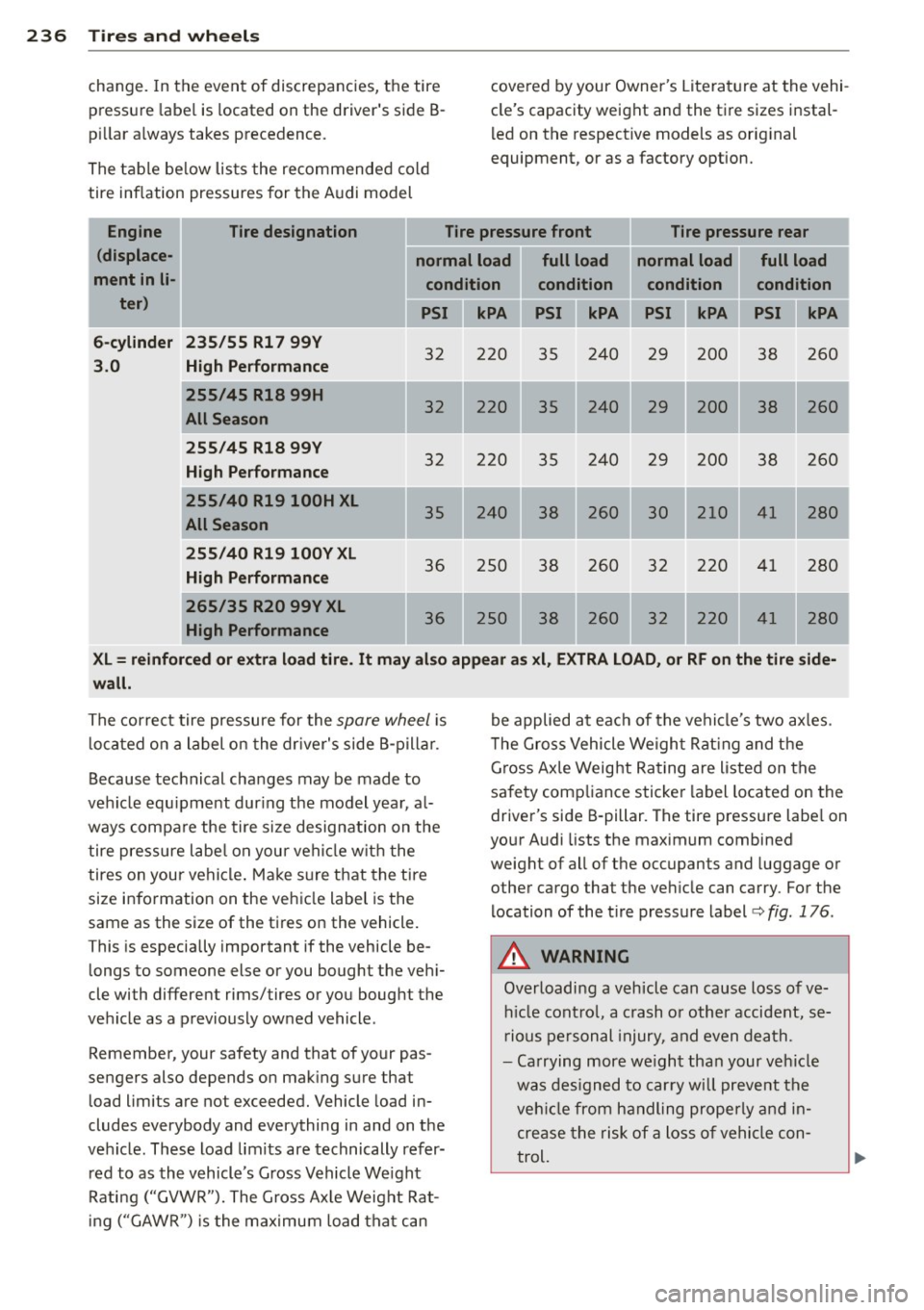
The table below lis ts the recommended cold
tire inflation pressures for the Audi model covered
by your Owner's Literature at the vehi
cle's capacity weight and the tire sizes instal
l ed on the respective models as orig inal
equipment, or as a factory option.
I Engine Tire designation
Tire pressure front Tire pressure rear I
(displace-
normal load full load normal load full load
ment in
li-condition condition condition condition
I
ter) PSI II kPA PSI JI kPA PSI II kPA PSI II kPA :
6-cylinder 235/55
Rl 7 99Y
3.0 High Performance 32
220
35 240 29 200
38 260
255/45 Rl8 99H '
32 220 35
240
29 200 38 260 All Season I
255/45 Rl8 99Y
32 220 35 240 29 200 38 260
High Performance
255/40 Rl9100H XL
35 240
38 260
30 2 10 41
280 All Season
255/40
Rl9100YXL
36 250 38 260 32 220 41 280
High Performance
265/35 R20 99Y XL '
36 250 38 260 32 220 41 280
High Performance .. • .. .. .. .. ..
XL= reinforced or extra load tire. It may also appear as xl, EXTRA LOAD, or RF on the tire side
wall.
The correct tire pressure for the spore wheel is
loc ated on a label on the driver's side B-pillar.
Because technical changes may be made to
vehicle equ ipment dur ing the model year, a l
ways compare the tire size designation on the
tire pressure labe l on your vehicle w ith the
tires on your vehicle . Make sure that the tire
size information on the vehicle label is the
same as the size of the ti res on the vehicle.
This is especially important if the vehicle be
longs to someone else or you bought the vehi
cle with different rims/tires or you bought the
vehicle as a previously owned vehicle.
Remember, your safety and that of your pas
sengers also depends on making sure that load limits are not exceeded. Vehicle load in
cludes everybody and everything in and on the
vehicle . These load limits are technically refer
red to as the vehicle's Gross Vehicle We ight
Rating ("GVWR"). The Gross Ax le Weight Rat
ing ("GAWR") is the maximum load that can be applied at each
of the vehicle's two ax les .
T he Gross Vehicle Weight Rat ing and the
Gross Axle Weight Rating are listed on the
safety compliance sticke r label located on the
driver's side B-pillar. The tire pressure labe l on
your Audi lists the maximum combined
weight of all of the occupants and luggage or
other cargo that the vehicle can carry . For the
location of the tire pressure label
¢fig. 176 .
A WARNING
-Overloading a vehicle can cause loss of ve-
hicle control, a crash or other accident, se
r ious personal injury, and even death.
- Carrying more weight than your veh icle
was designed to carry will prevent the
vehicle from handling properly and in
crease the risk of a loss of vehicle con
trol.
Page 240 of 294

238 Tire s and whee ls
Remember that the vehicle manufacturer, not
the tire manufacturer, determines the correct
tire pressure for the t ires on your vehicle.
I t is important to check the tire pressu re when
the tires are cold.
- Read the requ ired t ire pressure from the tire
pressure label. The tire pressure labe l is lo
cated on the drive r's side 8-p illar.
- T urn the valve stem cap counter-clockwise
to remove it from the tire valve.
- Place the air pressu re gauge on the valve.
- The tire pressures should only be checked
and adjusted when the tires are cold. The
sl ightly raised p ressures of warm tires must
not be reduced.
- Adjust the tire pressure to the load you are
carrying.
- Re install the va lve stem cap on the valve .
When should I check the ti re pres sure ?
The correct tire pressure is especially impor
tant at high speeds. The pressure should
therefore be checked at least once a month
and always before start ing a jou rney. Do not
fo rget to check the tire pressure for the spare
wheel
<=? page 253.
When should I adju st the tire p re ss ure s?
Adjust the tire pressure to the load you are
carry ing . After changing a wheel
or replacing
wheels you have to adjust the tire pressures
on all wheels. In addition, you must then
sto re t he new ti re press ures in the t ire pres
sure mon itor ing system* ~
page 249.
_8 WARNING
Incorrect tire pressures and/or underinf la
tion can lead sudden tire failure, loss of
contro l, collision, ser ious persona l injury
or even death.
- When the warning symbo l
RI] appears in
the instrument cluster, stop and inspect
the tires .
- Incorrect tire pressure and/or underinfla
t ion can cause increased t ire wear and
can affect the handling of the veh icle and
stopp ing ability. -
Incorrect tire pressures and/or underin
f lation can a lso lead to s udden t ire fail
ure, including a blowout and sudden de
flation, caus ing loss of veh icle control.
- The driver is responsible for the correct
tire pressures for all tires on the veh icle.
The applicable pressure values are locat ed on a sticker on the dr iver's s ide 8-pil
lar.
- Only when all tires on the vehicle are fil led to the correct pressure, the t ire pres
sure mon itor ing* system can work cor
rectly.
- The use of incorrect t ire pressure va lues
can lead to acc idents or other damage.
Therefore it is essential that the drive r
observe the spec ified tire pressure values
for the tires and the correct pressures for
the function of the ti re press ure monitor
ing system*.
- Always inflate tires to the recommended
and correct tire press ure before driving
off.
- Driving with underinflated tires bend
more, letting them get too hot resulting
in tread separation, sudden tire failure
and loss of control.
- Excessive speed and/overloading can cause heat build-up, sudden tire failure
and loss of control.
- If the tire pressure is too low or too high,
the t ires will wear prematurely and the
veh icle w ill not handle well.
- If the tire is not flat and you do not have
to change a wheel immediately, drive at
reduced speed to the nearest service sta
tion to check the t ire p ress ure and add
air as req uired .
Q) Note
Driving without valve stem caps can cause
damage to the tire valves. To prevent this,
always make sure that factory insta lled
valve stem caps o n all whee ls are sec urely
mounted on the valve.
Page 241 of 294
@ For the sake of the environment
Underinflated tires will a lso increase the
fue l consumption .
Tires and vehicle load limits
There are limits to the amount of load or
weight that any vehicle and any t ire can carry.
A vehicle that is overloaded w ill not handle
well and is more difficult to stop. Overload ing
can not only lead to loss of vehicle control, but can a lso damage importan t pa rts of the
ve hicle and can lead to s udden tire failure, in
cluding a blowout and sudden deflation that
can cause the veh icle to crash.
Your safety and that of yo ur passenge rs a lso
depends on making s ure that load limits are
not exceeded . Vehicle load includes everybody
and everything in and on the vehicle. These
load limits are technica lly referred to as the
vehicle's
Gross Veh icle We ight R ating
("GVWR").
The "GVWR" includes the weight of the basic
vehicle, all factory insta lled accessories, a full
tank of f ue l, oil, coolant and other fluids plus
maximum load. The maximum load includes
the number of passengers that the vehicle is intended to carry ("seating capacity") with an
assumed weight of 150 lbs (68 kg) for each
passenger at a des ignated seat ing pos ition
and the total we ight of any l uggage in the ve
hi cle. If you tow a trailer, the weight of the
trailer hitch and the tong ue weight of the
loaded trailer must be included as part of the
vehicle load.
The
Gro ss Axl e W eight R ating ("GAWR") is
the maximum load that can be app lied at each
of the vehicle's two axles.
The Gross Vehicle Weight Rating and the
Gross Axle Weight Rating a re listed on the
safety compliance sticker labe l located on the
driver's side B -pillar . Your A udi has 4 seating
positions, 2 in the front and 2 in the rear for
total seating capacity of 4. Each seating pos i
tion has a safety belt¢
page 128, Safety
belts .
Tire s an d wheel s 239
The fact that there is an upper limit to your
vehicle's Gross Vehicle Weight Rating means
that the total weight of whatever is being car
ried in the vehicle ( includ ing the weight of a
trailer hitch and the tongue weight of the
loaded tra iler) is lim ited. The more passen
gers in the vehicle or passengers w ho are
heavier than the standard we ights assumed
mean that less we ight can be ca rried as lug
gage.
The tire pressure label on your Aud i also lists
the maximum combined weight of a ll of the
occupants and luggage or other cargo that
the ve hicl e can carry . For t he locat ion of the
label¢
page 235, fig . 176.
.&_ WARNING ~
Overloading a vehicle can cause loss of ve -
h icle contro l, a crash or other accident, se
rious personal injury, and even death.
- Carrying more weight than your vehicle
was designed to carry wi ll prevent the
veh icle from handling properly and in
crease the risk of the loss of vehicle con
trol.
- The brakes on a vehicle that has been
overloaded may not be able to stop the
veh icle w ith in a safe distance.
- Tires on a vehicle that has been over load
ed can fail suddenly, including a blowout
and sudden deflation, causing loss of
control and a crash .
- Always make sure that the total load be
ing transported -includ ing the weight of
a t railer hitch and the tongue we ight of a
loaded trailer - does not ma ke t he vehi
cle heavier than the vehicle's G ross Vehi
cle Weight Rating.
Determining correct load limit
U se th e exa mple below to cal
c ulat e the total weight of the
pa ssen ger s a nd lu ggag e or ot h-
e r thin gs that you pl an t o .,..
•
•
Page 246 of 294

24 4 T ire s and wheel s
T up to 118 mph (190 km/h)
U up to 124 mph (200 km/h)
H up to 130 mph (210 km/ h)
V up to 149 mph (240 km/h)
1l
Z over 149 mph (240 km/h)ll
W up to 168 mph (270 km/h)ll
Y up to 186 mph (298 km/h)l)
Your veh icle is norma lly fac to ry equipped with
tires , which possess excellent driving charac
teristics and give yo ur Audi opt imum driving
comfort . An e lectronic speed limit er
c:> page 28 wi ll normally prevent your vehicle
from go ing faster th an the tire speed rating
c:> & .
U.S . DOT Tir e Identification Numb er (TIN )
a nd tire manufacture d ate
This is the t ire's "serial number". It begins
with the letters "DOT" and indicates that the
tire meets all federal standards . The next two
numbers or letters indicate the p lant whe re it
was manufactured, and the last four numbers r epresent the week and year of manufacture.
F or example, the numbers 2211 mean the ti re
was p roduced in the 22nd week of 2011. The
other numbers are marketing codes that may
or may not be used by the ti re manufacturer .
T his informat ion is used to contact consumers
if a tire defect requires a recall.
Aud i Original tire
Tires wi th the ident ification "AO" or "RO" have
been specially matched with your Audi . We
recommend using only these tires because
they meet the highest standards regard ing
safety and driving character istics when used
correctly . Your authorized Audi dealer will
gladly prov ide you with more information .
Tire ply composition and materials u sed
The number of p lies ind icates the number of
layers of rubber-coated fabric in the t ire. In
general, the greater the number of plies, the mo re weight a tire can support . Tire manufac -
ll F t· "t h . or ires w 1 a m ax im um s pee d ca pabil ity ove r
1 4 9 mp h (240 k m/h) , tir e man ufactur ers somet imes
use the letters " ZR."
turers also must indicate the materials in the
tire, which include stee l, nylon, po lyester, and
others .
Maximum Load Rating
Th is number ind icates the maximum load in
k ilograms and po unds that can be carr ied by
the tire .
Tire quality grading for treadwear,
traction , and temperature resistance
Tre ad wear, traction and tempera ture grades
c:> page 245 .
Maximum Permissible Inflation Pressure
This number is the greatest amount of a ir
pressure tha t should ever be put in the tire
u nder norm al driv ing cond it ions .
_& WARNING
= -
-Using incorrect or unmatched tires and/
or wheels or improper tire and wheel
combinations can lead to loss of control
coll is ion and serio us personal in jury.
'
- Always use ti res, rims and whee l bolts
that meet the specifications of original factory-insta lled tires or other comb ina
tions that have been specifically ap proved by the vehicle manufacturer.
- Tires age even if they are not being used
and can fai l sudden ly, especially at hig h
speeds . Tires that are more than 6 years
old can only be used in an emergency
and then w ith specia l care and at lower
speeds.
- Ne ver mo unt used tir es on your veh icle if
you are not sure of the ir "p revio us histo
ry." O ld used tires may have been dam
aged even though the damage cannot be
seen that can lead to sudden tire fa ilure
and loss of vehicle control.
- All fo ur whee ls must be fitted with radial
tires of the same type, size (rolling cir cumference) an d the same tread pattern . ..,_
Page 251 of 294

In o rder to minimize the occurrence o f impact
damage to the tires of your vehicle, we recom mend that you observe the following precau
tions :
- Always maintain recommended inflation
pressures. Check your tire pressure every
2,000 miles (3,000 km) and add a ir if neces
sary.
- Drive carefu lly on roads with potholes, deep
gullies or ridges. The impact from driving
through or over such obstacles can damage
your tires. Impact with a curb may also cause damage to your tires .
- After any impact, immediately inspect your
tires or have them inspected by the nearest
authorized Aud i dealer . Replace a damaged
t ire as soon as poss ible .
- In spect your t ires every 2,000 miles (3,000
km) for damage and wear . Damage is not al
ways easy to see. Damage can lead to loss of
air and unde rinflation, wh ic h could eventu
ally cause ti re fail ure.
If yo u be lieve that a
ti re may have been damaged , replace the
tire as soon as possible.
- These tires may wear more quick ly than oth
ers.
- Please a lso remembe r that, whi le these t ires
deliver respons ive handling, they may ride
less comfortably and make more noise than
other c hoices.
Reduced p erformance in winter /cold
s ea son condit ion s
All ti res are designed for certain purposes .
The low aspect ratio, ultra hig h performance
tires originally installed on your veh icle are in
tended for max imum dry and wet road per
formance and handling . They are not suitable
for cold, snowy or icy weather cond it ions . If
you dr ive under those circumstances, you
should equip your vehicle with all-season or
winter tires, whi ch offe r better traction under
those cond it ions . We suggest you use the rec
ommended snow or all -season tires specified
for your ve hicle, or their equiva lent .
Refe r to ~
page 246 for mo re deta iled info r
mat io n regarding w in ter t ires.
Tire s an d wheel s 249
Tire pressure
monitoring system
ill General notes
App lies to vehicles : wi th tire p ress ure mo nito rin g system
Each tire, incl uding the spare (if provided),
shou ld be checked monthly when co ld and in
flated to the inflation pressure recommended
by the veh icle manufacturer on the veh icle
placard or tire inflation pressure label. (If your
vehicle has tires of a d ifferent size than the
s iz e indicated on the vehicle placard or tire in
flat io n pressu re labe l, you shou ld dete rmine
the p roper t ire inflation p ress ure fo r those
t i r es).
As an added safety feature, your veh icle has
been equipped with a tire pressure monitoring
system ( TPMS) that illum inates a low ti re
pressure te lltale whe n one or more o f your
ti res is significant ly under -inflated . According
ly, when the low tire pressure te lltale i llumi
nates, you shou ld stop and check your tires as
soon as possib le, and inflate them to the
proper pressure. Driving on a sign ificantly un
der- inflated t ire causes the tire to overheat
and can lead to tire fa ilure . Under-inflation al
so reduces fuel effic iency and tire tread life,
and may affect the vehicle 's hand ling and
stopp ing abil ity.
Please note that the TPMS is not a subst itute
fo r proper tire ma intenanc e, and it is the d riv
er's respo nsibility to maintain co rrect tire
pressure, even if under-inflation has not
reached the leve l to tr igger illum inat ion of the
T PMS low ti re p ressu re tellta le .
You r vehicle has also been equipped with a
T PMS ma lf u nction indicator to ind icate w hen
the sys tem is not operating prope rly . T he
T PMS ma lfunction indicator is combined w ith
the low tire pressure te lltale. When the sys
tem detects a malfunction, the telltale wi ll
flash for approximate ly one min ute and then
rema in con tinuously i llum inated . T hi s se
quence will continue upon subsequent vehicle
start-ups as long as the malfunct ion exists . ..,.
•
•