warning AUDI A7 2016 Owners Manual
[x] Cancel search | Manufacturer: AUDI, Model Year: 2016, Model line: A7, Model: AUDI A7 2016Pages: 294, PDF Size: 73.82 MB
Page 184 of 294
Child safet y
Please remembe r that the lower anchorage
points are on ly intended for installation and at
tachment of child restra ints specifica lly certified
for use w ith
LATCH lower anchorages . Child re
straints that are not equ ipped w ith the lower an
chorage attachme nts can still be installed in
comp liance with the child restraint manufactur
er 's instructions on using vehicle safety belts .
A WARNING
Improper use of LATCH lower anchorages can
cause serious personal injury in an accident.
- Always ca refully follow the ch ild restraints
man ufa ctu rer's instructions for proper in
sta llation of the child rest raint and proper
use of the lower anchorages or safety belts
in your vehicle .
- Never sec ure o r attach any l uggage or other
items to the
LATCH lower anchorages .
- Always read and heed the impor tant i nfor
mation about child res traints in this chap ter
and WARNINGS
<=> page 167, Child safety .
Installing a child restraint with LATCH
lower anchorages
Whenever you install a child restraint always fol
low the child restraint manufacturer 's instruc
tions.
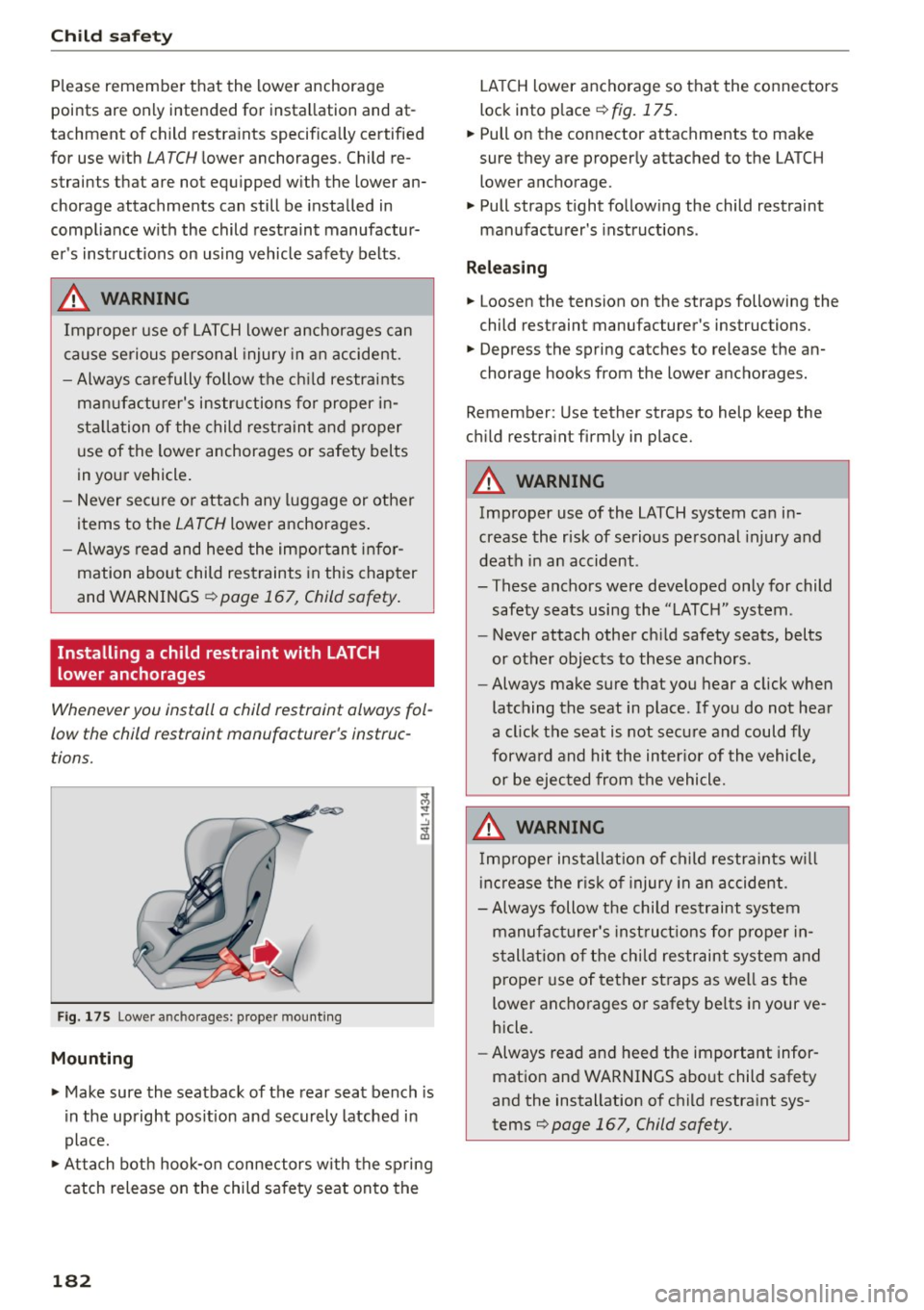
F ig . 175 Lowe r an ch orages: proper mount ing
Mounting
.,. Make sure the seatback of the rear seat bench is
i n the upright pos ition and securely latched in
place .
.. Attach both hook-on connectors with the spring
catch release on the child sa fety seat onto the
182
LA TC H lower anchorage so that the connectors
lock into p lace
<=> fig. 175 .
.. Pull on the connector attachments to make
sure they are properly attached to the LATCH lower anchorage .
.. Pull straps tight follow ing the child restraint
manufactu re r's instruct ions .
Releasing
.. Loosen the tension on the straps following the
child restraint manufacturer's instructions.
.. Depress the spring catches to release the an
chorage hooks from the lower anchorages .
Remember: Use tether straps to help keep the
ch ild restra int firmly in place.
A WARNING
-
Improper use of the LATCH system can in
crease the risk of serious pe rsonal injury and
death in an accident .
- These ancho rs were developed only for child
safety seats using the "LATCH" system .
- Never attach other ch ild safety seats, belts
or other objects to these anchors .
- Always make sure that you hear a click when
latching the seat in place. If you do not hear
a cl ick the seat is not secure and could fly
forward and hit the inter ior of the vehicle,
or be ejec ted from the vehicle.
A WARNING
Imp roper ins tallat ion of child restra ints w ill
inc rease the r is k of i njury in an a ccident.
- Always follow the chi ld restraint system
manufact urer's inst ruct ions for p rope r in
s tallat ion o f the child restraint system and
prope r use of te ther st raps as we ll as the
lower anchorages or safety be lts in your ve
hicle.
- Always read and heed the important infor
mation and WARNINGS abo ut child safety
and the installation of chi ld restra int sys
tems
r::> page 167, Child safety.
Page 185 of 294
M N <( I.J "". rl I.O
"' N I.O rl
Tether anchors and tether straps
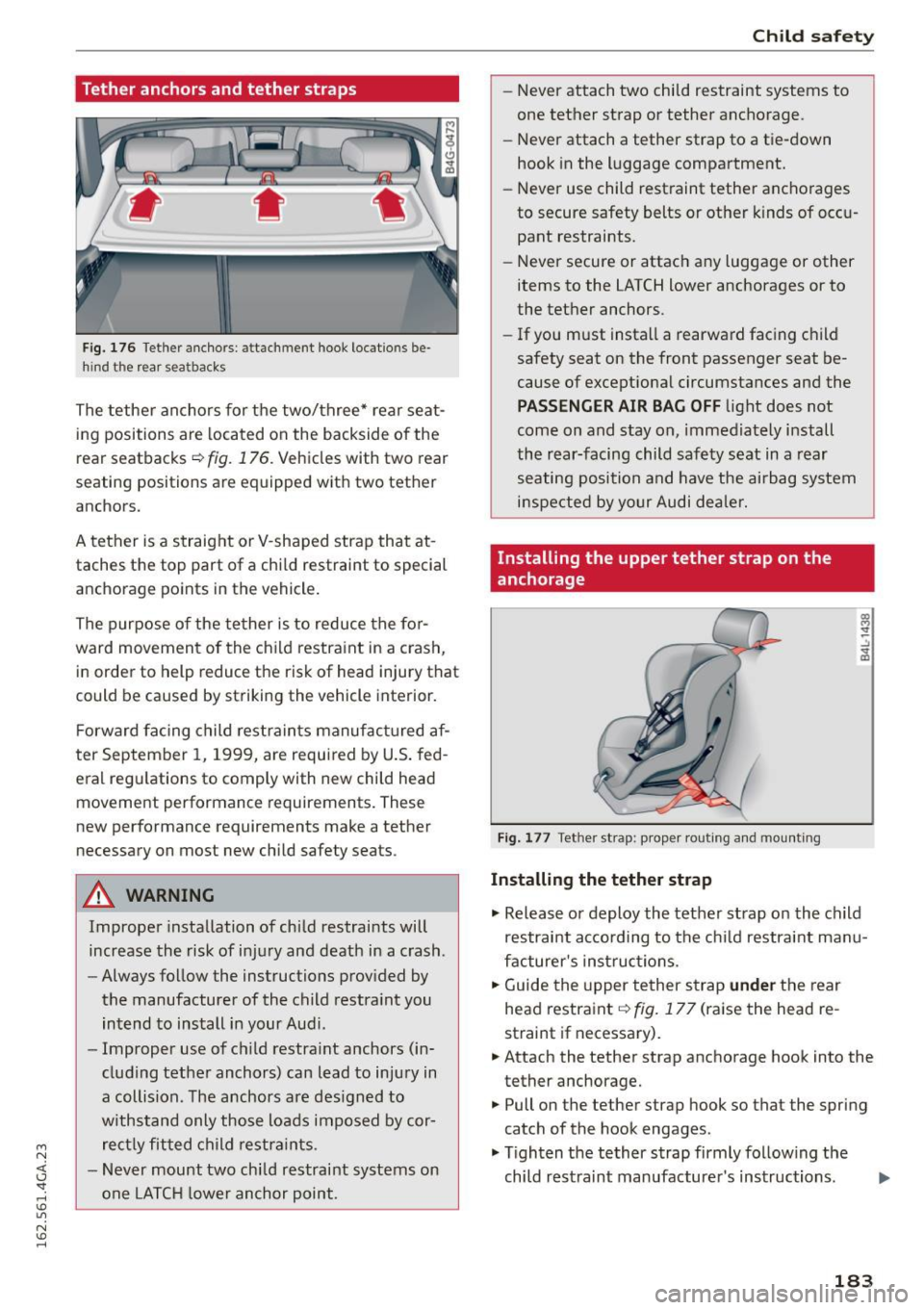
Fig. 176 Tether ancho rs: attach ment hook locatio ns be·
h ind t he rear sea tbacks
The tethe r anchors for the two/three* rear seat
ing positions are located on the backside of the
rear seatbacks
~ fig. 176 . Vehicles with two rear
seating positions are equipped with two tether
anchors.
A tether is a straight or V-shaped strap that at
taches the top part of a ch ild restraint to special
anchorage points in the vehicle.
The purpose of the te ther is to reduce the for
ward movement of the child restraint in a c rash,
in order to help reduce the risk of head injury that
could be caused by striking the vehicle interior.
F orward facing child restrain ts manufact ured af
ter Sep tember 1, 1999, are required by U.S . fed
eral reg ulations to comply with new child head
movement performance requirements. These
new performance requirements make a tether
necessary on most new chi ld safety seat s.
A WARNING
Improper installation of chi ld restraints will
increase the risk of i njury and death in a crash .
- Always follow the instructions prov ided by
the manufacturer of the child restra int you
intend to install i n your Aud i.
- Improper use of ch ild restra int anchors (in
cluding tether anchors) can lead to injury in
a collision . The anchors are des igned to
withstand only those loa ds i mposed by cor
rect ly fit ted child restra ints .
- N ever mount two chi ld restraint systems on
one LATC H lower anchor point .
.
Child sa fe ty
- Never attach two child restraint systems to
one tether strap or tether anchorage.
- Never attach a tether strap to a tie-down
hook in the luggage compartment.
- Never use child restraint tether anchorages
to secure safety belts or other k inds of occ u
pant restraints.
- Never secure or attac h any luggage or other
items to the LATCH lower anchorages or to
the tether anchors.
- If you must insta ll a rearwa rd facing child
safety seat on the front passenger seat be
cause of except ional circumstances and the
PASSENGER AIR BAG OFF light does not
come on and stay on, immediately install
the rear-facing child safety seat in a rear
seating position and have the airbag system
inspected by your Audi dealer.
Installing the upper tether strap on the
anchorage
Fig . 1 77 Tet her st ra p: prop er rou ting a nd m ou nting
Installing the tether st rap
... Release o r deploy the tet her st rap on the ch ild
restraint ac cording to the chi ld restraint manu
facturer's instructions.
... Guide the upper te ther strap
under the rear
head restraint ~
fig. 177 (raise the head re
straint if necessary).
... Attach the tether strap anchorage hook into the
tether anchorage.
... Pull on the tether strap hook so that the spring
catch of the hook engages .
.,. Tighten the tether strap firmly follow ing the
child restraint manufacturer's instructions.
ll>
183
Page 186 of 294
Child safety
Releasing the teth er str ap
.,. Loosen the tension following the c hild restra int
manufacturer's instructions.
.,. Depress the spring catch on the hook and re
lease it from the anchorage.
(D Note
I f you leave the child restraint with the tether
strap firmly insta lled for severa l days, this
co uld leave a mark on the upho lstery on the
seat cush ion and backrest in the area where
the tet he r strap was installed. The upholstery
would also be permanently stretched around the tethe r stra p. This a pplies espec ially to
l e ather seats.
Using tether straps on rearward-facing
child restraints
Cur rently, few rear-facing child rest raint systems
come with a tethe r. P lease read and h eed the
child restra int system manufactu rer's instruc
tions carefully to determ ine how to properly in
stall the tether.
A WARNING
A c hild in a rearward-facing child safety seat
installed on the front passenger seat will be
ser iously injured and can be killed if the front
air bag infl ates -even w ith an Advance d Ai rb ag
System.
- T he inflati ng a irbag w ill hit the child safety
seat or infa nt c arrie r with gre at force and
will smash t he chi ld safety seat and ch ild
against the bac krest, center armrest, or
doo r.
- If you mus t insta ll a rearward facing chi ld
safety seat on the fro nt passenger seat be
ca use of exceptional ci rc u mstances and the
PASSENGER AIR BAG OFF light does not
come on and stay on, immediately install
the rear-fac ing c hild safety seat in a rear
seat ing pos ition and have the airbag system
inspec ted by your A udi dealer .
184
Additional information
· Sources of information about child
restraints and their use
There are a number o f sources of additiona l infor
mation about child restraint se lection, insta lla
tion and use :
N HT SA advises t hat the bes t chi ld safety seat is
the one tha t fits yo ur child and fits in yo ur vehi
cle, and that you will use correctly and co nsis
tent ly.
Try before yo u buy!
U.S National Highway Traffic Safety Admin ist ra
t ion
Tel.: 1 -888-3 27-4 236 (TIY: 1-8 00-42 4-9153)
www. n htsa .gov
National SAFE KIDS Campaign
Tel.: (202) 662-0600
www.safe kids.o rg
Safety BeltSaf e U.S.A
Tel.: (800) 7 45-SAFE (English)
T el.: (800) 747-SANO (Spanish)
www. ca rseat.org
T ransport Canada Information Centre
Tel.: 1-800-333-0371 o r call 1-613-998-86 16 if
yo u are in the Ottawa a rea
http://www .t c.gc. ca/e ng/ roadsafety/menu .htm
Audi Customer Relations
Tel.: (800) 822-2834
Page 187 of 294
M N <( (.J
'SI: ,...., \!) 1.1'1
N \!) ,....,
Audi pre sense Preventative passenger
protection
App lies to veh icles: with Audi p re se nse
Pre sense can initiate steps to protect veh icle oc
cupa nts in certain dangerous situations. The
functions descr ibed a re ava ilable depending on
ve hicle equ ipme nt:
Pre sense ba sic*
The fo llow ing funct ions can be triggered in cer
tain driving situations:
- Tensioning of the safety be lts (for example,
during heavy b raking) : The front safety belts
have revers ib le be lt pretensioners. If a collision
does not occur, the safety belts loosen sli ght ly
and are ready to trigger aga in.
- Clos ing the windows and the sunroof* (for ex
amp le, when over- or understeering): The door
windows and the sunroof* are closed almost
completely until o nly a sma ll gap is open .
Audi pre sense basic functions can be triggered at
speeds above 20 mph (30 km/h).
Drive se lect: The deployment time is adapted in
Dynamic mode .
Pre sense front (vehicles with adaptive cruise
control* }
Pre sense front contains the functions of pre
sense basic . In add ition, the likelihood of a rear
end collis ion with the vehicle ahead is also calcu
lated, within the limits of the system. If the risk
of a collision is detected, the following functions
can trigger:
- Brak ing guard
¢ page 91
-Tensioning of the safety be lts
- Closing the w indows and the sun roof*
Pre sense rear (v ehicles with side assist* }
Pre sense rea r contains the funct ions of pre sense
bas ic. I n addit io n, the li kelihood of a rea r-end
coll is ion from the veh icle behi nd is also calc ulat
ed, w it hi n the lim its of the system. If the risk of a
collision is de tected, the following functions can
trigger :
Audi pre sense
-Tens ion ing of the sa fe ty belts
- Clos ing the windows an d the s unroo f*
Pre sense plus*
P re sense p lus conta ins the functions of pre
sense front and p re se nse rea r.
Error mes sage
Aud i pre sense: Unavailable
Preventative passenge r protection is not availa
ble. Drive to yo ur autho rized Audi deale r immedi
ately to have the ma lfunction corrected.
A WARNING
-
Pre sense cannot overcome natural physical
l aws. It is a system designed to assist and it
ca nnot prevent a collision. Do not let the in
creased safety prov ided temp t you into taking
risks . This could incr eas e yo ur risk of a co lli
s ion.
- The system can deploy incorrectly .
- Please note that t he sensors do not always
detect a ll objects . This inc reases the r isk of a
coll is io n.
- Pre sense does not react to people or a ni
mals or objec ts that are crossi ng the vehi
cle 's path o r are difficult to det ect
¢ page 85.
-Reflec tive ob jects s uch as guard rai ls o r the
entrance to a tunne l, heavy rai n and ice can
a ffec t the fu nction of the rada r senso rs and
t he system's ability to de te ct a co llision risk.
(D Note
The sensors can be d isplaced by impacts or
d amage to the bumper, w heel housing a nd
u nder body. Pre se nse can be impa ired by th is .
H ave an a utho riz e d Aud i de aler o r au th orized
A udi Service Facility check the ir func tion .
(D Tips
-Certa in p re sense fro nt functions swi tch off
w he n sp o rt mode is sw itche d off or w hen
dr iving in reverse .
- T he p re sense fun ctions m ay not be av aila
b le i f th ere is a m alfu nction in t he ES C sys
tem or t he a irbag con tro l mod ule.
185
Page 191 of 294
M N <( I.J ""'. rl I.O
"' N I.O rl
will switch on again automatically when
conditions have returned to normal.
Steering recommendation
The ESC helps to stabilize the vehicle by changing
the steering torque.
In vehicles with dynam ic steering*, ESC also
he lps to stabilize the steering in critical situa
tions.
Selective wheel to rque control
Selective wheel torque control is used when driv
ing on curves . The front wheel on the inside of
the curve or both wheels on the i nside of the
curv e are braked selectively as needed . This al
lows more precise dr iving in curves.
Automatic post-collision braking system
The "Automatic post-collision braking system"
can help to reduce the risk of sliding and of other
collis ions after an accident. If the airbag control
module detects a coll is ion above a ce rtain veh icle
speed, the vehicle is braked by the ESC.
The vehicle does not brake automatically if:
- the driver presses the acce lerator pedal, or
- the braking force generated by the pressed
brake pedal is greater than the braking force
that would be initiated by the system, or
- the ESC, the brake system or the vehicle electri
ca l system are not functioning.
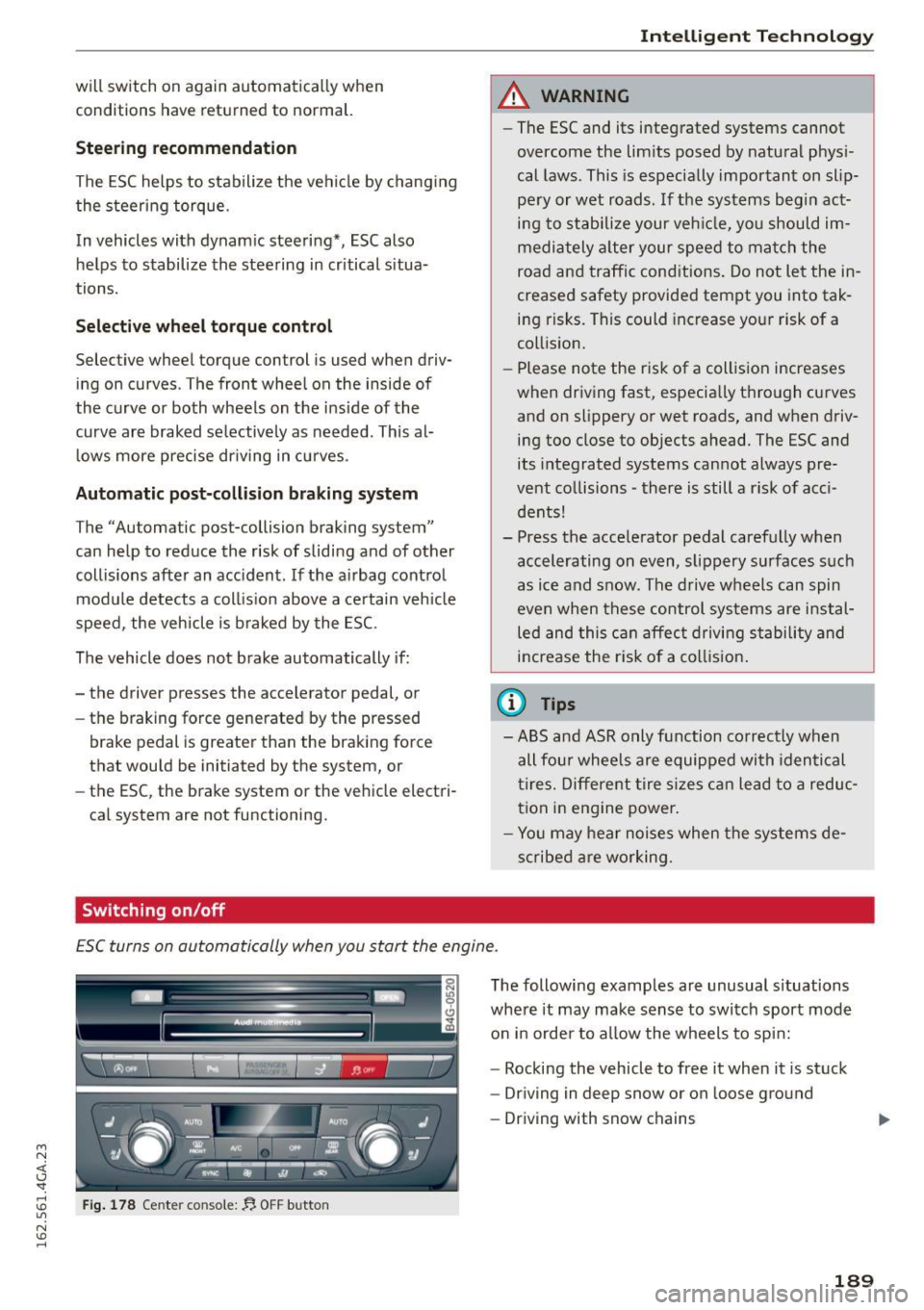
Switching on/off
Intelligent Technology
A WARNING ,-
-The ESC and its integrated systems cannot
overcome the limits posed by natural phys i
cal laws. This is especially important on slip
pe ry or wet roads. If the systems begin act
ing to stabilize your vehicle, you should im
mediately alter your speed to match the
road and traffic conditions. Do not let the in
creased safety provided tempt you into tak
ing risks. This could increase your risk of a
collis ion.
- Please note the r isk of a collision increases
when driving fast, especially thro ugh curves
and on slippery or wet roads, and when driv
ing too close to objects ahead. The ESC and its integrated systems cannot always pre
vent collisions· there is still a risk of acc i
dents!
- Press the accelerator pedal carefully when
accelerating on even, slippery surfaces such
as ice and snow. The drive wheels can spin
even when these control systems are instal
led and this can affect driving stability and
i n crease the r isk of a coll ision .
(j) Tips
-ABS and ASR only function correctly when
all four wheels are equipped with identical
tires. Different tire s izes can lead to a reduc
tion in engine power .
- You may hear noises when the systems de
scribed are working.
ESC turns on automatically when you start the engine .
Fig. 178 Center console: !J, OFF butto n
The following examples are unusual situations
where it may make sense to switch sport mode
on in orde r to allow the wheels to sp in:
- Rocking the vehicle to free it when it is stuck
- Driving in deep snow or on loose ground
- Driving with snow chains
189
Page 192 of 294
Intelligent Technology
ESC lev els
Sport mode on Sport mode off
Beha vior
The ESC and ASR stabilization f unctions are The full stabilization function of t he ESC
limited
c> ,& . and ASR is avai lab le again .
Operation Press the 1.$ OFF I button. Press the 1.$ OFF I button agai n.
In dicato r II turns on. II turns off.
light s
Driv er m es- S ta bi liz at ion contr ol (ESC ): sport. Warn -Stabiliz ati on c ontr ol (ESC ): on
s age s ing! Res tricted stabilit y
A WARNING
Only switch sport mode on when yo ur driving
abilities and the traffic situation permit, be
cause there is a risk of sliding.
- The stabilization function is limited when
sport mode is switched on. The dr iv ing
wheels could spin and the vehicle could
swerve, especially on slick or slippery road
s u rfaces .
(D Tips
-Sport mode cannot be switched on if the
cruise control system* or adaptive cruise
control* is switched on.
- If the rear spoiler system malfunctions,
sport mode may not switch on or it may
switch off again automat ically.
Braking
What affects braking efficiency?
New brake pads
During the f irst 250 miles (400 km), new brake
pads do not possess the ir full braking effect, they
have to be "broken in" first
c> ,& . You can com
pensate for this sl ightly reduced brak ing power
by pushing ha rder on the brake pedal. Avoid
heavy brak ing loads dur ing the b reak-in per iod.
Operat ing condit ions and d riving hab its
The brakes on today's automobi les are st ill sub
ject to wear, depending largely on operating con
d itions and dr iving habits
c> ,& . On veh icles that
are either driven mostly in stop-and-go c ity t raf
fic or are dr iven hard, the b rake pads should be
checked by your author ized Audi dea ler mo re of -
190
ten than specified in the Warrant y & Mainte
nan ce b ookl et.
F ail ure to have your brake pads
inspected can resu lt in reduced brake perform
ance.
On steep slopes, you sho uld use the braking ef
f ect of the engine. This way, you prevent unnec
essary wear on the brake system. If yo u must use
you r brakes, do not hold the brakes down contin
u ously. Pump the brakes at intervals .
Operating noise
Noises may occur when braking depend ing on the
speed, braking force and ou tside cond itions su ch
as temperature and hum idity .
Effect of wat er and road salt
In certa in situations, for examp le after driv ing
t hr ough water, in heavy rain, after overnight con
densa tion or after washing yo ur ca r, the bra king
effect can be reduced by moisture or ice on the
brake rotors and brake pads . The brakes must be
dried fi rst with a few careful brake applications .
At higher speeds and with the winds hield wipers
turned on, the brake pads press against the brake rotors for a short amount of time . This occurs at
r egular intervals without the driver noticing and
provides for better brake response time under
wet cond itions .
The effect iveness of the brakes can be reduced
when the vehicle is d riven on a salt-covered road
and the brakes are not used. Likewise, you clean
off accumulated salt coating from brake discs
and pads wi th a few caut ious applications of the
brake
c> ,& . IJI>
Page 193 of 294
M N <( (.J
'SI: ,...., \!) 1.1'1
N \!) ,....,
Corro sion
There may be a tendency fo r dirt to bui ld up on
the brake pads and corrosion to fo rm on the discs
if the car is not driven regularly or only for short
trips with little use of the brakes.
If the b rakes are not used frequently, or if corro
sion has formed on the discs, it is advisab le to
clean
off the pads and discs by braking firmly a
few times from a moderately high speed
c=> .&, .
Faults in the brake sy stem
If you should not ice a sudden increase in brake
pedal travel, then one of the two brake circuits
may have fai led
c=> .&, .
Low brake flu id level
Malfunct ions can occur in the brake system if the
brake fluid level is too low. The brake flu id leve l is
monitored e lectronically.
Br ake boo ste r
The brake booster works w ith vacuum pressure
which is created only when the engine is running
~ ,& .
Brake lining wear sta tu s
Brake lining wear may be checked by visual in
spection of the condition of the brake pads
through the openings in the wheel. If necessary,
the wheel may be removed for this inspection
c=> page 2 55, Replacing wheels.
.8, WARNING -
- New brake pads don't have the best stop
ping power and must be "broken-in" during
the initial 250 mi les ( 400 km) . You can com
pensate for this by pressing the brake peda l
more firmly. This a lso applies later when
new pads are installed.
- You should perform braking maneuvers for
the purpose of clean ing the brake system
only if road conditions perm it. Other road
users must not be put at risk -you may
cause an accident!
- Before descending a steep grade, reduce
speed and shift transmiss ion into a lower
gear or lower driving range. Do not ride the
In te llig ent T echnolog y
brakes or hold the peda l down too long o r
too often. This could cause the brakes to get
hot and dimin ish braking effic iency.
- Do not "ride the brakes" by rest ing your foot
on the pedal when you do not intend to
brake. This may cause the brakes to over
heat, premature wear and increased stop
ping distance .
- Under certain cl imatic and operat ing condi
tions such as passing through water , dr iv ing
in heavy rain or afte r washing the veh icle,
the effect iveness of the brakes can be re
duced. In winter, ice c an accumulate on the
b rake pads, lin ings, discs and drums. Care
fu lly apply brakes for a test . Brakes will dry
and ice coatings will be cleaned
off after a
few ca reful brake app lications.
- Driving for an extended period of t ime on
salt-covered roads without using your
brakes can a lso affect braking efficiency.
Clean
off accumulated salt coating from
brake discs and pads with a few careful
brake applications.
- If you damage the front spoiler, or if you in
stall a different spoiler, be su re the air f low
to the front brakes is not obstructed . Other
wise the brake system could overheat reduc ing the effect iveness of the entire brake sys
tem.
- Fai lure of one brake circuit will impa ir th e
b rak ing capability res ulting in an increased
s topping distance. Avoid driving the vehicle
a nd have it towed to the nearest Aud i dea ler
or qualified workshop .
- Never let the vehi cle roll to a s top with the
engine shut
off .
- If the b rake booste r is no t working, the
b rake peda l must be pressed cons iderably
harder to make up for the lack of booster as
sistance.
191
Page 195 of 294
M N <( I.J "". rl I.O
"' N I.O rl
Offroad vehicle?
Your Aud i is not an off road vehicle -there is not
enough ground clea rance . For this reason, avo id
difficu lt terrain .
A WARNING
-Also, in vehicles with all whee l dr ive, adapt
your dr iving style to the current road and
traffic conditions. Do not let the increased
safety provided tempt you into taking risks, because t his increases the risk of an acci
dent .
- The brak ing ability of yo ur vehicle is lim ited
to the traction of the wheels . In this way, it
is not different from a two wh eel drive veh i
cl e. Do not be tempted to ac celerate to a
high speed when t he ro ad is s lippery th is in
cr eases the r is k of an accident .
- Note t hat on wet streets, t he front w heels
c an "hyd rop lane" if d riving at speeds that
are too high. Unli ke front whee l drive
vehicles, the engi ne does not rev higher sud
den ly when the vehicle begins hydrop laning.
For this reaso n, pay attent ion to the r oad
condit ions regardless of your speed to re
duce t he risk of an accident .
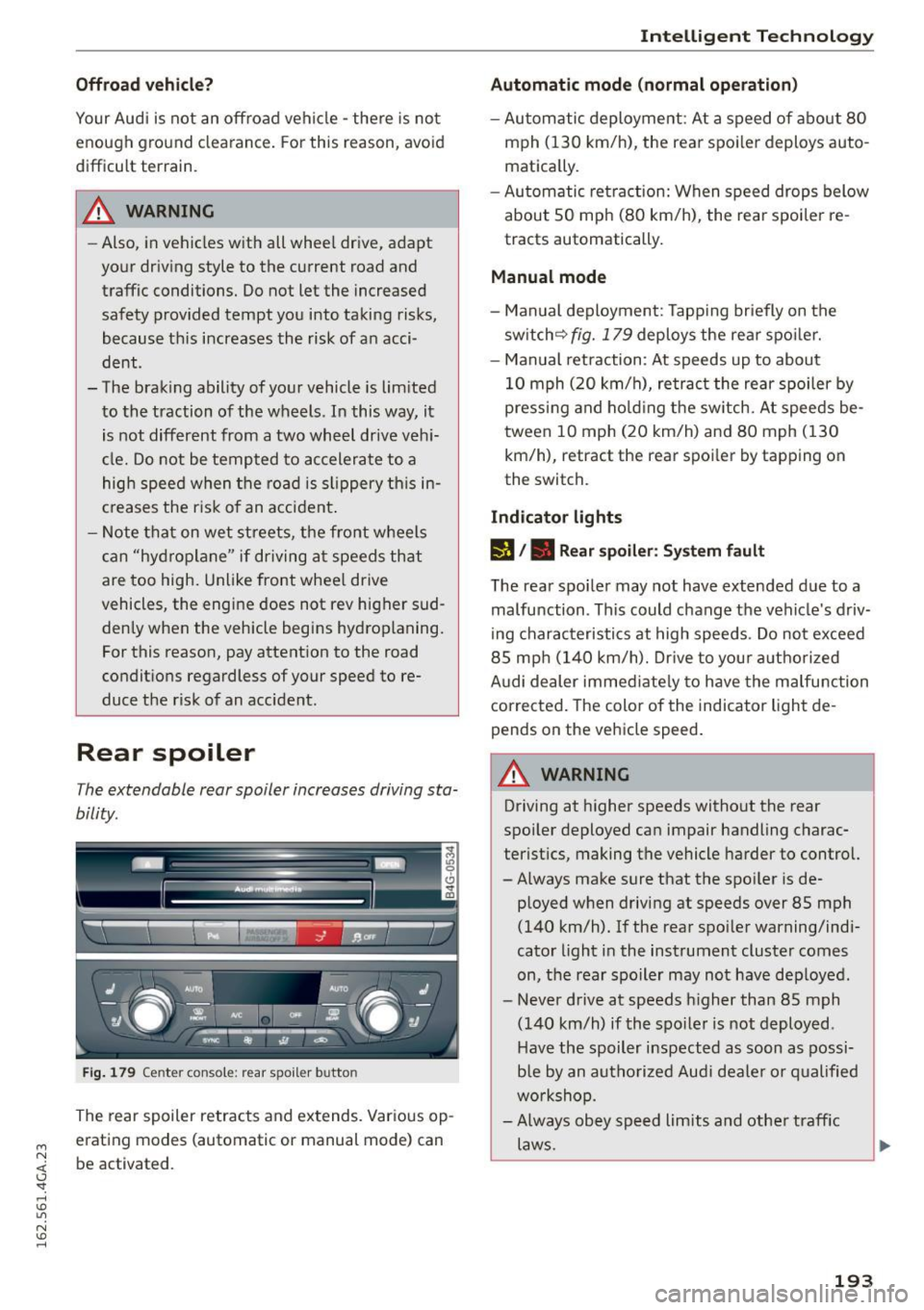
Rear spoiler
The extendable rear spoiler increases driving sta
bility.
Fi g. 179 Cente r con sole : re ar s poil e r b utto n
The rear spoiler retrac ts and extends. Var ious op
erat ing modes (automatic or manual mode) can
be activated .
Intelligent Technology
Automatic mode (normal operation)
-Au tomatic deployment : At a s peed of about 80
mph (130 km/h) , the rear spo ile r deploys auto
matically .
- Au tomatic retra ction: When speed drops below
abou t SO mph (80 km/h), the rea r spoi ler re
tracts automatically.
Manual mode
- Man ual deployment: Tapp ing br iefly on the
sw itch ~
fig. 179 deploys the rea r spo ile r.
- Manual retraction : At speeds up to about
10 mph ( 20 km/h), re tract the rear spoiler by
pressi ng and hold ing t he sw itch. At speeds be
tween 10 mph (20 km/h) and 80 mph ( 130
km/h), retract the rear spoi ler by tapping on
the switch.
Indicator lights
rJ /. Rear spoiler : S ys tem fault
The rea r spoi le r may not have exte nded due to a
malfunction . Th is could change the vehicle's driv
i ng charac teristics at high speeds . Do not exceed
8 5 mp h (140 km/h). Dr ive to you r authorized
A udi dealer immed iate ly to have the malfu nction
corrected. The color of the indicator light de
pends on the vehicle speed .
A WARNING
-
Driving at higher speeds witho ut the rear
spoi ler deployed ca n impair handling charac
terist ics, making the vehicle harder to control.
- Always make sure that the spo iler is de-
p loyed w hen d riving at speeds over 85 mph
(140 km/h). If the rea r spo ile r warning/ind i
cato r light i n the instrument cluster comes
on, the rear spoile r may not have deploye d.
- Never drive at speeds h igher than 85 mph
(140 km/h) if the spo iler is not deployed.
Have the spoiler i nspected as soon as possi
b le by an au tho riz e d Aud i deale r o r q ualified
w orkshop.
- Always obey speed li mits and othe r traff ic
laws.
193
Page 196 of 294
Intelligent Technology
& WARNING
Improp er operat ion of the rear spoiler can
cause crushing injuries.
- Always make sure that nobody, espec ially
children , is in the way when the rea r spo ile r
i s deployed or retracted.
@ Note
- Neve r push on the vehicle on the rear spoi l
er. Th is co uld cause damage .
- To prevent damage to the rear spoiler do
not lean or p lace anyth ing on it.
- Only ope rate the rear spoi ler manually when
the luggage compartment lid is close and
the rear spo iler moving parts are not
blocked . Ot herwise, damage could occur.
(D Tips
Clean the rear spoiler compartment every 2 to
3 mont hs. To function correct ly, the rear
sp oiler must be free of ice, sn ow and leav es.
Energy management
The starting ability is optimized
The energy management system manages the
ele ctrical energy distribu tion and op timi zes the
availability of elec trical energy for starting the
engine .
Whe n a ve hicle wit h a co nven tional e nergy sys
tem is not dr iven for a long time, the ba tte ry is
d rained by equipmen t (fo r example the immobil
izer). In certa in circ umstances, there cou ld may
not be eno ugh energy to start the engine .
Your veh icle i s equ ipped w ith an intellige nt ener
gy managemen t system for distr ibuting electr ic i
ty . Th is significantly improves the starti ng ability
a nd increases the battery life .
T he energy m anagemen t sys tem Is made up of
battery diagno sis, idling current management
and dynamic energy management.
Battery diagnosis
T he batte ry diagnos is determines the ba tte ry
ch arge leve l. The sen sors de te ct the ba tte ry, the
194
batte ry current, an d the batte ry tempera ture.
The c urrent charge leve l and the perfo rmance of
t h e battery are determined based on th is.
Idling current management
The idling cur ren t management decr eases the
energy used wh ile pa rke d. Wi th the eng ine
switched off, it manages the energy dis trib ution
to t he d ifferent e lectr ica l components . Date from
battery diagnos is is ta ken into acco unt for this .
Depend ing on the batte ry charge leve l, elec trical
equipmen t is switched off one item afte r th e o th
e r, to prevent the battery from dra ining and to
r etain the starting ability.
Dynamic energy management
While driv ing , d ynam ic ene rgy man agement dis
t ribu tes the ap propri ate amount of energy to the
e lectrica l equ ipment. It controls the battery
c h arge level so t hat more ene rgy is not use d then
i s be ing generated in order to maintain an opti
mal battery charge level.
(D Tips
- Energy management can not overcome the
laws of p hys ics. Note that the charge level
and length of the battery life a re limited.
- W he n the sta rting ability is endange red, the
(•j indicator light t urns on¢ page 16 .
What you should know
Maintaining the starting ability is the highest
priority .
A lot of st ress is placed on the ba ttery when dr iv
i ng sho rt distances, in t raff ic, and at cold t imes
of the year . A lot of ene rgy is used but little is
generated .
It is also critical when the engine is
not ru nning but e lectr ica l equipment is sw itched
o n. In th is case, energy is used but none is gener
ated.
In sit uat ions like this, energy ma nagement w ill
active ly regu lated the distribution of energy.
Long periods without use
If you do not drive yo ur vehicle for several days or
weeks, e lectr ica l equipment is grad ually scaled ..,.
Page 198 of 294
Driving and the environment
Driving and the
environment
Breaking in
New engine
The engine needs to be run-in during the first
1,000 miles (1,500 km).
For the first 600 miles (1,000 kilometers ):
.,. Do not use full throttle .
.,. Do not drive at engine speeds that are more
than 2/3 of the maximum permitted RPM .
.,. Avoid high engine speeds.
From 600 to 1,000 miles (1,000 to 1,500
kilometers ):
.,. Speeds can gradually be increased to the maxi
mum perm issible road or eng ine speed.
During and after break-in period
.,. Do not rev the engine up to high speeds when it
is cold . This applies whether the transmission is
i n N (Neutral) or in gear .
After the break-in period
.,. Do not exceed maximum engine speed under
any circumstances.
.,. Upshift into the next higher gear
before reach
i ng the red area at the end of the tachometer
scale~
page 10 .
During the first few hours of driving, the engine's
internal friction is higher than later when all the
mov ing parts have been broken in. How well th is
break-in process is done depends to a cons idera
b le extent on the way the vehicle is driven during
the first 1,000 miles (1,500 kilometers).
(D Note
Extremely high engine speeds are automati
cally reduced. However, these rpm limits are
programmed for an engine wel l run-in, not a
new engine.
196
® For the sake of the environment
Do not drive with unnecessarily high engine
speeds -upshifting early saves fuel, reduces
noise and protects the environment.
New tires
If your vehicle is running on new tires, drive par
ticularly careful for the first 350 miles (500 kilo
meters) after f itting .
.8, WARNING
New tires tend to be slippery and must also
be "broken- in". Be sure to remember this dur
ing the first 350 mi les (500 kilometers).
Brake gently. Avoid following closely behind
other ve hicles or other situations that might
require sudden, hard braking.
Avoid damaging the
vehicle
When you are driving on poor roads, or over
curbs, steep ramps, etc ., make certain that low
lying parts such as spoilers and exhaust system
parts do not bottom out and get damaged .
This is especially true for vehicles with low-slung chass is (sports chassis)* and fully loaded
vehicles .
-
Driving through water on
roads
Note the following to avoid vehicle damage whe n
driving through water, for example on flooded
roads:
- The water must not be any highe r than the bot
tom of the vehicle body.
- Do not dr ive faster than walk ing speed .
.8, WARNING
After driv ing through water or mud, the brak
ing effect can be reduced due to moisture on
the brake discs and brake pads. A few careful
brake applications shou ld dry off the brakes.