seat adjustment AUDI A7 2017 Owner´s Manual
[x] Cancel search | Manufacturer: AUDI, Model Year: 2017, Model line: A7, Model: AUDI A7 2017Pages: 284, PDF Size: 72.29 MB
Page 148 of 284
Safety belt s
"'Push the loop -around fittings up c> fig . 154 @,
or
"'squeeze together the (D button, and push the
loop-around fittings
down @.
"'Pull the belt to make sure that the upper at
tachment is properly engaged.
A WARNING
Always read and heed all WARNINGS and oth
er impo rtant informat ion
c>page 14 2.
(D Tips
With the front seats , the height adjustment
of the seat can also be used to adjust the po
sition of the safe ty belts.
Improperly worn safety belts
Incorrectly positioned safety belts can cause se
vere injuries.
Wearing safety belts imprope rly can cause seri
ous injury or death. Safety belts can only work
when they a re correctly pos itioned on the body.
Imp roper seating positions reduce the effect ive
ness of safety be lts and will even inc rease the
ris k of injury a nd deat h by mov ing the safety bel t
to cr it ica l areas of the bo dy. Imp roper seating
positions a lso increase the risk of serio us inj ury
and deat h when an airbag deploys and strikes an
occ upant who is not in the co rrect seat ing pos i
tion. A driver is responsible for the safety of all
ve hicle occupants and especia lly for children.
Therefore:
"' Never permit anyone to assume an inco rrect
s itting position in the vehicle wh ile trave ling
c> ,&. .
A WARNING
Impro perly wor n safety belts increase t he risk
of se rious personal injury a nd death wheneve r
a vehicle is bei ng use d.
- Always make sure tha t all veh icle occupa nts
are co rrectly restra ined and stay in a co rrect
seat ing pos ition w heneve r the veh icle is be
ing used.
146
- Always read and heed all WAR NINGS and
o ther impo rtant in format ion
c>page 142.
Belt tensioners
How safety belt pretensioners work
In front, side and rear-end collisions above a
particular severity and in a rollover, safety belts are tensioned automatically.
Reversible safety belt tensioner s
The safety belts on the front seats are equipped
with power revers ible tensioners. The following
funct io ns are available when the dr iver's/front
passenger 's safety belts are faste ned:
- Automatic tensione rs: at the start of a drive,
the safety belts automat ica lly adjust to the
passenger after a certain time period or ve hicle
spee d. To switch the a utomat ic tens ioners off,
select the following in t he M MI :
!CARI function
button
> ( Car )* systems > Vehicle settings >
Seat s > Driver's seat or Pas senger's seat > Au ·
tomatic belt tensioner > Off .
-In certain drivi ng s ituations, the s afe ty bel ts
m ay tighten w ith a reversib le tensioning func
tion
c> page 138 .
- The s afety be lts may also tigh ten with this re-
vers ible tension ing f unct io n in m ino r collisions .
Pyrotechnic safety belt pretensioners
The safety belts are eq uipped w it h safety bel t
pretensione rs. The system is activa ted by se nsors
i n front, s ide a nd r ear-end collisions of grea t se
verity and in a ro llover. This tig htens the bel t and
takes up belt slack
c> &. in Service and disposal of
safety belt pretensioner on page 147.
Taking up
the slack helps to reduce forward occupant
movement during a collision.
A WARNING
-It is poss ible for the pretensioners to dep loy
incorrectly .
- The pyrotechnic system can only p rovide
protection for one collision. If the py rotech
nic pretens ioners deploy, the pretensioning
sys tem must be rep laced.
Page 150 of 284
Airbag syste m
Airbag system
Important information
Importance of wearing safety belts and
sitting properly
Airbags are only supplemental restraints . For
airbags to do their job, occupants must always
properly wear their safety belts and be in a prop
er seating position.
For your safety and the safety of your passen
ge rs , before driving off, always :
"' Adjust the driver's seat and steering wheel
properly ¢
page 130,
"'Adjust the front passenge r's seat properly
¢ page 48,
"'Wear safety belts p roperly ¢ page 142 ,
"'Always properly use the proper child restraint
to protect children
¢ page 172.
In a coll is io n, airbags mus t inflate within the
blink of an eye and wi th considerab le force. The
supp lemental airbags can cause injuries if the
driv er or th e front s eat passeng er is not s eated
properly. Therefore in order to he lp the airbag to
do its job, it is important, both as a dr iver and as
a passenger to sit properly at all t imes.
By keeping room between your body and the
steering whee l and the front of the passenger
compartment, the a irbag can inflate fully and
completely and provide supplemental protect ion
in certain frontal collisions¢
page 130, Correct
passenger seating positions .
For details on the
operation of the seat adjustment con trols
¢ page 48.
It's especially important that children are proper
ly restra ined
¢ page 172 .
There is a lot that the driver and the passengers
can and must do to help the ind iv idual safety fea
tures installed in your Audi work together as a
system .
Proper seating posit ion is important so that the
front airbag on the drive r side can do its job. If
you have a physical impairment or cond ition that
prevents you from s itting properly on the driver
seat with the safety be lt properly fastened and
148
reaching the peda ls, or if yo u have concerns w ith
regard to the function or operation of the Ad
vanced Airbag System, please contact your a u
thori zed Audi dea ler or qua lified workshop, or
ca ll Audi Customer Relations at 1-800-822-2834
for poss ib le modifications to your vehicle .
When the airbag system dep loys, a gas generator
will fill the airbags, break open the padded cov ers, and infla te between the steering wheel and
the driver and between the instrument panel and
t h e front passenger . T he a irbags w il l deflate im
med iate ly after deployment so that the front oc
cupants can see t hrou gh the windsh ie ld again
without i nterruption.
All of th is takes p lace in the b link of an eye, so
fast that many people don't even rea lize that the
a irbags have deployed. The airbags a lso infla te
with a g re at deal of force and nothing should be
i n the ir way when they deploy. Front airbags in
combination with properly worn safety belts slow
down and limit the occupant 's forward move
ment . Together they he lp to prevent the driver
and front seat passenger from hitting pa rts of
the ins ide of the vehicle while reduc ing the fo rces
acting on the occupant dur ing the cras h. In th is
way they help to reduce the risk of injury to the
head and uppe r body i n the crash . Airbags do not
protect the arms or the lower pa rts of the body.
Both front airbags will not inflate in all frontal
collisions . The t riggering of the a irbag system de
pends on the veh icle decelerat ion rate caused by
t h e coll is io n and regis tered by the ele ctroni c con
tro l unit . If this ra te is be low the refe rence value
programmed in to the contro l unit, the airbags
will not be trigge red, even tho ugh the car may be
badly damaged as a resu lt of the collision. Vehi
cle damage, rep air costs or even the lack of vehi
cle damage is not necessarily an indication of
whether an a irbag should inflate or not .
Since the circumstances will vary cons iderab ly
between one co llision and another, it is not possi
ble to define a range of veh icle speeds that will
cover every poss ible kind and angle of impact
that w ill always t rigger t he a irbags . Important
factors i nclude, for examp le, the nat ure (hard or
soft) of the object which the ca r hits, the angle of
i mp act , vehicle speed , etc. The front airbags will .,.
Page 165 of 284
co
co
.... N r-N .... 0
00
\.J -
install a forward-facing child restraint on
the front passenger seat, always move the
seat into its rearmost position in the seat 's
fore and aft adjustment range, as far away
from the airbag as possible . The backrest
must be adjusted to an upright position.
- Make sure that the
PASSENGER AIR BAG
OFF
light comes on and stays on all the time
whenever the ignition is switched on.
_& WARNING
- If the PASSENGER AIR BAG OFF light does
not go out when an adult is sitting on the
front passenger seat after taking the steps
described above, make sure the adult is
properly seated and restrained at one of the
rear seating positions .
- Have the airbag system inspected by your
Audi dealer before transporting anyone on
the front passenger seat .
(D Tips
If the capacitive passenger detection system
determines that the front passenger seat is
empty, the frontal airbag on the passenger
side will be turned off, and the
PASSENGER
AIR BAG OFF
light will stay on.
Repair , care and disposal of the airbags
Parts of the airbag system are installed at many
different places on your Audi. Installing , remov
ing , servicing or repairing a part in an area of the
vehicle can damage a part of an airbag system
and prevent that system from working properly
in a collision.
There are some important things you have to
know to make sure that the effectiveness of the
system will not be impaired and that discarded
components do not cause injury or pollute the
environment.
_& WARNING
Improper care, servicing and repair proce
dures can increase the risk of personal injury
and death by preventing an airbag from de-
-
Airbag system
ploying when needed or deploying an airbag
unexpectedly :
- Never cover, obstruct, or change the steer
ing wheel horn pad or airbag cover or the in
strument panel or modify them in any way.
- Never attach any objects such as cup holders
or telephone mountings to the surfaces cov
ering the airbag units.
- For cleaning the horn pad or instrument
panel, use only a soft, dry cloth or one mois
tened with plain water. Solvents or cleaners
could damage the airbag cover or change
the stiffness or strength of the material so
that the airbag cannot deploy and protect properly.
- Never repair, adjust, or change any parts of
the airbag system.
-All work on the steering wheel, instrument
panel, front seats or electrical system (in
cluding the installation of audio equipment,
cellular telephones and CB radios , etc.)
must be performed by a qualified technician
who has the training and special equipment
necessary.
- For any work on the airbag system, we
strongly recommend that you see your au
thorized Audi dealer or qualified workshop.
- Never modify the front bumper or parts of
the vehicle body.
- Always make sure that the side airbag can
inflate without interference:
- Never install seat covers or replacement
upholstery over the front seatbacks that
have not been specifically approved by
Audi .
- Never use additional seat cushions that
cover the areas where the side airbags in
flate.
- Damage to the original seat covers or to
the seam in the area of the side airbag
module must always be repaired immedi
ately by an authorized Audi dealer.
- The airbag system can deploy only once. Af
ter an airbag has been deployed, it must be
replaced with new replacement parts de
signed and approved especially for your
Audi model version. Replacement of com plete airbag systems or airbag components
163
Page 175 of 284

co
co
.... N
" N .... 0
00
\.J '
Child ren on the front seat of any car even w ith
Advanced Airbags can be seriously injured or
even killed when an airbag inflates. A child in
a rearward-facing child safety seat installed
on the front passenger seat will be seriously
injured and can be killed if the front airbag in
flates.
- The inflating airbag will hit the child safety
seat or infant carrier with great force and
will smash the ch ild safety seat and child
against the backrest, center armrest, or
door.
- Always install rear-facing child safety seats
on the rear seat.
- If you must install a rearward fac ing ch ild
safety seat on the front passenger seat in
exceptiona l circumstances and the
PA SSEN
GER AIR BAG OFF
light does not come on
and stay on, immediately insta ll the rear
facing child safety seat in a rear seating po
sition and have the airbag system inspected immediately by your Audi dealer.
A WARNING
- Forward-facing chi ld seats installed on the
front passenger seat may interfere with the deployment of the a irbag and cause serious
personal injury to the child.
- If exceptional circumstances require the use
of a forward-facing child restraint on the
front passenger's seat, the child's safety and well-being require the following special
precautions to be taken:
- Always make sure that the forward-facing
seat has been designed and certified by its
manufacturer for use on a front passenger
seat with a front and side airbag.
- Always carefully follow the manufacturer's
instructions provided with the child seat
or infant carrier.
- Never install a child restraint without a
properly attached top tether strap if the
child restraint manufacturer's instructions require the top tether strap to be used.
Ch ild safety
-Never put the forward-facing child re
straint up against or very near the instru
ment panel.
- Always set the safety belt upper anchor
age to the adjustment position that per
mits proper installation in accordance
with the child restraint manufacturer's in
structions.
- Always move the front passenger seat to
the h ighest position in the up and down
adjustment range and move it back to the
rearmost position in the seat's fore and
aft adjustment range, as far away from
the a irbag as poss ible, befo re installing
the forward-facing child restraint .
- Always make sure that the safety belt up
per anchorage is behind the chi ld restraint
and not next to or in front of the child re
straint so that the safety belt wi ll be prop
erly positioned.
- Always make sure that nothing prevents
the front passenger's seat from being
moved to the rearmost position in its fore
and aft adjustment range.
- Never place objects on the seat (such as a
laptop, CD player, electronic games de
vice, power inverter or seat heater for
ch ild seats) . These may influence the elec
trical capacitance measured by the capac i
tive passenger detection system and can
also fly around in an acc ident and cause
serious personal injury.
- Never place or use any elect rical device
(such as a laptop, CD player, electronic
games device, power inverter or seat heat
er for child seats) on the front passenger
seat if the device is connected to the 12-
vo lt socket or the cigarette lighter socket.
- If a seat heater has been retrofitted or
otherwise added to the front passenger
seat, never insta ll any child restraint sys
tem on this seat.
- Make sure that there are no wet objects
(such as a wet towe l) and no water or oth
er liquids on the front passenger seat
cushion .
- Always make sure that the
PASS ENGER
AI R BA G OFF
light comes on and stays on
17 3
Page 179 of 284

co
co
.... N
" N .... 0
00
\.J '
jure each other in a n accident .
- Never install rear-facing chi ld safety seats
or infant carriers on the front passenger
seat. A child will be serious ly injured and
can be killed when the passenger airbag in
flates - even with an Advanced Airbag Sys
tem.
- The inflating a irbag will hit the child safety
seat or infant carrier with great force and
will smash the ch ild safety seat and chi ld
against the backrest, center armrest, door
o r roof.
- Always install rear-facing child safety seats
or infant carriers on the rear seat.
- Make sure there is enough space in front of
the ch ild in the child seat. If necessary, ad
just the ang le and posit ion of the seat in
front of the child sea t.
- Forward-fac ing ch ild safety seats installed
on the front passenger's seat can inte rfe re
with the airbag when it inflates and cause
serious injury to the child . Always insta ll for
ward-facing child safety seats on the rear
seat.
- If exceptional circumstances require the use
of a forward-facing child restraint on the
front passenger's seat, the child's safety and well-being require that the following
special precautions be taken:
- Make sure the forward-fa cing seat h as
been designed and certif ied by its manu
facturer for use on a front seat with a pas
senger front and side airbag.
- Always care fully follow the manufacturer's
instr uctions provided with the child safety
seat or carrier.
- Always move the front passenger seat to the highest position in the up and down
ad justment range and move it back to the
rearmost posit ion in the seat's fore and
aft adjustment range, as far away from
the airbag as possible, before installing
the forward-fac ing ch ild restraint .
- Always make sure that the safety be lt up
per anchorage is behind the child restra int
and not next to or in front of the child re-
Ch ild safety
straint so that the safety belt wi ll be prop
erly pos it ioned.
- Always make sure that nothing prevents
the front passenger's seat from being
moved to the rearmost position in its fore
and aft adjustment range.
- Always make sure that the backrest is in the upright posit ion.
- Never place or use any elect rical device
(such as a laptop, CD player, electronic
games device, power inverter or seat heat
er for child seats) on the front passenger
seat if the device is connected to the 12-
vo lt socket or the cigarette lighter soc ket.
- If a seat heater has been retrofitted or othe rw ise added to t he fron t passenger
seat, neve r insta ll any child rest raint sys
tem on this seat.
- Make su re that there a re no wet objects
(such as a wet towe l) and no water or oth
er liquids on the front passenger sea t
cush ion .
- Neve r place objects o n the sea t (such as a
laptop, CD player, e lect ronic games de
vice, power inverter or seat heater for
child seats). These may inf luence the elec
trical capacitance meas ured by t he capac i
tive passenger detection system and can also fly around in an acc ident and cause
serious personal injury.
- Always buckle the child safety seat firm ly in
p lace even if a ch ild is not sitt ing in it. A
loose child safety seat can fly around dur ing
a sudde n stop or i n a co llision .
- Always read and heed all WARNINGS when
ever us ing a child restrained in a vehicle is
be ing used ~
page 140, Safety belts,
<=> page 148, Airbag system and
<=> page 172, Child safe ty.
_&. WARNING
To reduce the risk of serious injury, ma ke sure
t h at the
PASSENGER AIR BAG OFF ligh t
comes on and stays on whenever a child re
straint is installed on the front passenger seat
and the ign it ion is switched on. ..,
177
Page 183 of 284
co
co
.... N
" N .... 0
00
\.J '
move the rear seat head restraint if it is dif
ficult to install the child seat with the head restraint in place¢
page 50 . Install the
head restraint again immediately once the
child seat is removed. Driving w ithout head
restra ints or w ith head rest raints that are
not properly adjusted increases the risk of
serious o r fatal neck injury dramatically.
- Always read and heed all WARN INGS when
ever using a child res trained in a veh icle is
being used
¢ page 140, Safety belts,
¢ page 148, Airbag system and
¢ page 172, Important information.
&_ WARNING
If exceptional circumstances require the use
of a forward-facing child restraint on the
front passenger's seat, the child's safety and
well-being require that the follow ing spec ial
precaut ions be taken:
- Make sure the forward-facing seat has been
designed and certified by its manufacturer
for use on a front seat with a passenger
front and side airbag .
-Always follow the manufacturer 's instruc
t ions prov ided with the ch ild safety seat or
infant carrier.
- Always move the front passenger seat to
the highest position in the up and down ad
justment range and move it back to the
rearmost position in the se at's fore and aft
adjustment range, as far away from the air
bag as possib le, before insta lling the for
ward-facing child restra int .
- Always make sure that the safety belt upper
anchorage is behind the child restraint and
not next to or in front of the chi ld restraint
so that the safety belt will be properly pos i
t ioned.
- Always make sure that nothing prevents the
front passenger's seat from being moved to
the rearmost position in its fore and aft ad
justment range.
- Always make sure the backrest is in an up
right position.
Ch ild safety
-Never p lace or use any e lectrica l device
(such as a laptop, CD player, e lectron ic
games device, power inverter or seat heater
for child seats) on the front passenger seat if the device is connected to the 12-volt
socket or the cigarette lighte r socket.
- If a seat heater has been retrofitted or oth
erwise added to the front passe nger seat,
never install any child restra int system on
this seat.
- Make sure that the re are no wet objects
(such as a wet towel) and no wate r o r other
liqui ds on t he front passenger seat cush ion.
- Never p lace objects on the seat (such as a
laptop, C D playe r, electro nic games device,
power inverter o r seat heater fo r ch ild
seats). These may influence the electri cal
capacitance measu red by the capacitive pas
senger detect ion system and can also fly
aro und in an accident and cause serious per
sonal injury.
- Make sure that the
PASSENGER AIR BAG
OFF
li ght comes on and stays on all the time
whenever the ignit ion is switched on.
- If the
PASSENGER A IR BAG OFF li ght does
not come on and stay on, immediately in
stall the forward-fac ing ch ild seat at a seat
ing position on the rea r seat and have the
ai rbag system inspected by your authorized
Aud i deale r.
- Take the child restra int off the front passen
ge r seat and install it prope rly at one of the
rear seat positions if the
PASSENGER AIR
BAG OFF
light does no t stay on whenever
the igni tion is switched on.
181
Page 184 of 284
Child safety
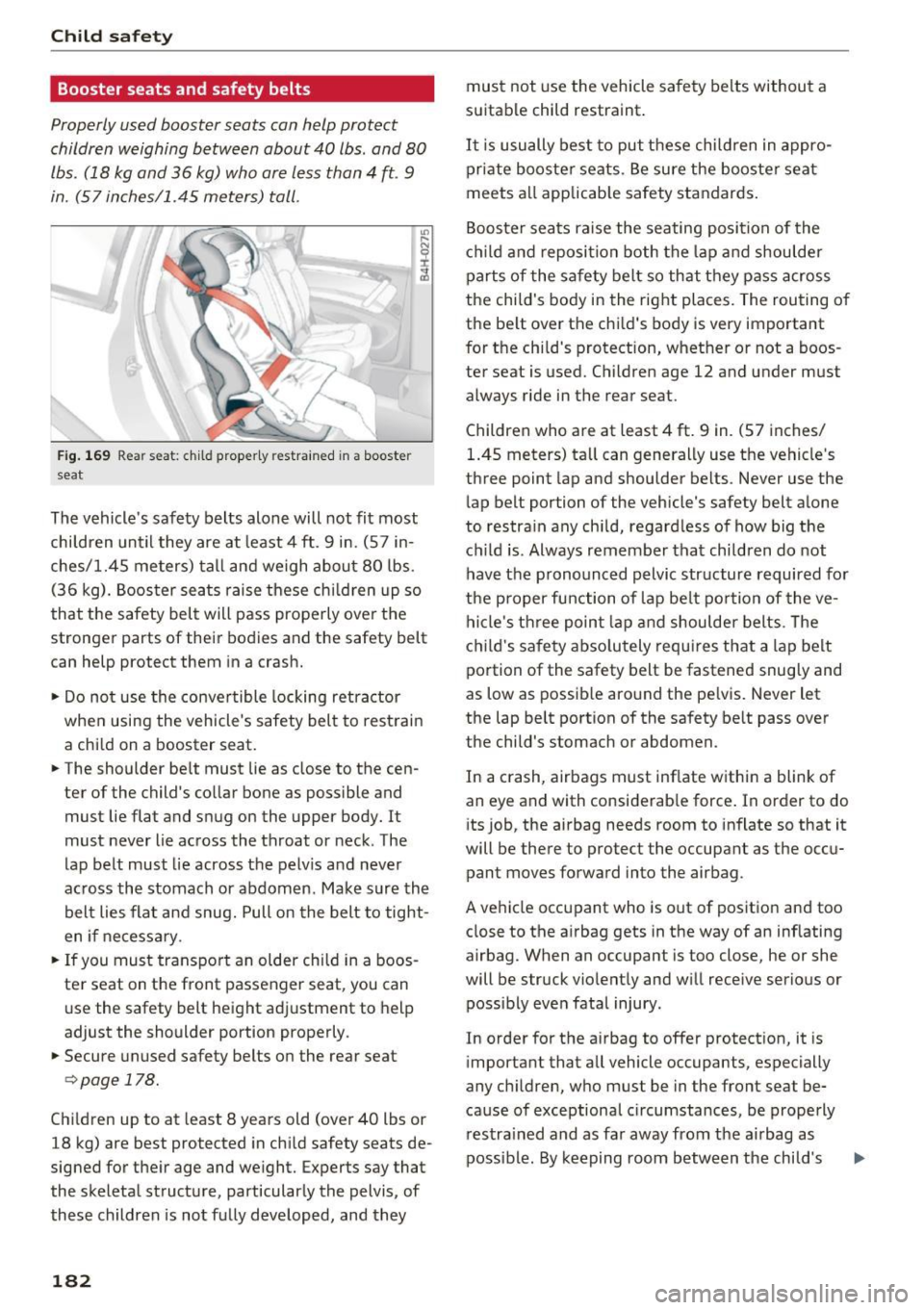
Booster seats and safety belts
Properly used booster seats can help protect
children weighing between about 40 lbs . and 80
lbs. (18 kg and 36 kg) who are less than 4
ft. 9
in. (57 inches/1.45 meters) tall .
Fig. 169 Rear seat: ch ild proper ly restrained in a booster
seat
The vehicle's safety belts alone will not fit most
children until they are at least 4
ft. 9 in. (57 in
ches/1.45 meters) tall and weigh about 80 lbs.
(36 kg). Booster seats raise these chi ld ren up so
that the safety belt will pass properly
over the
stronger parts of their bodies and the safety belt
can help protect them in a crash.
• Do not use the convertible locking retractor
when using the vehicle's safety belt to restrain
a chi ld on a booster seat.
• The shoulder be lt must lie as close to the cen
ter of the child's collar bone as possible and
must lie flat and snug on the upper body. It
must never lie across the throat or neck. The
lap belt must lie across the pelv is and never
across the stomach or abdomen . Make sure the
belt lies flat and snug. Pull on the belt to tight
en if necessary .
• If you must transport an older child in a boos
te r seat on the front passenger seat, you can
use the safety belt height adjustment to help
adjust the shoulder portion properly .
• Secure unused safety belts on the rear seat
c> page 178.
Children up to at least 8 years old (over 40 lbs or
18 kg) are best protected in child safety seats de
signed for their age and weight. Experts say that
the skeletal structure, particularly the pelvis, of
these children is not fully developed, and they
182
must not use the vehicle safety belts without a
suitable child restraint .
It is usually best to put these children in appro
priate booste r seats. Be sure the booster seat
meets all applicab le safety standards.
Booster seats raise the seating position of the
child and reposition both the lap and shoulder
parts of the safety belt so that they pass across
the child's body in the right places. The routing of
the be lt
over the chi ld's body is very important
for the child's protection, whether or not a boos
ter seat is used. Children age 12 and under m ust
always ride in the rear seat.
Children who are at least 4
ft. 9 in. (57 inches/
1.45 meters) ta ll can generally use the vehicle 's
three point lap and shoulder belts. Never use the
lap belt portion of the vehicle's safety belt alone
to restrain any child, regard less of how big the
c hi ld is. Always remember that children do not
have the p ronounced pelvic structure required for
the proper function of lap belt portion of the
ve
hicle's three point lap and shoulder belts. The
c hi ld's safety absolutely requ ires that a lap belt
portion of the safety belt be fastened snugly and
as low as possible around the pe lvis. Never let
the lap belt portion of the safety belt pass over
the child's stomach or abdomen.
In a crash, airbags must inflate within a blink of
an eye and with considerab le force . In order to do
i ts job, the airbag needs room to inflate so that it
will be there to protect the occupant as the occu
pant
moves forward into the airbag.
A ve hicle occupant who is out of position and too
close to the a irbag gets in the way of an inflating
airbag. When an occupant is too close, he or she
will be struck violently and will receive serious or
possibly even fatal injury .
In order for the a irbag to offer protection, it is
important that all vehicle occupants, especially
any ch ildren, who must be in the front seat be
cause of exceptional c ircumstances, be properly
re stra ined and as far away from the a irbag as
possible. By keeping room between the child's .,..
Page 187 of 284
co
co
.... N
" N .... 0
00
\.J '
has been designed and certified by its man
ufacturer for use on a front seat with a
passenger front and side airbag.
- Never put the forward-facing child restraint
up, against or very near the instrument pan
el.
- Always move the front passenger seat to
the highest position in the up and down ad
justment range and move it back to the
rearmost position in the seat's fore and aft
adjustment range, as fa r away from the air
bag as possib le, before insta lling the for
wa rd-facing child restra int.
- Always make sure that the safety belt upper
anchorage is beh ind the child restraint and
not next to or in front of the chi ld restraint
so that the safety belt will be properly posi
tioned.
- Make sure that the
PAS SENGER AIR BAG
OFF
light comes on and stays on all the time
whenever the ignition is switched on .
_&. WARNING
Rearward-facing child restraints:
- A ch ild in a rearward-facing child safety seat
installed on the front passenger seat will be
seriously injured and can be killed if the
front airbag inflates - even with an Ad
vanced Airbag System.
- The inflating a irbag will hit the child safety
seat or infant carrier with great force and
will smash the ch ild safety seat and child
against the backrest, center armrest, door
or roof .
- Always be especially careful if you must in
stall a rearward facing child safety seat on
the front passenger seat in exceptional c ir
c u mstances.
- Make sure that the
PASSENGER AI R BA G
OFF
light comes on and stays on all the time
whenever the ignition is switched on.
- If the
PA SSENGER A IR BAG OFF light does
not come on and stay on, immediately in
sta ll the rear-fac ing ch ild safety seat in a
rear seating position and have the airbag
system inspected by your Audi dealer .
Child safety
Activating the convertible locking retractor
Use the convertible locking retractor to secure a
child restraint .
Always heed the ch ild safety seat manufacturer 's
instruct ions when installing a child restraint in
your vehicle. To activate the convertible locking retractor:
.. Place the child restraint on a seat, preferably
on the rear seat .
.. Slowly pull the belt
all the w ay out .
.. Route it around or through the child restra int
be lt path ¢&_ .
.. Push the ch ild safety seat down with you r full
weight to get the safety belt really tight.
.. Insert the belt tongue into the buckle for that
seating position.
.. Guide the safety belt back into the retractor un
til the belt lies flat and snug on the child safety
seat .
.. You should hear a ''cl icking" noise as the belt
w inds back into the inertia reel. Test the con
vert ible lock ing retractor by pull ing on the belt .
You shou ld no longer be able to pull the belt
out of the retractor. The convertib le loc kin g re
t ractor is now activated.
.. Make sure that the red release button is facing
away from the child restraint so that it can be
unbuckled quickly .
.. Pull on the belt to make sure the safety belt is
properly tight and fastened so that the seat
cannot move forward or sideways more than
one inch (2 .5 cm) .
,&. WARNING
Using the wrong ch ild rest raint o r an improp
e rly installed child restra int can cause se rious
personal injury or death in a crash.
- Always make sure that the safety be lt re
tr actor is locked when installing a child
safety seat . An un locked safety be lt retrac
tor cannot hold the chi ld safety seat in p lace
during normal driving or in a crash.
- Always buckle the child safety seat firm ly in
p lace even if a child is not sitting in it. A
loose child safety seat can fly around during
a sudden stop or in a crash. .,.
185
Page 210 of 284

Checking and Filling
@
Fire, sparks, open flame and smok ing are
forb idden.
~
A highly explosive mixture of gases can
form when charging batteries.
®
Keep c hildren away from bat tery acid and
batteries.
A WARNING
All work on the battery or electrica l system in
your vehicle can result in injuries, chemical
burns, accidents or burns. Because of this, a ll
work m ust be performed
only by an author
ized Aud i dea le r o r autho rized Aud i Serv ice
Facili ty.
A WARNING
California Proposit io n 65 Warning:
- Battery posts, termina ls and re lated acces
so ries contai n lead and lead compounds,
chemicals known to the Sta te of Californi a
to ca u se ca nce r and rep roduct ive p roblems.
Wash hands after handling.
0 Note
Protect the vehicle ba ttery against freezing if
t he vehicle will be p arked for long per iods of
time so th at it is not destroyed by "free zing"
¢page 208.
@ For the sake of the environment
~ Batteries cont ain poll utin g substances suc h
as s ulfu ric ac id and lead. Contac t an a uthor
ized Audi dealer or aut horized Audi Service
Facility for more information.
Vehicle battery
The term "vehicle battery" refers to the 12 Volt
battery in your vehicle.
Not running the vehicle for long periods of
time
If you do not drive your ve hicle for seve ral days or
weeks, e lec trical equipment is gradually scaled
back or switched off. This reduces energy use and
ensures the veh icle wi ll be able to start after long
periods of timer=;,
page 126 . Some conven ience
208
funct ions, such as interior lighting o r power seat
adjustment, may not be avai lab le under certain
c ircumstances. These convenience functions will
be available again once you switch the ignition on
and start the eng ine.
Even when electrical equipment is switched off,
the eq uipment can st ill dra in the vehicle batte ry
if the veh icle is not dr iven for long pe riods of
time . Deep drai ning results in a chemica l reaction
that destroys t he ins ide of the vehicle battery .
The vehicle battery must be charged every mon th
to reduce the risk of this happening r=;,
page 208.
Contact an a uth o rized Aud i dea le r or a uth o rized
Audi Se rvice Fac ility for mo re informa tion.
Winter operat ion
Co ld weather places higher demands on the vehi
cle battery . T his res ults in reduced starting ab ili
ty. Have the vehicle batte ry checked by an au
thorized Audi dea le r or authori zed Audi Service
Fac ility befo re t he cold time of year.
Charging the vehicle battery
Fi g. 1 88 En g ine compa rt m ent: con nectors fo r a c ha rge r
and j ump start cab les
Requirement: only use chargers with a maximum
charging voltage of 30 amp s/14 .8 Volts .
The
vehicle battery cab les remain connected .
.. Read the warnings r=;,
A in General warnings
about batteries on page 208
and r=;, A.
.. Switch off the ign it ion and all electrica l equ ip
ment.
.. Open the hood r=;,
page 201.
.. Open the red cover on the pos itive terminal
~ fig . 188.
Page 253 of 284
co
co
.... N
" N .... 0
00
<.,;) 'SI"
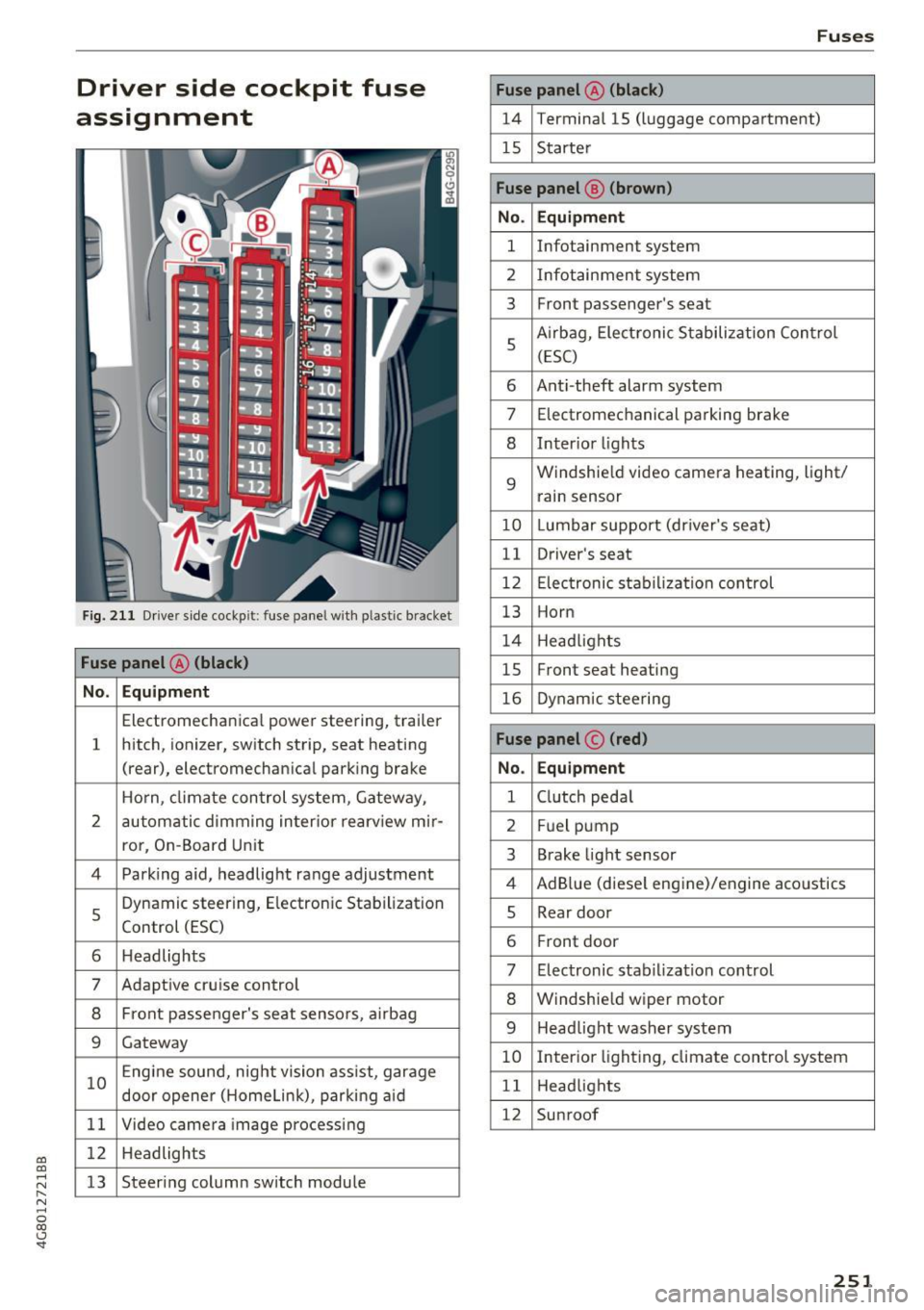
Driver side cockpit fuse
assignment
Fig. 2 11 Driver side cockp it: fuse panel wit h plastic bracket
Fuse panel @ (black)
No . Equipment
Electromecha nica l powe r steering, trailer
1 hitch, ionizer, switch st
rip, seat heating
(rear), electromechan ica l park ing brake
Ho rn, climate con trol system, Gateway,
2 automati
c dimm ing in ter ior rearv iew m ir-
ro r, On -Board Un it
4 Park ing aid, headlight ra nge adjustment
5
Dynamic steering, E lectron ic Stabilization
Control (ESC)
6 Headlights
7 Adapt ive cruise control
8 Front passenger's seat senso rs, a irbag
9 Gateway
10 Engine sound, night vision ass
ist, garage
door opene r (H ome link), parki ng aid
11 Video camera image processing
1 2 Headlights
13 Steering column sw
itch module
Fuses
Fuse panel @ (black)
14 Termina l 15 (luggage compartment)
15 S tarte r
Fuse panel @ (brown)
No . Equipment
1 Infotainment system
2 Infotainment system
3 Front passenger's seat
5
A
irbag, Elect ronic S tabilization Con trol
( E SC)
6 Ant
i-theft alarm system
7 Electromec hanical pa rking brake
8 Inter io r li ghts
9
Windshie ld video came ra heating, light/
rain sensor
10 Lumbar support (dr iver's seat)
11 Driver
's seat
12 Electronic st abilization con trol
13 Horn
1 4 Head lights
15 Front seat heating
16 Dynam ic steering
Fuse panel © (red)
No . Equipment
1 Clutch peda l
2 Fuel p ump
3 Brake
light sensor
4 AdB lue (diese l engine)/engine aco ustics
5 Rear door
6 Fr
ont door
7 Electronic stab ilization control
8 Windshie ld w iper motor
9 Head light washer system
10 Interio
r lighting, climate control system
1 1 Head lights
12 Sunroof
251