brake AUDI A8 2015 Workshop Manual
[x] Cancel search | Manufacturer: AUDI, Model Year: 2015, Model line: A8, Model: AUDI A8 2015Pages: 312, PDF Size: 79.18 MB
Page 214 of 312

212 Trailertowing
drive at the maximum permissible speed. Re
duce your speed even more if load, weather or
wind condit ions are unfavorable -part icu larly
when going downhill.
Reduce vehicle speed
immedi atel y if the trail
er shows the slightest sign of swaying .
Do not
tr y to stop th e sway ing by acceler ating .
Observe speed limi ts. In some areas, speeds
for vehicles towing trailers are lower than for
regular vehicles .
A lways apply brakes early. When driv ing
downhill, shift into a lower gear to use the en
gine braking effect to slow the vehicle . Use of
the brakes a lone can cause them to overheat
and fail.
Coolant t emperature
The coolant temperature gauge¢ page 10
must be observed carefully. The coolant tem
perat ure can increase if you drive on long in
clines in a low gear at high engine speeds. Re
duce your speed immediate ly if the L EDs in
the top part of the display turn on.
F or more in formation about indicator lights,
referto .¢page
15 .
A WARNING
Anyone not properly restrained in a mov
ing veh icle is at a much greater risk in an
accident . Never let anyone ride in your car
who is not properly wear ing the restra ints
provided by Aud i.
Trailer towing tips
Important to know
Your vehicle hand les different ly when towing
-
a trailer because of the addit ional weight and
d ifferent weight distribution . Safety, perform
ance and economy w ill greatly depend on how
carefully you load your trailer and operate
your ng.
Before you actually tow your trailer, practice
turning, stopp ing and back ing up in an area
away from traffic . Keep practicing until you have become completely familiar with the way
your vehicle-trailer combination behaves and responds .
Backing up is diffi cult and requ ires practice .
Backing up with a trailer gene rally req uires
steering action opposite to that when backing
up your vehicle without a tra iler.
Maintain a greater d ista nce between you r ve
hicle and the one in front of you . You wi ll need
more room to stop. To compensate for the
trailer, you w ill need a larger than normal
turning rad ius.
When passing, remember that you cannot ac
ce lerate as fast as you norma lly would be
ca use of the added load. Make sure yo u have
enough room to pass. After passing, allow
plenty of room for your trailer be fore chang
ing lanes again .
Avoid jerky starts, sharp turns or rapid lane changes.
(D Tips
- Do not tow a trailer during the break-in
period of your vehicle .
- If you tow a trailer, your Audi may re
quire more frequent maintenance due to
the extra load¢
page 290.
Parking on a slope
Do not park on a slope with a trailer. If it can
not b e avoided, do so only after doing th e fol
lowing:
When par king:
.,. App ly the foot brake.
.,. Have someone p lace chocks under both the
vehicle and the tra iler wheels .
.,. With chocks in place, slowly release the
brakes unt il the wheel chocks absorb the
load .
.,. Turn the whee ls towards the curb .
.,. Apply the parking brake .
.,. Select the P se lector lever posit ion.
When re starting after parking:
.,. App ly the foot brake.
Page 215 of 312

,....,
N ,....,
N
0 J:
'SI: ,...., \!) 1.1'1 ,...., 1.1'1 ,....,
~ Start the engine.
~ Se lect the D selector lever position.
~ Re lease the park ing brake and slowly pull
out and away from the wheel chocks .
~ Stop and have someone retrieve the wheel
chocks.
(D Tips
If you move the selector lever of the auto
matic transm ission to P before applying
the parking brake and before blocking the
wheels, you may have to use more force
later to move the lever out of the P posi
tion .
Trailer towing 213
•
•
Page 217 of 312

,....,
N ,....,
N
0 J:
'SI: ,...., \!) ..,.,
,...., ..,., ,....,
Vehicl e ca re a nd cl eanin g 215
Rinse the vehicle thoroughly with water. Then
clean using a neutral shampoo and a soft mi
crofiber cloth.
Rinse the vehicle tho roughly again and let it
air dry. Remove any water residue using a
shammy .
A WARNING
-Only wash the vehicle when the ignition
is off and follow the instructions from
the car wash operator to reduce the risk
of accidents .
- To reduce the risk of cuts, protect your
self from sharp metal components when
wash ing the underbody or the inside of
the wheel housings .
- After washing the vehicle, the braking ef
fect may be delayed due to mo isture on
the brake rotors or ice in the winter. The
brakes must be dried first with a few
careful brake applicat ions.
- If you wash the vehicle in an automatic car wash, you must fold the exterior m ir
rors in to reduce the r is k of damage to
the mirrors. Power folding exterior m ir- rors* must only be fo
lded in and out us
ing the power folding fu nction .
- T o prevent paint damage, do not wash
the vehicle in direct sunlight.
- T o reduce the r is k of damage to the sur
face, do not use insect removing spong
es, kitchen sponges or similar items.
- Matte finish painted vehicle compo
nents:
- To reduce the risk of damage to the
surface, do not use polishing agents or hard wax.
- Never use car wash cycles that apply
protective wax. It can destroy the
matte fin ish effect .
- Do not place any stickers or magnet ic
signs on vehicle parts painted w ith
matte fin ish paint. The paint cou ld be
damaged when the stickers o r magnets
a re removed.
@ For the sake of the environment
Only wash the vehicle in facilities spec ially
designed for that p urpose . This will red uce
the r is k of dirty wate r contam inated with
oil from entering the sewer system.
Cleaning and care information
When clea ning and caring for individual vehi
cle components, refer to the fo llow ing tab le.
The information contained there is simp ly rec
ommendations. For questions or for compo -nents that are not listed
, refer to a n author
ized Audi dea ler or a qualified workshop. Also
follow the information found in ¢ .&. .
Cle an ing exte rior
Component Situation Solution
Wipe r blades
Dirty ~ page 54, Cleaning windshield wiper blades
Headlight s/ Dirty Soft sponge with a mild soap solutiona>
tail ligh ts
S en sor s/
Dirty Sensors: soft cloth with a so lvent-free cleaning product
camera le nse s Camera lenses: soft cloth with an alcohol-free cleaning
so lution
Snow/ice Hand brush/so
lvent-free de-icing spray
Wheel s Road salt Water
Brake dust Acid-free special cleaning
solution
•
•
Page 230 of 312

228 Checking and filling
Checking and filling Engine hood
Releasing the engine hood
The engine hood is released from inside the
vehicle .
Fig. 197 Driver foo twell: release lever
Fig. 198 Rocker switch un der the hood
Make sure the wiper arms are not raised up
from the windshield. Otherwise the paint
could be damaged.
.,. Pull the lever under the instrument panel in
the direction of the arrow
¢ fig. 197.
.,. Raise the hood slightly¢,&. .
... Press the rocker switch under the hood up
ward ~
fig. 198. This releases the catch.
• Open the hood.
&_ WARNING
Hot engine coolant can burn you.
- To reduce the risk of being burned, never
open the hood if you see or hear steam
or coolant escaping from the engine compartment . Wait until no steam or
coolant can be seen or heard before care
fully opening the hood .
'Working in the engine compartment
Be especially careful whenever you work in
the engine compartment.
Whenever you must perform any work in the
engine compartment, for example checking
and filling different fluids, there is a risk of injury, burns and accidents. To prevent per
sonal injury always observe the following
WARNINGS. The engine compartment of any
vehicle is a hazardous area
¢ ,&. .
A WARNING
To help avoid injury, before you check any
thing under the hood:
- Turn off the engine.
- Switch off the ignition .
- Apply the parking brake.
- Move selector lever to "P" (Park) .
- Always let the engine cool down. Hot
components will burn skin on contact.
- To reduce the risk of being burned, never
open the hood if you see or hear steam
or coolant escaping from the engine
compartment. Wait until no steam or
coolant can be seen or heard before care
fully opening the hood.
- Keep children away from the engine com
partment.
- Never spill fluids on hot engine compo
nents . They can cause a fire .
- Never touch the radiator fan. The auxili
ary electric fan is temperature controlled
and can switch on suddenly .
- Never open the coolant reservoir cap
when the engine is still warm . The cool
ant system is pressurized and hot cool
ant could spray out.
- Protect your face, hands and arm from
steam or hot engine coolant by placing a
thick rag over the cap when you open the
coolant reservoir.
- Do not
remove the engine cover under
any circumstances. This increases the
risk of burns.
- If work on the fuel system or the electri
cal system is necessary:
Page 231 of 312

,....,
N ,....,
N
0 J:
'SI: ,...., \!) 1.1'1 ,...., 1.1'1 ,....,
-Always disconnect the battery.
- Never smoke or work near heaters or open flames. Fluids in the engine com
partment could start a fire.
- Keep an approved fire extinguisher im
mediately available.
- To avoid electrical shock and personal in
jury while the engine is running or being
started, never touch :
- Ignition cables
- Other components of the high voltage
electronic ignition system.
- If you must perform a check or repair
with the engine running:
- First, fully apply the parking brake,
move selector lever to "P" (Park).
- Always use extreme caution to prevent
clothing, jewelry, or long hair from get
ting caught in the radiator fan, V-belts
or other moving parts, or from contact ing hot parts. Tie back hair before
starting, and do not wear clothing that
will hang or droop into the engine.
- Minimize exposure to emission and
chemical ha zards c:::> & .
A WARNING
California Proposition 65 Warning:
- Engine exhaust, some of its constituents,
and certain vehicle components contain
or emit chemicals known to the State of
California to cause cancer and birth de
fects and reproductive harm. In addition ,
certain fluids contained in vehicles and
certain products of component wear con
tain or emit chemicals known to the
State of California to cause cancer and
birth defects or other reproductive harm .
Checking and filling 229
-Battery posts, terminals and related ac
cessories contain lead and lead com
pounds, chemicals known to the State of
California to cause cancer and reproduc
tive harms. Wash hands after handling.
(D Note
When adding fluids, always make sure that
they are poured into the proper container
or filler opening, otherwise serious dam
age to vehicle systems will occur.
(® For the sake of the environment
To detect leaks in time, inspect the vehicle
floor pan from underneath regularly . If
you see spots from oil or other vehicle flu ids, have your vehicle inspected by an au
thorized Audi dealer.
Closing the engine hood
.,. Pull the hood down until the pressure from
the struts is reduced.
"'Let the hood
drop down and latch in place.
Do not try to push it shut; it may fail to en
gage
c:::> ,A .
A WARNING
-
A hood that is not completely latched
could fly up and block your view while driv
ing .
- When you close the engine hood, check it
to make sure the safety catch has proper ly engaged. The hood should be flush
with the surrounding vehicle body parts.
- If you notice while driving that the hood
is not secured properly , stop at once and
close it. •
•
Page 233 of 312

,....,
N ,....,
N
0 J:
'SI: ,...., \!) 1.1'1 ,...., 1.1'1 ,....,
(!) Windshield/headlight washer
t .
(~ ) con ainer ,..., .. .... ... .. .. . 244
@ Jump start point( -) with hex
h ead screw ............... .. 242, 281
® Jump start point( +) under a cov-
er . ..... .. ... .. ..... ... .. . 242, 281
@ Engine oil filler cap(~) . . . . . 234
® Brake fl uid reservo ir ((0)) . . . . . 239
® Coolant expansion tank (-L) . . . 237
0 O il dipstick . . . . . . . . . . . . . . . . . 234
The engine oil filler neck (item @) may be lo
cated in a different area depend ing on the ver
sion of the eng ine .
A WARNING
Before yo u check anything in the engine
compartment, always read and heed all
WARN INGS
Q .&. in Working in the engine
c ompartment on page 228.
Engine oil
Engine oil specifications
The engine oil used in your Audi needs the
right kind of oil .
-
The engine in your Audi is a sophisticated
powerp lant that was b uilt to exacting specifi
cations . This engine needs the right kind of
engine o il that meets specificat ions regarding
q ua lity and viscos ity so that it can run
smoothly and reliably . Choos ing the right oil
and changing oil within the time and mileage
in terva ls pr inted in your veh icle's War ranty
&
M aintenance book let matters a lot more to
day than i t did yea rs ago . Audi has developed
a special quality s tanda rd fo r engine oil th at
will he lp assure that your veh icle's eng ine will
get the lubrication it needs for prope r opera
tion .
M odern eng ine lubrica tion has taken a qu an
tum leap in the last few years . Many synthetic
oils ava ilable today provide better engine lu
brication that can outlast traditional petrole
um-based o ils, making them a smart choice
for use throughout the life of your A udi.
Checkin g and fillin g 231
Whether you use synthetic o r petro le um
based engine oil, the oil that you use m ust
conform to Aud i's oi l quality standard
VW 502 00 (vehicles with gasoline engine) or
VW 507 00 (vehicles w it h diesel eng ine) to
help keep your veh icle's engine ru nning
smoot hly and he lp prevent the format io n of
harmful deposits, sometimes ca lled "s ludge, "
t h at over time can lead to expensive repairs.
At the time of printing, engine oils ava ilab le i n
t h e U.S . and Canada that meet the exac ting
specifications of Audi oil standard VW 502 00
(ve hicl es w ith gasoline engine) o r VW 50 7 00
(ve hicl es w ith diese l engi ne) are synthet ic en
gine oi ls. Th is does not mean, howeve r, that
every synthetic engine oil will meet A udi oi l
standard VW 502 00 (vehicles with gasoline
engine) or VW 507 00 (vehicles with d iesel
engine). So always be sure that you use an ap
proved o il.
To he lp prevent the formation of harmfu l de
pos its use on ly oil with the following specifi
cations pr inted on the o il conta iner:
- Audi oil standard VW 502 00 (gasoline en
gine )
- Audi oil standard VW 507 00 (diesel en-
gine )
Oil containe r labels may car ry the spe cifica
tion sing ly or in combination wi th other desig
nations and oil quality s tanda rds .
Viscosity
Engine o ils are graded accord ing to their vis
cosity . The proper viscos ity grade oil fo r your
engine depends o n climactic or seasona l con
ditions where you d rive. You ca n use o il wit h a
vis cosity gr ade of SA E SW40 across all tem
pera ture ranges for norma l driv ing con ditions.
Howeve r, if engine oil v iscos ity grade SA E
SW40 is not available, you can a lso use v iscos
i ty grade SA E SW -30 or SA E OW -40 as long as
i t meets Aud i oil q ua lity standard VW 502 00
(ve hicles w ith gasoline engine) o r VW 5 07 00
(ve hicles w ith diese l engine) specifications.
Be cause eng ine o il that mee ts the Audi o il
standard may no t be availab le everywhere
•
•
Page 241 of 312
- the temperature of the engine coolant rises
due to th e heat bui ld-up from the engine in
the engine compartment, or
- the engine compartment heats up because
the vehicle is parked in intense sunlight.
.&_ WARNING
- To reduce the r isk of personal injury nev
er touch the radiator fan.
- The auxiliary electr ic fan is temperature
controlled and can switch on sudden ly
even when the engine is not runn ing.
- The auxiliary radiator fan switches on au tomat ically when the engine coolant
reaches a certain temperature and will
continue to run until the coolant temper
at ure drops.
Brake fluid
Checking brake fluid level
The brake fluid level can be checked with a
quick glance.
N N
-N
i
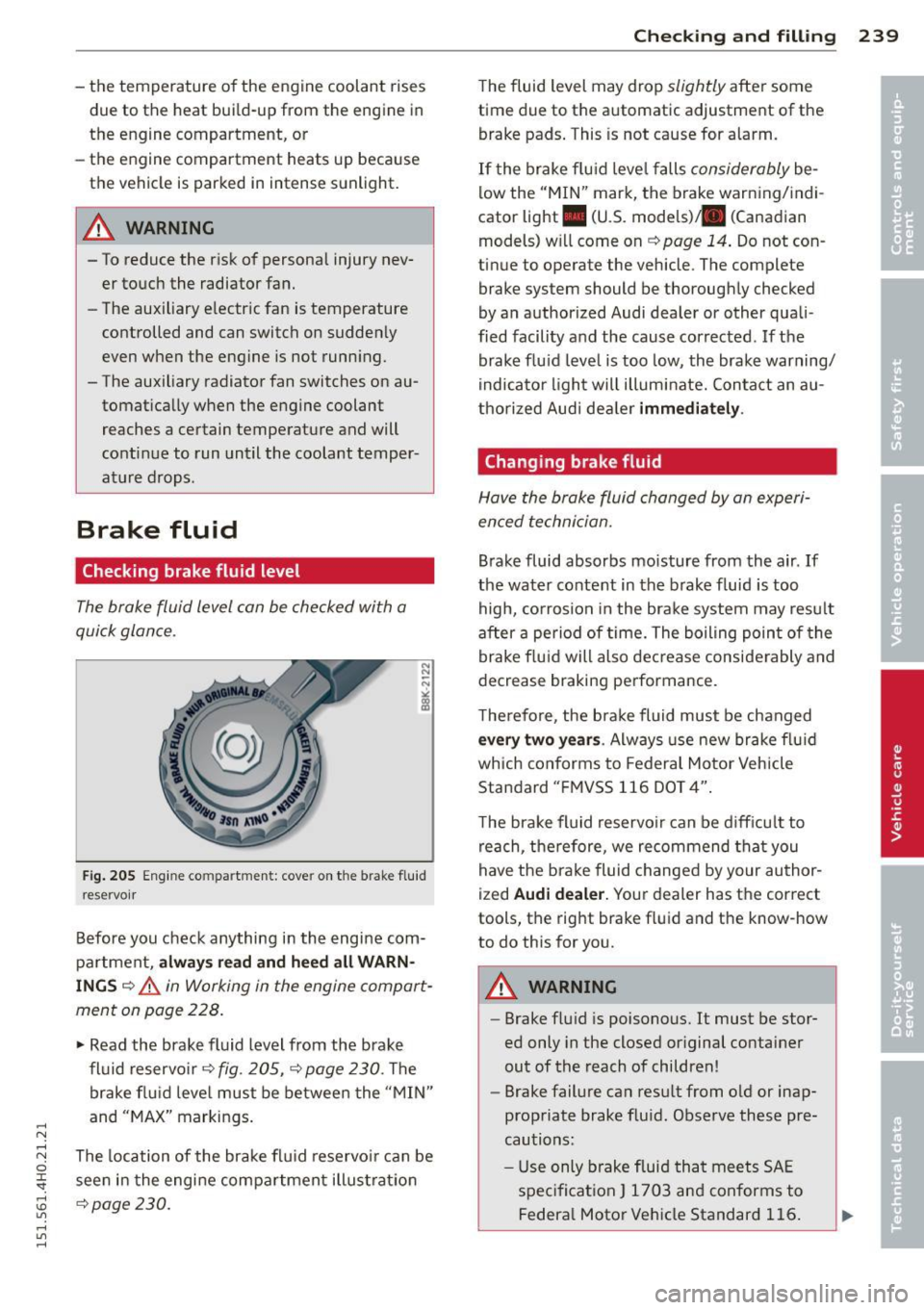
F ig . 2 05 Eng ine co mpartmen t: cove r on the b rake f lui d
r eservo ir
Before you check anything in th e engine com
partment,
alwa ys read and he ed all WARN
INGS c::> .&. in Working in the engine compart
ment on page 2 28.
~ Read the brake fluid level from the brake
fl uid reservo ir ~
fig . 205, c::> page 230. The
brake f luid leve l must be betwee n the "M IN"
and "M AX" marki ngs.
The location of the brake fl uid reservo ir can be
see n in t he engi ne comp artment illus trati on
c::> page 230.
Checkin g and fillin g 239
The fluid level may d rop slightly afte r some
time due to the automatic adjustment of the
brake pads . T his is not cause for alarm .
If the brake flu id leve l falls considerably be
low the "MIN" mark, the brake warning/indi
cator light . (U.S. models) . (Canadian
models) w ill come on
~ page 14 . Do not con
tin ue to operate the vehicle . The complete
brake sys tem should be thoroughly checked
by an authorized Audi dea ler or other quali
fied facility and the cause corrected.
If the
brake f lu id leve l is too low, the brake warning/
indica tor ligh t will illumi nate. Conta ct an au
thorized Aud i de aler
immediately .
Changing brake fluid
Have the brake fluid changed by an experi
en ced technician.
B rake fluid absorbs moisture from the air . If
the water content in the brake fluid is too
high, co rrosion in the brake system may resu lt
after a pe riod of time. The boiling point of the
brake f lu id will also dec rease conside rably and
decrease brak ing performance.
T herefo re , the bra ke fluid must be changed
every tw o year s. Always use new br ake f lu id
which con forms to Federal Mo tor Veh icle
Standard " FMVSS 116 DOT 4".
T he bra ke fluid reservo ir can be d iff icu lt to
reach, the refore, we recommend that you
have the bra ke fluid changed by your author
ized
Audi dealer. Your dealer has the cor rect
tools, the right brake fluid and the know -how
to do this for you.
A WARNING
---- Brake flu id is poisonous. It must be stor
ed only in the closed or iginal container
out of the reach of children!
- Brake failure can resu lt from old or inap
prop riate brake f lu id. Observe these pre
cautions:
- U se only brake fluid tha t meets SAE
specificat ion
J 1703 and conforms to
Federa l Motor Vehicle Standard 116.
Page 242 of 312
24 0 Ch eck ing and filling
Always check wi th your a uthorized Audi
dealer to make s ure you are using the
correct brake flu id. The correct type of
brake fluid is also indicated on the
brake fluid reservoir.
- The brake fluid must be new. Heavy use
of the brakes can cause a vapor lock if
the brake fluid is left in the system too
long. This can ser ious ly affect the effi
ciency of the b ra kes as well as yo ur
safety. This could result in an acc ident.
(D Note
Brake flu id will damage the paint of your
veh icle.
@ For the sake of the environment
Because of the problem of proper d isposa l
of brake flu id as wel l as the special tools
requ ired and the necessary expert ise, we
recommend that you have the b rake fluid
changed by your author ized Audi dealer.
Battery
General information
Under
normal operating conditions, the bat
tery in your Audi does not need any mainte
n ance . With
high outside temperatures or
l ong daily dr ives we recommend that you have
the elec trolyte level checked by a service fa
cili ty. The e lec trolyte level sho uld a lso be
checked each time the battery is charged
¢ page 242.
Have the b attery checked when you ta ke yo ur
ve hicl e in for service. Yo u are well adv ise d to
replace a battery that is older than S years .
W ith certa in types of airbag deployment, the
battery is d isconnected from the vehicle ele c
tr ica l system for sa fety reasons¢
& in Re
pair, care and disposal of the airbags on
page 165.
Disconnecting the battery terminals
Some veh icle func tions (power w indow regu
l ato rs, for example) a re los t if the b attery ter- mina
ls are disconnected. These functions have
to be relearned after the battery termina ls are
connected aga in. To prevent th is, the battery
sho uld only be disconnected from the ve hicle
electrical system when abso lutely necessary
for repairs.
Vehicle s not driven for long peri ods
If you do not d rive your vehicle over a period
of several days or weeks, e lectr ica l compo
nents are gradually cut back or sw itched off.
This reduces energy consumption and ma in
ta ins start ing capability over a longer period
¢
page 202. Some of the convenience func
t ions may not ope rate, such as the inter ior
li gh ts or the power seat adjus tment. The con
venience func tions will be ava ilable ag ain
when you switch on the ignition and start the
engine .
Winter operation D uring the winte r months, battery capac ity
tends to de crease as temperatures drop. This
is beca use more power is also consumed wh ile
sta rting, and the headlights, rear window de
fogger, etc ., are used more often .
Avoid unnecessary power consumpt ion, p ar
t icu lar ly in city traffic or whe n traveling only
short distances. Let yo ur au thorized Aud i
dealer check the capacity of the vehicle bat
tery before winter sets in ¢
page 242. A well
charged battery will not on ly prevent starting
problems when the weather is cold, but will
also last longer.
(!) Tips
If your vehicle is left standing for several
weeks at extremely low temperatures, the
vehicle battery sho uld be removed and
stored where it w ill not freeze. This will
prevent it from be ing damaged and having
to be repla ced.
Page 247 of 312
,....,
N ,....,
N
0 J:
'SI: ,...., \!) 1.1'1 ,...., 1.1'1 ,....,
Tires and wheels
Tires
General notes
Tires may be the least appreciated and most
abus ed parts of a motor vehicle .
Tires may be the least ap preciated and most
a b used parts of a motor vehicle . T ires are,
however, one of the most important parts of a
vehi cle, particularly considering the compara
tively small patch of rubber on eac h tire that
assures that a ll- important contact between
you, you r vehicle and the road.
Ma intaining the correct tire pressure, mak ing
sure that your vehicle and its tires do not have
to carry mo re weight than they can safe ly han
d le, avoiding damage from road ha za rds and
r eg ularly inspec ting t ires for damage i nclud
ing cuts, slashes irreg ular wear and ove ra ll
condition are the most important things that
you can do to he lp avoid s udden tire failure in
cluding tread separat ion and b lowouts.
Avoiding damage If you have to d rive ove r a curb or similar ob
stacle, drive very slow ly and as close as possi
b le at a right angle to the curb.
A lways keep chemicals incl ud ing grease, o il ,
gasoline and brake fluid off the t ires .
I nspect the t ires regularly for damage (cuts,
cracks or b listers, e tc.). Remove any fo reign
bod ies embedde d in the t reads.
Storing tires Mark t ires when you remove them to indicate
the direction of rotation . T his ensures you to
be ab le to mount them correctly when you re
in stall them .
When removed, the whee ls or t ires should be
sto red in a cool, d ry and preferably dark place .
Store tires in a vertical pos ition if they are not
mounted on r ims, in a horizontal pos it ion if
they are mounted on rims .
Tires an d wheel s 245
New tires
New tires h ave to be broken in ¢ & .
The tread depth of new t ires may va ry, accord
ing to the type a nd make of t ire and the tread
pa tte rn.
Hidden damage
Damage to tires and r ims is ofte n not readily
visible . If you notice unusual v ib rat io n or the
vehicle p ulls to one s ide, th is may ind icate
that one of the t ires has been damaged . T he
tir es m ust be che cked immed iate ly by an au
t horized Audi dea le r or q ua lified wor kshop .
Unidirectional tires
A un idirec tional tire can be identified by ar
rows on the s idewa ll, that po int in the direc
tion the t ire is desig ned to rotate. You mus t
f ol low the specified d irection o f rotation . T his
is necessary so that these tires can develop
their optimum characteristics regarding grip, road noise, wear and hydrop laning resistance.
For more information
¢ page 275.
A WARNING
New tires or t ires that are o ld, worn or
damaged can not provide maximum con
trol and braking ability .
-
-New tires tend to be slippery and must
be broken in. To reduce the r isk of losing
contro l, a co llision and ser ious personal
in ju ries, d rive with special ca re fo r the
fi rst 350 m iles ( 560 km).
- Driving with worn or damaged tires can
le ad to loss of control, sudde n tire fail
ure, including a blowout and sud den de
fla tion, c ras hes and se riou s personal in
juries . Have wo rn or d amaged t ires re
placed immediate ly.
- Ti res age even if they are no t being used
an d can fai l sudden ly, especially at hig h
spee ds. Tires that are more than 6 years
old can only be used in an emergency
and then w ith special care and at low
speed.
•
•
Page 248 of 312
24 6 T ire s and whee ls
- Never mount used tires on yo ur vehicle if
you are not sure of their "previous histo
ry." Old used tires may have been dam
aged even though the damage cannot be
seen that can lead to sudden tire failure
and loss of vehicle control.
- If you notice unusual vibration or if the
vehicle pulls to one side when driving, al
ways stop as soon as it is safe to do so and check the wheels and tires for dam
age.
(D Note
- Please note that summer and winter
tires are designed for the cond itions that
a re typ ica l in those seasons. Aud i recom
mends using w inter t ires d uring the win-
Glossary of tire and loading terminology
Accessory weight
means t he comb ined weight (in excess of
those standard items which may be rep laced)
of automatic transmission, power steering,
power brakes, power windows, power seats,
radio, and heater, to the extent that these
items are available as factory-installed equip
ment (whether installed or not).
Aspect ratio
means t he ratio of the height to the width of
the tire in percent. Numbers of 55 or lower in
d icate a low sidewall for improved steer ing re
sponse and better overall handling on dry pavement .
Bead
means the pa rt of the tire t hat is made of
steel wires, wrapped or reinforced by ply cords
and that is shaped to fit the r im.
Bead separation
means a breakdown of the bond between
components in the bead.
Cord
means t he strands forming the plies in the
tire. ter months.
Low tempe ratu res signifi
cantly decrease the elasticity of summer
tires, which affects traction and braking ability. If summer tires are used in very
co ld temperatures, cracks can form on
the tread bars, resu lting in permanent
tire damage that can cause loud driving noise and unbalanced tires. Aud i is not
responsib le for this type of damage.
- Burn ished, polished or chromed rims
must not be used in winter weather. The
surface of the rims does not have suff i
c ien t corrosion protect io n for this and
cou ld be pe rmanently damaged by road
salt or simi lar substances. This damage
is not covered by war ranty.
Cold tire inflat ion pre ssure
means the t ire press ure recommended by the
vehicle manufacturer for a tire o f a des ignated
size that has not been driven for more than a
coup le of miles (ki lometers) at low speeds in
the three hour period before the tire press ure
is measured or adjusted.
Curb weight
means the weight of a motor vehicle w ith
standard equipment including the maximum
capacity of fuel, o il, and coolant, air cond i
tion ing and additional weight of optiona l
equipment.
E x tra load tire
means a tire design to operate at higher loads
and at higher inflation pressures than the cor
responding standard tire. Extra load tires may
be identified as "XL", "xl", "EXTRA LOAD", or
"RF" on the sidewall.
Gross A xle Weight Rating ("GAWR ")
means the load-carrying capacity of a single
axle system, measured at the tire-ground in -
terfaces.
IJ>,