weight AUDI Q3 2015 Owners Manual
[x] Cancel search | Manufacturer: AUDI, Model Year: 2015, Model line: Q3, Model: AUDI Q3 2015Pages: 258, PDF Size: 64.9 MB
Page 5 of 258
M N
M N
0 ::i co ,...., \!) 1.1'1 ,...., 1.1'1 ,....,
Airbag system ............ ... .. 112
Important things to know . . . . . . . . . . 112
Front airbags .................... 116
Monitoring the Advanced Airbag
System . . . . . . . . . . . . . . . . . . . . . . . . . 123
Side airbags . . . . . . . . . . . . . . . . . . . . . 127
Side curtain a irbags . . . . . . . . . . . . . . . 130
Child Safety . . . . . . . . . . . . . . . . . . . 133
Important things to know . . . . . . . . . . 133
Child safety seats . . . . . . . . . . . . . . . . . 139
Installing a child safety seat . . . . . . . . 143
LATCH Lower anchorages and tethers
for child ren . . . . . . . . . . . . . . . . . . . . . . 146
Additional Information
lSl
Vehicle operation . . . . . . . . . . . . . 1S2
Intelligent technology . . . . . . . . 152
Notice about data recorded by the
Event Data Recorder and vehicle
control modules . . . . . . . . . . . . . . . . . . 152
Electronic Stabili zation Control (ESC) . 153
Braking . . . . . . . . . . . . . . . . . . . . . . . . . 156
Electromechanical steering . . . . . . . . . 158
Driving with your quattro . . . . . . . . . . 158
Energy management . . . . . . . . . . . . . . 159
Driving and environment . . . . . 161
The first 1,000 miles (1,500 km) and
afterwards . . . . . . . . . . . . . . . . . . . . . . 161
Avoid damaging the vehicle. . . . . . . . . 161
Catalytic converter . . . . . . . . . . . . . . . . 161
Shutting down vehicle . . . . . . . . . . . . . 162
Operate your vehicle economically and minimize pollution. . . . . . . . . . . . . . . . 162
Driving offroad . . . . . . . . . . . . . . . . . . . 164
Trailer towing . . . . . . . . . . . . . . . . . 166
Driving with a trailer . . . . . . . . . . . . . . 166
Trailer towing tips . . . . . . . . . . . . . . . . 168
Vehicle care . . . . . . . . . . . . . . . . . . . 170
Vehicle care and cleaning . . . . . 170
General information . . . . . . . . . . . . . . 170
Car washes . . . . . . . . . . . . . . . . . . . . . . 170
Cleaning and care information . . . . . . 171
Table of contents 3
Fuel supply and filling your
fuel tank ..... .... ..............
175
Gasoline .. .. .. .. .. .. .. .. .. .. .. .. 175
Fuel tank. . . . . . . . . . . . . . . . . . . . . . . . 176
Checking and filling . . . . . . . . . . . 179
Engine hood . . . . . . . . . . . . . . . . . . . . . 179
Engine compartment ............. .
Engine oil . .. .. .... ... .. ..... ... .
Engine cooling system .......... .. .
Brake fluid ....... .............. .
Battery ........................ .
Windshield washer container
Tires and wheels ... ..... ... .. .
181
181
186
189
190
193
195
Tires . . . . . . . . . . . . . . . . . . . . . . . . . . . 195
Tire pressure monitoring system 213
Do-it-yourself service . . . . . . . . . 216
What do I do now? ............ 216
General information . . . . . . . . . . . . . . 216
Vehicle tool kit with lifting jack . . . . . . 216
Folding chocks . . . . . . . . . . . . . . . . . . . 217
Removing bass box . . . . . . . . . . . . . . . 217
Space-saving spare tire (compact
spare tire) . . . . . . . . . . . . . . . . . . . . . . . 217
Changing a wheel . . . . . . . . . . . . . . . . . 218
Fuses and bulbs . . . . . . . . . . . . . . . 224
Fuses. ....... ... .. .............. 224
Bulbs. . . . . . . . . . . . . . . . . . . . . . . . . . . 226
Emergency situations . . . . . . . . . 228
General . . . . . . . . . . . . . . . . . . . . . . . . . 228
Starting by pushing or towing . . . . . . . 228
Starting with jumper cables . . . . . . . . 228
Use of jumper cables . . . . . . . . . . . . . . 229
Emergency towing with commercial
tow truck . . . . . . . . . . . . . . . . . . . . . . . 230
Lifting vehicle . . . . . . . . . . . . . . . . . . . . 232
Technical data . . . . . . . . . . . . . . . . . 234
Technical Data . . . . . . . . . . . . . . . . . 234
Vehicle identification . . . . . . . . . . . . . . 234
Weights . . . . . . . . . . . . . . . . . . . . . . . . 234
Dimensions . . . . . . . . . . . . . . . . . . . . . . 235
•
•
Page 38 of 258
36 Opening and clo sing
The a utomatic closi ng process begins if you
push down on the rear lid.
.&_ WARNING
- Never close the rear lid inatten tively or
without checking first. Although the closing force of the rear lid is limited,
you can st ill ser iously injure yourself or
others .
- Always ensure that no one is w ith in
range of the rear lid when it is mov ing, in
part icu la r close to the h inges and the up
per and lowe r edges -fingers or hands
can be pin ched.
- To help p revent po isonous exha ust gas
from bei ng drawn into the vehicle, al
ways keep the rear lid closed while driv ing. Never transport objects large r than
those which fit completely into the l ug
gage area, because then the rear lid can
not be fully closed.
- Never leave yo ur vehicle u nattended es
pecially with the rear lid left open . A
child could crawl into the car through the
luggage compa rtment and pull the lid
shut, becom ing trapped and unable to
get out . To reduce the risk of persona l in
jury, never let ch ildren play in or around
yo ur vehicle . A lways keep the rear lid as
we ll as the vehicle doo rs closed when not
in use.
- If there i s a luggage ra ck or b icycle ra ck
mounted on the rear l id, it may not be
able to open comple tely or an opened
rear lid may close by itself beca use of the
added weight. So the ope n rear lid must
be s upported or the weight m ust be re
moved from the luggage rack first .
@ Tips
-When the vehicle is locked, the rear lid
can be un locked sepa rately by pressing
the button
c:s on the master key. W hen
t h e rear lid is closed aga in, it locks auto
matically.
- The following applies to veh icles equip
ped with the conven ience key* feature: if
the remote control key is left in the lug- gage compa
rtment, luggage compart
ment wi ll automatically unlock itself af
ter yo u lock the vehicle. T his prevents
you from unintentionally lock ing your
key in the l uggage compartment.
- If the vehicle battery charge drops be
low a certain level, you can still open or
close the rear lid manua lly, however , you
w ill need to app ly more force to close it .
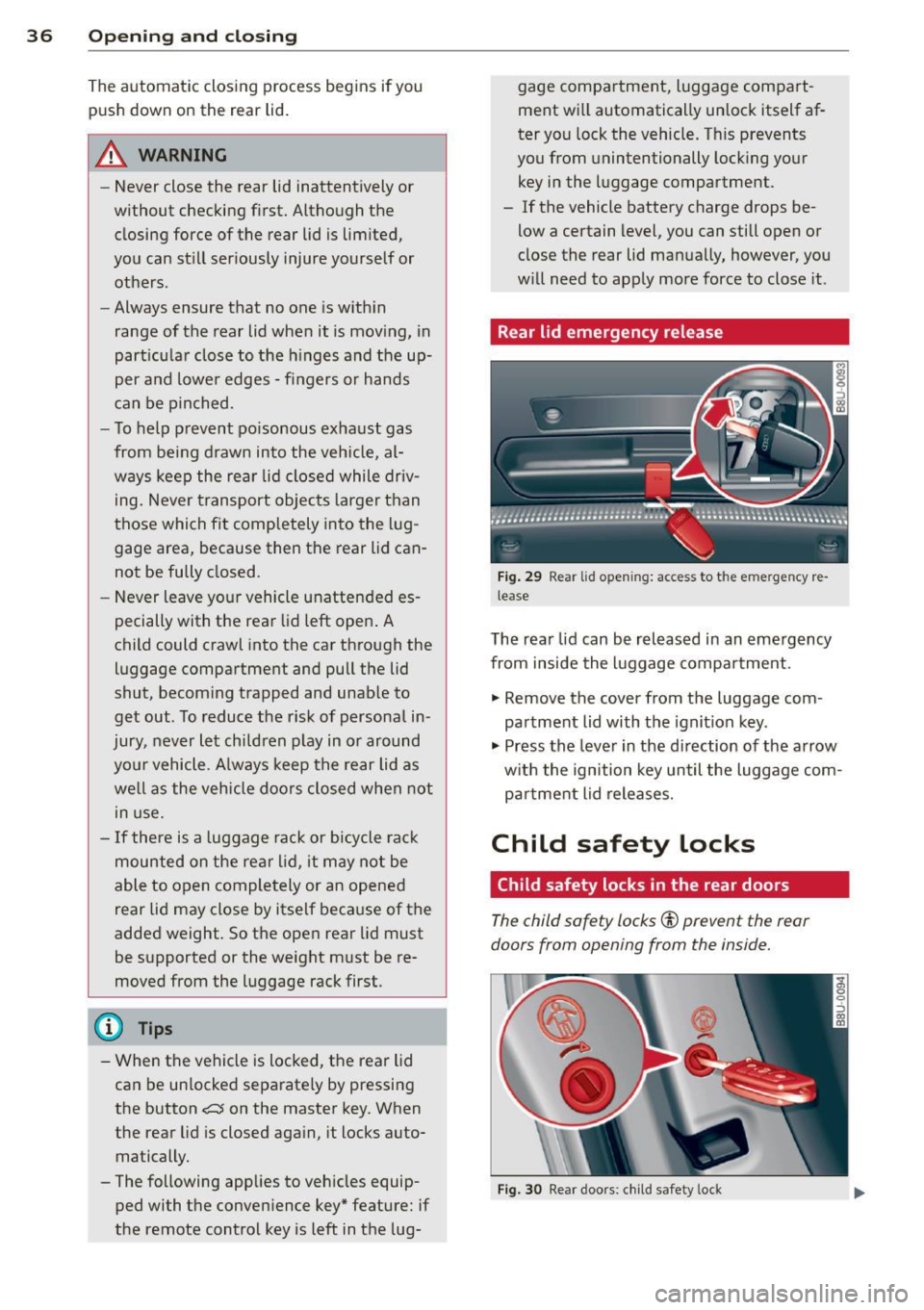
Rear lid emergency release
Fig. 2 9 Rear lid o penin g: a cces s to t he e mergency re
lea se
The rea r lid can be rel eas ed in an emergency
from inside the luggage compa rtment.
., Remove the cover from t he luggage com
pa rtment lid with the ignit ion key .
., Press the leve r in the di rection of the arrow
w ith the ign ition key until the luggage com
pa rtment lid releases.
Child safety Locks
Child safety locks in the rear doors
The child saf ety locks© prevent the rear
doors from opening from the inside.
Fi g. 30 Rear doo rs : chi ld safe ty lo ck
Page 56 of 258
54 Seats and storage
A WARNING
T he ciga rette lighter only works when the
ign ition is on . Improper use can cause seri
ous injury or start a fire. To avo id the r isk
of injury, nev er leave children unsupe r
vised in the vehicle with the key.
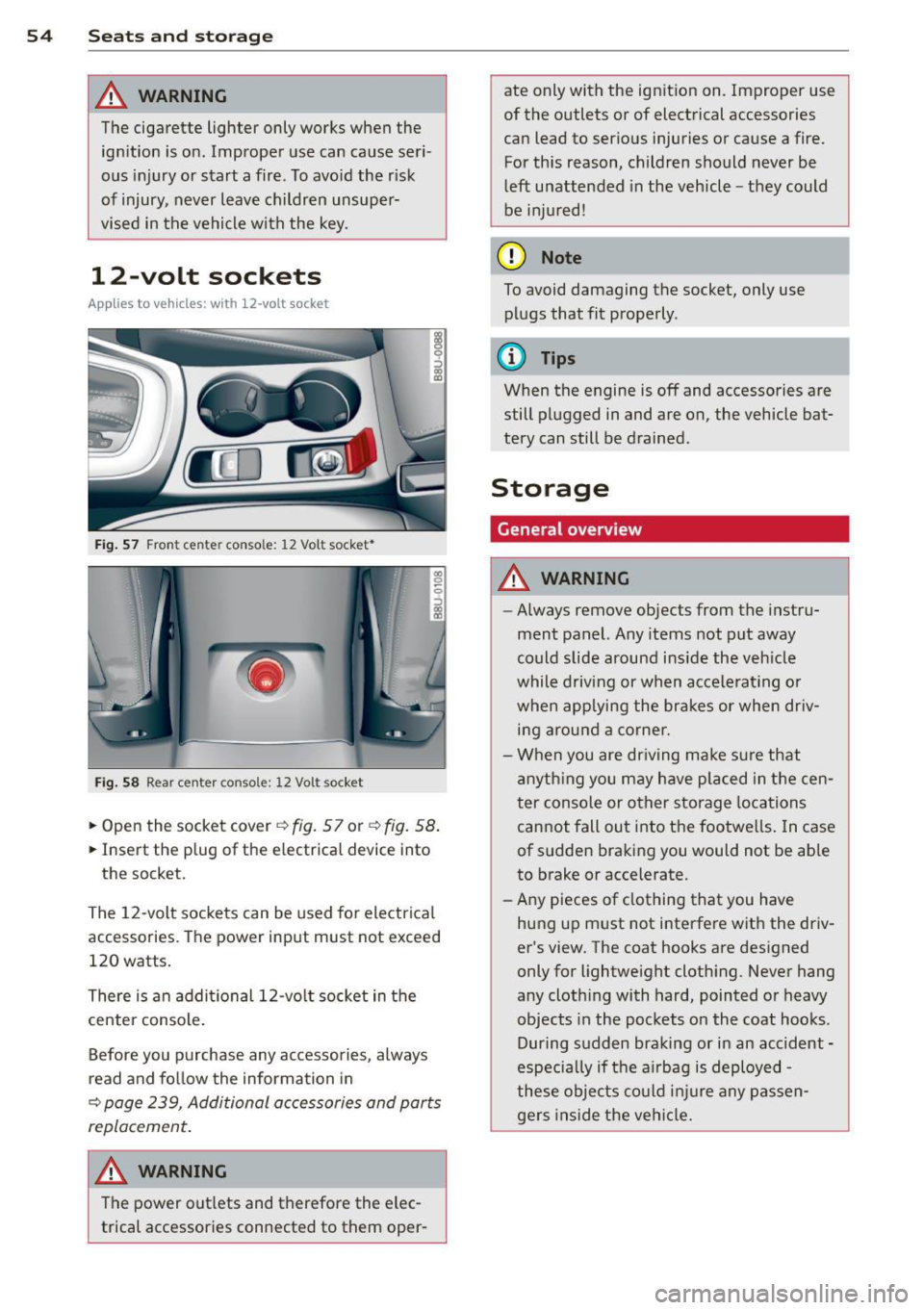
12-volt sockets
Ap plies to vehicles: with 12 -volt socket
Fi g. 57 Fro nt cen ter conso le: 12 Vo lt socket •
Fig. 58 R ear ce nter c onso le: 12 Vo lt socket
.. Open the socket cover ¢ fig. 57 or¢ fig. 58 .
.. Insert the p lug of the e lectrica l device into
the socket.
The 12 -volt sockets can be used fo r electr ical
accessories. The power input must not exceed
120 watts.
There is an addi tional 12-vo lt socket in the
center console .
Before you purchase any accessories, always
read and fo llow the informa tion in
¢ page 239, Additional accessories and parts
r e plac em ent .
A WARNING
The power out lets and therefore the elec
trical accessories connected to them oper- ate only with the ignit
ion on. Improper use
of the outlets or of electrical accessories
can lead to ser ious injuries or cause a fire.
For this reason, children should never be
l eft unattended in the vehicle -they could
be injured!
(D Note
To avoid damaging the socket, only use plugs that fit properly .
(D Tips
When the engine is off and accessories are
still plugged in and are on , the vehicle bat
tery can still be drained .
Storage
General overview
A WARNING
--
-Always remove objects from the instru
ment panel. Any items not put away
could slide around ins ide the veh icle
while driving or when ac cele rat ing o r
when applying the brakes or when dr iv
ing arou nd a corne r.
- When you are dr iving make s ure that
an yth ing you may have pla ced in the cen
ter conso le or other storage loca tions
cannot fall out into the footwe lls . In case
of sudden braking you would not be able
to brake or accelerate.
- Any pieces of clothing that you have
hung up must not i nterfere with the dr iv
er's view. The coat hooks are des igned
only for lightweight cloth ing . Never hang
any cloth ing with hard, pointed o r heavy
objects in the pockets on the coat hoo ks .
During s udden braking or in an accident -
especia lly if t he a irbag is deployed -
these objec ts co uld in ju re any passen
ge rs inside the ve hicl e.
Page 58 of 258
56 Seats and storage
in the vehicle while it is moving. In case
of an accident, sudden braking or other
vehicle movement, hot liquid could spill,
causing scalding burns . Spilled hot liquid
can also cause an accident and personal
injury.
- Use only soft cups in the cupholder. Hard
cups and glasses can cause injury in an
accident .
- Never use the cupholder or adapter as an
ashtray -risk of fire .
CD Note
Only drink containers with lids should be
carried in the cupholder . Liquid could spill
out and damage your vehicle's electronic
equipment or stain the upholstery, etc.
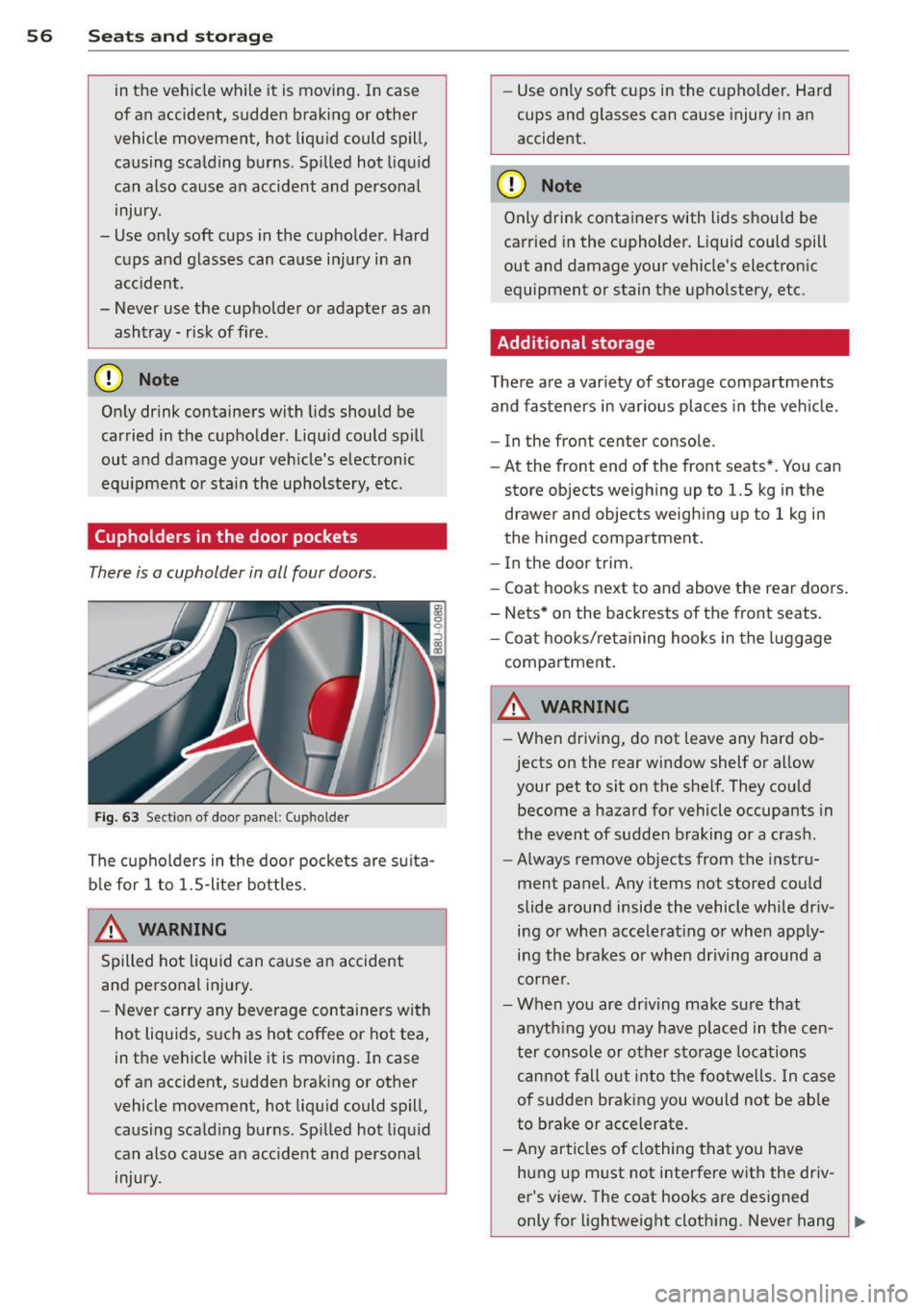
(upholders in the door pockets
There is a cupholder in all four doors .
Fig. 63 Sect ion of doo r panel: Cupho lder
The cupholders in the door pockets are suita
ble for 1 to 1.5-liter bottles.
_& WARNING ,~ ~
Spilled hot liquid can cause an accident
and personal injury.
- Never carry any beverage containers with
hot liquids, such as hot coffee or hot tea,
in the vehicle while it is moving. In case
of an accident, sudden braking or other
vehicle movement, hot liquid could spill,
causing scalding burns. Spilled hot liquid
can also cause an accident and personal injury . -
Use only soft cups in the cupholder. Hard
cups and glasses can cause injury in an
accident.
CD Note
Only drink containers with lids should be
carried in the cupholder. Liquid could spill
out and damage your vehicle's electronic
equipment or stain the upholstery, etc.
Additional storage
There are a variety of storage compartments
and fasteners in various places in the vehicle .
- In the front center console.
- At the front end of the front seats*. You can
store objects weighing up to 1.5 kg in the
drawer and objec ts weighing up to 1 kg in
the hinged compartment .
- In the door trim.
- Coat hooks next to and above the rear doors.
- Nets* on the backrests of the front seats.
- Coat hooks/retaining hooks in the luggage
compartment.
A WARNING
- When driving, do not leave any hard ob
jects on the rear window shelf or allow
your pet to sit on the shelf. They could become a hazard for vehicle occupants in
the event of sudden braking or a crash .
- Always remove objects from the instru
ment panel. Any items not stored could
slide around inside the vehicle while driv
ing or when accelerating or when apply ing the brakes or when driving around a
corner .
- When you are driving make sure that
anything you may have placed in the cen
ter console or other storage locations
cannot fall out into the footwells. In case
of sudden braking you would not be able
to brake or accelerate.
- Any articles of clothing that you have
hung up must not interfere with the driv
er's view. The coat hooks are designed
only for lightweight clothing. Never hang
~
Page 60 of 258
58 Seat s a nd s tor ag e
attached to it to fall off the roof onto the
road .
- Objects falling from the roof of a vehicle
can cause a crash and persona l injury.
- Only mount the roof rack on the desig
nated locations on the roof¢
fig. 64 .
- The roof rack system must be insta lled
exactly according to the instructions pro
vided.
- When driving with a roof rack system,
changes to the center of gravity and wind
resistance can change the vehicle han
dling and lead to a collision . Always
adapt your driv ing and your speed to the
current conditions .
(D Note
-Your vehicle warranty does not cover any
damages to the veh icle caused by using
roof racks or mount ing structures not
approved by Audi for your vehicle . The
same applies to damage resulting from
i nco rrect roof rack installation .
-Always check the roof rack mountings
and hardware before each trip and dur
i ng a tr ip to make sure eve rythi ng is se
cu rely tightened. If ne cessary, retighten
the mo unt ings and check the ent ire sys
tem from time to time.
- After mounting a roof rac k system, or
when you transport objects on the roof
of your vehicle, the height of the vehicle
is natura lly increased . Be careful when
driving under low br idges or in parking
garages for examp le. This could cause
damage to the load and even the vehicle
i tself .
- Make sure that the open rear lid and the
sunroof do not come into contact w ith
objects on the roof .
Loading the roof rack
Always distribute loads evenly. Make sure
any thing on the roof rack is securel y tied
down.
.. Always distrib ute the loads on the roof rack
even ly.
.. Always attac h it em s to the roof rack securely
before you dr ive off .
T he max im um perm issible roof weight is
165 lb (75 kg ). The roof we ight is the total of
the weigh t of the roof rack, the at tachments
and the cargo you are carrying . You must a lso
not exceed the maximum load we ight for the
r oof rack you are using.
When using a roo f rack system which has a
lower load carrying capacity , you must not use
up the tota l maximum permiss ible load carry
ing capac ity specified above. Instead, you
shou ld load the roof rack system only to the
maximum capacity specified by the manufac
tu rer of the roo f rack sys tem.
A WARNING
=
Weak, damaged or imprope r straps used
to secure items to the roof rack can fail
d uring hard braking or in a coll is ion and
cause ser ious personal injury.
- Make sure the roof rack is installed exact
ly as specif ied above ¢
page 5 7.
- Always use s uitable mounting straps for
secur ing items to the roof rack to help
prevent items from sh ifting or flying for
ward .
- Items on the roof rack must always be
securely mounted.
- The use of a roof rack can negatively af
fect the way a vehicle hand les . Cargo
that is large, heavy, bulky, long or flat
will have a greater negat ive influence on
the vehicle's aerodynamics, center of
g rav ity and overall handling. Always
d rive s lowly, avoid s udden bra king and
maneuvers when transporting ca rgo on
the roof of your vehicle .
~
Page 61 of 258
M N M N
0 ::i co
rl I.O
"' rl
"' rl
-Never exceed the maximum permissible
load carry ing capacity of the roof of your
vehicle, the perm issible axle weights and
the permiss ible total weight of your veh i
cle ¢
page 234 , Weights .
(D Note
- Make sure the rear lid does not hit the
cargo on the roof rack when you open it.
On vehicles with automatic rear lid/trunk
lid operation* you may have to adjust the
open position of the rear lid
¢ page 35.
- Remove the roof rack and attachment
before taking your vehicle through an au
tomatic car wash to avoid damage .
@l For the sake of the environment
As a result of the increased w ind resist
ance created by a roof rack, your veh icle is
using fue l unnecessarily . So remove the
roof rack after using it.
Luggage compartment
General information
,& WARNING
Read and heed the importan t safety pre
cautions on ¢
page 100, Stowing lug
gage .
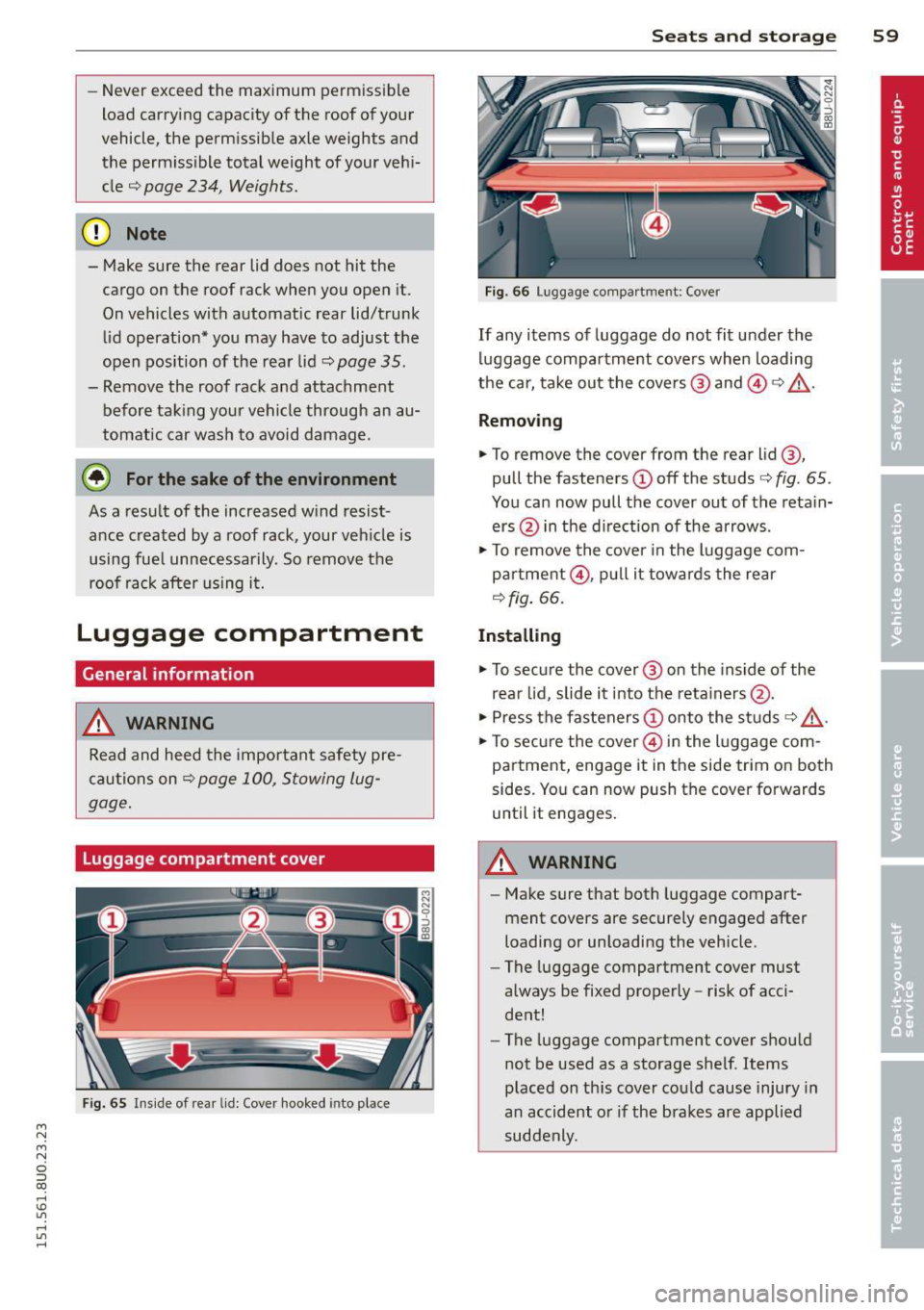
Luggage compartment cover
Fig. 65 Inside of re ar lid: Cove r hooked in to pl ace
-
S ea ts a nd s to rage 59
Fig. 66 Lug gage compa rtm en t: Co ver
If any items of luggage do not fit under the
luggage compartment covers when loading
the car, take out the covers @ and @¢,&. .
Remo ving
.,. To remove the cover from the rear lid@,
pull the fasteners
CD off the studs c:> fig. 65 .
You can now pull the cover ou t of the retain
ers @in the d irection of the arrows .
.,. To remove the cove r in the luggage com
p a rtment @, pu ll it towards the rear
¢ fig. 66.
Installing
.,. To secure the cover @ on the inside of the
rea r lid, slide it into the reta iners @.
.,. Press the fasteners
CD onto the studs¢,&. .
.,. To sec ure the cover @ in the luggage com
partment, engage it in the side trim on both
sides. You can now push the cover forwards
until it engages.
,& WARNING
- Make sure that both luggage compart
ment covers are securely engaged after
loading or unloading the vehicle .
- The luggage compartment cover must
always be fixed properly -risk of acci
dent!
- The luggage compartment cover shou ld
not be used as a storage shelf. Items
placed on th is cover could cause injury in
an accident o r if the bra kes are applied
suddenly.
-
Page 62 of 258
60 Seats and st o rage
Enlarging the luggage compartment
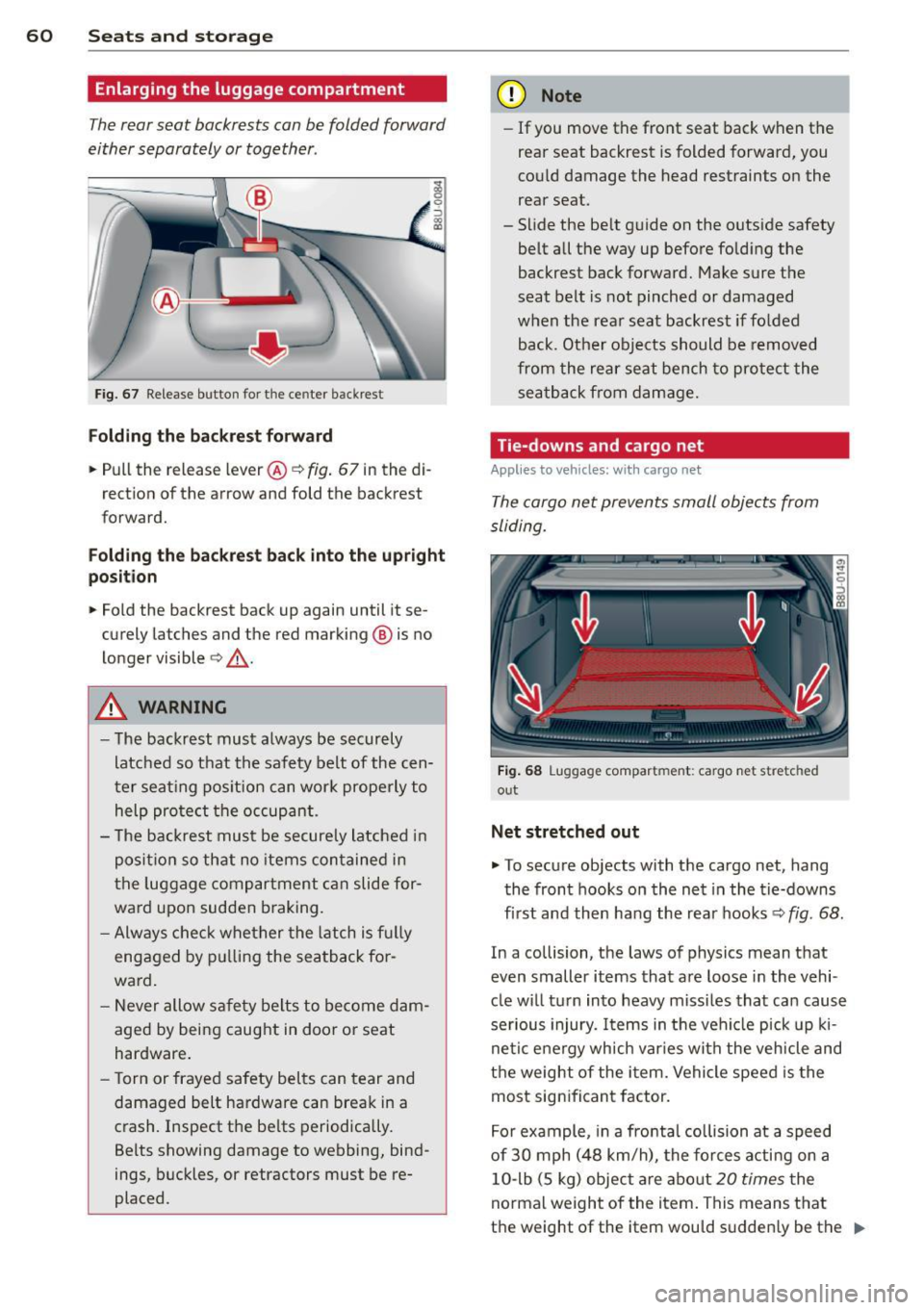
The rear seat backrests can be folded forward
either separately or together .
Fig. 67 Release button for t he ce nter backr est
Folding th e back rest forward
.. Pull the release lever®¢ fig. 67 in the di
rect ion of the arrow and fold the backrest
forward.
Folding th e back rest back into th e upright
position
.. Fold the backrest back up again until it se
curely latches and the red marking @ is no
longer visible ¢
_&..
&_ WARNING
-The backrest must a lways be securely
latched so that the safety belt of the cen
ter seat ing pos ition can wor k properly to
help protect the oc cupant .
- T he backrest must be secure ly latched in
posi tion so that no items contained in
the luggage compar tment can slide for
ward upon sudden braking.
- Alw ays che ck whe ther the l atch is f ully
engaged by p ulling the seatback for
ward .
- Never allow safe ty belts to be come dam
aged by being caught in doo r or seat
hardware.
- T orn or frayed safety belts can tear and
damaged belt hardware can break in a
crash. Inspect the be lts periodically.
Belts showing damage to webbing, bind
ings, buckles, or retractors must be re
placed .
(D Note
-If you move the front seat back when the
rear seat backrest is folded forward, you
cou ld damage the head restraints on the
rear seat.
- Slide the be lt guide on the outside safety
belt all the way up before folding the
backrest back forward. Make sure the
seat belt is not pinched or damaged
when the rear seat backrest if folded
back. Other objects should be removed
from the rear seat bench to protect the sea tback from damage.
Tie-downs and cargo net
Applies to vehicles: with cargo ne t
The cargo net prevents small objects from
sliding.
Fi g. 68 Lu gg ag e compar tment: cargo net s tre tc h ed
o u t
Net stretched out
.. To secure objects with the cargo net, hang
the front hooks on the net in the tie-downs
f ir st and then hang the rear hooks¢
fig. 68 .
In a co llision, the laws of physics mean that
even smaller items that are loose in the vehi
cle w ill turn into heavy miss iles that can cause
serious injury. Items in the vehi cle pick up k i
neti c energy wh ich var ie s with the veh icle and
t h e weight of the item. Vehicle speed is the
most sig nificant factor.
For example, in a fronta l collision at a speed
of 30 mph (48 km/h), the forces a cti ng on a
10-lb (5 kg) object are abo ut
20 times the
normal weight of the item. This means t hat
t h e weight of the item wou ld sudden ly be the
ll-
Page 63 of 258
M N M N
0 ::i co
rl I.O
"' rl
"' rl
equivalent of about 200 lbs (90 kg). One can
easi ly imagine the injuries that an item of that
weight flying free ly through the passenger
compartment can cause in a collision at a
speed considered relatively low.
A WARNING
Weak, damaged or improper straps used
to secure items to t ie-downs can fail dur
ing hard brak ing o r in a collision and cause
ser ious personal injury.
- Always use suitable retaining straps and
properly secure items to the tie-downs in
the luggage compartment to help pre
vent items from shifting or flying for
ward.
- When the rear seat backrest is folded down, always use su itab le retain ing
st raps and proper ly sec ure items to the
tie-downs in the luggage compartment
to help prevent items from flying for
ward into the passenger compartment.
- Never attach a child safety seat tether
strap to a tie-down.
Ski sack
Appl ies to vehicles : wit h pass -t hr oug h and ski -sack
Long objects such as skis or snowboards can
be transported in the ski sack.
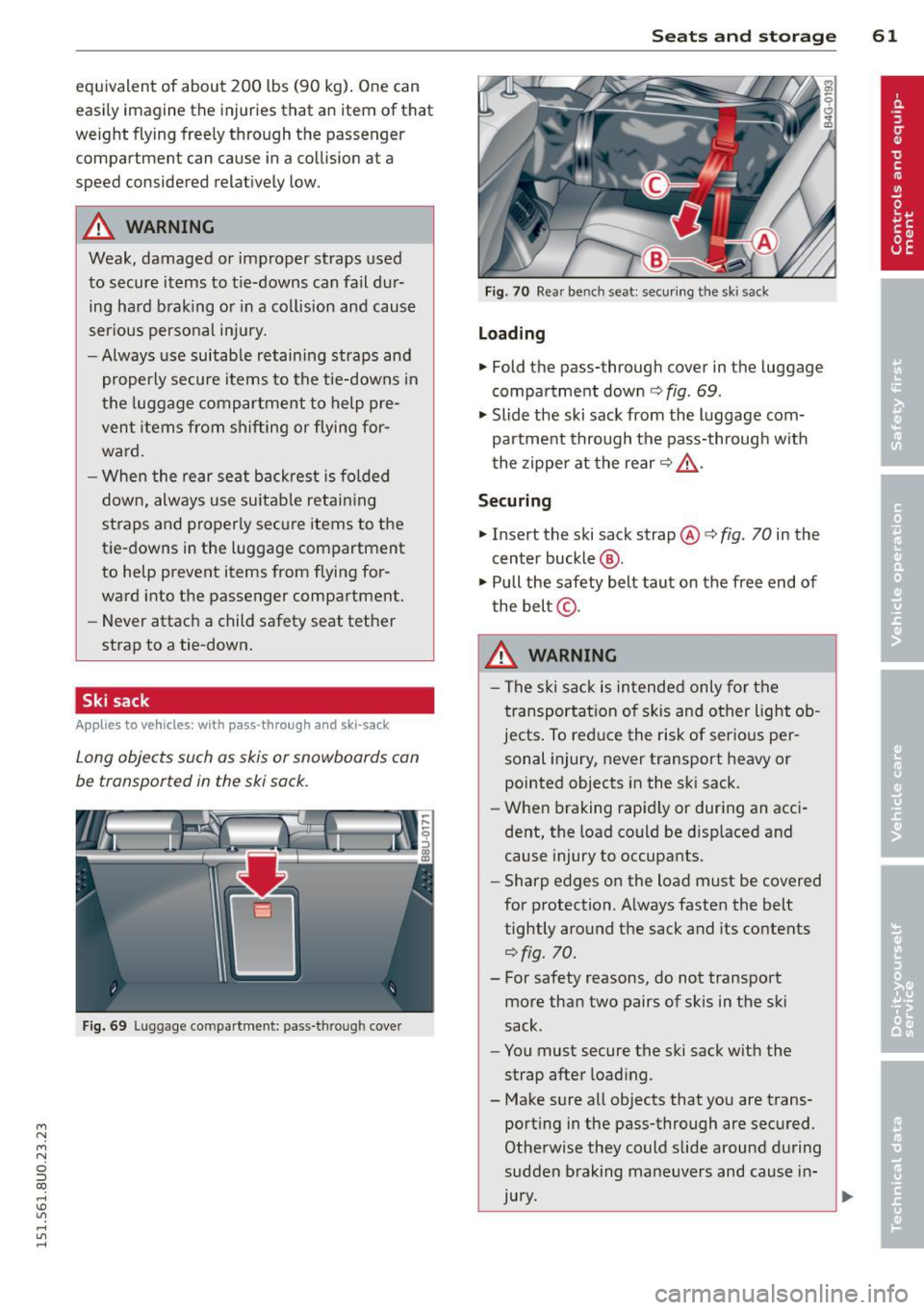
F ig. 69 Luggag .e compartment: pass-t hroug h cover
Sea ts a nd s to rage 61
Fig . 70 Rea r be nch seat : secu ring the ski sack
Lo ading
.. Fold the pass-through cover in the luggage
compartment down
¢ fig . 69 .
.. Slide the ski sack from the luggage com
partment through the pass-through with
the zipper at the rear ¢
,&.
Securing
.. Insert the ski sack strap@¢ fig. 70 in the
center buckle @.
.. Pull the safety belt taut on the free end of
the belt @.
8_ WARNING
-
-The s ki sack is intended only for the
transportat ion of sk is and other light ob
jects . To reduce the risk of serious per
sonal injury, never transport heavy or pointed objects in the sk i sack.
- When braking rapid ly or during an acci
dent, the load could be d isp laced and
cause injury to occupants.
- Sharp edges on the load must be covered
for protection. A lways fasten the belt
tightly around the sack and its contents
¢fig. 70.
- For safety reasons, do not transport
more than two pairs of skis in the ski
sack .
- You must secure the ski sack wit h the
strap after load ing.
- Make sure all objects that you are trans port ing in the pass-through are secured .
Otherwise they could slide around during
sudden braking maneuvers and cause in-
jury .
~
Page 74 of 258
72 On the road
Starting off with a trailer
To prevent rolling back unintentionally on an
incline, do the follow ing:
.. Keep the switch@¢ page 70, fig. 77 pulled
and depress the accele rator. The park ing
brake stays applied and prevents the vehicle
from roll ing bac kward.
"' You can release the switch @ once you are
sure that you a re develop ing enough dr iv ing
f orce at the wheels by dep ress ing the accel
erator.
Depending on the weight of the r ig (veh icle
and tra iler) and the seve rity of the in cli ne, you
may roll backwards as you start . You can pre
vent rolling backwards by holding the parking
brake switch @ pulled out and accelerating -
just as you would when starting on a hill with a conventional hand brake.
Hill hold
Hill hold makes it easier to start on hills.
Requirement : The driver door must be closed
and the engine must be r unning .
The system is act ivated when the brake pedal
i s pressed wh ile the veh icle is sta tionary .
To prevent the vehicle from rolling back when
start ing , the brake power is held for a br ief
moment after re leas ing the b rake peda l. Dur
i ng th is t ime, yo u can easily begin to move
your ve hicle.
A WARNING
- The inte lligent technology of Hill Hold
cannot overcome the lim itations im
posed by natural phys ica l laws. The in
creased comfort offered by Hill Hold
should not cause you to take safety risks.
- Hi ll Hold cannot hold the veh icle in all
hill start situations (for examp le, if the
ground is slippery or icy).
- If you do not begin moving immediately
after releasing the brake pedal, the veh i
cle could begin to roll backward under
certai n circumstances . Press the b rake
-
pedal or set the parking brake immedi
ately .
- If the engine "stalls", press the brake
pedal or set the parking brake immedi
ately .
- Starting on inclines in stop-and-go traf
f ic: To help prevent the vehicle from roll
ing back when start ing, press and ho ld
the brake pedal for several seconds when
the vehicle is stationary.
Emergency braking
In the event tha t the conventional brake sys
tem fails or locks .
.. In an emergency, pu ll the switch @
¢
page 70, fig. 77 and continue to pull it to
slow your vehicle down with the parking
brake .
.. As soon as you release the switch @ or ac-
celerate, the b rak ing process stops.
If you pull the switch @ and hold it above a
speed of about S mph (8 km/h), the emergen
cy brak ing funct io n is initiated . T he veh icle is
braked at all fou r whee ls by activating the hy
draulic b rake system. The brake pe rfo rmance
is sim ila r to m akin g an emergency stop ¢_&. .
In order not to act ivate the eme rgency brak
ing by mistake, an audib le warning tone (buz
zer) sounds whe n the switch @ is pulled. As
soon as t he sw itch @ is re leased, or the acce l
erator pedal is depressed, eme rgency braking
stops.
A WARNING
=
Emergency braking should only be used in
an emergency, when the norma l foot bra ke
has fa iled or the brake pedal is obstructed.
Using the park ing brake to perform emer
gency braking will s low your veh icle down
as if you had made a full brake application .
The laws of phys ics cannot be suspended
even with ESC and i ts associa ted compo
nents (ABS, ASR, EDS). In corners and
when road or weathe r cond itions are bad
,
a full brake application can ca use the
Page 102 of 258
100 Driving Safel y
Stowing luggage
Loading the luggage compartment
All luggage and other objects must be prop
erly stowed and secured in the luggage com
partment.
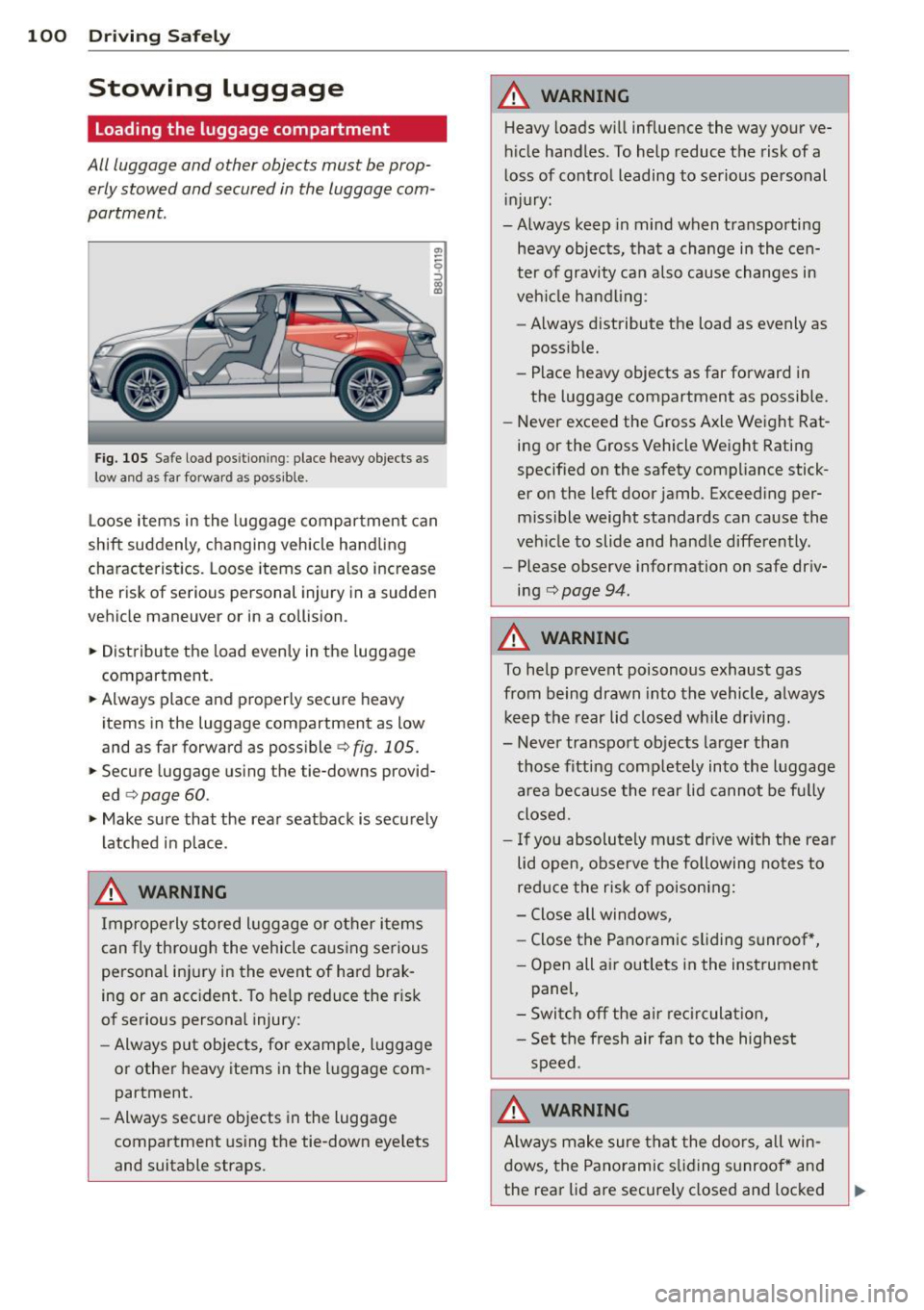
Fig. 105 S afe load pos itio nin g: place heavy objects as
low a nd as far forward as possible .
Loose items in the luggage compartment can
shift suddenly, changing vehicle hand ling
characteristics. Loose items can also increase
the risk of serious personal injury in a sudden
vehicle maneuver or in a collision .
.. Distribute the load evenly in the luggage
compartment .
.. Always place and properly secure heavy
items in the luggage compartment as low
and as far forward as possible
c> fig. 105.
.. Secure luggage using the tie-downs provid
ed
c> page 60.
.. Make sure that the rear seatback is securely
latched in place .
A WARNING
Improperly stored luggage or other items
can fly through the vehicle ca using serious
personal injury in the event of hard brak
ing or an accident. To help reduce the r isk
of serious personal injury:
- Always put objects, for examp le, luggage
or other heavy items in the luggage com
partment.
- Always secure objects in the luggage
compartment using the tie-down eye lets
and suitable straps.
A WARNING
-Heavy loads will influence the way your ve-
hicle handles. To help reduce the risk of a
loss of control leading to serious personal
injury:
-Always keep in mind when transporting
heavy objects, that a change in the cen
ter of gravity can also cause changes in
veh icle handling :
- Always distribute the load as evenly as
possible.
- Place heavy objects as far forward in
the luggage compartment as possible.
- Never exceed the Gross Axle Weight Rat
ing or the Gross Vehicle Weight Rating
specified on the safety compliance stick
er on the left door jamb. Exceeding per
missible weight standards can cause the
veh icle to slide and handle differently.
- Please observe information on safe driv
ing
c> page 94.
A WARNING
-
To help prevent poisonous exhaust gas
from being drawn into the vehicle, a lways
keep the rear lid closed while driving.
- Never transport objects larger than
those fitting comp letely into the luggage
area because the rear lid cannot be fully
closed .
- If you absolutely m ust dr ive with the rear
lid open, observe the following notes to
reduce the risk of poisoning:
- Close all windows,
- Close the Panoramic sliding sunroof *,
- Open all air outlets in the instrument
pane l,
- Switch off the air recirculat ion,
- Set the fresh air fan to the highest
speed.
A WARNING
A lways make sure that the doors, all win
dows, the Panoramic sliding sunroof * and
the rear lid are securely closed and locked
-