tow AUDI Q3 2016 Owner's Guide
[x] Cancel search | Manufacturer: AUDI, Model Year: 2016, Model line: Q3, Model: AUDI Q3 2016Pages: 252, PDF Size: 62.81 MB
Page 225 of 252
Emergency situations
General
This chapter is intended for trained emergency
crews and working personnel who have the nec
essary tools and equipment to perform these
operations.
Starting by pushing or
towing
(D Note
Vehicles with an automatic transmission
cannot be started by pushing or towing.
Starting with jumper
cables
If necessary, the engine can be started by con
necting it to the battery of another vehicle .
If the engine should fail to start because of a dis
charged or weak battery, the battery can be con
nected to the battery of
another vehicle, using a
pair of jumper cables to start the engine.
Jumper cables
Use only jumper cables of sufficiently large cross
section
to carry the starter current safely. Refer
to the manufacturer's specifications.
Use only jumper cables with
insulated terminal
clamps which are distinctly marked :
plus(+) cable in most cases colored red
minus(·) cable
in most cases colored black.
A WARNING
Batteries contain electricity, acid, and gas.
Any of these can cause very serious or fatal in
jury. Follow the instructions below for safe
handling of your vehicle's battery.
-Always shield your eyes and avoid leaning
over the battery whenever possible.
-A discharged battery can freeze at tempera
tures just below 32 °F (0 °C). Before con
necting a jumper cable, you must thaw the
Emergency situations
frozen battery completely, otherwise it
could explode .
- Do not allow battery acid to contact eyes or
skin. Flush any contacted area with water immediately.
- Improper use of a booster battery to start a
vehicle may cause an explosion.
- Vehicle batteries generate explosive gases.
Keep sparks, flame and lighted cigarettes
away from batteries.
- Do not try to jump start any vehicle with a
low acid level in the battery .
- The voltage of the booster battery must also
have a 12-Volt rating. The capacity (Ah) of
the booster battery should not be lower
than that of the discharged battery. Use of
batteries of different voltage or substantial
ly different "Ah" rating may cause an explo
sion and personal injury .
- Never charge a frozen battery. Gas trapped
in the ice may cause an explosion.
- Never charge or use a battery that has been
frozen . The battery case may have be weak
ened .
- Use of batteries of different voltage or sub
stantially different capacity (Ah) rating may
cause an explosion and injury. The capacity
(Ah) of the booster battery should not be
lower than that of the discharged battery.
- Before you check anything in the engine
compartment, always read and heed all
WARNINGS
r::!)page 177.
(D Note
-Applying a higher voltage booster battery
will cause expensive damage to sensitive
electronic components, such as control
units, relays, radio, etc.
- There must be no electrical contact between
the vehicles as otherwise current could al
ready start to flow as soon as the positive
(+) terminals are connected.
(D Tips
- The discharged battery must be properly
connected to the vehicle's electrical system. ..,.
223
Page 227 of 252
.... N
c:i ::J CX)
.... I.Cl U"I
N I.Cl ......
-The battery cell lock ing screws must be
t ightened secure ly.
- Befo re yo u check anything in the en gine
compartment, a lways read and heed a ll
WARNINGS
¢ page 177.
(D Note
Imp ro per hook -u p of jum pe r cables can r uin
the gene rato r.
-Always con nect POSIT NE
(+ ) to POSITI VE
(+ ), and NEGATIVE( -) to NEGATIVE( -)
ground post of the battery manager contro l
u nit .
- Check that all sc rew p lugs on the batter y
ce lls are screwed in firmly . If not, t ighten
pl ugs prior to connecting clamp on negative
batte ry te rminal.
- Please note t hat the procedure fo r con nect
i ng a jumper cab le as desc ribed above ap
p lies specif ica lly to the case of yo ur vehicle
being jump start ed. Wh en you are giv ing a
ju mp sta rt to anothe r vehicle, do
not con
n ec t t he neg ative (-) ca b le to the negative
( -) t ermina l on the disch arged b attery @
¢
fig. 175. In ste ad , secure ly connec t the
negative( -) ca b le to either a solid me tal
com ponent th at is f irm ly bolted to the e n
gine block o r to t he engine block i tsel f. If
the battery that is be ing c ha rged does not
vent to the outs ide, escap ing batte ry ga s
could ignite and exp lode!
Towing with a tow truck
General hints
Your Audi requires s pecial handling for towing .
The following informa tion is to be used by com
mercia l tow tr uck operators who know how to op
e ra te the ir equip men t safely.
- Ne ver tow your Audi, towing will cause dam
age to the engine and transmission .
- Never wrap the safety chains or winch cables
around the brake lines.
- To prevent unnecessary damage, your Audi
must be transported with a flat bed truck .
Emergency situations
-To load the vehicle on to the flat bed , use the
towing loop found in the vehicle tools and at
tach to the front or rear anchorage
¢ page 225 and ¢ page 226.
A WARNING
A veh icle being towed is not safe for passen
ge rs. Neve r allow a nyo ne to ride in a vehicle
b eing towed, for any reason .
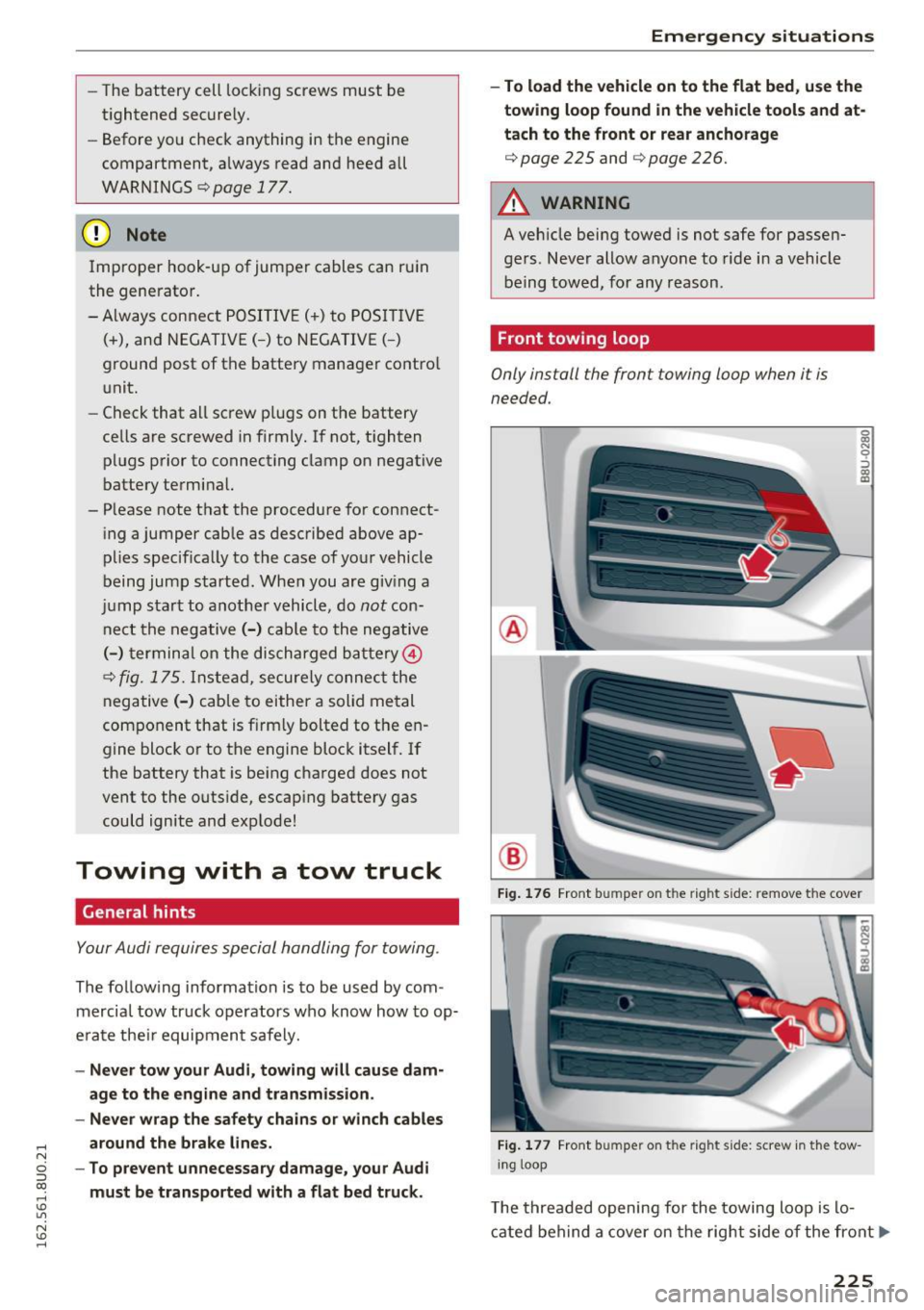
Front towing loop
Only ins tall the front towing loop when i t is
needed .
®
®
-
0 0) N 9 ::>
gi
Fig. 176 Front bum pe r o n th e rig "h t side : remove t he co ver
Fi g. 177 Fron t bum per o n th e right sid e: screw in t he tow
in g loop
The threaded opening for the towing loop i s lo
cate d be hind a cove r on t he rig ht side of the front .,.
225
Page 228 of 252
Emergency situations
bumper. Depending on the version, the cover can
be removed in different ways ¢
fig. 176.
• Version @: Remove the towing loop and the
hook from the veh icle tool kit ¢
page 211. Or
• Version @: Remove the towing loop from the
vehicle tool kit ¢
page 211.
•Version @: Insert the hook into the hole on the
cover and carefully pull off the cover in the di
rection of the arrow ¢
fig. 176. Or
• Ve rsion @: press the cap inward with brief,
forceful pressure
¢fig. 176. The cap w ill loosen
from the bumper.
• Tighten the towing loop in the th readed open
ing until it stops¢
fig. 177 and then tighten it
with a wheel wrench.
• After using, place the towing loop back in the
vehicle tool kit.
A WARNING
If the towing loop is not tightened until it
stops when installing, the threads may be
pulled out when towing the veh icle and that
could cause an accident.
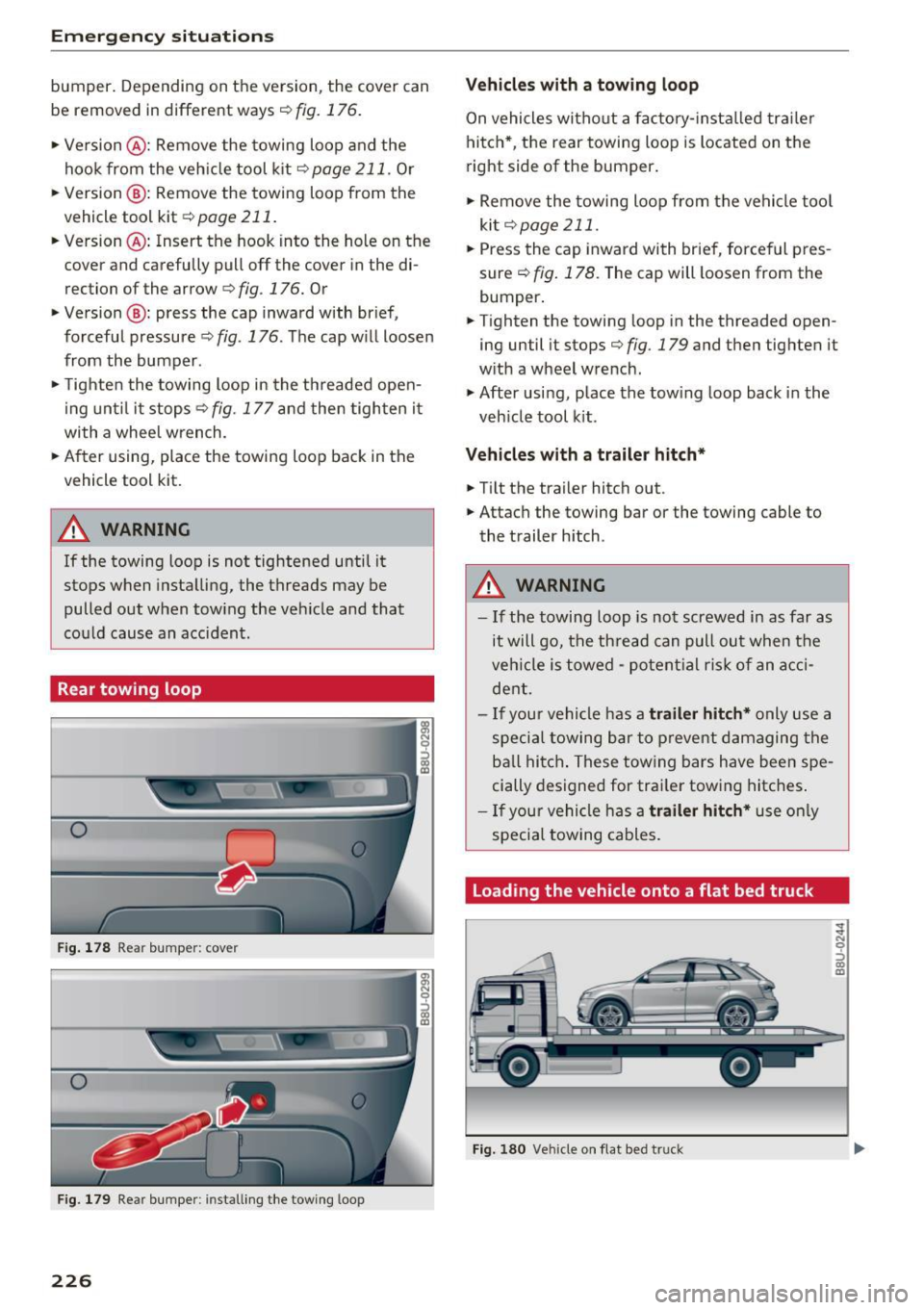
Rear towing loop
Fig. 178 Rear bumper: cover
Fig. 179 Rear bumper: installing the towing loop
226
Vehicles with a towing loop
On vehicles witho ut a factory-installed trailer
hitch*, the rear towing loop is located on the
right side of the bumper .
• Remove the towing loop from the vehicle too l
kit
¢ page 211.
• Press the cap inward with brief, forceful pres
sure¢
fig. 178. The cap will loosen from the
bumper.
• Tighten the towing loop in the threaded open
ing until it stops¢
fig. 179 and then tighten it
w ith a wheel wrench.
• After using, place the tow ing loop back in the
vehicle tool kit.
Vehicles with a trailer hitch*
• Tilt the trailer hitch out.
• Attach the towing bar or the towing cable to
the trailer hitch.
A WARNING
- If the towing loop is not screwed in as far as
it will go, the thread can pull out when the
veh icle is towed - potential risk of an acci
dent.
- If your vehicle has a
trailer hitch* only use a
specia l towing bar to prevent damaging the
ball hitch. These towing bars have been spe
cially designed for trailer towing hitches .
- If your vehicle has a
trailer hitch* use only
special towing cables.
Loading the vehicle onto a flat bed truck
Fig. 180 Vehicle on flat bed truck
~ 0 ::', (IC) m
Page 229 of 252
.... N
c:i ::J CX)
.... I.Cl U"I
N I.Cl ......
Front hook up
• Align the vehicle w ith the centerline of the car
earner ramp .
• Attach the winch hook to the front towline eye
previously installed.
Rear hook up
• Al ign the vehicle w ith the centerline of the car
carr ier ramp .
• Attach the winch hook to the rear towline eye
previously installed.
@ Tips
Check carefully to make sure the hook-up is
secure befo re moving the car up the flatbed
truck ramp.
Raising the vehicle
Lifting with workshop hoist and with floor
jack
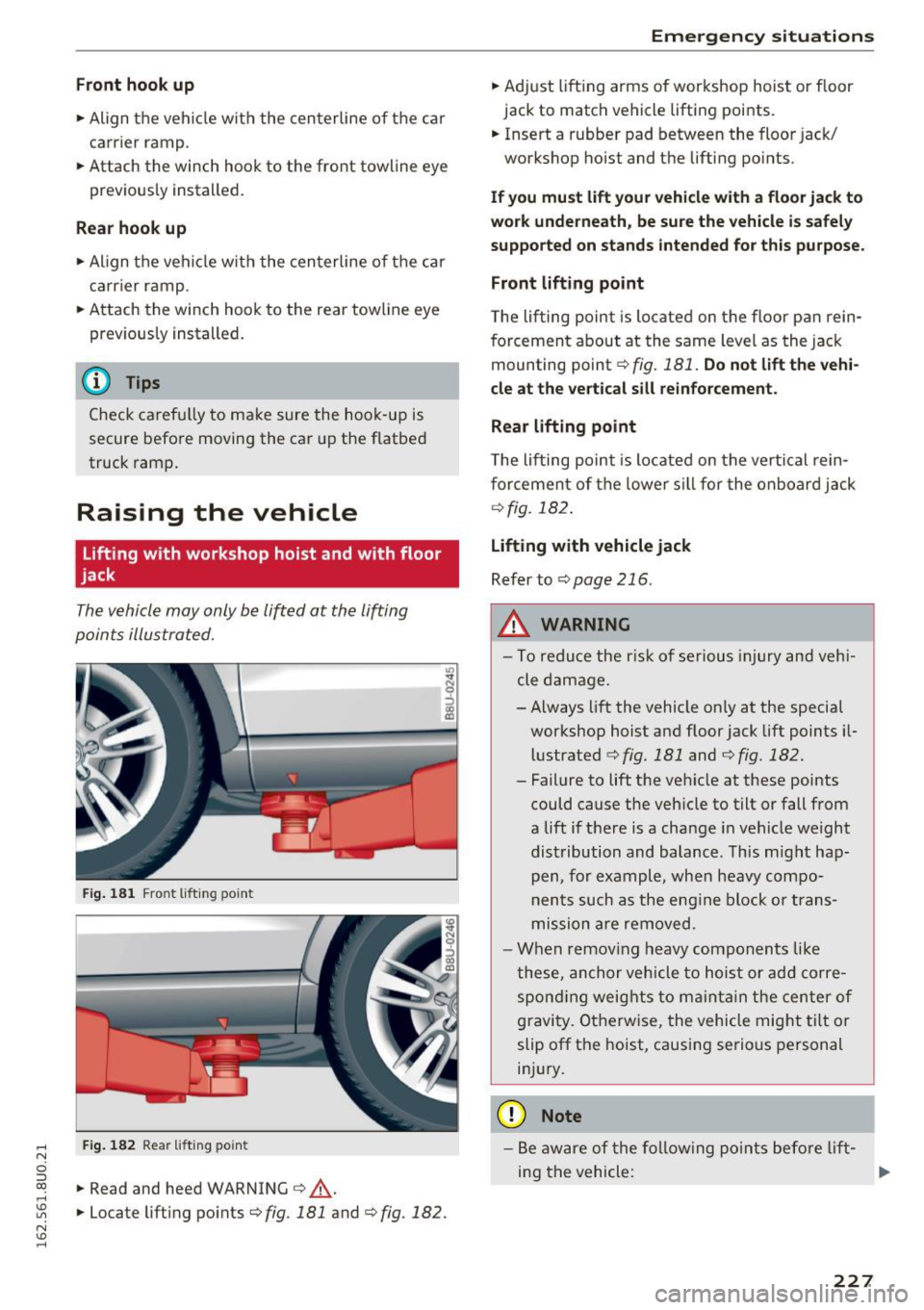
The vehicle may only be lifted at the lifting
points illustrated.
Fig. 181 Front lifting point
F ig . 182 Rear lifting point
• Read and heed WARNING¢,&..
I
• Locate lifting points ¢fig.181 and ¢ fig. 182.
Emergency situations
• Adjust lifting arms of workshop hoist or floor
jack to match vehicle lifting points .
• Insert a rubber pad between the floor jack/
workshop hoist and the lifting points .
If you must lift your vehicle with a floor jack to
work underneath, be sure the vehicle is safely
supported on stands intended for this purpose .
Front lifting point
T he lifting point is located on the floor pan rein
forcement about at the same level as the jack
mounting point ¢
fig. 181. Do not lift the vehi
cle at the vertical sill reinforcement .
Rear lifting point
The lifting point is located on the vertical rein
forcement of the lower sill for the on board jack
¢fig . 182.
Lifting with vehicle jack
Refer to¢ page 216.
&_ WARNING
- To reduce the risk of se rious injury and vehi
cle damage.
- Always lift the vehicle on ly at the special
workshop hoist and floor jack lift points il
lustrated ¢
fig. 181 and ¢ fig. 182.
- Failure to lift the vehicle at these points
could cause the vehicle to tilt or fall from
a lift if there is a change in vehicle weight
distribution and balance . This might hap
pen, for example, when heavy compo
nents such as the engine block or trans
mission are removed.
- When remov ing heavy components like
these, anchor vehicle to hoist or add corre
sponding weights to maintain the center of
gravity. Otherw ise, the vehicle might tilt or
slip off the hoist, causing serious personal
injury .
([) Note
-Be aware of the following points before lift-
ing the vehicle: ..,_
227
Page 234 of 252
Consumer information
Consumer information
Warranty coverages
Your Audi is covered by the following warran
ties:
- New Vehicle Limited Warranty
- Limited Warranty Against Corrosion Perfora-
tion
- Emissions Control System Warranty
- Emissions Performance Warranty
- California Emissions Control Warranty (USA
vehicles only)
- California Emissions Performance Warranty
(USA vehicles only)
Detailed information regarding your warranties
can be found in your
Warranty & Maintenance
booklet .
Operating your vehicle
outside the U.S.A. or
Canada
Government regulati ons in the United States and
Canada require that automobi les meet specific
emission regulations and safety standards.
Therefore, vehicles built for the U.S.A. and Cana
da differ from vehicles sold in other countries.
If you plan to take your vehicle outside the conti
nenta l limits of the United States or Canada,
there is the poss ibility that:
- un leaded fue ls for vehicles with catalytic con
verter may not be available;
- fuel may have a considerably lower octane rat
ing . Improper fuel may cause engine damage;
- service may be inadequate due to lack of proper
service facilities, tools or testing equipment;
- r eplacement parts may not be readily available.
- Nav igation systems for veh icles built for the
U.S .A . and Canada will not necessarily work in
Europe, and may not work in other countries
outside of North America.
232
(D Note
Audi cannot be responsib le for mechanical
damage that could result from inadequate
f u el, service or parts ava ilability.
Audi Service Repair
Manuals and Literature
Audi Official Factory Service Manuals and Litera
ture are published as soon as poss ible after mod
el introd uction . Service Manuals and literature
are available to order from the Audi Technical Lit
erature Ordering Center at :
www.audi.techliterature .com
Maintenance
General '
Your vehicle has been designed to help keep
maintenance requirements to a min imum. How
ever, a certain amount of regular maintenance is
still necessary to assure your vehicle's safety,
economy and reliability . For detailed vehicle
maintena nce consult your Warranty & Mainte
nance booklet .
Under difficult operating conditions, for exam
ple at extremely low outside temperatures, in
very dusty regions, whe n towing a trailer very fre
quently, etc., some service work should be per
formed between the intervals specified. This ap
plies particularly to:
- oil changes, and
- cleaning or replac ing the a ir filter .
'
@) For the sake of the environment
By regularly maintain ing your vehicle, you
help make sure that em iss ion standards are
maintained, thus minimizing adverse effects
on the environment .
Important considerations for you and your
vehicle
The increasing use of electronics, sophisticated
fuel injection and emission control systems, and
the genera lly increas ing technica l complexity of ..,_
Page 248 of 252
Index
Tires. . . . . . . . . . . . . . . . . . . . . . . . . . . . . . . . 191
All wheel drive . . . . . . . . . . . . . . . . . . . . . . 156
Low aspect ratio tires . . . . . . . . . . . . . . . . 207
Replacing . . . . . . . . . . . . . . . . . . . . . . . . . . 213
Service life . . . . . . . . . . . . . . . . . . . . . . . . . 199
Tire pressure . .. ................ 201,210
Tire pressure monitoring system . . . 208, 209
Tire pressure table . . . . . . . . . . . . . . . . . . . 202
Tread wear ind icators . . . . . . . . . . . . . . . . 199
Unid irectional. . . . . . . . . . . . . . . . . . . . . . . 193
Uniform tire quality grading . . . . . . . . . . . 207
T ires and wheels
Glossary of tire and loading terminology . 193
Tires and vehicle load limits . . . . . . . . . . . 203
Tool . . . . . . . . . . . . . . . . . . . . . . . . . . . . . . . . 211
Torn or frayed safety belts . . . . . . . . . . . . . . 106
Towing Tow trucks . . . . . . . . . . . . . . . . . . . . . . . . . 225
Towing loop . . . . . . . . . . . . . . . . . . . . . 225, 226
TPMS (tire pressure monitoring system) . . . 209
Trailer mode . . . . . . . . . . . . . . . . . . . . . . . . . 164
Notes . . . . . . . . . . . . . . . . . . . . . . . . . . . . . 166
Trailer towing
Operating in structions . . . . . . . . . . . . . . . . 165
Parking system . . . . . . . . . . . . . . . . . . . . . . . 94
Technical requirements . . . . . . . . . . . 164, 165
Tongue load . . . . . . . . . . . . . . . . . . . . . . . . 165
Trailer turn signal assembly Warning/indicator lights . . . . . . . . . . . . . . . 19
Transmission malfunction (indicator light) . . 86
Transport Canada . . . . . . . . . . . . . . . . . . . . . 103
Trunk
refer to Luggage compartment . . . . . . . . . . 58
Turn signa ls . . . . . . . . . . . . . . . . . . . . . . . . . . 40
Warning/indicator lights . . . . . . . . . . . . . . . 19
u
Unfasten ing safety belts
Uniform tire quality grading
Unlocking/locking 109
207
by remote control . . . . . . . . . . . . . . . . . . . . 29
On the door lock . . . . . . . . . . . . . . . . . . . . . . 32
with the central locking switch . . . . . . . . . . 31
with the convenience key . . . . . . . . . . . . . . . 30
With the door lock . . . . . . . . . . . . . . . . . . . . 32
Use of jumper cables . . . . . . . . . . . . . . . . . . 224
246
V
Vanity mirror . . . . . . . . . . . . . . . . . . . . . . . . . . 44
Vehicle Care/cleaning . . . . . . . . . . . . . . . . . . . . . . . 168
Vehicle control modules . . . . . . . . . . . . . . . . 150
Vehicle electr ica l system . . . . . . . . . . . . . . . . 15
Vehicle identification label . . . . . . . . . . . . . 229
Vehicle Identification Number (VIN) . . . . . . 229
Vehicle jack ..... .. .. .. ... ........ 211,216
Vehicle shut-down . . . . . . . . . . . . . . . . . . . . 160
Vehicle tool kit . . . . . . . . . . . . . . . . . . . . . . . 211
w
Warning/indicator lights
Airbag system . . . . . . . . . . . . . . . . . . . . . . . 16
Brake system . . . . . . . . . . . . . . . . . . . . . . . . 13
Electromechanical parking brake . . . . . . . . 14
Electronic power control . . . . . . . . . . . . . . . 17
Electronic Stabilization Control (ESC) . . . . . 16
Generator . . . . . . . . . . . . . . . . . . . . . . . . . . . 15
Malfunction Indicator Lamp (MIL) . . . . . . . 17
Safety belt . . . . . . . . . . . . . . . . . . . . . . . . . . 15
Safety systems . . . . . . . . . . . . . . . . . . . . . . . 16
Trailer turn signal assembly . . . . . . . . . . . . 19
Turn signals . . . . . . . . . . . . . . . . . . . . . . . . . 19
Warning lights
refer to Indicator lights . . . . . . . . . . . . . . . . 11
Warranty coverages . . . . . . . . . . . . . . . . . . . 232
Washing matte finish paint . . . . . . . . . . . . . 168
Weights . . . . . . . . . . . . . . . . . . . . . . . . . . . . . 229
What happens if you wear your safety belt too loose? . . . . . . . . . . . . . . . . . . . . . . . . . . . . . . 108
What happens to unbelted occupants? . . . . 105
What impairs driving safety? . . . . . . . . . . . . . 96
Wheel bolt caps Removing . . . . . . . . . . . . . . . . . . . . . . . . . . 215
Wheel bolts . . . . . . . . . . . . . . . . . . . . . . . . . 205
Loosening . .. .. .. .. .. ............. .. 215
Tightening ...... .. .. .. ........... .. 215
Wheel covers, removing . . . . . . . . . . . . . . . . 215
Wheels . . . . . . . . . . . . . . . . . . . . . . . . . . . . . 191
Cleaning . . . . . . . . . . . . . . . . . . . . . . . . . . . 169
Glossary of tire and loading terminology . 193
Replacing . . . . . . . . . . . . . . . . . . . . . . . . . . 213
Tires and vehicle load limits . . . . . . . . . . . 203