sport mode AUDI Q3 2018 Owners Manual
[x] Cancel search | Manufacturer: AUDI, Model Year: 2018, Model line: Q3, Model: AUDI Q3 2018Pages: 230, PDF Size: 57.03 MB
Page 68 of 230
Driving
the vehicle and maintains a constant speed as a
result
r=> page 91 .
However, your Audi i s no t an offroad vehi cle.
Only dri ve in terrain th at i s s uit a ble for th e vehi
cle and your dri ving abilit y. Ne ver tak e an y un
ne ce ss ary risks!
After driving offroad
- After dr iving offroad, remove branches and
other debr is from the radiator gr ille, unde r
body, and whee ls. Look espec ially for foreign
objects (such as stones) that may be stuck in
the tire tread.
- Clean the vehicle body and underbody and in
spect the vehicle for possib le damage.
- Clean the windows, headlights, tail lig hts and
the license plate if they are dirty.
- Perfo rm a brake test (especially after dr iv ing
through water).
A WARNING
- Be especia lly aware and attent ive when driv
ing under difficult conditions. Vehicle dam
age and injuries may occur when driv ing at
excessively high speeds or with incorrect
dr iv ing maneuvers .
- Always adjust your speed and driving style
to the roads, terra in , traffic and weather
condit ions. Drive espec ially slowly if there is
low v is ibility when offroad .
- Please note that the wheels can spin more
and the vehicle can swerve when i n ESC off
road mode, especially when the road is slip
pery or has loose surface mate rial.
- Driving stability is reduced in the ESC Off
road mode .
@ For the sake of the environment
Avoid harming the environment and show
consideration for nature.
(D Tips
On ly dr ive where it is a llowed and always stay
on the provided roads and paths.
66
Driving information
Applies to: vehicles with offroad mode
T here is only one right way to drive in difficult
conditions: slo wly and with caution!
Observe the following when driving on unpaved
roads :
.,. On ly driv e in terrain that is suitable for the ve
hicle and your driving ability. Never take any
unnecessary risks!
.,. Dr ive slowly and caut iously!
.,. Pay attent ion to the
g round cl earan ce of your
veh icle . The clearance may va ry depending on
the load, ground compos ition and the environ
ment. The g round clearance is reduced for spe
cial suspension systems, such as sport s uspen
sion. The dr iver is therefore responsible for de
ciding whether a vehicle can handle a specif ic
situation .
.,. Activate the
ESC offroad mode as needed
r=>page90 .
.,. Use the hill de sce nt ass ist when driving down
steep hills
r=> page 91 .
Difficult terrain
When driving in unfamiliar areas and offroad,
drive slowly and keep on the watch for unexpect
ed obstacles (such as potholes, rocks, tree
stumps , etc .) .
T o prevent th e vehicl e from bottoming out and to
reduce the risk of underbody damage, you should
drive across uneven ground on only one side of
the veh icle so that only two of your wheels cross
the uneven area, instead of driving across the cente r of the uneven area with all four wheels .
Drive quickly through sandy or marshy off-ro ad
sections and do not stop, if at all possible.
Driving through wat er on road s
Also read the information found in r=> page 57.
Automatic transmission
Introduction
The automatic transmission is controlled elec
troni cally. Upshifting a nd downshifting o ccu r au -
tomat ically . ..,.
Page 69 of 230
a
co
...... N r--. N .-< 0 0 ::, co
When a moderate driving s tyle is used, the
transmission selects the most economical driving
mode. The transm iss ion upsh ifts at a lower RPM
and downshifts at a higher RPM to improve fuel
efficiency .
The transmission switches to a sporty mode after a kick-down or when the driver uses a
spo rt y
dri ving st yle
character iz ed by quick accelerator
pedal movements, heavy acceleration, frequent
changes in speed and traveling at the maximum
speed .
If desired , the driver can also select the gears
manually (tip tronic mode ) ¢ page 70, Manual
shifting (tiptronic mode) .
Power is transferred using a torque converter.
Selector lever positions
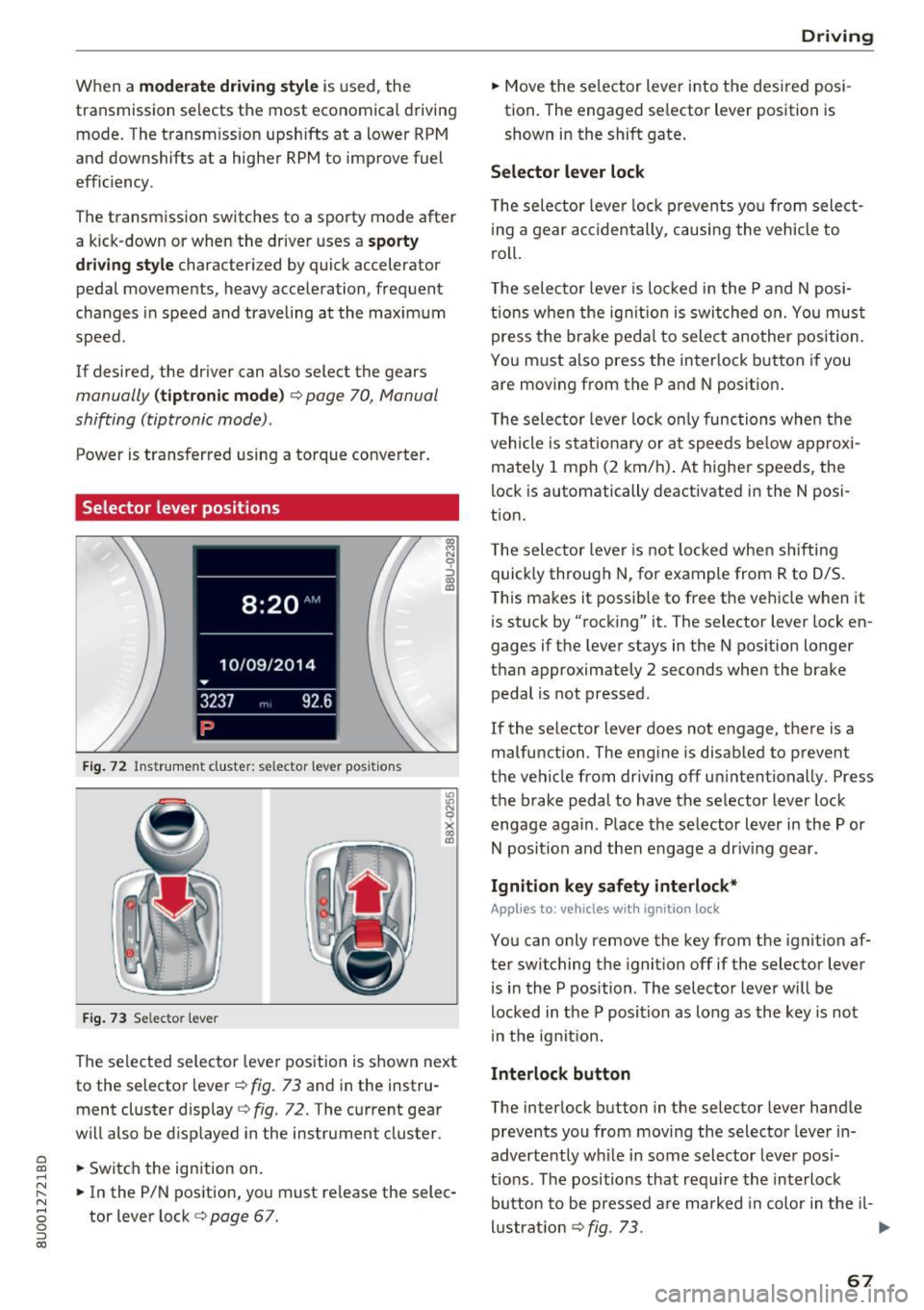
Fig. 72 Inst rument cluste r: selector leve r pos it ions
F ig. 7 3 Selec tor lever
The selected selector lever position is shown next
to the selector lever ¢
fig. 73 and in the instru
ment cluster display
¢ fig . 72. The current gear
will also be d isp layed in the instrument cluster.
.. Switch the ign ition on.
.. In the P/N position, you must release the selec
tor lever lock ¢
page 67.
Drivi ng
.. Move the selector lever into t he des ired posi
tion. The engaged se lector lever position is
shown in the shift gate .
Selector lever lock
The selec tor leve r lock p revents yo u from select
i ng a gear accidentally, causing the vehicle to
roll.
T he selector leve r is lo cked in the P and N posi
ti ons when the ig nit ion is switched on. You mus t
press the brake peda l to sele ct another position.
You must also press the interlock button if you are moving from the P and N position.
T he selec tor leve r lock o nly functions when the
vehicle is stat ionary or at speeds be low approxi
mately 1 mph (2 km/h) . At higher speeds, the
lock is automatically deactivated in the N posi
tion.
T he selec tor leve r is not locked whe n shifting
quick ly through N, for example from R to 0/S.
This makes it possib le to free the vehicle when it
is stuck by "rocking" it. The selector lever lock en
gages if the lever stays in the N pos ition longer
than approximately 2 seconds when the brake peda l is not pressed .
If the selector lever does not engage, there is a
malfunction . The engine is disabled to prevent
the vehicle from driv ing off un intent ionally. Press
the brake pedal to have the se lector lever lock
engage again . Place the selector lever in the P or
N position and then engage a dr iv ing gear.
Ignition key safety interlock*
Applies to: vehicles with ignition lock
You can only remove the key from the ignition af
ter switching the ignition off if the selector lever
is in the P position . The selector leve r will be
locked in the P position as long as the key is not
in the ignit ion.
Interlock button
The interlock button in the selector lever handle
prevents you from movi ng the selector lever in
advertently wh ile in some selector lever posi
tio ns. The positions that requ ire the interlock
button to be pressed a re marked in color in the il-
l u strat io n ¢
fig. 73. .,.
67
Page 70 of 230
Driving
P - Park
This selector lever position prevents the vehicle
from rolling. You can only shift into Park when
the vehicl e is
stationary ¢&. .
To shift in and out of the P selector lever posi
tion, press the interlock button in the selector
lever
while pressing the brake pedal.
R- Reverse
Only shift into reverse gear when the vehicle is
stationary and the engine is running at idle
speed ¢&, .
To select the R selector lever position, press the
interlock button
while pressing the brake pedal.
N - Neutral
The transmission is in idle in this position.
To engage the N selector lever position, press the
button on the selector lever and shift into the N
position.
To
move from selector lever position out of N,
you must press the brake pedal and the vehicle
must be traveling less than 1 mph (2 km/h) or be
stationary.
DIS -Normal position for driving forward
In the D/S selector lever position, the transmis
sion can be operated either in the normal D mode
or in the S sport mode. To select the S sport
mode, pull the selector lever back briefly. Pulling
the lever back again will select the normal D
mode. The instrument cluster display shows the
selected driving mode .
In the
normal mode D, the transmission auto
matically selects the suitable gear ratio. It de
pends on engine load, vehicle speed and driving
style.
The engine's power reserves are used fully in the
Sport mode S. Shifting may become noticeable
when accelerating.
To
move from selector lever position N to D, you
must press the brake pedal and the vehicle must
be traveling less than 1 mph (2 km/h) o r be sta
t ionary ¢&, .
68
A WARNING
-
Read and follow all WARNINGS.
-The vehicle can roll
even if the ignition is
switched off.
- Never select R or P while driving, because
this increases the risk of an accident.
- Power is still transmitted to the wheels
when the engine is running at idle. To pre
vent the vehicle from "creeping", you must keep your foot on the brake in all selector
lever positions (except P) when the engine is
running .
- Do not inadvertently press the accelerator
pedal when the vehicle is stopped if a gear is
engaged . Otherwise, the vehicle will imme
diately start to
move -sometimes even if
the parking brake is firmly applied. This in
creases the risk of an accident.
- To reduce the risk of an accident, do not
press the accelerator pedal when changing
the selector lever position while the vehicle
is stationary and the engine is running.
- Never leave your vehicle with the engine
running while in gear. If you must leave
your vehicle when the engine is running, set
the parking brake and move the selector lev
er to the P position.
- Before you or other persons open the hood
and work on a running engine, the selector
lever must be in the P position and the park ing brake must be applied to reduce the risk
of an accident . Always read and follow the
applicable warnings ¢
page 155, Working
in the engine compartment.
- Read and following all WARNINGS¢&. in
Driving tips on page 69 .
(D Note
Never let the vehicle roll downhill with engine
off and the selector lever in the N position,
because this could damage the automatic
transmission and catalytic converter.
(D Tips
- If you accidentally select N while driving,
take your foot off the accelerator pedal and .,.
Page 83 of 230

a
co
...... N r---. N .-< 0 0 ::, co
Auto and Dynamic, using the r:l.l'e'i button in the
center console or by using the Infotainment sys
tem . This allows you to switch between a sporty
and a comfortable driving mode, for examp le.
Description
Applies to: vehicles with Audi drive select
The following systems, among other things, are
influenced by drive select:
Engine and automatic transmission
Depending on the mode, the engine and auto
matic transmission respond more quickly or in a
more balanced manner to accelerator pedal
movements. In the sporty dynamic mode, the
transmission shifts at higher speed ranges .
Suspension control*
The suspension control uses sensors to record in
formation regarding steering movements, brak ing and accelerat ion operations by the driver, as
well as information about the road surface, dr iv
ing speed, and load. With dr ive select, you can
adjust the suspension control to sporty (dynam ic), comfortable (comfort) or balanced (a uto).
Steering
The steering adapts in terms of steering assis
tance . Indirect steering that moves easily as in
comfort mode is especially su ited to long dr ives
on a highway. In contrast, dynamic mode pro
vides sporty, direct steering.
Cornering light*
The cornering light adapts to driving on curves.
The pivot ing action and the lighting also adapt to
the mode.
(D Tips
The S selector lever position automatically en
gages if the dynamic mode is selected.
Assistance systems
Selecting the driving mode
Applies to: vehicles with Audi drive select
Fig. 84 Center console : dr ive select button
.,. To set the mode, press the ~:1;:e'i button repeat
edly until the desired mode is d isplayed in the
instrument cluster. Or
.,. Select in the Infotainment system: ICARlfunc-
tion button
> Comfort , Auto or Dynamic .
You can change the driving mode when the vehi
cle is stationary or while driving . If traff ic per
mits, after changing modes, briefly take your
foot off the accelerator pedal so that the recently
selected mode is also activated for the engine.
Comfort -provides a comfort-or iented vehicle
setup and is suited fo r long drives on h ighways.
Automatic -provides an overall comfortable yet
dynamic driving feel and is suited for everyday
u se.
Dynam ic -gives the driver a sporty driving fee l
and is suited to a sporty driving style.
A WARNING
Pay attention to traffic when operating the
drive select to reduce the ris k of an accident.
81
Page 129 of 230
0 co ......
"' ,....
"' ...... 0 0 :::,
00
OFF light comes on and stays on all the time
whenever the ignition is switched on.
A WARNING
- If the PASSENGER AIR BAG OFF light does
not go out when an adult is sitting on the
front passenger seat after taking the steps described above, make sure the adult is
properly seated and restrained at one of the
rear seating positions .
- Have the airbag system inspected by your
authorized Audi dealer before transporting
anyone on the front passenger seat.
{D) Tips
If the weight -sensing mat in the front passen
ger seat detects an empty seat, the front air
bag on the passenger side will be turned off,
and
PASSENGER AIR BAG OFF will stay on.
Repair, care and disposal of the airbags
Parts of the airbag system are installed at many
different places on your Audi. Installing, remov
ing, servicing or repairing a part in an area of th e
vehicle can damage a part of an airbag system and prevent that system from working properly in a collision .
There are some important things you have to know to make sure that the effectiveness of the
system will not be impaired and that discarded
components do not cause injury or pollute the
environment.
A WARNING
Improper care, servicing and repair proce
dures can increase the risk of personal injury
and death by preventing an airbag from de
ploying when needed or deploying an airbag
unexpectedly:
-
- Never cover, obstruct, or change the steer
ing wheel horn pad or airbag cover or the in
strument panel or modify them in any way.
- Never attach any objects such as cupholders
or telephone mountings to the surfaces cov
ering the airbag units.
Airbag system
-For cleaning the horn pad or instrument
panel, use only a soft, dry cloth or one mois
tened with plain water . Solvents or cleaners
could damage the airbag cover or change
the stiffness or strength of the material so
that the airbag cannot deploy and protect
properly.
- Never repair, adjust, or change any parts of
the airbag system.
-All work on the steering wheel, instrument panel, front seats or electrical system (in
cluding the installation of audio equipment,
cellular telephones and CB radios, etc.) must be performed by a qualified technician
who has the training and special equipment
necessary.
- For any work on the airbag system, we
strongly recommend that you see your au
thorized Audi dealer or qualified workshop.
- Never modify the front bumper or parts of the vehicle body.
- Always make sure that the side airbag can
inflate without interference:
- Never install seat covers or replacement
upholstery over the front seatbacks that
have not been specifically approved by
Audi .
- Never use additional seat cushions that
cover the areas where the side airbags in
flate.
- Damage to the original seat covers or to
the seam in the area of the side airbag
module must always be repaired immedi
ately by an authorized Audi dealer.
- The airbag system can be activated only
once. After an airbag has inflated, it must
be replaced by an authorized Audi dealer or
qualified technician who has the technical
information, training and special equipment
necessary.
- The airbag system can be deployed only
once. After an airbag has been deployed, it
must be replaced with new replacement
parts designed and approved especially for
your Audi model version. Replacement of complete airbag systems or airbag compo
nents must be performed by qualified work-
shops only. Make sure that any airbag
Ill-
127
Page 139 of 230
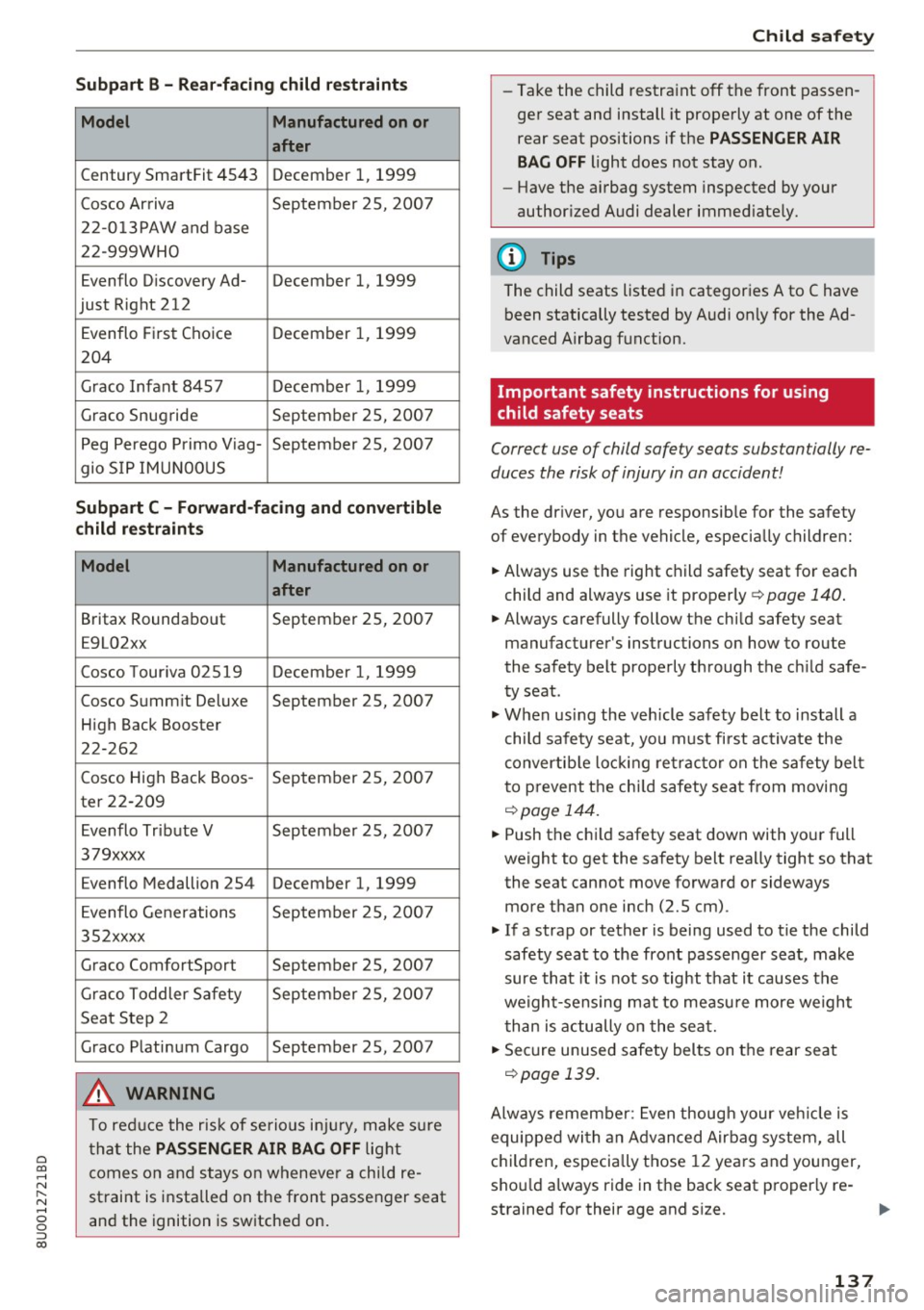
0 co ......
"' ,....
"' ...... 0 0 :::,
00
Subpart B - Rear-facing child restraints
Model Manufactured on or
after
Century SmartFit 4543 December 1, 1999
Cosco Arriva September 25, 2007
22-013PAW and base
22-999WHO
Evenflo Discovery Ad- December 1, 1999
just Right 212
Evenflo First Choice December 1, 1999
204
Graco Infant 8457 December 1, 1999
Grace Snug ride September 25, 2007
Peg Perego Primo Viag- September 25, 2007
gio S IP IMUNOOUS
Subpart C -Forward-facing and convertible
child restraints
Model Manufactured on or
after
Britax Roundabout September 25, 2007
E9L02xx
Cosco Tour iva 02519 December 1, 1999
Cosco Summit Deluxe September 25, 2007
High Back Booster
22-262
Cosco High Back Boos-
September 25, 200 7
ter 22-209
Evenflo Tribute V September 25, 2007
379xxxx
Evenflo Medallion 2S4 December 1, 1999
Evenflo Generations September 25, 2007
352xxxx
Grace ComfortSport September 25, 2007
Grace Toddler Safety September 25, 2007
Seat Step 2
Grace Platinum Cargo September 25, 2007
A WARNING
To reduce the risk of serious injury, make sure
that the
PASSENGER AIR BAG OFF light
comes on and stays on whenever a child re
straint is installed on the front passenger seat
and the ignition is switched on.
Child safety
- Take the child restraint off the front passen
ger seat and install it properly at one of the
rear seat positions if the
PASSENGER AIR
BAG OFF
light does not stay on.
- Have the airbag system inspected by your
authorized Audi dealer immed iately.
(D Tips
The child seats listed in categor ies A to C have
been statically tested by Audi only for the Ad
vanced Airbag function.
Important safety instructions for using
child safety seats
Correct use of child safety seats substantially re
duces the risk of injury in an accident!
As the driver, you are responsible for the safety
of everybody in the vehicle, especially children:
.,. Always use the right child safety seat for each
child and always use it properly ¢
page 140 .
.,. Always carefully follow the chi ld safety seat
manufacturer's instructions on how to route
the safety belt properly through the child safe ty seat.
.,. When using the vehicle safety belt to install a
child safety seat, you must first activate the
convertible locking r etractor on the safety belt
to prevent the chi ld safety seat from moving
~page 144.
.,. Push the chi ld safety seat down with yo ur full
weight to get the safety belt really tight so that the seat cannot move forward or sideways more than one inch (2.5 cm).
.,. If a strap or tether is being used to tie the child
safety seat to the front passenger seat, make
sure that it is not so tight that it causes the
weight-sensing mat to measu re more weight
than is actually on the seat.
.,. Secure unused safety belts on the rear seat
~page 139.
Always remember: Even though your veh icle is
equipped with an Advanced Airbag system, all
children, especia lly those 12 years and younger,
shou ld a lways ride in the back seat proper ly re-
strained for their age and s ize.
liJJ..
137
Page 226 of 230

Index
Sunroof
refer to Panorama glass roof . . . . . . . . . . . 31
Sunshade
Emergency closing (panorama glass roof) .
32
Sun visors . . . . . . . . . . . . . . . . . . . . . . . . . . . . 3 7
Symbols
refer to Indicator lights . . . . . . . . . . . . . . . . 10
T
Tachometer. . . . . . . . . . . . . . . . . . . . . . . . . . 8, 9
Technical data . . . . . . . . . . . . . . . . . . . . . . . . 209
Technical modifications . . . . . . . . . . . . . . . . 215
Temp erature display
Outside temper ature . . . . . . . . . . . . . . . . . . . 9
Temperature indicator Coolant . . . . . . . . . . . . . . . . . . . . . . . . . . . . . .
8
Temporary spare tire . . . . . . . . . . . . . . . . . . 197
Tether anchors . . . . . . . . . . . . . . . . . . . . . . . 149
Tether strap . . . . . . . . . . . . . . . . . . . . . . . . . 149
Tie-down rings . . . . . . . . . . . . . . . . . . . . . . . 103
Tie -downs . . . . . . . . . . . . . . . . . . . . . . . . . . . . 47
Time . .... .. .. .. ............. .... .. ... 9
tiptronic mode (automat ic transmission) . . . 70
tiptronic (automatic transmission) . . . . . . . . 66
Tires................................ 166
All
wheel drive . . . . . . . . . . . . . . . . . . . . . . . 93
Low-profile tires . . . . . . . . . . . . . . . . . . . . . 182
Replacing . . . . . . . . . . . . . . . . . . . . . . . . . . 191
Service life . . . . . . . . . . . . . . . . . . . . . . . . . 17 5
Tire pressure . . . . . . . . . . . . . . . . . . . . . . . 176
Tir e pressure monitoring system . . . . . . . 183
Tire pressure table . . . . . . . . . . . . . . . . . . . 177
Tire pressure (trailer towing) . . . . . . . . . . . 73
Treadwear indicators . . . . . . . . . . . . . . . . .
175
Unidirectional . . . . . . . . . . . . . . . . . . . . . . . 168
Uniform tire quality grading . . . . . . . . . . . 182
Tires and wheels
Glossary of tire and loading terminology .
169
Tires and vehicle load limits . . . . . . . . . . . 17 8
Tool . . . . . . . . . . . . . . . . . . . . . . . . . . . . . . . . 19 1
Torn or frayed safety belts . . . . . . . . . . . . . . 108
Towing
Tow trucks . . . . . . . . . . . . . . . . . . . . . . . . .
205
Towing loop . . . . . . . . . . . . . . . . . . . . . 205, 206
TPMS (Tire Press ure Monitoring System) . . 183
224
Trailer towing . . . . . . . . . . . . . . . . . . . . . . . . . 73
Parking systems . . . . . . . . . . . . . . . . . . . . . .
88
Trailer load . . . . . . . . . . . . . . . . . . . . . . . . . . 73
Turn signals . . . . . . . . . . . . . . . . . . . . . . . . .
16
Transport Canada . . . . . . . . . . . . . . . . . . . . . 104
Turn signal . . . . . . . . . . . . . . . . . . . . . . . . . . . 34
u
Unfastening safety belts
Uniform tire quality grading
Unlocking/ locking 111
182
By remote control . . . . . . . . . . . . . . . . . . . . 24
With the central locking sw itch . . . . . . . . . 25
With the convenience key . . . . . . . . . . . . . . 24
Use of jumper cables . . . . . . . . . . . . . . . . . . 204
V
Vanity mirror.... .. .. .. ............. ... 37
Vehicle Care/cleaning . . . . . . . . . . . . . . . . . . . . . . .
185
D .
. 1mens1ons ...... .. .. .............. .
Out of service .. .. .. .. .. ........... . .
Specifications ..................... . . 210
190
209
Vehicle battery . . . . . . . . . . . . . . . . . . . . . . . 163
Charge leve l . . . . . . . . . . . . . . . . . . . . . . . . . 94
Charging . . . . . . . . . . . . . . . . . . . . . . . . 13, 164
Energy management . . . . . . . . . . . . . . . . . . 94
Vehicle control modules . . . . . . . . . . . . . . . . . 95
Vehicle jack . ... ... .. .. ... ..... ... 191,194
Vehicle key . . . . . . . . . . . . . . . . . . . . . . . . . . . 23
Vehicle tool kit . . . . . . . . . . . . . . . . . . . . . . . 191
VIN . . . . . . . . . . . . . . . . . . . . . . . . . . . . . . . . 209
w
Warning lights
refer to Indicator lights . . . . . . . . . . . . . . . . 10
Warranty coverages . . . . . . . . . . . . . . . . . . . 212
Washing matte finish paint . . . . . . . . . . . . . 185
Weights . . . . . . . . . . . . . . . . . . . . . . . . . . . . . 209
What happens if you wear your safety belt too
loose? . . . . . . . . . . . . . . . . . . . . . . . . . . . . . .
110
What happens to unbelted occupants? . . . . 107
What impairs driving safety? . . . . . . . . . . . . . 97
Wheel bolt caps
Removing . . . . . . . . . . . . . . . . . . . . . . . . . .
193