weight AUDI Q5 2016 Owner's Guide
[x] Cancel search | Manufacturer: AUDI, Model Year: 2016, Model line: Q5, Model: AUDI Q5 2016Pages: 300, PDF Size: 75.02 MB
Page 189 of 300
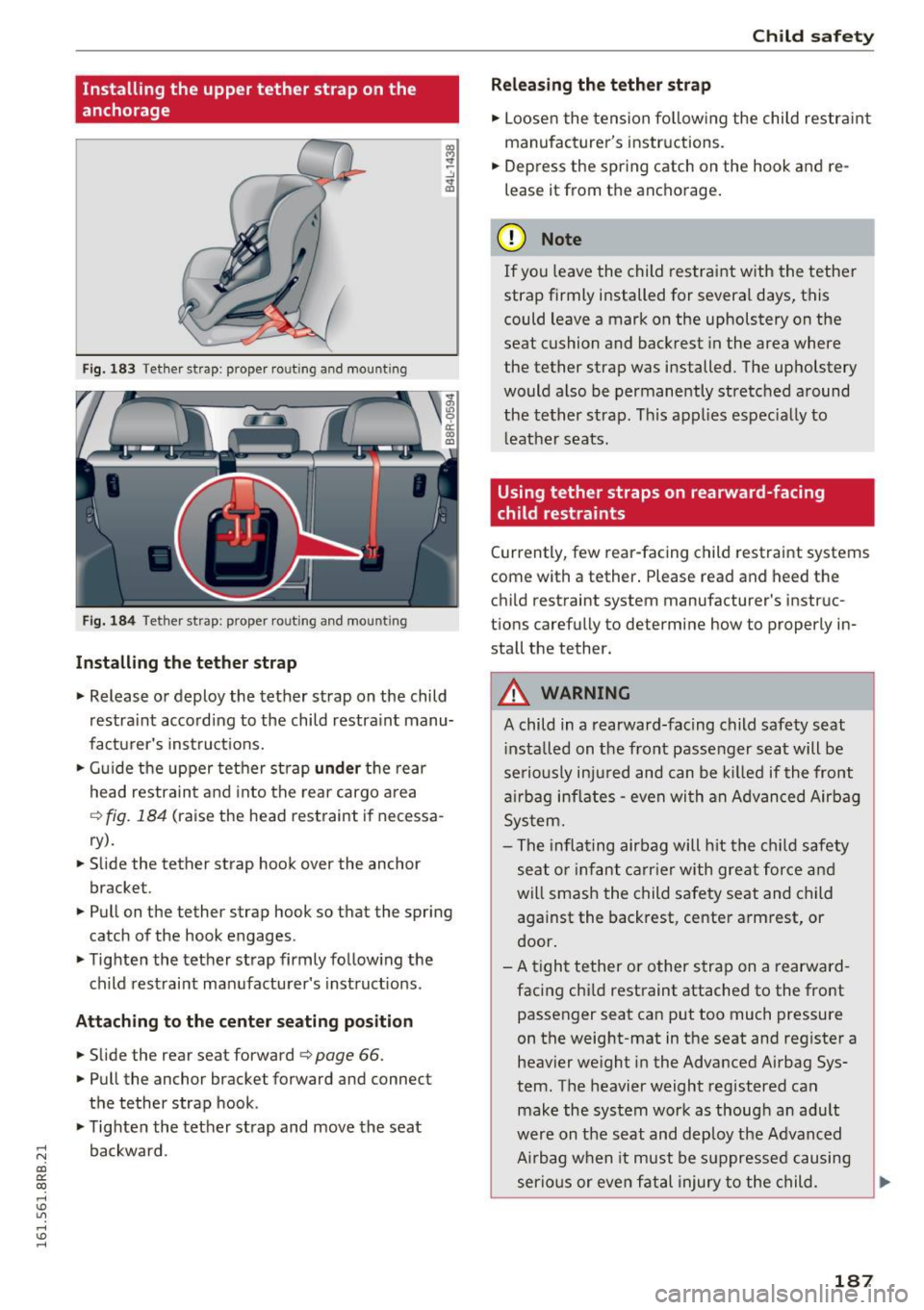
Installing the upper tether strap on the
anchorage
Fig. 183 Tether strap: proper rout ing and mount ing
Fig. 184 Tether strap: proper ro utin g and mo untin g
Inst all ing th e teth er str ap
.,. Release or deploy the tether strap on the child
restra int according to the child restra int manu
factu rer's instruct ions.
.,. Gu ide the upper tether st rap
und er the rear
head restra int and into the rear cargo a rea
¢ fig. 184 (raise the head restraint if necessa
ry) .
.,. Slide the tether strap hook over the anchor
bracket .
.,. Pull on the tether strap hook so that the spring
catch of the hook engages.
.,. Tighten the tether strap firmly follow ing the
child restraint manufacturer's instruct ions.
Atta ching to the center seating p osition
.,. Slide the rear seat forward c> page 66.
.,. Pull the anchor bracket forward and connect
the tether strap hook .
.,. Tighten the tether strap and move the seat
;::: backward .
co ~ CX)
rl I.Cl U"I
rl I.Cl rl
Child sa fety
R elea sing the teth er str ap
.,. Loosen the tension following the child restra int
manufacturer's instructions .
.,. Depress the spring catch on the hook and re
lease it from the anchorage.
(D Note
If you leave the child restraint with the tether
strap firmly installed for several days, this
could leave a mark on the upholstery on the
seat cushion and backrest in the area where
the tether strap was installed . The upholstery
would also be permanently stretched around
the tether strap . T his applies espec ially to
l eather seats.
'
Using tether straps on rearward-facing
child restraints
Currently, few rear-facing child restraint systems
come with a tether . Please read and heed the
child restraint system manufacturer's instruc
tions carefully to determine how to properly in
stall the tether.
_&. WARNING ~
A child in a rearward-facing child safety seat i nsta lled on the front passenger seat will be
se riously inju red and can be ki lled if the front
a ir bag inflates - even wi th an Advanced Airbag
Sys tem.
- The inflating airbag will h it the ch ild safety
seat o r infant carr ier with great force and
will smash the child safety seat and child against the backrest, cente r armrest, or
door .
- A t ight tether or other strap on a rearward
facing chi ld restraint attached to the front
passenger seat can put too much pressure
on the weight-mat in the seat and register a
heavier weight in the Advanced Airbag Sys
tem. The heavier weight registered can
make the system work as thoug h an adu lt
were on the seat and deploy the Advanced Ai rbag when it must be suppressed causing
serio us or eve n fatal injury to the child. .,..
18 7
Page 193 of 300
..... N
co ~ CX)
..... I.Cl U"I
.... I.Cl .....
wheels can spin even with these ass istance
systems that cannot always he lp to reduce
the risk of loss of vehicle control.
@ Tips
-ABS and AS R on ly work correctly when a ll
fo ur whee ls are e quipped w ith ide ntical
Switching on /off
Intelligent Technology
tires. Diff eren t tire s izes can lead to a red uc
tion i n engine po wer .
- You may hear noises when t he sy stems de
scribe d are workin g.
- Whe n in sta lling a facto ry-s up plied roo f ra ck
system o n the roof r ailing , the ESC wi ll
adapt itself to a different center of gravity .
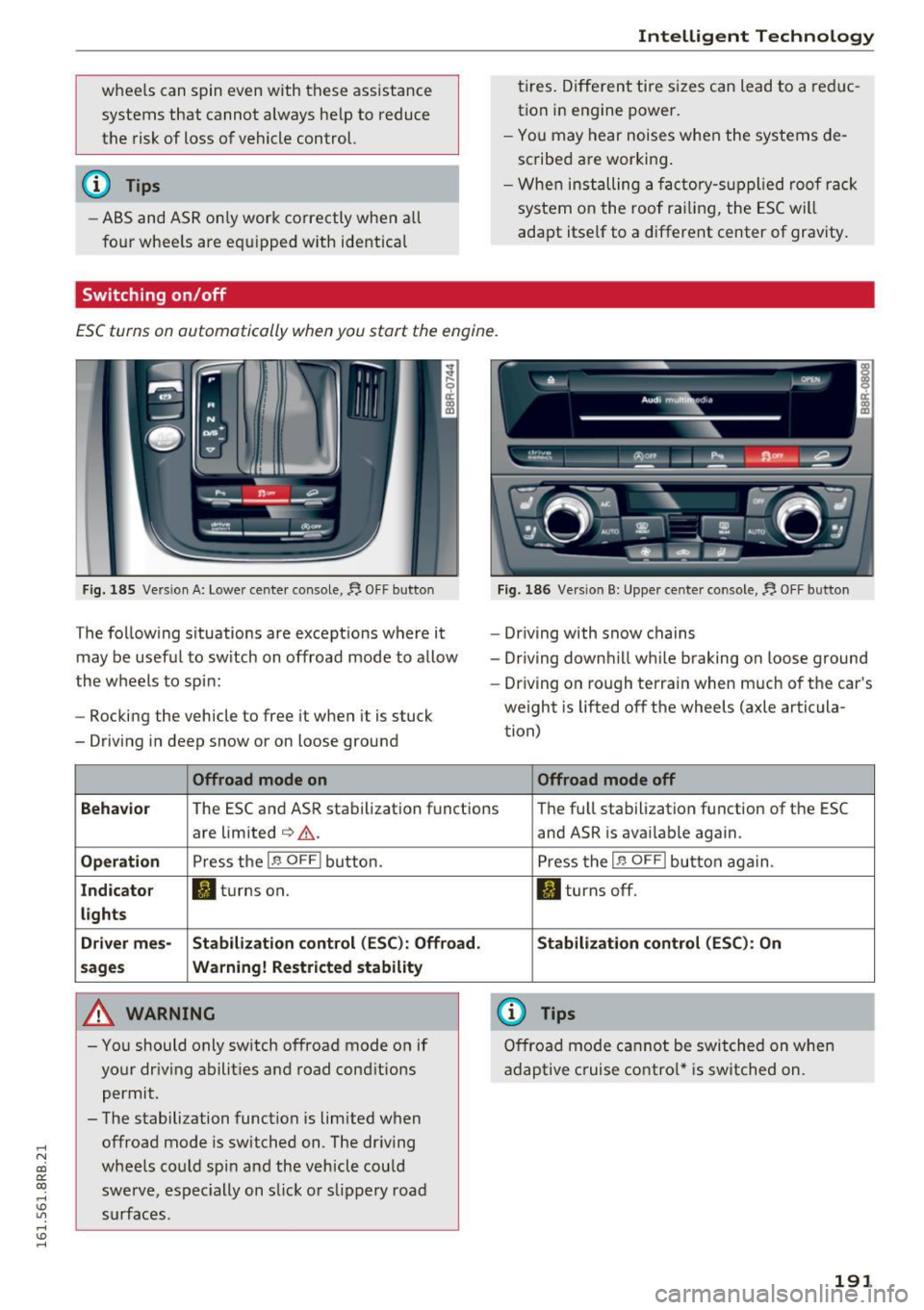
ESC turns on automatically when you start the engine.
Fig . 18 5 Versio n A: Lowe r cente r conso le,~ OFF b utto n
The follow ing s ituations are except ions where it
may be usef ul to sw itch on offroad mode to allow
the wheels to spi n:
- Rocking the vehicle to free it when it is stuck
- Driv ing in deep snow or on loose ground
Offroad mode on
~ Q:)01_1 _ --.!'3.- -ft.
- Driving with snow chains
- Dr iving down hill wh ile braking on loose ground
- Dr iving on ro ugh te rra in when m uch of the car's
weight is lifted off the wheels (axle articula
tion)
Offroad mode off
Behavio r
The ESC and AS R stabilization f unctions Th
e fu ll sta bilization f unction of the ESC
a re limited
c:> &. .
Operation Press the 1.$ OFF I button.
Indicator II turns on.
lights
Driver mes- Stabilization
control (ESC): Offroad.
sages Wa rning! Restricted stability
A WARNING
- You should only sw itch o ffroad mode o n if
yo ur dr iv ing abilit ies a nd road cond it io ns
permit.
- The stabilization function is limited when offroa d mode is switched on. The dr iv ing
wheels co uld spi n and th e vehicle cou ld
swerve, es pec ially on s lick o r sli ppery roa d
s ur fac es. and ASR
is avai lab le again.
P ress t he
1.$ OFFI button aga in.
II turns off.
Stabilization control (ESC ): On
(D Tips
Offro ad mode ca nno t be switche d on whe n
adaptive c ruise co ntro l* is switched on.
191
Page 205 of 300
,....,
N
co
er::
co
,....,
General information
Your Audi was designed primarily for passenger
transportation .
If you plan to tow a trailer, please remember that
the additional load will affect durability, econo my and performance.
T railer towing not only places more stress on the
vehicle, it also calls for more concentration from
the driver.
For this reason, always follow the operating and
driving instructions provided and use common
sense.
Technical requirements
Trailer hitch
Use a weight-carrying hitch conforming to the
gross trailer weight. The hitch must be suitable
for your vehicle and trailer and must be mounted
securely on the vehicle's chassis at a technically
sound
location . Use only a trailer hitch with a re
movable ball mount . Always check with the trail
er hitch manufacturer to make sure that you are
using the correct hitch.
Do not use a bumper hitch.
The hitch must be installed in such a way that it
does not interfere with the impact -absorbing
bumper system . No modifications should be
made to the vehicle exhaust and brake systems .
From time to time, check that all hitch mounting
bo lts remain securely fastened.
When you are not towing a trailer,
remove the
tra iler hitch ball mount . This prevents the hitch
from causing damage should your vehicle be
struck from beh ind ¢
,&. .
Trailer brakes
If your trailer is equipped with a braking system,
check to be sure that it conforms to all regula
tions .
Trailer mode
The trailer hydraulic brake system must not be
directly connected to the vehicle's hydraulic
brake system ¢.&. .
Safety chains
Always use safety chains between your vehicle
and the trailer.
Trailer lights
T ra iler lights must meet all regulations . Be sure
to check with your author ized Audi dealer for cor
rect wiring, switches, and relays.
Mirrors
If you are unable to see the traffic behind you us
ing the regular outside mirrors, then you
must in
stall extended mirrors. It is important that you
always have clear vision to the rear.
,8. WARNING
-If a trailer has electrical brakes please note
that these brakes are not activated by the
factory-fitted control unit -risk of accident!
- After removing the trailer hitch, do not store it in your vehicle. In case of sudden
braking, the hitch could fly forward and in
jure you or your passengers.
- Never install a "weight distributing" or
"load equalizing" trailer hitch on your vehi
cle. The vehicle was not designed for these
kinds of trailer hitches . The hitch attach
ment can fail, causing the trailer to tear
loose from the vehicle.
- The Gross Vehicle Weight Rating for your
vehicle, found on the safety compliance la bel on the driver's side B-pillar, must never
be exceeded under any circumstances. Ex
ceeding the Gross Vehicle Weight Rating of
your vehicle is likely to damage your vehicle,
and such damage will not be covered by
your Limited New Vehicle Warranty. Exceed
ing the Gross Vehicle Weight Rating will al
so change the performance and handling
characteristics of your vehicle, which could
cause a crash resulting in serious injury or
death.
203
Page 206 of 300
Trailer mod e
Operating instructions
6"
~ 2
. 1/2 "
.(. '-I} 1-1/2"
-
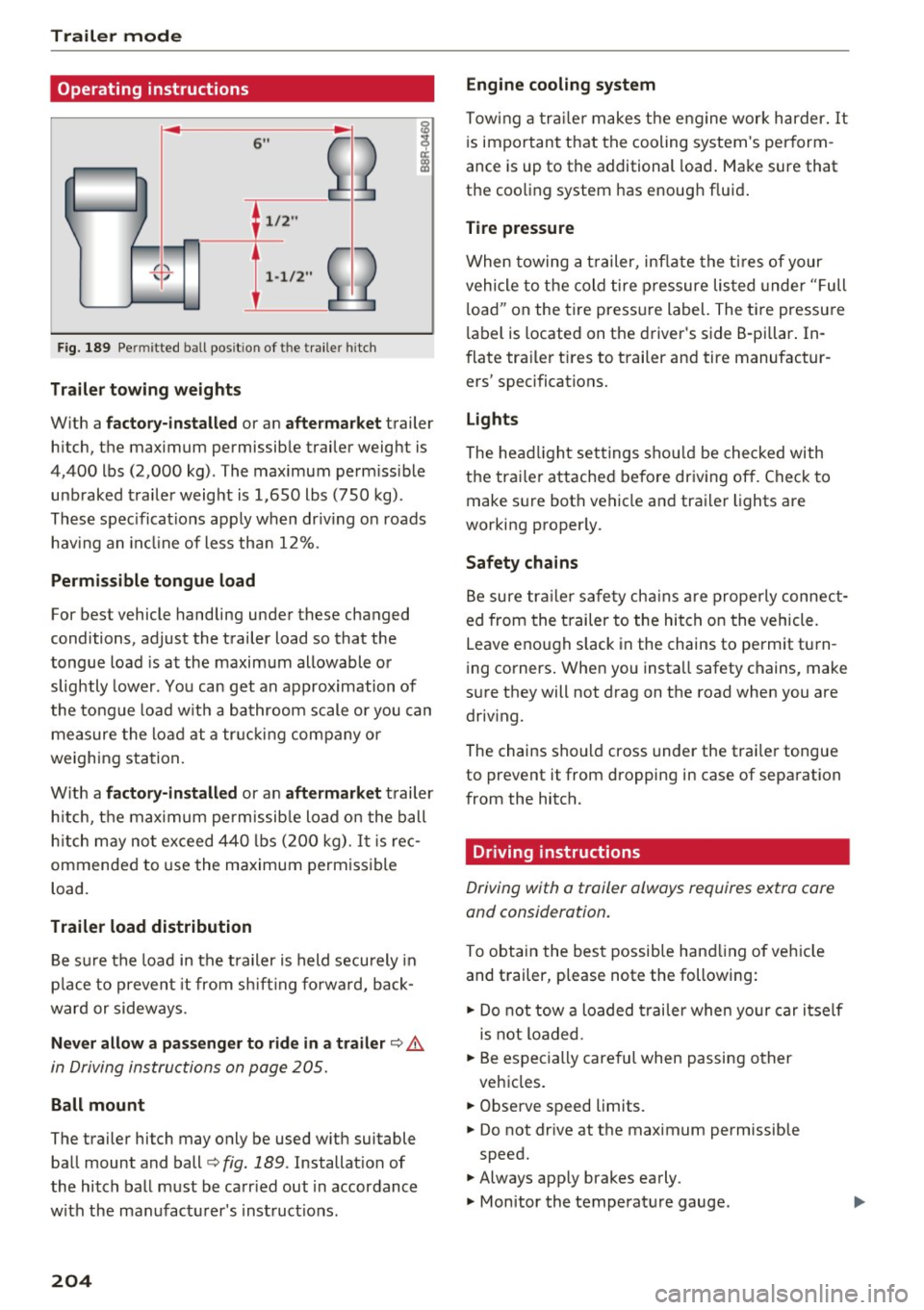
F ig. 189 Pe rmi tted ball posit io n of the traile r hi tch
Tr aile r to wing weights
With a f ac tor y-inst all ed or an a ft er ma rket trailer
h itch, the maximum permissib le trailer weight is
4,400 lbs (2,000 kg) . The maximum perm iss ible
unb raked trailer weight is 1,650 lbs (750 kg) .
These spec ificat ions apply when dr iv ing on roads
hav ing an incl ine of less tha n 12%.
Perm is sible tongue load
For best vehicle handling under these changed
conditions, adjust the trailer load so that the
tongue load is at the maxim um allowable or
slightly lower. You can get an approx imation of
the tongue load w ith a bathroom scale or you can
measure the load at a tr ucking company or
weighing station.
W ith a
fa ctor y-installed or an aftermarket trailer
h itch, t he maximum permissib le load on the ball
h itch may not exceed 440 lbs (200 kg).
It is rec
ommended to use the maximum permissible
load.
Trailer load di stribution
B e su re the load in the trailer is held securely in
p lace to prevent it from s hift ing fo rwa rd, back
ward or sideways.
Nev er allo w a p assenge r to ride in a trail er c::> A
in Driving instructions on page 205.
Ball mount
The trailer hitch may only be used w ith suitable
ball mount and ball
c::> fig. 189 . Installat ion of
the hitch ball must be carr ied out in accordance
w ith the manufacturer 's inst ruct ions.
204
Engine cooling system
Towing a tra ile r makes t he engine work harder. It
is important that the cooling system's perform
ance is up to the additional load . Make sure that
the cooling system has enough fluid .
Tire pressure
When towing a t railer, inflate the ti res of your
vehicle to the cold tire pressure listed under "Full
l oad" on the tire press ure label. The tire pressure
l abel is located on the driver 's side B-pillar . In
flate tra iler tires to trailer and tire manufactur
ers' specifications.
Lights
The head light settings shou ld be checked with
the trailer attached before driving off. Check to
make s ure both vehicle and trailer lights are
working properly.
Safety chains
Be sure tra ile r safety cha ins a re properly connect
ed from the trailer to the hitch on the vehicle.
Leave enough slack in the chains to permit tu rn
i ng corners . When you install safety chains, make
s u re they will not drag on the road when you are
driv ing.
The chains should cross under the trai ler tongue
to prevent it from dropping in case of separation
from the hitch.
Driving instructions
Driving with a trailer always requires extra care
and consideration.
To obtain the best possible handling of veh icle
and t railer, p lease note the following:
.., Do not tow a loaded trai ler when your car itself
is not loaded.
.., Be especially care ful when passing other
vehicles .
.., Observe speed limits.
.., Do not drive at the maximum permissible
speed.
.., Always app ly brakes early.
.., Monitor the temperature gauge.
Page 207 of 300
,....,
N
co
er::
co
,....,
Towing a loaded trailer with an empty car res ults
in a high ly unstable distribution of weight. If this
cannot be avoided, drive at very low speeds only
to avoid the risk of losing steering control.
A "balanced" rig is eas ier to operate and control.
This means that the tow vehicle should be loaded
to the extent possible and permissible, while
keeping the trailer as light as possible under the
circumstances. Whenever possible, transfer
some cargo to the luggage compartment of the
tow vehicle while observ ing tongue load require
ments and vehicle loading considerat ions.
Speed
The higher the speed, the more difficult it be
comes for the driver to contro l the rig. Do not
drive at the maximum permiss ible speed . Reduce
your speed even more if load, weather or wind
conditions are unfavorable - part icularly when
going downhill.
Reduce veh icle speed
immediately if the tra iler
shows the slightest sign of swaying .
Do not try
to stop the swaying by accelerating.
Observe speed lim its . In some areas, speeds for
veh icles towing trai lers are lower than for regular
veh icles.
Always apply brakes early. When driving down
h ill , shift into a lower gear to use the engine
braking effect to slow the veh icle. Use of the
brakes alone can cause them to overheat and fa il.
Coolant temperature
The coolant temperature gauge r=;, page 10 must
be observed carefully . If the needle moves close
to the upper end of the scale, reduce speed im mediately and/or turn off the air conditioner.
If the coolant temperature warning light in the
instrument cluster starts flashing., pull off
the road, stop and let the engine
idle for about
two minutes to prevent heat build-up.
A WARNING
Anyone not properly restrained in a moving
vehicle is at a much greater risk in an acci-
-
Trailer mode
dent. Never let anyone ride in your car who is
not properly wear ing the restraints provided
by Aud i.
Trailer mode notes
Important to know
Your vehicle handles differently when towing a
t railer because o f the additional weight and dif
ferent weight distribution. Safety, performance
and economy will greatly depend on how carefu l
ly you load your trai ler and operate your rig.
Before you actually tow your trailer, practice
tu rning, stopping and backing up in an area away
from traffic. Keep practicing until you have be
come comp lete ly familiar w ith the way your vehi
cle-tra iler combination behaves and responds.
Backing up is difficu lt and requires practice.
Backing up with a t railer generally requires steer
ing action opposite to that when backing up your
vehicle without a trailer.
Maintain a greater distance between your vehicle
and the one in front of you . You will need more
room to stop. To compensate for the trailer, you
will need a larger than normal turning radius.
When passing, remember that you cannot accel
erate as fast as you normally would because of
the added load. Make sure you have enough room
to pass. After passing, allow p lenty of room for
your trailer before c hanging lanes again.
Avoid jerky starts, sharp turns or rapid lane
changes.
(D Tips
- Do not tow a trailer during the break-in peri
od of your veh icle.
- If you tow a trailer, your Audi may requ ire
more frequent maintenance due to the ex
tra load
r=;, page 280.
205
Page 238 of 300
Wheels
be happy to provide more infor
mation.
® Mud and snow capability
"M/S" or "M+S" indicates the tire
has characteristics that make it
suitab le for driving on mud and
snow.
& indicates a winter t ire.
@ Compos ition of the tire cord
and materials
The number of plies indicates the
number of rubberized fabric lay
ers in the tire . In general: the
more layers, the more weight a
tire can carry. Tire manufacturers must also specify the materia ls
used in the tire. These include
steel, nylon, polyester and other
materials .
@ Maximum permitted load
This number indicates the maxi
mum load in k ilograms and
pounds that the tire can carry.
@ Uniform tire quality grade
standards for treadwear,
traction and temperature
resistance
Tread wear, t raction and temper
ature ranges
¢ page 251 .
@ Running direction
The arrows indicate the running
direction of unidirec tiona l tires.
23 6
You must a lways follow the speci
fied runn ing direction
¢ page 263.
@ Maximum permitted
inflation pressure
This number indicates the maxi
mum pressure to which a tire can be inflated unde r normal operat
ing condit ions .
Glossary of tire and loading
terminology
Accessory weight
means the comb ined we ight (in
excess of those standard items
which may be replaced) o f auto
matic tra nsmission , power steer
ing , power brakes , power wi n
dows, power seats , radio , and
heater, to the extent that these
items a re available as facto ry-in
stalled equipment (whet her in
stalled or not).
Aspect ratio
means the rat io of the height to
the width o f the tire in pe rcent.
Numbe rs of 55 or lower indicate a
low sidewa ll for imp roved steer
ing response and better overa ll
handling on dry pavement .
...
Page 239 of 300
Bead
means the part of the tire that is
made of steel wires, wrapped or
reinforced by ply cords and that is
shaped to fit the rim.
Bead separation
means a breakdown of the bond
between components in the bead.
Cord
means the strands forming the
plies in the tire.
Cold tire inflation pressure
means the tir e pressure recom
mended by the vehic le manufac
turer for a tire of a designated
size that has not been driven for
more than a couple of miles (kilo
meters) at low speeds in the
three hour period before the tire pressure is measured or adjusted .
Curb weight
means the weight of a motor ve
hicle with standard equipment in
c luding the maximum capacity of
fuel, oi l, and coolant, a ir condi
tioning and add itional weight of
optional equipment.
E xtra load ti re
means a tire designed to operate
at higher loads and at h igher in -
Wheels
flation pressures than the corre
sponding standard tire . Extra load
tires may be identified as "XL",
" xl", "EXTRA LOAD", o r "RF" on
the sidewal l.
Gross Axle Weight Rating
( " GAWR")
means the load -carrying capacity
of a single axle system, measured
at the tire-ground interfaces .
Gross Vehicle Weight Rating
("GVWR ")
means the max imum total loaded
weight of the vehic le.
Groove
means the space between two ad
jacent tr ead ribs .
Load rating (code)
means the max im um load tha t a
tire is rated to carry fo r a g iven in
flat ion pressure . You may not find
this informat ion on all tires be
cause it is not requ ired by law.
Maximum load rating
means the load rating for a tire at
the maximum pe rmissible infla
tion pressure for that tire.
Maximum loaded vehicle
weight
means the sum o f:
23 7
..
Page 240 of 300
Wheels
(a) Curb weight
(b) Accessory weight
(c) Vehicle capacity weight, and
(d) Production options weight
Maximum (permissible )
inflation pressure
means the maximum cold infla
tion pressure to which a tire may be inflated. Also called "maxi
mum inflation pressure ."
Normal occupant weight
means 150 lbs . (68 kilograms)
times the number of occupants
seated in the vehicle up to the to
ta l seating capacity of your vehi
c le .
Occupant distribution
means distribut ion of occupan ts
in a vehic le .
Outer diameter
means the overall diamete r of an
inflated new tire.
Overall width
means the l inear distance be
tween the exter iors of the side
walls of an infla ted tire , including
elevations due to labeling , deco
rations, or protective bands or
r ibs.
23 8
Ply
means a layer of rubber -coated
pa rallel cords.
Production options weight
means t he comb ined we ight of
those insta lled regular production
options weighing over 5 lbs . (2 .3
kg) in excess of those standard
items which they replace , not pre
viously considered in curb weight or accessory weight, inc luding
heavy duty brakes, ride levelers,
roof rack, heavy duty battery, and
special trim.
Radial ply tire
means a pneumatic tire in which
the ply co rds that extend to the
beads are laid at subs tantially 90
deg rees to the centerline o f the
tread .
Recommended inflation
pressure
see~ page 23 7, Cold tire infla
tion pressure.
Reinforced tire
means a tire designed to operate
at highe r loads and at h igher in
flat ion pressures than t he corre
spond ing standa rd tire . R ein
forced tires may be identified as .,.
Page 242 of 300
Wheels
Uniform Tire Quality Gr ading
is a tire information system devel
oped by the United States Nation
al Highway Traffic Safety Admin
istration (NHTSA) that is designed
to help buyers make relative com parisons among tires. The UTQG
is not a safety rating and not a
guarantee that a tire will last for
a prescr ibed number of miles
(kilometers) or perform in acer
tain way. It simply gives tire buy
ers additional information to
combine with other considera
tions, such as price, brand loya lty
and dealer recommendations. Un
der UTQG, tires are graded by the
tire manufacturers in three areas:
treadwear , traction, and tempera
ture resistance . The UTQG in for
mation on the tires, molded into
the sidewalls.
U.S. DOT Tire Identification
Number (TIN)
This is the tire's "serial number" .
It begins with the letters "DOT"
and indicates that the tire meets
all federal standards. The next
two numbers or letters indicate
the plant where it was manufac
tured, and the last four numbers represent the
week and year of
manufacture . For example,
24 0
DOT ... 2215 ...
means that the tire was produced
in the 22nd week of 201 5. The
other numbers are marketing co
des that may o r may not be used
by the tire manufacturer . This in
formation is used to contact con sumers if a tire defect requires a
recall.
Veh icle capac ity weight
means the rated ca rgo and lug
gage load pl us 150 lbs . (68 k ilo
grams) times the vehicle's desig
nated seating capacity .
Vehicle maximum load on the
tire
means that load on an ind ividual
tire that is determined by distrib
uting to each axle its sha re of the
maximum loaded veh ic le we ight
and dividing by two.
Vehicle normal load on the tire
means that load on an individual
tire that is determi ned by distrib
uting to each axle its share of the
curb weight, accessory weight,
and normal occupan t weight (dis
tributed in accordance with
c::> ta
ble on page 246) and dividing by
two .
~
Page 248 of 300
Wheels
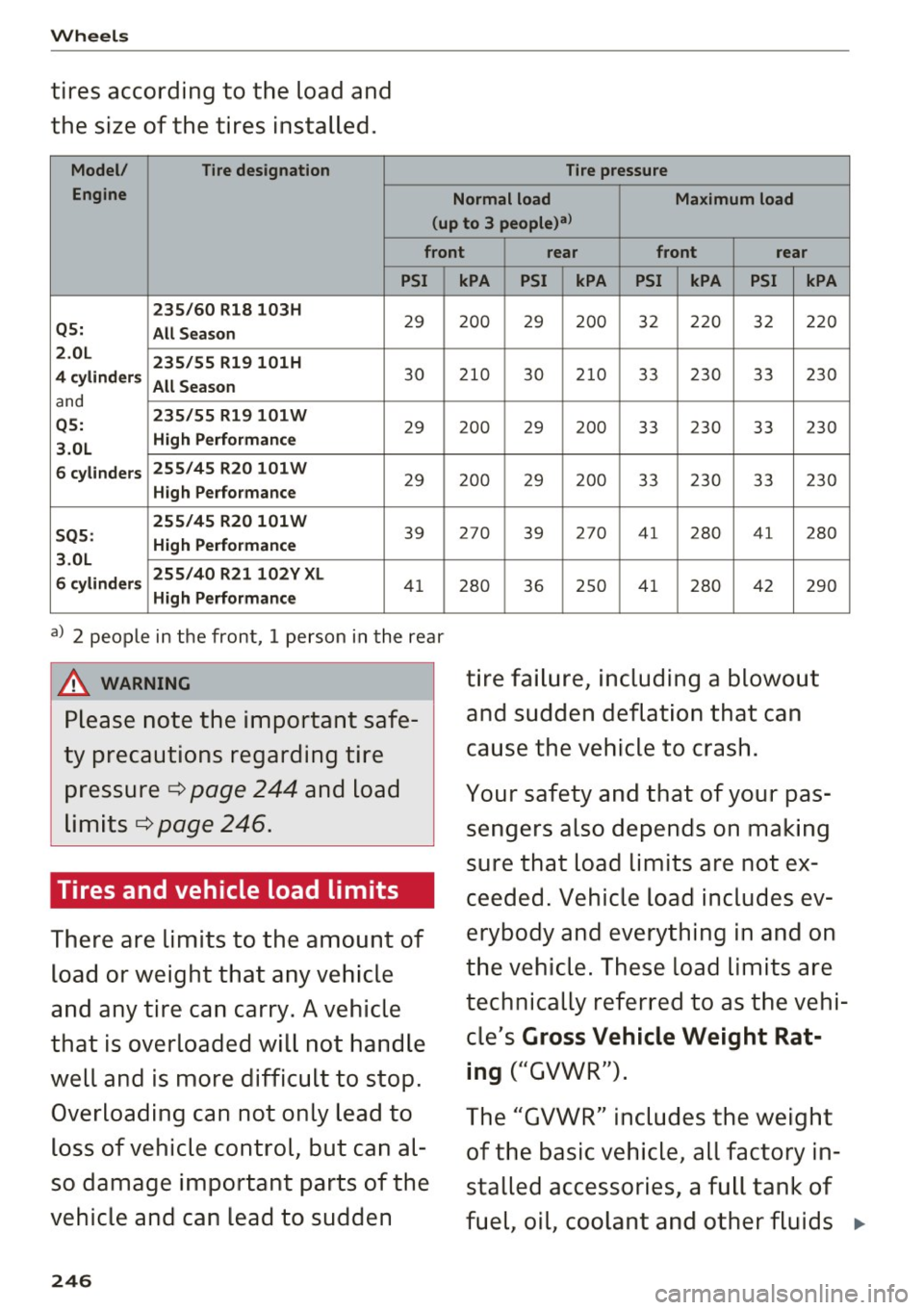
tires according to the load and
the size of the tires installed.
Model/ Tire designation
Engine Tire pressure
Normal load Maximum load
(up to 3 people)al
front rear front rear
PSI
235/60 Rl8 103H
29 Q5:
All Season
2 .0L
235/55 R19 101H
4 cylinders All Season
30
and
Q5: 235/55 R19101W 29 High Performance
3.0L
6 cylinders 255/45
R20 101W
29 High Performance
255/45 R20 101W
39 SQ5: High Performance
3.0L
6 cylinders 255/40
R21102Y XL
41 High Performance
a) 2 people in the front, 1 person in the rear
A WARNING
Please note the important safe
ty precautions regarding tire pressure ¢
page 244 and load
limits ¢
page 246.
Tires and vehicle load limits
There are limits to the amount of
load or weight that any vehicle
and any tire can carry. A vehicle
that is overloaded will not handle
well and is more difficult to stop.
Overloading can not only lead to
loss of vehicle control, but can al
so damage important parts of the
vehicle and can lead to sudden
246
kPA PSI kPA PSI kPA PSI kPA
200 29 200 32 220 32 220
210
30 210 33 230 33 230
2 00 29 2 00 33 2 30 33 230
200 29 200 33 230 33 230
27 0
39 27
0 41 2 80 41 2 80
280 36 250 4 1 280 42 290
tire failure, including a blowout
and sudden deflation that can
cause the vehicle to crash.
Your safety and that of your pas
sengers also depends on making
sure that load limits are not ex
ceeded. Vehicle load includes ev
erybody and everything in and on
the vehicle. These load limits are
technically referred to as the vehi
cle's
Gross Vehicle Weight Rat
ing
("GVWR").
The "GVWR" includes the weight
of the basic vehicle, all factory in
stalled accessories, a full tank of
fuel, oil, coolant and other fluids ..,.