weight AUDI Q5 2018 Owner's Manual
[x] Cancel search | Manufacturer: AUDI, Model Year: 2018, Model line: Q5, Model: AUDI Q5 2018Pages: 392, PDF Size: 60.56 MB
Page 301 of 392
Convertible child safety seats
Properly used convertible child safety seats can
help protect toddlers and children over age one
who weigh between
20 and 40 lbs. (9 and 18 kg)
in a crash.
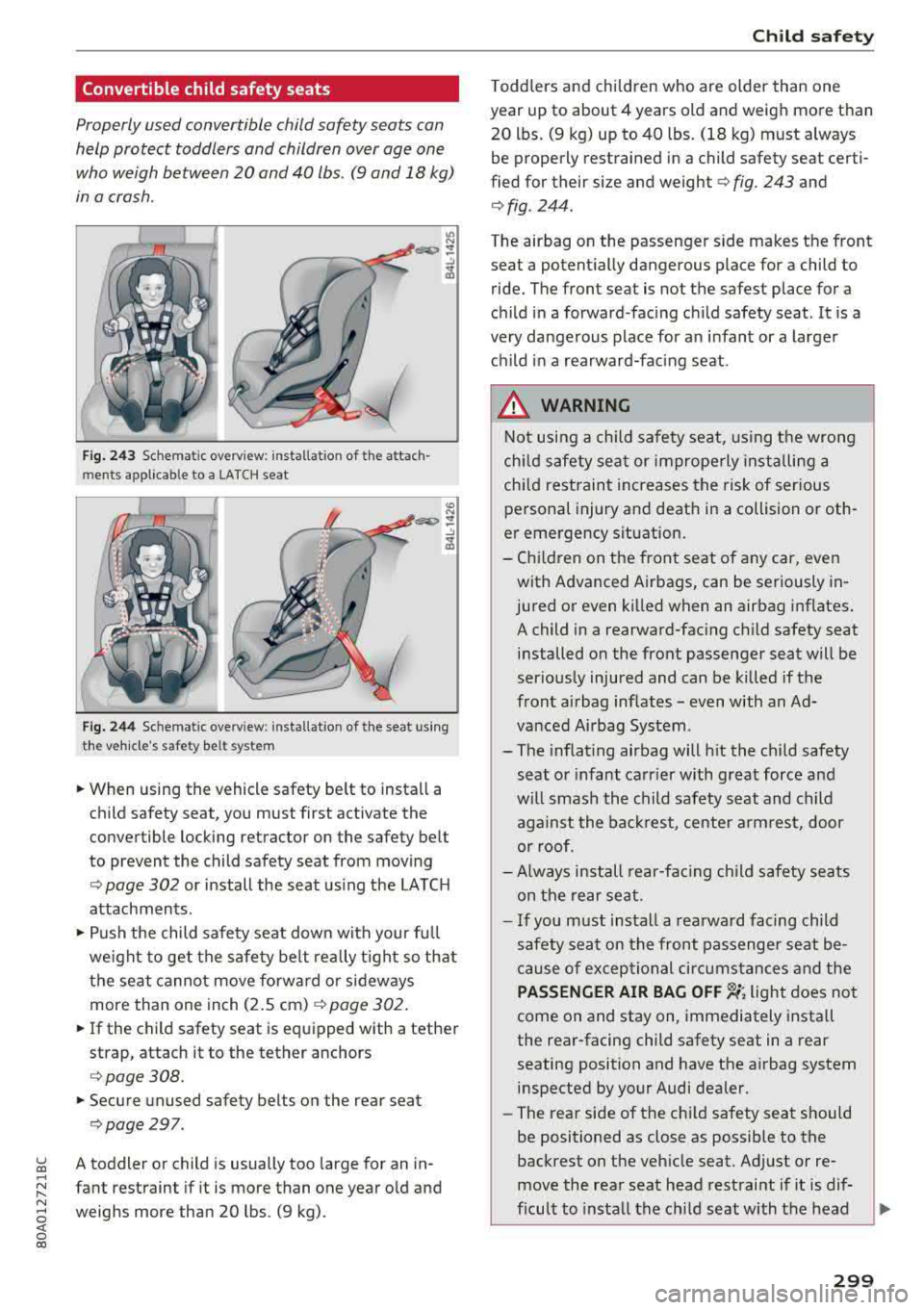
f ig . 243 Sche matic overview: installatio n of the attach
ments applica ble to
a LA TCH seat
Fig. 2 44 Schematic overview: installat ion of the seat using
the vehicle's safety belt system
~ When using the vehicle safety belt to install a
child safety seat, you must first activate the
convertible locking retractor on the safety belt
to prevent the child safety seat from moving
¢page 302 or install the seat us ing the LA TC H
attachments .
~ Push the child safety seat down with your fu ll
weight to get the safety be lt rea lly t ight so that
the seat cannot move forward o r sideways
more than one inch (2.5
cm)¢ page 302 .
~ If the child safety seat is equipped with a tether
strap, attach it to the tether anchors
¢page 308.
~ Secure unused safety belts on the rear seat
¢page 297.
~ A toddler or child is usually too large for an in-
~ fant restraint if it is more than one year old and r--
~ weighs more than 20 lbs. (9 kg).
~ 0 co
Child s afe ty
Todd lers and children who are older than one
year up to about 4 years old and weigh more than
20 lbs. (9 kg) up to 40 lbs . (18 kg) must always
be properly restrained in a child safety seat certi
fied for their size and
weight¢ fig. 243 and
¢ fig. 244.
The airbag on the passenger side makes the front
seat a potent ially dangerous place for a child to
ride. The front seat is not the safest place for a
child in a forward -fac ing child safety seat . It is a
very dangerous place for a n in fant or a larger
child in a rearward-facing seat .
_&. WARNING
Not using a child safety seat, using t he wrong
chi ld safety seat or imprope rly insta lling a
chi ld restraint increases the risk of ser ious
personal injury and death in a collision or oth
er emergency situation.
-Ch ildren on the front seat of any car, eve n
wit h Advanced Airbags, can be seriously in
jured or even killed when an airbag inflates .
A child in a rearward-fac ing ch ild safety seat
installed on the front passenger seat will be
serious ly injured and can be killed if the
front airbag inflates -even with an Ad
va nced Ai rbag System .
-The inflat ing airbag will h it the ch ild safety
seat or infant carr ier with great force and
will smash the child safety seat and child aga inst the backrest, ce nter a rmrest, door
or roof.
- Always ins tall rear-fa cing c hild safety seats
on the rear seat .
-If you m ust instal l a rea rwa rd facing child
safety seat on the front passenger seat be
cause of exceptional circ ums tan ces and the
PASSENGER AIR BAG OFF "1; light does not
come on and stay on, immediately insta ll
the rea r-facing child safety seat in a rear
seating position and have the a irbag system
inspected by your Audi dealer.
-The rear side of the ch ild safety seat shou ld
be positioned as close as possible to the
backrest on the veh icle seat. Adjust or re
move the rear seat head restraint if it is dif-
f icult to instal l the ch ild seat with the head ._.
299
Page 329 of 392
u a, .... N r-N ....
~ a,
(J) US DOT number (TIN) and
manufacture date
T he manufacture date is listed on
the tire sidewall (it may only ap
pear on the inner s ide of the tire):
DOT .. . 2217 .. .
means , for example, that the tire
was produced in the 22nd week of
the year 2017 .
@ Audi Original Tires
Audi Original equipment tires
with the designation
"AO" have
been specially matched to your
Audi . When used correct ly , these
tires meet the highest standards
for safety and handling . An au
thorized Audi dealer or author
ized Audi Service Facility will be
able to provide you with more in
formation .
® Mud and snow capability
"M/5 " or "M+S" indicates the tire
is suitable for driving on mud and
snow .
& indicates a winter tire .
@ Composition of the tire cord
and materials
The number of plies indicates the
number of rubberized fabric lay
ers in the tire. In general : the
more layers, the more weight a
tire can carry . Tire manufacturers
Wh eel s
must also specify the materials
used in the tire . These include
steel, nylon, polyester and other
materials.
@ Ma ximum permitted load
This number indicates the maxi
mum load in kilograms and
pounds that the tire can carry .
@ Uniform tire qual ity grade
standards for treadwear,
traction and temperature resistance
Treadwear , tract ion and tempera
ture ranges
r=:>page 341 .
@ Running direction
The arrows indicate the runn ing
direction of unidirectional tires .
You must always follow the speci
fied running direction
Q page 355.
@ Ma ximum permitted
inflation pressure
This number indicates the maxi
mum pressure to which a tire can
be inflated under normal operat
ing cond itions .
327
Page 330 of 392
Wheel s
Glossary of tire and loading
terminology
Accessory weight
means the combined weight (in
excess of those standard items
which may be replaced) of auto matic transmission, power steer
ing , power brakes , power win
dows , power seats, radio, and
heater, to the extent that these
items are available as factory-in
stalled equipment (whether in
stalled or not).
Aspect ratio
means the ratio of the height to
the width of the tire in percent. Numbers of 55 or lower indicate a
low sidewall for improved steer
ing response and better overall
handling on dry pavement .
Bead
means the part of the tire that is
made of steel wires, wrapped or
reinforced by ply cords and that is
shaped to fit the rim.
Bead separation
means a breakdown of the bond
between components in the bead.
328
Cord
means the strands forming the
plies in the tire.
Cold tire inflation pressure
means the t ire pressure recom
mended by the vehicle manufac
turer for a tire of a designated
size that has not been driven for
more than a couple of miles (kilo
meters) at low speeds in the
three hour period before the tire pressure is measured or adjusted.
Curb weight
means the weight of a motor ve
hicle w ith standard equipment in
cluding the maximum capacity of
fuel, oil, and coolant, ai r condi
tioning and additional weight of
optional equipment.
E x tra load ti re
means a tire designed to operate
at higher loads and at higher in
flation pressures than the corre
sponding standard tire. Extra load
tires may be identified as "X L",
"
l" "EXTRA LOAD" or "RF" on X I I
the sidewall. .,.
Page 331 of 392
u a, .... N r-N ....
~ a,
Gross Axle Weight Rating ( " GAWR")
means the load-carrying capacity
of a single axle system, measured
at the tire-ground interfaces.
Gross Vehicle Weight Rating (" GVWR ")
means the maximum total loaded
weight of the vehic le.
Groove
means the space between two ad
jacent tread ribs.
Load rating (code )
means the maximum load that a
tire is rated to carry for a given in
flation pressure . You may not find
this information on all tires be
cause it is not required by law .
Maximum load rating
means the load rating for a tire at
the maximum permissible infla
tion pressure for that tire .
Maximum loaded vehicle
weight
means the sum of:
(a) Curb weight
(b) Accessory weight
(c) Vehicle capacity weight, and
(d) Production options weight
Ma ximum (permissible )
inflation pressure
Wh eel s
means the maximum cold infla
tion pressure to which a tire may be inflated . Also called "maxi
mum inflation pressure ."
Normal occup ant weight
means 150 lbs . (68 kilograms)
times the number of occupants
seated in the vehicle up to the to
ta l seating capacity of your vehi
cle .
Occupant distribut ion
means distribution of occupants
in a vehicle .
Outer diameter
means the overall diameter of an
inflated new tire .
Overall width
means the linear distance be
tween the exteriors of the side
walls of an inflated tire, including elevations due to labeling, deco
rations , or protective bands or
ribs.
Ply
means a layer of rubber-coated
parallel cords.
329
Page 332 of 392
Wheels
Production options we igh t
means the combined weight of
those installed regular production
options weighing over 5 lbs.
(2.3 kg) in excess of those stand
ard items which they replace, not previously considered in curb
weight or accessory weight, in
cluding heavy duty brakes, ride levelers, roof rack, heavy duty
battery, and special trim.
Radial pl y tir e
means a pneumatic tire in which
the ply cords that extend to the beads are laid at substantially
90 degrees to the centerline of
the tread.
R ecomm ended in flation
pressure
see¢ page 328 , Cold tire infla
tion pressure.
R einforced tire
means a tire designed to operate
at higher loads and at higher in
flation pressures than the corre
sponding standard tire . Rein
forced tires may be identified as
"XL" "xl" "EXTRA LOAD" or "RF" , , ,
on the sidewall.
330
Rim
means a metal support for a tire
or a tire and tube assembly upon
which the tire beads are seated.
Rim diam eter
means nominal diameter of the
bead seat . If you change your
wheel size, you will have to pur
chase new tires to match the new rim diameter .
Rim size designation
means rim diameter and width.
Rim width
means nomina l distance between
r im
flanges .
Sidewall
means that portion of a tire be
tween the tread and bead .
Speed rating (letter code )
means the speed at which a tire is
designed to be driven for extend
ed periods of time. The ratings range from 93 mph (150 km/h)
to
186 mph (298 km/h) ¢ table
on page 326 .
You may not find
this information on all tires be
cause it is not required by law .
The speed rating letter code,
where applicable, is molded on
the tire sidewall and indicates the
...
Page 334 of 392
Wheels
by the tire manufacturer. This in
formation is used to contact con sumers if a tire defect requires a
recall.
Vehicle capacity weight
means the rated cargo and lug
gage load plus 150 lbs. (68 kilo
grams) times the vehicle's desig nated seating capacity .
Vehicle maximum load on the
tire
means that load on an individual
tire that is determined by distrib
uting to each axle its share of the
maximum loaded vehic le weight
and dividing by two.
Vehicle normal load on the tire
means that load on an individual
tire that is determined by distrib
uting to each axle its share of the
curb weight, accessory weight,
and normal occupant weight (dis
tr ibuted in accordance
with¢ ta
ble on page 33 7)
and d ividing by
two .
Occupant loading and distri
bution for vehicle normal load
for various designated seating capacities
Re fer to the tire inflation pres
sure
label¢ page 335, fig. 269
332
for the n umbe r of seating posi
tions. Refer to the
table ¢ table
on page 337
for the number of
people tha t correspond to the ve
hicle normal load.
New tires or wheels
Audi recommends having all work
on t ires or wheels performed by
an authorized Audi dealer or au
thorized Audi Service Facility.
These facilities have the proper
know ledge and are eq uipped with
the required too ls and rep lace
ment parts.
... New t ires do not yet have the
optim um gripping properties.
Drive carefully and at moderate
speeds for the first 35 0 m iles
(500 km) with new tires .
... Only use tires with the same de
sign, size ( rolling circumfer
ence) , and as close to t he same
tread pattern as possible on a ll
four wheels .
...
Do not replace tires individually.
At least replace bo th tires on the
same axle at the same time .
... Audi recommends that you use
Audi O riginal Tires. If you would
like to use di fferent tires, please
note that the tires may perform
...
Page 339 of 392
u co .... N r--N .... 0 <( 0 00
on the label on the driver's side B
pillar, always follow the specifica
tion on the B-pillar label
c:::> page 335, fig. 268.
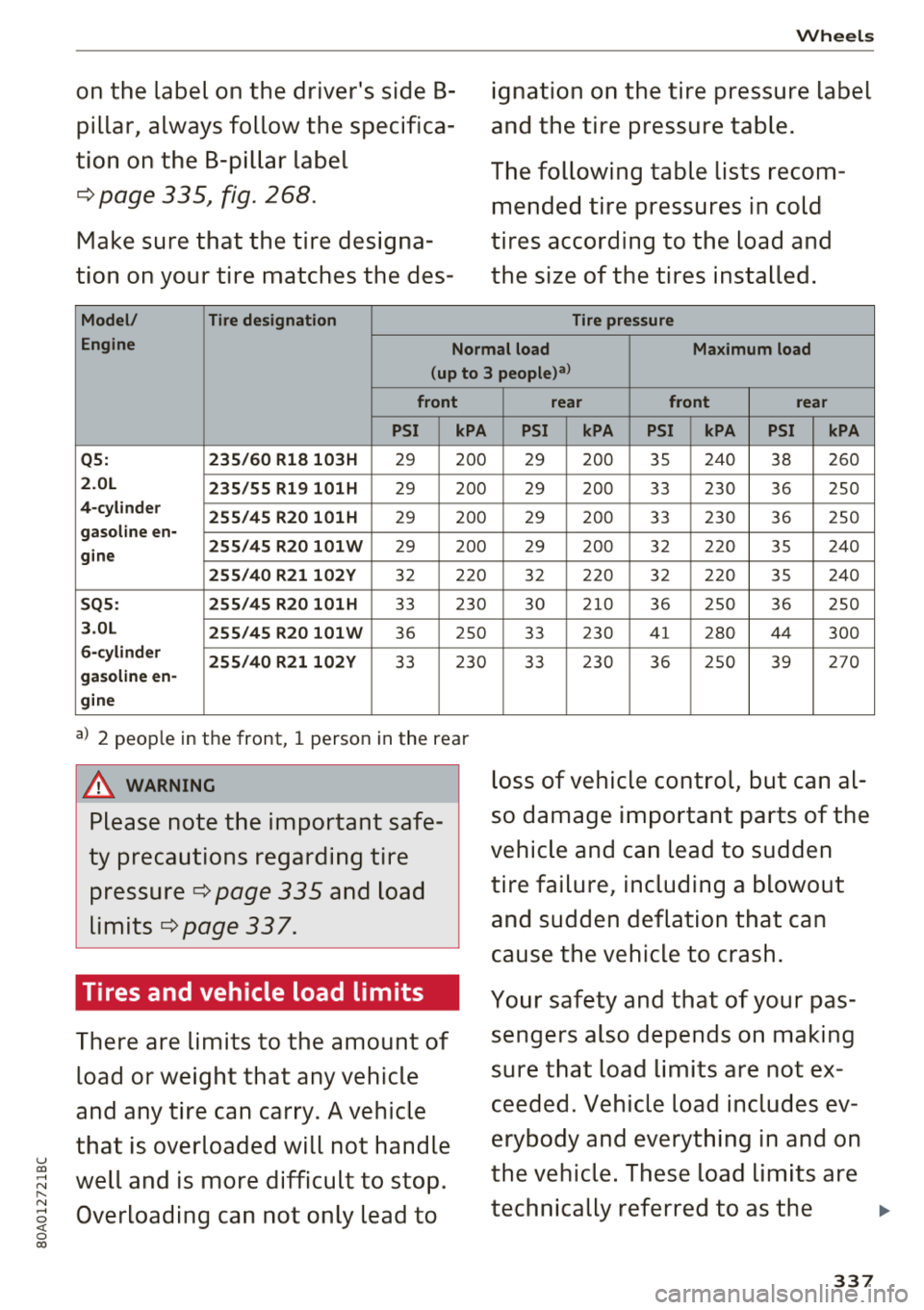
Make sure that the tire designa
tion on your tire matches the des-
Model/ Tire designation
Wheels
ignation on the tire pressure label
and the tire pressure table.
The following table lists recom mended tire pressures in cold
tires according to the load and
the size of the tires installed.
Tire pressure
Engine Normal load Maximum load
(up to 3
people)a)
front
PSI kPA
Q5: 235/60 R18 103H 29 200
2.0L
235/55 R19 101H 29 200
4-cylinder
255/45 R20 101H 29 200
gasoline en-
255/45 R20 101W
29 200 gine
255/40 R21102Y
32 220
SQ5: 255/45 R20 101H 33 230
3.0L
255/45 R20 101W 36 250
6-cylinder
gasoline en- 255/40 R21102Y 33 230
gine
a
) 2 people in the front, 1 person in the rear
A WARNING
Please note the important safe
ty precautions regarding tire
pressure
c:::> page 335 and load
limits
c:::> page 337.
Tires and vehicle load limits
There are limits to the amount of
load or weight that any vehicle
and any tire can carry. A vehicle
that is overloaded will not handle
well and is more difficult to stop .
Overloading can not only lead to
rear front rear
PSI kPA PSI kPA PSI kPA
29 200 35 240 38 260
29 200 33 230 36 250
29 200 33 230 36 250
29 200 32 220 35 240
32 220 32 220 35 240
30 210 36 250 36 2 50
33 230 4
1
280 44
300
33 230 36 250 39 270
loss of vehicle control, but can al
so damage important parts of the
vehicle and can lead to sudden
tire failure, including a blowout
and sudden deflation that can
cause the vehicle to crash.
Your safety and that of your pas
sengers also depends on making
sure that load limits are not ex
ceeded. Vehicle load includes ev
erybody and everything in and on
the vehicle . These load limits are
technically referred to as the
..,
337
Page 340 of 392
Wheels
vehicle's Gross Veh ic le Weig ht
R ati ng
("GVWR").
The "GVWR" includes the weight
of the basic vehicle, all factory in
stalled accessories, a full tank of
fuel, oil, coolant and other fluids
plus maximum load. The maxi
mum load includes the number of
passengers that the vehicle is in
tended to carry ("seating capaci
ty") with an assumed weight of 150 lbs . (68 kg) for each passen
ger at a designated seating posi
tion and the total weight of any luggage in the vehicle. If you tow
a trailer, the weight of the trailer
hitch and the tongue weight of
the loaded trailer must be includ
ed as part of the vehicle load .
The
Gro ss Ax le W eight Rating
("GAWR") is the maximum load
that can be applied at each of the
vehicle's two axles .
T he fact that there is an upper
limit to your vehicle's Gross Vehi
cle Weight Rating means that the
total weight of whatever is being
carried in the vehicle (including
the weight of a trailer hitch and
the tongue weight of the loaded
trailer) is limited . The more pas
sengers in the vehicle or passen -
338
gers who are heavier than the
standard weights assumed mean
that less weight can be carried as luggage .
The Gross Vehicle Weight Rating and the Gross Axle Weight Rat ing
are listed on the safety compli
ance sticker labe l located on the
driver's side B-pillar.
1.8. WARNING
Overloading a vehicle can cause loss of vehicle control, a crash
or other accident, serious per
sonal injury, and even death.
-Carrying more weight than your vehicle was designed to carry will prevent the vehicle
from handling properly and increase the risk of the loss of
vehicle control.
-The brakes on a vehicle that has been overloaded may not
be able to stop the vehicle
within a safe distance .
-Tires on a vehicle that has been overloaded can fail sud
denly, including a blowout and
sudden deflation, causing loss
of contro l and a crash.
-Always make sure that the to tal load being transported
-..
Page 341 of 392
u a, .... N r-N ....
~ a,
including the weight of a trail
er hitch and the tongue
weight of a loaded trailer -
does not make the vehicle heavier than the vehicle's
Gross Vehicle Weight Rating .
Determining correct load
limit
Use the example below to calcu
late the total weight of the pas
sengers and luggage or other
things that you plan to transport
so that you can make sure that
your vehic le w ill not be over load
ed .
Steps for Determining Correct
Load Limit
1. L ocate the statement "TH E
COMBINED WEIGH T OF OCCU
PANTS AND CARGO SHOULD
NEVER EXCEED XXX KG OR XXX
L BS" on your vehicle's placard
(tire inflation pressure label)
¢ page 335, fig . 269 .
2. Determine the combined
weight of the driver and pas
sengers that w ill be riding in
your vehic le .
3. Subt ract the combined weight
of the driver and passengers
from "XXX" kilograms or "XXX"
Wheels
pounds shown on the stick
er ¢ page 335, fig. 269 .
4. The resulting figure equals the
available amount of cargo and
luggage load capacity . For ex
ample , if the
"XXX" amount
equa ls
1400 lbs . and there will
be five
150 l bs . passengers in
your vehicle, the amount of
available cargo and luggage
load capacity is
650 lbs .
(1 400- 750 (5 X 1 50) = 650
lbs .)
5. Determine the comb ined
weight of luggage and cargo
being loaded on the vehicle .
T hat weight may not safely ex
ceed the availab le cargo and
luggage load capacity calculat
ed in Step 4 .
6 . If your vehicle will be towing a
tra iler, load from your tra iler
w ill be transferred to your ve
hicle. Consult this manual to
determine how this reduces
the availab le cargo and lug
gage load capacity of your veh i
c le .
.,. Check the tire sidewall
(¢ page 326, fig . 266) to deter
mine the designated load rat ing
for a specific t ire .
339
Page 369 of 392
u co ..... N r-N .....
~ 0 co
Raising the vehicle
Lifting with workshop hoist and with floor
jack
The vehicle may only be lift ed at the lifting
points illus tr at ed.
......_.__ -+,c___------= ------i
cli
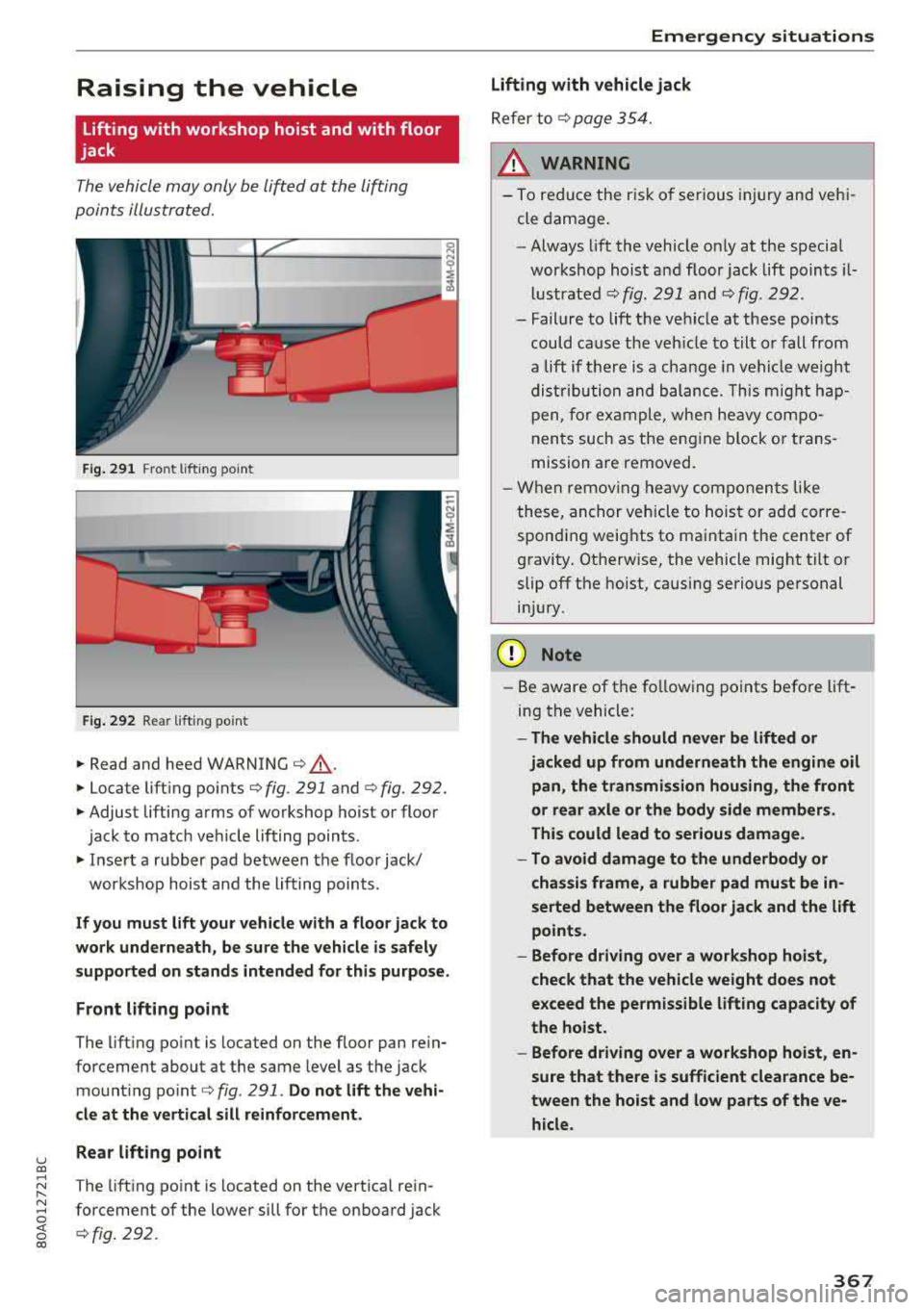
Fig. 291 Fro nt lift in g poin t
Fig. 292 Re ar lift ing poin t
.,. Read and heed WARNING c::> &, .
.. Locate lift ing po in ts c::> fig . 291 and c::>fig. 292.
.. Adjust lifting arms of wo rkshop ho ist or floo r
jac k to match veh icle lifting points .
.. Insert a r ubb er pad b etween t he floor jack/
workshop hois t and the lifting points.
If you must lift your vehicle with a floor jack to
work underneath , be sure the vehicle is safely
supported on stands intended for this purpose.
F ront lifting point
The lift ing po int is located on the floor pan re in
forcement about a t th e same leve l as the jack
mo unt ing po int
c::> fig . 291 . Do not lift the vehi
cle at the vertical sill reinforcement.
Rear lifting point
T he lift ing po int is located on the vert ica l re in
forcement of the lower sill fo r th e on board jack
c::> fig. 292 .
Emergency situations
Lifting with vehicle jack
Refer to c::> page 354.
__&. WARNING
- To red uce the r is k of se riou s injury and veh i
cle dama ge.
- Always lift the vehicle on ly at the special
workshop hois t and floor jack lift poin ts i l
l u stra ted
c::> fig. 291 and c::> fig . 292.
- Failure to lift t he ve hicle at these poi nts
could cause the veh icle to tilt o r fall from
a lift if t here is a change in v ehi cle weight
d is tr ibu tion and b ala nce . T his migh t ha p
pen , for ex am ple, when heavy co mpo
nen ts such as the e ngine block o r trans
mission a re removed.
- Wh en remov ing heavy com ponen ts like
t hese, an chor ve hicle to hoist or ad d corre
spond ing weig hts to ma inta in the center of
g ravi ty . Ot herw ise, the vehicle mig ht tilt or
slip off the hoist, causing serious pe rsonal
in ju ry.
(D Note
- Be aware of the fo llow ing points before lift
in g th e vehicle :
-The vehicle should never be lifted or
jacked up from underneath the engine oil pan, the transmission housing, the front
or rear axle or the body side members .
This could lead to serious damage .
- To avoid damage to the underbody or
chassis frame, a rubber pad must be in
serted between the floor jack and the lift
points.
- Before driving over a workshop hoist ,
check that the vehicle weight does not
exceed the permissible lifting capacity of
the hoist.
- Before driving over a workshop hoist , en
sure that there is sufficient clearance be
tween the hoist and low parts of the ve hicle.
367