trailer AUDI Q7 2009 Owner´s Manual
[x] Cancel search | Manufacturer: AUDI, Model Year: 2009, Model line: Q7, Model: AUDI Q7 2009Pages: 426, PDF Size: 97.13 MB
Page 310 of 426
ll'I __ T_ r _a_ il_e _r_ t_ o_ vv_ in__... g,_ __________________________________________________ _
& WARNING
Anyone not properly restrained in a moving vehicle is at a much
greater risk
in an accident. Never let anyone ride in your car who
is not properly wearing the restraints provided by Audi .
c:
Trailer towing tips
Important to know
Your vehicle handles differently when towing a trailer because of
the additional weight and different weight distribution. Safety,
performance and economy will greatly depend on how carefully you
load your trailer and operate your rig.
Before you actually tow your trailer, practice turning, stopping and
backing up in an area away from traffic. Keep practicing until you
have become completely familiar with the way your vehicle -trailer
combination behaves and responds.
Backing up is difficult and requires practice. Backing up with a
trailer generally requires steering action opposite to that when
backing up your vehicle without a trailer.
Maintain a greater distance between your vehicle and the one in
front of you. You will need more room to stop. To compensate for
the trailer, you will need a larger than normal turning radius.
When passing, remember that you cannot accelerate as fast as you normally would because of the added load. Make sure you have
enough room to pass. After passing, allow plenty of room for your
trailer before changing lanes again.
Avoid jerky starts, sharp turns or rapid lane changes.
[ i] Tips
• Do not tow a trailer during the break-in period of your vehicle. • If you tow
a trailer, your Audi may require more frequent mainte
nance due to the extra load~
page 401. •
Parking on a s1ope
Do not park on a slope with a trailer. If it cannot be
avoided , do so only after doing the following:
When parking:
-Apply the foot brake.
- Have someone place chocks under both the vehicle and
the trailer wheels.
- With chocks in place, slowly release the brakes until the
wheel chocks absorb the load.
- Turn the wheels towards the curb.
- Apply the parking brake.
- Move the selector lever to
P.
When restarting after parking:
- Apply the foot brake.
- Start the engine.
- Move the selector lever to
D.
-Release the parking brake and slowly pull out and away
from the wheel chocks.
- Stop and have someone retrieve the wheel chocks.
[ i] Tips
I f you move the selector lever of the automatic transmission to P
before applying the parking brake and before blocking the wheels, II-
Page 311 of 426

you may have to use more force later to move the lever out of the P
position .•
Controls and equip
ment Safety first Vehicle operation
Trailer towing
Vehicle care Do-it-yourself service
Technical data
Page 355 of 426
Tires a nd wh eels -
----------------
•
Because technical changes may be made to vehicle equipment
during the mode l year, always compa re the tire size designation on
the tire pressure label on your vehic le with the tires on your vehicle.
Make sure that the tire size information on the vehicle labe l is the
same as the size of the tires on the vehicle . This is especially impor
tant if the vehicle belongs to someone else or you bought the
veh ic le with different rims/tires or you bought the vehicle as a previ
ously owned vehicle.
Remember, your safety and that of your passengers also depends
on making sure that load limits are not exceeded. Vehicle load
includes everybody and everything in and on the vehicle . These load
limits are technically referred to as the vehicle's Gross Vehicle
Weight Rating ("GVWR"l. The Gross Axle Weight Rating ("GAWR"l is
the maximum load that can be applied at each o f the vehicle's two
ax les . The Gross Vehic le Weight Rating and the Gross Ax le Weight
Rating are l isted on the safety compl iance sticker labe l located
either on the driver's side 8 -pillar or on the inside of the fuel fi ller
flap. The ti re pressure labe l on your Audi lists the maximum
combined we ight of a ll of the occupants and luggage or other cargo
t hat the vehic le can carry. For the location of the tire pressure la bel
=>
page 357, fig . 291.
& WARNING
O verload ing a vehi cle can c ause loss of vehi cle co ntrol , a cra sh or
other a ccid ent , s eriou s per sonal injury , and even death.
• Carrying more weight than your vehicle wa s de signed to carry
w ill p revent the vehicle from h andling properly and incre ase the
ri sk of a l oss of vehi cle control .
• The brake s on a vehicle that ha s been o verloaded m ay not be
a ble to stop the vehicle with in a safe distance .
• Tires on a v ehi cle that ha s been o verlo aded can fail suddenl y
c au sin g loss o f control a nd a cra sh .
• Alwa ys ma ke sure that the total l oad being tr ansp o rted -
including th e wei ght of a trailer hit ch and the tongu e weight of a
& W AR N IN G (c ontinued )
loaded trailer -does not m ake the vehi cle heavier than the
v ehicle' s Gro ss Vehicle W eight Rating.
& WARNING
• Incor re ct t ire pre ssures a nd/o r underi nfl ation can le ad to a
s erious or fatal a ccident.
• Incorre ct t ire pre ssure s and/or u nderinfla tion ca use in crea sed
tire w ear and can affect th e handling of the vehicle.
• Incorre ct t ire p ressu res and /or underinfl ation c an als o lead to
s udden tire failure , including a blowout and sudden deflation ,
c au sin g lo ss of vehi cle co ntr ol. •
Checking tire pressure
The correct tire pressure for the tires originally installed
o n your vehicle is listed on the tire pressure label located
either on driver's side 8 -pil/ar or inside the fuel filler flap .
The recommended tire pressures are on the tire pressure label and
in the table=>
page 351, "Cold tire inflation pressure" .This means
that the pressure must be checked and adjusted when the tire has
not been driven for more than a couple of mi les (kilomete rs} at low
speeds during the previous three hours. Air in the tires expands
when the tire heats up as a result of internal fric tion as i t flexes in
use. The tire pressure is higher when the tire has warmed up than
when it is "cold ."
It is the inflation pressure in a "cold" tire that counts. Therefore, you
should never let air out of a warm tire to match "Co ld tire inflation
pressure" recommendations=>
page 351 . The tires wou ld then be
underinflated and could fail suddenly.
The tire pressure label on your Audi lists the recomme nded cold tire
inflation pressures at maximum capacity for the new, origina l equip -.,.
Vehicle care I t •
Page 357 of 426
Tires and wheels -_____________ .:.....::...=..____:__:_:_:_=-=----
•
& WARNING (continu ed )
• Incorrect tire pressure and /or under inflation can cause
in creased tire wear and can affect the handling of the vehicle and
stopping ability .
• Incorrect t ire pressures and /o r underinflat ion can also lead to
sudden tire failure, including a blowout and sudden deflation,
causing lo ss of vehicle control .
• The driver is respon sible for the correct tire pressures for all
tires on the vehicle. The applicable pre ssure values are located on
a sticker on the driver 's side 8-pillar or on the inside of the fuel
filler flap .
• Only when all tires on the vehicle are filled to the correct pres
sure , the tire pressure monitoring sy stem can work correctly .
• The use of incorrect tire pressure values can lead to accidents
or other damage . Therefore it is essential that the driver observe
the specified tire pressure value s for the tires and the correct pres
sures for the function of the tire pressure monitoring system.
• Always inflate tires to the re commended and correct tire pres
sure before driving off .
• Driving with underinflated tires bend more , letting them get
too hot resulting in tread separation , sudden tire failure and loss
of control.
• Ex cessive speed and /overloading can cause heat build-up ,
s udden tire failure and lo ss of control .
• If the tire pres sure is too low or too high , the t ires will wear
prematurely and the vehicle will not handle well .
• If the tire is not flat and you do not have to change a wheel
immediately , drive at reduced speed to the nearest service station
to check the t ire pressure and add air as required.
0 Note
Dr iving wi thout valve stem caps ca n cause damage to t he tire
valves. To prevent this, always make sure that factory instal led va lve
stem caps o n all wheels are sec urely mou nted on the va lve .
c£> For the sake of the environment
Underi nflate d tir es w ill a lso inc rease the fue l consu mptio n.•
Tires and vehicle load limits
There are li m its to the a mou nt o f load or weig ht th at any ve hic le and
any tire can carry . A vehicle that is overloaded wil l not handle wel l
and is more diff icu lt to stop . Overload ing ca n no t only lead to loss
of vehic le control, but can also damage important parts of the
ve hicle a nd can lead to sud den tire failu re, i nclu di ng a bl owou t and
sudden deflat ion that can cause the vehic le to crash.
Your safety an d that of your passengers also depends on ma kin g
su re tha t load l imits are not exceeded . Vehicle load includes eve ry
body and everything in and on the vehic le. These load limits are
t echnica lly re ferred to as the ve hicle's
Gross Vehicle Weight Rating
("GVWR"l.
The "GVWR" in clu de s th e we ig ht of t he basi c ve hicle, all fac tory
insta lled accessories, a ful l tank of fuel, oil, coolant and other fluids
plus m aximu m load. The maxi mum l oad inc lude s the n umber of
passen gers that the vehicle is intended to carry !"seating capacity")
with an assumed weight of 150 lbs (68 kg) fo r each passenger at a
designated seating position and the total weight of any lugga ge in
the vehicle. If you tow a trailer, the weight of the trailer hitch and the
to ngue we ig ht of th e loaded tra iler must b e included as par t of th e
vehic le load.
The
Gross Axle Weight Rating ("GAWR") is the m aximum loa d th at
can be applied at each of the vehicle's two ax les. _,,,
Vehicle care I t •
Page 358 of 426
-~_T_ ir_e _s_ a_n_ d_ w_ h _e_e_ l_ s _______________________________________________ _
The Gross Veh icl e We ight Rating and the Gross Axle Weight Rating
ar e l isted on th e safe ty comp lia nce st icker labe l located ei ther on
the driver's side 8 -p illar or on the inside of the fue l filler flap. Your
Audi has 5 seating positi ons, 2 in the fron t and 3 in the rea r for total
seating capacity of 5 . On vehicles with s ix seats*, your ve hicle has
two front seats, two seats in the second row seating an d two sea ts
i n t he t hir d row seating. On ve hic les w ith seven seats*, your ve hicle
has two front seats, three seats in the second row seating and two
seats in the th ir d row sea tin g. Eac h seat ing pos it ion has a seat belt
=>
page 231, " S afety belts".
T he fact that there is a n upper l imit to your ve hicle's Gro ss Vehic le
Weight Rating means that the total we ight of whatever is bein g
carried in the vehic le ( including the we ig ht of a t rai le r h itc h a nd the
t on gue wei ght o f the load ed trai ler) is lim ited. The more passen ge rs
in the ve hicle o r passe nger s w ho are heavier t han the s tanda rd
we ights assumed mea n th at l ess wei ght ca n be ca rri ed as lu gg age .
Th e tire pressure labe l on your Audi also lists the maximum
co mbi ned we igh t of all o f th e occ upa nts a nd luggage o r othe r ca rgo
that the vehicle can carry. For the location of the label=>
page 351,
fig . 291 .
LJ}. WARNING
Overloading a vehicle can cause loss of vehicle control , a crash or
other accident , serious personal injury , and even death .
• Carrying more weight than your vehicle was designed to carry
will prevent the vehicle from handl ing properly and increase the
ri sk of the loss of vehicle control.
• The brakes on a vehicle that has been overloaded may not be
able to stop the vehicle within a safe distance.
• Tires on a vehicle that has been overloaded can fail suddenly ,
including a blowout and sudden deflation , causing loss of control
and a crash .
• Always make sure that the total load being transported -
including the weight of a trailer hitch and the tongue weight of a
& WARNING (continued)
loaded trailer -does not make the vehicle heavier than the
vehicle's Gross Vehicle Weight Rating .•
Determining correct load limit
Use the example below to calculate the
total weight of the passengers and
luggage or other things that you plan to
transport so that you can make sure that
your vehicle will not be overloaded.
Steps for Determining Correct
Load Limit
1. Locate the statement "THE COMBINED WEIGHT OF OCCUPANTS AND CARGO SHOULD NEVER EXCEED XXX KG OR XXX LBS"on your vehicle's placard (tire infla
tion pressure label)=>
page 351, fig. 291.
2. Determine the combined weight of the driver and passengers that will be riding
in your vehicle.
~
Page 359 of 426
3. Subtract the combined weight of the driver and passengers from
"XXX" kilo
grams or
"XXX" pounds shown on the
sticker=>
page 351, fig. 291.
4. The resulting figure equals the available amount of cargo and luggage load capacity. For example, if the
"XXX"
amount equals 1400 lbs. and there will
be five 150 lbs. passengers in your
vehicle, the amount of available cargo and luggage load capacity is 650 lbs. (1400-750 (5
X 150) = 650 lbs.)
5. Determine the combined weight of luggage and cargo being loaded on the
vehicle. That weight may not safely exceed the available cargo and luggage
load capacity calculated in Step 4.
6. If your vehicle will be towing a trailer, load from your trailer will be transferred
to your vehicle. Consult this manual to determine how this reduces the avail
able cargo and luggage load capacity of
your vehicle.
Tires and wheels -
-Check the tire sidewall (=> page 359,
fig. 295) to determine the designated
load rating for a specific ti re. •
Tire service life
The service life of tires depends on a lot of different things
including proper installation and balancing, correct tire
pressure and driving style.
--
~-----------~
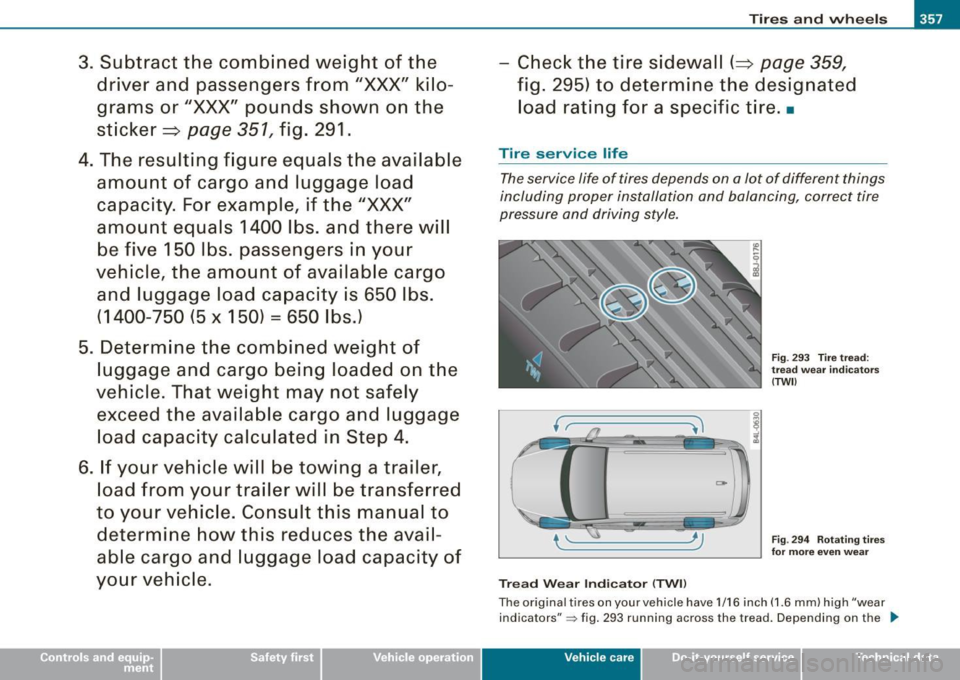
Tread Wear Indicator (TWI)
Fig. 293 Tire tread:
tread wear indicators
(TWI)
Fig. 294 Rotating tires
for more even wear
The original tires on your vehicle have 1 /16 inch (1.6 mm) high "wear
indicators" => fig. 293 running across the tread. Depending on the ._
Vehicle care I I irechnical data
Page 375 of 426
What do I do now? -
---------------~.;______
•
& WARNING (continued)
• Loose items in the passenger compartment can cause serious
personal injury during hard braking or in an accident .
- Never store the inflatable spare tire or jack and tools in the
passenger compartment.
- Always store all jacking equipment, tools, and the inflatable
spare tire in the luggage compartment.
- Tighten the knurled retaining screw for the inflatable spare
tire securely.
0 Note
• Th e inflatable spare tire has been developed specifically for this
vehicle model. It must not be exchanged or used for other vehicle
models. Similarly, inflatable tires from other vehicle models must
not be used.
• Normal summer or winter tires must not be installed on the
inflatable tire rim.•
Changing a wheel
Before changing a wheel
Observe the following precautions for your own and your
passenger's safety when changing a wheel.
-After you experience a tire failure, pull the car well away
from moving traffic and try to reach
level ground before
you stop => & .
- All passengers should
leave the car and move to a safe
location (for instance, behind the guardrail)=> &.
- Engage the
parking brake to prevent your vehicle from
rolling unintentionally=> &. -
Move
selector lever to position P =:> & .
- If you are towing a trailer: unhitch the trailer from your
vehicle.
- Block the diagonally opposite wheel with the folding
chocks or other objects.
- Take the
jack and the inflatable spare tire out of the
luggage compartment=>
page 370.
& WARNING
You or your passengers could be injured while changing a wheel if
you do not follow these safety precautions:
• If you have a flat tire, move a safe distance off the road. Turn off
the engine, turn the emergency flashers on and use other warning
devices to alert other motorists.
• Make sure that passengers wait in a safe place away from the
vehicle and well away from the road and traffic.
• To help prevent the vehicle from moving suddenly and possibly
slipping off the jack , always fully set the parking brake and block
the wheel diagonally opposite the wheel being changed with the
folding chocks or other objects. When one front wheel is lifted off
the ground, placing the Automatic Transmission in "P" (Park) will
not prevent the vehicle from moving.
• Before you change a wheel, be sure the ground is level and firm .
If necessary, use a sturdy board under the jack.
• After installing the inflatable spare tire, make sure that you
replace the flat tire/wheel in its storage area properly and tighten
the knurled retaining screw securely. •
Do-it -yourself service
Page 387 of 426

_________________________________________________ F_ u_ s_ e_s _ a_n _ d_ b_ u_lb _ s __ llll
No . Equipm ent Amps No. Equipm ent Amps
Fuse holder (brow n) 10 Trailer hitch (left side of vehicle) 20
1 Not used 11 Trailer hitch (right side of v ehicle) 20
2
Not used 12 Not used •
3 Not used
4 Not used Bulbs
5 K -box (MMll, antenna amplifier 5
Not used Replacing light bulbs
7 Navigation 5 For your safety, we recommend that you have your autho-
Digital Signal Processing (DSP)/ rized Audi dealer replace burned out bulbs for you .
8 BOSE amplifier 30
It is becoming increasingly more and more difficult to replace --
9 Digital Tuner 5 vehic le light bu lbs since in many cases, other parts of the car must
10 Bang & Olufsen amplifier 30 first be removed before you are able to get to the bulb. This applies
especially to the light bulbs in the front of your car which you can
11 Rear view camera 5 only reach through the engine compartment.
12 Not us ed
Sheet metal and bulb holders can have sharp edges that can cause
Fuse holde r (re d ) serious cuts, and parts must be correctly taken apart and then prop -
1 Not used erly put back together to he
lp prevent breakage of parts and long
term damage from water that can enter housings that have not
2 Not used been properly resealed.
3 Not used For your safety, we recommend that you have your authorized Audi
4 Not used dea
ler replace any bu lbs for you, since your dealer has the proper
tools, the correct bulbs and the expertise.
5 Not used Gas disch arge lamp s (Xeno n ligh ts)*:
6 Soft close 20 Due to the high electrica
l voltage, have the bulbs replaced by a qua I -
7 Power rear lid 30 ified technician. Headlights with Xenon light can be identified by the
8 Power rear lid 30 h igh voltage sticker . .,,,
9 Trailer hitch 15
• Do-it-yourself service
Page 400 of 426
___ G_ e_n_ e _ r_a _l _ i_n _f_o _ r_ m_ a_ t_ i_ o _ n ________________________________________________ _
& WARN ING (continued )
• The Gro ss Veh icle Weight R ating for y our Audi 07 would be
e xc eeded if your vehicle is simult aneously equipped with
P a nor amic slid ing sunroof ; thi rd-ro w seating ; trailer tow ing equ ip
ment (factory or deale r-inst alled ), and running bo ards (de aler
in stalled) . UNDER NO CIRCUMSTANCES MAY ALL SUCH ITEM S BE
IN STALLED ON THE SAME VEHICLE.
• The a ctual Gros s Axle We ight R ating at the front and rear axles
s hould not e xceed the p ermi ssible weight s, and their comb ination
mu st not e xceed the Gross Vehi cle Weight Rati ng .
• Exc eeding perm issible weight rating s can result in vehi cle
d amage , a cc ident s and per son al inj ury.
0 Note
• The vehicle capacity weight figures apply when the load is
distr ibuted evenly in the vehic le (passengers a nd luggage) . When
transporting a heavy load in the luggage compartment, carry the load as near to the rear ax le as possible so that the vehic le's
handling is not impaired.
• Do not exceed the maximum perm issible axle loads or the
maximum gross vehic le weight. Always remember that the vehicle's
handling will be af fected by the extra load. Therefore, adjust your
speed according ly .
• Always observe local regulations .•
Dimensions
The specifications refer to the basic mode l. Differences may occur
depending on the mode l type and options ordered, for example, tire
s izes .
0 Note
When driving up steep ramps, on rough roads, over curbs, etc. it is
important to remember that some parts of your vehic le, such as
spo ilers or exhaust system components, may be c lose to the
ground. Be carefu l not to damage them. •
Page 404 of 426
____ C_ o_n_ s_ u_m _ e_ r_ ln_ f_ o _r _m _ a_ t_ i_o _n ______________________________________________ _
reliability. For detailed vehicle maintenance consult your Warranty &
Maintenance book let.
Und er di ffi cult ope rating cond ition s, for example at extremely low
outside temperatures, in very dusty regions, when towing a trailer
very frequen tly, etc., some service work shou ld be performed
between the intervals specified. This applies particularly to:
• oil changes, and
• cleaning or replacing the air filter.
sion standards are maintained, thus minimizing adverse effects on
the environment. •
Important considerations for you and your
vehicle
The increasing use of electronics, sophisticated fuel injection and
emission control systems, and the general ly increasing technical
complexity of today's automobi les, have steadi ly reduced the scope
of maintenance and repa irs which can be carried out by vehicle
owners.
Al so, sa fety a nd e nvironment al concerns p lace very strict
limi ts on the na ture of repairs a nd adjustments to engine and trans
mission parts which an owner can perform.
Maintenance, adjustments and repairs usually require special tools,
testing dev ices and other equipment ava ilable to specially trained
workshop personnel in order to assure proper performance, reli
ability and safety of the vehicle and its many systems.
Improper maintenance, adjustments and repairs can impair the
ope ration and re liability of your vehic le and even void your vehic le
warranty. Therefore, proof of servicing in accordance with the main
tenance schedu le may be a condition for upholding a pos sible
warranty claim made within the warranty period. Above all, operational safety can be adversely affected, creating
unnecessary r isks for you and your passengers .
If in doubt about any servicing, have it done by your authorized Audi
dea ler or any other properly equipped and qualified workshop. We
strongly urge you to give your authorized Audi dealer the opportu
nity to perform all scheduled maintenance and necessary repairs.
Your dealer has the fac ilities, origina l parts and trained spec ial ists
to keep your vehicle running proper ly.
P e rforming limited maint ena nce your self
The following pages describe a lim ited number of procedures which
can be performed on your vehicle wi th ordinary too ls, should the
need arise and trained personnel be unavai lab le. Before performing
any of these procedures, a lways thoroughly read all of the appli
cable text and carefu lly follow the instructions given. Always rigor
ously observe the
WARNINGS provide d.
Before you che ck anything in th e eng ine compartment , always read
and heed all WARNINGS~
& and~ & in "Working in the engine
compartment" on
page 331.
& WARNING
• Serio us per sonal injur y may oc cur a s a re sult of improperly
performed maintenan ce , adjustment s or repair s.
• Alway s be e xtremely careful when working on the vehi cle .
Alway s follow commonly accepted s afety pra ctice s and general
c ommon sen se . Ne ver ri sk p ers onal injury .
• Do not attempt any of the maintenan ce , check s or repair s
de scr ibed on the follo wing page s if you are not full y familia r with
the se or other procedure s with respect t o the vehicle , or are uncer
tain ho w to pr oceed .
• Do not do any work without the proper tool s and equ ipment .
Ha ve the ne cessa ry work done by your authorized Audi deale r or
another properly equipped and qu alified work shop .
~