child seat AUDI Q7 2011 Owner´s Manual
[x] Cancel search | Manufacturer: AUDI, Model Year: 2011, Model line: Q7, Model: AUDI Q7 2011Pages: 392, PDF Size: 93.29 MB
Page 193 of 392
________________________________________________ D_ r_ i_ v _i_n ""'g "-- S_a_ f_ e_ l _,,y'-- __
Important things to do before driving
Safety is everybody's job! Vehicle and occupant safety always depends on the informed and careful driver.
For your safety and the safety of your passengers, before
driving always:
- Make sure that all lights and signals are operating
correctly.
- Make sure that the tire pressure is correct.
- Make sure that all windows are clean and afford good visi-
bility to the outside.
- Secure all luggage and other items carefully::::>
page 107.
-Make sure that nothing can interfere with the pedals.
- Adjust front seat, head restraint and mirrors correctly for your height .
- Instruct passengers to adjust the head restraints according to their height.
- Make sure to use the right child restraint correctly to
protect children ::::,
page 233, "Child Safety".
- Sit properly in your seat and make sure that your passen gers do the same::::,
page 85, "General recommenda
tions".
- Fasten your safety belt and wear it properly. Also instruct
your passengers to fasten their safety belts properly
=:> page 201. •
Controls and equip
ment Safety first Vehicle operation
What impairs driving safety?
Safe driving is directly related to the condition of the
vehicle, the driver as well as the driver's ability to concen
trate on the road without being distracted .
The driver is responsible for the safety of the vehicle and all
of its occupants. If your ability to drive is impaired, safety
risks for everybody in the vehicle increase and you also
become a hazard to everyone else on the road::::,,& . There
fore:
Do not let yourself be distracted by passengers or by using
a cellular telephone.
NEVER drive when your driving ability is impaired (by
medications, alcohol, drugs, etc.).
- Observe all traffic laws, rules of the road and speed limits
and plain common sense .
- ALWAYS adjust your speed to road, traffic and weather
conditions.
- Take frequent breaks on long trips. Do not drive for more than two hours at a stretch.
- Do NOT drive when you are tired, under pressure or when
you are stressed .
& WARNING
Impaired driving safety increases the risk of serious personal
injury and death whenever a vehicle is being used.•
Vehicle care Do-it-yourself service Technical data
Page 195 of 392
________________________________________________ D_ r_ i_ v _i_n ""'g "-- S_a_ f_ e_ l _,,y'-- __
& WARNING (continued)
• Always sit in an upright position and never lean against or
place any part of your body too close to the area where the airbags
are located.
• Before driving, always adjust the front seats and head
restraints properly and make sure that all passengers are properly
restrained.
• Never adjust the seats while the vehicle is moving. Your seat
may move unexpectedly and you could lose control of the vehicle.
• Never drive with the backrest reclined or tilted far back! The
farther the backrests are tilted back, the greater the risk of injury
due to incorrect positioning of the safety belt and improper
seating position.
• Children must always ride in child safety seats~
page 233.
Special precautions apply when installing a child safety seat on
the front passenger seat~
page 211. •
Proper seating position for the front
passenger
The proper front passenger seating position is important
for safe, relaxed driving .
For your own safety and to reduce the risk of injury in the
event of an accident, we recommend that you adjust the seat
for the front passenger to the following position:
- Adjust the angle of the seatback so that it is in an upright
position and your back comes in full contact with it when
ever the vehicle is moving.
- Adjust the head restraint so the upper edge is as even as
possible with the top of your head. If that is not possible,
try to adjust the head restraint so that it is as close to this
position as possible=>
page 194.
Controls and equip
ment Safety first Vehicle operation
-
Keep both feet flat on the floor in front of the front
passenger seat.
- Fasten and wear safety belts correctly::::>
page 205.
For detailed information on how to adjust the front passenger's seat,
see ~
page 85.
& WARNING
Front seat passengers who are unbelted, out of position or too
close to the airbag can be seriously injured or killed by the airbag
as it unfolds. To help reduce the risk of serious personal injury:
• Passengers must always sit in an upright position and never
lean against or place any part of their body too close to the area
where the airbags are located.
• Passengers who are unbelted, out of position or too close to
the airbag can be seriously injured by an airbag as it unfolds with
great force in the blink of an eye.
• Always make sure that there are at least 10 inches (25 cm)
between the front passenger's breastbone and the instrument
panel.
• Each passenger must always sit on a seat of their own and
properly fasten and wear the safety belt belonging to that seat.
• Before driving, always adjust the front passenger seat and
head restraint properly.
• Always keep your feet on the floor
in front of the seat. Never
rest them on the seat, instrument panel, out of the window, etc.
The airbag system and safety belt will not be able to protect you properly and can even increase the risk of injury in a crash.
• Never drive with the backrest reclined or tilted far back! The
farther the backrests are tilted back, the greater the risk of injury
due to incorrect positioning of the safety belt and improper
seating position.
II>
Vehicle care Do-it-yourself service Technical data
Page 196 of 392
111....__D_ r_iv _i_ n_, g=-- S_ a _ f_e _,Ly _ ______________________________________________ _
& WARNING (continued)
• Children must always ride in child safety seats=> page 233.
Special precautions apply when installing a child safety seat on
the front passenger seat=>
page 211. •
Proper seating positions for passengers in
rear seats
Rear seat passengers must sit upright with both feet on
the floor consistent with their physical size and be prop
erly restrained whenever the vehicle is in use.
To reduce the risk of injury caused by an incorrect seating
position in the event of a sudden braking maneuver or an
accident, your passengers on the rear bench seat must
always observe the following :
- If there are passengers in the rear seat, fold the head
restraints up on the occupied seats or slide the center
head restraint upward at least to the next notch
~ page 93.
Make sure that the seatback is securely latched in the
upright position ~
page 96.
-Keep both feet flat in the footwell in front of the rear seat.
- Fasten and wear safety belts properly~
page 205.
- Make sure that children are always properly restrained in a
child restraint that is appropriate for their size and age
~ page 233.
& WARNING
Passengers who are improperly seated on the rear seat can be seri
ously injured in a crash.
• Each passenger must always sit on a seat of their own and
properly fasten and wear the safety belt belonging to that seat.
• Safety belts only offer maximum protection when the seatback
is securely latched in the upright position and the safety belts are
properly positioned on the body. By not sitting upright, a rear seat
passenger increases the risk of personal injury from improperly
positioned safety belts!
• Always adjust the head restraint properly so that it can give
maximum protection. •
Proper adjustment of head restraints
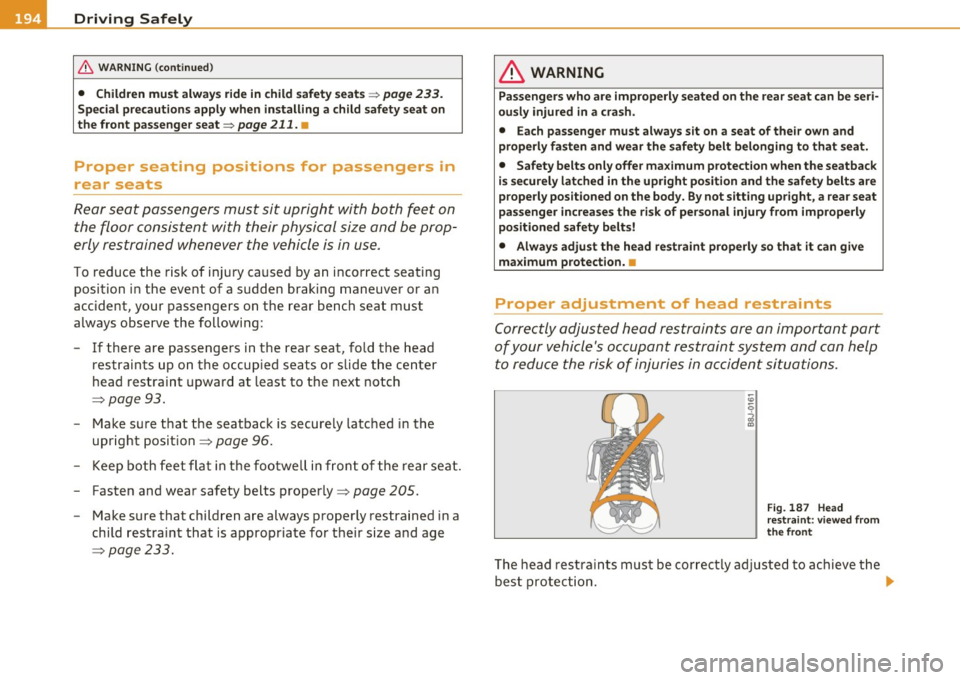
Correctly adjusted head restraints are an important part
of your vehicle's occupant restraint system and can help
to reduce the risk of injuries in accident situations .
Fig. 187 Head
restraint: viewed from
the front
The head restraints must be correctly adjusted to achieve the
best protection.
~
Page 197 of 392

________________________________________________ D_ r_ i_ v _i_n ""'g "-- S_a_ f_ e_ l _,,y'-- __
- Adjust the head restraints so the upper edge is as even as
possible with the top of your head. If that is not possible,
try to adjust the head restraint so that it is as close to this
position as possible=:> fig. 187.
- If there are passengers in rear seat, fold the head
restraints up on the occupied seats or slide the center
head restraint upward at least to the next notch.
Adjusting head restraints=> page 92.
& WARNING
Driving without head restraints or with head restraints that are
not properly adjusted increases the risk of serious or fatal neck
injury dramatically. To help reduce the risk of injury:
• Always drive with the head restraints in place and properly
adjusted.
• Every person in the vehicle must have a properly adjusted head
restraint.
• Always make sure each person in the vehicle properly adjusts
their head restraint. Adjust the head restraints so the upper edge
is as even as possible with the top of your head. If that is not
possible, try to adjust the head restraint so that it is as close to
this position as possible.
• Never attempt to adjust head restraint while driving. If you
have driven off and must adjust the driver headrest for any reason,
first stop the vehicle safely before attempting to adjust the head restraint.
• Children must always be properly restrained in a child restraint
that is appropriate for their age and size=>
page 233. •
Controls and equip
ment Safety first Vehicle operation
Examples of improper seating positions
The occupant
restraint system can only reduce the risk of
injury if vehicle occupants are properly seated.
Improper seating positions can cause serious injury or death.
Safety belts can only work when they are properly positioned
on the body. Improper seating positions reduce the effective
ness of safety belts and will even increase the risk of injury
and death by moving the safety belt to critical areas of the
body. Improper seating positions also increase the risk of
serious injury and death when an airbag deploys and strikes
an occupant who is not in the proper seating position. A
driver is responsible for the safety of all vehicle occupants
and especially for children . Therefore:
- Never allow anyone to assume an incorrect seating posi-
tion when the vehicle is being used=:>&.
The following bulletins list only some sample positions that will
increase the risk of serious injury and death . Our hope is that these
examples will make you more aware of seating positions that are
dangerous.
Therefore, whenever the vehicle is moving:
• never stand up in the vehicle
• never stand on the seats
• never kneel on the seats
• never ride with the seatback reclined
• never lie down on the rear seat
• never lean up against the instrument panel
• never sit on the edge of the seat
• never sit sideways
• never lean out the window
• never put your feet out the window
Vehicle care Do-it-yourself service Technical data
Page 200 of 392
• ....__D_ r_iv _i_ n_, g=-- S_ a _ f_e _,Ly _ ______________________________________________ _
& WARNING (conti nu ed )
• Pleas e obse rve information on s afe driving => page 190.
& WARNING
To help prevent poi sonous exhau st ga s from being drawn into the
vehicle, always keep the rear lid closed while driving.
• Never transport object s larger than tho se fitting completely
into the luggage area because the rear lid cannot be fully closed.
• If you ab solutely must drive with the rear lid open, observe the
following notes to reduce the ris k of po isoning:
- Close all windows,
- Close the Pano ramic sliding sunroof*,
- Open all air outlets in the instrument panel,
- Swit ch off the air recirculation,
- Set the fresh air fan to the h ighest speed.
& WARNING
Alway s make sure that the doors, all windows, the Panorami c
sliding sunroof* and the rear lid are secur ely closed and locked to
reduce the risk of injury when the vehicle is not being used.
• After closing the rear lid, always make sure that it is properly
clo sed and locked .
• Never leave your vehicle unattended especially with the rear lid
left open . A child could crawl into th e vehicle through the luggage
compartment and close the rear lid becoming trapped and unable
to get out . Being trapped in a vehicle can lead to serious personal
injury.
• Never let children play in or around the vehicle.
• Never let passengers ride in the luggage compartment. Vehicle
occupants must alway s be properly restrained in one of the
vehicle 's seating positions.
W Tips
• Air circulation helps to reduce window fogging. Sta le air escapes
to the outside th rough vents in the trim panel. Be sure to keep these
slo ts free and open.
• Th e tire pressure m ust correspond to the load . The tire pressure is
shown o n th e t ire pressu re label. The tire pressure label is located o n
the driver's side 8-pillar . The tire p ress ure label lists the recom
me nded co ld tire inflation pressures fo r th e ve hicle at its max imum
capacity weight and the tires that were on your vehicle at t he time it
was manufactured. For recommended t ire pressu re s for normal loa d
conditions, p lease see chapter=>
page 322. •
Tie-downs
The lug gage c omp artm ent is equ ipped with fo ur tie
do wns to secur e luggag e and oth er items .
Use the t ie-downs to sec ure yo ur cargo properly => page 197,
"Load ing the l uggage comp artmen t".
In a co llision , the laws of physics mean that even smaller items that
are loose in the vehicle will become heavy m issi les t hat can ca use
ser ious injury. Items in the vehicle possess energy which va ry with
veh icle speed and the weight of the item . Vehicle speed is the most
sign ifi cant factor .
For example, in a frontal coll is ion at a speed of 30 mp h (48 km/h),
the forces a cting on a 1 0-lb (4.5 kg) o bje ct are about 20 times the
normal weight of the item. This means that the weight of the item
wou ld sudden ly be abo ut 200 l bs. (9 0 kg). You can imagine the inju
r ies that a 200 lbs. (90 kg) item flying freely through the passenger
compar tment cou ld cause in a collision like this .
liJ,
Page 201 of 392
& WARNING
Weak, damaged or improper straps used to secure items to tie
downs can fail during hard braking or in a collision and cause
serious personal injury.
• Always use suitable mounting straps and properly secure items
to the tie-downs in the luggage compartment to help prevent
items from shifting or flying forward as dangerous missiles.
• When the rear seat backrest is folded down, always use suit
able mounting straps and properly secure items to the tie-downs
in the luggage compartment to help prevent items from flying
forward as dangerous missiles into the passenger compartment.
• Never attach a child safety seat tether strap to a tie-down. •
Reporting Safety Defects
Applicable to U.S.A.
If you believe that your vehicle has a defect
which could cause a crash or could cause injury or death, you should immediately inform the National Highway Traffic Safety Administration
(NHTSA) in addition to notifying Audi of
America, Inc.
If NHTSA receives similar complaints, it may
open an investigation, and if it finds that a
safety defects exists in a group of vehicles, it may order a recall and remedy campaign.
However, NHTSA cannot become involved in
Controls and equip ment Safety first Vehicle operation
Driving Safely
-
individual problems between you, your dealer,
or Audi of America, Inc.
To contact NHTSA, you may call the Vehicle
Safety Hotline toll-free at:
Tel.: 1-888-327-4236 (TTY: 1-800-424-9153) or write to:
Administrator NHTSA 1200 New Jersey Avenue, SE
Washington, D.C. 20590
You can also obtain other information about motor vehicle safety from:
http:/ /www.safercar.gov
Applicable to Canada
Canadian customers who wish to report a
safety-related defect to Transport Canada,
Defect Investigations and Recalls, may tele
phone the toll free hotline:
Tel.: 1-800-333-0371 or
Tel.: 1-613-998-8616 if you are in the Ottawa area
TTY for hearing impaired: 1-888-675-6863
email comments/questions to: [email protected] ..,
Vehicle care Do-it-yourself service Technical data
Page 203 of 392
_______________________________________________ S_ a_ f_ e_ t_ y_ b_ e_ lt_s __ _
Safety belts
General notes
Always wear safety belts!
Wearing safety belts correctly saves lives!
This chapter explains why safety belts are necessary, how
they work and how to adjust and wear them correctly.
- Read all the information that follows and heed all of the
instructions and WARNINGS.
& WARNING
Not wearing safety belts or wearing them improperly increases
the risk of serious personal injury and death.
• Safety belts are the single most effective means available to
reduce the risk of serious injury and death in automobile acci
dents. For your protection and that of your passengers, always
correctly wear safety belts when the vehicle is moving.
• Pregnant women, injured, or physically impaired persons must
also use safety belts. Like all vehicle occupants, they are more
likely to be seriously injured if they do not wear safety belts. The
best way to protect a fetus is to protect the mother - throughout
the entire pregnancy. •
Number of seats
Vehicles with five seats: Your vehicle has two front seats and three
rear seats. Each seating position has a safety belt.
Vehicles with six seats:* Your vehicle has two front seats, two seats
in the second row and two seats in the third row. Each seating posi
tion has a safety belt.
Controls and equip ment Safety first Vehicle operation Vehicles with
seven seats:* Your vehicles has two front seats, three
seats in the second row and two seats in the third row . Each seating
position has a safety belt.
& WARNING
Not wearing safety belts or wearing them improperly increases
the risk of serious personal injury and death.
• Never strap more than one person, including small children,
into any belt. It is especially dangerous to place a safety belt over
a child sitting on your lap.
• Never let more people ride in the vehicle than there are safety
belts available.
• Be sure everyone riding in the vehicle is properly restrained
with a separate safety belt or child restraint. •
Safety belt warning light l
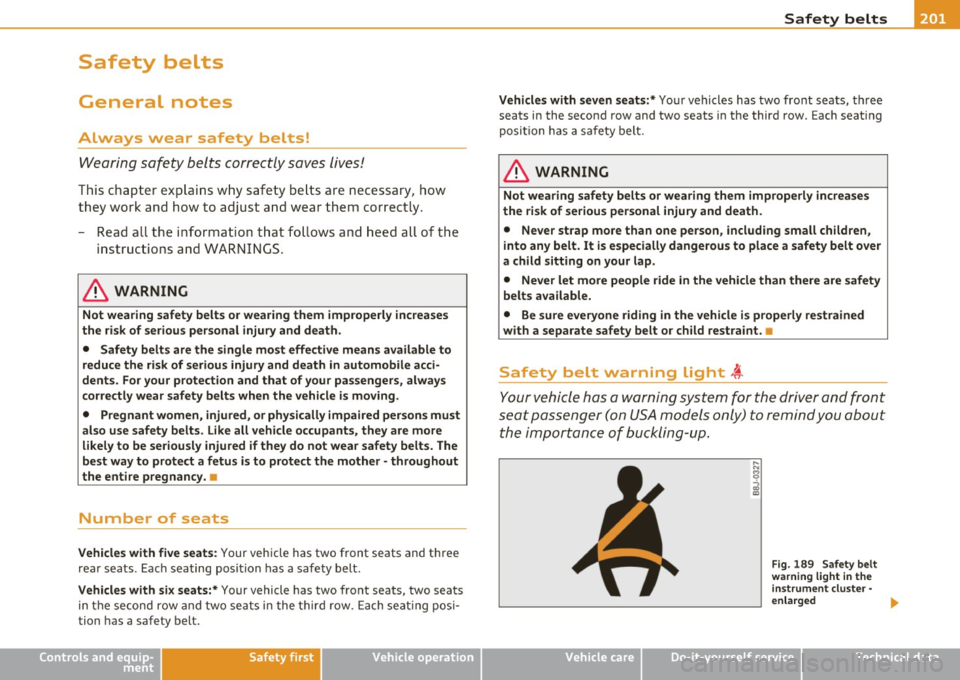
Your vehicle hos a warning system for the driver and front
seat passenger (on USA models only) to remind you about the importance of buckling-up.
Vehicle care
Fig. 189 Safety belt
warning light in the
instrument cluster·
enlarged ...
Do-it-yourself service Technical data
Page 206 of 392
__ _:::S:.::a :..:f...:e :.:t::1y ~ b:..:e:.: l:.: t :.:s :._ ____________________________________________ _
Safety belts protect
People think it's possible to use the hands to brace the
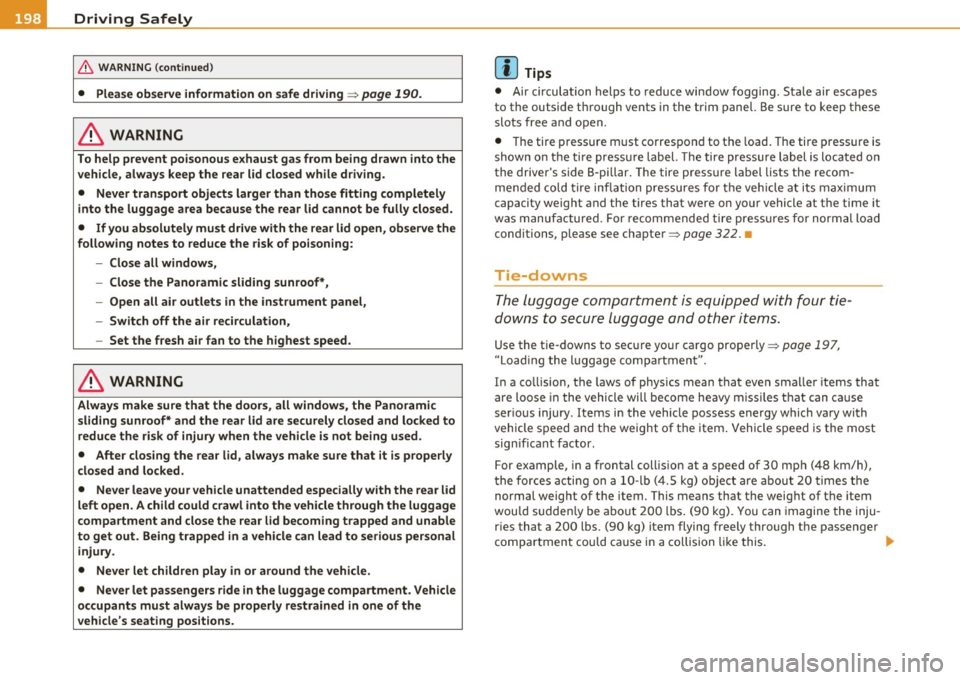
body in a minor collision . It's simply n ot true!
F ig. 194 Driver is
correct ly re str ain ed in
a s udden b rakin g
m ane uver
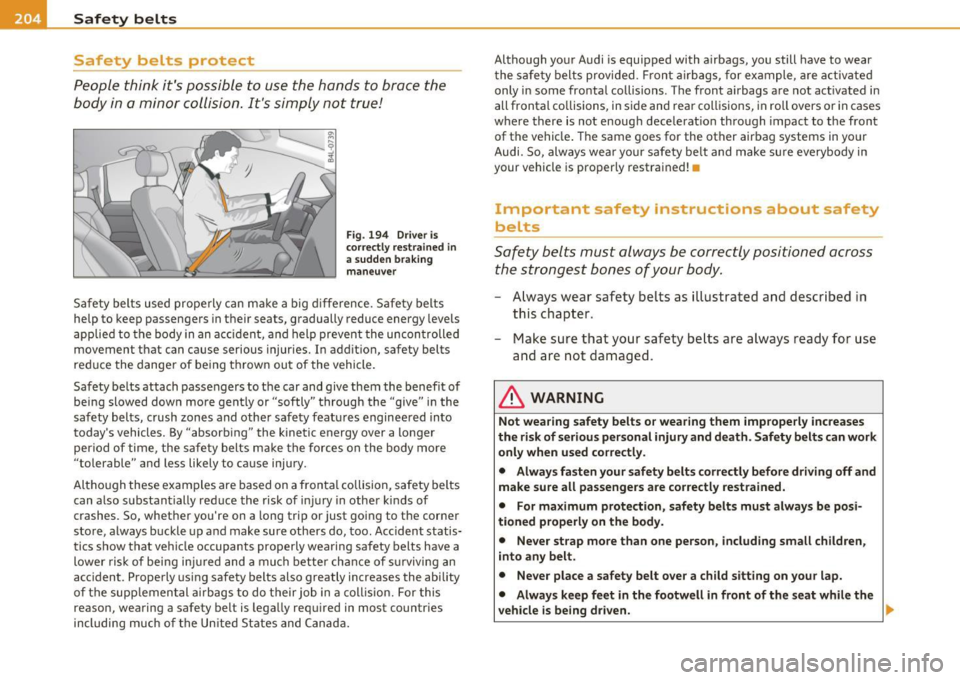
Safe ty belts used properly can make a big d ifference. Safe ty belts
help to keep passengers in their seats, gradually reduce energy levels
applied to the body in an accident, an d help prevent the uncon trolled
movement that can cause serious injuries. In add it ion, safety belts
red uce the danger of be ing t hrown ou t of the vehicle .
Safety be lts attach passengers to the car and give them the benefit of
being slowed down more gently or "softly" through the "give" in the
safety belts, crush zones and othe r saf ety features engine ered into
today's vehicles. By "absorb ing" the kinetic energy over a longer
per iod of time , the safety belts m ake the forces on the body more
"tolerable" and less likely to cause injury.
Altho ugh these examples are based on a fronta l collision, safety belts
can also s ubstant ially red uce the risk of injury in other ki nds of
crashes. So, whether you're on a long trip or just going to the corner
sto re, always buckle up and make sure others do, too. Acc ident statis
tics show that vehicle occupants properly wear ing safety belts have a
lower ris k of bei ng inj ured and a mu ch better cha nce of s urviv ing an
acc ident . Properly using safety belts also greatly increases the ability
of the supp lemen tal air bags to do the ir job in a coll is ion. For this
reason, wearing a safety bel t is lega lly requ ired in most coun tries
including muc h of the Un ited States and Canada. Altho
ugh your Audi is equ ipped with a irbags, you still have to wear
t he safe ty belts provided. Fron t air bags, for ex ample, are a ctiv ate d
only in some frontal collisions . T he front a irbags are not act ivated in
all frontal co llisions, in s ide and rear coll isio ns, in roll overs or in cases
where there is not enough decelerat ion thro ugh impact to the front
of the vehicle . The same goes for the other airbag systems in yo ur
Audi. So, always wea r your safety be lt and make su re everybody in
your vehicle is properly restrained!
Important safety Instructions about safety
belts
Safety b elts must always be correctly positioned across
the strongest bones of your body .
-Always wear safety belts as illustrated and described in
this chapter .
- Make sure that your safety belts are always ready for use and are not damaged .
& WARNING
Not wearing safety belts o r wearing them improperly inc reases
the risk of s eriou s personal injury and death . Safety belts can work
only when u sed correctl y.
• Alway s fasten your safety belts correctly bef ore driving off and
make sure all passengers are corre ctly restrained.
• For ma ximum protection , safety belts must alw ays be posi
ti oned properly on the body.
• Never strap more than one person , including small children ,
into any belt .
• Never place a safety belt o ver a ch ild sitting on you r lap .
• Alway s keep feet in the footwell in front of the seat while the
vehicle is being driven.
~
Page 207 of 392
& WARNING (continued)
• Never let any person ride with their feet on the instrument
panel or sticking out the window or on the seat.
• Never remove a safety belt while the vehicle is moving. Doing
so will increase your risk of being injured or killed.
• Never wear belts twisted.
• Never wear belts over rigid or breakable objects in or on your
clothing, such as eye glasses, pens, keys, etc., as these may cause
injury.
• Never allow safety belts to become damaged by being caught
in door or seat hardware.
• Do not wear the shoulder part of the belt under your arm or
otherwise out of position .
• Several layers of heavy clothing may interfere with correct
positioning of belts and reduce the overall effectiveness of the
system.
• Always keep belt buckles free of anything that may prevent the
buckle from latching securely.
• Never use comfort clips or devices that create slack in the
shoulder belt. However, special clips may be required for the
proper use of some child restraint systems.
• Torn or frayed safety belts can tear, and damaged belt hard
ware can break in an accident. Inspect belts regularly. If webbing, bindings, buckles, or retractors are damaged, have belts replaced
by an authorized Audi dealer or qualified workshop.
• Safety belts that have been worn and loaded in an accident
must be replaced with the correct replacement safety belt by an
authorized Audi dealer. Replacement may be necessary even if
damage cannot be clearly seen. Anchorages that were loaded
must also be inspected.
• Never remove, modify, disassemble, or try to repair the safety
belts yourself.
Safety first Vehicle OP-eration
Safety belts
& WARNING (continued)
• Always keep the belts clean. Dirty belts may not work properly
and can impair the function of the inertia reel=>
page 289,
"Safety belts". •
Safety belts
Fastening safety belts
Seat first -everybody buckle up!
Fig. 195 Belt buckle
and tongue on the
driver's seat
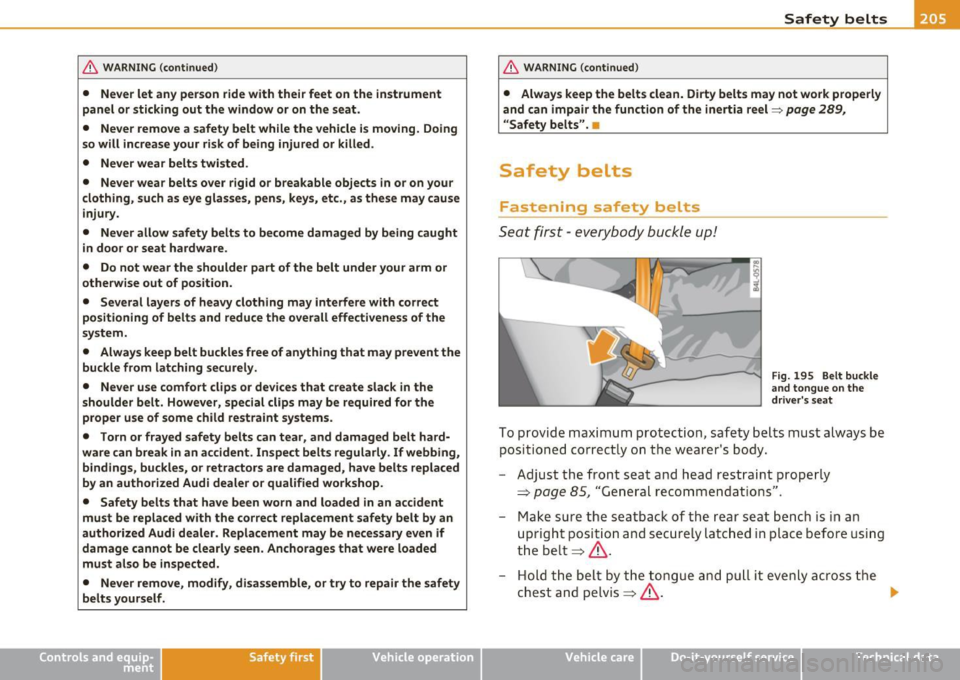
To provide maximum protection , safety belts must always be
positioned correctly on the wearer's body.
- Adjust the front seat and head restraint properly
=>
page 85 , "General recommendations" .
- Make sure the seatback of the rear seat bench is in an
upright position and securely latched in place before using
the belt =>& .
- Hold the belt by the tongue and pull it evenly across the
chest and pelvis=>& . _,.
Vehicle care Do-it-yourselt service iTechnical data
Page 208 of 392
___ s_ a_ f_ e_ t_ y~ b_ e_ lt_s _____________________________________________ _
- Insert t he tongue into the correct buck le of your seat until
you hear it latch secure ly==> fig. 195 .
- Pull on the be lt to make sure tha t it is secure ly la tched in
the buck le.
Automatic safety belt retractors
Every safety be lt is equipped with an automatic be lt retractor on the
shoulder be lt. This feat ure locks the be lt whe n the belt is pulled out
fast, during hard braking and in an acc ident. The belt may also lock
w hen you dr ive up or dow n a steep hill or throug h a sharp curve.
Dur ing normal driv ing the belt lets you move freely.
Safety belt pretensioners
The safety belts are equipped w ith a belt pretensioner that helps to
t ighten the safety be lt and remove sla ck when the p re tensioner is
act ivated. The function of the pretensioner is monitored by a warn ing
light =>
page 17.
Switchable locking feature
Every sa fety be lt ex ce pt t he one on the driver sea t is eq uipped wi th a
switchab le locking feature that
must be used when the safety belt is
used to at tach a child safety seat. Be s ure to read t he importa nt info r
mation about this feature=>
page 243.
& WARNING
Imp roperly positioned safety belts can c au se se rious injury in a n
accident =>
page 206, "Safety b elt po sition ".
• Safety belts offer optimum protection only when the seatback
i s upr ight and belts are properly positioned on the body .
• Always make sure th at the rear seat backre st to which the
center rear safety belt is attached i s secur ely latched when ever the
rear cente r sa fety belt is be ing u sed . If the ba ckre st is not securely
latched, the pas senger will move forward with th e backre st during
sudde n braking, in a sudden maneuve r and especiall y in a crash .
& WARNING (continued )
• Never attach the safety belt to the buckle fo r another seat .
Attaching the belt to the wrong buckle will reduce safety belt
effectiveness and can cause ser ious personal injury.
• A pass enger who i s not properly restrained can be seriou sly
i njured by the safety belt itself when it mo ves from the stronger
part s of the body into critical area s like the abdomen.
• Alway s loc k the convertible locking retractor when you a re
securing a child safety seat in the vehicle=>
page 245. •
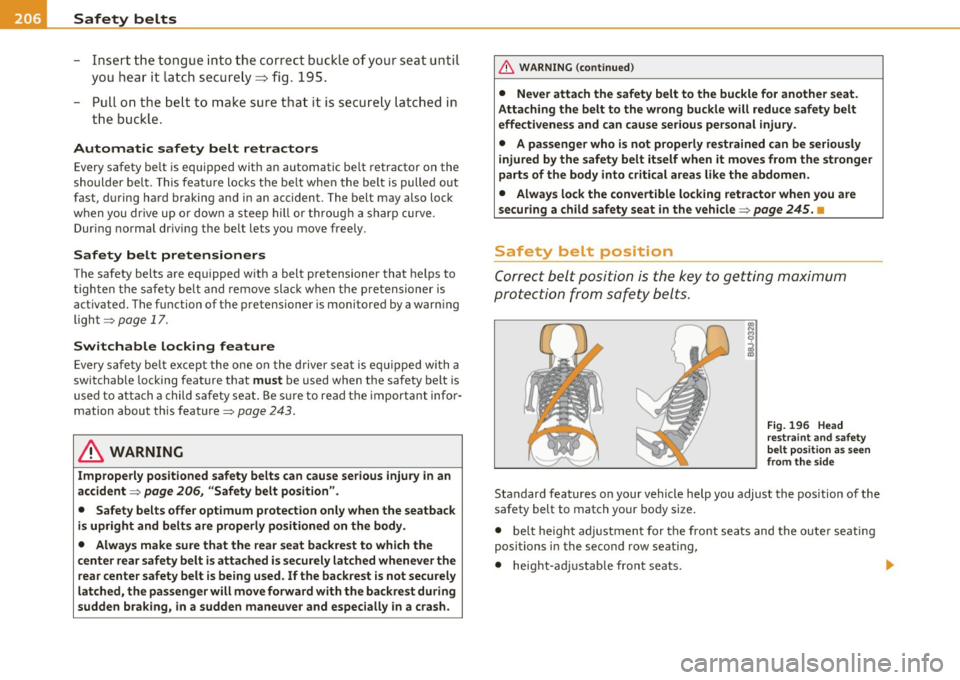
Safety belt position
Correct belt position is the key to getting maximum
pro tection from safety belts .
Fig. 196 Hea d
r e str aint a nd safet y
belt po sit ion a s seen
from the side
Standard features on your vehicle help you adjust the position of the
safety belt to match your bo dy size.
• belt h eigh t adjustment for the front seats and the oute r seat ing
positions in the second row seating,
• height-ad justable front seats. .,