wheel AUDI R8 2007 Owner's Manual
[x] Cancel search | Manufacturer: AUDI, Model Year: 2007, Model line: R8, Model: AUDI R8 2007Pages: 210, PDF Size: 8.1 MB
Page 113 of 210
Seat belts111
Controls
Safety
Driving tips
General maintenance
Self-help
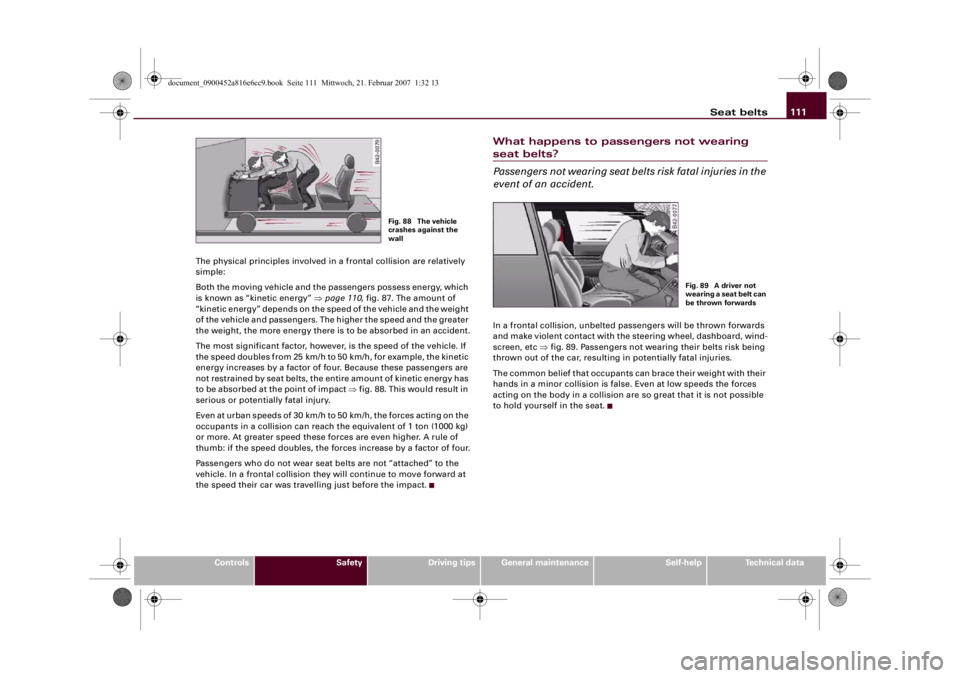
Technical data The physical principles involved in a frontal collision are relatively
simple:
Both the moving vehicle and the passengers possess energy, which
is known as “kinetic energy” ⇒page 110, fig. 87. The amount of
“kinetic energy” depends on the speed of the vehicle and the weight
of the vehicle and passengers. The higher the speed and the greater
the weight, the more energy there is to be absorbed in an accident.
The most significant factor, however, is the speed of the vehicle. If
the speed doubles from 25 km/h to 50 km/h, for example, the kinetic
energy increases by a factor of four. Because these passengers are
not restrained by seat belts, the entire amount of kinetic energy has
to be absorbed at the point of impact ⇒fig. 88. This would result in
serious or potentially fatal injury.
Even at urban speeds of 30 km/h to 50 km/h, the forces acting on the
occupants in a collision can reach the equivalent of 1 ton (1000 kg)
or more. At greater speed these forces are even higher. A rule of
thumb: if the speed doubles, the forces increase by a factor of four.
Passengers who do not wear seat belts are not “attached” to the
vehicle. In a frontal collision they will continue to move forward at
the speed their car was travelling just before the impact.
What happens to passengers not wearing seat belts?
Passengers not wearing seat belts risk fatal injuries in the
event of an accident.In a frontal collision, unbelted passengers will be thrown forwards
and make violent contact with the steering wheel, dashboard, wind-
screen, etc ⇒fig. 89. Passengers not wearing their belts risk being
thrown out of the car, resulting in potentially fatal injuries.
The common belief that occupants can brace their weight with their
hands in a minor collision is false. Even at low speeds the forces
acting on the body in a collision are so great that it is not possible
to hold yourself in the seat.
Fig. 88 The vehicle
crashes against the
wall
Fig. 89 A driver not
wearing a seat belt can
be thrown forwards
document_0900452a816e6cc9.book Seite 111 Mittwoch, 21. Februar 2007 1:32 13
Page 118 of 210
Airbag system 116•
If you sell the vehicle, please remember to pass on the
complete Service Wallet to the new owner. If the front passenger's
airbag has been deactivated, it is important that the new owner is
also given the relevant documents.
•
The relevant safety requirements must be observed when the
vehicle or components of the airbag or belt tensioner systems are
scrapped.
•
In an accident in which one or more airbags are triggered the
alternator and the starter are - for safety reasons - both discon-
nected from the battery via a pyrotechnic circuit breaker.
−Any repairs to the pyrotechnic circuit breaker must always
be performed by a qualified workshop (accident risk).
−The relevant safety requirements must be observed when
the vehicle or the circuit breaker are scrapped.
When are the airbags triggered?
The airbag system is triggered in collisions with a severe
impact.The airbag system is designed so that the airbags for the driver and
front passenger are triggered in a severe frontal collision.
In severe side collisions the side airbags are triggered on the impact
side of the vehicle.
In certain types of accident the front airbags and the side airbags
may be triggered together.
The airbag system is not triggered in minor frontal or side collisions,
or in rear collisions or if the car overturns. In these situations the
occupants are protected by wearing the seat belts.
Factors determining the triggering response
It is not possible to define the exact triggering response of the
airbag system in all possible situations, since the circumstances in different types of accident will vary considerably. Important factors
include, for example, the nature (hard or soft) of the object which
the car hits, the angle of impact, vehicle speed and so on.
Whether the airbags are triggered depends primarily on the vehicle
deceleration rate resulting from the collision. By processing the
signals from the sensors located in the vehicle, the electronic
control unit is immediately able to evaluate the severity of the colli-
sion and activate the restraint systems accordingly. If the decelera-
tion rate is below the predefined reference value in the control unit
the airbags will not be triggered, even though the accident may
cause extensive damage to the car.
Note
The airbag releases a fine dust when it inflates. This is quite normal
and does not mean there is a fire in the vehicle.Front airbagsDescription of front airbags
The airbag system is not a substitute for the seat belts.
WARNING (continued)
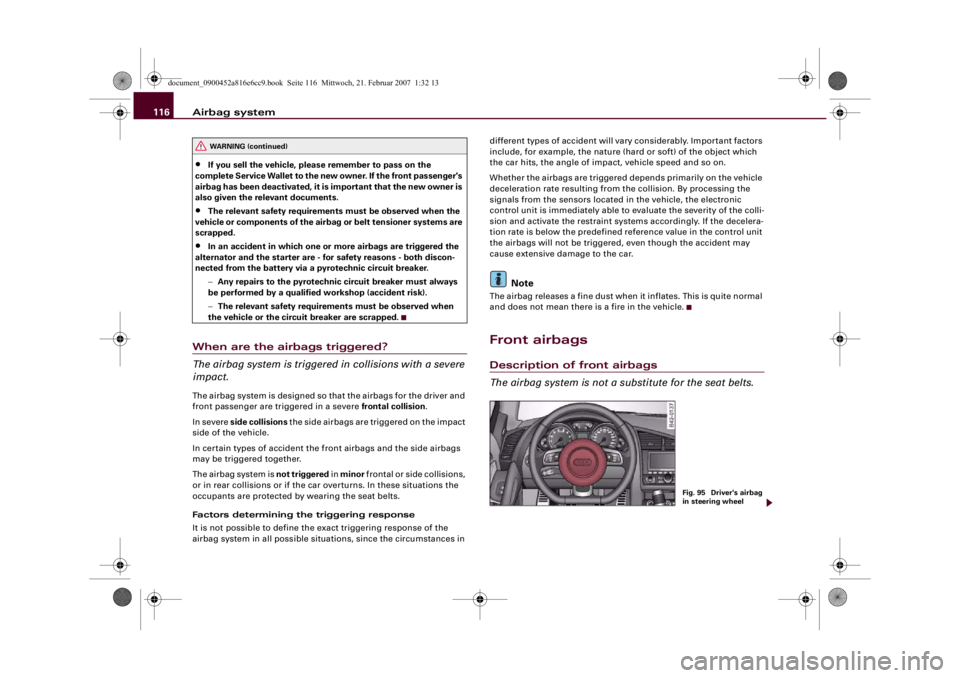
Fig. 95 Driver's airbag
in steering wheel
document_0900452a816e6cc9.book Seite 116 Mittwoch, 21. Februar 2007 1:32 13
Page 119 of 210
Airbag system117
Controls
Safety
Driving tips
General maintenance
Self-help
Technical data The front airbag for the driver is located in the padded hub of the
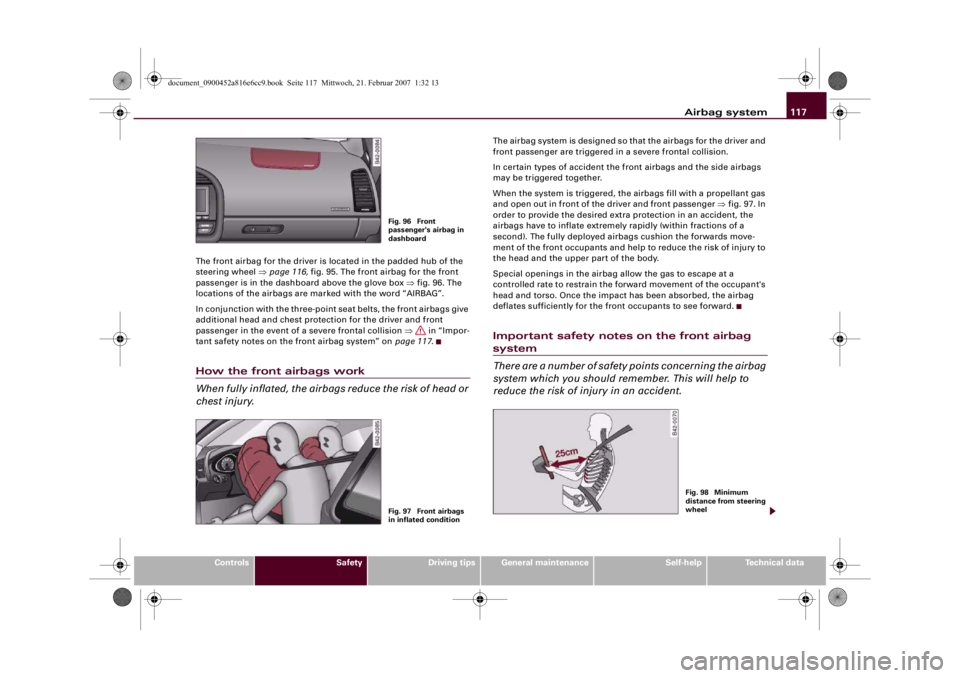
steering wheel ⇒page 116, fig. 95. The front airbag for the front
passenger is in the dashboard above the glove box ⇒fig. 96. The
locations of the airbags are marked with the word “AIRBAG”.
In conjunction with the three-point seat belts, the front airbags give
additional head and chest protection for the driver and front
passenger in the event of a severe frontal collision ⇒ in “Impor-
tant safety notes on the front airbag system” on page 117.
How the front airbags work
When fully inflated, the airbags reduce the risk of head or
chest injury.
The airbag system is designed so that the airbags for the driver and
front passenger are triggered in a severe frontal collision.
In certain types of accident the front airbags and the side airbags
may be triggered together.
When the system is triggered, the airbags fill with a propellant gas
and open out in front of the driver and front passenger ⇒fig. 97. In
order to provide the desired extra protection in an accident, the
airbags have to inflate extremely rapidly (within fractions of a
second). The fully deployed airbags cushion the forwards move-
ment of the front occupants and help to reduce the risk of injury to
the head and the upper part of the body.
Special openings in the airbag allow the gas to escape at a
controlled rate to restrain the forward movement of the occupant's
head and torso. Once the impact has been absorbed, the airbag
deflates sufficiently for the front occupants to see forward.Important safety notes on the front airbag system
There are a number of safety points concerning the airbag
system which you should remember. This will help to
reduce the risk of injury in an accident.
Fig. 96 Front
passenger's airbag in
dashboardFig. 97 Front airbags
in inflated condition
Fig. 98 Minimum
distance from steering
wheel
document_0900452a816e6cc9.book Seite 117 Mittwoch, 21. Februar 2007 1:32 13
Page 120 of 210
Airbag system 118
WARNING
•
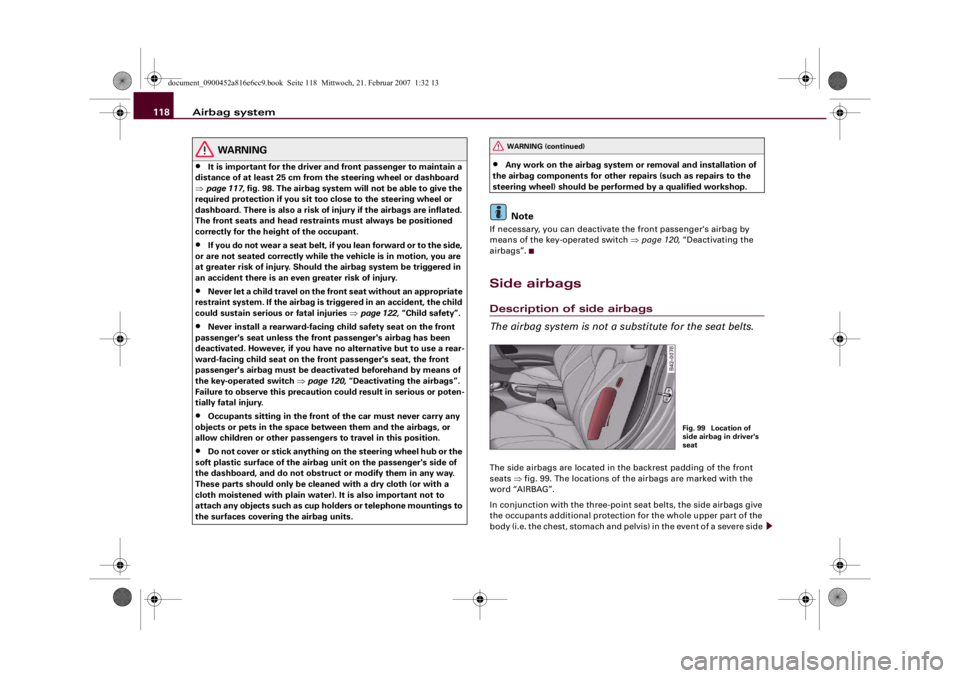
It is important for the driver and front passenger to maintain a
distance of at least 25 cm from the steering wheel or dashboard
⇒page 117, fig. 98. The airbag system will not be able to give the
required protection if you sit too close to the steering wheel or
dashboard. There is also a risk of injury if the airbags are inflated.
The front seats and head restraints must always be positioned
correctly for the height of the occupant.
•
If you do not wear a seat belt, if you lean forward or to the side,
or are not seated correctly while the vehicle is in motion, you are
at greater risk of injury. Should the airbag system be triggered in
an accident there is an even greater risk of injury.
•
Never let a child travel on the front seat without an appropriate
restraint system. If the airbag is triggered in an accident, the child
could sustain serious or fatal injuries ⇒page 122, “Child safety”.
•
Never install a rearward-facing child safety seat on the front
passenger's seat unless the front passenger's airbag has been
deactivated. However, if you have no alternative but to use a rear-
ward-facing child seat on the front passenger's seat, the front
passenger's airbag must be deactivated beforehand by means of
the key-operated switch ⇒page 120, “Deactivating the airbags”.
Failure to observe this precaution could result in serious or poten-
tially fatal injury.
•
Occupants sitting in the front of the car must never carry any
objects or pets in the space between them and the airbags, or
allow children or other passengers to travel in this position.
•
Do not cover or stick anything on the steering wheel hub or the
soft plastic surface of the airbag unit on the passenger's side of
the dashboard, and do not obstruct or modify them in any way.
These parts should only be cleaned with a dry cloth (or with a
cloth moistened with plain water). It is also important not to
attach any objects such as cup holders or telephone mountings to
the surfaces covering the airbag units.
•
Any work on the airbag system or removal and installation of
the airbag components for other repairs (such as repairs to the
steering wheel) should be performed by a qualified workshop.Note
If necessary, you can deactivate the front passenger's airbag by
means of the key-operated switch ⇒page 120, “Deactivating the
airbags”.Side airbagsDescription of side airbags
The airbag system is not a substitute for the seat belts.The side airbags are located in the backrest padding of the front
seats ⇒fig. 99. The locations of the airbags are marked with the
word “AIRBAG”.
In conjunction with the three-point seat belts, the side airbags give
the occupants additional protection for the whole upper part of the
body (i.e. the chest, stomach and pelvis) in the event of a severe side
WARNING (continued)
Fig. 99 Location of
side airbag in driver's
seat
document_0900452a816e6cc9.book Seite 118 Mittwoch, 21. Februar 2007 1:32 13
Page 134 of 210
Intelligent technology 132Intelligent technologyElectronic stabilisation program (ESP)The Electronic Stabilisation Program increases the car's
stability.Description
The anti-lock brake system (ABS), the electronic differential lock
(EDL) and the traction control system (ASR) are all integrated into
the electronic stabilisation program (ESP). The ESP is designed to
enhance the control over the vehicle in critical handling situations,
such as when accelerating and cornering. It reduces the tendency to
skid at all speeds under all road conditions and improves the
stability and roadholding of the vehicle. ESP helps the car to start
moving, accelerate and climb a gradient in slippery conditions
where this may otherwise be difficult or even impossible. The ESP is
switched on automatically when the engine is started. It should
normally be left switched on at all times for optimum car stability.
Driving situations
If the car is oversteering (rear wheels losing grip first) the ESP
mainly brakes the outside front wheel; if the car is understeering
(front wheels losing grip first), the ESP brakes the inside rear wheel
and possibly also other wheels. This automatic brake application is
accompanied by characteristic noises.If, when braking, one of the wheels is turning too slowly in relation
to the road speed and is close to locking up, the system will reduce
the pressure in the brake line to this wheel. The driver is made aware
of this control process by a pulsating of the brake pedal and accom-
panying noise. In this situation it is important to keep the brake
pedal fully depressed so the ABS can regulate the brake application
- do not “pump” the brake pedal. However, the ABS will not neces-
sarily guarantee shorter stopping distances in all conditions. For
instance, on loose gravel or fresh snow on top of an icy surface the
stopping distance with ABS may even be slightly longer.
Whenever it detects a significant difference in the speed of the driven
wheels of one axle (for example, if the road is slippery on one side)
the electronic differential lock (EDL) applies the brake to slow down
the spinning wheel so that more of the power is directed to the
other wheels. This function is active up to about 100 km/h. The brake
system will make noises while it is working.
If one wheel has less grip and starts spinning (for instance, if one of
the driven wheels is on ice), press the accelerator hard until the car
starts moving.
If the wheels start to spin, the traction control system (ASR) auto-
matically reduces the engine torque to match the amount of grip
available.
Activating the sport mode
If required (for instance if you want to use the launch control), you
can switch the traction control system (ASR) and electronic stabili-
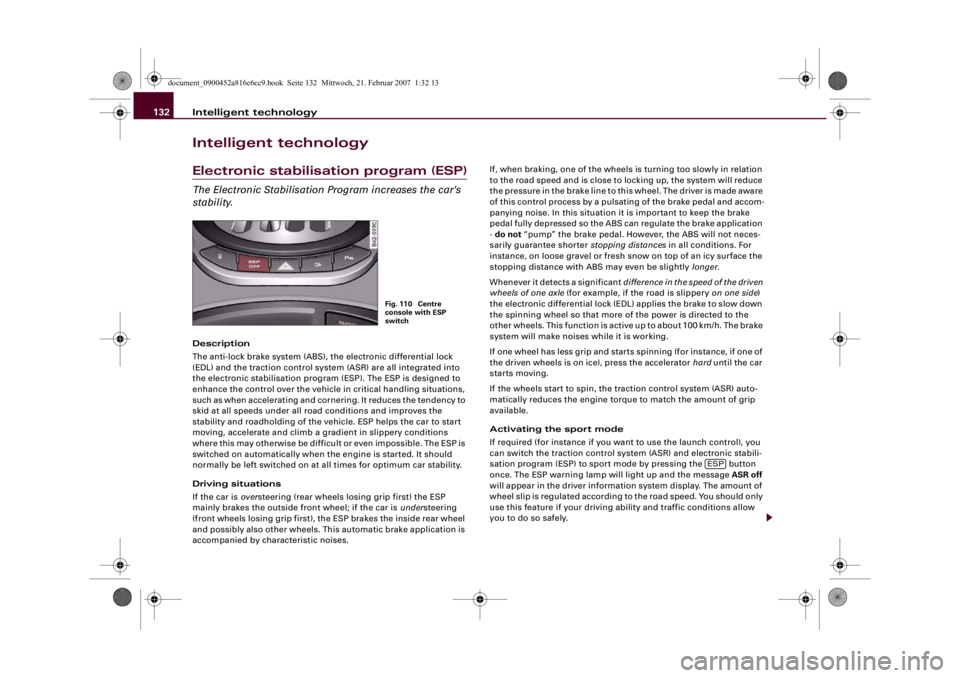
sation program (ESP) to sport mode by pressing the button
once. The ESP warning lamp will light up and the message ASR off
will appear in the driver information system display. The amount of
wheel slip is regulated according to the road speed. You should only
use this feature if your driving ability and traffic conditions allow
you to do so safely.
Fig. 110 Centre
console with ESP
switch
ESP
document_0900452a816e6cc9.book Seite 132 Mittwoch, 21. Februar 2007 1:32 13
Page 135 of 210

Intelligent technology133
Controls
Safety
Driving tips
General maintenance
Self-help
Technical data Switching off the ESP and traction control system
(ASR)
To switch off the ASR and ESP in certain situations (e.g. when
driving with snow chains, in deep snow, or on a loose surface, or
when rocking the car backwards and forwards to free it from mud)
press the button for longer than 3 seconds. The ESP warning
lamp will light up and the message ESP switched off will appear in
the driver information system display. You should only use this
feature if your driving ability and traffic conditions allow you to do
so safely.
Switching on the ESP/traction control system (ASR)
To activate the ASR/ESP, press the button again.
Overheating of the brakes
To prevent the disc brake of a braked wheel from overheating, the
EDL cuts out automatically on the wheel in question if subjected to
excessive loads. The car remains operational and will behave in the
same way as a car without EDL.
The EDL will switch on again automatically when the brake has
cooled down.
WARNING
•
The grip provided by the ESP, ABS, EDL and ASR systems is still
subject to the physical limits of adhesion. Always bear this in
mind, especially on wet or slippery roads. If you notice the
systems cutting in, you should reduce your speed immediately to
suit the road and traffic conditions. Do not let the extra safety
features tempt you into taking any risks when driving – this can
cause accidents.
•
Please remember that the accident risk always increases if you
drive too fast, especially in corners or on a slippery road, or if you
follow too close behind the vehicle in front of you. Please bear in
mind that even ESP, ABS, EDL and ASR cannot compensate for the
increased accident risk.
•
When accelerating on a uniformly slippery surface (for instance
all four wheels on ice or snow), press the accelerator gradually and
carefully. The driven wheels may otherwise start to spin (in spite
of the EDL), which would impair the car's stability and could lead
to an accident.
•
Please note that, when the traction control system (ASR) or
ASR/ESP is switched off, the driven wheels may start to spin,
causing the vehicle to lose grip, in particular on slippery or wet
roads - danger of skidding!Note
•
In the event of a malfunction in the rear spoiler system or in the
Audi magnetic ride, it may not be possible to switch off the traction
control system (ASR) or ASR/ESP, or the ASR/ESP may be reactivated
automatically from the deactivated status.
•
If a malfunction should occur in the EDL, this is indicated by a
warning lamp ⇒page 19.
•
Some racing circuits (e.g. with banked curves) can affect the
behaviour of the ESP.
ESP
ESP
WARNING (continued)
document_0900452a816e6cc9.book Seite 133 Mittwoch, 21. Februar 2007 1:32 13
Page 137 of 210

Intelligent technology135
Controls
Safety
Driving tips
General maintenance
Self-help
Technical data We ar
The rate of wear on the brake pads depends a great deal on how you
drive and the conditions in which the vehicle is operated. Negative
factors are, for instance, city traffic, frequent short trips or hard
driving with abrupt starts and stops.
Wet roads; road salt
When you are driving at a speed higher than 70 km/h and have the
windscreen wipers switched on (at or above intermittent setting 4)
the brake pads are very briefly brought into contact with the brake
discs. This automatic process which goes unnoticed by the driver is
carried out at regular intervals and is intended to improve braking
response in wet conditions.
In certain conditions, such as in heavy rain, or after washing the car
or driving through water, the full braking effect can be delayed by
moisture (or in winter by ice) on the discs and brake pads. The
brakes should be “dried” by pressing the pedal to restore full
braking effect.
The effectiveness of the brakes can also be temporarily reduced if
the car is driven for some distance without using the brakes when
there is a lot of salt on the road in winter. The layer of salt that accu-
mulates on the discs and pads can be removed with a few cautious
brake applications.
Corrosion
There may be a tendency for dirt to build up on the brake pads and
corrosion to form on the discs if the car is used infrequently, or if
you only drive low mileages without using the brakes very much.
If the brakes are not used frequently, or if corrosion has formed on
the discs, it is advisable to clean off the pads and discs by braking
firmly a few times from a moderately high speed ⇒.
Faults in the brake system
If the brake pedal travel should ever increase suddenly, this may
mean that one of the two brake circuits has failed. Drive immedi-
ately to the nearest qualified workshop and have the fault rectified. On the way to the dealer, be prepared to use more pressure on the
brake pedal and allow for longer stopping distances.
Low brake fluid level
Malfunctions can occur in the brake system if the brake fluid level is
too low. The brake fluid level is monitored electronically.
Brake servo
The brake servo amplifies the pressure you apply to the brake pedal.
It only works when the engine is running.
WARNING
•
When applying the brakes to clean off deposits on the pads and
discs, select a clear, dry road. Be sure not to inconvenience or
endanger other road users; do not risk an accident.
•
Never let the car coast with the engine switched off (this can
cause accidents).Caution
•
Never let the brakes “drag” by leaving your foot on the pedal
when you do not really intend to brake. This overheats the brakes,
resulting in longer stopping distances and greater wear.
•
Before driving down a long, steep gradient, it is advisable to
reduce speed and select a lower gear. In this way you will make use
of the engine braking effect and relieve the load on the brakes. If you
still have to use the brakes, it is better to brake firmly at intervals
than to apply the brakes continuously.Note
•
If the brake servo is out of action due to a malfunction, or if the
car has to be towed, you will have to press the brake pedal consid-
erably harder to make up for the lack of servo assistance.
•
If you wish to equip the car with accessories such as a front
spoiler or wheel covers, it is important that the flow of air to the
document_0900452a816e6cc9.book Seite 135 Mittwoch, 21. Februar 2007 1:32 13
Page 138 of 210

Intelligent technology 136front wheels is not obstructed, otherwise the brakes can overheat. Power steeringThe power steering assists the driver when turning the
steering wheel (with the engine running).The power steering assists the driver by reducing the force needed
to turn the steering wheel.
The power steering does not function when the engine is switched
off. In this case the steering wheel is very hard to turn.
If the steering is held at its turning limit when the car is stationary,
this will place an excessive load on the power steering system. In
this case, the power steering system will make noises. It will also
reduce the idling speed of the engine.
Caution
Do not keep the steering in the full-lock position for longer than
15 seconds when the engine is running – this could cause damage
to the power steering system.
Note
•
If the power steering should fail at any time or the engine is
switched off (for instance when being towed), the car can still be
steered. However, more effort will be required to turn the steering
wheel.
•
If the system is leaking or malfunctioning, please take the car to
a qualified workshop as soon as possible.
•
The power steering requires a special hydraulic fluid. The
container for the fluid is located in the engine compartment. The
correct fluid level in the reservoir is important for the power
steering to function properly. The hydraulic fluid level is checked at
the Inspection Service.
Four-wheel drive (quattro®)On quattro models the engine power is distributed to all
four wheelsGeneral notes
On four-wheel drive vehicles, the engine power is distributed to all
four wheels. The distribution of power is controlled automatically
according to your driving style and the road conditions. Also refer
to ⇒page 132.
Winter tyres
Thanks to its four-wheel drive, your car will have plenty of traction
in winter conditions, even with the standard tyres. Nevertheless, we
still recommend that winter tyres should be fitted on all four wheels
when winter road conditions are expected, mainly because this will
give a better braking response.
Snow chains
On roads where snow chains are mandatory, this also applies to cars
with four-wheel drive ⇒page 171, “Snow chains”.
Replacing tyres
The dimensions of the wheels and tyres used on four-wheel drive
vehicles must comply with the manufacturer's specifications
⇒page 168, “Replacing wheels and tyres”.
WARNING
•
Even with four-wheel drive, you should always adjust your
speed to suit the conditions. Do not let the extra safety provided
tempt you into taking any risks when driving – this can cause acci-
dents.
•
The braking ability of your car is limited by the grip of the tyres.
In this respect, your car is no different from a car without four-
wheel drive. So do not be tempted to drive too fast on icy or slip-
document_0900452a816e6cc9.book Seite 136 Mittwoch, 21. Februar 2007 1:32 13
Page 139 of 210

Intelligent technology137
Controls
Safety
Driving tips
General maintenance
Self-help
Technical data pery roads just because the car still has good acceleration in these
conditions (accident risk).
•
On wet roads bear in mind that the front wheels may start to
“aquaplane” and lose contact with the road if the car is driven too
fast. If this should happen, there will be no sudden increase in
engine speed to warn the driver, as with a front-wheel drive car. So
do not drive too fast in the wet: adjust your speed to suit the
conditions (accident risk).
Dry sump lubrication systemLarge lateral and longitudinal forces act on the engine and vehicle
when a sporty driving style is adopted. A dry sump system ensures
that the engine continues to be supplied with oil and lubricated
optimally under these conditions.
In a “normal” car, the oil is stored in the oil sump and is pumped
from there to the lubrication points inside the engine. The oil then
flows from there back into the oil sump. In extreme situations this
can cause air to be sucked into the oil pump with the result that the
oil pressure is no longer high enough.
In a dry sump lubrication system, the oil is stored in a separate oil
tank instead of the oil sump (which is “dry”). While one pump sends
oil to the engine, a second pump returns the oil from the engine to
the oil tank. The tall and slim shape of the oil tank means that the oil
pressure can be kept constant even in extreme conditions.
In addition, the oil sump is much lower on vehicles with dry sump
lubrication. This means that the engine can also be arranged lower
down for a lower centre of gravity and improved handling.
WARNING (continued)
document_0900452a816e6cc9.book Seite 137 Mittwoch, 21. Februar 2007 1:32 13
Page 146 of 210
Care of vehicle and cleaning 144Care of vehicle and cleaningGeneral notesRegular care helps to maintain the value of the vehicle.Regular and careful care helps to maintain the value of the vehicle.
This may also be one of the requirements for upholding any
warranty claims in the event of corrosion or paint defects.
Audi R8 dealers and specialist retailers carry stocks of suitable car
care products. Please follow the instructions for use on the pack-
aging.
WARNING
•
Cleaning products and other materials used for car care can
damage health if misused.
•
Car care materials can contain toxic substances and must
always be kept in a safe place out of reach of children.For the sake of the environment
•
When purchasing car care products, try to select ones which are
not harmful to the environment.
•
Surplus cleaning materials should not be disposed of together
with ordinary household waste.
Care of exteriorWa s hi ng t he c a rThe longer substances like insects, bird droppings, resinous tree
sap, road dirt, industrial deposits, tar, soot or road salt and other
aggressive materials remain on the vehicle, the more damage they do to the paintwork. High temperatures (for instance in strong
sunlight) further intensify the corrosive effect.
After the period when salt is put on the roads it is important to have
the underside of the vehicle washed thoroughly.
Automatic car washes
Before going through a car wash, be sure to take the usual precau-
tions such as closing the windows. If the vehicle is fitted with
special accessories such as spoilers or a two-way radio aerial, etc.,
it is advisable to consult the car wash operator ⇒.
It is best to use a car wash without revolving bristles if possible.
Washing your car with a high-pressure cleaner
When cleaning the vehicle with a high-pressure cleaner, always
follow the operating instructions for the equipment. This applies
particularly to the operating pressure and the spraying distance. Do
not hold the spray nozzle too close to soft materials, such as rubber
hoses or seals.
Do not use a nozzle that sprays the water out in a direct stream or
one that has a rotating jet for forcing off dirt.
Washing the car by hand
When washing the car by hand, use plenty of water to soften the dirt
first, and rinse off as well as possible.
Then clean the vehicle with a soft sponge, glove or brush, using only
slight pressure. You should start on the roof and work down. Special
car shampoo should only be used for very persistent dirt.
Rinse the sponge or glove thoroughly and often.
Wheels, sills and similar should be cleaned last. Use a second
sponge for this.
document_0900452a816e6cc9.book Seite 144 Mittwoch, 21. Februar 2007 1:32 13