engine AUDI S3 2010 Owners Manual
[x] Cancel search | Manufacturer: AUDI, Model Year: 2010, Model line: S3, Model: AUDI S3 2010Pages: 320, PDF Size: 75.34 MB
Page 288 of 320

IIII.___E_ m_ e_r -=g :...e_ n _ c-=y _ s_ i_t _u _a _t_ i_o _n_ s _______________________________________________ _
& WARN ING (continued )
• Before you check anything in the engine compartment , always
read and heed all WARNINGS=>
page 215, "Engine compa rt m ent" .
0 Note
• Applying a higher voltage booster battery wil l cause expensive
damage to sensitive electronic components, such as contro l units,
relays, rad io, etc.
• There must be no electrical contact between the vehicles as
otherwise current cou ld already star t to flow as soon as th e positive
(+ ) termina ls are connected .
• Improperly connected jumper cab les can cause substantia l
damage to the electrica l system of the vehic le.
[ i ] Tips
• The disc harged battery must be p ro per ly connected to the
ve hicle's elec trica l system .•
General information of starting
assistance
P lease observe tha t the p rocedure described below for conn ecti ng
jumper cab les is intended to provide a jump start for your vehicle.
M ake sure that the connected c la mp s have s ufficien t metal cont act.
& WARNING
Improper handling of the jumper cables can lead to an explosion
of the battery and severe inju ries . To reduce the r isk of injury, note
the following:
& WARNING (continued )
• The sections of the terminal clamps that are not insulated
must not touch each other. In addition , the cable clamped to the
battery's positive terminal must not come in contact with electri
cally connected parts of the vehicle -danger of short circuit!
• Route the jumper cable so that it cannot catch in any rotating
part s in the engine compartment .
• Do not bend over the batteries -danger of chemical burns!
• The battery cell locking screws must be t ightened securely .
• Keep ignition sources (open flame, burning cigarettes, etc .)
away from the batteries -danger of explosion!
• Do not clamp the minus cable to parts of the fuel system or the
brake lines .
0 Note
If you provide start assistance for others with your vehicle, you
s h ould not c lamp t he min us ca ble(-) to t he negat ive ter min al o f the
discharged battery=> fig. 196
© but to a solid meta l part screwed
f ir m ly to the eng ine bloc k, or to the engi ne b loc k it sel f. In ca se of a n
inadequately v entilated battery of the veh ic le receiving power, there
i s a danger of expl osio n due to deto nating gas !•
Page 289 of 320
______________________________________________ E_ m_ e_r .;::g ;...e _ n_ c __,c. y_ s_it _u_ a_ ti_o _ n_ s _ __._
Use of jumper cables
Make sure to connect the jumper cable clamps in exactly
the order described below!
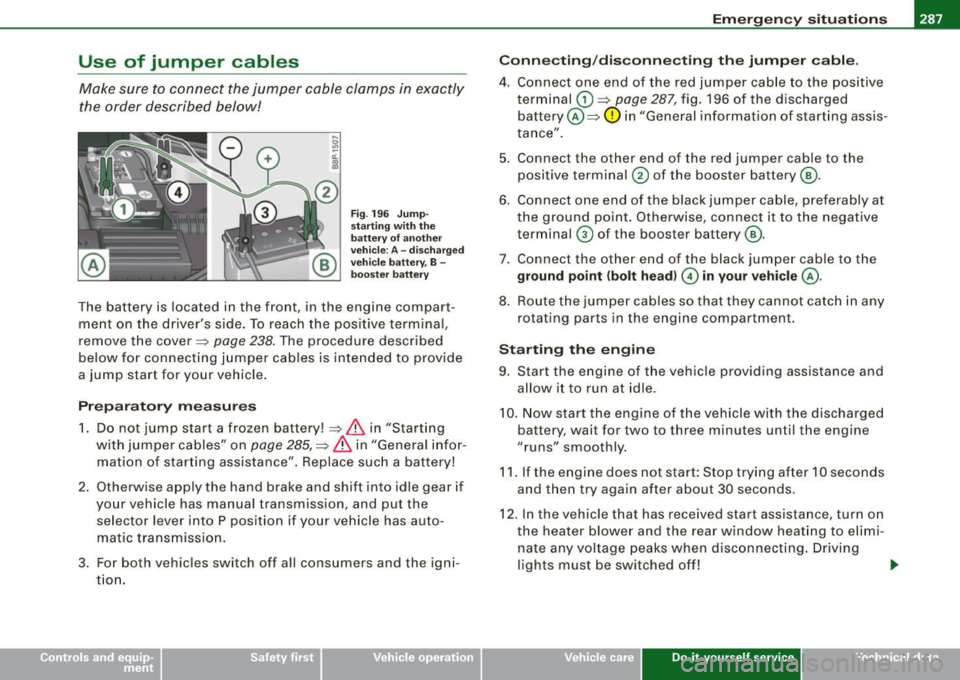
Fig . 196 Jump
starting with the
battery of another
vehicle : A -discharged
vehicle battery , B -
booster battery
The battery is located in the front, in the engine compart
ment on the driver's side. To reach the positive terminal,
remove the cover=>
page 238. The procedure described
below for connecting jumper cables is intended to provide
a jump start for your vehicle.
Preparatory measures
1. Do not jump start a frozen battery ! => & in "Sta rting
with jumper cables" on
page 285, => & in "General infor
mation of starting assistance" . Replace such a battery!
2. Otherwise apply the hand brake and shift into idle gear if
your vehicle has manual transmiss ion, and put the
selector lever into P position if your vehicle has auto
matic transmission.
3. For both veh ic les switch o ff a ll co nsumers and the igni
tion.
Connecting/disconnecting the jumper cable.
4. Connect one end of the red jumper cable to the positive
terminal
(D => page 287, fig . 196 of the discharged
battery @=> (Din "General information of starting assis
tance".
5. Connect the other end o f the red jumper cable to the
positive terminal
@ of th e boost er battery ®·
6. Connect one end of the black jumper cable, preferably at the ground point. Otherwise, connect it to the negat ive
terminal
0 of the booster battery ®·
7. Connect the other end of the black jumper cable to the
ground point (bolt head) © in your vehicle @.
8. Route the jumper cables so that they cannot catch in any
rotating parts in the engine compartment.
Starting the engine
9. Start the engine of the veh icle providing ass istance and
allow it to run at idle.
10. Now start the engine of the vehicle with the discharged
battery , wait for two to three minutes unt il the eng ine
" runs " smoothly.
11. If the engine does not start: Stop t rying after 10 seconds
and then try again after about 30 seconds.
12. In the vehicle that has received start assistance, turn on the heater blower and the rear window heating to elimi
nate any voltage peaks when disconnecting. Driving lights must be switched off! .,
Vehicle care Do-it-yourself service irechnical data
Page 290 of 320

11111.___E_ m _ e _r-==g :...e_ n_ c...:y _ s_ i_t _u _a _t_ i_o _n_ s _______________________________________________ _
13. Disconnect the cable while the engine is running exactly
in
reverse order to that described in~ page 287,
11Connecting/disconnecting the jumper cable.11
• When
doing so, make sure that the cable cannot contact rotating engine parts.
14. Turn the heater blower and the rear window heating off again.
The battery is vented to the outside to prevent gases from entering
the vehicle interior.
Make sure that the jumper clamps are well connected with their
metal ports in full contact with the battery terminals .
& WARNING
To avoid serious personal injury and damage to the vehicle, heed
all warnings and instructions of the jumper cable manufacturer. If
in doubt, call for road service.
• Jumper cables must be long enough so that the vehicles do not
touch .
• When connecting jumper cables, make sure that they cannot
get caught in any moving parts in the engine compartment.
• Before you check anything in the engine compartment, always
read and heed all WARNINGS =>
page 215, "Engine compartment" .
0 Note
Improperly connected jumper cables can damage or destroy the
generator.
• Do not use the battery negative terminal for jump starting or a
malfunction could occur in the vehicle electrical system.
• Always connect POSITIVE(+) to POSITIVE(+), and NEGATIVE( -) to
NEGATIVE (-l terminal. •
Check that all screw plugs on the battery cells are screwed in
firmly. If not, tighten plugs prior to connecting clamp on negative battery terminal.
• Please note that the procedure for connecting a jumper cable as
described above applies specifically to the case of your vehicle
being jump started. When you are giving a jump start to another
vehicle, do
not connect the minus(-) cable to the minus 1-l terminal
on the discharged battery@=>
page 287, fig. 196. Instead, securely
connect the minus(-) cable to either a massive metal component
that is firmly bolted to the engine block or to the engine block itself.
If the battery that is being charged does not vent to the outside,
escaping battery gas could ignite and explode! •
Emergency towing with commercial
tow truck
General hints
Your Audi requires special handling for towing.
The following information is to be used by commercial tow truck
operators who know how to operate their equipment safely.
• Never tow your Audi, towing will cause damage to the engine
and transmission.
• Never wrap the safety chains or winch cables around the brake
lines.
• To prevent unnecessary damage, your Audi must be transported
with a car carrier (flat bed truck).
• To load the vehicle on to the flat bed, use the towing loop found
in the vehicle tools and attach to the front or rear anchorage
=>
page 289 and => page 289 . .,_
Page 293 of 320
________________________________________________ E_ m_ e_r .::g :...e_ n _ c_,y'-- s_ i_t _u _a_ t_ i_o _n_ s _---J_
Lifting the vehicle
Important safety precautions
Be aware of the following hazards before lifting the vehicle with a
workshop hoist or floor jack:
• The vehicle should never be lifted or jacked up from underneath
the engine oil pan, the transmission housing, the front or rear axle
or the body side members. This could lead to serious damage.
• Use lifting equipment with padded contact surfaces to avoid
damage to the underbody or chassis frame.
• Alternatively, cover the contact surfaces on workshop hoist or
floor jack with rubber pads before lifting .
• Before driving over a workshop hoist, check that the vehicle
weight does not exceed the permissible lifting capacity of the hoist .
• Before driving over a workshop hoist, ensure that there is suffi
cient clearance between the hoist and low parts of the vehicle .
& WARNING
To reduce the risk of serious injury and vehicle damage:
• Always lift the vehicle only at the special workshop hoist and
floor jack lift points illustrated
=> fig. 202 and => fig. 203 .
• Failure to lift the vehicle at these points could cause the vehicle
to tilt or fall from a lift if there is a change in vehicle weight distri
bution and balance. This might happen, for example, when heavy
components such as the engine block or transmission are
removed .
• When removing such heavy components, anchor vehicle to
hoist or add corresponding weights to maintain the center of
gravity . Otherwise , the vehicle might tilt or slip off the hoist,
causing serious personal injury. •
Lifting with workshop hoist and with floor
jack
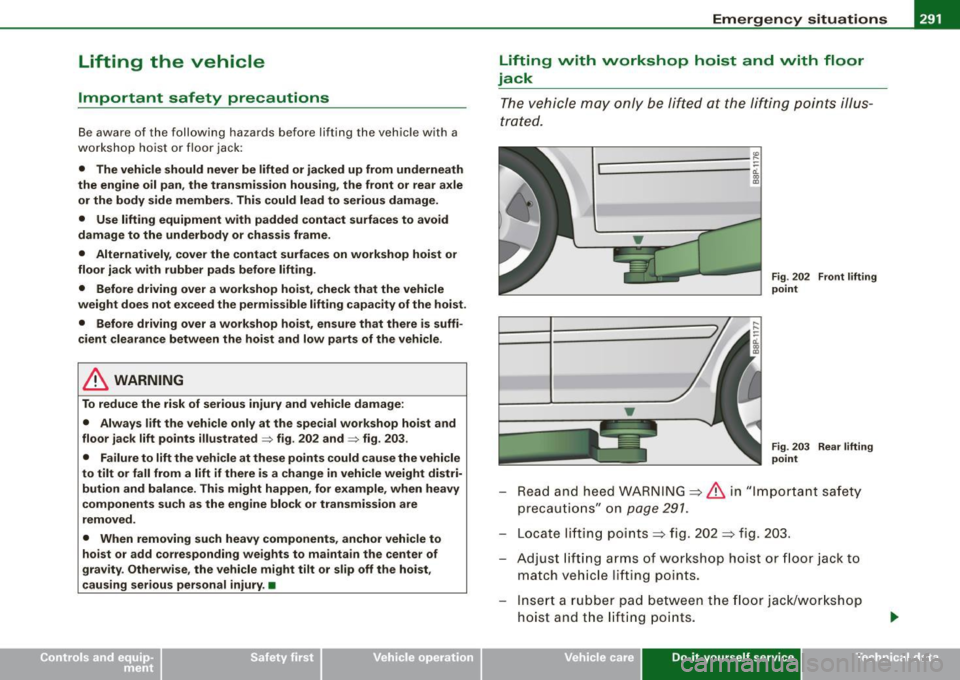
The vehicle may only be lifted at the lifting points illus
trated.
.... L===========::::==:: ~ 0:.
Fig . 202 Front lifting
point
Fig . 203 Rear lifting
point
Read and heed WARNING ~ & in "Important safety
precautions " on
page 291.
Locate lifting points~ fig. 202 ~ fig. 203.
Adjust lift ing arms of workshop hoist or floor jack to
match vehicle lifting points.
Inse rt a rubber pad between the floo r jack/workshop
hoist and the lifting poin ts.
Vehicle care Do-it-yourself service irechnical data
Page 294 of 320
lllffl.___E_ m _ e _r-==g :...e_ n_ c...:y _ s_ i_t _u _a _t_ i_o _n_ s _______________________________________________ _
If you mu st lift your veh icle with a floor jack to work underneath , be
sure the vehicle is safely supported on stands intended for this
purpose .
Front lifting point
T he lifting point is located on the floor pan reinforcement about at
t he same leve l as t he jac k mou nti ng poi nt=>
pag e 291, fig. 202 . Do
not lift the vehicle at the vertical sill reinforcement .
Rear lifting point
T he lifting point is located on the vertical reinforcement of the lower
sill for the o n board jack=>
page 291, fi g. 203 .
Lifting with vehicle jack
Refe r to=> page 274.
0 Note
• Be aware of the fo llo wi ng po ints before l ifting t he ve hicle :
- The vehicle should never be lifted or jacked up from under
neath the engine oil pan , the transmission housing , the front or
rear axle or the body side members . This could lead to serious
damage.
- To avoid damage to the underbody or chassis frame , a rubber
pad must be inserted between the floor jack and the lift points .
- Before driving over a workshop hoist, check that the vehi cle
weight does not exceed the permissible lifting capacity of the
hoist .
- Before driving over a workshop hoist , ensure that there is
sufficient clearance between the hoist and low parts of the
vehicle. •
Page 296 of 320

___ G_ e_ n_ e_r_ a _ l_ in_ f_ o _r_m _ a_ t_ i_ o _ n __________________________________________________ _
General information
Explanation of technical data
Some of the technical data listed in this manual requires
further explanation.
The technical data for your vehicle is listed in the charts starting on
~ page 296. This section provides general information, notes and
restrictions which apply to this data. •
Vehicle identification
The key data are given on the vehicle identification
number (VIN) plate and the vehicle data sticker.
Fig. 204 Vehicle Identi
fication Number (VIN)
plate: location on
driver's side dash
panel Fig
. 205 The vehicle
identification label -
inside the luggage
compartment
The Vehicle Identification Number (VIN)
is located on the driver's side so that it is visible from the outside
through the windshield -see ~ fig. 204.
The vehicle identification label
is located in the luggage compartment in the spare wheel well.
The label ~ fig. 205 shows the following vehicle data:
© Production control no.
0 Vehicle identification no.
© Type code number
© Type designation/engine output in Kilowatts
© Engine and transmission code letter
© Paint no./lnterior
0 Optional equipment no.'s
Vehicle data 2 to 7 are also found in your Warranty
& Maintenance
booklet .
The safety compliance sticker
is your assurance that your new vehicle complies with all applicable
Federal Motor Vehicle Safety Standards which were in effect at the
time the vehicle was manufactured. You can find this sticker on the ._
Page 298 of 320
___ D_ a_ ta ______________________________________________________ _
Data
Applies to vehi cles: with 2.0 lite r TFS I 4-cyl. g asoline eng ine ,
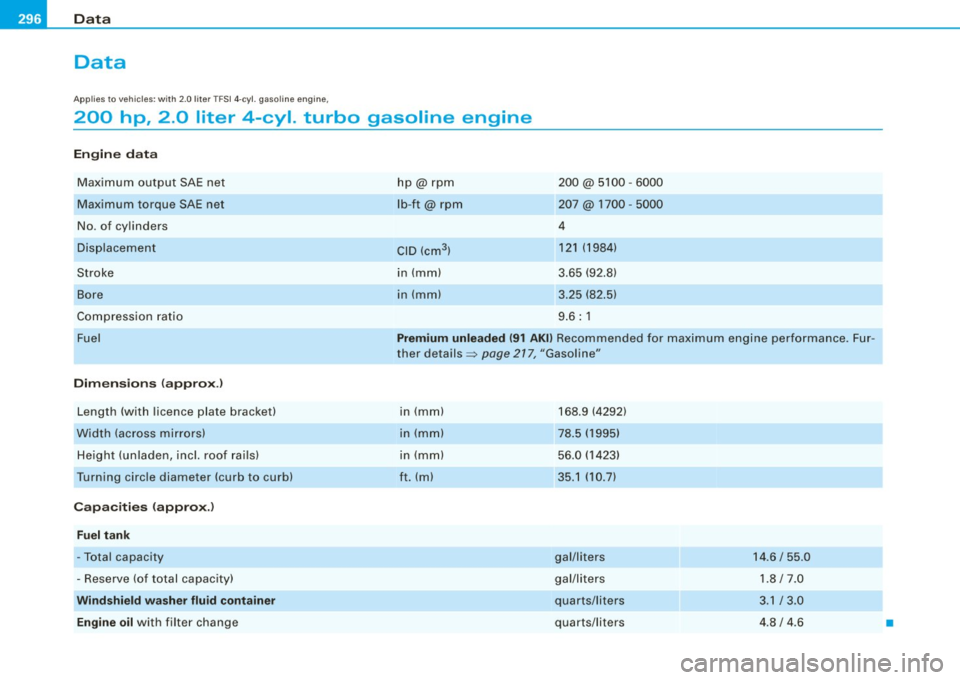
200 hp, 2.0 liter 4-cyl. turbo gasoline engine
Engin e data
Maximum output SAE net
Maximum torque SAE net
No. of cy linders
Disp lacement
Stroke
Bore
Compression ratio
Fuel
D im ensio ns (a pprox.)
Length (with licence plate bracket)
Width (across mirrors)
Height (unladen, incl. roof rails)
Turning circle diameter (curb to cu rb)
Ca pacitie s (a pprox.)
F u el t ank
-Total capacity
- Reserve (of total capacity)
W ind shi eld was her fluid cont ain er
Engine oil
with filter change hp@rpm
lb
-ft@ rpm
CID (cm
3 )
in (mm)
in (mm)
200@ 5100 -6000
207 @ 1700 -5000
4 121 (1984)
3.65 (92.8)
3 .25 (82 .5)
9 .6 : 1
Premium unleaded (91 AKI) Recommended for maximum engine performance . Fur
ther det ails =:>
page 277, "Gasol ine"
in (mm)
in (mm)
in (mm)
ft. (ml
168.9 (4292)
78 .5 (1995)
56.0 (1423)
35.1 (10.7)
gal/liters
gal/liters
quarts/liters
quarts/liters 14 .6 / 55.0
1 .8/7.0
3 .1 / 3 .0
4 .8 / 4.6
•
Page 299 of 320
___________________________________________________ D_a_ t_ a __ !II
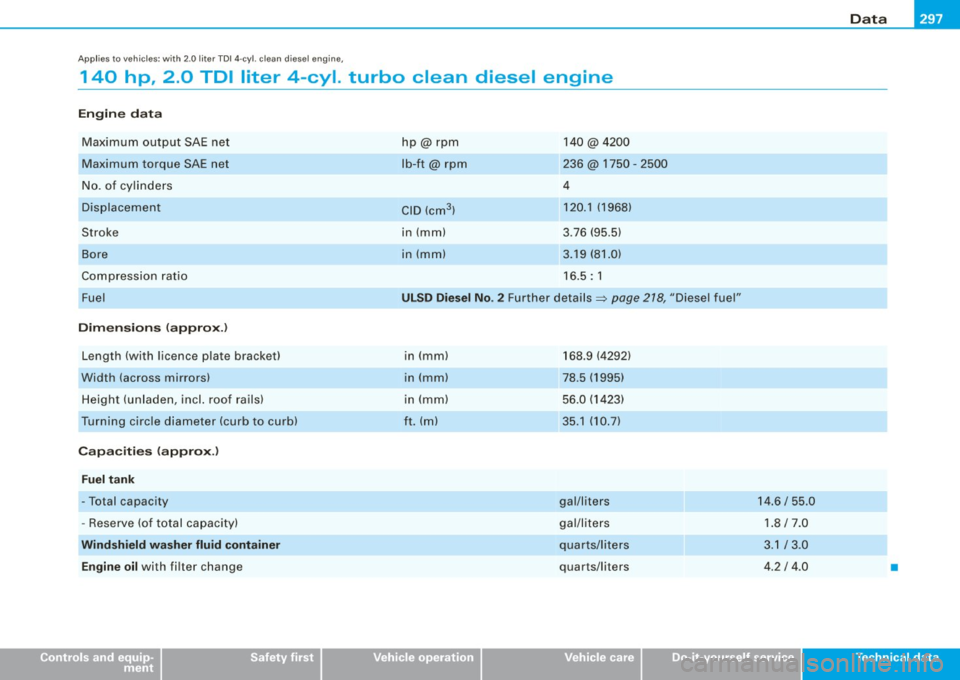
A pp lies to veh ic les : w it h 2 .0 liter TDI 4 -cyl. c le an di esel e ngin e,
140 hp , 2 .0 TOI liter 4-cyl. turbo clean diesel engine
Engine data
Maximum output SAE net
Maximum torque SAE net
N o. o f cy linders
Displacement
Stroke
Bore
Co mpression ratio
Fuel
Dimensions (approx .)
Length (with licence p late bracket)
Width (across mirrors) H eight (unla den, incl. roof ra ils)
Turning circle diameter (curb to curb)
Capacities (approx .)
Fuel tank
-Total capacity
- Reserve (of t otal capacity)
Wind shield wa sher fluid container
Engine oil
with filter change
Controls and equip ment Safety first
hp@rpm
lb-ft@ rpm
CID (cm
3
)
in (mm)
in (mm)
14 0 @4200
236 @ 1750 · 2500
4
120.1 (1968)
3 .76 (95 .5)
3.19 (81 .0)
16. 5: 1
ULSD Diesel No . 2 Further details=> page 218, "Diesel fue l"
in (mm)
in (mm)
in ( mm)
ft. (ml
Vehicle operation
168.9 (4292)
78.5 (1995) 56.0 (14 23)
35.1 (10.7)
gal/liters
gal/li te rs
quarts/liters
quarts/liters
Vehicle care
14.6 / 55.0 1.8/7.0
3.1 / 3_0
4.2 I 4 .0
Do-it-yourself service
•
T ec hn ica l da ta
Page 300 of 320

___ C_ o_n_ s_ u_m _ e_ r_ ln_ f_ o _r _m _ a_ t_ i_o _n ______________________________________________ _
Consumer Information
Warranty coverages
Your A udi i s cov ered b y the follo wing war ra nt ies:
• New Vehicle Limited Warranty
• Limited Warranty Against Corrosion Perforation
• Emissions Control System Warranty
• Emissions Performance Warranty
• California Emissions Control Warranty (USA vehicles only)
• California Emissions Performance Warranty (USA vehicles only)
Detailed information rega rding your warranties can be found in
your
W arr ant y & Maint ena nce Booklet .•
Operating your vehicle outside the
U .S.A. or Canada
Government regulations in the United States and Canada require
that automobiles meet specific em ission regulations and safety
standards. Therefore, vehic les bui lt for the U.S .A. and Canada differ
from vehicles sold in other countries .
If you plan to take your vehic le outside the continental limits of the
United States or Canada, there is the possibility that
• unleaded fue ls for vehicles with catalyt ic converter may not be
available;
• f uel may have a considerably lower octane rating . Improper fuel
may cause engine damage;
• service may be inadequate due to lack of proper service facilities,
tools or testing equipment;
• replacement parts may not be readi ly available . •
Navigation systems for vehicles built for the U.S.A . and Canada
wil l not necessarily work in Europe, and may not work in other coun
tries outside of North Amer ica.
Audi c annot be responsib le for me ch an ical damage that could
result from inadequate fuel , serv ice or parts availability .
0 Note
Audi cannot be responsible fo r mechanica l damage that could
result from inadequate fuel, service or parts avai lability .•
Audi Service Repair Manuals and
Literature
Audi Official Factory Service Manuals are published as soon as
possible af ter model introduction . Service manua ls are available
from:
Audi Te ch n ic al Liter ature Ordering Center
Ca ll toll -free:
Tel. :
1 (800) 544-802 1
(from 8:00 AM to 8:00 PM, EST, Mon day t hrough Friday)
or access their website
www .audi .dd sltd .com on the Internet to
order repair manuals and other Audi literature .•
Page 301 of 320
Consumer Information I'll _________________________________ __::..::....:...:...::...:.:..:....:....:.:;__ _____ _
Maintenance
General
Your vehicle has been designed to help keep maintenance require
ments to a minimum.
However, a certain amount of regular maintenance is still necessary
to assure your vehicle's safety, economy and reliability.
For detailed vehicle maintenance consult your Warranty
& Mainte
nance booklet.
Under difficult operating conditions, for example at extremely low
outside temperatures, in very dusty regions, when towing a trailer
very frequently, etc., some service work should be performed
between the intervals specified. This applies particularly to:
• oil changes, and
• cleaning or replacing the air filter.
ci> For the sake of the environment
By regularly maintaining your vehicle, you help make sure that emis
sion standards are maintained, thus minimizing adverse effects on
the environment. •
Important considerations for you and your
vehicle
The increasing use of electronics, sophisticated fuel injection and
emission control systems, and the generally increasing technical
complexity of today's automobiles, have steadily reduced the scope
of maintenance and repairs which can be carried out by vehicle
owners.
Also, safety and environmental concerns place very strict
limits on the nature of repairs and adjustments to engine and trans
mission parts which an owner can perform.
Controls and equip
ment Safety first Vehicle operation
Maintenance, adjustments and repairs usually require special tools,
testing devices and other equipment available to specially trained
workshop personnel in order to assure proper performance, reli ability and safety of the vehicle and its many systems.
Improper maintenance, adjustments and repairs can impair the
operation and reliability of your vehicle and even void your vehicle
warranty. Therefore, proof of servicing in accordance with the main tenance schedule may be a condition for upholding a possible
warranty claim made within the warranty period.
Above all, operational safety can be adversely affected, creating unnecessary risks for you and your passengers.
If in doubt about any servicing, have it done by your authorized Audi
dealer or any other properly equipped and qualified workshop. We
strongly urge you to give your authorized Audi dealer the opportu
nity to perform all scheduled maintenance and necessary repairs.
Your dealer has the facilities, original parts and trained specialists
to keep your vehicle running properly .
Performing limited maintenance yourself
The following pages describe a limited number of procedures which
can be performed on your vehicle with ordinary tools, should the
need arise and trained personnel be unavailable. Before performing
any of these procedures, always thoroughly read all of the appli
cable text and carefully follow the instructions given. Always rigor
ously observe the
WARNINGS provided.
Before you check anything in the engine compartment, always read
and heed all WARNINGS=>
& and=> & in "Working in the engine
compartment" on
page 224.
& WARNING
• Serious personal injury may occur as a result of improperly
performed maintenance, adjustments or repairs.
Vehicle care Do-it-yourself service Tec hn ica l da ta