check engine light AUDI S3 2012 Owner's Manual
[x] Cancel search | Manufacturer: AUDI, Model Year: 2012, Model line: S3, Model: AUDI S3 2012Pages: 280, PDF Size: 70.11 MB
Page 206 of 280
204 Checking and filling
Checking the engine coolant level
The engine coolant level can be checked with
a quick glance .
Fig. 162 Engine compartme nt: coo lant expansio n tank
Before you check anything i n the eng ine com
partment,
a lw ays rea d and h eed all WARN
ING S ¢&. in Working in the engine compart
ment on page 194.
.. Park your vehicle on a level surface.
.. Turn
off the ignit ion .
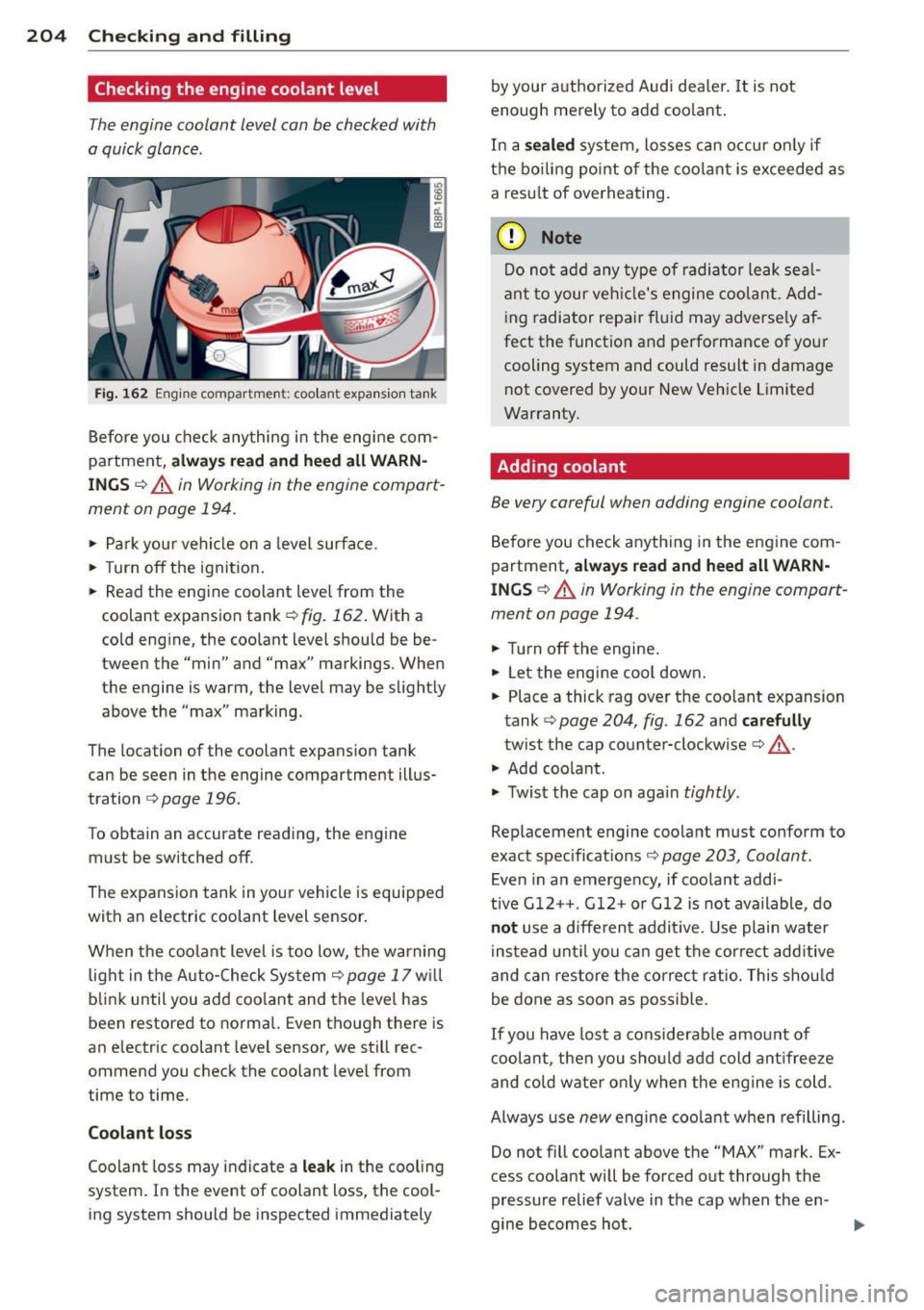
.. Read the eng ine coolant leve l from the
coolant expansion tank<=>
fig. 162 . With a
cold eng ine, the coo lant level should be be
tween the "min" and "max" markings . When
the engine is warm, the level may be slightly above the "max" marking.
The location of the coolant expansion tank
can be seen in the engine compartment illus
tration
i:> page 196.
To obtain an accurate read ing, the engine
must be switched
off.
The expansion tank in yo ur vehicle is equipped
with an e lectric coolant level sensor .
When the coolant level is too low, the warning light in the Auto -Check System
c> page 17 w ill
blink until you add coo lant and the level has
been restored to norma l. Even though there is
an electric coolant level sensor, we still rec
ommend you check the coolant level from
time to time.
Coolant lo ss
Coolant loss may indicate a le ak in the cooling
system . In the event of coolant loss, the cool
ing system should be inspected immediately by your authorized Audi dea
ler .
It is not
enough merely to add coolant .
In a
se aled system, losses can occur on ly if
the boiling point of the coo lant is exceeded as
a res ult of overheating.
(D Note
Do not ad d any type of radiator leak sea l
ant to your veh icle's engine coolant . Add
i ng radiator repair fl uid may adverse ly af
fect the funct ion and performance of your
cooling system and could result in damage not covered by your New Veh icle Limited
Warranty .
Adding coolant
Be very careful when adding engine coolant.
Before you check anything in the eng ine com
partment,
a lw ays re a d and heed all WARN
INGS c::> A in Working in the engine compart
ment on page 194 .
.. Turn off the engine .
.. Let the engine cool down.
.. Place a thick rag over the coolant expansion
tank
c::> page 204, fig . 162 and ca refull y
twist the cap counter-clockwise c::> A.
.. Add coo lant .
.. Twist the cap on aga in
tightly .
Replacement engine coolant must conform to
exact spec ificat ions
c::> page 203, Coolant.
Even in an emergency, if coolant addi-
t ive G12++ . G 12+ or G12 is not ava ilable, do
n ot use a d iffe rent addit ive. Use plain water
instead unt il you can get the correct add itive
and can restore the correct ratio. This shou ld
be done as soon as possible .
If you have lost a considerab le amou nt of
c oolant, then you sho uld add cold ant ifree ze
and co ld wate r on ly when the engine is cold.
Always use
new engine coo lant when refilling .
Do not f ill coolant above the
"MAX" mark. Ex
cess coolant will be forced out through the
pressure relief valve in the cap when the en -
gine becomes hot .
Iii>
Page 208 of 280
206 Checking and filling
Brake fluid
Checking brake fluid level
The brake fluid level can be checked with a
quick glance .
Fig. 163 Engine compartme nt: brake flu id reservo ir
Before you check anything i n the engine com
partment,
a lwa ys rea d and h eed a ll WA RN·
ING S c:> & in Working in the engine compart
ment on page
194.
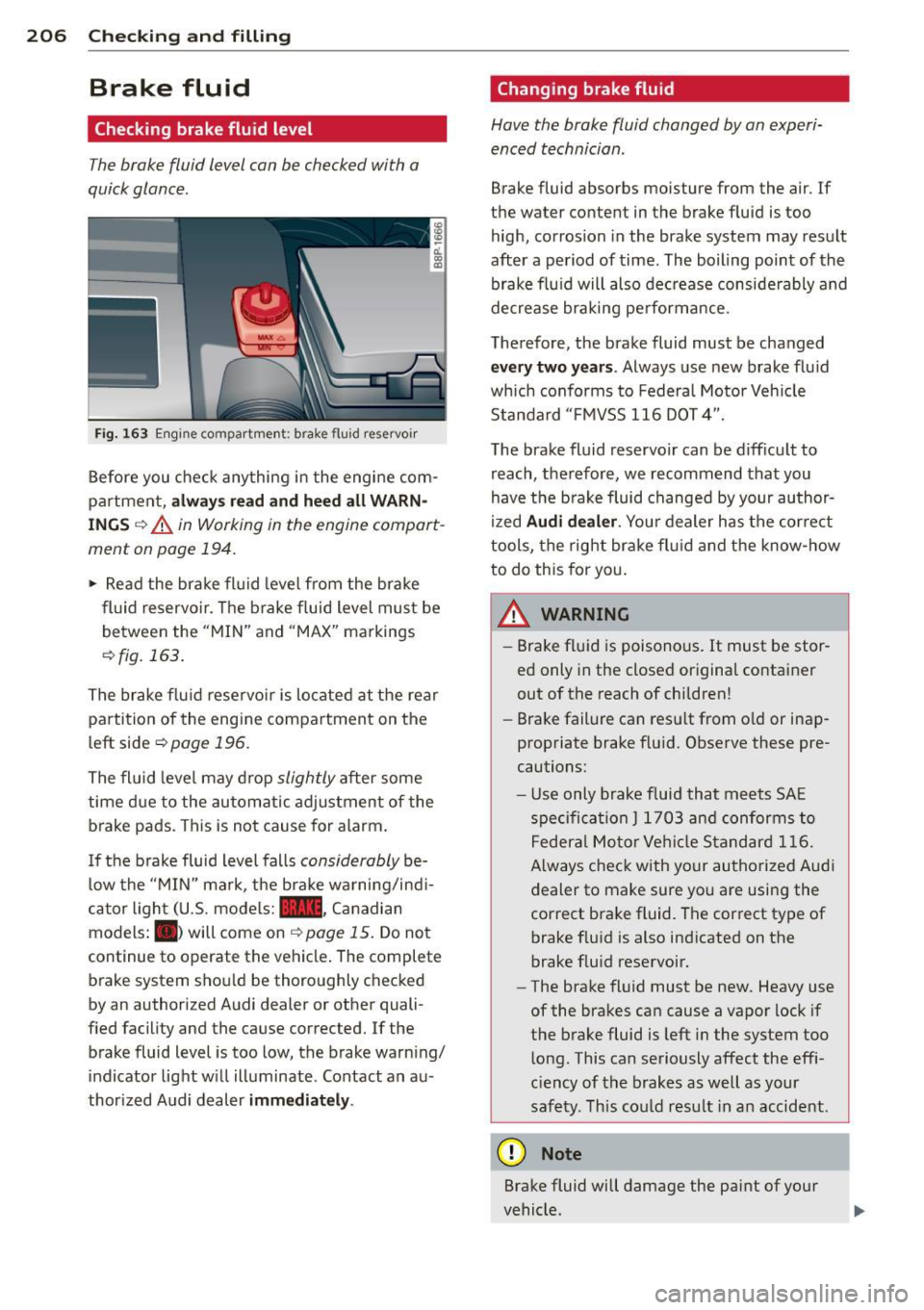
~ Read the brake fluid level from the bra ke
fluid reservoir. The brake fluid Level must be
between the "MIN" and "MAX" markings
9fig. 163 .
The brake f lu id rese rvoir is located at the rear
partition of the engine compartment on the
L eft side
¢page 196.
The fluid level may drop slightly after some
time due to the automatic adjustment of the b rake pads . This is not cause for alarm .
I f the b rake fluid Level falls
considerably be
low the "MIN" mark, the brake wa rning/ind i
cator Light (U.S. models:
1111 , Canadian
models:
llllt will come on c:> page 15 . Do not
continue to operate the vehicle . The complete
brake system sho uld be thoroughly checked
by an authorized Audi dealer or other quali
fied facility and the cause corrected. If the
brake fluid level is too low, the brake warn ing/
indicator Light w ill illuminate . Contact an au
thor ized Audi dealer
imm ediatel y.
Changing brake fluid
Have the brake fluid changed by an experi
enced technician .
Brake fluid absorbs moisture from the air. If
the water content in the brake fluid is too high, corrosion in the brake system may result
after a period of time . The boiling point of the
brake flu id will also decrease conside rably and
decrease braking pe rformance.
Therefore, the brake fluid must be changed
eve ry two y ears. Always use new brake flu id
which conforms to Federal Motor Veh icle
Standard "F MVSS 116 DOT 4".
The brake fluid reservoir can be diff icult to
reach, therefore, we recommend that you
have the b rake fluid changed by your author
ized
Audi dealer . Your dealer has the correct
tools, the right brake fl uid and the know -how
to do this for you.
A WARNING
- Brake fluid is poisonous . It must be stor
ed only in the closed original container
out of the reach of children!
- Brake failure can resu lt from o ld or inap
propriate brake flu id. Observe these pre
cautions:
- Use only brake f luid that meets SA E
specifica tion
J 1 7 03 and conforms to
Federa l Moto r Ve hicl e Standard 1 16.
Always check with yo ur authorized Aud i
dealer to make sure yo u are using the
correct brake fluid. The correct type of brake f lu id is also ind icated on the
brake flu id reservoir.
- The brake fluid must be new. Heavy use
of the brakes can cause a vapor lock if
the brake fluid is left in the system too
l ong. This can seriously affect the effi
c iency of the brakes as well as your
safety. This cou ld resu lt in an accident.
(D Note
Brake fluid will damage the paint of your
vehicle .
Page 209 of 280
@ For the sake of the environment
Because of the problem of proper disposal
of brake fluid as we ll as the special tools
req uired and the necessary expert ise, we
recommend that you have the brake fluid
changed by your author ized Audi dealer.
Battery
General information
All work on the battery requires technical
knowledge!
F ig . 1 64 Eng ine co mpa rtment: Batte ry w it h cover*
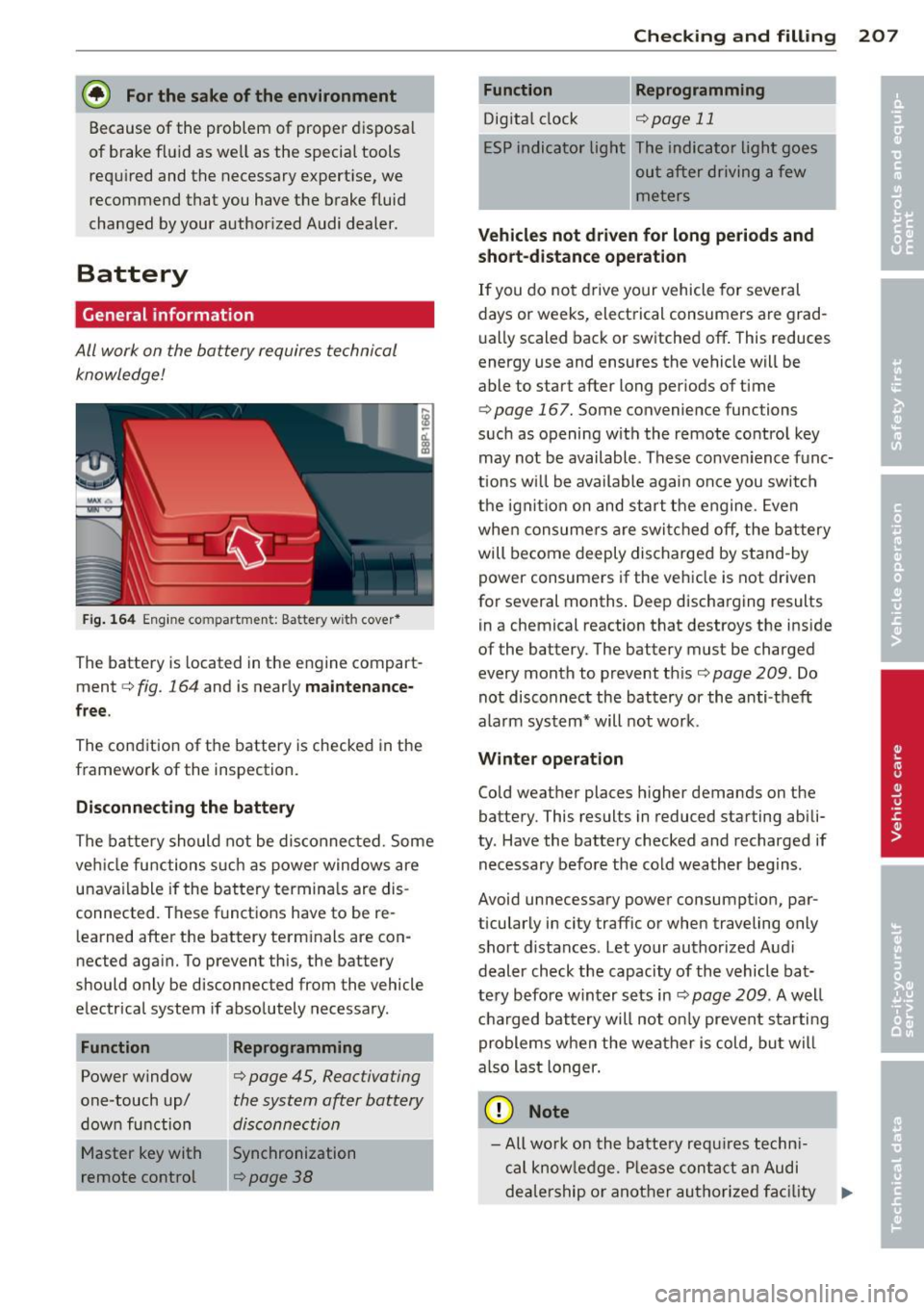
The battery is located in the engine compart
ment
c::> fig. 164 and is near ly m ain te nance
fre e.
The condition of the battery is checked in the
framework of the inspection.
Disconnecting the battery
The batte ry should not be disconnected. Some
ve hicl e functions such as power windows are
unavailable if the battery termina ls are dis
connected. These funct ions have to be re
l earned after the battery term inals are con
nected aga in. To prevent this, the battery
should only be disconnected from the vehicle
electrical system if absolutely necessary .
Function
Power window
one-touch up/
down function
Master key with
remote control
Reprogramming
c::, page 45, Reactivating
the system after battery
disconnection
Synchronization
~page 38
Checkin g and fillin g 207
Reprogramming
Digita l clock c::, page 11
ESP indicator light The indicator ligh t goes
out after driving a few
meters
Vehicl es not driven for long periods and
sho rt -d is tance op eration
If you do no t drive your vehicle for several
days or weeks, electrical consumers are grad
u ally scaled back or switched off . This reduces
energy use and ensures the vehicle will be
able to start after long periods of time
c::, page 167. Some convenience functions
such as opening w it h the remote control key
may not be available. These conve nience func
tions wi ll be available again once you switch
the ignit io n on and sta rt the engine. Even
whe n consume rs a re switched off, the battery
will become deeply discharged by stand -by
power consumers if the vehicle is not driven
for several months . Deep discharging results
in a chemical reaction that destroys the inside
of the battery. The battery must be charged
every month to prevent th is
c::, page 209. Do
not disconnect the battery or the anti-t heft
alarm system* will not work .
Winter operation
Cold weather places higher demands on the
battery. This results in reduced starting abili
ty. Have the battery checked and recharged if
necessary befo re the cold weather begins.
Avoid unnecessary power consumpt ion, par
ticularly in city traffic or when traveling only
short distances . Let your authorized Audi
dealer check the capacity of the vehicle bat
tery before winter sets in
c::, page 209 . A well
c harged bat tery will not o nly prevent s tarti ng
problems when the weather is cold, but will
also last longer .
(D Note
-All wo rk on the batte ry requ ires techn i
cal know le d ge. P lease con ta ct an Audi
dealership or another authorized fa cility
lill>
Page 211 of 280
-When a battery is charged, it produces
hydrogen gas which is explosive and
could cause personal injury.
- Always keep the battery well out of the
reach of children.
- Before work is done on the electrical sys
tem, disconnect the negative ground ca
ble.
- Before performing any work on the elec
trical system, switch off the engine and
ignition as well as any electrical equip
ment. The negative cable on the battery
must be disconnected. If you are just go
ing to replace a light bulb, then it is
enough to switch off the lights.
- Before disconnecting the battery, switch
off the anti-theft alarm system! Other
wise you will set off the alarm.
- When disconnecting the battery, first
disconnect the negative cable and then
the positive cable.
- Before reconnecting the battery, make
sure all electrical consumers are switch
ed off. Reconnect the positive cable first
and then the negative cable. Never inter
change the cables -this could start a fire!
- Never charge a frozen or a thawed-out
battery. It could explode! If a battery has
frozen, then it must be replaced. A dis
charged battery can freeze over at
32 °F
(0 oc).
-Mak e sure the vent hose is always attach
ed to the opening on the side of the bat
tery.
- Never use batteries which are damaged.
There is the danger of an explosion! Al
ways replace a damaged battery.
_& WARNING
California Proposition 65 Warning:
- Battery posts, terminals and related ac cessories contain lead and lead com
pounds, chemicals known to the State of
California to cause cancer and reproduc
tive problems. Wash hands after han dling.
Checking and filling 209
(D Note
- Do not disconnect the vehicle battery
when the ignition is switched on or when
the engine is running, otherwise, you will
damage electronic components in the
electrical system.
- When working on the engine, protect the
battery housing from ultraviolet (UV)
rays by not parking the vehicle in direct
sunlight .
- If your vehicle is going to stand for a
long period of time without being driven,
protect the battery from "freezing", oth
erwise it will be damaged and will then
have to be replaced
~ page 209.
Charging of battery
All work on the battery requires technical knowledge!
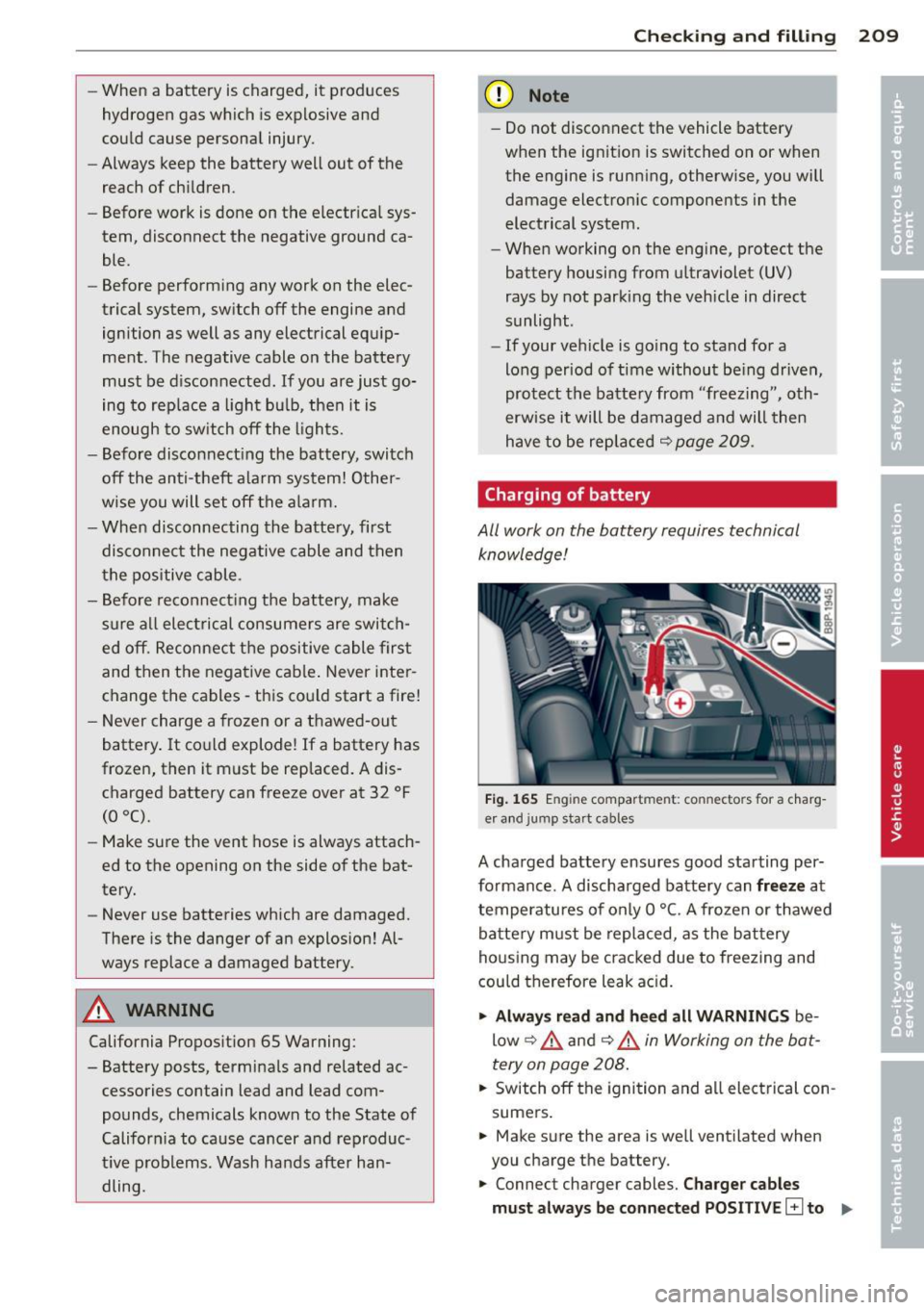
Fig. 165 E ngine compart ment: conne ctors for a charg
er and jump start cables
A charged battery ensures good starting per
formance . A discharged battery can
freeze at
temperatures of only
O 0C. A frozen or thawed
battery must be replaced, as the battery
housing may be cracked due to freezing and
could therefore leak acid.
.,. Always read and heed all WARNINGS be
low~ .&, and ~.&, in
Working on the bat
tery on page 208.
... Switch off the ignition and all electrical con
sumers .
.,. Make sure the area is well ventilated when
you charge the battery.
.,. Connect charger cables.
Charger cables
must always be connected POSITIVE
G to ..,.
Page 247 of 280
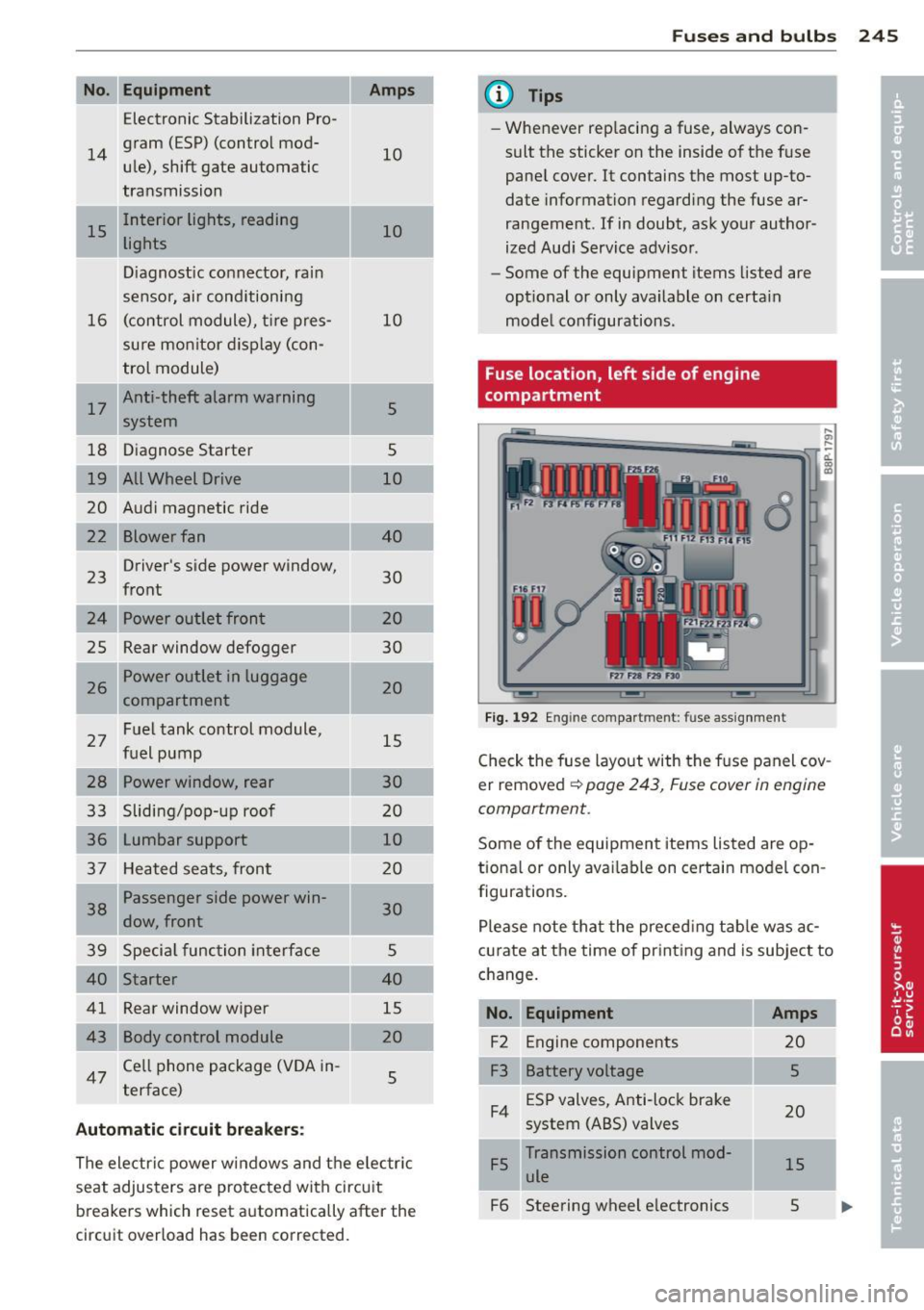
No. Equ ipment
Electronic Stabilization Pro-
14
gram (ESP) (control mod-
u le), shift gate automatic
transmission
15 Interior lights, reading
lights
Diagnostic connector, rain
sensor, air conditioning
16 (control module), t
ire pres-
sure monitor d isplay (con-
trol module)
I 17
Anti-theft alarm warning
system
18 D iagnose Starter
19 All Wheel D rive
20 Audi magnetic ride
Blower fan
23
Driver's
side power window,
front
24 Power outlet front
2S Rear window defogger
26 Power outlet in luggage
compartment
27 Fuel tank control module,
fuel pump
28 Power window, rear
33 Slidi ng/pop-up roof
36 Lumbar support
37 Heated sea ts, front
1 38
Passenger side power win-
dow, front
39 Specia l func tion interface
40 Starter
41 Rear window wiper
43 Body control module
47
Ce ll phone package (V OA in-
terface)
Automatic circuit breakers:
10
10
10
5
5
10
40
30
20
30
20
15
30
20 10
20
30
5
40
15
20 5
The electri c power w in dows and the e lectr ic
seat adjusters are pro tected with circu it
breake rs which reset automatically after the
circuit overload has been corrected.
Fu se s and bulb s 245
@ Tips
-Whenever rep lacing a fuse, always con
sult the sticker on the inside of the f use
pane l cover. It contains the most up-to
date information regarding the fuse ar
rangement. If in doubt, ask your author
ized Aud i Service adviso r.
- Some of the equipment items listed are
opt ional or only available on certa in
mode l configurations.
Fuse location, left side of engine
compartment
Fig . 192 En gine compar tment : fuse assig nment
,._
-d. a, a>
Check the fuse layout with the f use panel cov
er removed
¢ page 243, Fuse cover in engine
comportment.
Some of the equipmen t items listed are op
tiona l or only ava ilab le on certain model con
figurations.
Please note tha t the preced ing tab le was ac
c u rate at the time of pr int ing and is subject to
c h ange.
No. Equipment
F2 Engine compone nts
F3 Battery voltage ESP valves, Anti-lock brake
F4 system (ABS) valves
Transmission control mod
F5 ule
F6 Steering wheel e lectronics
Amps
20
5
20
15
s
Page 250 of 280
248 Emergency situations
Emergency situations
General
This chapter is intended for trained emer
gency crews and working per sonnel who
have the necessary tools and equ ipment to
perform these ope rations.
Starting by pushing or
towing
Q;) Note
Vehicle s with an automati c transmission
cannot be started by pushing or towing .
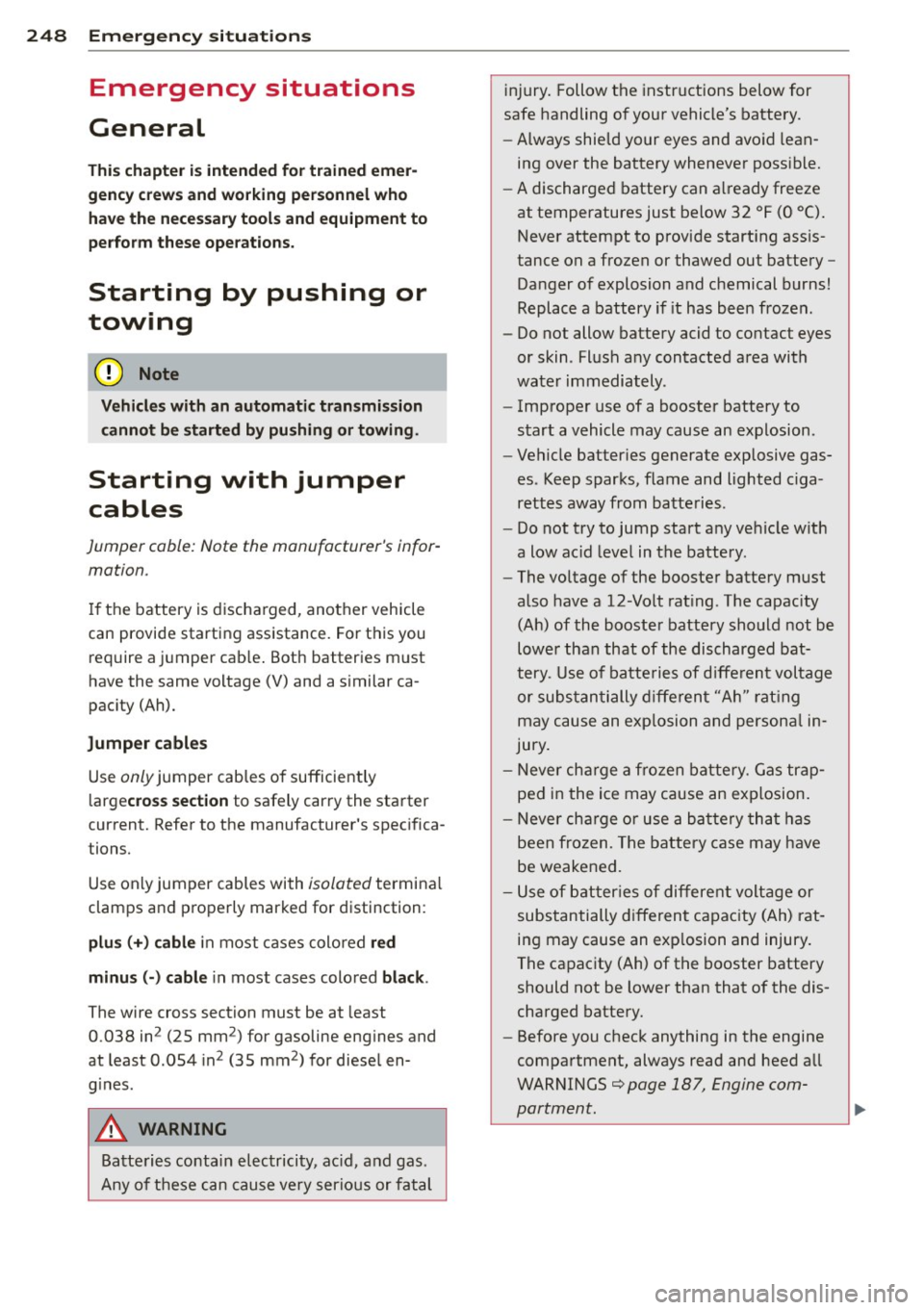
Starting with jumper
cables
Jumper cable: Note the manufacturer's infor
mation.
If th e battery is d ischa rged, another vehicle
can provide starting assistance. For this you
req uire a j umper cab le . Both batteries m ust
have the same voltage (V) and a s imilar ca
pac ity (Ah).
Jumper cables
Use only jumper cab les of sufficiently
large cross section to safely carry the sta rter
cur rent. Refer to the manufacturer 's specifica
ti ons.
Use on ly jumper cables with
isola ted termina l
clamps an d properly marke d for distinction :
plus(+) cable in most cases colo red red
minu s(-) cable
in most cases colo red black .
The wire cross section must be at least
0.038 in
2 (25 mm2 ) for gasoline eng ines and
at least 0.054 in
2 (35 mm2
) for diese l en
gines .
A WARNING
Batte ries co ntain e lec tricity, ac id, a nd gas .
Any of these can cause ve ry ser io us or fatal i
njury . Follow the instructions below for
safe handling o f your vehicle's battery.
- Always shie ld your eyes and avo id lean-
ing over the battery wheneve r poss ib le.
- A discharged battery can a lready freeze
at temperatures just be low 32 °F (0 °() .
N ever attempt to provide start ing ass is
tance on a frozen or thawed out batte ry -
Da nger of explosion and chemical burns!
Replace a battery if it has bee n froze n.
- Do not allow battery acid to contact eyes
or skin . Fl ush a ny con tacted a rea with
wa te r immediat ely .
- Imp rope r use of a booster battery to
start a vehicle may cause an ex plosion .
- Vehicle batter ies ge nerate explosive gas
e s . K eep spar ks, flame and lighted c iga
r e ttes away from ba tteries.
- Do not try to ju mp start a ny ve hicle w it h
a low ac id leve l in the battery .
- The vo ltage of the bo oste r batte ry m ust
a lso have a 12-Vo lt rat ing. T he capacity
(A h) of the booste r battery sho uld not b e
lowe r than that of the discharged bat
tery . U se o f batte rie s of d iffe ren t voltage
or subs tan tia lly diffe ren t "Ah" rat ing
may c ause an exp losion and person al in
jury .
- N ever ch arge a fr oze n b atte ry. Gas t rap
ped in the i ce may c ause an ex plosion .
- N ever ch arge or use a batt ery th at h as
been frozen . T he battery case may have
be weake ned.
- Us e of batt erie s of diff ere nt vol tage or
subs tanti ally diff eren t ca pac ity (Ah) rat
in g may cause an exp losion and injury.
The ca pac ity ( Ah) of the booster battery
should not be lower than that of the dis
charged batte ry.
- Before you check anythin g in the engine
compa rtment, always read and heed a ll
WAR NIN GS¢
page 187, Engine com
partment.
Page 252 of 280
250 Emergency sit uat ions
2. Otherwise apply the hand brake and shift
into idle gear if your vehicle has manua l
transmission, and put the selector lever
into P position if your vehicle has auto
matic transmission.
3 . For both vehicles switch off all consumers
and the ig nition .
Connectin g/disco nn ecting th e jumper
cable
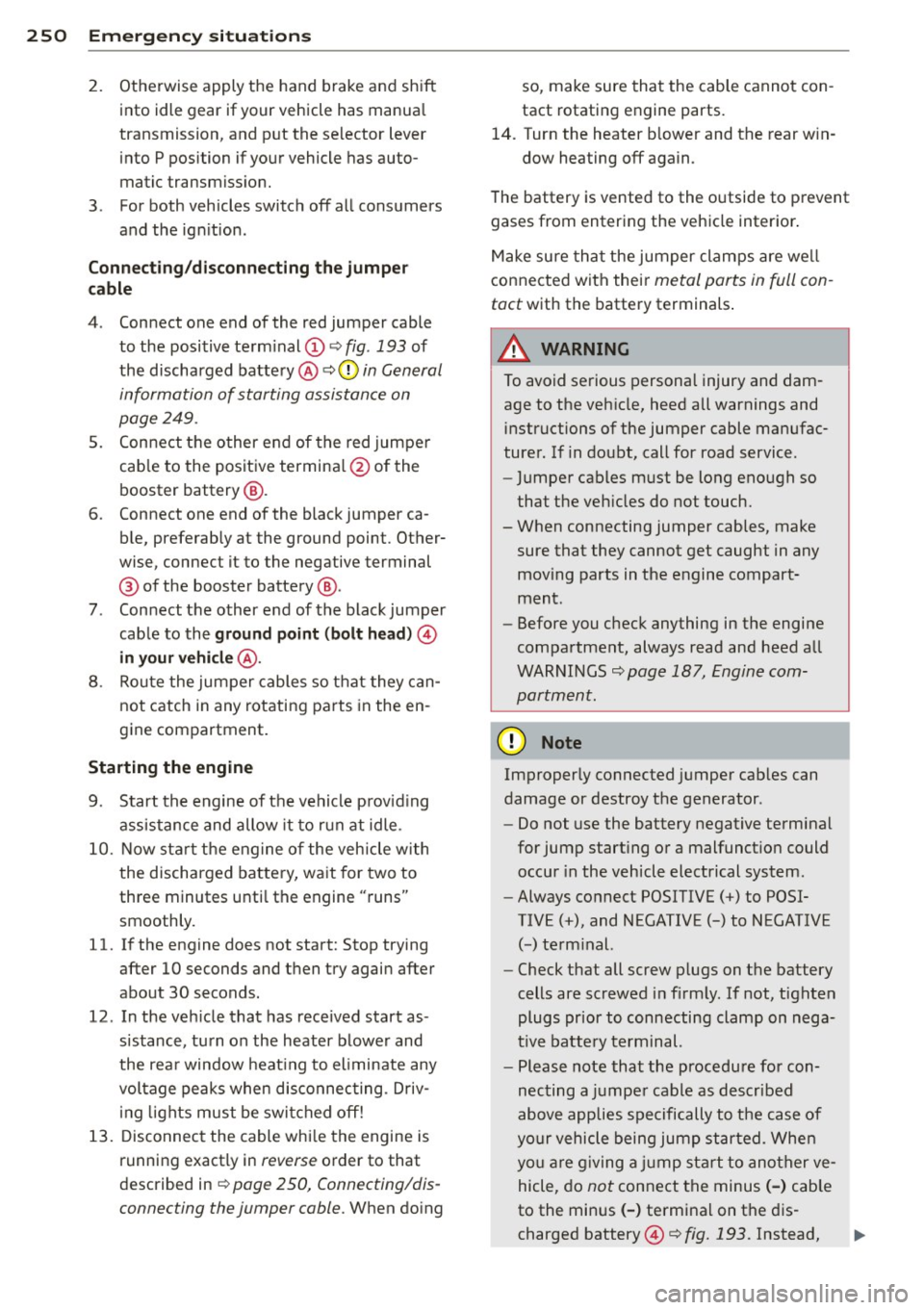
4 . Connect one end of the red jumper cable
to the positive term inal
(D ¢ fig . 193 of
the discharged battery @ ¢0
in General
information of starting assistance on
page 249 .
5. Connect the other end of the red jumper
cab le to the positive termina l@ of the
booster battery @.
6 . Connect one end of the black jumper ca
b le, preferably at the ground point. Other
wise, connect it to the negative terminal
@ of the booster battery @.
7 . Connect the other end of the black jumper
cab le to the
ground po int (bolt head )©
in your v ehi cle @ .
8. Route the jumper cables so that they can
not catch in any rotating parts in the en
gine compartment.
Starting the engine
9 . Start the engine of the vehicle provid ing
assistance and allow it to run at idle .
10. Now start the eng ine o f the vehicle w ith
the discharged battery, wa it for two to
three minutes unti l the engine "runs"
smoothly .
11. If the engine does not start: Stop trying
after
10 seconds and then try again after
about
30 seconds.
12 . In the veh icle that has received start as
sistance, turn on the heater blower and
the rea r window heat ing to eliminate any
voltage peaks when disconnecting. Driv
ing lights must be swi tched off!
13. Disconnect the cable whi le the engine is
running exact ly in
reverse order to that
described in¢
page 250, Connecting/dis
connecting the jumper cable.
When do ing so, make sure that the cable cannot con
tact rotating engine parts.
14. Turn the heater b lower and the rear w in-
dow heating off again .
The battery is vented to the outside to prevent gases from entering the vehicle interior .
Make sure that the jumper clamps are we ll
connected with thei r
metal ports in full con
tact
with the battery terminals .
A WARNING
To avoid serious personal injury and dam
age to the vehicle, heed all warnings and
instructions of the jumper cable manufac
turer. If in doubt, call for road service.
- Jumper cables must be long enough so
that the veh icles do not touch.
- When connecting jumper cables, make sure that they cannot get caught in any
mov ing parts in the engine compart
ment.
- Before you check anything in the engine
compartment, always read and heed all
WARNINGS ¢page 187, Engine com
partment.
{CT) Note
Improperly connected jumper cab les can
damage or destroy the generator .
- Do not use the battery negative terminal
for jump start ing or a malfunct ion could
occur in the vehicle electrical system.
- Always connect POSITIVE(+) to POSI-
TIVE(+), and NEGATIVE(-) to NEGATIVE
( - ) term inal.
- Check that all screw p lugs on the battery
cells are screwed in firm ly . If not, tighten
plugs prior to connecting clamp on nega
tive batte ry term inal.
- Please note that the procedure for con
necting a jumper cable as described
above applies specifically to t he case of
your vehicle being jump st arted. When
yo u are g iving a jump sta rt to another ve
hicle, do
not connect the minus( -) cable
to the minus (-) terminal on the dis
charged battery@¢fig.193 . Instead,
Page 270 of 280
268 Index
Eme rgency towing ......... .. .. .... . 251
E ne rgy management ........... .. ... 167
Ba ttery power ........... .... .. .. . 168
Dr iver notific ation ...... .. .. .. .. .. . 16 8
Eng ine
4-cylinder diesel (140 hp) ....... .... 197
4-cyl ind er g asoline (200 hp) .. .. .. ... 196
Coolant .. ... ............ .. .. .. .. . 203
H ood .. ...... ........... .. .. .... . 194
Pr ehea ter . . . . . . . . . . . . . . . . . . . . . . . . . 86
Start ing . . . . . . . . . . . . . . . . . . . . . . 89, 90
Starting with j umper cab les . ..... .. . 248
Stopping . . . . . . . . . . . . . . . . . . . . . . . . . . 91
E ng ine compartmen t ................ 196
Safety instruc tions .......... .. .... . 194
Working in the engine compar tment .. 194
Eng ine coolant system ........... .... 203
Adding coo lant ............ ... .. .. . 204
Chec king coolan t leve l ..... .. .. .... . 204
Che cking the eng ine coolant leve l ..... 204
M alfunct ion . . . . . . . . . . . . . . . . . . . . . . . 17
Radiator fan . .. .. ..... ... .. .. .... . 205
E ng ine coolant temperature
Gauge ... .. ................ ... .. .. 11
Eng ine data .. ............... ...... . 257
Engine fault Warning light .. .. ..... ... .. .. .... .. 20
E ng ine hood
C lo sing .. .. ............. .. .. .. .. . 194
Release lever . ........... .... .... . 194
Releasing and open ing . ... .. ... ... . 194
Eng ine malfunction (diesel engine)
War ning light ............ .. .. .... .. 20
Eng ine oil . ............... .. .. .... . 197
Adding .. .. ............... .... .. . 200
Addit ives . .. ................ ... ... 200
C hanging .. ... .... ...... ... ... .. . 20 1
Chec king the eng ine o il level .. .. .. .. . 200
Di ese l eng ine ............ .. .. .... . 20 2
I ndications and con ditions req uiring ex-
tra check ing . .. .. ..... ... .. .. .... . 200
Oil consumption .. ..... ... .. .. .... . 199
Oi l grades . .... . ...... ... .. .. .... . 197
Recommended oil check intervals ..... 200
Specification and viscos ity .... .. .... . 197
Specifications Diesel engine .. .... ... 202
Specifications gasoline engine .. .. ... 197
Tempe ratu re d isplay ...... .. .. .. .. . . 31 E
ngine oi l leve l . . . . . . . . . . . . . . . . . . . . . . 20
E ngine o il pressu re (malfunction) ....... 16
Engine oil sensor defective ............ 20
En gine preheate r .................... 86
C onnect ing . ..... .. ... ..... ... .. .. . 86
E ngine speed limitation . . . . . . . . . . . . . . . 20
Environment Break-in per iod . .. ............. .... 169
Catalytic converter ............. .... 170
Diesel particulate f ilter ............ . 171
D ispos ing of your veh icle battery ... .. 210
D riv ing at high speeds .............. 172
D riving to minimize pollution and noise 171
F uel ............................. 192
F uel economy . . . . . . . . . . . . . . . . . . . . . 171
Leaks under your vehicle ..... ... .. .. 194
Letting the vehicle stand and warm up . 172
Proper d isposal of drained bra ke fluid . 206
Proper disposal of drained eng ine cool-
ant ............................. 204
Proper d isposal of drained eng ine
o il . . . . . . . . . . . . . . . . . . . . . . . . . 200, 201
Recycling used engine oil ............ 200
U nleaded fuel . ... ................ . 189
Wha t shou ld I do w ith an o ld b att ery? . 210
EPC
refer to E lect ron ic power co ntrol ... .. . 19
Event Data Recorder (EDR) ........ .... 161
E xh aus t tai l pipes
Cleaning .. .... .. ............. .... 183
Expansion tank .. .. ................ . 204
Exterior mirrors Adjusting . . . . . . . . . . . . . . . . . . . . . . . . . 53
Dimming .......................... 54
Heating ........................... 53
F
Fahrenheit
Switching between Fa hrenhe it and Centi-
grade ....... .... .... ........... .. 83
F an
Adjusting the fan speed ...... .... . .. . 83
Climate controls ............... .. .. . 83
Radiator ......................... 205
Page 272 of 280
270 Index
Heated
exterior mirrors . . . . . . . . . . . . . . . . . . . . 53
rear w indow . . . . . . . . . . . . . . . . . . . . . . . 85
H eated washe r jets
W iper and washer system .. .. .. .... .. 55
H eavy clothing and safety belts .... .... 116
High beam ... ... . ...... ... .. .. .. 47, SO
H igh voltage warn ing label .. .. .. .... . 255
H ill Descen t A ss ist .. ........... .. .. .. 99
H ill hold assist
Starting on hills .. ..... ... .. .. .... .. 92
hood
refer to Engine hood .. .... .. .. .... . 194 Installing the upper te
ther st rap on the
anchorage . ..... .. .. ... .. ..... ... .. 159
Instrument pane l
Illum ina tion ... .. ....... ..... ... .. . 49
Instrument panel and controls .. .. .. .. . 10
Inst ruments and controls
Gen era l illustration . . . . . . . . . . . . . . . . . . 8
Interior light
Re ar . .. .. .. .. .. .. ....... ...... .. . 52
Interior light s . . . . . . . . . . . . . . . . . . . . . . . S 1
Amb ient lig hti ng . . . . . . . . . . . . . . . . . . . 52
luggage compartment . . . . . . . . . . . . . . 53
H ood re le as e ... ... ..... ..... .. .. .. . 194
J
Horn ..... .. ... .. ..... ... .. .. .... .. . 8
H ow are child restra int system anchors re-
l ated to child safety . ....... .. .. .. .. . 155
H ow m any airb ags doe s my veh icle h ave? 129
H ow often sho uld I check my tire pres -
su res? .... .. ... .. ..... ... .. .. .... . 219
H ow safety belt pretensione rs wo rk . .. . 120
Hydroplaning .. .... .... ..... .. .. .. . 223
I
Ignit ion key . . . . . . . . . . . . . . . . . . . . . . . . . 89
I gnition lock . . . . . . . . . . . . . . . . . . . . . . . . 89
Ign ition lock po sit ions . . . . . . . . . . . . . . . . 89
I mmobilizer .... .. ..... ... .. .. .... .. 1 2
I mportant informat ion for veh icles w ith
D iese l eng ine when add ing o r changing en -
g ine oi l ... .. .... .. .. ... .. .. .. .. .. . 20 2
Important thing s to do before driving .. 103
I mproperly worn safety be lts ... .. .... . 119
I ndicator light
A irbag sys tem .... .... .... ... .. .. . 133
Audi magnetic ride ........ .. .. .... .. 2 2
C lutch ove rheating ... ... .. .. .. .. .. . 10 1
P ASSENGER A IR BAG OFF . ... .. .... . 133
Indicator lights . . . . . . . . . . . . . . . . . . 10, 13
Red symbol s in the center d isp lay .. .... 13
Yellow symbols in the cen ter disp lay . .. 14
also refer to Warn ing/ indicator lights . . 13
Infant seats ................... .... 148
Install ing chi ld safety s eats
Safety belts . . . . . . . . . . . . . . . . . . . . . . 1S2 Jack and tools
Jump-starting
234
248
Jumper cables . .. .. ... .. .. .. .. .. .. .. 249
Jump s ta rt ing . .. .. .... ... .. .. .. .. .. 249
K
Key ... .. ... .. .. .. .. .... .. .... ... .. . 34
Batte ry replacement .... ....... .... . 35
Coded se ttings . ...... ... .. .. .. .. .. . 84
Co nvenience openi ng and clos ing of win -
dows . ....... ... .................. 44
Key r eplacement . . . . . . . . . . . . . . . . . . . 34
Master key . . . . . . . . . . . . . . . . . . . . . . . . 34
Vale t key . . . . . . . . . . . . . . . . . . . . . . . . . . 34
Key-coded settings Climate co ntrols . . . . . . . . . . . . . . . . . . . . 84
Kick-down Automat ic transmiss ion . ....... .... 101
L
LATCH ... .. .... .. ... .. ..... .... . .. 155
D esc ription . ..... .. ... ..... ... .. .. 156
I ns talling a c hild re stra int ....... .... 157
location .. .. .. .. ....... ..... ..... 156
Mounting and releasing the anchorage
hook ........ ... ................ . 157
La unch Control Prog ram . ..... ... .. .. 101
L eathe r . . . . . . . . . . . . . . . . . . . . . . . . . . . 185
Cleaning .. .. .. .. ....... ...... .. .. 186
leav ing home ... .. ... .. .. ... ..... .. . 48
Lifting/raisi ng the vehicle ..... ... .. .. 252
Page 275 of 280
----------------------------~I~n ~d ~e ~x 273
Remote control ..... .... ... .. .. .. .... 35
Resetting r emote control . ... .. .. .. .. 38
Un lock ing and locking .. ... .. .. .. .. .. 37
Remote master key Battery replacement ................ 35
Check light ..... .. .... ... .. .. .. .... 35
Repa ir manuals ..................... 259
Repairs Airbag system .................... 135
Replacing Wheel rims
... ... ..... ... .. .. .. ... 223
Replacing a sound system ........... . 262
Replacing light bulbs ............... . 246
Replacing tires and whee ls ... .. .. .. .. . 224
Replacing w indshield wiper blades ...... 57
Report ing Safety Defects . . . . . . . . . . . . . 11 1
Reset b utton . ............. .. .. .. .. .. 12
Resett ing remote control .............. 38
Retractor
' . .. .... ...... ... .. .. .. .. . 1 16
Reverse Automatic t ransmission .. .. .. .. .. 97
R ims
Cast alloy .. ............. .... .. .. . 182
Replacing ........................ 223
Steel rims ................ ...... .. 182
Roof rack Attac hment points with separate roof
rack system ............. .... .. .... 72
Loading ........................... 73
M ou nti ng loca tions ......... .. .. .. .. 73
Safe mounting .......... .... ... .. .. 7 1
Roof weight . . . . . . . . . . . . . . . . . . . . . . . . . 73
s
SAFE · .. · . .. .. .... .. .... ... .. .. .... 12
Safe d riving hab its .................. 103
Safety belt position . . . . . . . . . . . . . . . . . 117
Safety belt he ight adjustment .. .. .. . 119
Safety belts worn by p regnant women . 118
Safety belt pretens ioner . . . . . . . . . . . . . . 120
Service and disposal ............... 120
Safety belts .. .... ......... .... .. .. . 116
cleaning ... ... .. ..... ... .. .. .. ... 187
Danger to passengers who do not wear a
safety belt ... .. .. .... ... .. .. .. ... 114
Fastening .. .. ........... .. .. .. ... 116 height adjustment .
.. .. ..... ... .. .. 119
Improper ly worn ... . ... .... ... .. .. 119
Not worn . . . . . . . . . . . . . . . . . . . . . . . . 114
Safety belt pos ition . . . . . . . . . . . . . . . . 117
Safety instructions .... ............. 116
Securing child safety seats .......... 152
Spec ial considerations for pregnant
women .......................... 118
Un fastening . .. .. .. . .............. 118
W arning/ind icator light ............. 113
Why YOU MUSTwearthem ... .. 113,11 4
Wor n properly . . . . . . . . . . . . . . . . . . . . 115
Safety be lt warning light . . . . . . . . . 16, 113
Safety compliance sticker ........ .. .. 255
S afety equipme nt .. ................. 103
Safety features for occupant restraint and
protection .. ... .... ................ 103
Safety gu idelines
Seat adjustment . . . . . . . . . . . . . . . . . . . . 61
Safe ty instr uctions
Engine compartment . ... .... ... .. .. 194
for side c urtain airbags . ..... ... .. .. 142
for using child safety seats .......... 146
for using safety belts ............... 116
Monitoring the Advanced Airbag Sys-
tem ............................. 135
Safety lock Ign it ion key, automatic transmission 89
Seat adjus tment
Drive r's sea t ... .. .... ............. . 61
F ront passenger's seat . . . . . . . . . . . . . . . 62
Front seats . ..... .. . .. .. ..... ... .. . 61
Head restraints
.. .. .. .. .... ... .. .. 107
Head restraints, front seat ........... 65
Lumbar support .. .. ........... .... . 64
Manua l controls .. .. . .. .. ..... ... .. . 62
Manual seats ...................... 62
Power s eat . . . . . . . . . . . . . . . . . . . . . . . . 63
Seat be lts
WhyYOU MUSTwearthem ..... 113,114
also refer to Safety be lts .. ..... ... .. 113
Seating capacity ...... .. ..... ... .. .. 113
Seating position Drive r ........................... 104
F ron t passenger .. ............. .... 105
How to ad just the front seats . ... .. .. 105
Incorrect seat position ... .... ... .. .. 107
•
•