engine AUDI S3 SEDAN 2015 Workshop Manual
[x] Cancel search | Manufacturer: AUDI, Model Year: 2015, Model line: S3 SEDAN, Model: AUDI S3 SEDAN 2015Pages: 282, PDF Size: 71.14 MB
Page 115 of 282
....,
N
0 > co
rl I.O
"'
"'
"'
rl
@ Tips
In some models, the maximum vehicle speed
can only be reached in the auto and dynamic
modes.
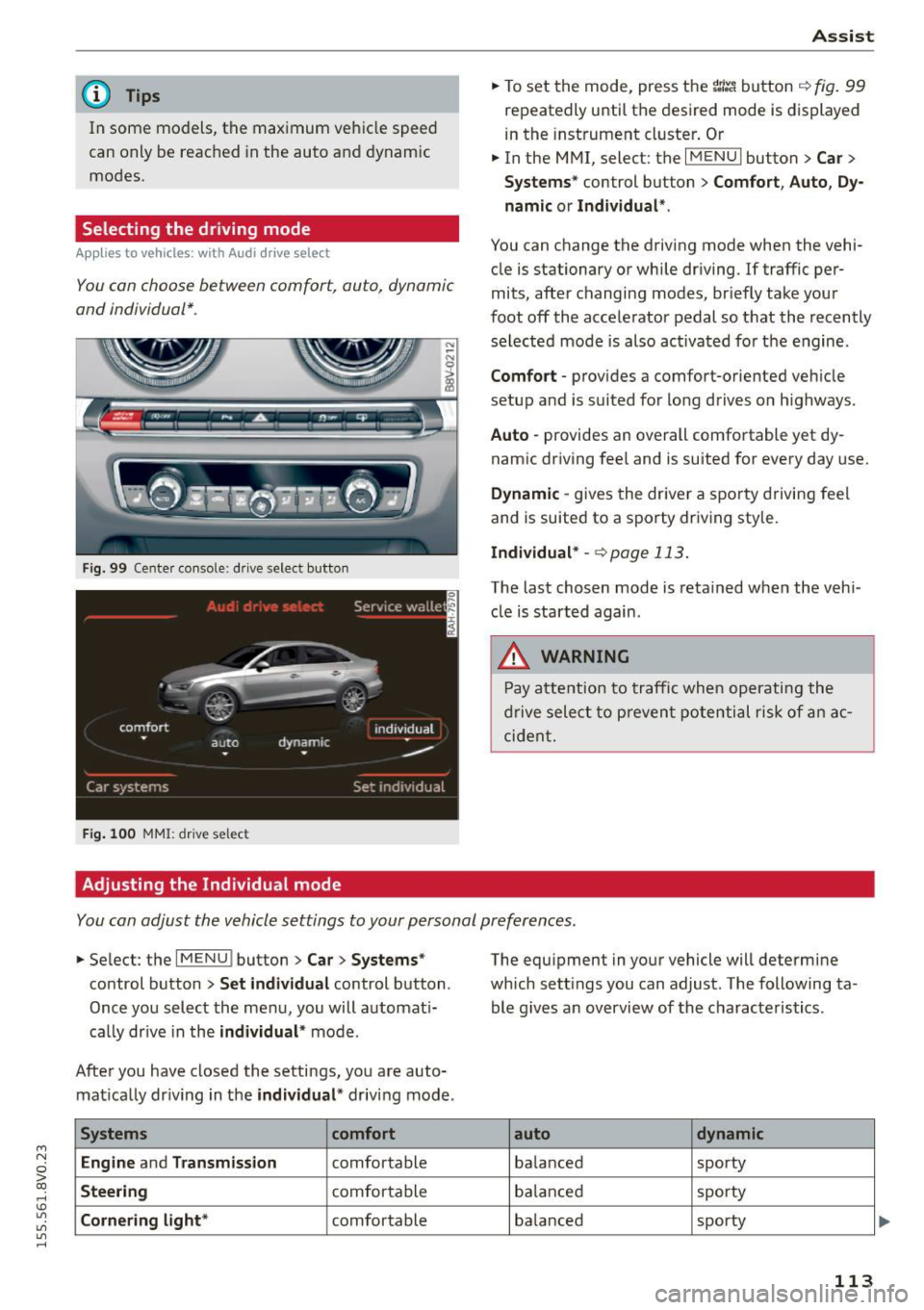
Selecting the driving mode
A ppl ies to vehicles: with Audi drive select
You con choose between comfort, auto, dynamic
and individual* .
Fig. 99 Center console: dr ive selec t button
Fig . 100 MMI : drive select
Adjusting the Individual mode Assist
.,.
To set the mode, press the r:1:.~ button ~ fig. 99
repeatedly until the desired mode is displayed
in the instrument cluster. Or
.,. In the MMI, select: the
I MENU I button >C ar>
Systems"
control button > Comfort, Auto, Dy
namic or Individual ".
You can change the driving mode when the vehi
cle is stationary or while driving.
If traffic per
mits, after changing modes, briefly take your
foot off the accelerator pedal so that the recently
selected mode is also activated for the engine .
Comfort -provides a comfort-oriented vehicle
setup and is suited for long drives o n highways.
Auto -provides an overall comfortable yet dy
namic driving feel and is suited for every day use.
Dynamic -gives the driver a sporty driving feel
and is suited to a sporty driving sty le.
Individual* -<=>page 113.
The last chosen mode is retained when the veh i
cle is started again .
.&, WARNING
-Pay attention to traffic when operating the
drive select to prevent potential risk of an ac
cident.
You con adjust the vehicle settings to your personal preferences .
.,. Select : the IMENU ! button> Car> Systems*
control button > Set individual control button .
Once you select the menu, you will automat i
ca lly dr ive in the
individual* mode .
After you have closed the settings, you are auto mat ically dr iving in the
individual * driving mode .
Systems comfort
Engine
and Transmission comfortable
Steering comfortable
Cornering light* comfortable The equipment
in your vehicle will determine
which sett ings you can adjust. The following ta
ble g ives an overview of the characteristics .
auto dynamic
balanced sporty
balanced sporty
ba lanced sporty
113
Page 116 of 282

Assist Systems comfort
Audi adaptive cru ise control*
comfortable
Adaptive damper s* comfor table
Engine sound* subtle
a) Subtle in the selector lever position D and sporty in S.
(D Tips
Your individual * mode settings are automati
cally stored and assigned to the remote co n
trol key being used.
114
auto dynamic
ba
lanced sporty
ba la nced sporty
subtle/sportyal sporty
Page 124 of 282
Intelligent Technology
Intelligent Technology Notice about data
recorded by the Event
Data Recorder and
vehicle control modules
Event Data Recorder
This vehicle is equipped with an Event Data Re
corder (EDR). The main purpose of an EDR is to
record, in certain crash or near crash-like situa
tions, such as an airbag deployment or hitting a
road obstacle, data that will assist in understand
ing how a vehicle's systems performed. The EDR
is designed to record data related to vehicle dy
namics and safety systems for a short period of
time, typically 30 seconds or less. The EDR in this
veh icle is designed to record such data as:
- How various systems in your vehicle were oper
at ing;
- Whether or not the driver and passenger safety
belts were buckled/fastened;
- How far (if at all) the driver was depressing the
acce lerator and/or brake pedal; and,
- How fast the vehicle was traveling.
These data can help provide a better understand
ing of the circumstances in which crashes and in
juries occur. NOTE: EDR data are recorded by your
vehicle only if a non-trivial crash situation occurs;
no data are recorded by the EDR under normal
driving conditions and no personal data (e.g .,
name, gender, age, and crash location) are re
corded. However, other part ies, such as law en
forcement, could combine the EDR data with the
type of personally identify ing data routinely ac
qui red during a crash investigation.
To read data recorded by an EDR, special equip
ment is requ ired, and access to the vehicle or the
E DR is needed. In addition to the vehicle manu
facturer, other parties, such as law enforcement,
that have the specia l equipment, can read the in
formation if they have access to the veh icle or the
EDR.
Some state laws restrict the retrieval or down
loading of data stored by EDRs installed in a vehi
cle for the express purpose of retrieving data af-
122
ter an accident or crash event without the own
er's consent.
Audi will not access the EDR and/or similar data
o r g ive it to others -
- unless the veh icle owner (or lessee if the veh i
cle has been leased) ag rees; or
- upon the official request by the police; or
- upon the order of a court of law or a govern-
ment agency; or
- for the defense of a lawsuit through the judicial
discovery process .
- Audi may also use the data for research about
veh icle operation and safety performance or
provide the data to a third party for research
purposes without identifying the spec ific vehi
cle or information about the identity of its own
er or lessee and only after the recorded vehicle
data has been accessed.
Vehicle control modules
Your vehicle is also equipped with a number of
electronic contro l modules for var ious vehicle
systems, such as engine management, emission
control, airbags, and safety belts.
These electronic control modules record data during normal vehicle operation that may be
needed by trained technicians for diagnostic and
r epair pu rposes. The recording capabil ity of these
modules is lim ited to data (no sound is recorded).
Only a small amount of data is actua lly recorded
over a very limited period of time, or stored when
a system fau lt is detected by a contro l modu le.
Some of the data stored may relate to vehicle
speed, direction, or brak ing, as well as restraint
system use and performance in the event of a
crash. Stored data can also only be read and
down loaded w ith specia l equipment that is di
r ect ly connected to the vehicle.
(D Tips
Your vehicle may be equipped with Audi con
nect. Your use of certain Audi connect fea
tures requires wireless se rv ic es that are pro
v id ed by a third party wireless telecommuni
cations provider. For details regarding how in
formation obtained through Audi connect is
collected, processed, transmitted, used, and ..,..
Page 125 of 282
M N
0 > co ,...., \!) 1.1"1
1.1"1
1.1"1
,....,
shared, please see your contract with the
wireless telecommunications provider and the
"About Aud i connect" tab in your vehicle's
MMI: ! MENUI button> Audi connect > About
Audi connect .
Electronic stabilization
control (ESC)
Description
The E lectronic Stabilization Contro l (ESC) reinfor
ces driver safety. It reduces the risk of slipping
and improves driving stability. ESC detects criti
cal s ituations such as the vehicle oversteering
and understeering or the wheels a re spinning.
The vehicle is stabilized by applying the brakes or
reducing engine torque. Once the ESC is activat
ed, the indicator light
DJ blinks in the instru
ment cluster.
The fol low ing systems a re integrated in the ESC:
Anti-lock braking system (ABS)
ABS prevents the wheels from locking when brak
i ng. The vehicle can still be steered even during
hard braking . Apply steady pressure to the brake
pedal. Do not pump the pedal. A pulsing in the
brake pedal ind icates that the system is acting to
stabilize the vehicle .
Brake assist system
The brake assist system can decrease braking d is
tance . It increases braking power when the driver
presses the brake pedal quickly in emergency s it
uations. You must press and hold the brake pedal
unti l the dangerous sit uation is ove r. In vehicles
with adaptive cruise control *, the brake assist
system is more sensit ive if the distance detected
to the vehicle ahead is too small.
Anti-slip regulation (ASR)
ASR reduces engine power when the drive whee ls
begin spinning and adapts the force to the road
conditions. This makes it easier to start, acceler
ate and drive up inclines.
Intelligent Technology
Electronic differential lock (EDL)
The EDL brakes whee ls that are spinning and
trans fers the drive power to the other drive wheel
or whee ls if the vehicle is equipped with all wheel
drive*). This function is not available at higher
speeds.
In extreme cases, EDL automatically switches off
to keep the brake on the braked wheel from over
heating. The vehicle is still working correct ly. EDL
will switch on again automatically when condi
tions have returned to normal.
Steering recommendation
The ESC helps to stabilize the vehicle by changing
the steering torque .
Selective wheel torque control
Selective wheel torque control is used when dr iv
i ng on curves. The front wheel on the inside of
the curve o r both wheels on the inside of the
curve are braked selectively as needed . This al
lows more precise driving in curves .
Automatic post-collision braking system
The "Automat ic post -collision braking system"
can help to reduce the ris k of sliding and of other
collisions after an accident. If the airbag control
module detects a collision above a certain vehicle
speed, the vehicle is braked by the ESC.
T he vehicle does not brake automatically if:
- the driver presses the accelerator pedal, or
- the braking force generated by the pressed
brake pedal is greater than the brak ing force
that would be initiated by the system, or
- the ESC, the brake system or the vehicle electr i
cal system are not funct ion ing .
A WARNING
-The ESC and its integrated systems cannot
overcome the limits posed by natural phys i
cal laws. This is especially important on slip
pery or wet roads .
If the systems begin act
ing to stabilize your vehicle, you should im-
mediately a lter your speed to match the ..,.
123
Page 126 of 282
Intelligent Technology
road and traffic conditions . Do not let the in
c reased sa fety prov ided tempt you into tak
ing risks. Th is cou ld increase your r isk of a
collision .
- Please note the risk of a co llision increases
when d riving fast, especially through curves
and on slippery or wet roads, and whe n dr iv
i ng too close to obj ects ahead . T he ESC and
i t s integr ated sy ste ms cann ot a lways pre
ven t colli sion s -the re is s till a risk of acci
dent s!
- Press the ac celerator ped al carefully whe n
acc ele ratin g on eve n, slippe ry su rfac es su ch
Switching on /off
as ice a nd snow . T he d rive wheels can spin
even wh en t hese control systems are instal
led and this ca n affect d riving stability and
increase the risk of a collis ion .
{!) Tips
-ABS an d ASR o nly fu nction co rrec tly when
all four wheels are equipped with identica l
t ir es . Differe nt tire s izes ca n lead to a reduc
t ion in e ngine powe r.
- Yo u may hear noises when t he systems de
sc rib ed ar e wo rking.
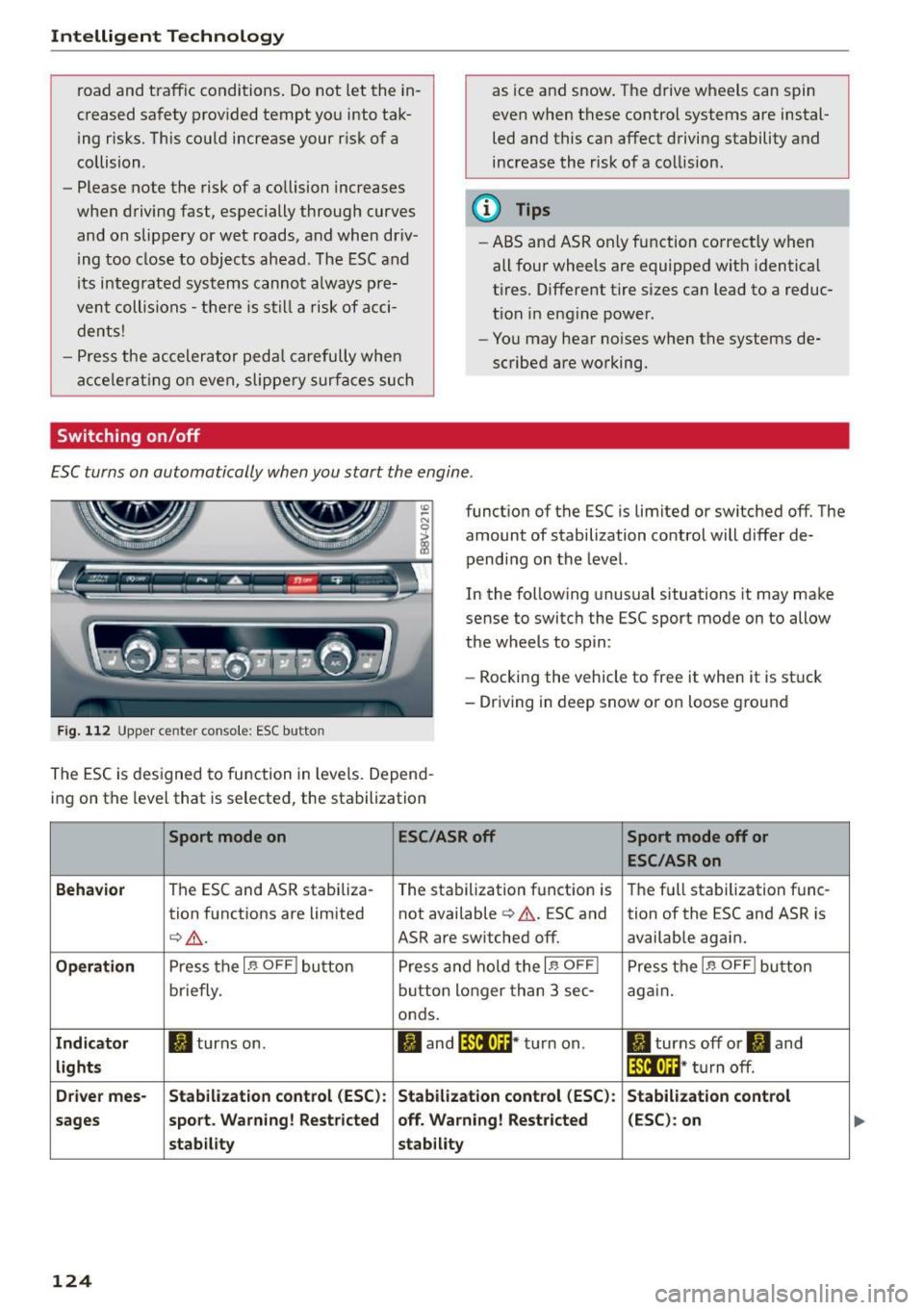
E SC turns on automatically when you start the engine .
Fig. 112 Upper ce nte r con so le : ESC butto n
functio n of the ESC is limited or switched off. The
amount of stabilization control will d iffer de
pend ing on the level.
In the fo llow ing unusual situations it may ma ke
sense to switch the ESC sport mode on to allow
t h e wheels to sp in:
- Rocking the vehicle to free it when it is st uck
- Driving in deep snow or o n loose g ro und
The E SC is d esigned to fu nction in levels . Depen d
i ng on the level that is se lected, the sta bilization
Sport mode on ESC/ASR off Sport mode off or
ESC/ASRon
Behavior
T he ESC and ASR stabiliza- The sta bilization f unct ion is T he f ull sta bilization f unc -
tion f unct ions a re lim ited not available¢& . ESC and
tion of the ESC and ASR is
¢ _& .
ASR are switched off. available again.
Operation Press t he I~ OFF ! bu tton P ress and hold t he I~ OFF I Pre ss th e I~ OFF ! bu tton
briefly. bu
tto n lon ger than 3 sec-
again.
onds.
Indicator II tur ns on. ltl and lf'tl•U~ * tu rn on . II turns off or II and
lights lf'tl•lH* turn off .
Driver mes- Stabilization control (ESC): Stabilization control (ESC) : Stabilization control
sages sport
. Warning! Restricted off . Warning! Restricted (ESC) : on
stab ility stability
124
Page 128 of 282
Intelligent Technology
& WARNING
-New brake pads do not achieve their full
braking effect during the first 250 mi
(400 km). They must be "broken in" first .
However, you can compensate for the slight·
ly reduced braking force by pressing firmly
on the brake pedal. Avoid heavy braking dur·
ing the break-in period.
- Alway apply the brakes for the purpose of
cleaning the brake system when road and
traffic conditions permit. You must not en·
danger other road users. This increases the
risk of an accident.
- On steep slopes , reduce the speed and se
lect a lower gear or lower selector lever po·
sition. Drive as little as possible while press· ing the brake pedal and avoid putting your
left foot on the brake pedal while driving.
This could cause the brakes to overheat and impair the efficiency of the brakes .
- Do not let the brakes "grind" by always
keeping your foot on the brake pedal. This
can cause the brakes to overheat, increase
wear and increase braking distance unneces·
sarily.
- Certain weather and operating conditions
such as driving through water, driving in
heavy rain or driving after washing your
ve·
hide can impair the effectiveness of the
brakes. In the winter, ice may build up on
the brake pads, rotors and drums. Check
these components by braking carefully. Ap·
plying the brakes carefully several times
dries the brakes and removes ice build-up .
- The efficiency of the brakes can also be im·
paired by driving for long stretches on roads
covered with salt without using the brakes.
You can
remove salt deposits from the brake
rotors and pads by carefully applying the
brakes several times.
- If the front spoiler is damaged or you install
another spoiler, make sure the front wheel
brakes are ventilated properly . Otherwise,
the brake system could overheat, which re·
duces their effectiveness.
- Failure of a brake circuit impairs braking
performance, which increases braking dis·
126
tance. Avoid driving the vehicle and have it
towed it to the nearest authorized Audi
dealer or authorized Audi Service Facility .
- Never let the vehicle roll while the engine is
stopped because this increases the risk of an
accident .
-If the brake booster is not working, you will
have to press much harder on the brake ped·
al to compensate for the lack of the booster .
(D Note
-Never let the brakes "rub" by pressing the
pedal lightly when braking is not really nee·
essary. This causes the brakes to overheat
and increases braking distance and causes
wear .
- Before driving on a long stretch with steep
slopes, reduce your speed and shift to the
next lower gear This makes use of the en·
gine braking effect and relieves the brakes .
If you need to brake additionally, brake in
intervals and not continuously.
(D Tips
-If the brake booster is not working, you
must press the brake pedal with much more
force then normal.
- If you retrofit your vehicle with a front spoil·
er, wheel covers or similar items, make sure
that the air flow to the front wheels is not
interrupted. Otherwise the brake system
can become too hot.
Electromechanical
steering
The electromechanical steering supports the
driver's steering movements .
Power steering adapts electronically based on
the vehicle speed.
T he vehicle still has full steering functionality if
the power steering fails or when the engine is
stopped (towing). To steer, you must apply much
more force than usual.
Indicator lights and messages
• Do not drive vehicle: steering defective
Page 129 of 282
M N
0 > co ,...., \!) 1.1'1
1.1'1
1.1'1
,....,
If th is indicator light turns on and stays on and
this message appears, the power steering may have failed .
Do
not continue driving. See an authorized Aud i
dea ler or autho rized Audi Service Facility for as
sistance.
• Do not drive vehicle: steering defective
There is a malfunction in the electron ic steering
l ock. You cannot turn the ignition on .
Do
not tow your vehicle because it cannot be
steered. See an authorized Aud i dealer or author
ized Audi Service Fac ility for assistance .
'-:r,ij Steering malfunction: you can continue driv
ing
If the indicator light turns on, the steering whee l
may be more difficult to move or more sensitive
than usual. The steering wheel may also be at an
angle when dr iving straight.
Drive slow ly to an authorized Audi dealer or au
thor ized Audi Se rvice Facility to have the ma l
function corrected.
!II Steering lock: system fault! Please contact
Service
There is a malfunct ion in the electron ic steering
l oc k.
Drive to an authorized Aud i dealer or authorized
Aud i Service Facility immediately to have the
malfunction corrected.
_& WARNING
-
Have the system malfunction corrected as
soon as possible by an authorized Audi dealer
or authorized Audi Service Faci lity, as th is in
creases the risk of an accident .
(D Tips
If
the . or ,-:r-n indicator light only stays on
for a short time, you may continue driving.
Intelligent Technology
All wheel drive (quattro)
Applies to vehicles: with all w heel drive
In all wheel drive, all four wheels are powered.
General information
In all wheel dr ive, the dr iv in g power is divided be
tween all four whee ls . T his happens automatical
ly depending on your driving behavior as well as
the current road conditions . Refer to¢
page 123,
Electronic stabilization control (ESC).
The all wheel drive concept is designed for high
engine power. Your vehicle is exceptionally pow
erfu l and has excellent driving characteristics
both under normal driving conditions and on
snow and ice. Always read and follow safety pre cautions
q ,& .
Winter tires
By using all wheel drive, your vehicle has good
forward motion with standard tires in winter con
ditions. However, in winter we recommend using
winter or all season tires on
all four wheels, be
cause this will improve the
braking effect .
Snow chains
If
there are snow chain laws, snow chains must
also be used on vehicles with all wheel drive
q page 230, Snow chains.
Replacing tires
For vehicles with all wheel d rive, only wheels wi th
the same rolling circumference should be used.
Avoid wheels with different tread depths
qpage 221.
Offroad vehicle?
Your Audi is not an offroad vehicle -there is not
enough ground clearance. For this reason, avoid
difficult terra in. Refer to¢
page 259.
_& WARNING ~
-Also, in vehicles with a ll wheel drive, adapt
your driving style to the current road and
traffic cond itions . Do not let the increased
safety provided tempt you into taking risks.
- The braking ability of your veh icle is limited
to the tract ion of the wheels. In th is way, it
127
Page 130 of 282
Intelligent Technology
is not different from a two wheel drive vehi
cle. Do not be tempted to accelerate to a
high speed when the road is slippery th is in
creases the r isk of an accident.
- Note that on wet streets, the front wheels
can "hydrop lane" if driving at speeds that
are too high . Unlike front whee l drive
vehicles, the engi ne does not rev higher sud
denly when the vehicl e begins hyd rop laning.
Fo r th is r easo n, pay a ttent ion to the road
co ndi tions regardless of your speed.
Energy management
The starting ability is optimized
The en ergy management system manages the
electrical energy distribution and optimizes the
availability of electrical energy for starting the
engine.
When a ve hicle with a co nventional energy sys
tem is not driven for a long time, the battery is
drained by equipment (for example the immobil
izer) . In certa in circumstances , there cou ld may
not be eno ugh energy to start the engine .
Your vehicle is equipped w it h an intelligent ener
gy management system for distr ibut ing electric i
ty . T his sign ificantly improves the starting ability
and inc reases the battery life .
The energy management system Is made up of
battery diagnos is , idling cu rrent management
and dynamic energy management.
Battery diagnosis
The batte ry diagnosis determines the batte ry
charge leve l. The sensors determine the batte ry
voltage, the battery current , and the battery
t emperature . The current cha rge level and the
pe rformance of t he battery a re dete rmined based
on this .
Idling current management
The idling cu rrent management decreases the
energy used while parked. W it h the engine
sw itched off, it manages the energy d istribution
to the different electrical components . Date from
battery diagnosis is taken into account for this .
128
Depend ing on the ba tte ry charge leve l, electrical
equipment is switched off one item after the oth
er, to prevent the battery from dra ining and to
retain the start ing ability.
Dynamic energy management
While driv ing, dynam ic ene rgy management dis
tribu tes the appropriate amount o f energy to the
e lectrica l equ ipment. It control s the battery
charge level so that more ene rgy is not used then
i s be ing generated in order to maintain an opti
mal battery charge level.
(D Tips
'
- Energy management cannot overcome the
laws of p hys ics. Note that the charge level
and length of the battery life a re limited.
- When the sta rting ability is endangered, the
(•) indicator light t urns on
c:> page 19 .
What you should know
Maintaining the starting ability is the highest
priority.
A lot of st ress is placed on the battery when dr iv
ing sho rt distances, in traffic, and at cold t imes
of the year. A lot of energy is used but little is
generated.
It is also critical when the engine is
not ru nning but e lectr ica l equipment is sw itched
o n. In th is case, energy is used but none is gener
ated.
In sit uat ions like this, e nergy ma nagement w ill
active ly regu lated the distribution of energy .
Long periods without use
If you do not drive your vehicle for several days or
weeks, e lectr ica l cons umers are grad ually scaled
back or sw itched off. This reduces energy use and
ensures the ve hicle w ill be able to start after long
per iods of time . Some conven ience functions
suc h as opening w it h the remote co ntrol key may
not be available. These conve nience f unct ions
will be ava ila ble aga in once you swi tch the igni-
tion on and st art the eng ine . .,_
Page 131 of 282
M N
0 > co ,...., \!) 1.1'1
1.1'1
1.1'1
,....,
With the engine switched off
The battery will dra in if you use functions s uch as
listening to the radio while the engine is switched
off.
The vehicle 's ability to start may be impaired by
the energy use, a message w ill appear in the In
fotainment system disp lay.
The message ind icates that the system will
switch off automatically soon.
If you would like
to continue using the functions, you must start
the eng ine.
With the engine running
Although electrical energy is generated wh ile
driving, the batte ry can drain. This can happen
when little energy is gene rated, and much is used
and the charge level of the battery is not optima l.
To restore the balance of energy, components
that require large amounts of energy are tempo
r ar ily sca led back or switched off. Heating sys
tems in particular require a great deal of energy.
If you notice, for example, that the seat heating*
or rear window defroster is not working, then it
has been temporari ly reduced or switched off .
These systems are avai lab le aga in as soon as the
energy balance has been restored.
In addition, you may notice that the idle speed
has slightly increased . That is normal and no
cause for concern. Due to the increased idling
speed, the add itional required energy w ill be gen
erated and the battery will be charged .
Intelligent Technology
129
Page 192 of 282
Checking and F ill in g
Checking and Filling
Gasoline
Fuel supply
App lies to veh icles: w ith gaso line engine
Using the right fuel helps keep the environment
clean and prevents engine damage.
Fuel re co mm en da tion
The fuel recommended for your vehicle is unl ead
e d prem ium
grade gaso line. Audi recommends
using TOP TIER Detergent Gasoline with a mini
mum octane rating of 91 AKI (95 RON). For more
information on TOP TIER Detergent Gasoline,
please go to the official website
(www.toptiergas .com).
The recommended gasoline octane rating for
your engine can also be found on a label located on the ins ide of the fuel filler flap . This rating
may be specified as AKI or RON .
Your vehicle may also be operated using unlead
ed regular gasol ine with a minimum octane rat
ing of 87 AKl/91 RON. However, using 87 AKI/
91 RON octane fue l wi ll sli ght ly reduce engine
pe rformance.
U se un leade d ga solin e only . Unleaded gasoline
is available throughout the USA, Canada, and in
most European countries. We recommend that
you do not ta ke you r vehicle to areas or countr ies
where unleaded gasoline may no t be ava ilable.
For more informat ion on refueling your veh icle,
see
¢page 192.
Octan e rat ing
Octane rating indicates a gasoline's ability to re
sist engine damaging "knock" caused by prema
ture ignition and detonation . Therefore, buying
the correct grade of gasoline is very important to
he lp prevent possible eng ine damage and a loss
of eng ine performance.
Gasoline most commonly used in the Un ited
States and Canada has the following octane rat
i n gs that ca n usually be found on the filler pump:
- Prem ium Grade : 91 - 96 AKI
190
- Regular Grade: 87 -90 AKI
Explanation of the abb reviations:
AKI = Anti Knock Index = (R +M)/2 = (RON+MON)/
2
RON= Research Octane Number
MON = Motor Octane Number.
{[) Note
-Do not use any fue l w ith o ctane rat ings low
er than 87 AKI or 91 RON otherwise expen
sive engine damage w ill occur .
- Do
not use leaded gasoline. The use of lead
ed gasoline will severely damage your veh i
cle's catalytic converter and its abi lity to
control exha ust em issions.
Blended gasoline
App lies to vehicles: wit h gaso line e ngi ne
U se of g aso lin e cont aining alcohol or MTBE
( meth yl tert iary butyl ethe r)
You may use unleaded gasoline blended with al
cohol or MTB E (commonly referred to as oxygen
ates) if the ble nded mixture meets the following
criteria:
Blend of gasoline methano l (wood alcohol or
m eth yl alcoho l)
-Anti -knock index must be 87 AKI or h igher.
- Blend must contain no more than 3% metha-
nol.
- Blend must contain more than 2% co-solvents.
Blend of ga solin e and ethan ol (grain alcoh ol or
ethyl alcohol )
- Anti-knock index must be 87 AKI or h igher.
- Blend must not conta in more than 15% etha-
nol.
Blend of ga soline a nd M TBE
- Anti-knock index must be 87 AK I or h igher.
- Blend must contain not more tha n 1S % MTB E.
S eas onall y adjust ed gasoline
Many gasoline grades are blended to perform es
pecially well for winter or summer dr iv ing . Dur-
i ng seasonal change-over, we suggest tha t you .,..