rim AUDI S3 SEDAN 2018 Owner's Manual
[x] Cancel search | Manufacturer: AUDI, Model Year: 2018, Model line: S3 SEDAN, Model: AUDI S3 SEDAN 2018Pages: 404, PDF Size: 62.3 MB
Page 291 of 404
LL co .... N
" N .... 0 N > co
How supplemental side airbags work
Side airbags deploy instantly and can help reduce the risk of upper torso injuries for occu
pants who are properly restrained.
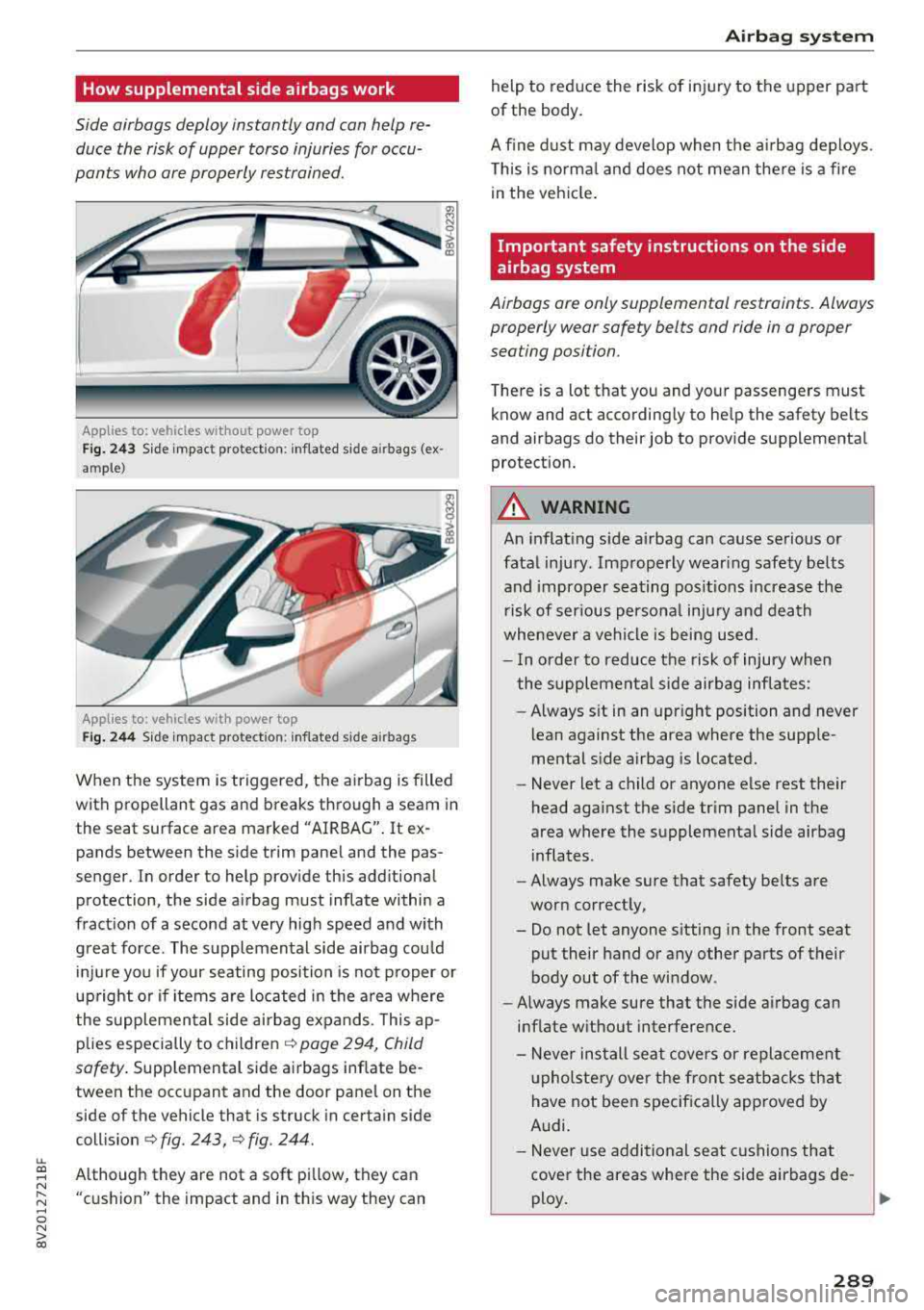
App lies to: vehicles wi thout power to p
Fig . 2 43 Side impac t protection: inflated side a irbags (ex ·
ample)
Applies to: vehicles wit h powe r top
Fig. 244 Side impact protect ion: inf lated side a irbags
When the system is triggered, the airbag is filled
with propellant gas and breaks through a seam in
the seat surface area marked "AIRBAG" . It ex
pands between the s ide trim pane l and the pas
senger. In order to help prov ide this add itional
protection, the side airbag must inflate within a
fract ion of a second at very high speed and with
g reat force. The supplemental side airbag cou ld
i njure you if your seating position is not p roper or
upright o r if items a re located in the area where
the supplemen tal side airbag expands . This ap
plies especially to children
c::> page 294, Child
safety.
Supp lemental side airbags inflate be
tween the occ upant and the door pane l on the
side of the vehicle that is struck in certa in side
collis ion
c::> fig. 243, c::> fig. 244.
Although they are not a soft pi llow, they can
"cushion" the impact and in th is way they can
Airbag system
help to reduce the risk of injury to the up per pa rt
of the body.
A fine dust may develop when the a irbag deploys.
Th is is no rma l and does not mean the re is a fi re
in the vehicle .
Important safety instructions on the side
airbag system
Airbags are only supplemental restraints. Always
properly wear safety belts and ride in a proper seating position .
There is a lot that you and yo ur passengers must
know and act according ly to he lp the safety belts
and airbags do their job to provide supplementa l
protection.
..&. WARNING
-
An inflating s ide a irbag can cause serious or
fatal injury. Improperly wearing safety belts and improper seating posit ions increase the
r isk of ser ious perso na l inju ry and death
whenever a vehicle is being used.
- In order to reduce the risk of injury when
the supplemental side airbag inflates:
- Always s it in an upr ight position and never
lean against the area where the supp le
mental side airbag is located.
- Never let a child or anyone e lse rest their
head against the side trim panel in the
area where the supplementa l side airbag
inflates.
- Always make sure that safety belts are
worn correctly,
- Do not let anyone sitting in the front seat put their hand or any other parts of their
body out of the window .
- Always make sure that the side airbag can
inflate w ithout interference.
- Never install seat covers or repla ceme nt
u pholste ry ove r the front seatbacks that
have not been specif ica lly approved by
Audi.
- Never use additional seat c ushions that
cover the areas where the side airbags de-
.
ploy . Ill>
289
Page 292 of 404
Airbag system
-Damage to the original seat covers or to
the seam in the area of the side airbag module must always be repaired immedi
ately by an authorized Audi dealer .
- Objects between you and the airbag can in
crease the risk of injury in an accident by in
terfering with the way the airbag unfolds or by being pushed into you as the a irbag in
flates.
- Never place or attach accessories or other
objects (such as cup holders, telephone
brackets, or even large, bulky objects) on
the doors, over or near the area marked
"AIRBAG" on the seat backrests .
- Such objects and accessories can become
dangerous projectiles and cause injury
when the supplemental s ide airbag de
ploys.
- Never carry any objects or pets in the de
ployment space between them and the
airbags or allow chi ldren or other passen
gers to travel in this posit ion.
- Always use the built-in coat hooks only for
lightweight clothing . Never leave any heavy
or sharp-edged objects in the pockets that
may interfere with side airbag deployment
and can cause personal injury in an accident .
- Always prevent the side airbags from being
damaged by heavy objects knocking against
or hitting the sides of the seatbacks.
- T he airbag system can only be triggered
once .
If the airbag has been triggered, the
system must be replaced by an authorized
Audi dealership.
- Damage (cracks, deep scratches etc.) to the
original seat covers or to the seam in the
area of the side airbag modu le must always
be repaired immediately by an authorized
Audi dealer.
-If children are seated improper ly, their risk
of injury increases in the case of an acc ident
¢ page 2 94, Child safety.
-Never attempt to modify any components of
the a irbag system in any way.
-In a side collision, side airbags w ill not func
t ion properly if sensors cannot correctly
measure increasing air pressure inside the
290
doors when air escapes through larger, un
closed openings in the door panel.
- Never drive with inte rior door trim panels
r emoved.
- Never dr ive when parts have been re
moved from the inside door panel and the
openings they leave have not been proper
l y closed.
- Never drive when loudspeakers in the
doors have been removed unless the
speaker holes have been properly closed.
- Always make certain that openings are
cove red or filled if additional speakers or
other equipment is installed in the inside
door panels .
- Always have work on the doors done by an
authorized Aud i dealer or qualified work
shop .
Side curtain airbags
Description of side curtain airbags
Applies to: vehicles with side curtain airbags
The side curtain airbag sys tem can provide sup
plemental protection to properly restrained oc
cupants .
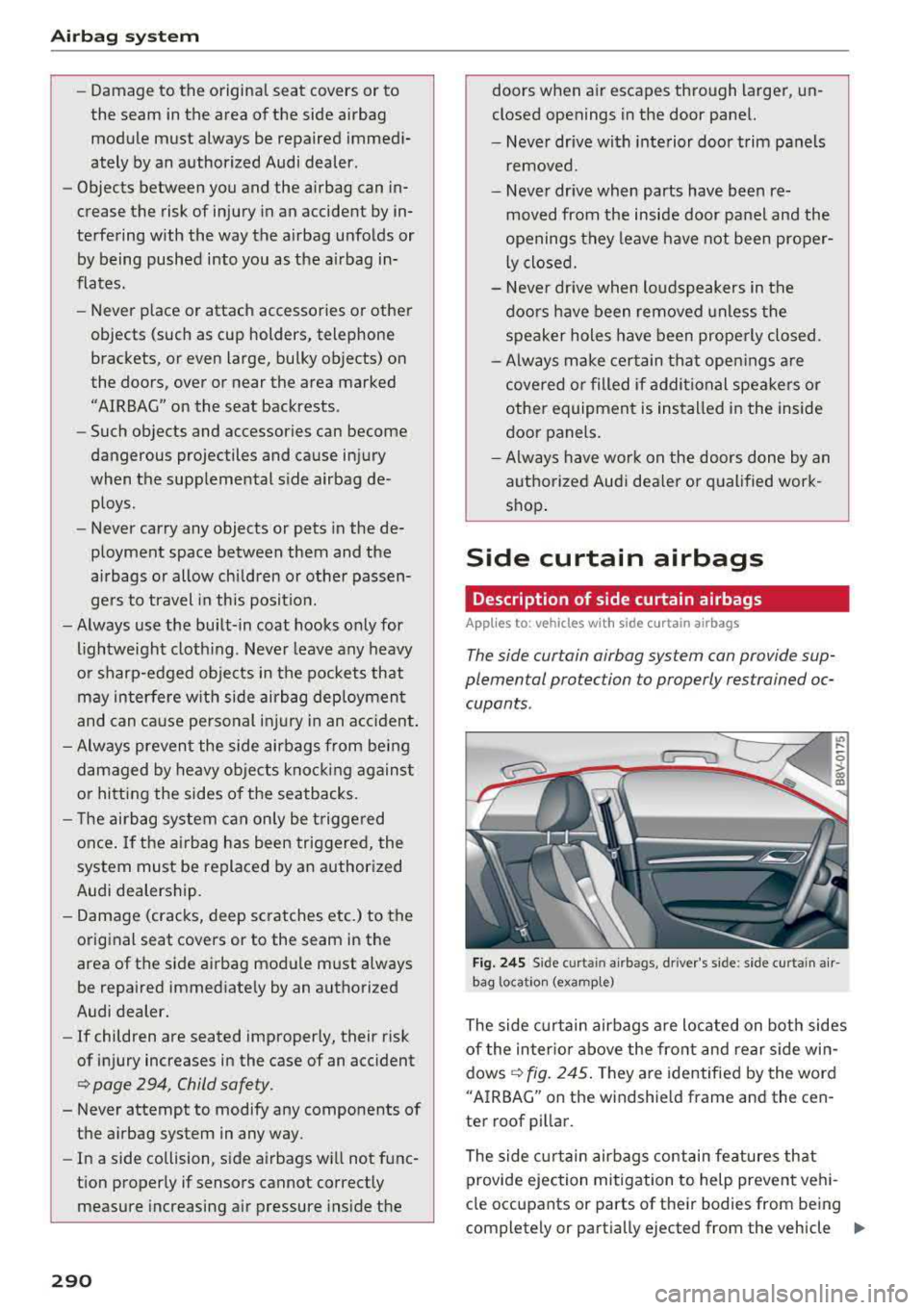
Fig. 24S Sid e curt ain air b ags , driver's s ide: s ide curt ain air
bag location (example)
The side curtain airbags are located on both sides
of the inter ior above the front and rear side win
dows ¢
fig. 245. They are identified by the word
"A IRBAG" on the windshie ld frame and the cen
ter roof pillar.
The side curtain airbags contain features that
provide ejection mitigation to help prevent vehi-
cle occupants or parts of their bodies from being completely or partia lly ejected from the vehicle
II>
Page 299 of 404
u. 00 .-< N l' N .-< 0 N > 00
Child restraints and Advanced front airbag
system
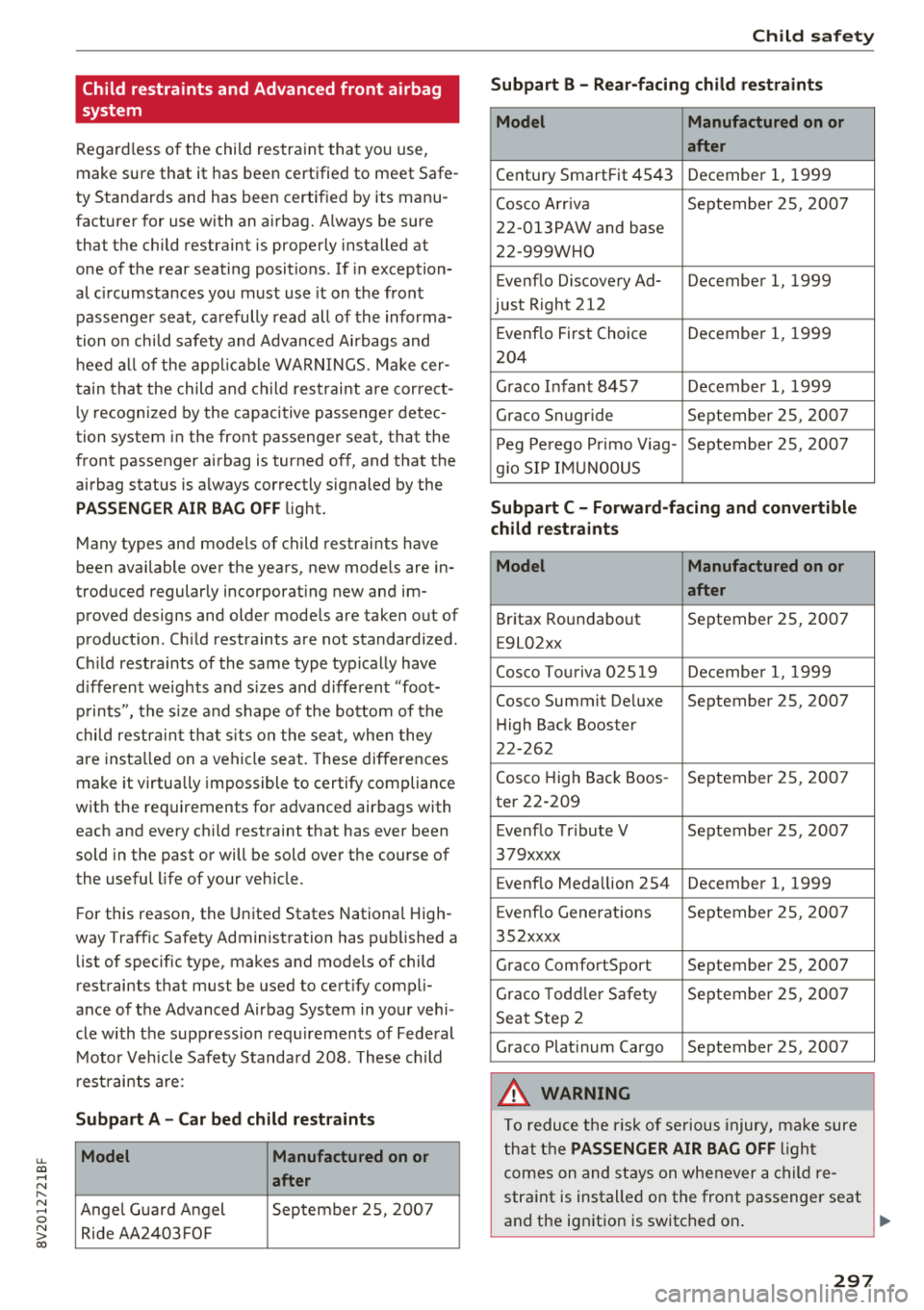
Regardless of the child restraint that you use,
make sure that it has been certified to meet Safe
ty Standards and has been certified by its manu
facturer for use with an airbag. Always be sure
that the child restraint is properly installed at
one of the rear seating positions . If in exception
al c ircumstances you must use it on the front
passenger seat, carefully read all of the informa
tion on child safety and Advanced Airbags and
heed all of the applicable WARNINGS. Make cer
tain that the child and child restraint are correct
l y recognized by the capacitive passenger detec
tion system in the front passenger seat, that the
front passenger airbag is turned off, and that the
airbag status is always correctly signaled by the
PASSENGER AIR BAG OFF light.
Many types and models of child restraints have
been available over the years, new mode ls are in
troduced regularly incorporat ing new and im
proved designs and older models are taken out of
product ion . Child restraints are not standardized .
Ch ild restraints of the same type typically have
different weights and size s and different "foot
prints", the size and sh ape of the bottom of the
chi ld restraint that sits on the seat, when they
are installed on a vehicle seat. These differences
make it virtua lly impossible to certify compliance
with the requirements for advanced airbags with
each and every child restraint that has ever been
sold in the past or will be sold over the course of
the useful life of your veh icle.
F or this reason, the United States National High
way Traffic Safety Administration has published a
list of specific type, makes and models of child
restraints that must be used to certify compli
ance of the Advanced Airbag System in your vehi
cle with the suppression requirements of Federal
Motor Vehicle Safety Standard 208. These child
restraints are:
Subpart A -Car bed child restraints
Model Manufactured on or
after
Ange l Guard Angel September 25, 2007
Ride AA2403FOF
Child safety
Subpart B - Rear-facing child restraints
Model Manufactured on or
after
Century SmartFit 4543 December 1, 1999
Cosco Arriva September 25, 2007
22-013PAW and base
22-999WHO
Evenflo Discovery Ad- December 1, 1999
just Right 212
E venflo First Choice December 1, 1999
204
Graco Infant 8457 December 1, 1999
Graco Snug ride September 25, 2007
Peg Perego Primo Viag- September 25, 2007
g io SIP IMUNOOUS
Subpart C -Forward-facing and convertible
child restraints
Model Manufactured on or
after
Britax Roundabout September 25, 2007
E9L02xx
Cosco Touriva 02519 December 1, 1999
Cosco Summit De luxe September 25, 2007
Hi gh Back Booster
22-262
Cosco High Back Boos- September 25, 2007
ter 22-209
E venflo Tribute V September 25, 2007
379xxxx
Evenflo Medallion 254 December 1, 1999
E venflo Generations September 25, 2007
352xxxx
Graco ComfortSport September 25, 2007
Graco Toddler Safety September 25 , 2007
Seat Step 2
Graco Plat inum Cargo September 25, 2007
A WARNING
To reduce the risk of serious injury, make sure
that the
PASSENGER AIR BAG OFF l ight
comes on and stays on whenever a child re
straint is installed on the front passenger seat
and the ignition is switched on .
~
297
Page 319 of 404
LL co ..... N
" N ..... 0 N > co
(D Tips
Fuel can age and may lead to problems when
starting . Audi recommends replacing the fuel
in your vehicle within six months.
Fuel filler door emergency release
If the central locking system is fault y, the fuel
filler door con be unlocked manually.
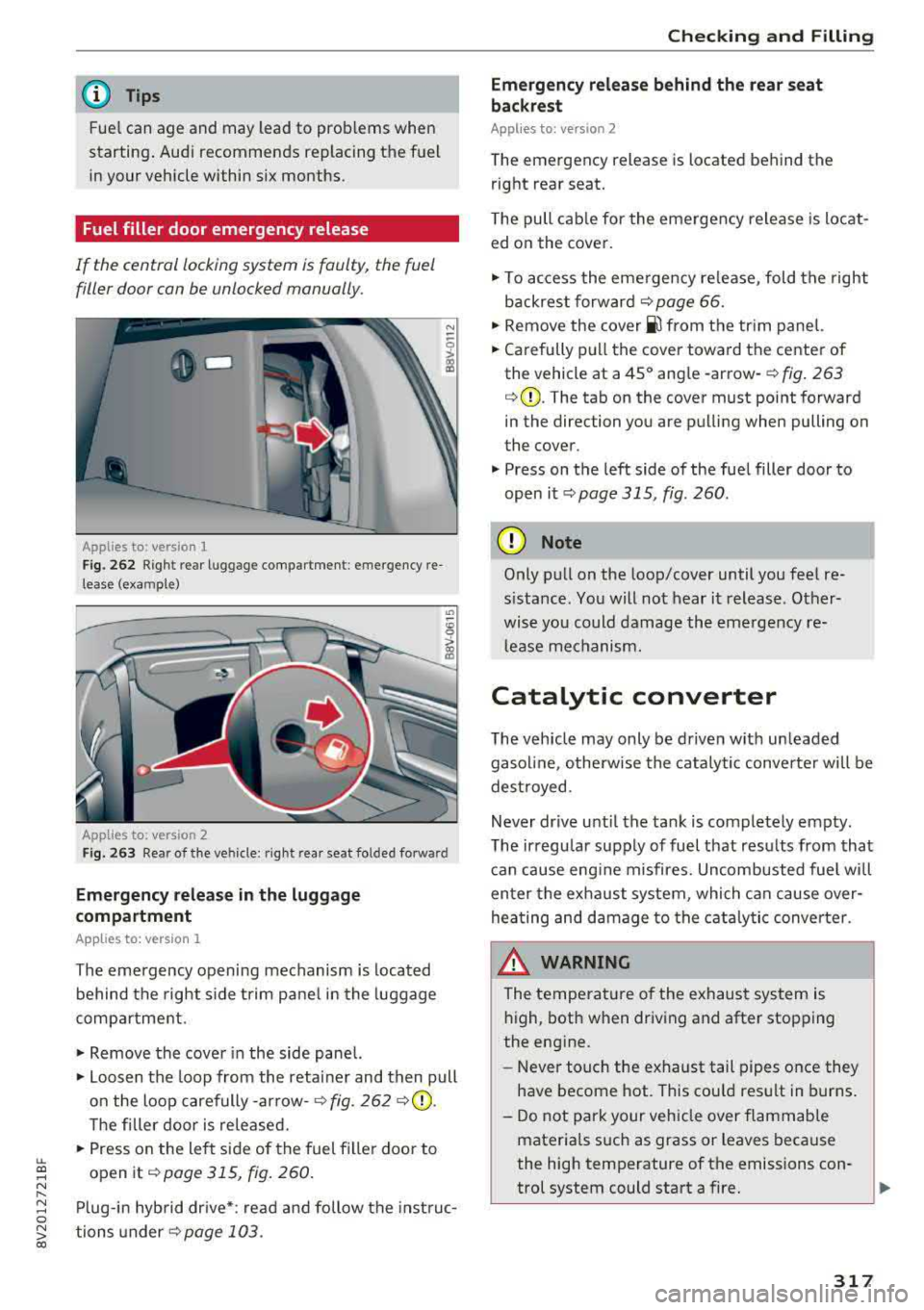
Applies to: version 1
F ig. 262 R ig ht rear l ugg age comp artment : eme rgency re
l ease (example )
Applies to: version 2
F ig . 26 3 Rea r of th e ve hicle: right rear se at fol ded forwa rd
Emergen cy relea se in the lug gage
compartment
Applies to: vers ion 1
The emergency opening mechanism is located
behind the right side trim pane l in the luggage
compar tment .
~ Remove the cover in the side panel.
~ Loosen the loop from the reta iner and then pull
on the loop carefully -arrow -
i=> fig. 262 i=> (D.
The filler door is released.
~ Press on the left side of the fuel fi ller door to
open it
i=> page 315, fig . 260.
P lug-in hybrid dr ive* : read and follow the inst ruc
tions under
i=> page 103 .
Checking and Filling
Emergency relea se behind the rear seat
back rest
Appl ies to: version 2
The emergency releas e is located behind the
right rear seat.
T he pull cab le for the emergency re lease is locat
ed on the cover .
~ To access the eme rgency re lease, fold the right
backrest forward
i=> page 66.
~ Remove the cover ~ from the tr im panel.
~ Carefully p ull the cover towa rd the center of
the vehicle at a 45° ang le
-arrow- ¢ fig. 263
i=>(D . The tab on the cover must point forward
in the direction you are pulling when pulling on
the cover .
~ Press on the left side of the fue l filler door to
open it
¢ page 315 , fig. 260.
(D Note
Only pull on the loop/cover until you fee l re
s istance . Yo u will not hear it release . Other
wise you could damage the emergency re
l ease mechanism.
Catalytic converter
The vehicle may only be driven w ith un leaded
gasol ine, otherwise the cata lyti c converte r wi ll be
dest royed.
Never dr ive until the tank is completely empty .
The ir regu lar supply of fuel that resu lts from that
can cause eng ine misfires. Uncombusted fuel will
en ter the exhaust system , which c an cause over
hea ting and damage to the cata lyti c conver ter .
A WARNING
The temperat ure o f the exhaust system is
high , both when driv ing and after stopping
the eng ine.
-
-Never touch the exhaust tail pipes once they
have become hot . This cou ld resu lt in burns.
- Do not par k your veh icle over flammable
materials such as grass or leaves because
the high temperature of the emissions con
trol system could start a fire.
317
Page 332 of 404
Wheels
Wheels
Wheels and T ires
General information
~check your tires regularly for
damage (punctures, cuts, cracks
and bulges). Remove foreign ob
jects from the tire tread.
~ If driving over curbs or similar
obstacles, drive slowly and ap proach the curb at an angle.
~Have faulty tires or rims re
placed immediately.
~ Protect your tires from oil,
grease and fuel.
~ Mark tires before removing
them so that the same running
direction can be maintained if
they are reinstalled.
~Lay tires flat when storing and
store them in a cool, dry location
with as little exposure to light as
possible.
_&. WARNING -
-Never drive faster than the maximum permitted speed
for your tires. This could cause
the tires to heat up too much.
This increases the risk of an
accident because it can cause
the tire to burst .
-Always adapt your driving to the road and traffic condi-
330
tions . Drive carefully and re
duce your speed on icy or slip
pery roads . Even winter tires
can lose traction on black ice.
(@ Note
-Please note that summer and
winter tires are designed for
the conditions that are typical
i n those seasons . Aud i recom
mends using winter tires dur
ing the winter months . Low
temperatures significantly de
crease the elasticity of summ
er tires, which affects traction
and braking ability. If summer
tires are used in very cold
temperatures, cracks can form
on the tread bars, resulting in
permanent tire damage that
can cause loud driving noise
and unbalanced tires.
-Burnished, polished or chromed rims must not be used in winter driving condi
t ions. The surface of the r ims
does not have sufficient corro
sion protection for this and
could be permanently dam
aged by road salt or similar
substances.
Page 333 of 404
LL co .... N
" N .... 0 N > co
Tire designations
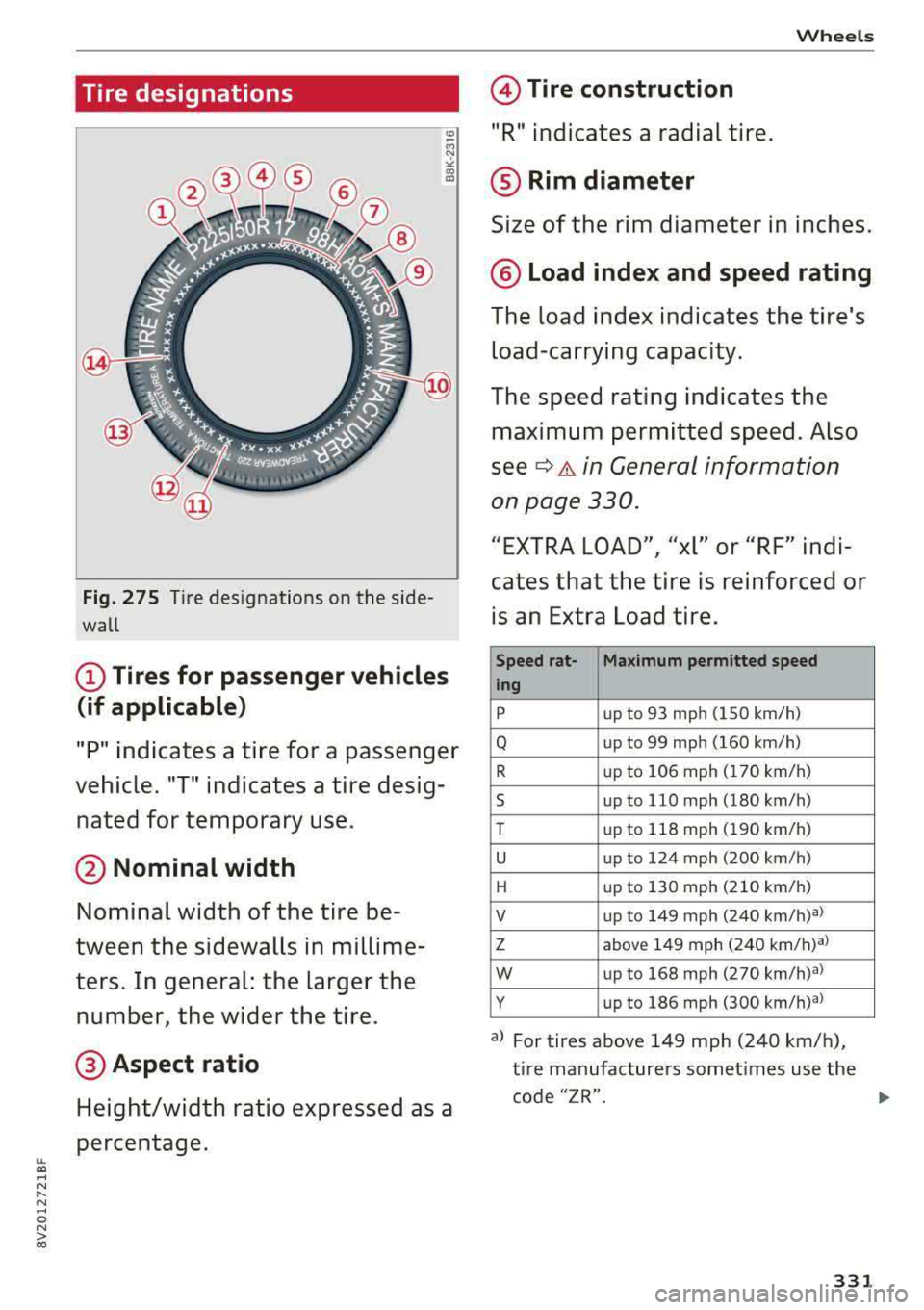
Fig. 275 Tire designations on the side
wall
(D Tires for passenger vehicles
(if applicable)
"P" indicates a tire for a passenger
vehicle. "T" indicates a tire desig
nated for temporary use.
@ Nominal width
Nominal width of the tire be
tween the sidewalls in millime
ters. In general: the larger the
number, the wider the tire.
@ Aspect ratio
Height/width ratio expressed as a
percentage .
Wheels
@Tire construction
"R" indicates a radial tire.
® Rim diameter
Size of the rim diameter in inches.
® Load index and speed rating
The load index indicates the tire's
load-carrying capacity.
The speed rating indicates the
maximum permitted speed. Also
see
¢ &. in General information
on page 330.
"EXTRA LOAD", "xl" or "RF" indi
cates that the tire is reinforced or
i s an Extra Load tire.
Speed rat-
Maximum permitted speed
ing
p up to 93 mph (150 km/h)
Q up to 99 mph (160 km/h)
R up to 106 mph (170 km/h)
s up to 110 mph (180 km/h)
T up to 118 mph (190 km/h)
u up to 124 mph (200 km/h)
H up to 130 mph (210 km/h)
V up to 149 mph (240 km/h)a)
z above 149 mph (240 km/h)a)
w up to 168 mph (270 km/h)a)
y up to 186 mph (300 km/h)a)
a) For tires above 149 mph (240 km/h),
tire manufacturers sometimes use the
code "ZR".
331
Page 335 of 404
u. a, ... N
" N ... 0 N > a:,
Glossary of tire and loading
terminology
Accessory weight
means the combined weight ( in
excess of those standard items
which may be replaced) of auto matic transmission , power steer
ing, power brakes, power win
dows, power seats, radio, and
heater, to the extent that these
items a re available as factory- in
stalled equipment (whether i n
stalled or not) .
Aspect ratio
means the ratio of the height to
the width of the tire in percent .
Numbers of 55 or lower indicate a
low s idewall for improved steer
ing response and better overall
handling on dry pavement.
Bead
means the part of the tire that is
made of steel wires, wrapped or
reinforced by ply cords and that is
shaped to fit the rim .
Bead separation
means a breakdown of the bond
between components in the bead .
Wheel s
Cord
means the strands forming the
plies in the tire .
Cold tire inflation pressure
means the tire pressure recom
mended by the vehicle manufac
turer for a tire of a designated
size that has not been driven for
more than a couple of miles (kilo
meters) at low speeds in the
three hour period before the tire pressure is measured or adjusted .
Curb weight
means the weight of a motor ve
hicle with standard equipment in
cluding the maximum capacity of
fuel, oil , and coolant, air condi
tioning and additional weight of
optional eq uipm ent .
Extra load tire
means a tire designed to operate
at higher loads and at highe r in
flation pressures than the corre
sponding standard tire . Extra load
tires may be identified as "X L",
"xl", "EXTRA LOAD", or "RF" on
the sidewall.
.,.
333
Page 337 of 404
u. a, ... N
" N ... 0 N > a:,
Production options weight
means the combined weight of
those installed regular production
options weighing over 5 lbs.
(2.3 kg) in excess of those stand
ard items which they replace, not
previously considered in curb
weight or accessory we ight, in
c luding heavy duty brakes, ride
levelers, roof rack, heavy duty
battery, and special trim .
Radial ply tire
means a pneumatic tire in which
the ply cords that extend to the beads are laid at substantially
90 degrees to the centerline of
the tread.
Recommended inflation
pressure
see ¢ page 333, Cold tire infla
tion pressure .
Reinforced tire
means a tire designed to operate
at higher loads and at h igher in
flat ion pressures than the corre
sponding standard tire. Rein
forced t ires may be identified as
"XL " "xl" "EXT RA LOA D" or "RF" , , ,
on the sidewall.
Wheels
Rim
means a metal support for a tire
or a tire and tube assembly upon
which the tire beads are seated .
Rim diameter
means nominal diameter of the
bead seat. If you change your
whee l size, you will have to pur
chase new tires to match the new
rim diameter .
Rim size designation
means rim diameter and width .
Rim width
means nominal distance between
rim flanges .
Sidewall
means that portion of a ti re be
tween the tread and bead.
Speed rating (letter code)
means the speed at which a tire is
designed to be driven for extend
ed periods of time . The rat ings
range from
93 mph (150 km/h)
to
186 mph (298 km/h) ¢ table
on page 331.
You may no t find
this info rmat ion on all tires be
cause it is not required by law.
T he speed rating letter code,
where applicable, is molded on
the tire sidewall and indicates t he
11>
335
Page 340 of 404
Wheels
.,.Audi recommends that you use
Audi Original Tires. If you would like to use different tires, please
note that the tires may perform
differently even if they are the
same size
¢ 11:,. .
.,. If you would like to equip your
vehicle with a tire/rim combina
tion that is different from what
was installed at the factory, con
sult with an authorized Audi dealer or authorized Audi Service
Facility before making a pur
chase¢ ,&.
Because the spare tire* is differ
ent from the regular tires instal
led on the vehicle (such as winter
tires or wide tires), only use the
spare tire* temporarily in case of
emergency and drive carefully
while it is in use. It should be re
placed with a regular tire as soon
as possible.
Applies to: vehicles with all wheel
drive: all four wheels must be
equipped with tires that are the
same brand and have the same
construction and tread pattern so
that the drive system is not dam
aged by different wheel speeds. For this reason, in case of emer
gency, only use a spare tire* that
338
is the same circumference as the
regular tires.
~ WARNING -
-Only use tire/rim combina tions and suitable wheel bolts
that have been approved by
Audi. Otherwise, damage to
the vehicle and an accident could result.
-For technical reasons, it is not possible to use tires from oth
er vehicles - in some cases,
you cannot even use tires from
the same vehicle model.
-Make sure that the tires you
select have enough clearance
to the vehicle. Replacement
tires should not be chosen simply based on the nominal
size, because tires with a dif
ferent construction can differ
greatly even if they are the
same size. If there is not
enough clearance, the tires or
the vehicle can be damaged and this can reduce driving
safety and increase the risk of
an accident.
-Only use tires that are more than six years old when abso
lutely necessary and drive
carefully when doing so.
...
Page 342 of 404
Wheels
front and rear axles are the same
size¢&.
Rotating the tires regularly is rec
ommended to ensure the tires
wear evenly . To rotate the tires,
install the tires from the rear axle
on the front axle and vice versa.
This will allow the tires to have
approximately the same length of
service life.
For unidirectional tires, make
sure the tires are installed accord
ing to the running direction indi
cated on the tire sidewall
¢page 368.
Hidden damage
Damage to tires and rims can of
ten occur in locations that are hidden . Unusual vibrations in the
vehicle or pulling to one side may
indicate that there is tire damage.
Reduce your speed immediately.
Check the tires for damage. If no
damage is visible from the out
side, drive slowly and carefully to
the nearest authorized Audi deal
er or authorized Audi Service Fa
cility to have the vehicle inspect
ed .
340
.&_ WARNING
-Tread that has worn too low or
different tread depths on the
tires can reduce driving safety.
This can increase the risk of an
accident because it has a neg
ative effect on handling, driv
ing through curves, and brak
ing, and because it increases
the risk of hydroplaning when
driving through deep puddles.
- Applies to: RS models: de
pending on the equipment,
the widths of the standard
summer tires may be different
on the front and rear axles.
The wider tires are mounted
on the front axle. The tires
must not be rotated .