coolant AUDI S6 2008 User Guide
[x] Cancel search | Manufacturer: AUDI, Model Year: 2008, Model line: S6, Model: AUDI S6 2008Pages: 390, PDF Size: 88.42 MB
Page 298 of 390
___ C_h_ e_ c_k _in --== g'-- a_n _d_ f_il _li _n ..:::g:::..- ___________________________________________ _
Checking and filling
Engine hood
Releasing the engine hood
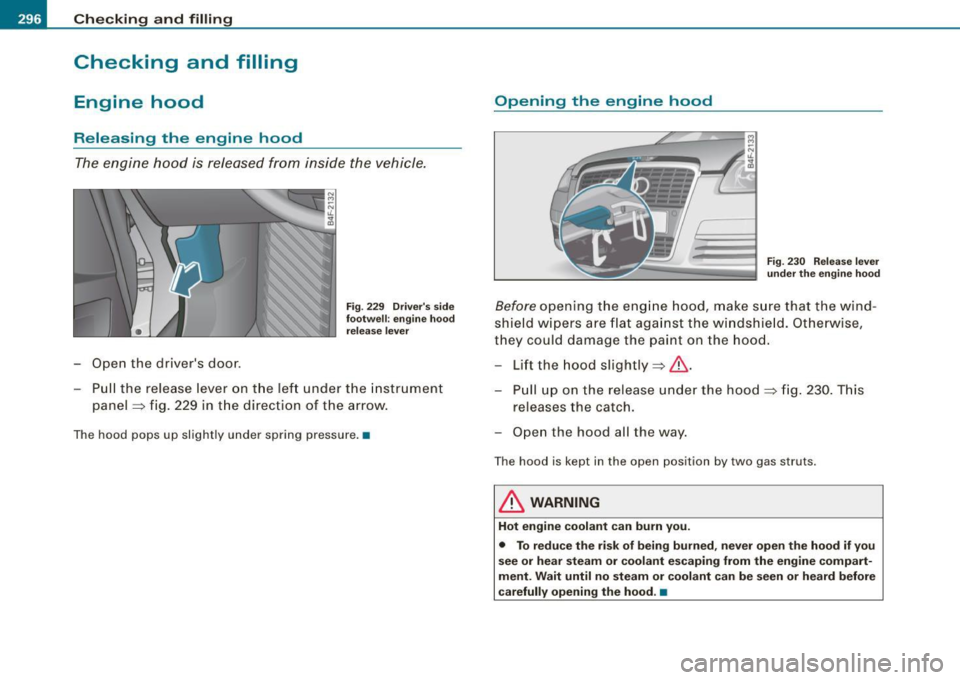
The engine hood is released from inside the vehicle.
-Open the driver's door .
Fig. 229 Driver's side
footwell: engine hood
release lever
-Pull the release lever on the left under the instrument
panel
=> fig. 229 in the direct ion of the arrow.
The hood pops up slightly under spring pressure. •
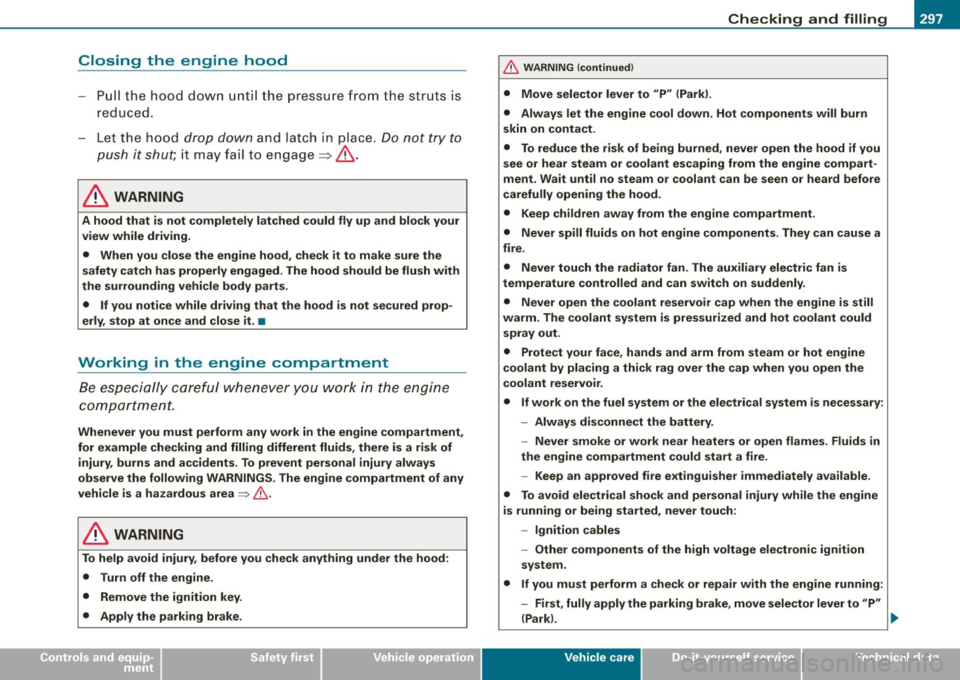
Opening the engine hood
Fig. 230 Release lever
under the engine hood
Before opening the engine hood, make sure that the wind
shield wipers are flat against the windshield. Otherwise,
they could damage the paint on the hood.
Lift the hood slightly =>&, .
Pull up on the release under the hood => fig. 230. This
releases the catch.
- Open the hood all the way.
The hood is kept in the open position by two gas struts.
& WARNING
Hot engine coolant can burn you.
• To reduce the risk of being burned, never open the hood if you
see or hear steam or coolant escaping from the engine compart
ment. Wait until no steam or coolant can be seen or heard before
carefully opening the hood. •
Page 299 of 390
___________________________________________ C_ h:....:e :....: c:....: k..:..: i..:.. n :..::g ::.....:: a:..:.n ..:..: d=---.:. f..:..:il ..:..:li ..:..n :.:::g !--_!11
•
Closing the engine hood
- Pull the hood down until the pressure from the struts is
reduced .
- Let the hood
drop down and latch in place. Do not try to
push it shut;
it may fail to engage => &.
& WARNING
A hood that is not completely latched could fly up and block your
view while driving.
• When you close the engine hood, check it to make sure the
safety catch has properly engaged. The hood should be flush with
the surrounding vehicle body parts.
• If you notice while driving that the hood is not secured prop
erly, stop at once and close it. •
Working in the engine compartment
Be especially careful whenever you work in the engine
compartment.
Whenever you must perform any work in the engine compartment,
for example checking and filling different fluids, there is a risk of injury, burns and accidents. To prevent personal injury always
observe the following WARNINGS. The engine compartment of any
vehicle is a hazardous area
~ & .
& WARNING
To help avoid injury, before you check anything under the hood :
• Turn off the engine.
• Remove the ignition key.
• Apply the parking brake .
& WARNING (continued)
• Move selector lever to "P" (Park).
• Always let the engine cool down. Hot components will burn
skin on contact.
• To reduce the risk of being burned, never open the hood if you
see or hear steam or coolant escaping from the engine compart
ment. Wait until no steam or coolant can be seen or heard before
carefully opening the hood.
• Keep children away from the engine compartment .
• Never spill fluids on hot engine components. They can cause a
fire.
• Never touch the radiator fan. The auxiliary electric fan is
temperature controlled and can switch on suddenly.
• Never open the coolant reservoir cap when the engine is still
warm . The coolant system is pressurized and hot coolant could
spray out.
• Protect your face, hands and arm from steam or hot engine
coolant by placing a thick rag over the cap when you open the
coolant reservoir.
• If work on the fuel system or the electrical system is necessary :
- Always disconnect the battery.
- Never smoke or work near heaters or open flames . Fluids in
the engine compartment could start a fire.
- Keep an approved fire extinguisher immediately available.
• To avoid electrical shock and personal injury while the engine
is running or being started, never touch:
- Ignition cables
- Other components of the high voltage electronic ignition system.
• If you must perform a check or repair with the engine running: -First, fully apply the parking brake, move selector lever to "P"
(Park). .,
Vehicle care
I t •
Page 305 of 390
_____________________________________________ C_h_ e_ c_k _in ~ g_ a_n _d_ f_il _li _n ~g __ lllll
•
because the lubricating properties of oil diminish gradually during
normal vehicle use .
Under some circumstances the engine oil should be changed more
frequently . Change oil more often if you drive mostly short
distances, operate the vehicle in dusty areas or under predomi
nantly stop -and -go traffic conditions, or have your vehicle where
temperatures remain below freez ing for extended periods.
Detergent additives in the oi l will make fresh oil look dark after the
engine has been running for a short time. This is normal and is not
a reason to change the oi l more often than recommended .
Because of the problem of proper disposal, along with the specia l
tools and necessary expertise required, we strongly recommend
that you have your oi l changed by an authori zed
Audi dea ler or a
qual ified service stat ion.
If you choo se to cha nge yo ur oi l y ou rse lf, please no te the following
important information:
& WARNING
To reduce the risk of per sonal injury if you m ust change the engine
o il in you r veh ic le y our self :
• Wear eye protection.
• To reduce the ri sk of burn s from hot engine oil , let the engine
c ool down to the tou ch.
• When removing the oil drain plug with your fing ers , sta y as far
away as po ssi ble . Alw ay s k eep your f orearm par allel to the gr ound
to help pre vent hot oil from running down your arm .
• Drain t he oil int o a contain er de signed for thi s purpo se , one
large enough to hold at l ea st th e total amount of oil in your eng ine .
• Engine oil i s poi sono us. K eep it well out of the rea ch of ch ildr en .
• Continuou s contact with u sed engine oil i s harmful to your
sk in. Al wa ys prote ct you r ski n by washing oil off thoroughl y with
s oap and w ater.
0 Note
Never mix oil addi tives with your engine oil. These add itives can
damage your engine and adversely affect your Audi Limited New
Vehicle Warranty .
c£> For the sake of the environment
• Before changing your oi l, first make sure you know where you
can properly dispose of the us ed oil.
• Always dispose of used engine oil properly. Do not dump it on
garden soil , wooded areas, into open streams or down sewage
drains .
• Recycle used engine oil by taking it to a used engine oil collec
tion fac ility in your area , or contact a service station. •
Engine cooling system
Coolant
The engine coolant performs two functions: it keeps the
engine from overheating and it protects the engine from
freezing i n the winter.
The cooling system is sea led and generally requires little attention.
The coo ling system has been fi lled at the factory with a permanent
coolant which does not need to be changed . The coolant consists of
a mixture of water and the manufac turer's glycol-basedcoolant
additive G 12+ an tifreeze with anticorrosion additives (50% for USA
models; 60% for Canadian models). This mixture both assures the
necessary frost protection and protects metal components in the
engine 's cooling system from corrosion and scaling . It also raises
the boiling point of the coolant.
Do not reduce the concentration of the coo lant in the summer by
adding plain water.
The p ropo rt ion of co ola nt additiv e mu st be at .,_
Vehicle care
I t •
Page 306 of 390
___ C_h_ e_ c_k _in --== g'-- a_n _d_ f_il _li _n ..:::g:::..- ___________________________________________ _
le as t 50% b ut not mor e th an 60 % to maintain antifreeze protection
and cooling efficiency . If the coo lant frost protection is too low, the
coo lant could freeze and damage the vehicle heating and engine
cooling system.
For year -round driving, antifreeze is added at the factory for temper
atures down to:
• -31 °F ( -35 °C) USA
• -40 °F ( -40 °C) Canada.
You can m ix the
Gl 2 + coolant additive with other add itives (for
example
Gl 1 or Gl 2). A lways check with your authorized Audi
dea ler .
& WARNING
Before you check anyt hing in the engine comp artment , alw ays
re ad and heed all WARNINGS ~
& in "Working in the eng ine
co mpar tm ent " o n
pag e 297.
0 Note
• Before win ter sets in, have the coolant checked to see if the
coolant additive in your vehicle is sufficient to meet the climate
conditions. This is especia lly important if you live in a region where
the winter is extremely cold. I f necessary, increase the proportion of
coo lant additive to 60%.
• When adding coolant additive to your coo ling system,
remember:
-We recommend using only coolant additive
Gl 2+ (check the
label) for your vehicle. This coolant addit ive is available at autho
rized Audi dealers. Other types of antifreeze can significantly
reduce corrosion protect ion . T he resulting corrosion can cause a
loss of coolant and serious engine damage.
• Do not add any type of radiator leak sealant to your vehicle's
engine coolant. Adding radiator repair fluid may adversely affect the function and performance of your cooling system and cou
ld result
in damage not c overed by your New Vehicle Limited Warranty. •
Checking the engine coolant level
The engine coolant level can be checked with a quick
glance.
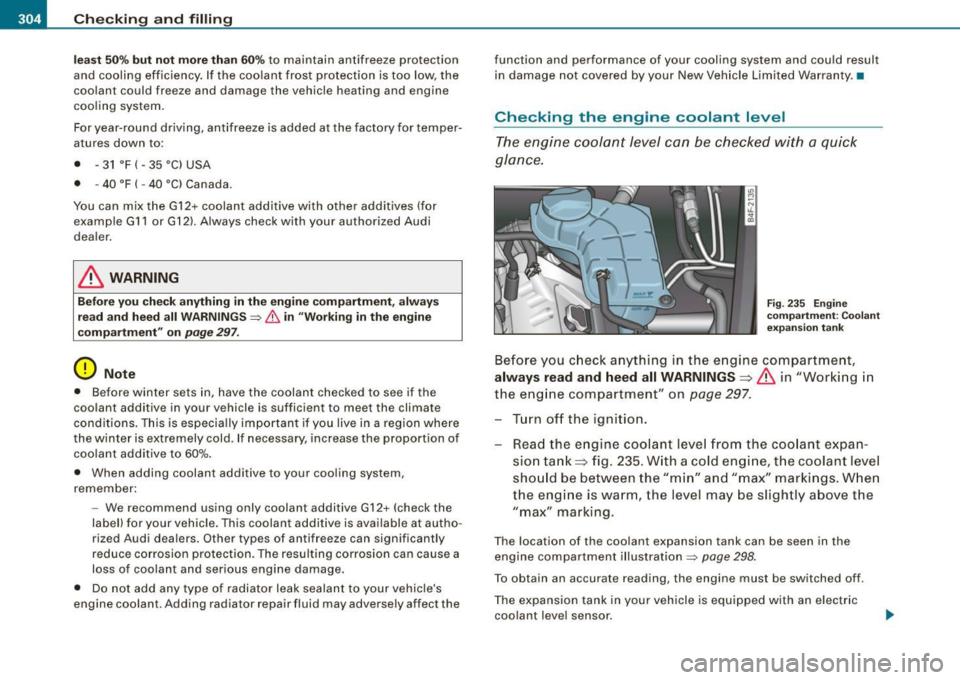
F ig . 235 Eng ine
c o mpartm ent : Cool ant
ex pa nsion tank
Before you check anything in the engine compartment,
always read and heed all WARNINGS~
& in "Working in
the e ngin e compa rtment" on
page 297 .
Turn off the ignition.
Re ad the en gine coo lant leve l from the coo lant exp an
sio n ta n k~ fig. 235. With a cold eng ine, the coolan t leve l
sho uld be between the "m in" and "max" markings. W hen
t h e eng ine is warm, the level may be s lightly abov e the
"max" marking .
The location of the coolant expansion tank can be seen in the
engine compartment illustration~
page 298.
To obtain an accurate reading, the engine must be switched off .
T he expansion tank in your vehicle is equipped with an e lectric
coo lant leve l sensor.
Page 307 of 390
_____________________________________________ C_h_ e_ c_k _in ~ g_ a_n _d_ f_il _li _n ~g __ _
•
When the coolant level is too low , the warning light in the Auto
Check System =>
page 33will blink un til you add coo lant and the
level has been restored to normal. Even though there is an electric
coolant leve l sensor, we still recommend you check the coo lant level
from time to time .
Coola nt lo ss
Coolant loss may indicate a leak in the cooling system . In the event
of coolant loss, the coo ling sys tem should be inspected immedi
ately by your authorized Audi dealer . It is not enough merely to add
coolant.
In a
s ealed system, losses can occur only if the boiling po int of the
coolant is exceeded as a result of overheating.
0 Note
Do not add any type of radiator leak sea lant to your vehicle's engine
coolant . Adding radiator repair fluid may adversely affect the func
tion and performance of your cooling system and could resu lt in
damage not covered by your New Vehic le Limited War ranty .•
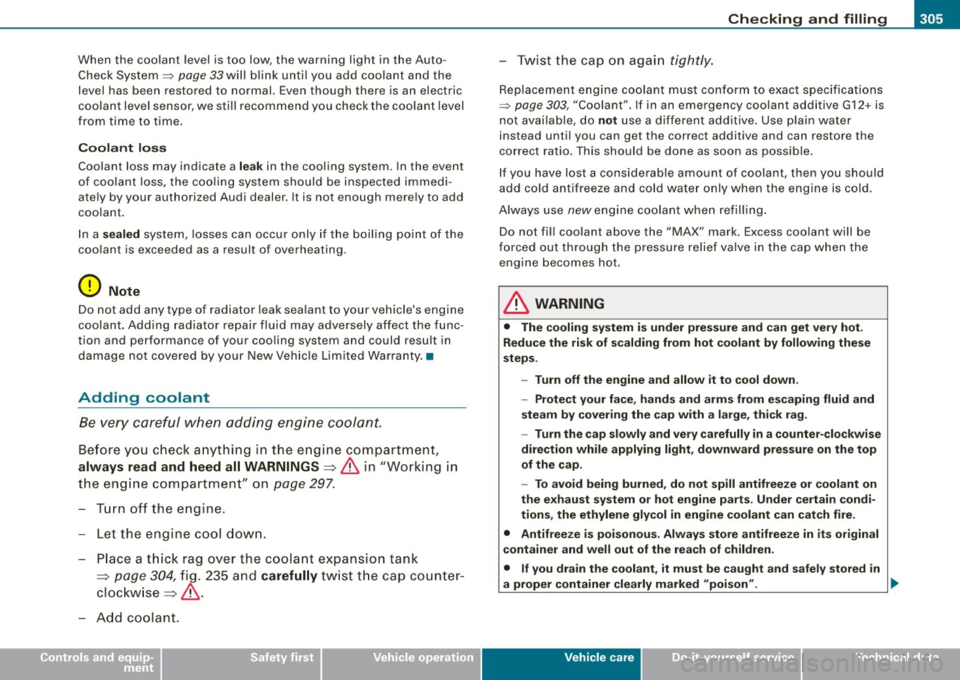
Adding coolant
Be very careful when adding engine coolant.
Before you check anything in the engine compartment,
always read and heed all WARNINGS => & in "Working in
the engine compartment" on
page 297 .
- Tu rn off the engine .
- L et the engine coo l dow n.
- Place a t hick rag over the coolant expansion tank
=> page 304, fig . 235 and carefully tw ist t he cap counter
cloc kw ise
=> & .
- Add coolant. - Twist the cap
on agai n
tightly.
Replacement engine coolant must conform to exact specifications
=>
page 303, "Coolant". If in an emergency coolant additive G12 + is
not avai lable, do
not use a different additive . Use p lain water
instead until you can get the correct additive and can restore the
correct ratio . This should be do ne as soon as possible.
If you have lost a considerable amount of coolant, then you should
add cold antifreeze and cold water only when the engine is cold .
Always use
new engine coolant when refilling .
Do not fil l coolant above the "MAX" mark. Excess coolant will be
forced out through the pressure relief va lve in the cap when the
engine becomes ho t.
& WARNING
• The cooling system is under pressure and can get ver y hot.
Redu ce the risk of sc alding from hot coolan t by follow ing the se
s tep s.
- Turn off th e en gine and allo w it to cool down .
- Protect your fa ce , ha nd s and arm s from e sc a pi ng fluid and
s tea m by cov ering the c ap with a large , thick rag.
- Tur n the cap slo wly an d very ca refully in a counter -clockw is e
dire ction whil e applying light , downward pres sure on the top
o f the cap.
- To av oid bei ng burn ed , do n ot spill antifree ze or cool ant on
the e xhau st sy stem or h ot e ngi ne part s. Under cert ain co ndi
tion s, the ethylen e gl ycol in engin e co olant c an c atch fire .
• Antifr eeze is po iso nous. Alwa ys store antifree ze in its or igin al
c ontainer and well out of the reach of c hildren .
• If you dra in t he coola nt, it mu st b e ca ught and sa fel y stor ed in
a prop er container clearly mark ed "poi son ".
~
Vehicle care I t •
Page 308 of 390
•---=C:.:h..:. e=-= c..:.k :..:.in :..:.:= g:.....= a..:.n :.:d::....:. f.:.:il .:.:li ..:.n :..::g~ --------------------------------------------
0 Not e
• Coolant pollutes the environment and cou ld cause an engine
fire. Excess coolant will be forced out through the pressure relief
valve in the cap when the engine becomes hot.
• If, in an emergency, only water can be added, the correct ratio
between water and antifreeze ~
page 303 must be restored as soon
as possible .
ci> For the sake of the environment
Dra ined coolant should not be reused . Always dispose of used
coolant whi le observing all environmental regulations. •
Radiator fan
The radiator fan switches on automatically by itself.
The rad iator fan is driven by the eng ine v ia the V-be lt . The v iscous
clutch regulates the speed of the fan according to the tempera ture
of the coo lant .
An auxiliary electric radiator fan * swi tches on and off depending on
coo lant temperature and other vehicle operating conditions.
After you switch the engine off, the auxiliary fan can continue running for up to 10 minut es -even with th e igni tion o ff. It can even
switch o n again later by itself~ & , if
• the temperature of the engine coo lant rises due to the heat
bui ld -up from the engine in the engine compartment, o r
• the engine compartment heats up because the vehic le is parked
in intense sun light.
& WARNING
• To reduce the ri sk of per sonal injury never tou ch the radiator
f a n.
& W AR N ING (continu ed )
• The auxiliary e le ctri c fan i s temperature controlled and can
s w itch on suddenly even when the engine is not running .
• The auxiliary radiator fan swit ches on automatically when the
engine coolant reache s a ce rtain temperature and will con tinue to
run until the coolant t emperatur e drop s. •
Brake fluid
Checking brake fluid level
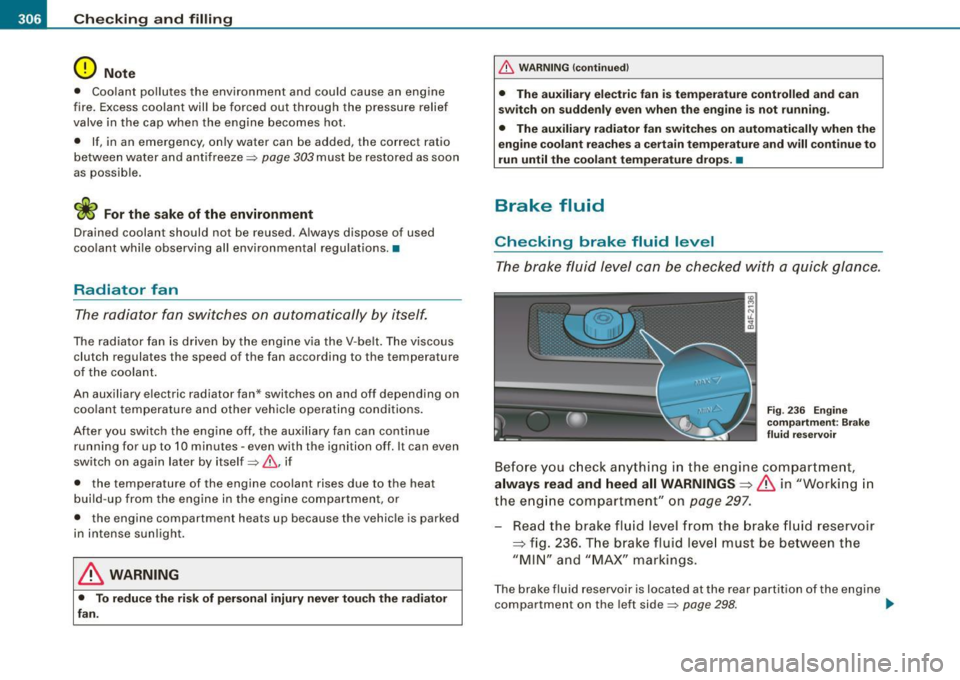
Th e brake fluid level c an be checked with a quick glance.
Fig . 23 6 En gin e
co mp art m ent : B ra ke
fl uid re servoir
Befo re yo u c heck anything in th e en gin e compar tme nt,
always read and heed all WARNINGS~ & in "Working in
the eng ine compartment" on
page 297 .
Rea d the brake fl uid level from the bra ke fluid reservoir
~ fig . 236. T he b rake fluid leve l must be betwee n the
" M IN " and "MAX" markings.
The brake fluid reservoir is located at the rear parti tion of the engine
compartment on the left side~
page 298. .,_
Page 316 of 390
-~_T_ ir_e_ s_ a_ n_d _ w_ h_ e_e _l_s _________________________________________________ _
& WARNING (continued)
crashes and serious personal injuries . Have worn or damaged tires
replaced immediately.
• Tires age even if they are not being used and can fail suddenly,
especially at high speeds. Tires that are more than 6 years old can
only be used in an emergency and then with special care and at
low speed.
Glossary of tire and loading terminology
Accessory weight
means the combined weight (in excess of those standard items
which may be replaced) of automatic transmission, power steering,
power brakes, power windows, power seats, radio, and heater, to
the extent that these items are available as factory-installed equip
ment (whether installed or not).
Aspect ratio means the ratio of the height to the width of the tire in percent.
Numb ers of 55 or lower indicate a low sidewall for improved
steering response and better overall handling on dry pavement.
Bead
means the part of the tire that is made of steel wires, wrapped or reinforced by ply cords and that is shaped to fit the rim.
Bead separation means a breakdown of the bond between components in the bead.
Cord
means the strands forming the plies in the tire.
& WARNING (continued)
• Never mount used tires on your vehicle if you are not sure of
their "previous history." Old used tires may have been damaged
even though the damage cannot be seen that can lead to sudden
tire failure and loss of vehicle control.
• If you notice unusual vibration or if the vehicle pulls to one side
when driving, always stop as soon as it is safe to do so and check
the wheels and tires for damage . •
Cold tire inflation pressure
means the tire pressure recommended by the vehicle manufacturer
for a tire of a designated size that has not been driven for more than
a couple of miles (kilometers) at low speeds in the three hour period
before the tire pressure is measured or adjusted .
Curb weight means the weight of a motor vehicle with standard equipment
including the maximum capacity of fuel, oil, and coolant, air condi
tioning and additional weight of optional equipment.
Extra load tire
means a tire designed to operate at higher loads and at higher infla
tion pressures than the corresponding standard tire . Extra load tires
my be identified as "XL",
"xi", "EXTRA LOAD", or "RF" on the side
wall.
Gross Axle Weight Rating ("GAWR")
means the load-carrying capacity of a single axle system, measured
at the tire -ground interfaces .
Gross Vehicle Weight Rating ("GVWR"l
means the maximum total loaded weight of the vehicle.
Page 323 of 390
Tires and wheels -________________ lf:HIIII
•
& WARNING (continu ed )
• Only when all tires on the veh icle are filled to the correct pres
s ure , the tire pre ssure monitoring sy stem can work correctly .
• The use of incorrect tire pressure values can lead to accidents
or other damage. Therefore it i s es sential that the driver observe
the specified tire pre ssure values for the tires and the correct pres
s ures for the function of the tire pressure monitoring system.
• Alway s inflate tires to the recommended and correct tire pres
sure before driving off .
• Driving with underinflated tires bend more , letting them get
too hot re sulting in tread separation , sudden ti re failure and loss
of control.
• Ex cessive speed and /overloading can cause heat build -up ,
sudden tire failure and loss of control.
• If the tire pressure is too low or too high, the tires will wear
prematurely and the vehicle will not handle well .
• If the tire is not flat and you do not have to change a wheel
immediately , drive at reduced speed to the nearest service stat ion
to che ck the tire pressure and add air as required .
0 Note
Driving without valve stem caps can cause damage to the tire
valves. To preven t this, a lways make su re t hat facto ry instal led
va lve
stem caps on a ll whee ls are securely mounted on the va lve .
'£> For the sake of the environment
Underinflated t ires will a lso increase the fuel consumption. •
Tires and vehicle load limits
There are limits to the amount of load or weight that any vehicle and
any t ire can car ry. A vehicle that i s ove rlo aded wil l n ot hand le well and
is more difficu lt to stop . Overloading can not only lead to loss
o f ve h ic le control, but ca n also damage impor ta nt parts o f the
vehic le and can lead to sudden tire fa ilure, inc luding a blowout and
sudden defla tion that ca n cause the vehic le to cra sh .
Your sa fety and that o f your passe ngers also depe nds on mak ing
sure that load limits are not exceeded . Vehicle load includes every
b ody and everyth ing in and on t he veh ic le . T hese load lim its a re
technica lly referred to as the vehicle's
Gross Vehi cle We ight Rating
(" GVWR"l .
The "GVWR" includes the weight of the basic veh ic le, all factory
insta lled accesso rie s, a ful l tank of fuel , oil, coolant an d other fluids
p lus max imum load. T he ma xim um load inc ludes the number o f
passe ngers that the veh icle is intended to carry ("seat ing capacity")
w ith a n assu med we ight of 150 l bs (68 kg) fo r each passen ger at a
designated seating position and the total weight of any luggage in
the v ehicle. I f you tow a trailer, the we ig ht o f the tra ile r hi tch and t he
tongue weight of the loaded trailer must be includ ed as part of the
ve hicle l oad.
The
Gross Axle Weight Rating ("GAWR"l is t he maximum load that
can be applied at each of the vehicle's two ax le s.
The Gross Ve hicle We ig ht Rat ing and t he G ross A xle Weig ht Rat ing
are listed on the safety comp liance stic ker label located either on
t he d rive r's side 8 -p illar or on th e inside of the fuel fil ler fla p. You r
Audi has 5 seating positions, 2 in the front and 3 in the rear for total
seating ca paci ty of 5 . Each seating p ositi on has a safe ty be lt
=> page 202, "Safety belts" .
The fact that there is an upper limit to your veh icle's Gross Vehicle
W eight Rating m eans tha t the to tal weight o f whateve r is bein g
carried in the vehicle (including the weight of a trailer hitch and the
to ngue we igh t of the l oad ed trai ler) is li mit ed . The m ore passe ng ers
in the vehicle or passengers who are heavie r than the standard
we ig ht s assum ed mean that les s we ight ca n be ca rri ed as luggage.
The tire pressure labe l on your Audi also lists the maximum
com bined we ig ht of a ll of t he occ upa nts and luggage or other ca rg o
~
Vehicle care I t •
Page 369 of 390
_______________________________________________ C _o_ n _ s_u _ m_ e_ r_l_n _f_o _ r_ m_ a_ t _i _o _ n __ PII
workshop personne l in order to assure proper performance, reli
abil ity and sa fe ty of the vehicle a nd i ts many sys te m s.
I mproper maintenance, adjustments and repairs can impair the
operation and reliabil ity of your vehicle and even void your vehicle
war ra nty. T here fore, proof o f serv ic ing in accorda nce with the main
tenance schedule may be a condition for uphold ing a possible
war ra nty claim made withi n th e warranty per iod .
Above all, operat ional safety can be adverse ly affected, creating
unnece ssary risks fo r you and you r passengers .
If in doubt about a ny servici ng, have it do ne by your authorized Aud i
dea ler or any other properly equipped and qua lified workshop. We
str ongly u rge you to give your auth orized Audi dealer the oppo rtu
nity to perform al l scheduled maintenance and necessary repairs.
You r deale r has the facil ities, origi nal par ts and trained special is ts
to keep your vehic le running proper ly.
Performing limited maintenance yourself
T he fo llow ing pages describe a limited numbe r of procedures which
can be perfo rme d on you r vehicle wi th ordi nary too ls, should the
need arise and trained personne l be unavailab le. Before performing
any of these proced ures, always thor oug hly read a ll of th e appli
cable text and carefu lly fo llow the instructions given. Always rigor
ously observe the WARNINGS provided.
Before you check anything in the engine compartment , alway s read
and heed all WARNINGS:::>
& and:::> & in "Wo rking in the engine
compartment" on
page 297.
& WARNING
• Ser ious persona l injury may occur as a result of improperly
performed maintenance , adjustments or repairs.
• Always be e xtremely careful when working on the vehicle .
Always follow commonly accepted safety practices and general
c ommon sense . Never ri sk per sonal injury .
Controls and equip ment Safety first
Vehicle operation
& WARNING (continued )
• Do not attempt any of the maintenance , checks or repairs
described on the following pages if you are not fully familiar with
these or other pro cedures with respect to the vehicle , or are uncer
tain how to proceed.
• Do not do any work without the proper tools and equipment.
Have the necessary work done by your autho rized Audi dealer or
another properly equipped and qualified workshop .
• The engine compartment of any motor vehicle is a potentially
hazardous area . Never reach into the area around or touch the
radiator fan . It i s temperature controlled and can switch on
suddenly - even when the engine is off and the ignition key has
been removed . The radiator fan switche s on automatically when
the coolant reaches a certain tempe rature and will continue to run
until the coolant temperature drops .
• Always remove the ignition key before anyone gets under the
vehicle.
• Always support your vehicle with safety stands if it is neces
sary to work underneath the vehicle. The jack supplied with the
vehicle is not adequate for this purpose and could collapse
causing serious personal injury .
• If you must work underneath the vehicle with the wheels on
the ground, always make sure the vehicle is on level ground , that
the wheels are always securely blocked and that the engine
cannot be started .
• Always make sure the transmission selector lever (automatic
transmission) is in "P " (Park position) and the park br ake is firmly
appl ied .
ffi For the sake of the environment
• Changing the engine settings wi ll adverse ly affect emission
leve ls. T his is detrimenta l to the envi ro nmen t and i ncreas es fu el
consumption.
Vehicle care Do-it-yourself service Tec hn ica l da ta
Page 374 of 390
-Alphabetical index ..,,,_.:_.__ ____ _...::.:...::..;.:___ ________________ _
A
A . ccessones ............. .... .... .. .
Adapter for cupholder ..... ...... ... . 368
103
Ad . A' S .
apt1ve 1r uspens1on .. .... ... .... 182
Automatic mode . . . . . . . . . . . . . . . . . 183
Description . . . . . . . . . . . . . . . . . . . . . 182
Dynamic mode . . . . . . . . . . . . . . . . . . 183
Jacking mode when changing a flat tire .
184
Lift mode . . . . . . . . . . . . . . . . . . . . . . . 183
Setting the driving modes .. .... ... 183
Standard mode . . . . . . . . . . . . . . . . . . 183
Trailer towing mode ... .... .... ... 184
Warning/indicator lights ....... .... 21
Adaptive Cruise Control . . . . . . . . . . . . . . 135
Changing speed .. ........... .... 138
Driver information ............... 142
Driver interven tion prompt ........ 146
Driving in traffic ...... .... ...... . 136
Driving program ...... .... .... ... 147
Error messages . . . . . . . . . . . . . . . . . . 145
Open road . . . . . . . . . . . . . . . . . . . . . . 136
Override . . . . . . . . . . . . . . . . . . . . . . . . 136
Request for driver to assume control 136
Save speed . . . . . . . . . . . . . . . . . . . . . . 137
Setting distance . . . . . . . . . . . . . . . . . 140
Setting time interval .. .. .......... 140
Settings . . . . . . . . . . . . . . . . . . . . . . . . 147
Specia l driving situations ......... 147
Status messages . . . . . . . . . . . . . . . . . 145
Switching on and off .. .... ... .... 137
System limits ...... .... .......... 147
Tempor arily turning off ... ...... .. 139
warning/indicator lights .... ...... . 143
Adaptive Light ......... ... .... .... ... 73
defective .......... .... ..... .. .... 37
Adding
Engine coolant ......... ... .... ...
305
Engine oil ... .. ...... ....... ..... 302
Windshield washer fluid .... .... ... 312
Additional accessories .... .... .... ... 368
Additives
Engine oil ... .. ..... .. ...... .....
302
Adjusting
Instrument cluster i llumination ......
16
Steering column electrically .... ... 123
Steering column manually ...... ... 122
Ad' . f Justing ront seats .. .... .... .... ... 87
Advanced Key ...... .. .... ........... 59 Care
........ ..... ....... ... .. ...
226
Child restraints .................. 236
Children ....... ....... .... ..... . 235
Components (front airbags) ........ 219
Danger of fitting a chi ld safety seat on the
front passenger seat .. ..... .. ...
214
Disposal ............ .. .... ...... 226
Fron t airbags ...... .... .... .. 216, 217
How do the front airbags work? . ... 221
How many airbags does my vehicle have?
219
How the Advanced Airbag System compo -
nents work together . . . . . . . . . . . . .
220
Important things to know ... ..... .. 212
Indicato r light ...... ... .. .... .... 223
Monitoring .... .... .... ...... .... 223
PASSENGER AIR BAG OFF light ..... 224
Repairs ..... .. .... .... ... ... ... . 226
Driver messages . . . . . . . . . . . . . . . . .
128 Safety instructions .... .... .... ... 225
Locking vehicle ................. .. 61 Side airbags ... .... .... ... ... ... . 228
START button ................... 126 Side curtain airbags (SIDEGUARD) .. 231
Starting engine ........ ..... .. ... 126 Weight-sensing mat .. ....... ..... 235
STOP button .... ... .... .... ...... 127 When must the system be inspected? .. .
Switching engine off ...... .... ...
127 223
Switching on ignition ...... .... ... 126 All Whee l Drive ... .... .... .......... 264
Unlocking vehicle ........... ...... 60 Alloy wheels . .... .... ....... .... ... 283
Air conditioning
See Climate controls ... .......... . 11 O
Airbag
Warning/indicator lights ..... ......
20
Airbag system ... ... .. .... .... .. 212, 229
Advanced Airbag System ...... .... 216
Advanced Airbag System components
219
All- whee l drive
Winter tires .... ........... .... ..
329
Alternator
See Generator . . . . . . . . . . . . . . . . . . . . 19
Anti -freeze
See Engine coolant system ...... .. 303
Anti-glare inside day-night mirror .... .. 82