rims AUDI S6 2009 Owners Manual
[x] Cancel search | Manufacturer: AUDI, Model Year: 2009, Model line: S6, Model: AUDI S6 2009Pages: 398, PDF Size: 43 MB
Page 289 of 398
_____________________________________________ C_ l_ e _a_ n_ in_ g_a _ n_d_ p_ r_ o_ t _e_ c_t _io _ n __ lll
•
T he best way to remove snow from windows and mirrors is to use a
brush . Use a non -abrasive
pla stic ice scraper -better still, a spray
deicer -to remove
ice from w indows and mirrors .
The windows must not be cleaned with insect remover or wax since
these can inter fere with the function of the w inds hie ld w iper blades
(chatter).
Oil, grease o r sil icone residue can be removed with
glass cleaner or
s ilicone remover . However, wax residue requires the use of a
spec ially for mulated solvent . Please contact your Audi dealer for
advice on safe products for wax removal.
Windows should also be c leaned on the inside at regular interva ls .
Never dry windows with the same chamois that you use to dry
painted surfaces . Wax residue on the chamois can impair vision
t hrough the windows.
& WARNING
• The windshield mu st not be treated with water -repellent mate
rials. They c an incre ase gl are under poor v isibility conditions such
a s wetne ss, darkne ss, or when the sun i s low on the hori zon. In
addition , they can cause the wind shield wipers to chatter .
• Alway s read and heed all WARNINGS and other information
~ page 282.
0 Note
• Never use warm or hot water to remove snow and ice from
windows a nd mirrors . This cou ld cause the glass to crack.
• T o prevent damage to the wires of the rear defogger, do not p lace
any adhesive stickers on the inside of the rear window over the
wires .
• T o he lp prevent dirt from scratching the window, always scrape
in a forward direction -pushing the scraper away from you -never
back and forth. •
Weatherstrips
Complete car car e includes the we atherst rip s as well .
App ly a suitable rubbe r con ditioner to the weatherstr ips
f ro m time to tim e.
To be able sea l properly, the weatherstrips around the hood, doors,
rear lid, etc . must remain pliable. Spray the weatherstrips with sili
co ne or coat them w ith ta lcum powder or glycer ine to retain the
f lexibility of the rubber and to protect them against freezing in the
winte r.
& WARNING
Always read and heed all WARNINGS and other information
~ page 282.
[ i ] Tip s
Keep si licone sprays off the windshield to avoid wiper smear in
ra in .•
Cast (light) alloy wheels
Cast (light) alloy wheels require special care.
- Was h the wheels w ith a sponge or hose b rus h every
other week.
Fo r de ep cle aning af terwar ds, use only a dedicat ed
acid
free cast al lo y whee l c leaner.
R ub a co at of
liquid wax onto t he rims ever y thr ee mo nth .
Be su re t o r ea ch and t reat a ll pa rts of t he r im.
To preserve the decorative appearance of the cas t al loy wheels,
some special care is necessary . In addition to road dirt and salt,
Vehicle care I t •
Page 319 of 398
________________________________________________ T_ i _r_e _s_ a_n_ d_ w_ h_ e_e _ l_s __ lllll
•
Tires and wheels
Tires
General notes
Tires may be the least appreciated and most abused parts
of a motor vehicle.
Tires may be the least appreciated and most abused parts of a
motor vehicle. Tires are, however, one of the most important parts
of a vehicle, particularly considering the comparative ly sma ll patch
of rubber on each tire that assures that all- important contact
between you, your vehicle and the road .
Maintaining the correct tire pressure, making sure that your vehicle
and its tires do not have to carry more weight than they can safely
handle, avoiding damage from road hazards and regu lar ly
inspecting tires for damage inc luding cuts , slashes irregular wear
and overa ll condition are the most important things that you can do
to help avoid sudden tire failure including tread separation and
b lowouts .
Avoiding dama ge
If you have to drive over a curb or similar obstacle, drive very slow ly
and as close as possible at a right angle to the curb.
A lways keep chemica ls includ ing grease, oil, gasoline and brake
f luid off the tires.
I nspec t the tires regularly for damage (cuts, cracks or blis ters, etc.l.
Remove any foreign bodies embedded in the treads.
Storing tires
Mark tires when you remove them to indicate the direction of rota
tion . This ensu res you to be ab le to mount them correctly when you
reinstal l them. When removed, the wheels or tires shou
ld be stored in a coo l, dry
and preferably dark place.
St ore t ires in a vertical posit ion if they a re not mounted on rims, in
a horizontal position if they are mounted on rims.
New tire s
New tires have to be broken in~&.
The tread dep th of new tires may va ry, according to the type and
make of tire and the tread pattern.
Hidden d ama ge
Damage to tires and rims is often not readily visible. If you notice
unusua l vibration or the vehicle pul ls to one side, this may indicate
that one of the tires has been damaged . The tires must be checked
immed iately by an authorized Audi dealer or qualified workshop .
Unidire ction al tir es
A unidirectio nal tire can be iden tif ied by arrows on the s idewa ll, that
point in the direction the tire is designed to rotate. You must follow
the specified direction of ro tation . This is necessary so that these
tires can deve lop their optimum characteristics regarding grip, road
noise, wear and hydroplaning resistance . For more information
~ page 349.
in. WARNING
Ne w tire s or tire s that are old , worn or damaged cann ot pro vide
m aximum cont rol and braking ability.
• New tire s tend to be slippe ry and m ust be broken in . To redu ce
the risk of losing control, a colli sion and seriou s per sonal injurie s,
drive with speci al care for t he fi rst 350 m ile s ( 560 km l.
• Driving with worn or damaged t ire s can lead to lo ss of co ntrol ,
s udd en tire failure , in clu ding a blowout a nd sudden deflation , .,,_
Vehicle care
I t •
Page 325 of 398
Tires and wheels -
----------------
•
The correct tire pressure for the spare wheel is located on a label on
the driver's side 8 -pillar.
Because technical changes may be made to vehicle equipment
during the mode l year, always compare the tire size designation on
the tire pressure label on your vehicle with the tires on your vehicle.
Make sure that the tire size information on the vehicle label is the
same as the size of the tires on the vehicle. This is especially impor
tant if the vehicle belongs to someone else or you bought the
vehic le with different rims/tires or you bought the vehicle as a previ
ously owned vehicle.
Remember, your safety and that of your passengers also depends
on making sure that load l imits are not exceeded. Vehicle load
includes everybody and everything in and on the vehicle . These load
limits are techn ically referred to as the vehicle's Gross Veh icle
Weight Rating ("GVWR"l. The Gross Axle Weight Rating ("GAWR"l is
the maximum load that can be applied at each of the vehicle's two
axles. The Gross Vehicle Weight Rating and the Gross Axle Weight
Rating are listed on the safety compliance sticker label located on
the driver's side 8-pillar. The tire pressure label on your Audi lists
the maximum comb ined weight of all of the occupants and luggage
or other cargo that the vehicle can carry. For the location of the tire
pressure label =>
page 327, fig. 247.
& WARNING
Overloading a vehicle can cause loss of vehicle control, a crash or
other accident , serious personal injury, and even death .
• Carrying more weight than your vehicle was designed to carry
will prevent the vehicle from handling properly and increase the
risk of a loss of vehicle control.
• The brakes on a vehicle that has been overloaded may not be
able to stop the vehicle within a safe distance.
• Tires on a vehicle that has been overloaded can fail suddenly
causing loss of control and a crash.
& WARNING (continued)
• Always make sure that the total load being transported -
including the weight of a trailer hitch and the tongue weight of a
loaded trailer -does not make the vehicle heavier than the
vehicle's Gross Vehicle Weight Rating .
& WARNING
• Incorrect tire pressures and/or underinflation can lead to a
serious or fatal accident.
• Incorrect tire pressures and/or underinflation cause increased
tire wear and can affect the handling of the vehicle.
• Incorrect tire pressures and/or underinflation can also lead to
sudden tire failure, including a blowout and sudden deflation,
causing loss of vehicle control. •
Checking tire pressure
The correct tire pressure for the tires originally installed
on your vehicle is listed on the tire pressure label located
on driver's side 8-pillar.
The recommended tire pressures are on the tire pressure label and
in the table=>
page 327, "Cold tire inflation pressure". This means
that the pressure must be checked and adjusted when the tire has
not been driven for more than a couple of mi les (kilometers) at low
speeds during the previous three hours. Air in the tires expands
when the tire heats up as a result of internal friction as it flexes in
use. The tire pressure is higher when the tire has warmed up than
when it is "cold ."
It is the inflation pressure in a "cold" tire that counts. Therefore, you
should never let air out of a warm tire to match "Cold tire inf lation
pressure" recommendations=>
page 327. The tires wou ld then be
underinflated and could fail suddenly. .,_
Vehicle care I t •
Page 331 of 398
__________________________________________________ T_ ir_e _ s_ a_ n _ d_ w_ h_ e_ e_ls _ ____. 11111
New tires and replacing tires and wheels
New tires and wheels have to be broken in.
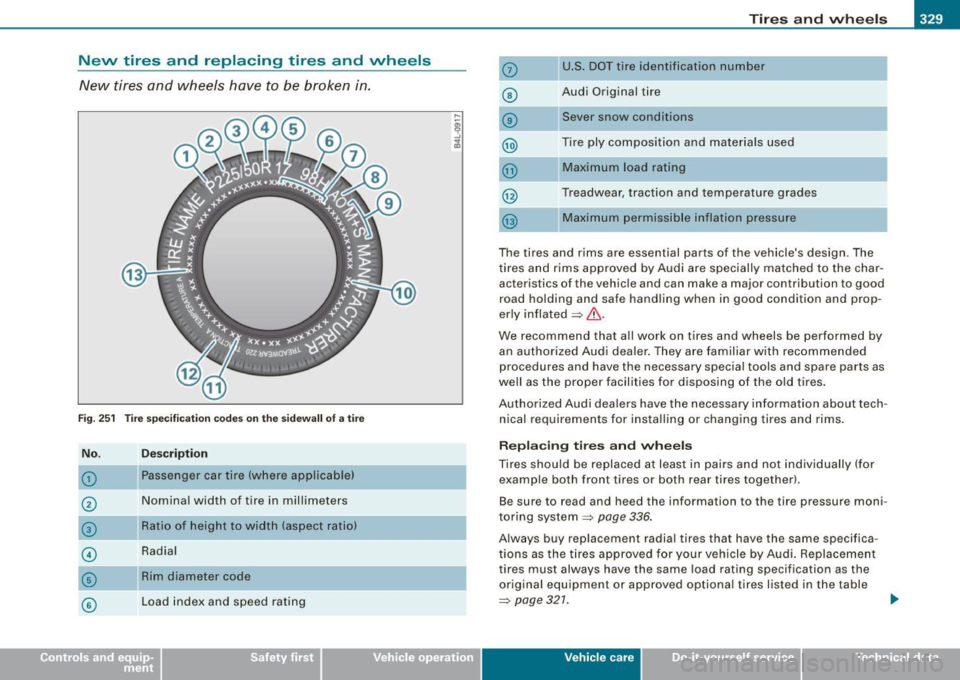
Fig. 251 Tire specification codes on the sidewall of a tire
No.
G)
@
©
©
©
©
Description
Passenger car tire (where applicable)
Nominal width of tire in millimeters
Ratio of height to width (aspect ratio)
Radial
Rim diameter code
Load index and speed rating
0
©
U.S. DOT tire identificat ion number
Audi Original tire
Sever snow condit ions
Tire ply composition and materials used
@ Maximum load rating
@ Treadwear, traction and temperature grades
@ Maximum permissible inflation pressure
The tires and rims are essential parts of the vehicle's design . The
tires and rims approved by Audi are specially matched to the char
acteristics of the vehicle and can make a major contribution to good
road holding and safe handling when in good condition and prop
erly inflated
=> & .
We recommend that all work on tires and wheels be performed by
an authorized Audi dealer. They are familiar with recommended
procedures and have the necessary special tools and spare parts as
well as the proper facilities for disposing of the old tires.
Authorized Audi dealers have the necessary information about tech
nical requirements for installing or changing tires and rims.
Replacing tires and wheels
Tires should be replaced at least in pairs and not individually (for
example both front tires or both rear tires together).
Be sure to read and heed the information to the tire pressure moni
toring system
=> page 336.
Always buy replacement radial tires that have the same specifica
tions as the tires approved for your vehicle by Audi. Replacement
tires must always have the same load rating specification as the
original equipment or approved optional tires listed in the table
=> page 327. ~
Vehic le care I I irechnical data
Page 333 of 398
Tires and wheels -________________ w-.
•
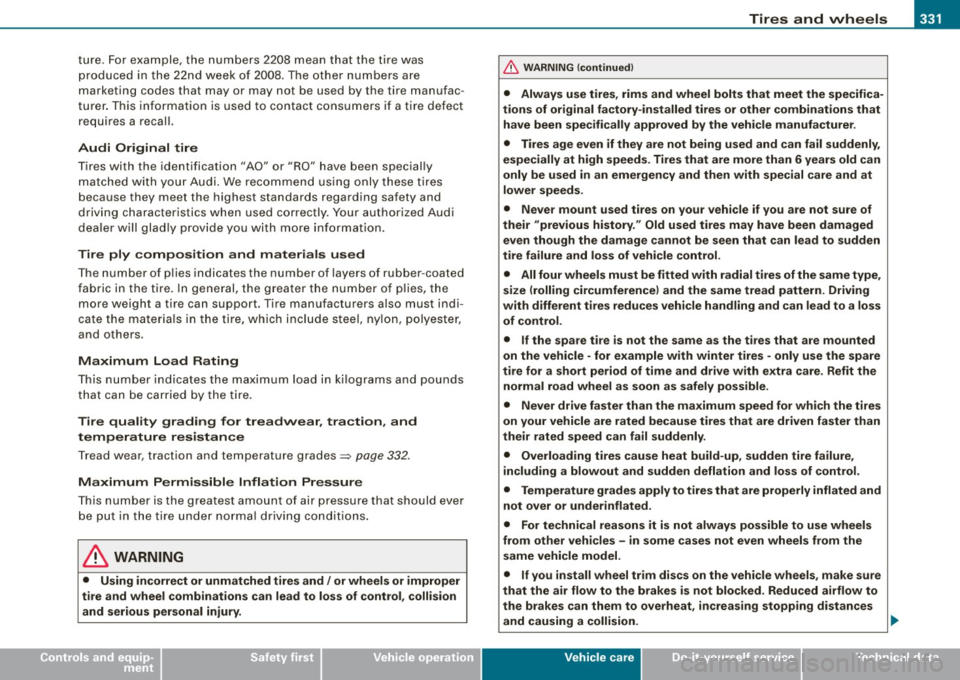
ture. For exam ple , t he numbers 2 208 mean that the tire was
pr od uce d in the 22nd w eek o f 20 08 . T he ot her num bers a re
marketing cod es that may or may not b e used by the tire manufac
tu rer. This inf or ma tion is use d to conta ct consum ers if a tir e defec t
requires a recall.
Audi Original tire
Ti res with the identification "AO" or "R O" hav e been specia lly
m atc h ed wi th you r A ud i. We re comm end u sing on ly these tire s
becaus e they meet the highest standards re garding safety and
dri ving c haracter istic s when used correctly . You r aut horized Audi
d ealer w ill glad ly prov ide you with mor e information .
Tire ply composition and materials used
The number of p li e s indicates the numb er of layers of rubber -coat ed
fabric i n the tir e . In genera l, the grea te r the number of pl ies, th e
mo re we ig ht a t ire can suppo rt. T ire ma nufactu rers also must ind i
cate the materia ls in the tire, which include steel, ny lon, polyester,
and oth ers .
Maximum Load Rating
This numb er ind icat es the maximum load in kil ograms and pou nds
th at ca n be ca rried by t he tire.
Tire qual ity grading for treadvvear , traction , and
temperature resistance
T read wear , traction and temperature grades::::;, page 332.
Maximum Permissible Inflation Pressure
This number is the greatest amount of air pressure that should ever
be put in the t ir e u nder nor mal d riving co nd it ion s.
& WARNING
• Using incorrect or unmatched tires and / or wheels or improper
tire and wheel combinations can lead to loss of control , collision
and serious personal injury .
& WARNING (continued )
• Always use tires, rims and wheel bolts that meet the specifica
tions of original factory -installed tires or other combinations that
have been spec ifically approved by the veh icle manufacturer .
• Tires age even if they are not being used and can fail suddenly,
especially at high speeds . Tires that are more than 6 years old can
only be used in an emergency and then with special care and at
lower speeds .
• Never mount used tires on your vehicle if you are not sure of
their "previous history." Old used tires may have been damaged
even though the damage cannot be seen that can lead to sudden
tire failure and loss of vehicle control.
• All four wheels must be fitted with radial tires of the same type ,
size (rolling circumference ) and the same tread pattern. Driving
with different tires reduces vehicle handling and can lead to a loss of control.
• If the spare tire is not the same as the tires that are mounted
on the vehicle - for example with winter tires - only use the spare
tire for a short period of time and drive with extra care . Refit the
normal road wheel as soon as safely possible.
• Never drive faster than the maximum speed for which the tires
on your vehicle are rated because tires that are driven faster than
their rated speed can fail suddenly.
• Overloading tires cause heat build -up, sudden tire failure ,
includ ing a blowout and sudden deflation and loss of control.
• Temperature grades apply to tires that are properly inflated and
not over or underinflated .
• For technical reasons it is not always possible to use wheels
from other vehicles -in some cases not even wheels from the
same vehicle model.
• If you install wheel trim discs on the vehicle wheels , make sure
that the air flow to the brakes is not blocked. Reduced airflow to
the brakes can them to overheat , increasing stopping distances
and causing a collision.
~
Vehicle care I t •
Page 334 of 398
-Tires and wheels
PW-------------------
& WARNING (continued)
• Run flat tires may only be used on vehicles that were equipped
with them at the factory. The vehicle must have a chassis designed
for run flat tires. Incorrect use of run flat tires can lead to vehicle
damage or accidents. Check with an authorized Audi dealer or tire
specialist to see if your vehicle can be equipped with run flat tires.
If run flat tires are used, they must be installed on all four wheels.
Mixing tire types is not permitted.
0 Note
• For technical reasons , it is not generally possible to use the
wheel rims from other vehicles. This can hold true for wheels of the
same vehicle type .
• If the spare tire is different from the tires that you have mounted
on your vehicle (for example winter tires or wide profile tires), then
use the spare tire for a short period of time only and drive with extra
care. Replace the flat tire with the tire matching the others on your
vehicle as soon as possible.
• Never drive without the valve stem cap. The valves could get
damaged.
~ For the sake of the environment
Dispose of old tires in accordance with the local requirements. •
Uniform tire quality grading
• Tread wear
• Traction AA A B C
• Temperature A B C
Quality grades can be found where applicable on the tire side wall between tread shoulder and maximum section width~
page 329,
fig. 251 .
For example: Tread wear 200, Traction AA, Temperature A.
All passenger car tires must conform to Federal Safety Require
ments in addition to these grades.
Tread wear
The tread wear grade is a comparative rating based on the wear rate
of the tire when tested under controlled conditions on a specified
government test course .
For example , a ti re graded 150 wou Id wear one and one half (1 1 /2)
times as well on the government course as a tire graded 100.
The relative performance of tires depends upon the actual condi
tions of their use, however, and may depart significantly from the
norm due to variations in driving habits, service practices and differ
ences in road characteristics and climate.
Traction
The traction grades, from highest to lowest, are AA, A, Band C.
Those grades represent the tire's ability to stop on wet pavement as
measured under controlled conditions on specified government
test surfaces of asphalt and concrete. A tire marked C may have
poor traction performance
~ & .
Temperature
The temperature grades are A (the highest), B, and C, representing
the tire's resistance to the generation of heat and its ability to dissi pate heat when tested under controlled conditions on a specified
indoor laboratory test wheel.
Sustained high temperature can cause the material of the tire to
degenerate and reduce tire life, and excessive temperature can lead
to sudden tire failure~& .
The grade C corresponds to a level of performance which all
passenger car tires must meet under the Federal Motor Vehicle
Safety Standard No. 109. Grades Band A represent higher levels of
performance on the laboratory test wheel than the minimum
required by law. .,_
Page 337 of 398
Tires and wheels -_______________________ ..::...:..:..-=::.......:.:..;::..:....____;___
•
Wheel bolts
Wheel bolts must always be tightened to the correct
torque.
The design of wheel bolts is matched to the factory installed rims. If
different rims are fitted, the correct wheel bolts with the right length
and correctly shaped bolt heads must be used. This ensures that
wheels are fitted securely and that the brake system functions
correctly.
In certain circumstances, you may not use wheel bolts from a
different vehicle - even if it is the same model~
page 374.
& WARNING
Improperly tightened or maintained wheel bolts can become loose
causing loss of control, a collision and serious personal injury.
• Always keep the wheel bolts and the threads in the wheel hubs
clean so the wheel bolts can turn easily and be properly tightened.
• Never grease or oil the wheel bolts and the threads in the wheel
hubs. They can become loose while driving if greased or oiled,
even if tightened to the specified torque.
• Only use wheel bolts that belong to the rim being installed.
• Never use different wheels bolts on your vehicle.
• Always maintain the correct tightening torque for the wheel
bolts to reduce the risk of a wheel loss.
If the tightening torque of
the wheel bolts is too low, they can loosen and come out when the
vehicle is moving. If the tightening torque is too high, the wheel bolts and threads can be damaged and the wheel can become
loose.
0 Note
The specified torque for the wheel bolts is 90 ft lb (120 Nm) with a
tolerance of ± 7,4 ft lb(± 10 Nm). Torque wheel bolts diagonally.
After changing a wheel, the torque must be checked as soon as possible with a torque wrench
-preferably by an authorized Audi
dealer or qualified workshop. •
Low aspect ratio tires
Your Audi is factory-equipped with low aspect ratio tires. These tires
have been thoroughly tested and been selected specifically for your
model for their superb performance, road feel and handling under
a variety of driving conditions. Ask your authorized Audi dealer for
more details.
The low aspect ratio of these tires is indicated by a numeral of 55 or
less in the tire's size designation. The numeral represents the ratio
of the tire's sidewall height in relation to its tread width expressed
in percentage. Conventional tires have a height/width ratio of 60 or
more.
The performance of low-aspect-ratio tires is particularly sensitive to improper inflation pressure. It is therefore important that low
aspect ratio tires are inflated to the specified pressure and that the
inflation pressure is regularly checked and maintained. Tire pres
sures should be checked at least once a month and always before a
long trip~
page 323, "Checking tire pressure" .
What you can do to avoid tire and rim damage Low aspect ratio tires can be damaged more easily by impact with
potholes, curbs, gullies or ridges on the road, particularly if the tire
is underinflated.
In order to minimize the occurrence of impact damage to the tires
of your vehicle, we recommend that you observe the following
precautions:
• Always maintain recommended inflation pressures . Check your
tire pressure every 2,000 miles (3,000 km) and add air if necessary.
• Drive carefully on roads with potholes, deep gullies or ridges.
The impact from driving through or over such obstacles can
damage your tires. Impact with a curb may also cause damage to
your tires. ..,
Vehicle care
I t •
Page 352 of 398
11111.___W_ h_ a _ t_d_ o_ l _d _o_ n_ o_ w_ ? ______________________________________________ _
• Have the wheel bolt tightening torque checked with a torque
wrench as soon a s possible by your authorized Audi dealer or a
qualified service station .
• With steel and alloy wheel rims , the wheel bolts are correctly
tightened at a torque of 90
ft lb (1 20 Nm ).
• If you notice that the wheel bolts are corroded and difficult to
turn while changing a tire , they should be repla ced before you check
the tightening torque .
• Replace the flat tire with a new one and have it installed on your
vehicle as soon as possible . Remount the wheel cover.
Until then , drive with extra care and at redu ced speeds .
& WARNING
• If you are going to equip your vehicle with tires or rims which
differ from those which were factory installed , then be sure to read
the information
=> page 329 , "New tires and replacing tires and
wheels" .
• Always make sure the damaged wheel or even a flat tire and
the jack and tool kit are properly secured in the luggage compart
ment and are not loose in the passenger compartment .
• In an accident or sudden maneuver they could fly forward ,
injur ing anyone in the vehicle .
• Always store damaged wheel , jack and tools securely in the
lugg age compartment . Otherwise , in an accident or sudden
maneuver they could fly forward, cau sing injury to passengers in
the vehi cle .
0 Note
Do not use commercially available ti re sealants . Otherwise, the elec
t rical components of the tire pressu re monitor ing sys tem* will no
longer work properly and the sensor for the tire pressure moni
to ring system wi ll hav e to be r eplace d by a qua lifi ed wo rkshop. •
Page 391 of 398
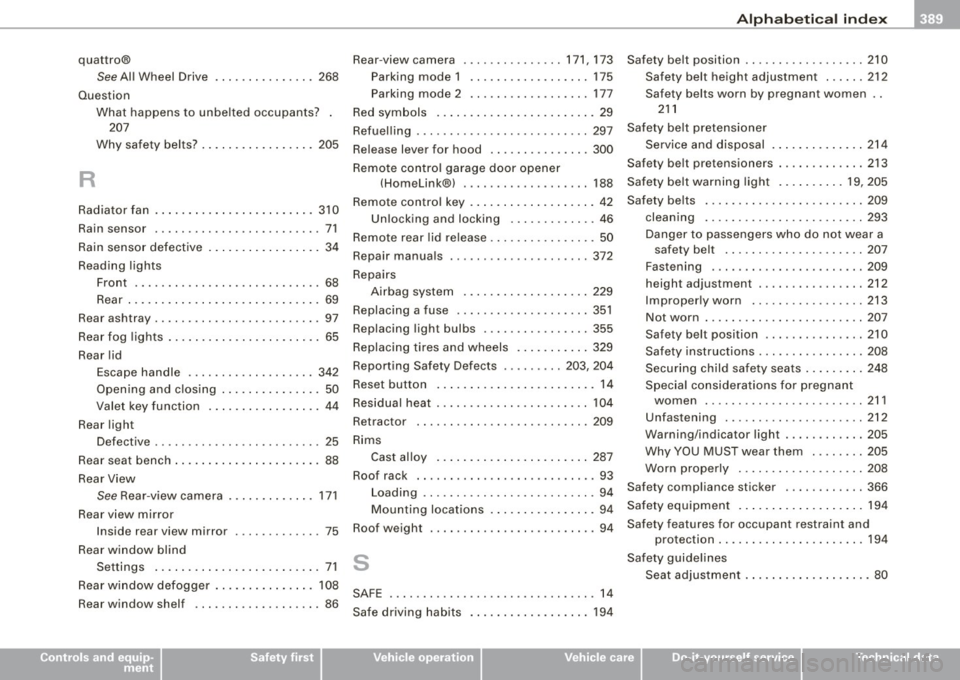
______________________________________________ A_ l_,_ p _h_ a_ b_e _t_i c_ a _ l _in _ d_e _ x __ lll
quattro®
See All Wheel Drive ... .... ........ 268
Question
R
What happens to unbelted occupants? .
207
Why safety belts? ... .... .... .... .. 205
Radiator fan .. . .... .. .. .... ....... .. 310
Rain sensor ... .... .... .... .......... 71
Rain sensor defective 34
Reading lights
Front .... ... .... .... .... ..... ... .
68
Rear ..... .. .. ...... .. ... .. ... ... . 69
Rear ashtray . .... .... .... ... .... ... .. 97
Rear fog ligh ts .... .... ... .... ..... ... 65
Rear lid
Escape handle .... .... ... .... ....
342
Open ing and c losing . .... ... ..... .. 50
Valet key function .. ..... .... .... .. 44
Rear light
Defective . .... .... ... .... .. .. .... .
25
Rear seat bench ...... .... ..... .... ... 88
Rear View
See Rear-view camera . ... .... .... . 171
Rear view mirror
Inside rear view mirror . ............
75
Rear window blind
Settings ..... .... .... ... .. .. .... .
71
Rear window defogger .. .... .... .... . 108
Rear window shelf ... .... ...... ...... 86
Controls and equip
ment Safety first
Rear
-view camera .. . .. .. .... .. .. 171, 173 Safety belt position . ... .. .... .. .. .... 210
Parking mode 1 .. .... ...... ..... . 175 Safety belt height adjustment . .... . 212
Parking mode 2 .. .. ........ .... .. 177 Safety belts worn by pregnant women
Red symbols .... .... .... .... .... ... .
29 21
1
Refuel ling ... .... .... .... .... .... ... 297 Safety belt prete nsioner
Release lever for hood .. ... ......... .
300 Service and disposal . ...... .... ... 214
Remote control garage door opener Sa
fety b elt pretensioners . .... .... .... 213
(Homelink®) ...... .... .... ... .. 188 Safety belt warning light ... .. .... . 19,205
Remote control key ... .... .... .... .... 42 Safety belts . .... .... .... ... .... .... 209
Un locking and locking ... .... .... .. 46 clea ning .. .... .... ... .... .... ... 293
Remote rear lid re leas ,e ... .... .... .... . 50 Danger to passengers who do not wear a
Repair manua ls .... ... ............ ..
372
Repa irs
Airbag system .. ...... .... .... ...
229
Replacing a fuse .... .... .... .... .... 351
safety belt .. ........ .... .... ... 207
Fastening ...... ..... .. .. ... ... .. 209
height adjustment . .... ... .... .... 212
Improper ly worn ..... ... . .. .. .... 213
Not worn . .... .... .... .... ...... . 207
Replacing light bulbs ...... ... ... .... 355 Safety belt position ... .... .... .... 210
Replaci ng tires and wheels . ...... .... 329 Safety instructions .... .... .... ... . 208
Reporting Safety Defe cts . ........ 203, 204 Securing child sa fety sea ts ..... ... . 248
Reset button . ...... .. .. .... .... .... . 14 Specia l considera tions fo r preg nant
Res idual heat . .... .... ... .... .... ...
104 women . ........ .... .. .... .... . 211
Retractor .. ... ... .. ...... .... .... .. 209 Unfastening ........ ........ ..... 212
Rims Warning/indicator light
....... ... .. 205
Cast alloy .. ...... .... .... ... .... 287
Roof rack .. ..... ... .... ... ... ... ... . 93
Why YOU MUST wear them . ..... .. 205
Worn properly . .... ... ... .. ...... 208
Loading ... ... .... .... .... ... .... . 94 Safety comp liance sticker .... .... .... 366
Mounting locat ions . ...... .... .... . 94 Safety equipmen t ... .... .... .... ... . 194
Roof weight .... .... ... ..... .... ... .. 94 Safety features for occupant restraint and
protection ...... .... .... .... ... .
194
s Sa fety guide lines
Seat adjus tment ...... .... .... .. . ..
80
SA FE .... ... .... ...... ...... .... ... . 14
Safe driving hab its ...... .... .... .... 194
Vehicle operation Vehicle care Do-it-yourself service Technical data