engine oil AUDI S7 2015 User Guide
[x] Cancel search | Manufacturer: AUDI, Model Year: 2015, Model line: S7, Model: AUDI S7 2015Pages: 316, PDF Size: 78.09 MB
Page 201 of 316
M N <( (.J
'SI: ,...., \!) 1.1'1 ,...., 1.1'1 ,....,
effect can be reduced due to moisture (or in
freezing conditions ice) on the brake pads . A
few careful brake app lications should dry off
the brake pads or remove any ice coatings.
When you are driving at higher speeds wit h
the windshield wipers on, the brake pads will briefly touch the brake d iscs in regular inter
vals so as to improve reaction t ime when brak
ing on wet surfaces. You the driver w ill not no
tice anything .
The effectiveness of the brakes can be reduced
when the vehicle is dr iven on a salt-covered
road and the brakes are not used . Here too,
you shou ld clean off accumulated salt coat ing
from brake discs and pads with a few careful
applications of the brake ¢
A.
Cor ro sion
There may be a tendency for dirt to build up
on the brake pads and corrosion to form on
the discs if the car is not dr iven regularly or
only for sho rt trips with l ittle use of the
b rakes .
If the brakes are not used frequently, or if cor rosion has formed on the discs, it is advisable
to clean off the pads and discs by b rak ing
fi rm ly a few times from a mode rately h igh
speed ¢,& .
Faults in the brake system
If you should notice a sudden increase in
brake peda l travel, t hen one of the two brake
circu its may have failed¢
A.
Low brake flu id le vel
Malfunct ions can occur in the brake system if
the brake fluid level is too low . T he brake fluid
level is monitored electronically .
Brake booste r
The brake booster works with vacuum pres
sure which is created only when the engine is
running ¢
A.
Brake lining w ear statu s
Brake lining wea r may be c hecked by vis ual in
spection of the condition of the brake pads
Int ellig ent technolog y 199
thro ugh the open ings in the wheel. If neces
sa ry, the whee l may be removed for t his in
spection ¢
page 2 75, Changing a wheel.
_& WARNING
- You should perform braking maneuvers
for the purpose of cleaning the brake
system only if road conditions permit.
Othe r road use rs must not be put at risk -
you may ca use an accident!
- Before descend ing a steep grade, reduce
speed and sh ift transmission into a lower
gea r o r l ower dr iving range. Do not ride
the brakes or hold the pedal down too long or too o ften . T hi s could c ause the
brakes to get hot and diminish braking
efficiency .
- Do not "ride the brakes" by rest ing you r
foot on the pedal when you do not intend
to b rake . This may cause the brakes to
overheat, premature wear and increased
stopping distance.
- Unde r ce rtain climatic and operating
conditions such as passing thro ugh wa
ter, dr iv ing in heavy rain or after washing
the vehicle, the effectiveness of the brakes can be reduced . In winte r, ice can
accumu late on the brake pads, lin ings,
discs and drums. Carefully app ly bra kes
for a test. Brakes will dry and ice co at
ings w ill be cleaned off after a few care
fu l brake applicat ions.
- Driving for an ex tended period of time on
salt-covered roads without using your
brakes can a lso affect bra king efficiency .
Clean off accum ulated salt coating from
brake discs and pads with a few careful
brake applications.
- If you damage the front spoiler, or if you
install a different spoiler, be sure the air
f low to the front brakes is not obstruct
ed. Otherw ise the brake system could
overheat reducing the effectiveness of
the entire brake system.
- Failure of one brake circuit will impair
the braking capab il ity result ing in an in
creased stopping distance . Avoid driving
the vehicle and have it towed to the
•
•
Page 206 of 316

204 Driving and en vir onm ent
Avoid damaging the
vehicle
When you are driving on poor roads, or over
curbs, steep ramps, etc ., make certain that
low-lying parts such as spoilers and exhaust
system parts do not bottom out and get dam
aged.
This is especially true for vehicles with low
slung chassis (sports chassis) * and fully load
ed veh icles .
Driving through water
on roads
Note the following to avoid vehicle damage
when driving through water, for example on
flooded roads:
- T he water must not be any higher tha n the
bottom o f the vehicle body.
- Do not d rive faster than wa lking speed.
_& WARNING
After d riving through water, m ud, slush,
etc., the brakes may be slow to take effect
because o f wet brake rotors and pads . Dry
the brakes first by braking carefully to re
store the full braking effect.
(]) Note
-Vehicle components such as the eng ine,
transmission, suspension or e lectr ica l
system can be severe ly damaged by driv
ing through water.
- Always switch
off the Start-Stop-System
when driving through water¢
page 81.
(D Tips
-Check the depth o f the water before driv
ing through it.
- Do no t stop the veh icle, dr ive in reverse
or switch the engine
off when driving
through water.
- Keep in mind that oncoming vehicles
may create waves that raise the water
level and make it too deep fo r your vehi
cle to drive through safely.
-
- Avoid driving through salt water because
it can cause corrosion .
Catalytic converter
Applies to vehicles : w ith gasoli ne e ngi ne
It is very important that your emission con
trol system (catalytic converter) is function
ing properly to ensure that your vehicle is run
ning in on environmentally sound manner.
.. Always use lead-free gasoline ¢ page 217,
Fuel supply .
.. Never run the tank down all the way to emp
ty.
.. Never put too much motor o il in your eng ine
¢ page 229, Adding engine oil~-
.. Never try to push- or tow-sta rt your vehicle.
The catalytic converter is an efficient "clean
u p" dev ice built into the exhaust system of
the ve hicle. The cata lytic conve rter bu rns
many of the pollutants in the exha ust gas be
f ore they are re leased into the atmosphere.
The exclusive use of unleaded fuel is c rit ically
important fo r the life of the catalyt ic convert
er and prope r fu nct ion ing of the engine.
A WARNING
-
The temperature of the exhaust system is
h igh, both when driving and after stopping
the engine.
- Never touch the exhaust tail pipes once
they have become hot . This could result
in burns .
- Do not park or operate the vehicle in
areas where the hot exha ust system may
come in contact with dry grass, brush,
fue l spill or other material which can
cause a fire .
- Do not app ly additional undercoating or
rustproofing on or near the exhaust
manifold, exhaust pipes, catalytic con
verter or heat shields. Dur ing driv ing, the
substance used fo r undercoating could
overheat and cause a fire.
~
Page 207 of 316
M N <( (.J
'SI: ,...., \!) 1.1'1 ,...., 1.1'1 ,....,
(D Note
-Be aware that just one tank fi lling with
le aded fuel will already seriously de
grade the performance of the catalytic
converter.
- Do not exceed the correct engine oil leve l
c>page229.
-Do not drive until the fuel tank becomes
complete ly empty. The engine could mis
fire. Unburned fuel could also get into
the exhaust system and this could cause
the catalyt ic converter to overheat.
- Do not switch off the ignition wh ile the
vehicle is moving .
- Do not continue to operate your vehicle
under these condit ions, as otherwise fuel
can reach the catalytic converter. This
could result in overheat ing of the con
verter, requ iring its replacement.
- To assure efficient operat ion of the Emis
s ion Control System:
- Have your vehicle maintained properly
and in accordance with the service rec
ommendations in your Warranty
&
Ma intenance booklet.
- Lack of proper maintenance as well as
improper use of the vehicle will impa ir
the funct ion of the emission control
system and could lead to damage .
@) For the sake of the environment
Even when the Emission Control System is
operating properly, the exhaust gas can
have a sulfur-like exhaust gas smell under
some operating states. This depends on
the s ulfur content of the fuel being used.
Using a d ifferent brand of fuel may help,
or filling the tank w it h lead-free super
grade gasoline .
Diesel particulate filter
Appl ies to vehicles : wit h diesel e ng in e
The diesel particulate filter fi lters nea rly a ll of
the soot part icles o ut o f the exhaus t. T he fi l
ter cleans itse lf automatically under normal
driving conditions . If the fi lter cannot clean it-
Drivin g and en vironm ent 205
self (for example, because you are on ly driving
short distances), the fi lter becomes clogged
with soot and the
II symbol for the diese l
particulate filter illuminates
c> page 21.
A WARNING
-Do not park your veh icle over flammable
mate ria ls such as grass or leaves because
the high temperature of the diesel par ticulate fi lter could start a fire.
- Do not apply an underbody protectant in
the exhaust system area or a fi re could
start.
Shutting down vehicle
If you would like your vehicle to rema in inop
erative for a longer per iod of t i me, contact an
Audi o r other spec iali zed dealer. They can ad
vise you on necessa ry precautions e.g. co rro
s ion p reven tion, maintena nce and s torage.
Pay attention to additional information con
cerning the battery . Refer to
c> page 235 .
Operate your vehicle
economically and
minimize pollution
General
Your personal style of driving will determine
the economy of your vehicle, as well as ex
haust and noise levels.
Fuel economy, environmenta l impact, and
wear on your engine, brakes and tires largely
depend on three factors:
- your personal d riving s tyle
- operati ng conditions
- technical limitat ions
If you ant ic ipate what you need to do next and
drive economically, you can easily cut your
fuel consumpt io n by 10-15 percent . T his sec
tion w ill give you some tips on how you can
help the env ironment and your poc ketbook. ..,_ •
•
Page 208 of 316

206 Driving and en vir onm ent
The consumption estimates as published
by ENVIRONMENTAL PROTECTION AGENCY
(EPA) and Transport Canada may not corre
spond to your actual consumption on the
road, which will vary depending upon vehi
cle load and speed, road and weather con
ditions, tr ip length, etc .
Drive smoothly and keep a lookout
ahead
Vehicles use the most fuel when they are ac
celerating.
• Avoid unnecessary accelerating and braking.
Vehicles use the mo st fuel when they are ac
celerating . If you anticipate what is go ing to
happen next, you will need to brake less and,
thus , accelerate less. Let the vehicle coast
wheneve r poss ible -for example when you see
that the next traffic l ight is red.
Avoid full throttle
Driving at moderate speeds saves fuel and
improves your mileage.
• Try and keep well below your car 's max imum
speed .
Accelerating gently reduces fuel consump
tion, engine wear, and does not disturb the
environment .
Fuel consumption, exhaust emissions and en
g ine no ise increase d isproportionately at high
speeds. If you dr ive at approximately three
quarters of top speed, fue l consumption will
be reduced by one half. Neve r dr ive faste r
than the posted speed limit and wea ther con
d itions permit.
Reducing unnecessary idling
Even when your car is just idling it burns up
fuel.
• Shut the engine off when you are not dr iv ing
the vehicle. •
Do not warm up the vehicle by letting the
engine run at id le .
T he id ling phase is automatically red uced for
vehicles with the Start -Stop -System . It is effi
cient to switch off the engine in vehicles with
out the Start-Stop -System when stopp ed at
railroad crossings and long red lights. Tu rning
the engine off for jus t 30-40 seconds saves
more fuel than is burned by starting the en-
. . gme again .
It takes a long time for the eng ine to warm up
fully when i t is running at idle. However, wear
and noxiou s emissions are espec ially high
when the eng ine is warm ing up . So you should
drive away as soon as you start the engine and
avo id running at high rpms while the engine is
still warming up.
W Note
Do not leave engine idling unattended af
ter start ing . If wa rning lights should come
on to indicate improper operation, they
wo uld go unheeded . Ex tended idling also
produces heat, wh ich could result in ove r
heating or other damage to the ve hicle or
other property .
Regular maintenance
A badly tuned engine unnecessarily wastes a
lot of fuel.
• Have your veh icle serviced at reg ular in ter -
vals .
By having your ve hicle regu la rly se rviced by an
Audi dealer he lps to ensu re tha t it runs p rop
erly and economically . The condition of your
vehicle not only affects its safety and ability to
ho ld its va lue, it also affects
fuel con sump
tion .
Check your oil e ach time you
fill y our tank.
The amount of o il used is re lated to engine
load and speed.
It is normal for the oil consumption of a new
engine to reach its lowest value after a certa in
mileage has bee n driven . ..,.
Page 220 of 316
218 Fuel supply and filling your fuel tank
-Blend must contain not more than 15%
MTBE.
Seasonally adjusted gasoline
Many gasoline grades are blended to perform
espec ially we ll for winter or summer driv ing.
During seasonal change-over, we suggest that
you fill up at busy gas stat ions where the sea
sonal adjustment is more likely to be made in
time.
(CT) Note
- Methanol fuels which do not meet these
requirements may cause corrosion and
damage to plastic and rubber compo
nents in the fuel system .
- Do not use fuels that fai l to meet the
specified criteria in this chapter.
- If yo u are unable to determine whether
or not a particular fuel blend meets the
specifications, ask your service station or
its fuel sup plier.
- Do not use fuel for which the contents cannot be identified.
- Fuel system damage and performance
problems resulting from the use of fuels
different from those specified are not
the respons ibility of Audi and are not
covered under the New Vehicle or the Emission Control System Warranties.
- If you experience a loss of fuel economy
or driveability and performance prob l ems due to the use of one of these fuel
blends, we recommend that you switch
to unblended fuel.
Gasoline additives
A major concern among many auto manufac
turers is carbon deposit build- up caused by
the type of gasoline you use.
A lthough gasoline grades differ from one
manufacturer to another, they have certain
things in common. All gasoline g rades contain
substances that can cause deposits to co llect
on vital engine parts, such as fuel injectors
and intake valves. Although most gasoline
brands include additives to keep engine and fuel
systems clean, they a re not equally effec
tive .
A udi recommends using TOP TIER Detergent
Gasoline. For more information on TOP TIER
Detergent Gasoline, please go to the official
website (www.toptiergas.com).
After an extended period of using inadequate
f uels, carbon deposit build-ups can rob yo ur
engine of peak performance.
CD Note
Damage or malf u nct ion due to poor fuel
quality is not covered by the Aud i New Ve
hicle Limited Warranty.
Diesel fuel
Applies to veh icles: w ith diesel engine
Always use ULSD (Ultra Low Su lfu r Diesel)
No. 2. The U LSD No. 2 meets the ASTM D975.
Diesel fuel with concentrations of biodiese l
higher than 5 % s uch as Bl 1, B2O or BlOO are
strictly prohib ited.
Serv ice stat ion fuel pumps are labeled with
the correct fuel information for easy recogn i
t io n by the user. If the diesel fuel pump is not
labeled ask the station operator what fue l is
being dispensed before filling up your vehicle.
ULSD No. 2 may not be available outside the
USA and Canada. Be sure to check before trav
eling to other countries.
ULSD No. 2 can become thicker in very cold
temperatu res, and this can impair the en
gine's start ing and running. Depending on the
season, gas stat ions provide ULSD No. 2 that
flows better in cold temperatures so that you
can continue operating your vehicle as usua l.
CD Note
-Yo ur vehicle's diesel engine was de
signed soley for use with ULSD No. 2.
Therefore, never use gasoline, heating
oil, other fuels or flow improvers. These
conta in substances that will severely
damage the fuel system and the engine.
II>
Page 228 of 316

226 Check ing and filling
- Always disconnect the battery.
- Never smoke or work near heaters or open flames . Fluids in the engine com
partment could start a fire.
- Keep an approved fire extinguisher im
mediately available.
- To avoid electrical shock and persona l in
jury while the engine is running or being started, never touch:
- Ignition cables
- Other components of the high voltage
electronic ignition system.
- If you must perform a check or repa ir
with the engine running:
- Fi rst, fully apply the parking bra ke,
move se lec to r lever to P (Pa rk) .
- Always use extreme caution to preven t
clot hing, jewe lry, or long h air from ge t
ting caught in the radiator fan, V -belts
or other moving parts, or from contact ing hot parts. Tie back hair before
start ing, and do not wear cloth ing that
will hang or droop into the eng ine.
- Min imize exposure to emission and
chemica l hazards¢ ,&..
A WARNING
California Propos ition 65 Warning:
- Engine exhaust, some of its constituents,
and certa in veh icle components conta in
or emit chemicals known to the State of
Califor nia to cause cancer and b irth de
fec ts a nd reproduct ive ha rm. In addition,
certain fluids conta ined in vehicles and
certa in prod ucts of co mponent wear co n
ta in o r emi t chemicals known to the
State o f Ca lifornia to cause can cer and
birth defects or ot her reproductive harm. -
Battery posts, terminals and re lated ac
cessories conta in lead and lead com
pounds, chemicals known to the State of
California to cause cance r and reproduc
tive harms. Wash hands after handling .
(D Note
When adding flu ids, always make sure that
they are poured into the proper conta iner
or f iller opening, otherwise serious dam
age to vehicle systems w ill occur.
® For the sake of the environment
To detect leaks in time, inspect the vehicle
floor pan from underneath regularly. If
you see spots from oil or other ve hicle flu
i ds, have yo ur vehicle inspected by a n au
thori zed Audi dea le r.
Closing the engine hood
.,. Pull the hood down un til the pressure from
t he struts is reduced.
.,. Let the hood
drop down and latch in p lace .
Do not try to push it shut; it may fail to en
gage ¢&_ .
A WARNING
-
A hood that is not completely latched
could fly up and b lock your view while dr iv
ing.
- When you close the engine hood, check it
to make sure the safety catch has p roper
ly engaged. The hood sho uld be flush
with the surrou nding vehicle body pa rts.
- If you notice while driv ing t hat the hood
is not s ecured prope rly, stop at onc e and
close it.
Page 229 of 316
M N <( I.J "". rl I.O
"' rl
"' rl
Checking and fillin g 22 7
Engine compartment
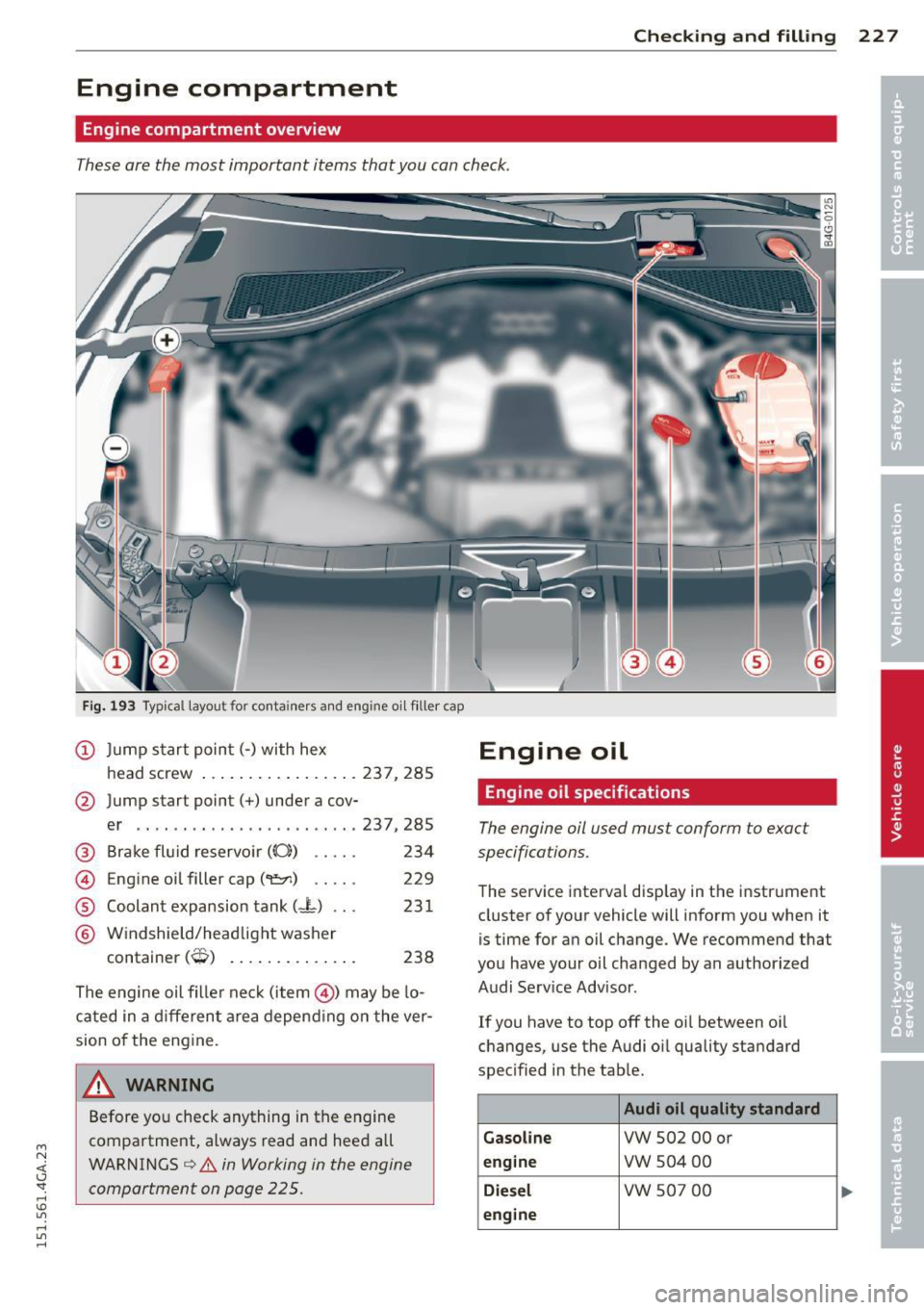
Engine compartment overview
These are the most important items that you can check.
Fig. 193 Typical l ayout for conta iners and engine o il filler cap
@ Jump start poin t(-) with hex
head screw .. .. ..... ... .. .. . 237, 285
@ Jump start point(+) under a cov-
er .. .. ... ..... ...... ...... 237,285
@ Brake fl uid reservo ir ((0)) .... .
© Engine oil filler cap ("1:::r.) .... .
® Coolant expansion tank (-L) .. .
© Windshield/headlight washer
t .
(;;:;) con ainer ,..,, .. .... .. .. . .. . 234
229
23 1
238
The engine oil fille r neck (item @) may be lo
cated in a d ifferent a rea depend ing o n the
ver
sion of the eng ine.
WARNING
Before you check anything in the engine
compartment, always read and heed all
WARNINGS
c::> &. in Working in the engine
compartment on page 225.
Engine oil
Engine oil specifications
The engine oil used must conform to exact
specifications.
T he service interva l d isp lay in the instrument
cluster of yo ur vehicle will inform you when it
is time for an oil change. We recommend that
you have your oil changed by an authorized
Audi Serv ice Advisor .
If you have to top off the oi l between oi l
changes, use the Audi o il quality standard
spec ified in the table.
Audi oil quality standard
Gasoline
VW 502 00 or
engine vw 504 00
Diesel vw 507 00
eng ine
Page 230 of 316
228 Check ing and filling
Using the proper engine o il is important for
the functionality and service life of the en
g ine. Your engine was factory-filled with a
h igh-quality oil which can usua lly be used
throughout the entire year.
0 Note
Your L imited New Vehicle Warranty does
not cover damage or ma lfunctions due to
fai lure to follow recommended mainte
nance and use requ irements as set forth in
the Audi Owner's Manual and Warranty
&
Ma intenance booklet.
- Use only a high quality eng ine oil that ex
pressly complies w ith the Audi o il quality
standard spec ified for your veh icle's en
gine. Using any other oil can cause seri
ous eng ine damage.
- Do not mix any lubricants o r othe r addi
tives into the eng ine o il. Doing so can
ca use engine damage.
If you need to add oi l and there is no ne
availab le tha t mee ts the Audi oil qua lity
s tandard your engine requires, yo u may
add a tota l of no more than 0 .5 quart/liter
of a high-quality "synthetic"oil that meets
the following specifications.
- Vehicles with gaso line engine: ACEA A3
or API SM with a viscosity grade of
SAE 0W-30, SAE SW-30 or SAE SW-40.
- Vehicles with diesel engine: ACEA C3 or
API CF with a v iscosity grade of
SAE 0W-30 or SAE SW-30.
- For more information abo ut eng ine oil
that has been approved for your vehicle, please contact either your a uthorized
Audi dealer or Audi Customer Relations
at 1 (800) 822-2834 or visit our web site
at www.audiusa .com or
www.aud icanada.ca.
Engine oil consumption
The engine in your vehicle depends on on ade
quate amount of oil to lubricate and cool all
of its moving ports .
In order to provide effective lubricat ion and
cooling of interna l eng ine components, all in
ternal combust ion e ngines consume a certain
amount of oil. Oil consumpt ion va ries from
engi ne to engine and may change sig nifican tly
over the life of the engine. Typically, engines
with a spec ified break -in period (see
c> page 203) consume more oil during the
break-in period than they cons ume after oi l
consumption has stabilized.
U nder normal cond itions, the rate o f oi l con
s u mption depends on the q uality and viscos ity
of the oil, the RPM (revolutions per minute) at
which the engine is operated, the ambient
temperature and road conditions. Further fac
tors are the amount of oil dilut ion from water
condensation or fue l residue a nd the oxida
t ion level of the oil. As any eng ine is subject to
wea r as m ileage builds up, t he oil co nsump
t ion may increase over time until replacemen t
of worn components may be come necessary.
With a ll these variab les coming into play, no
standard rate of oil consumpt io n can be es
tabl ished o r spe cified . There i s no alte rnative
to regu lar and frequent che ck ing of the o il lev
el , see
Note.
If the yellow engine oil leve l wa rning symbo l
i n t he i nstr ument cluster
Ill lights up, you
sho uld check the oil leve l as soon as possib le
i=> page 229 . Top off the oil at your earliest
convenience
i=> page 229.
A WARNING
--
Before you check anything in the engine
compartment, always read and heed a ll
WARNINGS
c> & in Working in the engine
comportment on page 225.
(D Note
Driving with an insufficient o il level is like-
l y to cause severe damage to the engine. .,.
Page 231 of 316
M N <( I.J "". rl I.O
"' rl
"' rl
@ Tips
-The oil pressure warning display. i s
not an indicator of the oil level. Do not
rely on it. Instead , check the oil level in
your engine at regular intervals, pref
erably each time you refuel , and always
before going on a long trip .
-If you have the impression your engine
consumes excessive amounts of oil, we r ecommend that you consult your Audi
dealer to have the cause of your concern
properly diagnosed. Keep in mind that
the accurate measurement of oil con
sumption requires great care and may
take some time. Your Audi dealer has in
structions about how to measure oil con
sumption accurately.
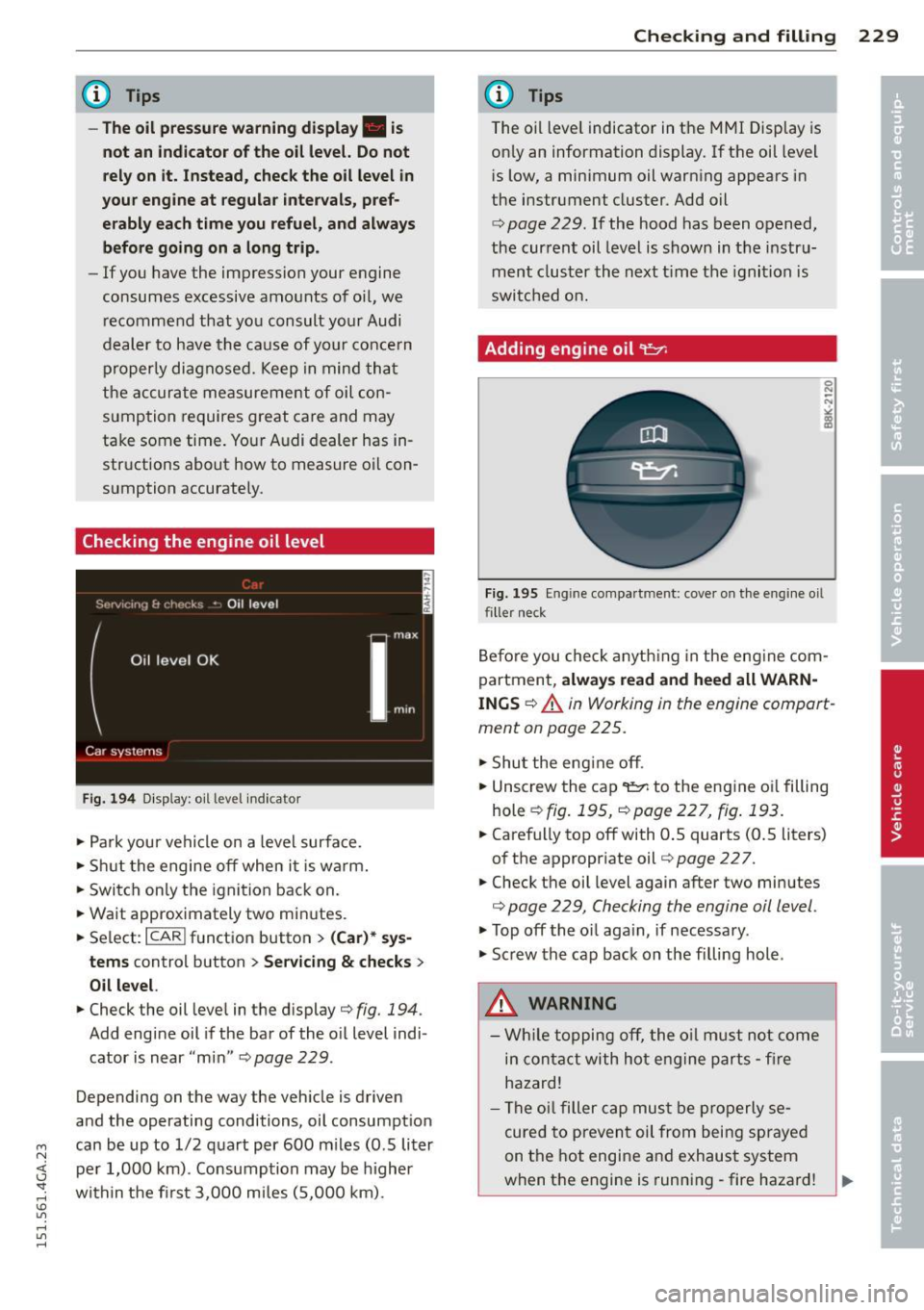
Checking the engin e oil lev el
Fig . 194 D isp lay : o il lev el indicato r
"' Park your vehicle on a level surface .
"' Sh ut the engine off when it is warm.
.. Switch only the ignition back on.
.. Wait approximately two min utes .
.. Select:
ICARI funct ion button> ( Car)* sys
tems
contro l button > Se rvicing & checks >
Oil level.
.. Check the oil level in the display¢ fig. 194 .
Add engine oil if the bar of the oil level indi
cator is near "min" ¢
page 229 .
Depending on the way the vehicle is driven
and the operating conditions, oil consumpt ion
can be up to 1/2 quart per 600 m iles (0 .5 liter
per 1,000 km) . Consumption may be higher
within the first 3,000 miles (5,000 km).
Checking and filling 229
@ Tips
The oil level indicator in the MMI Display is
on ly an information display. If the oil level
i s low, a minimum oil warn ing appears in
the instrument cluster. Add oil
c» page 229. If the hood has been opened,
the current oil level is shown in the instru
ment cluster the next time the ignition is
switched on.
Adding engine oil '1:::1:
Fig . 195 En gin e compart ment: cove r on the eng ine oil
filler neck
Before you check anything in the eng ine com
partment ,
always read and heed all WARN·
INGS
¢ A in Working in the engine compart
ment on page 225 .
.. Shu t the engine off .
"'U nscrew the cap
¢ fig. 195, ¢page 227 , fig. 193 .
.. Carefully top off with 0 .5 quarts (0 .5 liters)
of the appropr iate oil
¢ page 227.
.. Check the oil level again after two minutes
¢ page 229, Checking the engine oil level .
"'Top off the o il aga in, if necessary .
.. Screw the cap back on the fi lling hole .
_&. WARNING
-While topping off, the oil must not come
in contact with hot engine parts -fire
hazard!
- The oil filler cap must be prop erly se
cured to prevent oil from being sprayed
on the hot engine and exhaust system
when the engine is running -fire hazard! .,.
Page 232 of 316
230 Check ing and filling
- If your skin has come in contact with the
engine oil, you must subsequently
cleanse it thoroughly.
- Check the oil leve l using the MMI. If the
message
Ple ase red uce oil le vel appears,
contact your author ized Audi dealer or
other qualified workshop to have excess
oil extracted if necessary .
-Audi does not recommend t he use o f oil
add it ive s. They ma y damage the e ngine
and adve rsely aff ect your New Vehicl e
Warranty.
@ For the sake of the environment
- Under no circumstances can the oil come
in contact with the sewage network or
the soil.
- Observe and follow lega l regu lations
when disposing of empty oil containers.
Changing the engine oil
We recommend tha t have your oil changed by
an authorized Audi dealer or a qualified serv
ice station .
Before you check anything in the engine com
partment,
alway s read and heed all WARN
INGS
~ .& in Working in the engine compart
ment on page 225 .
The engine oil must be changed according to
the intervals specified in your Warranty
&
Maintenance booklet . This is very important
because the lubricating properties of oil di
minish gradua lly dur ing no rmal veh icle use .
Under some circumstances the engine o il
should be changed more frequently . Change
oil more often if you drive most ly short dis
tances , ope rate the vehicle in dusty areas or
under predominantly stop-and-go traffic con
d itions, or have your veh icle where tempera
tures remain below freezing fo r ex tended pe
riods .
Detergent addit ives in the o il w ill ma ke fresh
oil look dark after the eng ine has been run- ning for a sho
rt time. This is normal and is not
a reason to change the oil more often than
recommended.
Because of the problem of proper disposal,
along with the specia l tools and necessary ex
pertise req uired, we strongly recommend that
you have your oil changed by an a uthorized
Aud i deale r or a qualified service station.
If yo u choo se to chan ge your oil yours elf ,
please note the fo llowing important informa
t ion:
A WARNING
=
To reduce the risk of personal injury if you
must change the eng ine oil in your vehicle
yourself:
- Wear eye protect ion.
- To reduce the risk of burns from hot en-
g ine oil, let the engine cool down to the
touch.
- When removing the oil dra in p lug with
your fingers, stay as far away as possible.
Always keep your forearm parallel to the
ground to help prevent hot oil from runn ing down you r arm.
- Dra in the oil into a container designed
for this purpose, one large enough to hold at least the tota l amount of o il in
your engine .
- Engine oil is poisonous . Keep it wel l out
of the reach of children.
- Continuous contact with used eng ine o il
is harmful to your sk in . Always protect
your skin by washing oil off tho roughly
wit h soap and wate r.
(D Note
Neve r mix oil additives with you r engine
oi l. These additives can damage your en
gine and adversely affect your Audi Limit
e d New Veh icle War ranty.
@ For the sake of the environment
- Before changi ng your oil, first make su re
you know where you can prope rly dispose
o f the used oil. ..,.