child lock AUDI S8 2010 User Guide
[x] Cancel search | Manufacturer: AUDI, Model Year: 2010, Model line: S8, Model: AUDI S8 2010Pages: 384, PDF Size: 90.95 MB
Page 56 of 384
Opening and closing
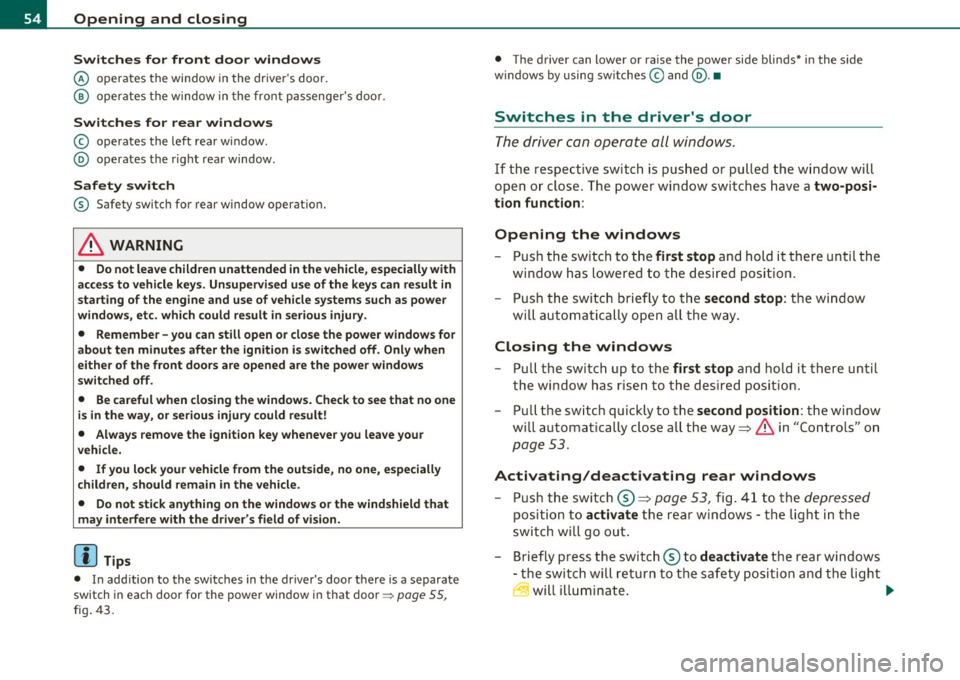
Switches for front door windows
@ operates the window in the drive r's door.
@ operates the w indow in the fro nt p assenge r's door .
Switches for rear windows
© operates the left rear wi ndow .
@ operates the rig ht rear window .
Safety switch
® Safety switch for rear window operat io n.
& WARNING
• Do not leave children unattended in the vehicle, espe cially with
ac cess to vehicle keys. Unsupervised u se of the keys can result in
starting of the engine and use of vehicle systems such as power
window s, et c. which could result in serious injury.
• Remember -you can still open or close the power windows for
about ten minutes after the ignition is swit ched off . Only when
either of the front doors are opened are the power windows
switched off.
• Be careful when closing the windows . Check to see that no one
is in the way, or seriou s injury could re sult!
• Always remove the ignition key whenever you leave your
vehicle .
• If you lock you r vehicle from the outside, no one, e specially
children, should remain in the vehicle .
• Do not stick anything on the windows or the windshield that
may interfere with the driver 's field of vision.
[I] Tips
• In add itio n to the switches in t he driver's door there is a separate
switch in each door for the powe r window in that door=>
page 55,
fig. 43.
• The driver can lower or ra ise the power side blinds* in the side
w indows by usin g sw itches © and @.•
Switches in the driver's door
T he driver can op erat e all windo ws.
If the respective sw itch is pus hed or pulled t he w indow w ill
open or c lose . Th e power win dow switches have a
two-posi
tion function :
Opening the windows
-Pus h the switch to th e first stop and hold it there until the
wi ndow has lowered to t he desired positio n.
- Push th e switch briefly to the
second stop : th e wi ndow
wi ll automat ically o pen all the way.
Closing the windows
- Pu ll the switch up to the first stop and hold it there u nti l
the window has rise n to the desire d positio n.
- Pu ll th e sw itch q uickly to t he
second position: th e w indow
wi ll automat ically close a ll the way =:>
& in "Contro ls" o n
page 53.
Activating/deactivating rear windows
-Pus h the swit ch© =:> page 53, fig. 41 to the depr essed
p os it ion to activate the r ea r w indows -the lig ht in th e
switch will go out .
- Briefly press t he swi tch © to
deactivate the r ear win dow s
- th e sw itc h w ill re turn to t he safety posit ion and t he light
& wi ll illuminate . ..,.
Page 57 of 384

Switching the power to the rear windows on
or off on vehicles with power child safety lock
-Press the left 00 button~ page 53, fig. 42 to switch off
the power window in the left door only. The LED in the
button illuminates .
- Press the right 00 button to
switch off the power window
in the
right door only . The LED in the button illuminates.
- Press the00button again to switch the power back on. The
LED in the button will go off.
By pressing the safety switch ®=> page 53, fig. 41, the function of
some switches in the rear can be turned off. When the / symbol in
the safety switch illuminates, the following functions are switched
off:
• The power w indows in the rear doors .
• Th e buttons for the interior lights.
• The buttons for the power sun blinds* in side windows.
• Th e button fo r the power sun blind* in the rear window.
• In veh icles with rear climate control * the
PASSIVE mode is acti
vated . In this mode the rear air conditioning can be operated only
from contro ls in the driver's area=>
page 114.
This feature has been prov ided for the safety of small children riding
in the rear of the vehicle.
On vehicles with the
power child safety lock*=> page 53, fig . 42
these features can likewise be switched off . Both
00 buttons ® must
be pressed.
• If
only the left (I) button is pressed, then only the rear left door
power window is switched off and the door is locked.
• If
only the right 00 button is pressed, then only the rear right
door
power window is sw itched off and the door is locked.
Controls and equip
ment Safety first
Opening and closing
(I] Tips
• Th
e windows can st ill be opened and closed for about ten minutes
after the ignition has been turned off . The power windows are not
shut off until one of the front doors is opened.
• To switch on the child safety lock in both rear doors, you must
press both ch ild safety switches . Make sure the LEDs in the switches
are illuminated .•
Switch in the front passenger 's door and on
the rear doors
Fig. 43 Switch loca
tion front passengers door
The power window switch has a two-position function:
Opening the windows
- Press the switch to the first position and hold it unt il you
have opened the window as far as you want .
- Press the switch quickly to the
second position and the
window will automatically open all the way.
Closing the windows
-Pull the switch to the first position and hold it until you
have closed the window as far as you want. ..,_
Vehicle care Technical data
Page 60 of 384

Opening and closing
When the glass roof opens, the su n visor , wh ic h is des igned to ward
o ff str ong sunligh t, op ens along w ith i t. T he v iso r ca n be clo sed
ma nua lly w hen the sunroof is closed .
[I] Tips
• Be awa re t hat the sunroof may actually be ope n whe n the sun visor
is close d. Chec k an d make sure t hat the sun roof is shut when parkin g
the ca r o r i f it sudde nly sta rts raining.
• If the s unroof is not f ully close d but you have pressed and he ld the
switch for the t ilt pos ition, the sunroof will not t ilt.•
Closing the power sunroof
Sliding the roof shut
- Turn the rota ry swi tc h to positio n@ => page 5 7, fig. 45
=> & .
Tilting the roof shut
-Briefly pull t h e rota ry switch to c lose t he roof .
To t ilt th e ro of down t o any in termed iat e po sitio n
pull and
h ol d
th e switc h until t he ro of reac hes th e de sired p osition.
& WARNING
Improper u se of the power sunroof can cause serious per sonal
injury.
• Be careful when closing the power sunroof . Not paying atten
tion could cause you or others to be trapped and injured as the roof
close s.
• Always take the key with you when you leave the vehicle to
prevent injurie s caused by the roof closing.
& WARNING (co ntinued )
• Never leave children or persons requiring as sistan ce alone in
the vehicle, especially when they could access the vehicle keys. Unsupervised use of the keys can result in the engine being started
or use of vehicle systems such as the power windows, etc. which
could result in serious injury. The doors could be locked with the
remote key, delaying help in an emergency.
• The power sunroof will continue to operate until the ignition
key has been removed and one of the front doors has been
opened. •
Power emergency closing
The s unr oo f can still be closed electrically if for some
reason the overload pro tection func tion b ecomes acti
vat ed.
The power sunroof is e quipped w ith an overload protection
f eatu re . If, u nder nor mal conditions , the power sun roof wi ll
n ot close, yo u ca n close it usi ng t his feat ure.
- Tu rn the ro tary switch to position @=>
page 5 7, fig. 45.
- Now pu ll the s witch
and hold it in this position u ntil the
power sun roof closes com plete ly .
& WARNING
Improper use of the power sunroof can cause serious personal
i njury.
• Be careful when closing the power sunroof. Not paying atten
tion could cause you or others to be trapped and injured as the roof
clo ses.
• Always take the key w ith you when you leave the vehicle to
prevent injuries caused by the roof clo sing .,,_
Page 61 of 384

& WARNING (continued)
• Never leave children or persons requiring assistance alone in
the vehicle, especially when they could access the vehicle keys.
Unsupervised use of the keys can result in the engine being started
or use of vehicle systems such as the power windows, etc. which
could result in serious injury. The doors could be locked with the
remote key, delaying help in an emergency.
• The power sunroof will continue to operate until the ignition
key has been removed and one of the front doors has been
opened. a
Emergency closing by hand
The sunroof can be closed by hand in case of a power
failure.
Con tro ls a nd e quip
m en t
Fig. 46 Section from
headliner: Where to
place the screwdriver
Vehicle OP-eration
Removing the cover
Opening and closing
Fig. 47 Section from
headliner: Crank for
emergency operation
- Insert the flat side of the screwdriver (found in the vehicle
tool kit) at the rear edge of the lens as indicated by the
-arrows- ::::> fig. 46.
- Carefully pry the clear lens cover open and remove it.
Retrieving the crank for emergency closing
-Use the ignition key or a screwdriver to carefully pry the
cover off the left end of the instrument panel
=> page 342, fig. 276. The crank is stored next to the fuse
carrier.
Closing the roof
- Push the crank ©::::> fig. 47 into the hex socket@ until
you can feel the crank engage. Start turning, maintaining
a steady pressure on the crank to keep it from slipping off.
- After you have closed the sunroof, remove the crank and
replace the dome light lens.
[ i] Tips
If you are unable to close the roof manually, contact the nearest
authorized Audi dealer for assistance. •
Vehicle care Do-it-yourselt service iTechnical data
Page 120 of 384

llffl..__O_ n_ t_h _e_ r_o _ a_ d _________________________________________________ _
& WARN ING (con tinu ed)
inju ries to the hands, arms and head if the d river 's airbag
deploy s.•
Easy entry feature
The easy entry feature makes it easier to enter and exit
the vehicle by autom atically adjusting the steering
w heel .
Press the button @=> page 11 7, fig. 130 to turn t he easy
en try featur e on or off.
W hen the easy entry fea ture is tu rned on ( button depre ssed) , the
steering wheel moves up to the parked position w hen the ignition is
tu rned off. After you ente r the vehicle, the steerin g wheel moves to
the stored pos ition as soon as you turn on the ign ition .•
Ignition Lock and ignition switch
Ignition key positions
The e ngine can be started or turned off with the ignition
key .
Fig . 131 Ig nition
swit ch posit ions
Position @
The ig nit io n key can be inserted into the ignition switc h in this posi
ti on . This automatically unloc ks the steer ing co lumn lock. When the
ig nition key is removed, the steer ing colum n lock is a utomat ically
locked~ &-
Ignition on (D
Turn t he ignit ion key to this position and re lease it.
Starting the engine@
The engine starts w ith the key in this position . Major electr ical loads
are te mpora rily tur ned off .
Ignition off 0
Turn the ignit ion key to this position and re lease i t.
& WARNING
• Never remove the key from the ignition lock while the vehicle
is moving . The steering wheel will lock , causing loss of control.
• If you have to leave your vehicle, even for just a minute, always
remove the ignition key and take it with you. This is especially
important if you are going to leave children unattended in the
vehicle. The children could start the engine or use other vehicle
controls . Unsupervised use of vehicle controls (for example, power
windows ) can cause serious personal injuries.
(D Note
• If the i symbol in the display blinks, there is a mal function in t he
elec tronic s tee ring co lumn lock. Follow the in struc tions in
~ page 31 , "Steer ing malfunction~" .
• If th e ~ sy m bol in the d is pla y blink s, t here i s a m alf unc tion in the
electronic ignition lock. Follow t he inst ru ctions in =>
page 31, "Igni-
t io n lock mal fu nctio n
.:2.". .,
Page 126 of 384

1111....__0_ n_ t_h_ e_ r_ o_ a _ d _________________________________________________ _
Parking
To p revent a parked vehicle from rolling away, there are
a fe w things you should do.
When you park your vehicle , do the following
- Stop t he veh icle us ing the bra ke pedal.
- Pull the switch to apply t he electromechanica l parking
brake .
- Move th e se lector lev er in to the
P position ~& .
- Switch off the e ngine and remove the ignition key from
the ignition lock.
When you park your vehicle on hills, do the
following
- Stop the veh icle us ing the bra ke pedal.
- Pull the switch to apply t he e lectromechanica l parking
brake .
- I f you a re parkin g h eaded
downhill , turn the front w heels
toward th e curb .
- I f you are parking headed
uphill , turn t he fro nt wh eels
away from t he curb.
- M ove the selector lever into the
P position.
- Switch off the e ngine and remove the ign it ion key from
the ignition lock.
& WARNING
Thi s is how you can reduce the risk of injury when lea ving your
vehicle.
& W ARNING (continued )
• Never park the vehicle where it can come in contact with dry
grass , spilled fuel or any other flammable material s.
• When parking on hills, always turn the wheel s so that the front
wheel s will fir st roll into the curb, if the vehicle should start to
roll.
• Never allow anyone · especially small children· to remain in
the vehicle when it i s locked. Locked door s make it more difficult
fo r rescu ers to acce ss the passenger compartment in the event of
an emergency. Danger to life!
• Never leave children unsuperv ised in the vehicle. Ch ildren
could relea se the parking brake or move the gear shift lever out of
gear. The vehicle could start to roll away and cau se an accident .
• No matter what the season i s, the temperature
in a parked
v ehicle can reach dangero us le vels .
0 Note
• Please exercise care when you pa rk your veh icle in parking areas
w ith park ing barriers o r cur bs. Parking barriers and curbs vary in
he ight and could damage your bumpe r and related components as
the front of your vehicle moves over a ba rrier or curb that is too high,
as you park or as you back out of a pa rking spot. In order to be sure
that no such damage can occur, yo u may wish to stop short of having
t he fro nt t ires of you r car touch t he p arking bar rie r or curb.
• Please a lso exerc ise except iona l care when you drive up or down
steep ramps or drive over curbs or o ther obstacles, for which the
vehicle is not des igned, because components of the vehicle close to
t he ground, s uch as bumpe r covers, spoilers and suspension and
exhaust system components, may become damaged. •
Page 191 of 384

______________________________________________ D_ ri_v _ i_n _,,g ,c.._ S_a_ f_ e_ l..:: y __ _
& WARNING (continued)
• Always adjust the driver's seat and the steering wheel so that
there are at least 4 inches (10 cm) between the knees and the
lower part of the instrument panel.
• Always hold the steering wheel on the outside of the steering
wheel rim with your hands at the
9 o'clock and 3 o'clock positions
to help reduce the risk of personal injury if the driver's airbag inflates.
• Never hold the steering wheel at the
12 o'clock position or with
your hands at other positions inside the steering wheel rim or on
the steering wheel hub. Holding the steering wheel the wrong way can cause serious injuries to the hands, arms and head if the
driver's airbag inflates
• Pointing the steering wheel toward your face decreases the
ability of the supplemental driver's airbag to protect you in a colli
sion.
• Always sit in an upright position and never lean against or
place any part of your body too close to the area where the airbags
are located.
• Before driving, always adjust the front seats and head
restraints properly and make sure that all passengers are properly
restrained.
• Never adjust the seats while the vehicle is moving. Your seat
may move unexpectedly and you could lose control of the vehicle .
• Never drive with the backrest reclined or tilted far back! The
farther the backrests are tilted back, the greater the risk of injury
due to incorrect positioning of the safety belt and improper
seating position.
• Children must always ride
in child seats ::::;, page 231. Special
precautions apply when installing a child seat on the front
passenger seat ::::;,
page 206. •
Controls and equip
ment Safety first Vehicle operation
Proper seating position for the front
passenger
The
proper front passenger seating position is important
for safe, relaxed driving.
For your own safety and to reduce the risk of injury in the
event of an accident, we recommend that you adjust the seat
for the front passenger to the following position:
- Adjust the angle of the seatback so that it is in an upright
position and your back comes in full contact with it when
ever the vehicle is moving.
- Adjust the head restraint so that the upper edge is as even
with the top of your head as possible but not lower than
eye level and so that it is as close to the back of your head
as possible =>
page 191.
-Keep both feet flat on the floor in front of the front
passenger seat.
- Fasten and wear safety belts correctly=>
page 201.
For detailed information on how to adjust the front passenger's seat,
see::::;,
page 76 .
& WARNING
Front seat passengers who are unbelted, out of position or too
close to the airbag can be seriously injured or killed by the airbag
as it unfolds. To help reduce the risk of serious personal injury:
• Passengers must always sit in an upright position and never
lean against or place any part of their body too close to the area
where the airbags are located.
• Passengers who are unbelted, out of position or too close to
the airbag can be seriously injured by an airbag as it unfolds with
great force in the blink of an eye. ..
Vehicle care Do-it-yourself service Technical data
Page 196 of 384
111....__D_ r_iv _i_ n_, g=-- S_ a _ f_e _,Ly _ ______________________________________________ _
in. WARNING
Improperly stored luggage or other items can fly through the
vehicle causing serious personal injury in the event of hard braking
or an accident. To help reduce the risk of serious personal injury:
• Always put objects, for example, luggage or other heavy items
in the luggage compartment.
• Always secure objects in the luggage compartment using the
tie-down hooks and suitable straps.
& WARNING
Heavy loads will influence the way your vehicle handles. To help
reduce the risk of a loss of control leading to serious personal
injury:
• Always keep in mind when transporting heavy objects, that a
change in the center of gravity can also cause changes in vehicle
handling:
-Always distribute the load as evenly as possible.
- Place heavy objects as far forward in the luggage compart-
ment as possible.
• Never exceed the Gross Axle Weight Rating or the Gross Vehicle
Weight Rating specified on the safety compliance sticker on the
left door jamb. Exceeding permissible weight standards can cause
the vehicle to slide and handle differently.
• Please observe information on safe driving
=> page 186.
in. WARNING
To help prevent poisonous exhaust gas from being drawn into the
vehicle, always keep the rear lid closed while driving.
• Never transport objects larger than those fitting completely
into the luggage area because the rear lid cannot be fully closed.
& WARNING (continued)
• If you absolutely must drive with the rear lid open, observe the
following notes to reduce the risk of poisoning:
-Close all windows,
- Close the power roof,
- Open all air outlets in the instrument panel,
- Switch off the air recirculation,
- Set the fresh air fan to the highest speed.
in. WARNING
Always make sure that the doors, all windows, the power roof and
the rear lid are securely closed and locked to reduce the risk of
injury when the vehicle is not being used.
• After closing the rear lid, always make sure that it is properly
closed and locked.
• Never leave your vehicle unattended especially with the rear lid
left open. A child could crawl into the vehicle through the luggage
compartment and close the rear lid becoming trapped and unable
to get out. Being trapped in a vehicle can lead to serious personal
injury.
• Never let children play in or around the vehicle.
• Never let passengers ride in the luggage compartment. Vehicle
occupants must always be properly restrained in one of the
vehicle's seating positions.
(I) Tips
Air circulation helps to reduce window fogging. Stale air escapes to
the outside through vents in the trim panel, on the left side of the
luggage compartment . Be sure to keep these slots free and open.•
Page 204 of 384
-Safety belts -----=-----------------------------------------
Automatic safety belt retractors
Every sa fe ty be lt is equipped wi th an au toma tic be lt r etrac tor on the
shoulder be lt. This feat ure locks t he belt whe n the belt is pull ed out
fast, during ha rd bra king an d in an acc ident . The belt may also loc k
w hen you dr ive up or dow n a s te ep h ill or throug h a sharp curve .
Dur ing norma l driv ing the belt lets you move freely.
Safety belt pretensioners
Th e safety belts are e quipped w ith a belt p retensioner that hel ps to
t igh ten the saf ety be lt and remove slac k w he n the p re tensioner is
act ivated . The f unction of t he p retens ioner is monitore d by a warn ing
light=>
pag e 17.
Switchable locking feature
Every safety be lt except the one on the driver sea t is equipped with a
switchab le locking feature that
must b e used when the safety belt is
us ed to attach a c hild se at. B e s ure to rea d the i mporta nt info rmation
about th is feature =>
page 241.
& WARNING
Improperly positioned safety belts can cause serious injury in an
accident =>
page 202, "Safety belt position ".
• Safety belt s offer optimum protection only when the seat back
is upright and belts are properly positioned on the body.
• Never attach the safety belt to the buckle for another seat.
Attaching the belt to the wrong buckle will reduce safety belt
effe ctivene ss and can cause seriou s per sonal injury.
• A passenger who is not properly restrained can be seriously
injured by the safety belt itself when it moves from the stronger
parts of the body into critical areas like the abdomen.
• Always lock the convertible locking retractor when you are
securing a child seat in the vehicle=>
page 243. •
Safety belt position
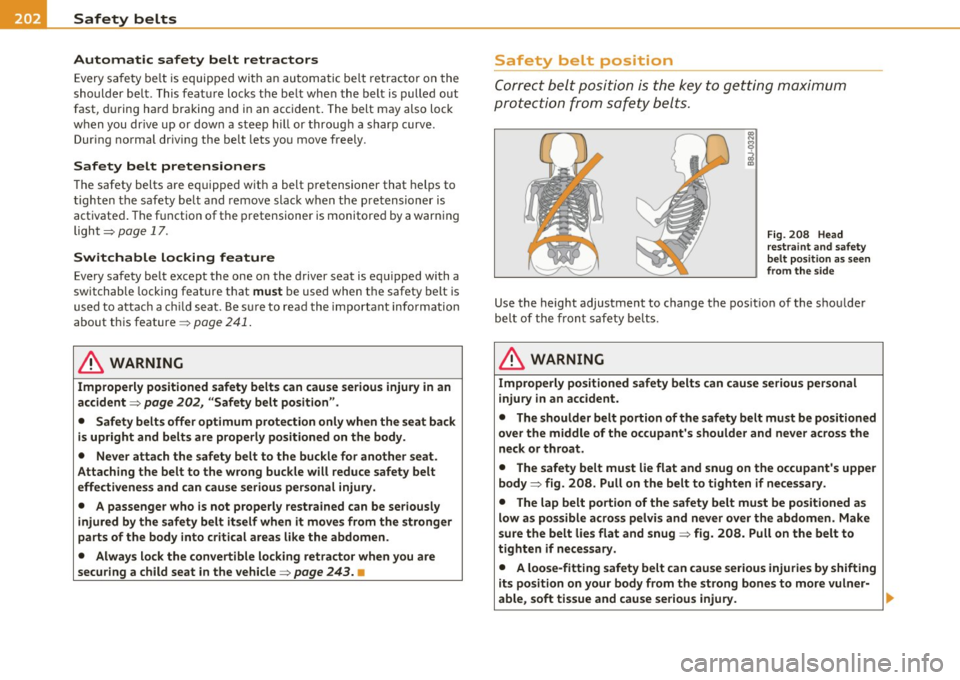
Corre ct b elt posi tion is the key t o getting maximum
p ro tec tion fro m sa fety belts .
Fig. 208 Head
restraint a nd safety
belt po sit ion as s een
from the side
Use the height adjustment to change the pos it io n of the s houl de r
be lt of the fron t sa fety be lts.
& WARNING
Improperly po sitioned safety belts can cau se serious per sonal
injury in an accident.
• The shoulder belt portion of the safety belt must be positioned
over the middle of the occupant's shoulder and never across the
neck or throat.
• The safety belt must lie flat and snug on the occupant's upper
body => fig. 208. Pull on the belt to tighten if necessary.
• The lap belt portion of the safety belt must be positioned a s
low as possible across pelvis and never over the abdomen . Make
sure the belt lies flat and snug => fig. 208. Pull on the belt to
tighten if necessary .
• A loose-fitting safety belt can cause serious injuries by shifting
its position on your body from the strong bones to more vulner-
able , soft tissue and cause serious injury .
~
Page 220 of 384
_,___A_ i_rb _ a_,g=-- s_, y:;.. s_ t_e _m ________________________________________________ _
PASSENGER AIR BAG OFF light
( ~ I :."!l.t.~A I ~
1~ J,
i
)
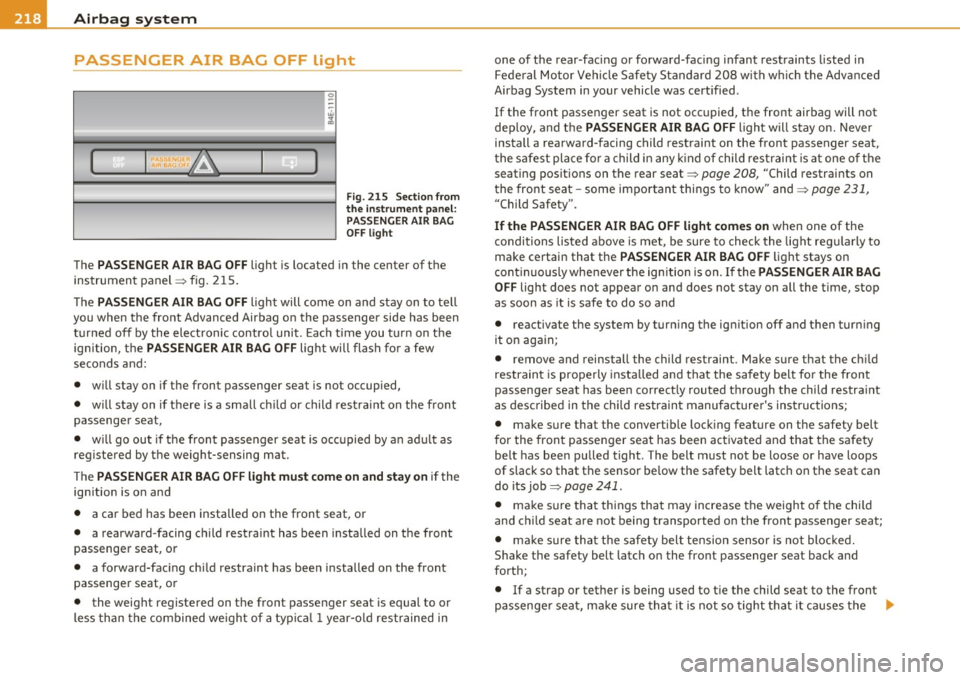
Fig . 215 Section from
the in strume nt panel :
PASSENGER AIR BAG
OFF light
The PASSENGER AIR BAG OFF ligh t is located in the center of t he
ins trumen t panel => fig. 2 15 .
T he
PASSENGER AIR BAG OFF ligh t will com e on and stay on to te ll
you when the front Advanced Airbag on the passenger side has been
t u rn ed off by the ele ct ronic contro l uni t. Each t ime you t urn on t he
ignition, the
PASSENGER AIR BAG OFF light will flash fo r a few
se conds and:
• will stay on if the front passenger seat is not occupied,
• will s tay on if t here is a small ch ild or child res trai nt on the fron t
passenger seat,
• will go out if t he front passenger seat is oc cupied by a n ad ult as
registered by the weight-sensing mat .
Th e
PASSENGER AIR BAG OFF light mu st come on and stay on if the
ignition is o n and
• a ca r bed has been installed o n the front seat, or
• a rearward -facing child restraint has been insta lled on t he front
passenger seat, o r
• a forward-fac ing ch ild restraint has bee n installed on the front
passenge r seat, o r
• the weight registered on t he front passe nger seat is equal to o r
less th a n the co mb ined we ight of a typic al 1 year-o ld rest rained in one of the rear-faci
ng or forward-facing infant restraints listed in
F e d era l Mo tor Ve hicle Safe ty St anda rd 2 08 w ith which th e Adv anced
Airbag System in your vehicle was cert ified.
If the front passen ger seat is not occupied, the front airbag will not
dep loy, and t he
PASSENGER AIR BAG OFF ligh t will stay on. Never
install a rearward -facing c hild rest raint on the f ront passenger seat,
t he s afest pl ace fo r a child in any k ind of child re stra in t is a t one o f th e
seating pos it ions on the rear seat::::;,
page 208, "Child restraints on
t he fro nt sea t - so me im port an t things to kno w" and =>
page 231,
"Ch ild Safety" .
If the PASSENGER AIR BAG OFF light comes on when one of the
c onditions lis ted above is met, be sure to check the lig ht reg ularly to
ma ke certain that the
PASSENGER AIR BAG OFF lig ht stays on
c ont inuo usly whenever the ignition is on. If the
PASSENGER AIR BAG
OFF
light does not appear on and does not stay on all the t ime, stop
as so on a s it is safe to do so and
• reactivate the system by turn ing the ig nition off and then tur ning
it on again ;
• remove and reinstall the child restraint. Make sure that the c hild
restrain t is properly inst alled and that the sa fety belt for the fron t
passenger seat has been correct ly routed th rough the chi ld restra int
as desc ribe d in the ch ild restrain t manufacture r's ins tructions;
• make su re that the convertib le lock ing feature on t he safety belt
f or the front passenger sea t has been act ivate d an d that the safe ty
belt has bee n pulled tight. The belt m ust not be loose or have loops
of slac k so that t he senso r be low the safety belt latc h on the seat can
do its job::::;,
page 241.
• make s ure tha t things tha t may in crease the weight o f the chi ld
and c hild seat a re not be ing transported o n the front passe nger seat;
• mak e s ure th at th e s afety bel t tension se nso r is not blocked.
Shake the safety belt latch o n the front passenger seat back and
f orth;
• If a strap or tether is being used to t ie the child seat to the front
pass en ge r sea t, mak e sure that it is not s o tight t hat it cau ses t he ...