instrument panel AUDI S8 2010 Owner's Manual
[x] Cancel search | Manufacturer: AUDI, Model Year: 2010, Model line: S8, Model: AUDI S8 2010Pages: 384, PDF Size: 90.95 MB
Page 230 of 384

___ A_ i_ r_b _ a_ g=- s_, y"-- s_t _e _m ______________________________________________ _
Side curtain airbags
Description of side curtain airbags
The side curtain airbag system can provide supplemental
protection to properly restrained occupants .
Fig. 220 Side curtain
airbags, driver's side:
s ide curtain airbag
location
The side curtain airbags are located on both sides of the interior
above the front and rear side windows=> fig. 220. They are identified
by the word "AIRBAG" on the windshield frame and the center roof
pillar.
The side curta in airbag system s upplements the safety belts and can
help to reduce the risk of injury for occupants' heads and upper torso
on the side of the vehicle that is struck in a sid e collision . The s ide
curtain a irbag inflates only in side impacts and only when the vehicle
acceleration registered by the contro l unit is high enough . If this rate
is below the reference value programmed into the control unit, the
side airbags will not be triggered, even though the car may be bad ly
damaged as a result of the collision.
It is not possib le to define an
airbag triggering range that will cover every possible angle of impact,
since the circumstances will vary considerably between one collision
and another. Important factors include, for example, the nature
(hard or soft) of the impacting object, the angle of impact, vehicle
speed, etc.=>
page 229, "How side curtain airbags work" . Aside from their normal safety function, safety belts work to help
keep the driver or front passenger in position in the event of a co lli
sion so that the s ide curta in a irbags can provide protection .
The airbag system is not a substitute for your safety belt . Rather, it is
part of the overall occupant restraint system in your veh icle. Always
remember that the airbag system can on ly help to protect you if you
are wear ing your safety belt and wearing it p rop erly . This is another
reason why you should always wear your safety belts , not just because
the law requires you to do so=>
page 197, "Gene ral notes".
It is important to remember that while the side curta in airbag system
is designed to he lp reduce the like lihood of serious injuries, other
injuries , for example, swell ing, bruis ing, and minor abrasions can
also be assoc iated with these airbags upon deployment. Remember
t oo, these airbags wi ll dep loy only once and only in certain kinds of
accidents - your safety belts are always there to offer protection .
The side curtain airbag system basically consists of:
• The electronic control module and external side impact sensors
• The side curtain airbags above the front and rear s ide windows
• Th e airbag indicator light in the instrument panel
The airbag system is mon itored electron ically to make certain it is
functioning properly at all times . Each time you turn on the ignition,
the air bag system indicator light will come on for a few seconds (self
diagnostics).
The side curtain airbag is not activated:
• if the ignition is turned off,
• in side co llisions when the acceleration measured by the sensor is
too low,
• in front-end collisions,
• in rea r-end co llisions,
• in rollovers .
Page 244 of 384
-Child Safety ------ ~---------------------------------
& WARNING (cont inued)
• It is safer to install a forward-facing child safety seat on the
rear seat.
• Always read and heed all WARNINGS whenever using a child
restrained in a vehicle is being used=>
page 231. Special precau
tions apply when installing a child safety seat on the front
passenger seat=>
page 208, "Child restraints on the front seat -
some important things to know".
& WARNING
Always take special precautions if you must install a forward or rearward-facing child restraint on the front passenger's seat in
exceptional situations:
• Whenever a forward or rearward-facing child restraint is installed on the front passenger seat, the PASSENGER AIR BAG
OFF light must come on and stay on whenever the ignition is
switched on .
• If the PASSENGER AIR BAG OFF light does not come on and
stay on, perform the checks described=>
page 217, "Monitoring
the Advanced Airbag System".
• Take the child restraint off the front passenger seat and install
it properly at one of the rear seat positions if the PASSENGER AIR
BAG OFF light does not stay on whenever the ignition is switched
on.
• Improper installation of child restraints can reduce their effec
tiveness or even prevent them from providing any protection .
• An improperly installed child restraint can interfere with the
airbag as it deploys and seriously injure or even kill the child.
• Always carefully follow the manufacturer's instructions
provided with the child safety seat or carrier.
• Never place additional items on the seat that can increase the
total weight registered by the weight-sensing mat and can cause
injury in a crash .
& WARNING
Forward-facing child restraints:
• Always make sure the forward -facing seat ha s been designed
and certified by its manufacturer for use on a front seat with a
passenger front and side airbag.
• Never put the forward-facing child restraint up, against or very
near the instrument panel.
• Always move the passenger seat into its rearmost position in
the seat's fore and aft adjustment range, as far away from the airbag as possible before installing the forward-facing child
restraint. The backrest must be adjusted to an upright position .
• Make sure that the PASSENGER AIR BAG OFF light comes on
and stays on all the time whenever the ignition is switched on.
& WARNING
Rearward-facing child restraints:
• A child in a rearward-facing child safety seat installed on the
front passenger seat will be seriously injured and can be killed if
the front airbag inflates - even with an Advanced Airbag System.
• The inflating airbag will hit the child safety seat or infant
carrier with great force and will smash the child safety seat and
child against the backrest, center armrest, door or roof.
• Always be especially careful if you must install a rearward
facing child safety seat on the front passenger seat in exceptional
circumstances.
• A tight tether strap on a rearward-facing child restraint
attached to the front passenger seat can put too much pressure on
the weight-mat in the seat and register a heavier weight in the
Advanced Airbag System. The heavier weight registered can make
the system work as though an adult were on the seat and deploy
the Advanced Airbag when it must be suppressed causing serious
or even fatal injury to the child.
Ill-
Page 280 of 384
-~_C_ le_ a_n_ i_ n_ g=- a_ n_d___. p_ ro_ t_e _c_ t_ i_o _n ___________________________________________ _
detergent. Apply the water with a damp cloth o r sponge a nd pat the
fabr ic dr y wi th a n ab sorb ent , dr y clot h.
Sta ins from choco late or makeup should have dete rge nt paste (e.g.
ox -gall soap) ru bbed into them . Afterwards, remove t he soap w ith
w at er ( damp s ponge).
Alcoho l can be used to treat sta ins from grease , oil, lipstick or a ba ll
po int p en. Melte d gre ase o r dye mus t be p atted o ff usi ng absorbe nt
material. It may be necessary to ret reat t he areas with detergent
paste a nd water .
In the case of ge nera l soili ng o f th e upholste ry an d cover mater ia l, we
recommend hiring a specialist that has the equ ipment to clean the
sea t cover s and o ther fab ric su rf a ces by sh am poo ing and s pray
extractio n.
& WARNING
Always read and heed all WARNINGS and the information
~ page 270 .
(I) Tips
Ope n Velcro fasteners on yo ur clothing can damage the sea t cover.
Please make su re t hat Velc ro fasteners are closed .•
Plastic parts and instrument panel
Always use a clean cloth moistened in clear water to clean t hese
a reas. For pers iste nt dirt use a n Audi appr oved
solvent-free plas tic
cleaner /protectant.
& WARNING
Solvents can change the properties of some plastics and make it harder for the airbag to deploy.
& WARNING (co ntinued )
• Never clean the instrument panel or the surface of airbag
modules with cleaning products that contain solvents.
• Products containing solvents will make the surface of this part
porous.
• Serious injuries can result if plastic parts come loose when the
airbag is deployed .
• Always read and heed all WARNINGS and other information
~page 270.
0 Note
Cleaning agents contai ning solvents will attack the mate rial and can
c hange the w ay it behave s.•
App lies to vehicles: with na tural leather
Natural leather
A udi makes gre at effo rts to main tain the propert ies,
natura l loo k and f eel of inte rio r le a th er .
General
We offe r m any di fferen t types o f lea ther on ou r ve hicl es. Most are
differen t types of nappa leat her, which has a smooth s urface and
comes in va rious co lo rs .
Th e int ensity of the colo r de ter min es th e vi sual cha ra cte ris tic s an d
appea rance. If the s urface o f the leathe r has a typical natu ral look,
t hen the le a the r is a nappa lea ther tha t has bee n left in a relat ively
natura l condition. This leat he r offers partic ularly good comfort a nd
brea thes wel l. Fine veins, closed gr ains, insec t bit e s, sk in fol ds , and
subt le variations i n color rema in v isib le. These character ist ics demon
stra te t hat the ma ter ia l is na tural.
N at ural nappa leat her i s not cov ered by a colo r finish.
It is therefor e
more sensitive to soiling and wea r, which is somethin g you need to ..,
Page 290 of 384
___ C_h_ e_c _k _i_n -=g :a,__ a_n_ d_ f_ i_ l _li _n _,g;._ __________________________________________ _
Checking and filling
Engine hood
Releasing the engine hood
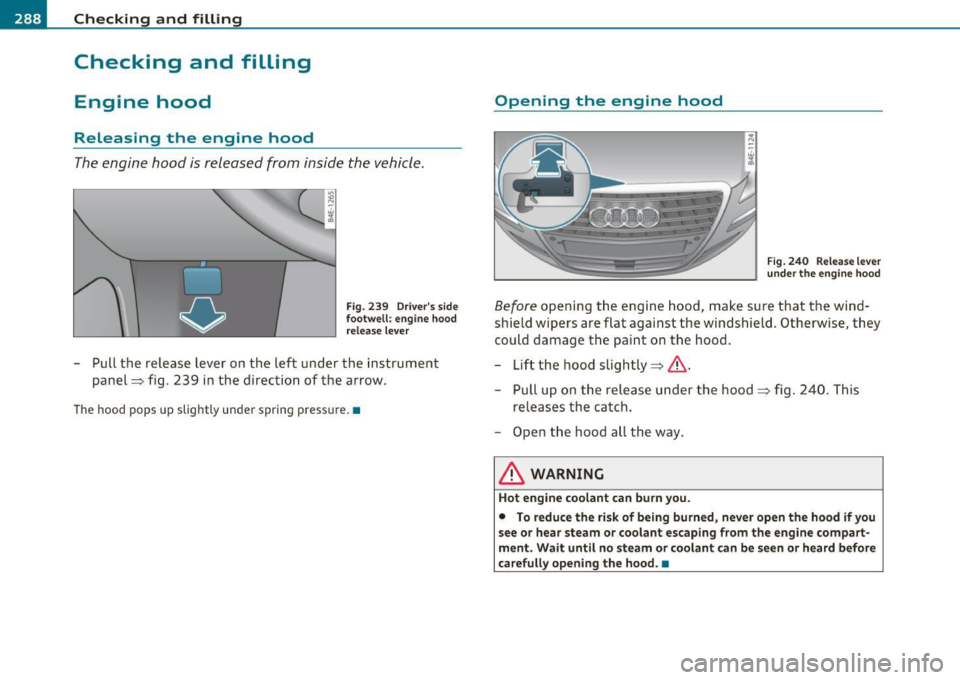
The engine hood is released from inside the vehicle.
Fig . 2 39 Dr iver 's sid e
f oo twell : e ng in e ho od
r elease leve r
-Pull the release lever on the left under the instrument
panel ~ fig. 239 in the dir ect ion of th e arrow .
The hood pops up slightly under spring pressure. •
Opening the engine hood
Fig. 24 0 Rel ease le v er
under the eng ine h ood
Before opening the eng ine hood, make sure that the wi nd
sh ield wipers are flat against the windshield . Otherwise, t hey
cou ld damage the pa int on the hood.
Lif t the hood slightly~ &.
- Pull u p on t he rel ease un der the hood ~ fig . 240. This
releases the c atch .
- Open t he hood a ll the way.
& WARNING
Hot eng ine coolant can burn you.
• To reduce the risk of being burned , never open the hood if you
see or hear steam or coolant escaping from the engine compart
ment . Wait until no ste am or coolant can be seen or heard before
c arefull y opening the hood .•
Page 344 of 384
lffll.,___F_ u_ s_e _ s_ a_n_ d_ b_u _ l_ b_ s _______________________________________________ _
Fuses and bulbs
Fuses
Replacing a fuse
A problem in the electrical system may be caused by a
blown fuse.
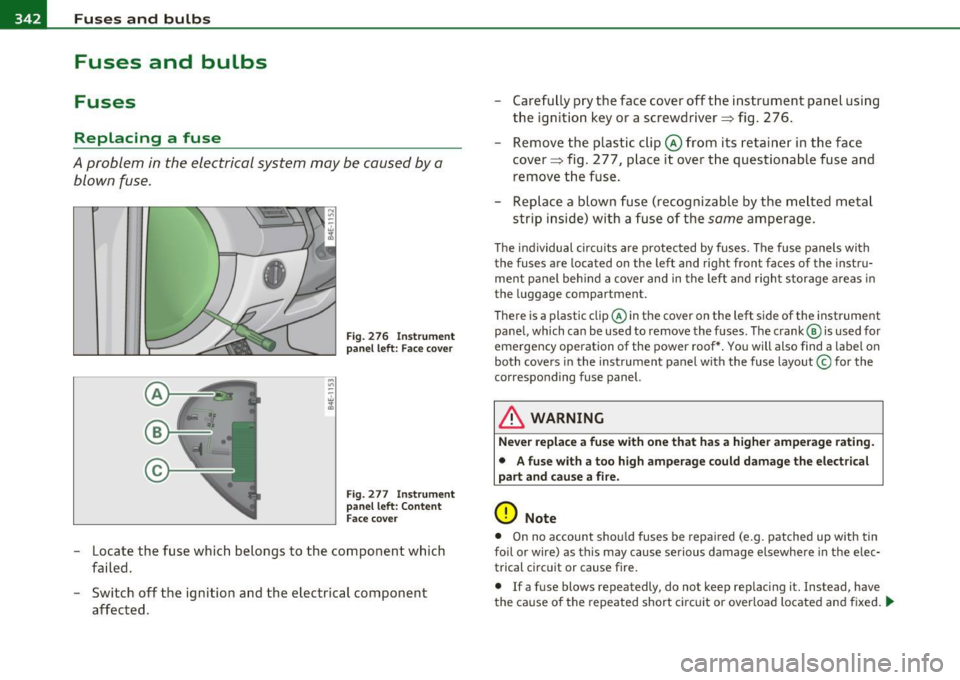
F ig . 2 76 I nstrum ent
pane l left: Face c over
Fig . 277 Instr ument
p anel left : Content
Fac e co ver
- Locate the fuse which belongs to the component which
failed.
- Switch off the ignit ion and the electrical component
affected . - Carefu
lly pry the face cover off the instrument panel using
the ignit ion key or a screwdriver==> fig. 2 76 .
- Re move the plast ic cl ip © from i ts re taine r in the face
cover=> fig. 2 77, place i t over t he ques tiona ble fuse and
remove the f use .
- Rep lace a blown fuse (re cog niz able by the m elte d m etal
s tri p inside) wit h a fuse of the
same amp erag e.
T he ind ividu al c ircui ts are protec ted by fuses. The f use panels wi th
the fuses are located on the left and right front faces of the instru
ment pane l beh ind a cover and in the lef t an d righ t storage area s in
the luggage compartment.
Th ere is a plastic clip@ in the cover on the left side of the instrument
pane l, which ca n be used to remove the f uses . The crank @ is used for
eme rgency operation of the power roof *. Yo u will also find a label o n
both cove rs in the instrument panel wit h the fuse layout © for the
co rresponding fuse panel.
& WARNING
Never replace a fuse with one that has a higher amperage rating.
• A fuse with a too high amperage could damage the electr ical
part and cau se a fire.
(D Note
• O n no account s houl d fuses be repaired (e .g. patched up with tin
foil o r wire) as th is may cause se rious damage elsewhe re in t he elec
trical circ uit or cause fire .
• If a fuse blows repeatedly, do not keep replacing i t. Instead, have
t he ca use o f the repeated short c ircu it or over load lo cate d an d fixed . .,_
Page 345 of 384
![AUDI S8 2010 Owners Manual ________________________________________________ F_ u_s _e_ s_ a_ n_ d_ b_u_ lb_ s _ __.1111
(]] Tips
You a re well adv ised to keep a supply of spare fuses in your veh icle .
Fuses with](/img/6/57617/w960_57617-344.png "AUDI S8 2010 Owners Manual ________________________________________________ F_ u_s _e_ s_ a_ n_ d_ b_u_ lb_ s _ __.1111
(]] Tips
You a re well adv ised to keep a supply of spare fuses in your veh icle .
Fuses with")
________________________________________________ F_ u_s _e_ s_ a_ n_ d_ b_u_ lb_ s _ __.1111
(]] Tips
You a re well adv ised to keep a supply of spare fuses in your veh icle .
Fuses with the proper ampere ratings are avai lab le at your Audi
dealer. •
Fuse Location, Instrument Panel left
Fig. 2 78 Fuse pa nel
la you t
Some of the equ ipment items listed a re opt io na l o r only availab le on
certain model configurations.
Note that the following table i s accu rate at the time of going to
pre ss and is subject to change . In the event of di scr epancie s, th e
label on the in side of the cover always takes precedence.
T he power wi ndows and the power seats are p rotected by cir cuit
breakers ,
which automatically reset after a few seconds after the
overlo ad -for e xamp le if a window is fro zen - has bee n remed ie d.
Equipment Amps
1 Garage door opener (Homelink) 5
Parking assist system 5
3
Pa rking assist sy stem 5
4
Headlight range control/light control devic e 10
Vehicle OP-eration
No.
5
6
7
8
9
10
11
1 2
13
14
1 5
16
17
1 8
19
20
2 1
22
23
24
25
26
27
28 29
Equipment Amps
Instrument cluster 5
Steering column electronics system control 10
Diagnostic co nnector 5
Diagnostic connector/oil level sensor 5
ES P contro l uni t/steer ing angle se nsor 5
Instrum ent cluster 5
Au di lane ass ist 10
B ra ke ligh t switch 5
Telephone/ cell phone 10
Vacant
Acces s/ st art cont rol m odul e
5
RSE system 10
Adaptive C ruise Control 5
Hea ted w asher je ts 5
Vacant
Tire pressure monitoring system *
5
Vacant
Bra ke light switch
5
Ce ll phone preparation 5
Horn 15
Wi ndshie ld wipe r system 4 0
Vacant
E le ctronic Stabilizati on Pro gram (E SP)
2 5
Vacant
Sw itch illumination
1
Vehicle care Do-it-yourself service iTechnical data
Page 346 of 384

lffll.,___F_ u_ s_e _ s_ a_n_ d_ b_u _ l_ b_ s _______________________________________________ _
No. IIEquipment
30 Vacant
31
32
33
34
35
36
37
38
39
4 0
41
42 Onboard power s
upply, light contro l (r ight
headlight)
Vacant L eft rea r footwell heate r
Vacant
Vaca nt
A udi si de assist
Coo ler
Onboard power supply, light control (left head
light)
Door control un it, dr iver's side
Power steerin g column adjustmen t
Door control unit, rear left
Access/start control module
4 3 Adaptive L ight, le ft
--44 Adap tive Light, righ t
Amps
30
25
5
15
30
7 .5
25
7 .5
25
10
10
•
Fuse Location, Instrument Panel right
Fig. 279 Fuse panel
la yout
Some of the equipment items listed are optiona l or only availab le on
certain mode l configurations .
Note that the following table is accurate at the time of going to
press and is subject to change. In the event of discrepancies , the
label on the in sid e of the cover alway s take s precedence .
The power window regu lators and the power seats are protected by
circuit breakers , which automatically reset after a few seconds after
the overload -for examp le if a window is frozen -has been remedied .
No. Equipment
1 Parking br ake
2 A ir cond ition ing
3 Shift gate
4 Vacan t
5
6
7
---· 8
Eng ine contro l
Oxygen sensor before the three-way
cat alytic converter
Oxygen sensor behind the three -way
catalytic converte r
E ngine control, auxiliary w ater pump
Amps
5
10
5
15
15
15
1 0
Page 378 of 384

___ A_ l_. p_ h _ a_b_ e_ t_ic _a_ l_ in_ d_e _ x ____________________________________________ _
Driver's seat memory .. ... ..... ... . 84 Side airbags
Front passenger's seat . .. ... ... .... 77 Description . .................... 225
Front seats .................. .... 76 How they work .................. 226
Head restraints . .. .. .. .. .. .... 81, 191 Side assist
Lumba r support .. .. .............. 80 Activating and deactivating . .. ..... 145
Power seat . .. .. .. .. .. .. .......... 77 Description . .. .... ......... .... . 145
Safety guidelines . ...... .......... 76 Informational and alert stage signals 147
Seat belts Messages in instrument cluster display . .
Why YOU MUST wear them ........ 197 152
Seat memory . . . . . . . . . . . . . . . . . . . . . . . 84
Seat position Inco rrect seat position . .. ......... 191
Seating capacity . .. .. .. .. .. ...... .. . 197
Seating position Driver ............. ...... .... ... 188
Front passenger ................. 189
How to adjust the front seats .. ..... 189
Occupants . ................... .. 188
Rear passengers
Seats Number of seats 190
197
Selective unlock feature ...............
44
Selector lever ... ................... 155
Service and disposal Safety belt pretensioner ........... 205
Service interval display .. .. .... ........ 25
Service position Windshield wipers ............. ... 72
Servotronic MMI
settings ............. .. .. .. . 150
Operation .. ............. .... .. . 147
Safety tips .... ........... .. ..... 152
Sensor detection area ...... .. .... . 146
Side curtain airbags ... .............. 228
Description ... ................. . 228
How they work ...... ...... ..... . 229
Safety instructions ... ..... .. .. ... 229
Side marker l ights ........... .. .. .. .. 60
Ski sack . .. .... ............. ...... .. 91
Snow chains ....................... 324
Sockets ......................... 97, 98
So lar blower fan/solar roof .... .. .... . 112
Sound system disp lay
Dr iver information display ...... .. .. 23
Sources of in formation about child restraints
and their use ................... 251
Spare wheel . ............. .. ... ... . 334
Speed control system
See Adaptive Cruise Control . .. .. .. . 128
Power steering .................. 257 Speed rating letter code ........ .. .. . 320
Shift buttons . .. ..... ... ........ ... 159 Speed warning system .............. .. 35
Ship Speedometer ....
................ ... 12
Transporting you r vehicle ........ .. 353 Sport Suspension
See Adaptive A
ir Suspension ....... 176
Starting off with a trai ler .......... ... 125
Starting the engine ............. 118, 119
What should I do if the engine does not start? .... .... .. .. .. .. .. .. .. .. 119
Steering . .. .. .. ................. .. 117
Adjusting steering column .. ..... .. 117
Easy entry feature ......... ... .. .. 118
Locking the steering .............. 118
Malfunction . ... .. .. .............. 31
Steering wheel heating ...... .. .. .. .. 108
Steps for determining correc t load limit 315
Stopping the engine .... ............. 120
Storage .. .. .. .. ...... ............. . 98
Compartments in the door trim panels ...
100
Compartments in the rear doors .. .. 100
(upholder . .. ...... .............. 94
(upholder rear center armrest ....... 95
Glove compartment .......... ... .. 99
Luggage compartment . .. ... .... .. 102
Ski sack ....... ... .... .. .. .. .. .. . 91
Small objects ....... ...... .... .. 100
Sun shade ................ .... ... ... 68
Sun visors .................. ... .. .. . 68
Switches Emergency flashers . . . . . . . . . . . . . . . 63
Power sunroof ............. .. .. .. . 57
Rear window defogger ...... .... .. 113
Symbols Red ..... ............. .......... 28
Yellow .................. ... ... .. 32