door lock AUDI S8 2010 Owner's Guide
[x] Cancel search | Manufacturer: AUDI, Model Year: 2010, Model line: S8, Model: AUDI S8 2010Pages: 384, PDF Size: 90.95 MB
Page 124 of 384
-On the road •m ___________________ _
& WARNING (continued)
• The brake booster and the servotronic only work when the
engine is running. If you turn off the engine, more force will be
required to steer or brake the vehicle. If you are not prepared, this
could result in a collision and serious personal injury.
• For your safety, move the selector lever to the P position, then
turn off the engine. Otherwise the vehicle could inadvertently roll
away.
• After turning off the engine, the radiator fan can come on and
run for up to 10 minutes -even if the ignition is switched off. Like
wise, the fan could come on if the temperature in the engine
compartment raises due to heat build up or if you leave the vehicle
standing in direct sunlight.
0 Note
After driving at high engine load, heat can build up in the engine
compartment after you have turned off the engine. This can damage
t he engine. Let the vehicl e stand and run in idl e for about 2 minutes
before turning off the engine. •
App lies to ve hicles : w ith Conve nie nc e key
Driver's messages in the instrument
cluster
Messages appear in the instrument cluster to let the
driver know if something is missing or if something must
be done.
No key identified
This message appears when you press the [START) button, but there
is no remote contro l key inside the vehicle or if the system does not
recognize the key. For example, if your key is
shielded by an object or
encased, i .e . in side an aluminum briefcase, the signal from the key cannot be detected
. Electron ic devices such as cell phones can also
in terfere w ith the radio signal.
Press brake pedal to start engine
This message appears when you press the !S T ART ) butto n when
starting the engine but you have not depressed the brake pedal.
Engage N or P to start engine
This message appears when you start the engine but the selector
lever is not in the P or N position . The engine can be started only if the
selector lever is in one of these two positions .
Key not in vehicle
This message appears together with the 7 symbol when the remote
control key is removed from the vehicle while the engi ne is running.
Th is is to remind you that you should not cont inue your tr ip without
your key.
If the key is no longer inside the vehicle when you turn off the engine,
you will not be able to switch on the ignition or restart the engine.
Also, you will not be able to lock the vehicle from the outs ide .
Shift to P, otherwise vehicle can roll away. Doors do not lock if lever
is not in P.
Thi s message appears for your safety together with an audible
warning signal when you press the
[STOP) button but the selector
lever is not in the P position and you open the driver's door. Move the
selector leve r in to P, otherwise the vehicle could roll away. I n addi
tion, you will not be able to lock the ve hicle with either the lock
button located on the door hand le or the remote control.
To engage steering lock, press and hold STOP button
Th is message appears for your personal safety if you switch off the
engine and the ignition by pressing the
[STOP) button and then open
the driver's door. In this case, the steering will still not be locked. The
steering wheel will lock:
• If you press the
I STO P I button for longer than 1 second.
• If you lock the vehicle from the outside .•
Page 126 of 384

1111....__0_ n_ t_h_ e_ r_ o_ a _ d _________________________________________________ _
Parking
To p revent a parked vehicle from rolling away, there are
a fe w things you should do.
When you park your vehicle , do the following
- Stop t he veh icle us ing the bra ke pedal.
- Pull the switch to apply t he electromechanica l parking
brake .
- Move th e se lector lev er in to the
P position ~& .
- Switch off the e ngine and remove the ignition key from
the ignition lock.
When you park your vehicle on hills, do the
following
- Stop the veh icle us ing the bra ke pedal.
- Pull the switch to apply t he e lectromechanica l parking
brake .
- I f you a re parkin g h eaded
downhill , turn the front w heels
toward th e curb .
- I f you are parking headed
uphill , turn t he fro nt wh eels
away from t he curb.
- M ove the selector lever into the
P position.
- Switch off the e ngine and remove the ign it ion key from
the ignition lock.
& WARNING
Thi s is how you can reduce the risk of injury when lea ving your
vehicle.
& W ARNING (continued )
• Never park the vehicle where it can come in contact with dry
grass , spilled fuel or any other flammable material s.
• When parking on hills, always turn the wheel s so that the front
wheel s will fir st roll into the curb, if the vehicle should start to
roll.
• Never allow anyone · especially small children· to remain in
the vehicle when it i s locked. Locked door s make it more difficult
fo r rescu ers to acce ss the passenger compartment in the event of
an emergency. Danger to life!
• Never leave children unsuperv ised in the vehicle. Ch ildren
could relea se the parking brake or move the gear shift lever out of
gear. The vehicle could start to roll away and cau se an accident .
• No matter what the season i s, the temperature
in a parked
v ehicle can reach dangero us le vels .
0 Note
• Please exercise care when you pa rk your veh icle in parking areas
w ith park ing barriers o r cur bs. Parking barriers and curbs vary in
he ight and could damage your bumpe r and related components as
the front of your vehicle moves over a ba rrier or curb that is too high,
as you park or as you back out of a pa rking spot. In order to be sure
that no such damage can occur, yo u may wish to stop short of having
t he fro nt t ires of you r car touch t he p arking bar rie r or curb.
• Please a lso exerc ise except iona l care when you drive up or down
steep ramps or drive over curbs or o ther obstacles, for which the
vehicle is not des igned, because components of the vehicle close to
t he ground, s uch as bumpe r covers, spoilers and suspension and
exhaust system components, may become damaged. •
Page 196 of 384
111....__D_ r_iv _i_ n_, g=-- S_ a _ f_e _,Ly _ ______________________________________________ _
in. WARNING
Improperly stored luggage or other items can fly through the
vehicle causing serious personal injury in the event of hard braking
or an accident. To help reduce the risk of serious personal injury:
• Always put objects, for example, luggage or other heavy items
in the luggage compartment.
• Always secure objects in the luggage compartment using the
tie-down hooks and suitable straps.
& WARNING
Heavy loads will influence the way your vehicle handles. To help
reduce the risk of a loss of control leading to serious personal
injury:
• Always keep in mind when transporting heavy objects, that a
change in the center of gravity can also cause changes in vehicle
handling:
-Always distribute the load as evenly as possible.
- Place heavy objects as far forward in the luggage compart-
ment as possible.
• Never exceed the Gross Axle Weight Rating or the Gross Vehicle
Weight Rating specified on the safety compliance sticker on the
left door jamb. Exceeding permissible weight standards can cause
the vehicle to slide and handle differently.
• Please observe information on safe driving
=> page 186.
in. WARNING
To help prevent poisonous exhaust gas from being drawn into the
vehicle, always keep the rear lid closed while driving.
• Never transport objects larger than those fitting completely
into the luggage area because the rear lid cannot be fully closed.
& WARNING (continued)
• If you absolutely must drive with the rear lid open, observe the
following notes to reduce the risk of poisoning:
-Close all windows,
- Close the power roof,
- Open all air outlets in the instrument panel,
- Switch off the air recirculation,
- Set the fresh air fan to the highest speed.
in. WARNING
Always make sure that the doors, all windows, the power roof and
the rear lid are securely closed and locked to reduce the risk of
injury when the vehicle is not being used.
• After closing the rear lid, always make sure that it is properly
closed and locked.
• Never leave your vehicle unattended especially with the rear lid
left open. A child could crawl into the vehicle through the luggage
compartment and close the rear lid becoming trapped and unable
to get out. Being trapped in a vehicle can lead to serious personal
injury.
• Never let children play in or around the vehicle.
• Never let passengers ride in the luggage compartment. Vehicle
occupants must always be properly restrained in one of the
vehicle's seating positions.
(I) Tips
Air circulation helps to reduce window fogging. Stale air escapes to
the outside through vents in the trim panel, on the left side of the
luggage compartment . Be sure to keep these slots free and open.•
Page 240 of 384
___ C_h _i_ld _ S_ a_ f_ e_ t_,, y'-----------------------------------------------
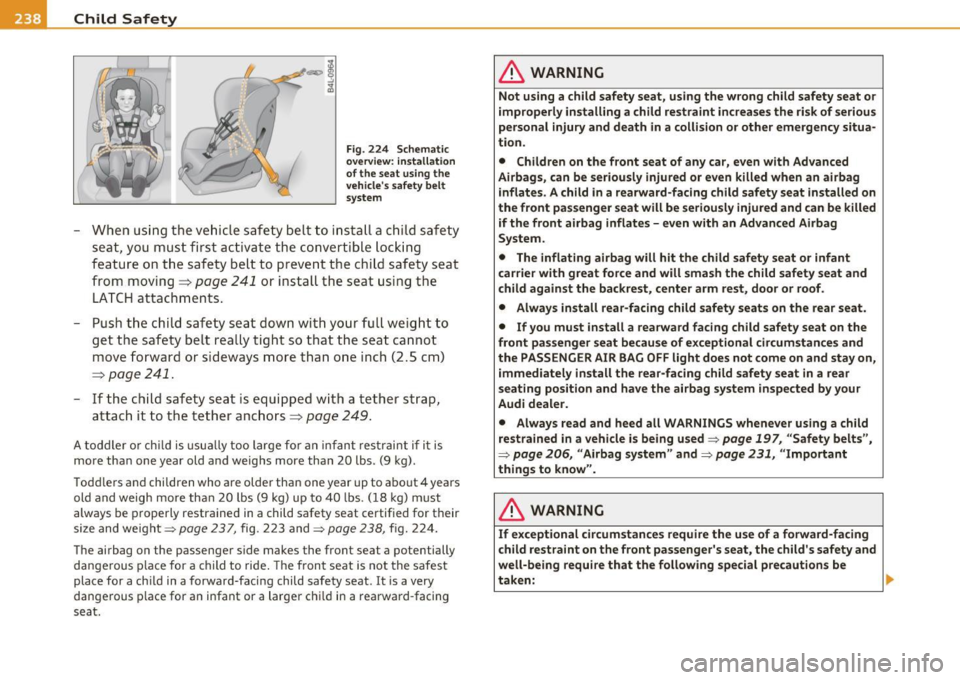
F ig. 22 4 Schema tic
overvie w: insta llatio n
of the seat using the
vehicle's sa fety be lt
sys tem
- When using the vehicle safety belt to insta ll a child safety
seat, you must first activate the convertible lock ing
feature on the safety belt to prevent the child safety seat
from moving~
page 241 or install the seat using the
LA TCH attachments .
- Push the child safety seat down with your full we ight to
get the safety belt really tight so that the seat cannot
move forward or s ideways more than one inch
(2.5 cm)
=>
page 241 .
- If the child safety seat is equipped w ith a tether strap,
attach it to the tether anchors=>
page 249.
A todd le r o r ch ild is usually too large for an i nfant res traint if it is
more than one year old and weighs more than 20 lbs . (9 kg) .
Todd lers and children who are older than one year up to about 4 years
old and weigh more tha n 20 lbs (9 kg) up to 40 lbs. (18 kg) must
always be properly restrained in a child safety seat certif ied for their
size and weight~
page 237, fig. 223 and~ page 238 , fig. 224.
The airbag on the passenger s ide makes the front seat a poten tially
dangerous place for a child to ride . The front seat is not the safest
place for a ch ild in a forward-facing child safety seat . It is a very
dangerous p lace for an infant or a larger chi ld in a rearward -facing
seat .
& WARNING
Not using a child safet y seat , us ing the w rong child safety seat or
improperl y install ing a child re straint in cre a ses the ri sk of seriou s
per sonal injury and death in a c olli sion or oth er em erg ency situa
tion.
• Children on th e front seat of any ca r, ev en with Ad vanced
Airbags , can be seriou sly injured or even killed when an air bag
i nflat es. A child in a re arward-facing child safet y seat installed on
the front pa ssenger seat will be seri ously injured and can be killed
i f the front a irbag inflates -ev en w ith an Advanc ed Airbag
System .
• The inflating airbag will hit th e child saf ety s eat or infant
carrier with grea t fo rce and will sma sh the child safet y seat and
child against the backrest, center arm rest , door or roof .
• Alway s in stall rear-f acing child safety seat s on the rear seat.
• If you must install a r ear ward fa cing ch ild safety seat on the
front p assenger seat becau se of except ional circum stance s and
th e PAS SENGER AIR BAG OF F light d oes not com e on and st ay on,
imm edia tel y i nstall the rear -facing child safet y se at in a re ar
seating position and ha ve the airbag s ystem insp ect ed by y our
Audi de aler.
• Alway s re ad and h eed all WARNINGS when ever u sing a child
re st rained
in a vehicle i s being use d~ page 197, "Safety belts ",
~ page 206 , "Airbag system " a nd ~ page 2 31 , "Important
thing s to know ".
& WARNING
If exc eptional cir cum stan ce s re quire the u se of a forward -f aci ng
c hild re straint on th e front p assenger 's seat, th e child 's saf ety and
w ell-being requ ire that the following sp eci al precauti ons b e
tak en:
11'-
Page 243 of 384

_______________________________________________ C_ h_ il_d _ S_a _ f_ e _ t..,. Y :...._ __
& WA RNING (c on tinued )
• If you mu st install a booster seat on the front pa ssenger seat
becau se of exceptional circumstance s the PASSENGER AIR BAG
OFF light must come on and stay on , whenever the ignition is
switched on.
• If the PASSENGER AIR BAG OFF light does not come on and
stay on, perform the checks described=>
page 217, "Monitoring
the Advanced Airbag System ".
• Take the child re straint off the front pa ssenger seat and install
it p roperly at one of the rear seat positions if the PASSENGER AIR
BAG OFF light does not stay on whenever the ign ition i s switched
on.
• Always read and heed all WARNINGS whenever using a child
restrained in a vehicle i s being used=>
page 197, "Safety belts",
=> page 206, "Airbag sy stem " and => page 231, "Important
things to know ".•
Installing a child safety seat
Securing a child safety seat using a safety
belt
S af ety b elts f or the re ar seats and th e fr on t passen ger
can be lock ed wit h the converti ble locking ret ract or to
properly secu re child safety seats.
The safety be lts emergency lo ck ing re trac tors for the rear seats
safety belts and for the front passenge r's seat safety belt have a
convertib le locking retractor for child rest raints . The safety be lt must
be locked so that belt webbing canno t un reel. The retractor can be
activated to lock the safety be lt and prevent the safety belt webbing
from loose ning up during normal dr iv ing. A child saf ety sea t can only
be properly insta lled when the safety belt is locked so that t he chi ld
and child s afety seat will stay in pla ce.
Controls and equip
ment Safety first Vehicle operation
Always remember:
Even though yo ur vehicle is equipped w ith a n
Adv anced Air bag system, all ch ild ren, espe cially those 12 ye ars and
younger, should always ride in the back seat properly restra ined for
their age and size.
& WARNING
Improperly installed child safety seats increase the risk of seriou s
personal injury and death in a collis ion.
• Alway s make sure that the safety belt retractor is locked when
installing a child safety seat . An unlocked safety belt retractor
c annot hold the child safety seat in place during normal driving or
in a crash .
• Always bu ckle the child safety seat firmly in pla ce even if a
child is not sitting in it. A loose child safety seat can fly around
during a sudden stop or in a colli sion .
• Always make sure that the rear seat backrest to which the
center rear safety belt is attached is securely latched whenever the
rear cente r safety belt is being used to secure a child restraint.
• If the backrest is not securely latched, the child and the child
restraint will be thrown forward together w ith the backrest and
will strike part s of the vehicle interior. The child can be seriou sly
injured or killed .
• Never install rear-facing child safety seat s or infant carriers on
the front passenger seat . A child w ill be seriously injured and can
be killed when the pa ssenger airbag inflates.
• The inflating airbag will hit the child safety seat or infant
carrier with great force and will smash the child safety seat and
child against the backrest, center armrest, door or roof.
• Always install rear-facing child safety seats or infant carriers
on the rear seat .
• Forward-facing child safety seats or infant carriers installed on
the front pas senger' s seat may interfere with the deployment of
the airbag and cause ser iou s injury to the child. .,
Vehicle care Do-it-yourself service Technical data
Page 279 of 384

____________________________________________ C_l_e _a_ n_ in--= g=-- a_n_ d_ p ,__r_o _t_ e_ c_ t _ io_ n __ ,n
Your authorized Audi dealer can provide cleaning products that have
bee n tested and approved for your veh icle. •
Care of interior
MMI display
- Clean the MMI display with a soft clean cloth and an LCD
cleaner .
The MMI display can be cleaned with a professionally available "LCD
cleaner". The cloth should be slightly dampened with the cleaning
fluid to clean the d isp lay .
0 Not e
To avoid scratching the MMI display, you should never clean it dry. •
MMI terminal
- First clean the MMI terminal with a brush to remove dust
from the housing.
- Then wipe the MMI terminal with a clean, soft, slightly
damp c loth .
The MMI te rmi nal shou ld be cleaned with a b rush first so that no di rt
is trapped between the buttons and the housing. We recommend
giving the MM I termina l a final wipe w ith a cloth moistened with
water and dish wash ing detergent .
0 Note
To prevent damage, make sure that no fluid ever gets into the MMI
terminal. •
Safety first
Aluminum trim
Use only neutral-pH products to remove spots and deposits from
al uminum surfaces. Ch rome care prod ucts and al kaline cleaners w ill
attack aluminum surfaces and can damage them over t ime .
& WARNING
Alw ay s re ad and heed all WARNING S and other information
~ page 2 70. •
Fabrics and fabric coverings
Fabrics and fabr ic coverings (e .g . seats, door trim panels, etc.) should
be clean ed at regular interva ls with a vacuum cl eaner . T his removes
surfa ce di rt pa rt icl es which co uld become embedded in the fabr ic
through use . Steam cleaners should not be used, because the steam
tends to push the d irt deeper into the f abric and lock it there.
Norm al clean ing
Genera lly, we recommend using a soft sponge or a li nt-free
microfiber cloth to the clean fabric. Brushes should on ly be used for
ca rpets and floor mats , since other fab ric surfaces could be ha rmed
by brushes.
No rma l sur face sta ins can be cleaned us ing a commercially avai lab le
foam cleaner. Spread the foam on the surface of the fabr ic with a soft
sponge and work it in gently . Do not saturate the fabric. Then pat the
foam dry using absorbent , dry cloths (e .g. microfiber cloth) and
vacuum it after it has dried comp letely.
Clean ing stains
Sta ins caused by beverages (e .g. coffee, fruit juice, etc.) can be
treated with a mild detergent solut ion. Apply the detergent solut ion
with a sponge . In the case of stubborn stains, a detergent paste can
be applied directly to the stai n and worked into the fabric . After
wards, use copious amounts of clean water to remove the remaining .,.
Vehicle care Technical data
Page 287 of 384

In order to fill the tank properly while protecting the environment,
please follow this refueling procedure carefully.
& WARNING
Under normal operating conditions, never carry additional fuel
containers in your car. Gas canisters and other containers used to
transport fuel can be dangerous. Such containers, full or empty,
may leak and could cause a fire in a collision. If you must transport
fuel to use for your lawn mower, snow blower, etc., be very careful
and always observe local and state laws regarding the use, trans
portation and storage of such fuel containers. Make certain the
container meets industry standards (ANSI /ASTM F852 -86).
0 Note
Never drive your vehicle until the fuel tank is completely empty . The
irregular supply of fuel can cause misfiring. Gasoline could enter the
exhaust system and damage the catalytic converter. •
Refuelling
The fuel filler flap is unlocked from a button in the
driver's door.
Fig . 235 Driver's
door: Unlock ing fuel
filler flap
Vehicle OP-eration
Fuel supply and filling your fuel tank
Fig. 236 Fuel cap
hooked on the opened
f uel filler flap
When adding fuel , the ignition and any cellular phones in the
vehicle must be switched
off.
Taking the fuel cap off
- To open the fuel filler flap, press the button~ fig. 235.
- Unscrew fuel filler cap counter-clockwise and hang it on
the fuel filler flap~ fig . 236.
Refuelling procedure
- Insert the fue l nozzle from the gasoline pump into the
fuel filler neck as far as it will go.
- Select a medium refuelling rate so that the nozzle
switches off automatically when the tank is full.
Putting the fuel cap back on
- After filling your tank, twist the fuel filler cap clockwise
until you hear a definite click .
- Close the fuel filler flap.
To avo id fuel spi lling or evaporating from the fuel tank always close
fuel filler cap properly and completely . An improperly closed fuel
filler cap may also cause the MIL lamp~
page 25 to come on. ._.
Vehicle care Do-it-yourselt service iTechnical data
Page 370 of 384

-Alphabetical inde x _ ___,_ ______ .::..:....=.:..:..__ __________________________ _
C
California Proposition 65 Warning ..... 290
Battery spec ific . .. .. .. .. .. .. ... .. 303
Capacities .... ................... .. 360
Car care .. .. .. .. .. ............... .. 270
Interior ..... ............. .... .. 277
Plastic and viny l ................. 274
Weatherstrips ................ ... 275
Car carrier Transporting your veh icle ........ .. 353
Care of exterior .. .... ............. .. 270
Cargo area
See Loading the luggage compartment ..
193
Cargo net .................. .... .... 90
Catalyt ic converter ... ...............
262
Center armrest
adjusting ....... ... .............. 83
Storage compartment . ............ 83
Centra l locking
Emergency locking ............ ... . 46
Cert ification .... .. .. .. .... ......... 364
Changing a flat tire .. .. .. .. ...... ... 330
Changing a wheel ............ .... ... 335
Changing engine oil .. .. .. .. ......... 295
Chassis Undercoating . ................... 276
See also Adaptive Air Suspension . .. 176
CHECK button ... .................... 13
Checking Engine coolant level ........... ... 297 Checking tire pressure ......
.. .. .. .. . 313
Child restraint system anchors ........ 244
Child restraints Danger of us ing child restraints in the front
seat ................... .. .... . 208
Where can I get additional information about child restra ints and their use? .. .
251
Child safety ............ ... . ... .... . 231
Convertible locking retractor ....... 241
Guidance fixtures for lower anchorages
246
Important safety instructions for using
child safety seats ........ .. .. .. . 234
Important things to know when driving with children ............ .. .. .. . 231
Insta lling a child restraint using the LATCH
system .... .... .. .. .. .. .. .. .. .
248
Mounting and releasing the anchorage
hook ......................... 248
Tether anchors ....... .. .. .. ..... 249
Tether straps ........... .. .. .. .. . 249
Child safety lock Rear doors (mechanical) ............ 49
Rear doors (power) ................
SO
Child safety seat ......... .... .. ..... 236
Convert ible lock ing retractor ...... .
241
How do I properly install a child safety seat
. h' l ? rn my ve 1c e .......... .. .. .. .. . 234
Installing ...... .. .. .. .. .... ..... 241
Safety instructions .. .. .. .. .. .. ... 234
Child safety seats Booster seats .. .. .... .... .. ..... 239
Convertible child seats ........... . 237 Infant seats
.. .. .... ..... ....... . 236
LATCH system ........ .... ... .. .. 248
Child seats Lower anchorages ... ............. 245
Cigarette lighter ........ ........ .... . 97
Cleaning Alcantara (synthetic suede) ........ 280
Engine compartment ........ ..... 281
Exhaust ta il pipes ... .. .. ... ..... . 276
Fabrics and fabric coverings .. .. .... 277
Inst rument panel . .. .. .. ......... 278
Interior . ............. .... .. .. .. 277
Leather ....... ... ... ... ........ 279
MMI display . ... ................ . 277
MMI terminal . ........... ... ... . 277
Plastic and vinyl ... ............. . 274
Plasti c parts ... .. ............... 278
Safety belts .. ....... .... .. .. .. .. 281
Trim strips ...................... 273
trim strips ..................... . 274
Cleaning and protection ...... ... .. .. 270
Climate controls ................ .. .. 103
Air distribution .... .... ... ... .. .. 109
Air outlets . . . . . . . . . . . . . . . . . . . . . . 111
Air outlets (rear) .. .. ......... .... 111
Air rec irculat ion .. .. ............. 109
AU TO (standard setting) .......... . 106
Basic settings ............ ... .. .. 115
Center air vent ........... ... .. .. 116
Controls ........ .... .. .. .. .. . ... 105
Defrosting/defogging ............ 109
Description .. ...... ............. 103
ECON operation ........ ... .. . ... 115
Page 371 of 384
___________________________________________ A_ l::.. p _h _a_ b_ e_t _ic _a_ l_ in_ d _ e_x __ _
Fan .. .. ... .... ..... ... .. .. .. .. . 109
Heated seats, front .............. . 107
in the rear ................... .... 114
Key coded setting .... .. .. ....... . 103
Rea r clim ate cont rols .......... .. . 1 14
Re ar se at oper ati on ...... .. .... .. . 11 6
Recircu lation mode (automati c) ..... 115
Recommended sett ings . .. ... .. .. . 103
Residua l heat .. ... .. .. .. .. .. .. .. . 106
Sett ing the temperature . .. ... .. .. . 106
SETUP ....... ...... .. .... .. .... . 115
So lar b lower fan/so la r r oo f .. .... .. . 112
So lar operation .. ............. ... 116
Switching on and off .......... .. .. 106
Synchron izat ion .. .. .............. 116
Us ing cli mate control economically .. 112
Winds hield defogge r/defroster .. .. . 1 12
Clock ... ................. .. .... .. .. 11
Clos ing
P owe r su nroof . .. ................. 58
Coat hooks ......... ........ ... ... .. 101
Cold ti re inflation pressure ..... .... .. . 310
Compa rtments in the door t rim panels . . 100
Compartments in the rear doors ....... 100
Comp liance . ... .. .. ... ..... ... .. .. . 3 64
Consumer Information .......... 195, 361
Contacting NHTSA .. .. .... ....... ... 195
Conve nien ce key ........... ...... .. .. SO
Dr ive r's mess ages ................ 122
Lo cking the vehicle . ........... .. .. 52
S TART b utton ... .. .. .. ... . .. .. .. . 120
Sta rting the engine ..... ... .. .. .. . 120
S T OP button ... .... .. . .... .. .. .. . 121
Controls and equip
ment Safety first
Stopping the engin
e ...... ..... ... 121
Switching on the iginition ..... ..... 120
Unlocking the vehicle .............. 51
Convenience open feature Windows .. .. .. .................. 56
Convert ib le child safety seats . .. .... .. 2 3 7
Convert ible locking retractor
Activat ing ..... .......... .. ...... 243
Deact ivat ing .. ..... ....... .... ... 244
Us ing to sec ure a ch ild safety seat .. 2 41,
243
C oo lant
See En gine coolant . .... ... .... ... 296
Cru ise control
Cha ng ing speed .................. 127
Presetting your speed .. .. .. ... .... 127
Swi tching off . .. ................. 127
Swit ching on .................. .. 12 6
W arning/ind ica tor ligh ts ........ ... 19
See also Adaptive Cruise Con trol . ... 128
Cru is ing range ....................... 36
(upholder . . . . . . . . . . . . . . . . . . . . . . 94, 95
Center console .. .................. 98
D
Damp ing
See Adaptive A ir Suspens ion ........ 176
Da ta ... .. .. ... ...... ....... ... .. . . 36 0
Data recorder ... .. .... .. .. .. ... .... 252
Date display ................ .. .... .. . 11
Day time ru nning ligh ts . . . . . . . . . . . . 60, 61 Declaration of compliance
Adaptive Cru ise Contro l ............ 364
Audi s ide ass ist .................. 364
C e ll phone pac kage ............... 364
Conven ien ce key ... ............. . 36 4
E lectroni c immobi liz e r ............ 364
Home link ® un iversal remote cont rol . 364
Remote cont rol key .... .... .... .. . 36 4
T ir e pressure monitoring system ... . 364
def What does t his mean when it appears in
the trip odometer display? .. .. ..... 12
Defective ligh t bul b war ning ......... .. 2 4
Defrosting/defogging the windows .. .. . 109
Defrosting/defogging windows ...... .. 11 1
De termining correct load limit .... . ... . 315
Digital clock . .. ...... ............... 11
Digit al speedometer ... .. .. .. ... .... .. 23
Dimens ions ............ ... .. .. ..... 357
Dips tic k
Reading the dipstick properly . .. ... . 293
Dis ta nc e con tro l system
See A daptive Cruise Co ntrol . .... .. . 128
Doors Mecha nical child safety lock ... . .. ... 49
Powe r ch ild safety lock .. ....... .... SO
Powe r side door closer .. .. ... ... ... 45
Driver
See Seating position .............. 188
Drive r informa tion d isplay
Driver information messages ... ... .. 27
I ntroduct ion . ....... ..... ... . .. .. 22
Ope n door or rear lid warn ing ..... .. . 24
Vehicle operation Vehicle care Do-it-yourself service Technical data
Page 372 of 384

__ _::_A:!: l~ p::_ h :....:..:: a:.:b::: e::..::. t:.:ic ::a::.: l:....:..: i n~ d:.:e ~ x::.._ ___________________________________________ _
Outside temperature display .... .... 23 Electronic speed limiter .. ...... .... ... 26 Malf u nction symbo l ....... ... . ... . 29
Sound system d isplay .............. 23
Electronic stabili zation prog ram ( ES P) Radiator fan
.................... 299
Dr iver Information System How the system works ...... .... .. 252 T
emperatu re gauge .......... ..... 10
Digita l speedometer .... ... ... .. ... 23 Wa rning/indicator l ights .. . .. .... .. 16 Engine data .. .. .. ...... ... .. .. .. .. 360
Dr ive r's seat .. .. .. .. .. .. .. ... ....... 77 Eme rgency braking . ............... . 12 5 Engine hood
Dr iver 's sea t memory ................. 84 Emergency closing Clos
ing ......................... 289
Act ivat ing remote control key ....... 85 Power su nroof ................. 58, 59 How to release the
hood ........ .. 288
Recalling a seat position ............ 84
Emergency flasher .. ..... ..... .. ... .. 63 Engine oil
.......... .......... ..... 291
Storing a seat position ... .. .. .. .... 84
Warning/indicator l ights .. . .. .... .. 17 Add
ing .... .... .... .. . .. .. .. .. .. 29 4
Dr iv ing messages .................... 27
Eme rgency locking ................. .. 46 Add
itives .... ....... ...... .... .. 294
Dr iv ing safely ... .. .. ............. .. 186
Driving through water . .......... ... . 263
Dr iv ing time . ... .. .. .. .. .. ..... ..... 36
Duplicate key ....................... 39
DVD playe r for navigat ion system ...... 102 Emergency
locking of doors ... .. ...... 46
Emergency st arting .... ..... ... .. .. . 3 48
Emergency towing .................. 350
E me rgency warning triang le ... .. .. .. . 332
E nergy managemen t .. ............. . 258 Cha
nging .... ....... .... .. .. .. .. 295
C hecking the engine oil leve l ... .. .. 293
I n dicat io ns and condi tions requiring ex tra
check ing . .. .. .. .. ............. 293
Oi l co nsumpt ion .. .. ... ... ..... .. 293
Oil grades ...................... 291
E
Battery power ................... 259
Dr ive r no tifica tion . .... ..... ... .. . 259 Oi
l level symbo l ................... 33
Pressu re malfunction .............. 30
Eas y entry feature
118 Engine
4.2 l, 8-cylinder (350 hp) ........ .. 290 Recommended oil check
inte rv a ls . .. 293
Sen sor defective .. .. .. .. .......... 33
Electrome chanical pa rking bra ke
Emergency br aki ng .. .. .. .. .... .. . 12 5
Ma lf u nct ion . .... .... ..... ... . .. . 12 5
Operation ... .. .. .. ... ... .... ... 1 23
Parking ... .. ..... ....... ... . ... 1 24
Releasing and app ly ing . .. .... ..... 123
Sta rting off w ith a trailer .. .. .. .... 125
Warning/ind icator lights . .......... 20
Electroni c dif feren tial loc k (EDL) 6
.0 l , 12-cylinde r (450 hp) ... ... .. . 291
Compa rtme nt .. .. .. .. .. .... . 2 9 0, 29 1
Coolan t ........................ 296
Hood .. ................. .. .. .. . 288
St art ing .. . .. .... .. .. .... .. . 1 18 , 119
Sta rting with jumpeir cab les ... .. .. . 3 48
Stopp ing . .. .. ... .. .. .... .. .. .. . 120
E ngine comp artment ................ 290
Safety ins truct ions .... .. .. .. .. ... 289 Spe
cifica tion and vis cosi ty .. ... .. .. 2 91
Engine speed lim itation ....... ... ... .. 33
Environment Break-in pe riod . ...... ......... .. 261
Catalytic converter .. .... ......... 262
Disposing of your veh icle battery .. .. 304
Dr iv ing at hig h speeds ............ 264
Dr iv ing to mi nimize pollution and noise ..
263
How the system wor ks ... ..... .... 253
Wa rning/indicator lights ... .. ... ... 19
Electron ic immobili ze r ... .. .... .. .. 12, 41 Wor
king the e ng ine compar tment .. 289
Engine coolant ... ... ... ...... .... .. 296
Add ing coolant .................. 298 Fuel
.... ...... ........... .... .. 285
Fuel economy .. .... ....... .... .. 263
Leaks under your vehicle . ......... 289
Electronic power contro l
Checking the engine coo la nt level ... 297
Letting the vehicle stand and warm up
(EPC) warning/ indicator light ........ 16
Expa nsio n tank .................. 297 264