ECU AUDI TT COUPE 2009 User Guide
[x] Cancel search | Manufacturer: AUDI, Model Year: 2009, Model line: TT COUPE, Model: AUDI TT COUPE 2009Pages: 316, PDF Size: 71.16 MB
Page 112 of 316
....... _H _o_ m _ e _L_i_n _k _ ® ____________________________________________________ _
- Press the appropriate programmed button
(0, ® or @
to activate the desired remote control function
~ & in
"General information" on
page 107. •
Applies to v ehic les : wit h Home link® univers al rem ote con tro l
Reprogramming a single button
A Homelink® button can be reprogrammed individually without affecting the other button a/locations.
Programming the overhead keypad
- Press the appropriate Homelink® button until the indi
cator light begins flashing slowly.
Programming the bumper mounted transmitter 1. Hold the
original remote control at a distance between 0-
5 in. (0-13 cm) from the bumper below the appropriate
headlight for your vehicle (use the shortest distance
possible) .
2. Aim the remote control just below the driver side head
light.
3. Press and hold the act ivation button on the remote
control.
4. The emergency flashers w ill flash three times (after
about
15-60 seconds) when the programming is
successful. Now release the button on the remote
control.
- If the device ut ilizes a rolling code, please follow phase 3
of ~
page 108, "Programming the Homelink® trans
mitter" for rolling code programming.
This procedure will cause the existing programming on the
Homelink ® button to be erased! •
App lies to ve hicl es: wit h Homeli nk® uni versal remote cont rol
Erasing the programming of the Homelink ®
transmitter
When you erase the programming, the programming on
all three of the transmitter channels with be lost!
- Perform steps 1 to 4 as described on~ page 108, "Phase
1: programming the overhead keypad".
When completed , the Homelink ® system will be in the p rog ram
ming mode and is then ready to learn the codes for remote
controlled devices.
[I) Tips
• Programmed buttons cannot be erased individually.
• For security reasons you are advised to erase the programming
of the Homelink ® system befo re you sell your vehicle. •
Page 117 of 316

Driving Safely 1111
----------------
-Make sure that all lights and signals are operating
correctly.
- Make sure that the tire pressure is correct.
- Make sure that all windows are clean and afford good
visibility to the outside.
- Secure all luggage and other items carefully =>
page 83.
-Make sure that nothing can interfere with the pedals.
- Adjust front seat, head restraint and mirrors correctly for
your height.
- Instruct passengers to adjust the head restraints
according to their height.
- Make sure to use the right child restraint correctly to
protect children =>
page 157, "Child Safety".
- Sit properly in your seat and make sure that your passen
gers do the same=>
page 69, "General recommenda
tions".
- Fasten your safety belt and wear it properly. Also instruct
your passengers to fasten their safety belts properly
=>
page 125. •
What impairs driving safety?
Safe driving is directly related to the condition of the
vehicle, the driver as well as the driver's ability to concen
trate on the road without being distracted.
The driver is responsible for the safety of the vehicle and all
of its occupants. If your ability to drive is impaired, safety risks for everybody in the vehicle increase and you also
Controls and equip ment Safety first Vehicle operation
become a
hazard to everyone else on the road =>&, .There
fore:
- Do not let yourself be distracted by passengers or by
using a cellular telephone.
- NEVER drive when your driving ability is impaired (by
medications, alcohol, drugs, etc .).
- Observe all traffic laws, rules of the road and speed limits
and plain common sense.
- ALWAYS adjust your speed to road, traffic and weather
conditions.
- Take frequent breaks on long trips. Do not drive for more
than two hours at a stretch.
- Do NOT drive when you are tired, under pressure or when
you are stressed.
in. WARNING
Impaired driving safety increases the risk of serious personal
injury and death whenever a vehicle is being used. •
Vehicle care Do-it-yourself service Technical data
Page 120 of 316
........ _o_ r_iv _i_ n""' g::;._ S_ a_f _e _ly =---------------------------------------------------
& WARNING (continued)
• Passengers must always sit in an upright position and never
lean against or place any part of their body too close to the area
where the airbags are located.
• Passengers who are unbelted, out of position or too close to the
airbag can be seriously injured by an airbag as it unfolds with
great force in the blink of an eye .
• Always make sure that there are at least 10 inches (25 cm)
between the front passenger's breastbone and the instrument
panel.
• Always make sure that there are at least 4 inches (10 cm)
between the front passenger's knees and the lower part of the
instrument panel .
• Each passenger must always sit on a seat of their own and
properly fasten and wear the safety belt belonging to that seat .
• Before driving, always adjust the front passenger seat and
head restraint properly.
• Always keep your feet on the floor in front of the seat. Never
rest them on the seat, instrument panel, out of the window, etc .
The airbag system and safety belt will not be able to protect you properly and can even increase the risk of injury in a crash .
• Never drive with the backrest reclined or tilted far back! The
farther the backrests are tilted back, the greater the risk of injury
due to incorrect positioning of the safety belt and improper
seating position.
• Children must always ride in child seats:::::,
page 157. Special
precautions apply when installing a child seat on the front
passenger seat
=:> page 135. •
Proper seating positions for passengers in
rear seats
Rear seat passengers must sit upright with both feet on
the floor consistent with their physical size and be prop
erly restrained whenever the vehicle is in use.
To reduce the risk of injury caused by an incorrect seating
position in the event of a sudden braking maneuver or an
accident, your passengers on the rear bench seat must
always observe the following:
- Make sure that the seatback is securely latched in the
upright position~
page 76.
Keep both feet flat in the footwell in front of the rear seat.
Fasten and wear safety belts properly ~
page 129.
-Make sure that children are always properly restrained in
a child restraint that is appropriate for their size and age
~ page 157.
& WARNING
Passengers who are improperly seated on the rear seat can be
seriously injured in a crash.
• Each passenger must always sit on a seat of their own and
properly fasten and wear the safety belt belonging to that seat.
• Safety belts only offer maximum protection when the seatback
is securely latched in the upright position and the safety belts are
properly positioned on the body . By not sitting upright, a rear seat
passenger increases the risk of personal injury from improperly
positioned safety belts! •
Page 123 of 316
---------------------------------------------------=D..:.r..:..iv .:....:..: in..:. 9 ::!-- S .=..::a:..:f...:e :..: l~y ---
& WARNING
Pedals that cannot move freely can cause loss of vehicle control
and increase the risk of serious injury.
• Never place any objects in the driver's footwell . An object could
get into the pedal area and interfere with pedal function. In case
of sudden braking or an accident, you would not be able to brake
or accelerate!
• Always make sure that nothing can fall or move into the
driver's footwell. •
Floor mats on the driver side
Always use floor mats that can be securely attached to
the floor mat fasteners and do not interfere with the free
movement of the pedals.
- Make sure that the floor mats are properly secured and
cannot move and interfere with the pedals =>& .
Use only floor mats that leave the pedal area unobstructed and that
are firmly secured so that they cannot slip out of position . You can
obtain suitable floor mats from your authorized Audi Dealer.
Floor mat fasteners are installed in your Audi.
Floor mats used in your vehicle must be attached to these fasteners .
Properly securing the floor mats will prevent them from sliding into
positions that could interfere with the pedals or impair safe opera
tion of your vehicle in other ways.
& WARNING
Pedals that cannot move freely can result in a loss of vehicle
control and increase the risk of serious personal injury.
• Always make sure that floor mats are properly secured.
Controls and equip ment Safety first
Vehicle operation
& WARNING (continued)
• Never place or install floor mats or other floor coverings in the
vehicle that cannot be properly secured in place to prevent them
from slipping and interfering with the pedals or the ability to
control the vehicle.
• Never place or install floor mats or other floor coverings on top
of already installed floor mats. Additional floor mats and other
coverings will reduce the size of the pedal area and interfere with
the pedals.
• Always properly reinstall and secure floor mats that have been
taken out for cleaning.
• Always make sure that objects cannot fall into the driver foot
well while the vehicle is moving. Objects can become trapped
under the brake pedal and accelerator pedal causing a loss of
vehicle control. •
Stowing luggage
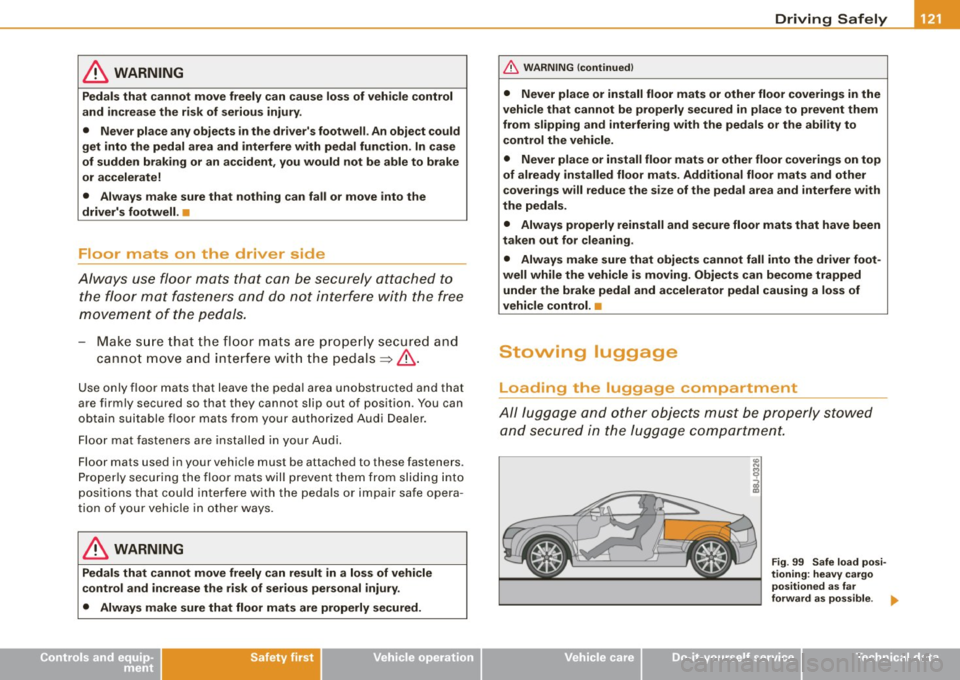
Loading the luggage compartment
All luggage and other objects must be properly stowed
and secured in the luggage compartment.
Vehicle care
co N
9
g!
Fig. 99 Safe load posi
tioning: heavy cargo
positioned as far
forward as possible. ..
Do-it-yourself service Technical data
Page 124 of 316
-Driving Safely at'f:I..,____--=-------=----------------
Loose items in the luggage compartment can shift
suddenly, changing vehicle handling characteristics. Loose
items can also increase the risk of serious personal injury in
a sudden vehicle maneuver or in a collision.
- Distribute the load evenly in the luggage compartment.
- Always place and properly secure heavy items in the
luggage compartment as far forward as possible
~ page 121, fig. 99.
Secure luggage using the tie-downs provided~
page 77.
- Make sure that the rear seat back is securely latched in
place.
& WARNING
Improperly stored luggage or other items can fly through the
vehicle causing serious personal injury in the event of hard braking or an accident. To help reduce the risk of serious personal injury:
• Always put objects , for example, luggage or other heavy items
in the luggage compartment.
• Always secure objects in the luggage compartment using the
tie-down eyelets and suitable straps.
& WARNING
Heavy loads will influence the way your vehicle handles. To help
reduce the risk of a loss of control leading to serious personal
injury:
• Always keep in mind when transporting heavy objects, that a
change in the center of gravity can also cause changes in vehicle
handling:
-Always distribute the load as evenly as possible.
& WARNING (continued)
-Place heavy objects as far forward in the luggage compart
ment as possible.
• Never exceed the Gross Axle Weight Rating or the Gross
Vehicle Weight Rating specified on the safety compliance sticker
on the left door jamb. Exceeding permissible weight standards
can cause the vehicle to slide and handle differently.
• Please observe information on safe driving~
page 114.
& WARNING
To help prevent poisonous exhaust gas from being drawn into the
vehicle, always keep the rear lid closed while driving.
• Never transport objects larger than those fitting completely
into the luggage area because the rear lid cannot be fully closed.
• If you absolutely must drive with the rear lid open, observe the
following notes to reduce the risk of poisoning:
-Close all windows,
- Open all air outlets in the instrument panel,
- Switch off the air recirculation,
- Set the fresh air fan to the highest speed.
& WARNING
Always make sure that the doors, all windows and the rear lid are
securely closed and locked to reduce the risk of injury when the
vehicle is not being used.
• After closing the rear lid, always make sure that it is properly
closed and locked .
• Never leave your vehicle unattended especially with the rear lid
left open. A child could crawl into the vehicle through the luggage
compartment and close the rear lid becoming trapped and unable
~
Page 125 of 316

Driving Safely -
----------------
& WARNIN G (continu ed )
to get out . Being tr apped in a vehi cle can lead to serious personal
injury.
• Never let children play in or around the vehicle .
• Never let pa ssengers ride in the lugg age compartment . Vehicle
occupants must always be properly restrained in one of the
vehicle 's seating po sitions.
[ i ] Tips
• Air circu lation helps to reduce window fogging. Stale air escapes
to the outside through vents in the trim pane l, on the left side of the
luggage compa rtme nt. Be sure t o keep t hese s lo ts free a nd ope n.
• T he tire pressure must correspond to the load -see the tire pres
sure sticker on driver's side B-pillar. •
Tie-downs
The lu ggag e com part men t is eq uipp ed wit h four tie
d o wns to se cu re l uggag e and other it e ms .
Use the tie -downs to secure your car go properly=> page 121,
"Lo ad in g the luggage com partme nt".
I n a col lision, the laws o f physics mea n tha t even smaller items tha t
are loose in the vehic le will become heavy missiles that can cause
se rious i nju ry . It em s i n t he vehicl e possess e nergy w hich vary with
vehic le speed and the weight of the item. Vehic le speed is the most
s igni ficant factor .
For example, in a frontal co llision at a speed of 30 mph (48 km/h),
the forces acting on a 10 -lb ( 4.5 kg) object are about 20 times the
normal weight of the item. This means that the weight of t he item
would suddenly be about 2 00 lbs. (90 kg). You can imagine the inju
ries that a 200 lbs. (90 kg) item fl ying free ly t hrou gh th e passe nge r
compartment could cause in a co llision like this .
Controls and equip
ment Safety first Vehicle operation
& WARNING
Weak
, damaged or imp roper straps used to secure items to tie
downs can fail during hard braking or in a collision and cause
serious personal injury .
• Always use suitable mounting straps and properly secure
items to the tie -downs in the luggage compartment to help
prevent items from shifting or flying forward as dangerous
missiles .
• When the rear seat backrest is folded down , always use suit
able mounting straps and properly secure items to the tie -downs
in the luggage compartment to help prevent items from flying
forward as dangerous missiles into the passenger compartment .
• Never attach a child safety seat tether strap to a tie -down. •
Reporting Safety Defects
Applicable to U.S.A. If you believe that your vehicle has a defect
which could cause a crash or could cause injury or death , you should immediately inform
the National Highway Traffic Safety Adminis
tration (NHTSA) in addition to notifying Audi of
America , Inc.
If NHTSA receives similar complaints , it may
open an investigation, and if it finds that a
safety defects exists in a group of vehicles , it
may order a recall and remedy campaign.
However, NHTSA cannot become involved in ..,
Vehicle care Do-it-yourself service Technical data
Page 131 of 316
- Make sure that your safety be lt s ar e alw ay s re ady fo r use
a nd are not damaged.
& WARNING
Not wearing safety belts or wearing them improperly increases
the risk of ser ious personal injury and death . Safety belts can work
only when used correctly.
• Always fasten your safety belts correctly before driving off and
make sure all passengers are properly restrained .
• For maximum protection , safety belts must always be posi
tioned correctly on the body.
• Never strap more than one person , including small children ,
into any single safety belt .
• Never place a safety belt over a child sitting on your lap.
• Always keep feet in the footwell in front of the seat while the
vehicle is being driven.
• Never let any person ride with feet on the instrument panel or
sticking out the window or on the seat.
• Never remove a safety belt while the vehicle is moving. Doing
so will increase your risk of being injured or killed.
• Never wear belts twisted.
• Never wear belts over rigid or breakable objects in or on your
clothing, such as eye glasses, pens, keys , etc ., as these may cause
injury .
• Never wear the shoulder part of the belt under your arm or
otherwise out of position .
• Several layers of heavy clothing may interfere with correct posi
tioning of belts and redu ce their effectiveness .
• Always keep belt buckles free of anything that may prevent the
bu ckle from latching securely .
• Never use comfort clips or devices that create slack in the
shoulder belt . However , special clips may be required for the
correct use of some child restraint systems.
Safety first
Safety belts
& WARNING !continued)
• Never allow safety belts to become damaged by being caught
in door or seat hardware.
• Torn or frayed safety belts can tear and damaged belt hardware
can break in an accident . Inspect belts regularly . If webbing , bind
ings, buckles, or retractors are damaged, have belts replaced by an
authori zed Audi dealer or qualified workshop.
• Safety belts that have been worn and loaded in an accident
must be replaced with the correct replacement safety belt by an
authorized Audi dealer or qualified workshop . Replacement may
be necessary even if damage cannot be clearly seen. Anchorages
that were loaded must also be inspected .
• Never remove , modify , disassemble, or try to repair the safety
belts yourself .
• Always keep the belts clean. Dirty belts may not work properly
and can impair the function of the inertia reel
=> page 209 , "Safety
belts" .•
Safety belts
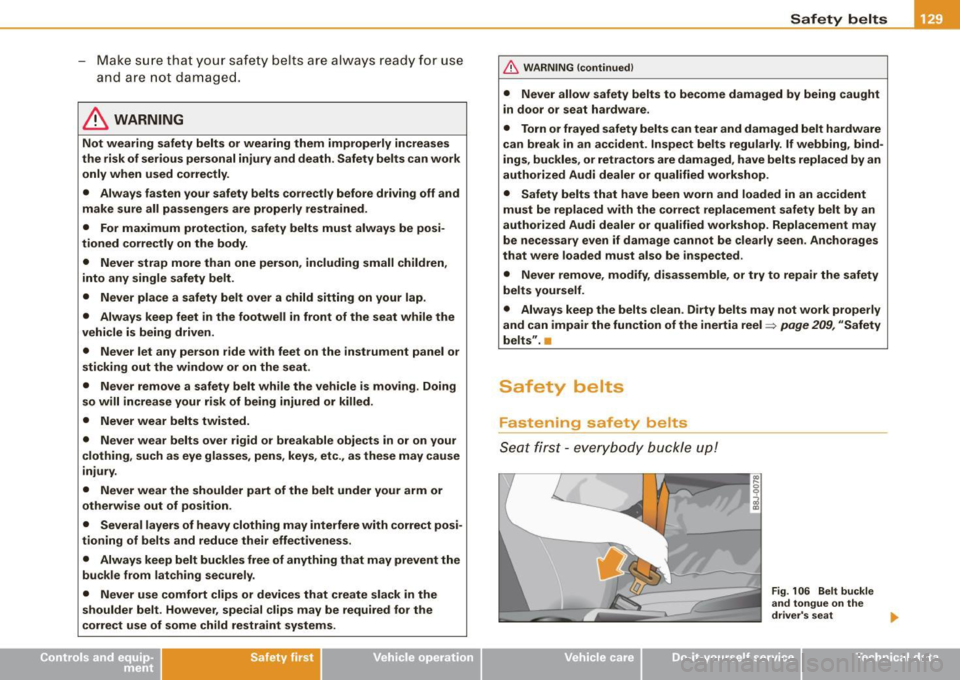
Fastening safety belts
S eat firs t - everybo dy b uckle u p!
Vehicle care I I
Fig . 106 Belt buckle
and tongue on the
driver 's seat
Iii>-
irechnical data
Page 132 of 316
___ S_a_ f_ e_ t-= y_ b_e_ l_ t _s _______________________________________________ _
To provide maximum protection, safety belts must always
be positioned correctly on the wearer's body.
Adjust the front seat and head restraint properly
=> page 69, "General recommendations ".
Hold the belt by the tongue and pull it evenly across the
chest and pelvis=>&.
- Insert the tongue into the correct buckle of your seat
until you hear it latch securely => page
129, fig. 106.
Pull on the belt to make sure that it is securely latched in
the buckle.
Automatic safety belt retractors
Every safety belt is equipped with an automatic belt retractor on the
shoulder belt. This feature locks the belt when the belt is pulled out
fast, during hard braking and in an accident . The belt may also lock
when you drive up or down a steep hill or through a sharp curve.
During normal driving the belt lets you move freely.
Safety belt pretensioners
The safety belts on the front seats are equipped with a belt preten
sion er that helps to tighten the safety belt and remove slack when
the pretensioner is activated. The function of the pretensioner is
monitored by a warning light:::::,
page 78, "Airbag system
t!A (USA models) /!.ir (Canada models)".
Switchable locking feature
Every safety belt except the one on the driver seat is equipped with
a switchable locking feature that
must be used when the safety belt
is used to attach a child seat. Be sure to read the important informa
tion about this feature:::::,
page 168.
& WARNING
Improperly positioned safety belts can cause serious injury in an
accident :::::,
page 130, "Safety belt position".
• Safety belts offer optimum protection only when the seat back
is upright and belts are properly positioned on the body.
• Never attach the safety belt to the buckle for another seat.
Attaching the belt to the wrong buckle will reduce safety belt
effectiveness and can cause serious personal injury.
• A passenger who is not properly restrained can be seriously
injured by the safety belt itself when it moves from the stronger
parts of the body into critical areas like the abdomen.
• Always lock the convertible locking retractor when you are
securing a child seat in the vehicle:::::,
page 170. •
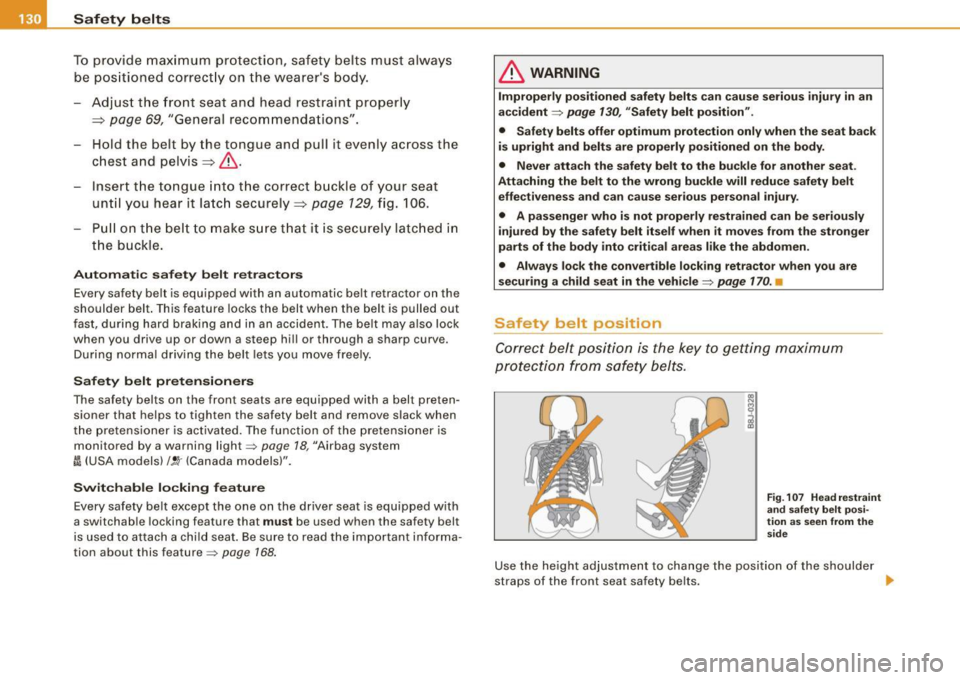
Safety belt position
Correct belt position is the key to getting maximum
protection f ram safety belts.
Fig. 107 Head restraint
and safety belt posi
tion as seen from the
side
Use the height adjustment to change the position of the shoulder
straps of the front seat safety belts.
~
Page 133 of 316
& WARNING
Improperly positioned safety belts can cause serious personal
injury in an accident.
• The shoulder belt portion of the safety belt must be positioned
over the middle of the occupant's shoulder and never across the
neck or throat .
• The safety belt must lie flat and snug on the occupant's upper
body =>
page 130, fig. 107 . Pull on the belt to tighten if necessary .
• The lap belt portion of the safety belt must be positioned as
low as possible across pelvis and never over the abdomen. Make
sure the belt lies flat and snug=>
page 130, fig. 107. Pull on the belt
to tighten if necessary.
• A loose -fitting safety belt can cause serious injuries by shifting
its position on your body from the strong bones to more vulner
able, soft tissue and cause serious injury.
• Always read and heed all WARNINGS and other important infor
mation=>
page 128. •
Safety first
Safety belts
Pregnant women must also be properly
restrained
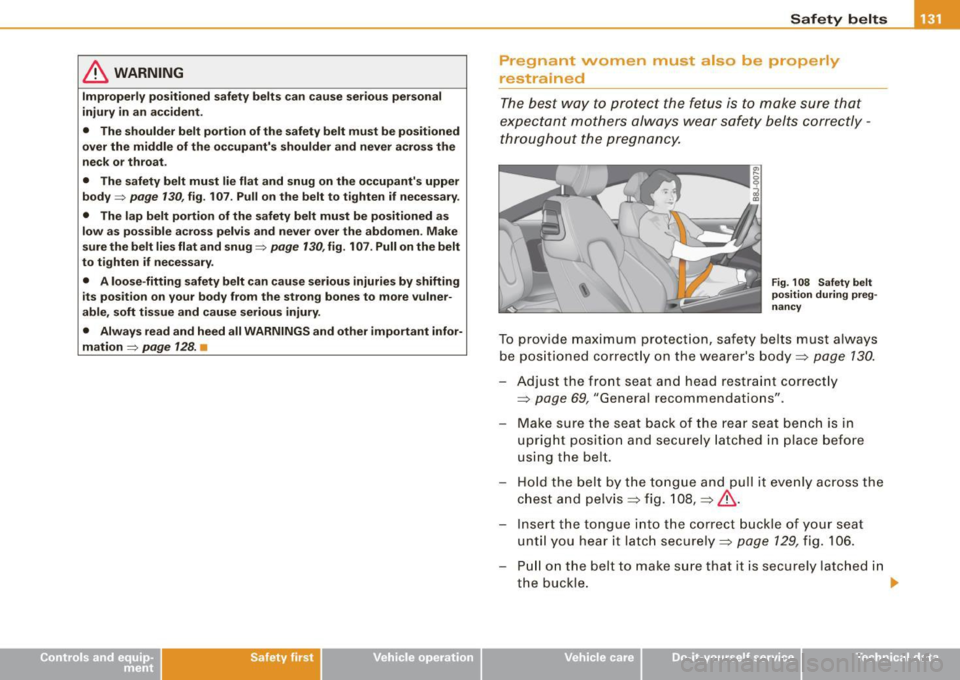
The best way to protect the fetus is to make sure that
expectant mothers always wear safety belts correctly -
throughout the pregnancy.
Fig. 108 Safety belt
position during preg
nancy
To prov ide maximum protection, safety belts must always
be posi tioned correctly on the wearer's body~
page 130.
-Adjust the front seat and head restraint correctly
~ page 69, "General recommendations".
- Make sure the seat back of the rear seat bench is in
upright position and securely latched in place before
using the belt.
- Hold the belt by the tongue and pull it evenly across the
chest and pelvis => fig. 108 ,
~ &.
- Insert the tongue into the correct buckle of your seat
until you hear it latch securely ~
page 129, fig. 106.
- Pull on the belt to make sure that it is securely latched in
the buckle. •
Vehicle care I I irechnical data
Page 169 of 316
& WARNING !continued )
• The minimum clearance between the passengers ' heads and
the rear window must never -under any circumstances -be less
than
1 inch ( 2 .5 cm .) when the passengers sits fully upright.
• Always make sure that the rear seat passengers cannot be
struck when the rear lid is closed. •
Booster seats on the front seat
Children aged ab out 7 yea rs and older an d weig hing more than 55
lbs 125 kg) who are between 4'3" (1.3 m) and 4'11" (1.5 m ) ta ll may in
e xceptional c ircumstances ride on the fr ont pas senge r's sea t. Chil
d ren l ess t han
4' 9" 1 1.4 m) tall must sit on a certified boos te r seat
and properly wear the vehicle's three -p o int la p and shoulder safety
belt.
A lways securely latch the passenger seat at the very rear of its fore
a nd a ft ad justment ra nge . T he b ackr est mu st b e ad juste d to an
upr ight position .
& WARNING
If you must install a booster seat child restraint on the front
passenger seat:
• Make sure the booster seat has been designed and certified by
its manufacturer for use on a front seat with a passenger front and
side airbag .
• Always follow the manufacturer's instructions provided with
the booster seat .
• Always move the passenger seat to the very rear of its fore and
aft adjustment range , as far away from the airbag as possible .
• Always make sure that the passenger seat is securely latched
in place before installing the booster seat. The backrest must be
adjusted to an upright position .
Safety first
Child Safety
& WARNING !continued )
• If the passenger seat cannot be securely latched in the very
rear of its fore and aft adjustment range, then the passenger front
airbag must be turned off with the ON / OFF sw itch .•
Safety belts and o lder children
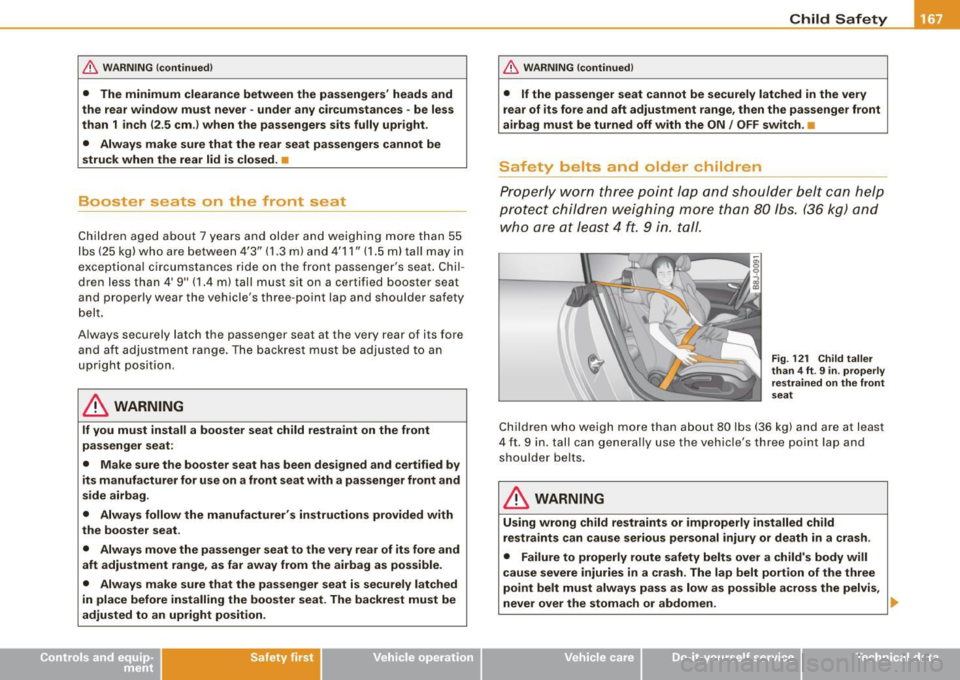
Prope rly worn th ree point la p an d sh oul der belt can hel p
p rotect ch ild ren weighi ng mor e th an 8 0 lbs. (3 6 kg) and
w ho are at lea st 4
ft. 9 in . tall .
Fig . 121 Child taller
th an 4
ft . 9 in . properly
restrained
on the front
seat
C hil dren who weigh mor e tha n about 80 lb s (36 kg) a nd are a t lea st
4 ft. 9 in. ta ll can gene ra lly use the vehicle's three point lap and
shou lder belts .
& WARNING
Using wrong child restraints or improperly installed child
restraints can cause serious personal injury or death in a crash .
• Failure to properly route safety belts over a child's body will
cause severe injuries in a crash . The lap belt portion of the three
point belt must always pass as low as possible across the pelvis ,
never over the stomach or abdomen .
~
Vehicle care I I irechnical data