change time AUDI TT COUPE 2009 User Guide
[x] Cancel search | Manufacturer: AUDI, Model Year: 2009, Model line: TT COUPE, Model: AUDI TT COUPE 2009Pages: 316, PDF Size: 71.16 MB
Page 222 of 316
-~_C_ h_e _c _ k_ i_n ...:::g::;...._ a_n_ d_ f_ i_ll _in -'g:::;.._ ___________________________________________ _
At the time of printing, engine oils available in the U.S. and Canada
that meet the exacting specifications of Audi oil standard VW 502 00
are synthetic engine oils. This does not mean, however, that every
synthetic engine oil will meet Audi oil standard VW 502 00. So
always be sure that you use an approved oil.
To help prevent the formation of harmful deposits use only oil with
the follow ing specifications printed on the oil container:
Audi oil standard VW 502 00
Oil container labels may carry the specification singly or in combi
nation with other designations and oil quality standards.
Viscosity
Engine oils are graded according to their viscosity. The proper
viscosity grade oil for your engine depends on climactic or seasonal conditions where you drive . You can use oil with a viscosity grade of
SAE 5W40 across all temperature ranges for normal driving condi
tions.
However, if engine oil viscosity grade SAE 5W40 is not available, you
can also use viscosity grade SAE 5W -30 or SAE 0W-40 as long as it
meets Audi oil quality standard VW 502 00 specifications.
Because engine oil that meets the Audi oil standard may not be
available everywhere when you need it, we strongly recommend
that you always carry with you an extra quart (liter) of oil that
e xpr ess ly conforms to the VW 502 00 specification, in case you have
to top off the oil while on the road.
Only if the level of the oil is at or below the minimum mark on the
oil dipstick -and no oil that expressly conforms to Audi oi l standard
VW 502 00 specifications is available -may you top off with a high
quality engine oi l, preferably synthetic-based, that meets ACEA A3,
ACEA A5 or ACEA B5, API SL or ILSAC GF-3 specifications, but even
then, only in viscosity grades SAE 5W -40, SAE 5W -30, or SAE 0W -40 .
However, during the entire time between oil change intervals, never
top off with more than a total of 0.5 qt/liter engine oil that does not
conform to Audi oi l specification VW 502 00. For
more information about engine oil that has been approved for
your vehicle, please contact either your authorized Audi dealer or
Audi Customer Relations at 1 (800) 822-2834 or visit our web site at
www .audiusa.com or www .audicanada.ca. Here you will also find a
current list of oils (manufacturers, brand names etc.) that conform
to Audi oil standard VW 502 00.
Changing the engine oil
The engine oil and oil filter must be changed according to the
mileage (kilometers) and time intervals specified in your vehicle's
Warranty
& Maintenance booklet. Do not exceed these intervals -
harmful deposits from old engine oil can reduce engine perfor
mance and can lead to expensive engine repairs.
Changing the oil at the recommended intervals is so very important
because the lubricating properties of oi l decrease gradually during
normal vehicle use. If you are not sure when you have your oil
changed, ask your authorized Audi Service Advisor .
Under some circumstances the engine oil should even be changed
more frequently. Change oil more often if you drive mostly short
distances, operate the vehicle in dusty areas or mostly under stop
and -go traffic conditions, or when you use your vehicle where
temperatures stay below freezing point for long periods.
Deterge nt additives in the oil will make fresh oil look dark after the
engine has been running for a short time . This is normal and is not
a reason to change the oil more often than recommended.
Damage or malfunctions due to lack of ma intenance
It is essential that you change your oil at the recommended interva ls
using only engine oil that complies with Audi oil standard
VW 502 00. Your Limited New Vehicle Warranty does not cover
damage or malfunctions due to failure to follow recommended
maintenance and use requirements as set forth in the Audi Owner's
Manual and Warranty
& Maintenance booklet. Your dea ler will have
to deny warranty coverage unless you present to the dealer proof in
the form of Service or Repair Orders that all schedu led maintenance
was performed in a timely manner. •
Page 223 of 316

___________________________________________ C_ h_e _c_ k_ i_n ...::g a....- a_n _d_ f_il _li _n --=g ------
•
Engine oil consumption
The engine in your vehicle depends on an adequate
am ount of oil to lubricate and c ool all of its moving parts.
In order to provide effective lubrication and cooling of internal
engine components, all internal combustion engines consume a
certain amount of oil. Oil consumption varies from engine to engine
and may change sign ificantly over the life of the engine . Typically,
engines with a specified break-in period (see~
page 190) consume
more oil during the break-in period than they co nsume after o il
consumption has stabilized .
Under normal conditions, the rate of oil consumption depends on
the quality and viscosity of the oil, the RPM (revo lutions per minute)
at which the engine is operated, the ambient temperature and road
conditions. Further factors are the amount of oil dilution from water
condensation or fue l residue and the oxidation level of the oil. As
any engine is subject to wear as mileage bu ilds up, the oil consump
tion may increase over time until rep lacement of worn components
may become necessary .
With all these variables coming into play, no standa rd rate of oil
consumption can be estab lished or specified. There is no a lternative
t o regula r and frequent checking of the oil level, see Note.
I f the yellow engine oil level warning symbol in the instrument
cluster _ lights up, y ou should check t he oi l level as soon as
possible
with the oil dipstick~ page 221. Top off the oil at your
earl iest co nvenience ~
page 222.
& WARNING
Before you check anything in the engine compartment , always
read and heed all WARNING S
~ & in "Working in the engine
c ompartment " on
page 217 .
0 Note
Driving with an insuff ic ie n t o il level is l ikely to cause severe damage
to the engine.
[ i ] Tip s
• The oil pressure w arning display ce,. is not an indi cator of the oil
level . Do not rely on it. Instead, check the oil level in your engine at
regular interv als , prefe rably ea ch time you refuel , and always before
going on a long trip.
• I f you have the impression your engine consumes excessive
amoun ts of oi l, we recommend tha t you consult your Audi dealer to
have the cause of your concern properly diagnosed . Keep in mind
that the accurate measureme nt of oil consumption requires great
care and may take some time. Your Audi dealer has instructions
about how t o measure oil consumption accurately. •
Checking the engine oil level
Vehicle care I t •
Fig. 13 9 Illu stra tion of
pri nciple 1 : Mar ker s on
oi l dip sti ck ...
Page 229 of 316

_____________________________________________ C_h_ e_ c _ k_in --= g'-a _ n_d _ f_il _li _n -=g =-- ____.•
• the engine compartment heats up because the vehicle is parked
in intense sunlight.
& WARNING
• To reduce the risk of personal injury never touch the radiator
fan.
• The auxiliary electric fan is temperature controlled and can
switch on suddenly even when the engine is not running .
• The auxiliary radiator fan switches on automatically when the
engine coolant reaches a certain temperature and will continue to
run until the coolant temperature drops. •
Brake fluid
Checking brake fluid level
The brake fluid level can be checked with a quick glance.
Fig. 143 Engine
compartment: brake
fluid reservoir
Before you check anything in the engine compartment,
always read and heed all WARNINGS=> & in "Working in
the engine compartment" on
page 217.
-Read the brake fluid level from the brake fluid reservoir
=> fig. 143. The brake fluid level must be between the
"MIN" and "MAX" markings.
The brake fluid reservoir is located behind the rear partition of the
engine compartment on the left side~ page 218.
The fluid level may drop slightly after some time due to the auto
matic adjustment of the brake pads. This is not cause for alarm.
If the brake fluid level falls considerably below the "MIN" mark, the
brake warning/indicator light (U.S. models:
BRAKE, Canadian models:
(Cf))) will come on~ page 19 and~ page 33. Do not continue to
operate the vehicle. The complete brake system should be thor
oughly checked by an authorized Audi dealer or other qualified
facility and the cause corrected. If the brake fluid level is too low, the
brake warning/indicator light will illuminate. Contact an authorized
Audi dealer
immediately. •
Changing brake fluid
Have the brake fluid changed by an experienced techni
cian.
Brake fluid absorbs moisture from the air. If the water content in the
brake fluid is too high, corrosion in the brake system may result
after a period of time . The boiling point of the brake fluid will also
decrease considerably and decrease braking performance.
Therefore, the brake fluid must be changed
every two years. Always
use new brake fluid which conforms to Federal Motor Vehicle Stan
dard "FMVSS 116 DOT 4".
The brake fluid reservoir can be difficult to reach, therefore, we
recommend that you have the brake fluid changed by your autho
rized
Audi dealer. Your dealer has the correct tools, the right brake
fluid and the know-how to do this for you.
~
Vehic le care I I irechnical data
Page 230 of 316

-~_C_ h_e _c _ k_ i_n ...:::g::;...._ a_n_d _ f_ i_ll _in -'g:::;.._ ___________________________________________ _
& WARNING
• Bra ke fluid i s poiso nou s. It must be stor ed only in the clo se d
original container out of the rea ch of children!
• Bra ke failure can re sult from old or inappropri ate br ake fluid .
Ob serve the se pre cauti ons:
- Use o nly br ake fluid th at m eets S AE spe cific ation
J 1703 and
co nform s to Fed era l Mo tor Vehic le Standard 11 6. Alway s check
w ith your authori zed Aud i de aler to mak e sure y ou are usi ng
the correc t brake fluid. The corre ct type of brake flu id i s also
indica ted on the br ake fl uid re se rvoi r.
- The brake fluid mu st be new . Heavy u se of the brake s can
ca use a vapor lock if th e bra ke fluid is left in the system too
long. Thi s can seriou sly affect the effic iency of the brake s as
w ell as y our safet y. T his c ould re s u lt in an a ccident .
0 Note
Brake fluid wil l damage the paint of your vehicle .
~ For the sake of the environment
Because of the problem of proper disposal of brake fluid as well as
the special tools required and the necessary expertise, we recom
mend that you have the brake fluid changed by your authorized Audi
dea ler. •
Battery
General information
Your vehicle is equipped with a specia l battery, an AGM battery. This
ba ttery is loca ted in the luggage compar tment and must be
replaced with an original equipment battery. Under normal oper
ating conditions, the battery is
ma inten anc e-free .
Have the battery checked when you take your vehicle in for service .
You a re well advised to replace a battery that is o lder than 5 years .
Disconn ecting th e batt ery te rmin als
Some vehicle functions (power w indow regulators, for example) are
lost if the battery terminals are disconnected. These functions have
to be relearned after the battery terminals are connected again. To prevent this, the battery should only be disconnected from the
vehic le electrical sys tem when abso lutely necessary for repairs .
Vehi cles not dri ven for lo ng p eriods
If you are going to let your vehic le stand for a long time and n ot
drive it, you should remember there are e lectrica l components
whic h are still functioning and they will draw energy from the
battery and drain it, for example, the engine immobilizer. To prevent
t his, you can eithe r charge the batte ry occasionally to keep it in
good working condition or you can disconnect the negative cable
on the battery.
W int er op erati on
During the winter months, batte ry capacity tends to decrease as
temperatures drop . This is because more power is also consumed
whi le starting, and the headlights, rear window defogger, etc ., are
used more often.
Avoid unnecessary power consumption, particularly in city traffic or
when trave ling o nly short distances . Let your authorized Audi dealer
check the capacity of the vehicle battery before winter sets in
~ page 232. A we ll charged battery will not only preven t starting
problems when the weather is cold, but will also last longer.
Repla cing batter y
The new battery must hav e the same capacity, voltage ( 12 volts),
amperage, construction and p lug sea ling, as the orig inal battery .
Specifications are listed on the battery housing. Batteries specia lly
developed by Aud i fulfill the main tenance, output, and safe ty
requirements. ...,
Page 233 of 316

Checking and filling -
---------------------=----"=---------
& WARNING ! continued )
• Make sure th e vent hose is always attached to the op ening on
t he side of the battery .
• Never u se batteries which are damaged . Danger of e xplo sion !
Al way s r epla ce a damaged battery .
& WARNING
Californi a Proposition 65 Warning :
• Batt ery po sts, terminal s and related a ccess orie s contain lead
and lead compound s, chemic als kno wn to the St ate of Cal if o rni a
to cau se c ancer and reproductiv e prob lem s. Wash hand s aft er
ha ndl ing .
0 Note
• Do not disconnect the vehicle battery when the ignition is
switched on or when the engine is running, otherwise, you wi ll
damage electronic components in the electrical system .
• If your vehicle is going to stand for a long period of time without
being driven, protect the battery from "freezing", otherwise it wil l
be damaged and will then have to be rep laced. •
Checking the battery acid level on magic eye
batteries*
The battery acid level in the battery can be checked
through the clear inspection window.
_.
Fig . 14 5 Lugg age
co mpa rtmen t: B att ery
w ith m agic eye .
On top of the battery, there is a round "window". This
window (magic eye) c hanges color as the batte ry charge
and acid leve l change .
Read and heed a ll WARNINGS~
& in "Work ing on the
battery" on
page 229
Read the ac id level f rom t he window on the battery
~ fig. 145 .
Air bubbles in the window can cause an inaccurate reading. Care
fully tap on the side of the window.
• I f the window is
green , the battery acid level is correct .
• If t he window has
no color or is bright yellow , the battery acid
level is too low. Have the battery tested by your authorized Audi
dea ler or a qual ified workshop .
• If the window is
bla ck , then the battery is insufficiently charged.
Recharge the battery as soon as possible =>
page 232 . ~
Vehic le care I I irechnical data
Page 238 of 316
-~_T_ ir_e_ s_ a_ n_d _ w_ h_ e_e _l_s _________________________________________________ _
Groove
means the space between two adjacent tread ribs.
Load rating (code)
means the maximum load that a tire is rated to carry for a given
inflation pressure . You may not find this information on all tires
because it is not required by law.
Maximum load rating
means the load rating for a tire at the maximum permissible infla
tion pressure for that tire.
Maximum loaded vehicle weight
means the sum of:
(a) Curb weight
(b) Accessory weight
(c) Vehicle capacity weight, and
(d) Production options weight
Maximum (permissible) inflation pressure
means the maximum cold inflation pressure to which a tire may be
in flated. Also called "maximum inflation pressure ."
Normal occupant weight
means 150 lbs. (68 kilograms) times the number of occupants
seated in the vehicle up to the total seating capacity of your vehicle.
Occupant distribution
means distribution of occupants in a vehicle .
Outer diameter
means the overall diameter of an inflated new tire.
Overall width
means the linear distance between the exteriors of the sidewalls of
an inflated tire, including elevations due to labeling, decorations, or
protective bands or ribs .
Ply
means a layer of rubber -coated parallel cords.
Production options weight
means the combined weight of those installed regular production
options weighing over 5 lbs. (2.3 kg) in excess of those standard
items which they replace, not previously considered in curb weight
or accessory weight, including heavy duty brakes, ride levelers, roof rack, heavy duty battery, and special trim.
Radial ply tire
means a pneumatic tire in which the ply cords that extend to the
beads are laid at substantially 90 degrees to the centerline of the
tread.
Recommended inflation pressure
see =:> page 235, "Cold tire inflation pressure".
Reinforced tire
means a tire designed to operate at higher loads and at higher infla
tion pressures than the corresponding standard tire. Reinforced
tires my be identified as "XL", "xi", "EXTRA LOAD", or "RF" on the
sidewall.
Rim
means a metal support for a tire or a tire and tube assembly upon
which the tire beads are seated .
Rim diameter
means nominal diameter of the bead seat. If you change your wheel
size, you will have to purchase new tires to match the new rim diam
eter.
Rim size designation
means rim diameter and width.
Rim width
means nominal distance between rim flanges .
Page 241 of 316
________________________________________________ T_ i _r_e _s_ a_n_ d_ w_ h_ e_e _ l_s __ l'III
•
If yo u w is h to impr ove com fort when operat ing the vehi cle at
nor mal load (up t o 2 occupant s), you c an adju st tire pres sur es to
th ose spe cified f or norm al v ehi cle lo ad . B efo re op era tin g the vehicle
at maximum load , you mu st in crease the tire pre ssure s to tho se
s pe cifi ed for m aximum vehi cle lo ad =>
& .
Bear in mind that the tire pressure mon itor ing syst em * can only
monitor the tire pressures you have stored. The system does not
recogni ze th e load cond ition o f you r vehicle .
T he effec tiveness of the tire pressu re monitoring system * will be
impaired if you store no rmal load pressures bu t then operate the
vehicle at its maximum load=>& . See the
illustra tion=>
page 238, fig . 148 for the location of the label
on driver's side 8 -pillar (co lor of the actual label and exact location
on the vehic le wi ll vary slightly).
Note that the following tab le is accurate at the time of going to
press and is subject to change . In the event of discrepancies, the t ire
pressure label (on dr iver's side 8 -pillar) always takes precedence .
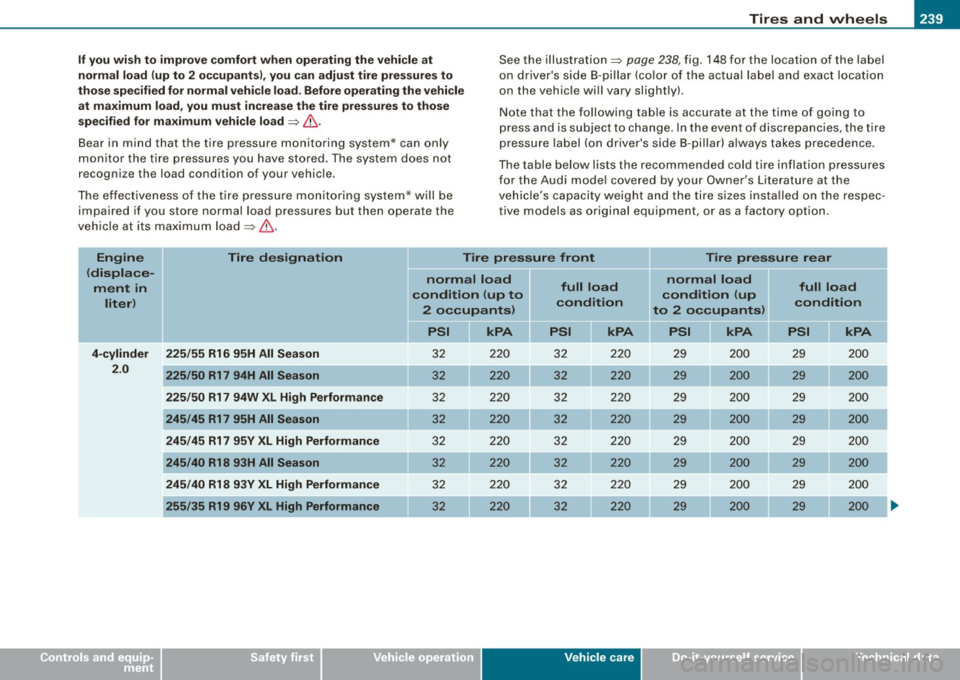
The table below lists the recommended cold tire i nflation pressures
for the Audi mode l covered by your Owner 's Litera ture at the
vehicle's capacity weight and the tire sizes insta lled on the respec
tive models as original equipment , or as a factory option .
Engine
(displ ace
m ent in
liter ) Tir
e design ation Tire pr es sur e front Tire press ure re ar
4 -c ylinder
2 .0 225
/55 R16 95H All Se ason
225 /50 R17 94H All S eason
2 2 5/5 0 R17 94W XL High Perf orma nce
245 /45 R17 95H All Sea son
2 45 /45 R17 95 V XL High Perform ance
245 /40 R18 93H All Se ason
245 /40 R18 93V XL High P erformance
255 /35 R19 96V XL High Perform ance
normal lo ad
conditi on (up to
2 occup ant s)
PSI kPA
32 220
32 220
32 220
32 220
32 220
32 220
32 220
32 220
full load
c ondition
PSI kPA
32 220
32 220
32 220
32 220
32 220
32 220
32 220
32 2 20
Vehicle care
n o rm al l oa d
full load
co ndition (up
condition
to 2 o ccupant s)
PSI kPA PSI kPA
29 200 29 200
29 200 29 200
29 200 29 200
29 200 29 200
29 200 29 200
29 200 29 200
29 200 29 200
29 200 29 200
I t •
Page 258 of 316
___ T_ i_ r_e _s_ a_ n_ d_ w_ h_ e_ e _ ls _________________________________________________ _
After a few seconds, the message disappears again. If you would
like to show the message again, press the Set/Check button
=>
page 72 , fig. 2@ .
[ i) Tips
• In the case of an intentional loss of air pressure, for example,
when re -adjusting tire pressure, this has to be stored again after
wards=>
page 256.
• Tire pressure must only be adjusted when the temperature of the
tires is about the same as ambient air tempera ture.
• The yellow symbol disappears, when the tire pressure is
correc ted and the new pressure is stored in the system=>
page 256.
• After changing a wheel or replacing a wheel with the spare tire
you have to adjust the tire pressures on all wheels. In addition , you
must then initialize the new tire pressures in the tire pressure moni
toring system*=>
page 257. •
Ap plies to vehicles: w ith tir e pressure monitor in g system
Storing tire pressures
Correct storage of specified pressure is the basic require
ment for reliable tire pressure monitoring.
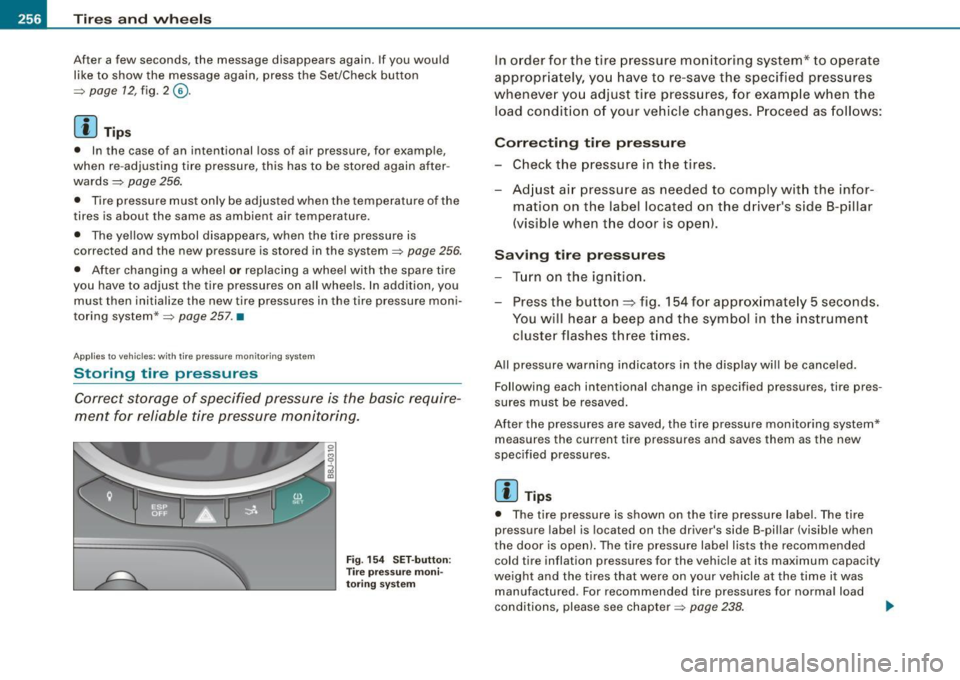
Fig. 154 SET-button :
Tire pressure moni
toring system
In order for the tire pressure monitoring system* to operate
appropriately, you have to re-save the specified pressures
whenever you adjust tire pressures, for example when the
load condition of your vehicle changes . Proceed as follows:
Correcting tire pressure
Check the pressure in the tires.
Adjust air pressure as needed to comply with the infor mation on the label located on the driver's side B -pillar
(vis ible when the door is open).
Saving tire pressures
Turn on the ignition.
Press the button=> fig. 154 for app roximately 5 seconds.
You will hear a beep and the symbol in the instrument
cluster flashes three times.
All pressure warning indicators in the display will be canceled.
Following each intentional change in specified pressures, tire pres
sures must be resaved.
After the pressures are saved, the tire pressure monitoring system* measures the current tire pressures and saves them as the new
specified pressures.
[ i J Tips
• The tire pressure is shown on the tire pressure label. The tire
pressure label is located on the driver's side B-pillar (visible when
the door is open). The tire pressure label lists the recommended cold tire inflation pressures for the vehicle at its maximum capacity
weight and the tires that were on your vehicle at the time it was
manufactured . For recommended tire pressures for normal load
conditions, please see chapter
=> page 238. .,_
Page 259 of 316

________________________________________________ T_ i _r_e _s_ a_n_ d_ w_ h_ e_e _ l_s __ !II
•
• The tire pressure monitoring system * helps the driver to keep an
eye on tire pressures. But the driver still has the responsibi lity for
maintaining the correct tire pressure .•
Applies to vehicles: with tire pressure mon itorin g system
Wheel change
If a wheel is changed, the wheels that were exchanged
have to be re-programmed .
- Turn on the ignition.
- Press the button~
page 256, fig. 154 for approximately 5
seconds. You will hear a beep and the symbol in the button flas hes three times.
Programming is necessary :
• after the tires have been rotated on the vehicle, or the spare tire
is used,
• if tires with new wheel sensors are used .
A ll pressure warning indicators in the display will be canceled. The
system malfunction error message wil l not disappear until the
vehicle is underway . With pressing the button~
page 256, fig. 154,
the re -programming of the new sensors and storing of ac tua l pres
sures starts. This learning phase can take up to 10 minutes driving
time .
During the learning process the tire pressure monitoring system* is
not avai lable. •
Applies to veh ic les: with tir e pressure monitoring system
Malfunctions •
A malfunction can have various causes.
F ig . 155 Display:
S yst e m m alfun ctio n
If the .J., warning light in the instrument cluster flashes for approxi
mately one minute and then remains continuously illuminated and
additional ly the T ~~ fig. 155 symbol appears in the display, the
tire pressure mon itoring system* is not available. This can have
various causes.
• If the message appears at the end of the lear ning process, the
system cannot recognize the wheels installed on the vehicle. This
can be because one or more wheels without a wheel sensor were
insta lled.
• A wheel sensor or other component may have failed .
• During initialization the system has detected more than 4 wheels
on the vehicle, for example whi le driving next to another car with a
tire pressure monitoring system*.
• A whee l change was made but the button
~ page 256 , fig. 154
was not pressed.
• Audi replacement parts were not used.
• I f snow chains are being used, system function can be compro
mised due to the shielding properties of the chains .
• The tire pressu re monitoring system* may not be available
because of a radio malfunction .
Vehicle care I t •
Page 261 of 316
________________________________________________ T_ ir_e _s_ a_n_ d_ w_ h _e_e_ l_s __ lfll
•
& WARNING (continued)
• Never drive with run-flat tires if heat build-up causes the tire to
give off smoke .
• Never drive with run-flat tires if the vehicle shakes or vibrates
severely.
• Never drive with a run-flat tire that develops sidewall cracks or
other damage while in use .
0 Note
Run-flat tires have specia l characteristics and requirements, that are
very different from conventional tires. Run-flat tires require special
rims for run-flat use and cannot be used on conventional wheel
rims.
[ i] Tips
• I f you are not able to continue driving with run -flat tires, please
seek professional assistance.
• Please contact your authorized Audi dealer or Audi of America,
Inc . if you have questions about tires and rims. •
Applies to vehic les: with Run-flat t ires
Driving with run-flat tires
Handling characteristics change when tire pressure is
low.
Driving on tires with low tire pressure changes the way a
vehicle handles, particularly when cornering and braking.
The handling characteristics of run-flat tires do not seem to
change a lot even when driving on low pressure or in the
run-flat mode. Nevertheless you must still take special
precautions when operating a vehicle on run-flat tires when
tire pressure is low or the tire(s) is flat: The
Electronic Stabilization Program (ESP) must be
switched on.
- Never drive faster than 50 mph (80 km/h)~
&-
Plan ahead when driving and anticipate what you will
have to do considering traffic and road conditions up
ahead.
- Accelerate carefully.
- Avoid unnecessary and sudden steering and braking
maneuvers.
Reduce your speed in plenty of time before intersections,
curves and other places where you may have to react
quickly.
Please see:=> page 258, "When it is not possible to continue driving,
even with run -flat tires?"
Handling characteristics change when driving with
low air pressure or with flat tires even with special run
flat tires
A low pressure or flat front tire affects vehicle handling characteris
tics by pulling the vehicle slightly to the side where the tire is
mounted and reduces braking performance.
A low pressure or flat rear tire also affects driving characteristics by
pulling to the side where the tire is mounted and also reduces
braking performance. The effect on vehicle handling is most notice
able when driving around curves.
& WARNING
Changed vehicle handling characteristics when driving in the run
flat mode can cause loss of vehicle control, a crash and serious personal injury. .,,,
Vehicle care
I t •