instrument panel AUDI TT COUPE 2009 Owner's Manual
[x] Cancel search | Manufacturer: AUDI, Model Year: 2009, Model line: TT COUPE, Model: AUDI TT COUPE 2009Pages: 316, PDF Size: 71.16 MB
Page 151 of 316

__________________________________________________ A_ i_ r _b _a...; g::- s_ y=--- s_t _e _m __ lllll
& W ARNING (continued )
seating position and have the airbag system inspected by your
Audi dealer .
• A tight tether or other str ap on a rearward-fac ing child restr aint
attached to the front pas senger seat can put too much pressure
on the weight-sensing mat in the seat and reg ister more weight
than i s actually on the seat. The heavier weight registered can
make the system work as though an adult were on the seat and
deploy the Advanced Airbag when it must be suppressed causing
s erious or even fatal injury to the child .
• If, in exceptional circumstance s, you mu st in stall a forward
fac ing child restra int on the front passenger seat , always move the
seat into its rearmost position in the seat 's fore and aft ad just
ment range , as far away from the airbag a s possible . The backrest
must be adjusted to an upright position . Make sure that the
PASSENGER AIR BAG OFF light comes on and stay s on all the time
whenever the ignition is switched on .
& WARNING
• If the PASSENGER AIR BAG OFF light does not go out when an
adult is sitting on the front passenger seat after taking the steps
described above, make sure the adult is properly seated and
restrained at one of the rear seating positions .
• Have the airbag system inspected by your Audi dealer before
transporting anyone on the front passenger seat .
[ i ] Tips
If the weight -sensing mat in the front passenger seat detects an
e mp ty seat, the fro nt air b ag on the pa ssenge r sid e will be t urned
off, and PASSENGER AIR BAG OFF will stay on.•
Controls and equip ment Safety first
Vehicle operation
Repair, care and disposal of the airbags
Parts of the airbag system are insta lled at many different places on
your Au di. In sta ll in g, re moving, ser vic in g or re pair in g a part in an
area of the vehicle can damage a part of an a irbag system and
pre ven t that system fro m wo rki ng p rope rly in a co llision .
There are some important things you have to know to make sure
that the effectiveness of the system will not be impai red an d that
d iscarded components do not cause inju ry or po llute t he e nv iron
ment .
& WARNING
Improper care , servicing and repair procedures can increase the
risk of personal injury and death by preventing an airbag from
deploying when needed or deploying an airbag unexpectedly:
• Never cover , obstruct , or change the steering wheel horn pad
or airbag cover or the instrument panel or modify them in any way .
• Never attach any obje cts su ch as cup holders or telephone
mountings to the surfaces covering the airbag units.
• For cleaning the horn pad or instrument panel, use only a soft ,
dry cloth or one moi stened with plain water . Solvents or cleaners
c ould damage the airbag cover or change the stiffness or strength
of the material so that the airbag cannot deploy and protect prop
erly .
• Never repair , adjust , or change any parts of the airbag system.
• All work on the steering wheel , instrument panel , front seats or
electrical system (including the installation of audio equipment ,
c ellular telephones and CB radios , etc .I must be performed by a
qualified technician who has the training and special equipment
necessary .
• For any work on the airbag system , we strongly recommend
that you see your authorized Audi dealer or qualified workshop .
• Never modify the front bumper or parts of the vehicle body .
Vehicle care Do-it-yourself service Technical data
Page 153 of 316

& WARNING
Items stored between the safety belt buckle and the center
console can cause the sensors in the buckle to send the wrong
information to the electronic control module and prevent the
Advanced Airbag System from working properly.
• Always make sure that nothing can interfere with the safety
belt buckles and that they are not obstructed.
as Perchlorate Material -special handling may apply, see
www.dtsc.ca.gov/hazardouswaste/perchlorate. When the vehicle or
parts of the restraint system including airbag modules safety belts
with pretensioners are scrapped, all applicable laws and regula
tions must be observed. Your authorized Audi dealer is familiar with
these requirements and we recommend that you have your dealer
perform this service for you. •
Safety first
Knee airbags
Description of knee airbags
Airbag system
The airbag system can provide supplemental protection
to properly restrained front seat occupants.
Fig. 114 Driver 's
airbag
The airbag for the driver is located in the instrument panel under
neath the steering wheel=> fig. 114, the airbag for the passenger is
at about the same height in the instrument panel underneath the
glove compartment.
The knee airbag offers additional protection to the driver's and
passenger's knees and upper and lower thigh areas as a supple
ment to the safety belts.
If the front airbags deploy, the knee airbags also deploy in frontal
collisions above a certain severity=>
page 144, "More importan t
things to know about front airbags".
Besides their normal safety function, safety belts work to help keep
the driver or front passenger in position in case of a frontal collision
so that the airbags can provide protection.
The airbag system is not a substitute for your safety belt. Rather, it
is part of the overall occupant restraint system in your vehicle.
Always remember that the airbag system can only help to protect
you if you are wearing your safety belt and wearing it properly. This •
Vehicle care I I irechnical data
Page 154 of 316
__ .....:::A::.::..:. ir..:b ::..:a::. 9:2...: s:::L y..::s :.:t ..::e :.:m.:..:... ________________________________________________ _
is why you should always wear your safety belt, not just because the
law requires you to do so~
page 125, "General notes".
The safety belt buckle for the driver and front seat passenger have switches that tell the airbag control module if the safety belt is
being used or not . If the safety belt is being used, the knee airbag
will deploy at a slightly higher rate of deceleration than if the belt is
not be ing used. Therefore, in a part icular collision, it is possible that
an airbag will not deploy at a seating position where the safety belt
is being used but will inflate a t the position where the safety belt is
not being used .
Remember too, airbags wi ll deploy only once and only in certain
kinds o f accidents -your safety belts are a lways there to offer
protection in those accidents in which airbags are not supposed to
deploy or when they have already deployed, for example when your
vehic le strikes or is struck by another after the first collision .
This is just one of the reasons why an airbag is not a substitute for
the safety be lt . The airbag system works most effectively when used
with the safety bel ts. Therefore, always wear your safety belts
correctly .
It is important to remember that while the supplemental airbag
system is des igned to reduce the likelihood of serious injuries, other
injuries, for example, swelling, bruising, and minor abrasions can
a lso be associated with airbags.
Th e kn ee a irbag s ystem b asica lly con sist s of:
• The electronic control module
• Two inflatable airbags (airbag and gas generator!, one for the
driver and one for the front passenger
• The airbag indicator light in the instrument panel
T he kn ee airb ag sys te m will not depl oy:
• when the ignition is turned off
• in front -end col lisions when the deceleration measured by the
control unit is too low
• in side collisions •
in rear-end collisions
• in rollovers
• in the event of a system malfunction (warning/indicator light illu
m inated)~
page 18 .
& WARNING
• Safet y belt s a nd th e airbag sy stem can onl y pr ovi de prote ction
when o ccupants are in the prop er seating posit ion ~
pag e 144.
• If the airbag i nd ica to r light com es whe n the vehi cle is being
used , have the sy ste m in spected imm ediat ely by y our authori zed
Audi deale r. The a irbag ma y not work p roperly when the v ehicl e
acceler ation in a sid e co llision i s high enou gh to deploy th e airbag.
S ee als o~
pag e 18. •
How knee airbags work
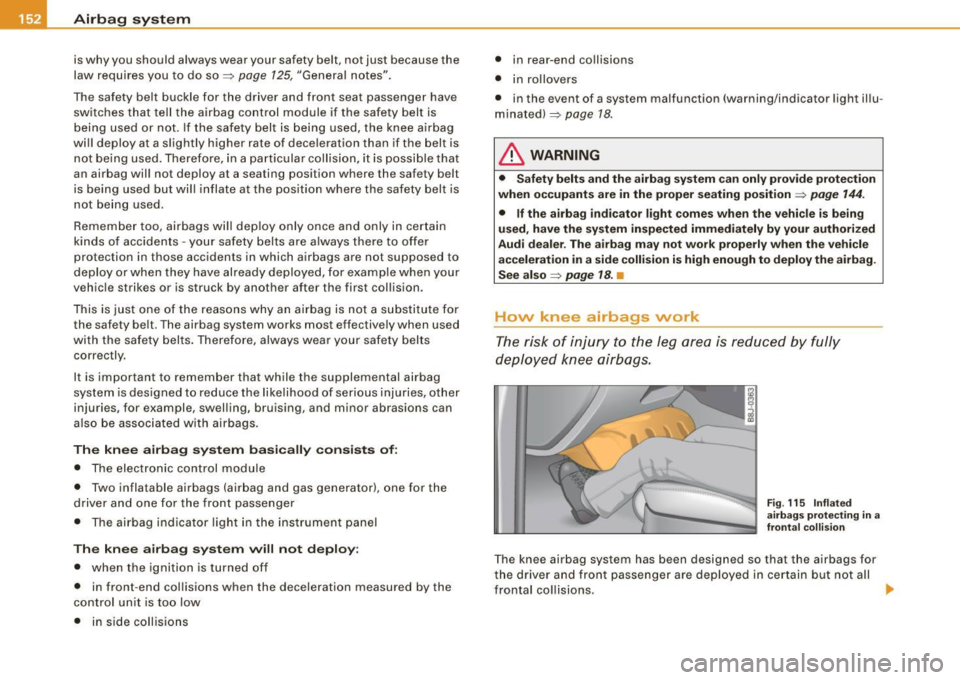
The risk of injury to the leg area is re duced by fully
deployed knee airbags.
Fig . 115 Inf lat ed
a ir bags pro tec ting in a
fr ontal co llision
The knee airbag system has been designed so that the airbags for
the driver and fron t passenger are deployed in certain but not all
frontal co llisions. .,.
Page 155 of 316

Airbag system -----------------=~-
If the fr ont airba gs deploy, t he kne e airbags also deploy in fro ntal
c o lli sion s above a ce rt a in s ev e rity.
W hen th e syst em is dep loy ed, the airbags start to f ill with a prope l
lant gas, and inflate between the lower part of the inst rument pane l
and the dri ver an d the l ower pa rt of t he in strument panel a nd the
front passenger =>
page 144, fig. 112.
A lth ough they ar e not a so ft pil low, the y ca n "c ush io n" the impac t
an d in this way they can h elp to reduce the risk of in jury to th e low er
e xtr emiti es.
A ll thi s takes place insta nt ane ous ly, so f ast th at many p eople don't
eve n realize that the a irbags ha ve deploye d. T he ai rb ag s als o i nflate
wi th a great dea l of force and it is im portant f or occ up ant saf ety that
no thi ng s ho ul d be in t he ir wa y when the y dep lo y.
Fu lly infl ate d airb ags in combin ation with pr operl y worn s afe ty b elt s
s lo w dow n and limi t the occu pant's fo rward moveme nt and h elp to
r e duc e th e risk. •
Important safety instructions on the knee
airbag system
A irbags are only s upplem enta l restra ints. Alwa ys wea r
safe ty belts corr ectly and ride in a prop er seating position .
There is a lo t th at you an d your p assenger s m us t kn ow and d o to
he lp the safety be lts an d air ba gs to p ro v ide supp leme nta l p ro tec
ti on.
& WARNING
An inflating knee airbag can cause serious injury. Wearing safety
belts incorrectly and improper seating positions increase the risk
of serious personal injury and death whenever a vehicle is being
used .
• The airbag system cannot protect you properly if you are
seated too close to any of the airbag locations. When adjusting
Controls and equip ment Safety first
Vehicle operation
& WARNING (continued)
their seat positions, it is important that both the driver and the
front passenger keep their upper bodies and knees at the
following minimum safe distances:
- 1
O inches (25 cm) between the chest and the steering
wheel /instrument panel .
- 4 inches (10 cm) between the knees and the lower part of the instrument panel .
• The risk of personal injury increases if you lean forward or to
the side, or if the seat is improperly positioned and you are not
wearing your safety belt . The risk increases even more should the
airbag deploy .
• Always make sure that the knee airbag can inflate without
interference . Objects between yourself and the airbag can
increase the risk of injury in an accident by interfering with the
way the airbag deploys or by being pushed into you as the airbag
deploys .
- No persons (children) or animals should ride in the footwell
in front of the passenger seat . If the airbag deploys , this can
result in serious or fatal injuries .
- No objects of any kind should be carried in the footwell area
in front of the driver's or passenger's seat . Bulky objects (shop
ping bags , for example) can hamper or prevent proper deploy
ment of the airbag . Small objects can be thrown through the
vehicle if the airbag deploys and injure you or your passengers .
• Make sure there are no cracks, deep scratches or other damage
in the area of the instrument panel where the knee airbags are
located .
• If children are incorrectly seated, their risk of injury increases in
the case of an accident=>
page 157, "Child Safety". •
Vehicle care Do-it-yourself service Technical data
Page 160 of 316

-Child Safety -------=---------------------------------------
& WAR NIN G (co ntinued )
• Alw ays in sta ll re ar-facin g child safety s eats on the r ear seat .
• If you m us t in sta ll a rear ward f acing child saf ety s eat on th e
fr ont pa ssenger seat in exceptional circum stan ces and the
PA SSEN GER AIR BAG OFF light do es not come on and sta y on ,
immediately in sta ll the re ar-facing child safety s eat in a rear
s eating po sit ion and ha ve th e airb ag s ystem insp ected immedi
atel y by your Audi dea ler .
& WARNING
If, in exceptional circum stance s, you mu st in sta ll a forward -f a cing
c hild re str ain t on th e fr ont p assenger's s eat:
• Always mak e sure the forward -fac ing seat ha s been de signed
a nd ce rt ified by it s m anufa cturer for u se on a fr ont se at w ith a
pa ssenger front and side airbag.
• Always follow the m anufacturer's instru ctions provided w ith
the child safety seat or carr ier.
• Alwa ys mo ve the pa ssenger seat into it s rea rmost positi on in
the seat' s fore and aft adju stment range , as far aw ay from the
ai rbag as possib le bef ore installing the ch ild r estr aint . The ba ck
re st mu st b e adjusted to an upright po sition.
• Alway s m ake sure that the PASSENGER AIR BAG OFF l ight
c om es on and sta y s on all the time whenever the ignition is
s w it c hed on . •
Advanced front airbag system and children
Your vehicle is equipped with an "Advanced Airbag System" in
complia nce with United States Federa l Motor Vehicle Safety Stan
dard (FMVSS) 208 as applicable at the time your vehicle was manu
factu red. T
he Advanced Airbag system in your vehicle has been certified to
meet the " low -risk" requirements for 3 and 6 year -old chi ldren on
the passenger side and smal l adults on the driver side . The low risk
deployment criteria are intended to reduce the risk of injury through
interaction with the airbag that can occur, for example, by being too
close to the steering wheel and instrument panel when the airbag
inflates. In addition, the system has been certified to comply with
the "suppression" requirements of the Safety Standard, to turn off
the front airbag for infants up to 12 months who are restrained on
the front passenger seat in child restraints that are listed in the
S tandard.
Even though your vehicle is equipped with an Advanced Airbag
system, all ch ildren, especially those 12 years and younger, should
always ride in the back seat properly restrained for their age and
size . The airbag on the passenger side makes the front seat a poten
tially dangerous p lace for a child to ride. The front seat is not the
safest p lace for a child in a forward -facing child safety seat. It can be
a very dangerous p lace for an infant or a larger ch ild in a rearward
facing seat. •
Advanced Airbags and the weight-sensing
mat in the front seat
The Advanced Airbag System in your vehicle detects the presence
of an infant or child in a chi ld restraint on the front passenger seat
using the weight -sensing mat in the seat cushion and the sensor
below the safety belt latch on the front passenger seat that
measures the tension on the safety belt.
The weight -sensing mat measures total weight of the chi ld and the
child safety seat and a child blanket on the front passenger seat . The
weight on the front passenger seat is related to the design of the
child restraint and its "footprint", the size and shape of the bottom
of the child restraint as it sits on the seat . The weight of a child
restraint and its "footprint" vary for different kinds of child ..,.
Page 171 of 316

____________________________________________ __:C:::. h :....:..:..:. il.:::d ~S :::.:::a.:.:fe :::. t:.! y~ _ffllll
& WARNING
Always take special precautions if you must install a forward or
rearward -facing child restraint on the front passenger's seat in
exceptional situations:
• Whenever a forward or rearward -facing child restraint is
installed on the front passenger seat , the PASSENGER AIR BAG
OFF light must come on and stay on whenever the ignition is
switched on.
• If the PASSENGER AIR BAG OFF light does not come on and stay
on , perform the checks described
=> page 146, "Monitoring the
Advanced Airbag System".
• Take the child restraint off the front passenger seat and install
it properly at one of the rear seat positions if the PASSENGER AIR
BAG OFF light does not stay on whenever the ignition is switched
on .
• Improper installation of child restraints can reduce the ir effec
tiveness or even prevent them from providing any protection .
• An improperly installed ch ild restraint can interfere with the
airbag as it deploys and seriously injure or even kill the child.
• Always carefully follow the manufacturer's instructions
provided with the child safety seat or carrier.
• Never place additional items on the seat that can increase the
total weight registered by the weight-sensing mat and can cause
injury in a crash .
& WARNING
Forward-facing child restraints:
• Always make sure the forward -facing seat has been designed
and certified by its manufacturer for use on a front seat with a
passenger front and side airbag .
• Never put the forward -facing child restraint up , against or very
near the instrument panel .
Controls and equip ment Safety first
Vehicle operation
& WARNING (continued )
• Always move the passenger seat into its rearmost position in
the seat's fore and aft adjustment range, as far away from the airbag as possible before installing the forward-facing child
restraint. The backrest must be adjusted to an upright position .
• Make sure that the PASSENGER AIR BAG OFF light comes on
and stays on all the time whenever the ignition is switched on.
& WARNING
Rearward -facing child restraints :
• A child in a rearward -facing child safety seat installed on the
front passenger seat will be seriously injured and can be killed if
the front airbag inflates -even with an Advanced Airbag System .
• The inflating airbag will hit the child safety seat or infant
carrier with great force and will smash the child safety seat and
child against the backrest , door or roof .
• Always be especially careful if you must install a rearward
fac ing child safety seat on the front passenger seat in e xceptional
circumstances .
• A tight tether strap on a rearward-facing child restraint
attached to the front passenger seat can put too much pressure
on the weight-mat in the seat and register a heavier weight in the
Advanced Airbag System. The heavier weight registered can make
the system work as though an adult were on the seat and deploy
the Advanced Airbag when it must be suppressed causing serious or even fatal injury to the child .
• Make sure that the PASSENGER AIR BAG OFF light comes on
and stays on all the time whenever the ignition is sw itched on .
• If the PASSENGER AIR BAG OFF light does not come on and stay
on , immediately install the rear-fac ing child safety seat in a rear
seating position and have the airbag system inspected by your
Audi dealer. •
Vehicle care Do-it-yourself service Technical data
Page 208 of 316
-~_C_ l_ e _a _n_ in_g=- a _n_d__, p,__ ro_ t_e _c_ t_ i_o _n _____________________________________________ _
In the case of general soiling of the upho lstery and cover material,
we recommend hiring a s pecialis t tha t has the equ ip m ent to c lean
the seat covers and other fabric surfaces by shampooing and spray
e xtraction .
& WARNING
Always read and heed all WARNINGS and the information
~ page 198 .
[ i ] Tip s
Open Ve lcro fasteners on your clothing can damage the seat cover.
Please make sure that Velc ro fas tene rs a re c losed. •
Plastic parts and instrument panel
Always us e a clea n clo th mo isten ed in cl ear wa ter t o clean thes e
areas . For persistent dirt use an Audi approved
solvent -free plastic
cleane r/ p rotec tan t.
& WARNING
Solvent s can change the propertie s of some plastic s and make it
h arder for the airbag to deploy .
• Never clean the instrument panel or the surface of Airbag
modules with cleaning produ cts that contain solvents .
• Products containing so lvents will make the surface of this part
porous.
• Serious injur ies can re sult if plastic part s come loose when the
airbag is deployed.
• Always read and heed all WARNINGS and the infor mation
~ page 198 .
0 Note
Cleaning agents co ntaini ng so lvents wil l attack t he ma ter ial and can
change the way it behaves .•
Instrument cluster glass
- Clea n the glass w it h a soft, damp clot h.
In order to preserve the anti -glare properties of the instrument
clus ter g lass, it sho uld only be clea ned w ith a soft , dam p clo th .•
Ap plies to vehicl es: w ith n atu ra l le ath er
Natural leather
A udi make s gr eat effo rts to maintai n the pro perti es ,
n at ura l look an d feel of int erior leather.
General
We offer many different types of lea ther on our veh icles . M ost are
different types of nappa leather, which has a smooth surface and
comes in va rious co lors .
Th e intensity o f the color de termi nes the visua l character istics a nd
appearance . If the surface of the leather has a typica l natural look,
t hen the leat her is a nappa leather tha t has been left in a re la tively
natural condition. This leather offers particu lar ly good comfort and
b rea thes well. Fi ne veins, closed grains, insect bi tes, skin fol ds, and
subt le variations in color remain visible. These characteristics
dem onstra te that the mater ial is natura l.
Natura l nappa leather is not covered by a color fin is h . It is therefo re
more sensitive to soiling and wear, which is something you need to
conside r if c hild ren, a nimals o r other factors migh t prove to be
particularly hard on the leather.
By c ontrast, lea ther types that a re covere d by a colo red fini sh layer
are more durable . This has a positive effect on the leather's resis -
~
Page 218 of 316

___ C_h_ e_ c_k _in --== g'-- a_n _d_ f_il _li _n ..:::g:::..- ___________________________________________ _
Checking and filling
Engine hood
Releasing the engine hood
The engine hood is released from inside the vehicle.
-Open the driver's door .
Fig. 135 Driver's side
footwell: engine hood
release lever
-Pull the release lever on the left under the instrument
panel
=> fig. 135 in the direct ion of the arrow.
The hood pops up slightly under spring pressure. •
Opening the engine hood
Fig. 136 Release lever
under the engine hood
Before opening the engine hood, make sure that the wind
shield wipers are flat against the windshield. Otherwise,
they could damage the paint on the hood.
Lift the hood slightly =>&, .
Pull up on the release under the hood => fig. 136. This
releases the catch.
- Open the hood all the way.
The hood is kept in the open position by two gas struts.
& WARNING
Hot engine coolant can burn you.
• To reduce the risk of being burned, never open the hood if you
see or hear steam or coolant escaping from the engine compart
ment. Wait until no steam or coolant can be seen or heard before
carefully opening the hood. •
Page 276 of 316
llffl.,___F_ u_ s_ e_s _ a_n _ d_ b_ u_lb _ s _______________________________________________ _
Fuses and bulbs
Fuses
Replacing a fuse
A problem in the electrical system may be caused by a
blown fuse.
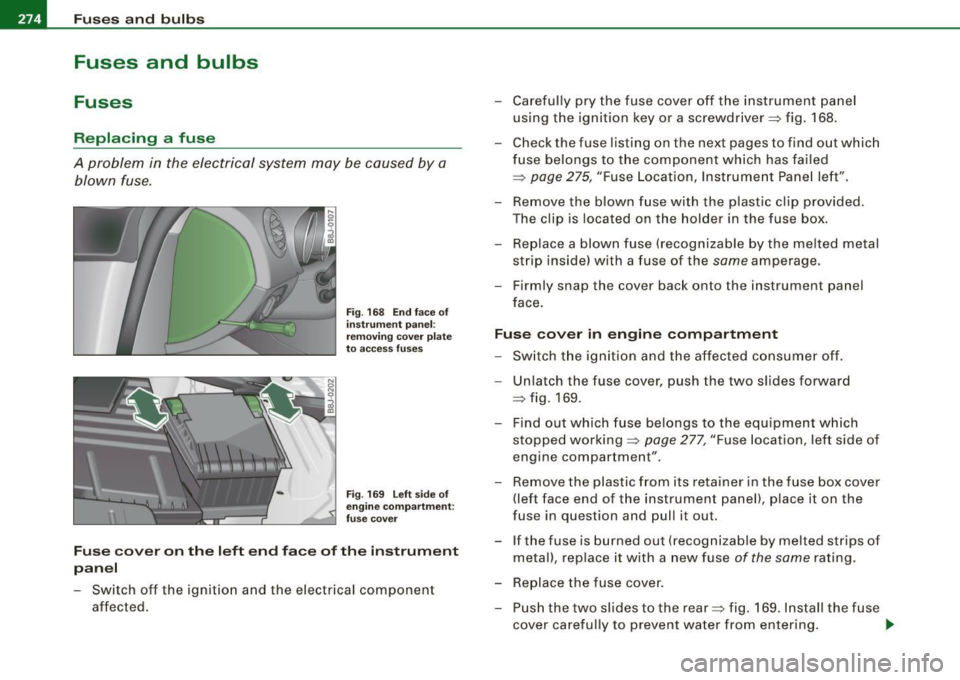
Fig . 168 End face of
instrument panel:
removing cover plate
to access fuses
Fig .
169 Left side of
engine compartment :
fuse cover
Fuse cover on the left end face of the instrument
panel
- Switch off the ignition and the electrical component
affected. - Carefully pry the fuse cover off the instrument panel
using the ignition key or a screwdriver~ fig. 168.
- Check the fuse listing on the next pages to find out which
fuse belongs to the component which has failed
~ page 275, "Fuse Locatio n, Instrume nt Panel left".
- Remove the blown fuse with the plastic clip provided.
The clip is located on the holder in the fuse box.
- Replace a blown fuse (recognizable by the melted metal
strip inside) w ith a fuse of the same amperage .
- Firmly snap the cover back onto the instrument panel
face.
Fuse cover in engine compartment
- Switch the ignition and the affected consumer off.
- Unlatch the fuse cover, push the two slides forward
~ fig. 169.
- Find out which fuse belongs to the equipment which
stopped working~ page 277, "Fuse location, left side of
engine compartment".
- Remove the plastic from its reta iner in the fuse box cover
(left face end of the instrument panel), place it on the
fuse in question and pull it out.
- If the fuse is burned out (recognizable by melted strips of
metal), replace it with a new fuse of the same rating.
- Replace the fuse cover.
- Push the two slides to the rear~ fig. 169. Install the fuse
cover carefully to prevent water from entering.
~
Page 277 of 316
Fuses and bulbs -
------------------
The various electrical circuits are protected by fuses. The fuses are
clustered in a centralized unit. The unit is located behind the face
panel at the end of the instrument panel.
Two spare fuses and a sticker identifying the fuses are located on
the inside of the fuse box cover.
You are well advised to keep a supply of spare fuses in your vehicle.
Fuses with the proper ampere ratings are available at your autho
rized Audi dealer.
& WARNING
Never replace a fuse with one that has a higher amperage rating .
• A fuse with a too high amperage could damage the electrical
part and cause a fire.
0 Note
• On no account should fuses be repaired (e.g. patched up with tin
foil or wire) as this may cause serious damage elsewhere in the elec
trical circuit or cause fire.
• If a fuse blows repeatedly, do not keep replacing it. Instead, have
the cause for the repeated short circuit or overload tracked and
fixed. •
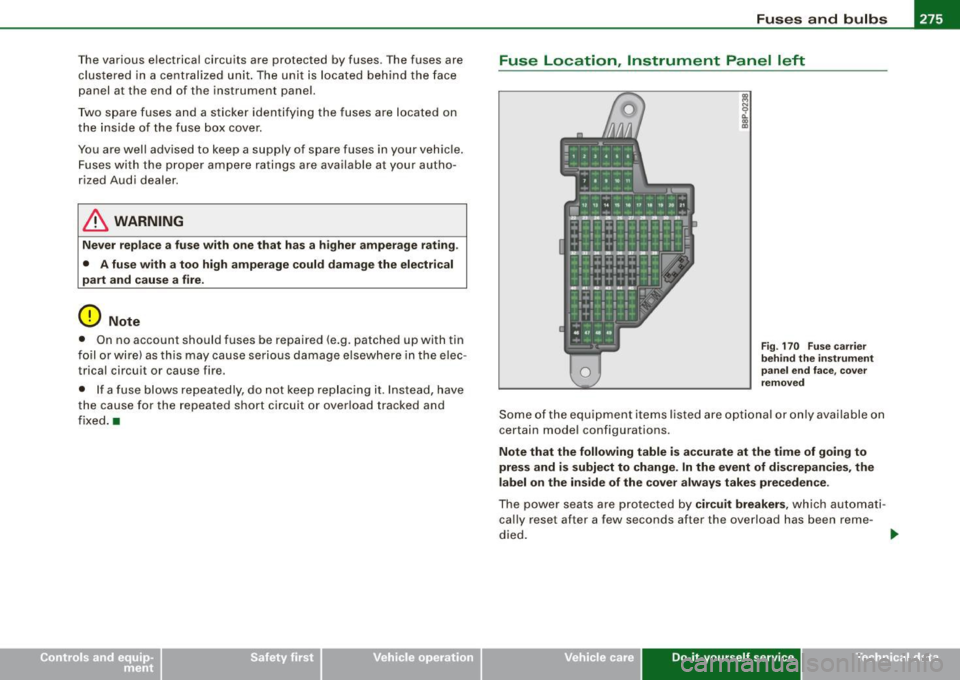
Fuse Location , Instrument Panel left
Fig . 170 Fuse carrier
behind the instrument
panelendface,cover
removed
Some of the equipment items listed are optional or only available on
certain model configurations.
Note that the following table is accurate at the time of going to
press and is subject to change. In the event of discrepancies, the
label on the inside of the cover always takes precedence.
The power seats are protected by circuit breakers, which automati
cally reset after a few seconds after the overload has been reme-
died. .,_
Vehicle care Do-it-yourself service irechnical data