Oil BMW 325i 1994 E36 Workshop Manual
[x] Cancel search | Manufacturer: BMW, Model Year: 1994, Model line: 325i, Model: BMW 325i 1994 E36Pages: 759
Page 198 of 759
170-
4
RADIATOR
AND
COOLING
SYSTEM
A
quick
testat
the
coolant
temperature
gauge
sender
can
The
auxiliary
cooling
fan
comes
on
when
coolant
tempera
determine
if
the
gauge
is
functioning
correctly
.
ture
exceeds
a
predetermined
leve¡
or
whenever
the
air
condi-
tioning
is
on
.
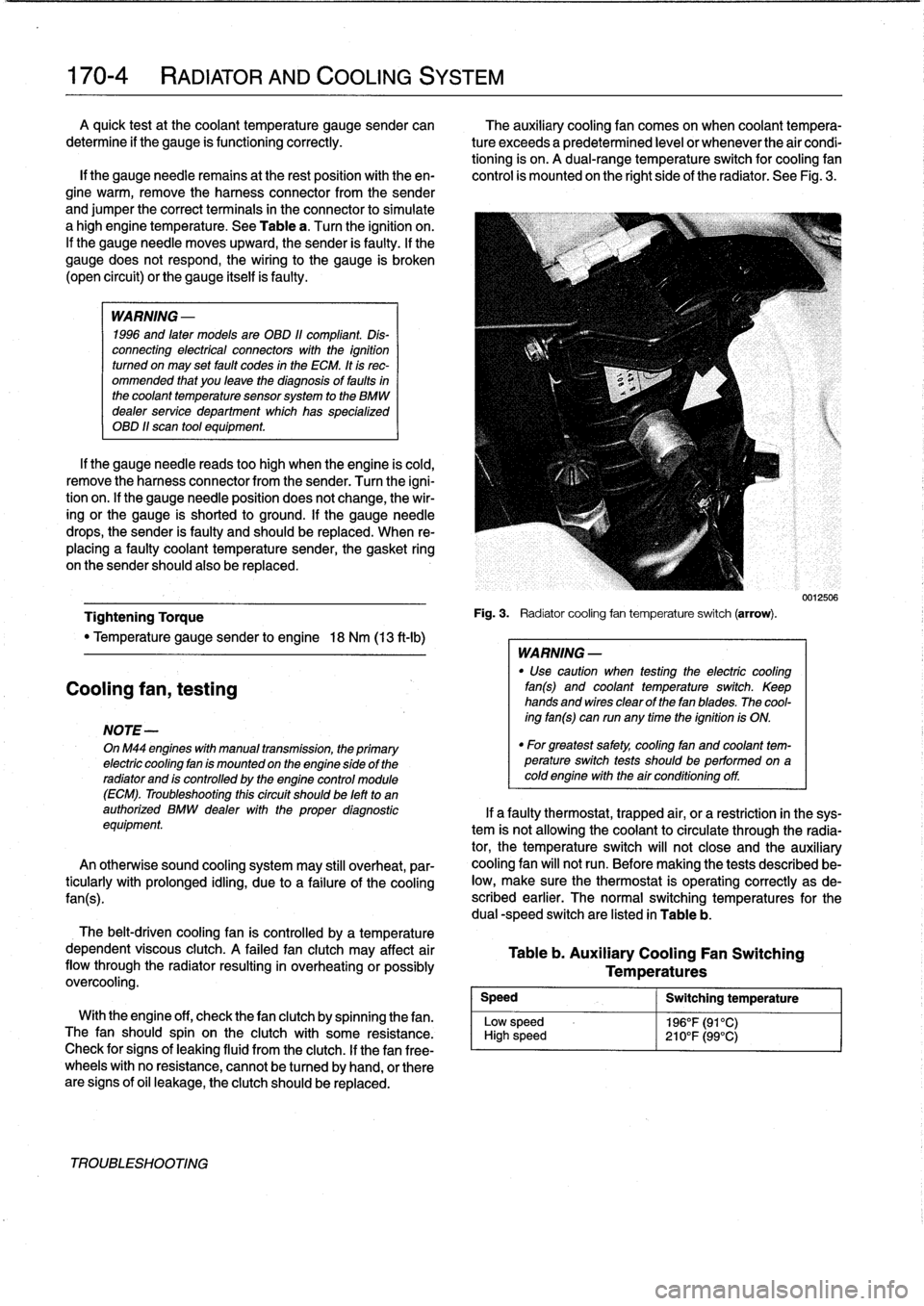
A
dual-range
temperature
switch
for
cooling
fan
lf
the
gauge
needie
remains
at
the
rest
position
with
theen-
control
is
mounted
on
the
right
side
of
the
radiator
.
See
Fig
.
3
.
gine
warm,
remove
the
harness
connector
from
the
sender
and
jumper
the
correct
terminals
in
the
connector
to
simulate
a
high
engine
temperature
.
See
Table
a
.
Turn
the
ignition
on
.
If
the
gauge
needle
moves
upward,
the
sender
is
faulty
.
If
the
gauge
does
not
respond,
the
wiring
to
the
gauge
is
broken
(open
circuit)
or
the
gauge
itselfis
faulty
.
WARNING
-
1996
and
laten
models
are
OBD
11
compliant
.
Dis-
connecting
electrical
connectors
wíth
the
ignition
turned
on
may
set
fault
codes
in
the
ECM
.
It
is
rec-
ommended
that
you
leave
the
diagnosis
of
faults
in
the
coolant
temperature
sensorsystem
to
the
BMW
dealer
service
department
which
has
specialized
OBD
11
scan
tool
equipment
.
If
the
gauge
needle
reads
too
high
when
the
engine
is
cold,
remove
the
harness
connector
from
the
sender
.
Turn
the
igni-
tion
on
.
lf
the
gauge
needle
position
does
not
change,
the
wir-
ing
or
the
gauge
is
shorted
to
ground
.
If
the
gauge
needle
drops,
the
sender
is
faulty
and
should
be
replaced
.
When
re-
placing
a
faulty
coolant
temperature
sender,
the
gasket
ring
on
the
sender
should
also
be
replaced
.
Tightening
Torque
"
Temperature
gauge
sender
to
engine
18
Nm
(13
ft-Ib)
Cooling
fan,
testing
NOTE-
OnM44
engines
with
manual
transmission,
the
primary
electric
cooling
fan
is
mounted
on
the
engine
side
of
the
radiator
and
is
controlled
by
the
engine
control
module
(ECM)
.
Troubleshooting
thiscircuit
should
be
left
to
an
authorized
BMW
dealer
with
the
proper
diagnostic
equipment
An
otherwise
sound
cooling
system
may
still
overheat,
par-
ticularly
with
prolonged
idling,
due
to
a
failure
of
the
coolíng
fan(s)
.
The
belt-driven
cooling
fan
is
controlled
by
a
temperature
dependent
viscous
clutch
.
A
failed
fan
clutch
may
affect
air
flow
through
the
radiator
resulting
in
overheating
orpossibly
overcooling
.
Speed
Low
sp
High
s
With
the
engine
off,
check
thefan
clutch
by
spinning
thefan
.
eed
The
fan
should
spin
on
the
clutch
with
some
resistance
.
peed
Check
for
signs
of
leaking
fluid
from
the
clutch
.
If
thefan
free-
wheels
with
no
resistance,
cannot
be
tu
rned
by
hand,
or
there
are
signs
of
oil
leakage,
the
clutch
should
be
replaced
.
TROUBLESHOOTING
Fig
.
3
.
Radiatorcooling
fan
temperature
switch
(arrow)
.
WARNING
-
"
Use
caution
when
testing
the
electric
cooling
fan(s)
and
coolant
temperature
switch
.
Keep
hands
and
wires
clear
of
thefan
blades
.
The
cool-
ing
fan(s)
can
run
any
time
the
ignition
is
ON
.
"
For
greatest
safety,
coolíng
fan
and
coolant
tem-perature
switch
tests
shouldbe
performed
on
acoldengine
with
the
air
conditioning
off
.
Table
b
.
Auxiliary
Cooling
Fan
Switching
Temperatures
Switching
temperature
196°F(91°C)
210°F(99°C)
0012506
If
a
faulty
thermostat,
trapped
air,
or
a
restriction
in
the
sys-
tem
is
not
allowing
the
coolant
to
circulate
through
the
radia-
tor,
the
temperature
switch
will
not
close
and
the
auxiliary
cooling
fan
will
not
run
.
Before
making
the
tests
described
be-
low,
make
sure
the
thermostat
is
operating
correctly
as
de-
scribed
earlier
.
The
normal
switching
temperatures
for
the
dual
-speed
switch
are
listed
in
Table
b
.
Page 207 of 759
GENERAL
.
.
.......
.
......
.
...
.
.
.
.
.
...
180-1
Exhaust
system,
removing
and
installing
.
...
.180-3
EXHAUST
SYSTEM
REPLACEMENT
.
...
180-1
Exhaust
manifolds,
removing
and
installing
.
.
.180-5
GENERAL
The
exhaust
system
is
designed
to
be
maintenance
free,
al-
though
regular
inspection
is
warranted
due
to
the
harsh
oper-
atingconditions
.
Under
normal
conditions,
the
catalytic
converter
does
not
require
replacement
unless
it
is
damaged
.
On
1996
and
later
cars,
a
pre-
and
post-catalytic
converter
oxygen
sensor
is
used
at
each
catalytic
converter
.
Be
sure
to
take
care
when
removingthe
system
not
to
damage
the
sen-
EXHAUST
SYSTEMREPLACEMENT
sors
.
See
130
Fuel
Injection
for
information
on
testing
oxygen
sensors
.
NOTE-
OnM52
engines,
two
resonator
pípes
(short
and
long)
are
incorporated
into
the
rear
muffler
assembly
.
See
Fíg
.
1
.
An
exhaust
flap
is
integrated
into
the
outlet
side
of
the
short
pipe
.
The
flap
is
operated
by
a
vacuum
ac-
tuator
via
the
Siemens
MS
41
.1
engine
control
mod-
ule)
.
The
flap
is
closed
at
engine
speeds
below
2,500
rpm
.
This
allows
exhaust
gasses
to
flow
through
the
long
resonator
pipe
and
reduce
noise
.
Above
2,500rpm,
the
exhaust
flap
is
open
(no
vacuum
applied
to
the
actuator)
and
allows
exhaust
gasses
to
flow
through
the
short
pipe
for
maximum
performance
.
180
Exhaust
System
0013101
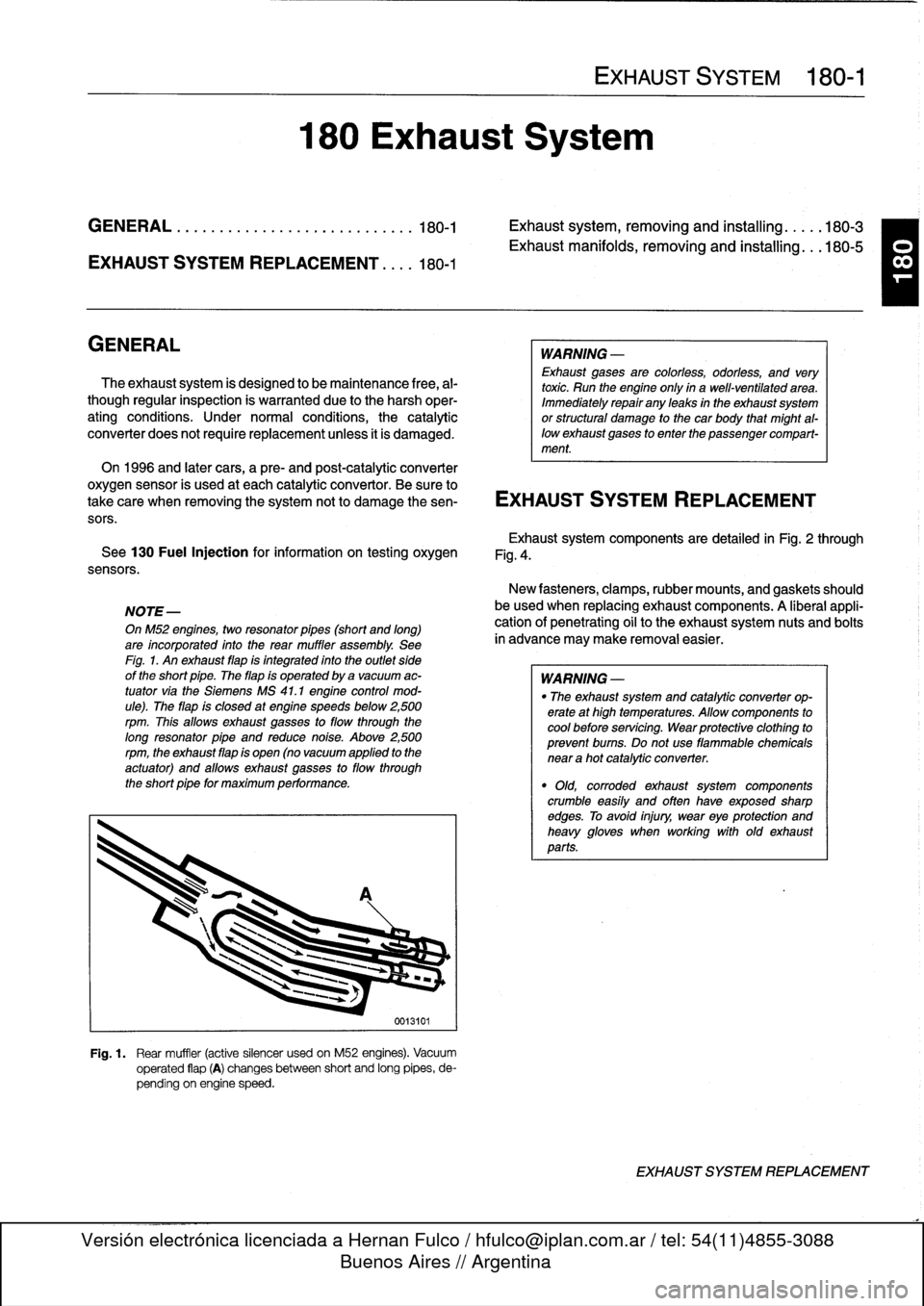
Fig
.
1
.
Rear
muffler
(active
silencer
usedon
M52
engines)
.
Vacuum
operated
flap
(A)
changesbetween
short
and
long
pipes,
de-
pending
on
engine
speed
.
EXHAUST
SYSTEM
180-1
WARNING
-
Exhaust
gases
are
colorless,
odorless,
and
very
toxic
.
Run
the
engine
only
ín
a
well-ventilated
area
.
Immediately
repair
any
leaks
in
the
exhaust
system
or
structural
damage
to
the
car
body
that
might
al-
lowexhaust
gases
to
enter
the
passenger
compart-
ment
.
Exhaustsystem
components
are
detailed
in
Fig
.
2
through
Fig
.
4
.
New
fasteners,
clamps,rubber
mounts,
and
gaskets
should
be
used
when
replacing
exhaust
components
.
A
liberal
appli-
cationof
penetrating
oil
to
the
exhaustsystem
nuts
and
bolts
in
advance
may
make
removal
easier
.
WARNING
-
"
The
exhaust
system
and
catalytic
converter
op-
erate
at
high
temperatures
.
Allow
components
to
cool
before
servicing
.
Wear
protectíve
clothíng
to
prevent
bums
.
Do
not
use
flammable
chemicals
near
a
hot
catalytic
converter
.
"
Old,
corroded
exhaust
system
components
crumble
easíly
and
often
have
exposed
sharp
edges
.
To
avoid
injury,
wear
eye
protection
and
heavy
gloves
when
working
with
old
exhaust
parts
.
EXHAUST
SYSTEM
REPLACEMENT
T
Page 214 of 759
200-2
TRANSMISSION-GENERAL
Transmission
ID
Codes
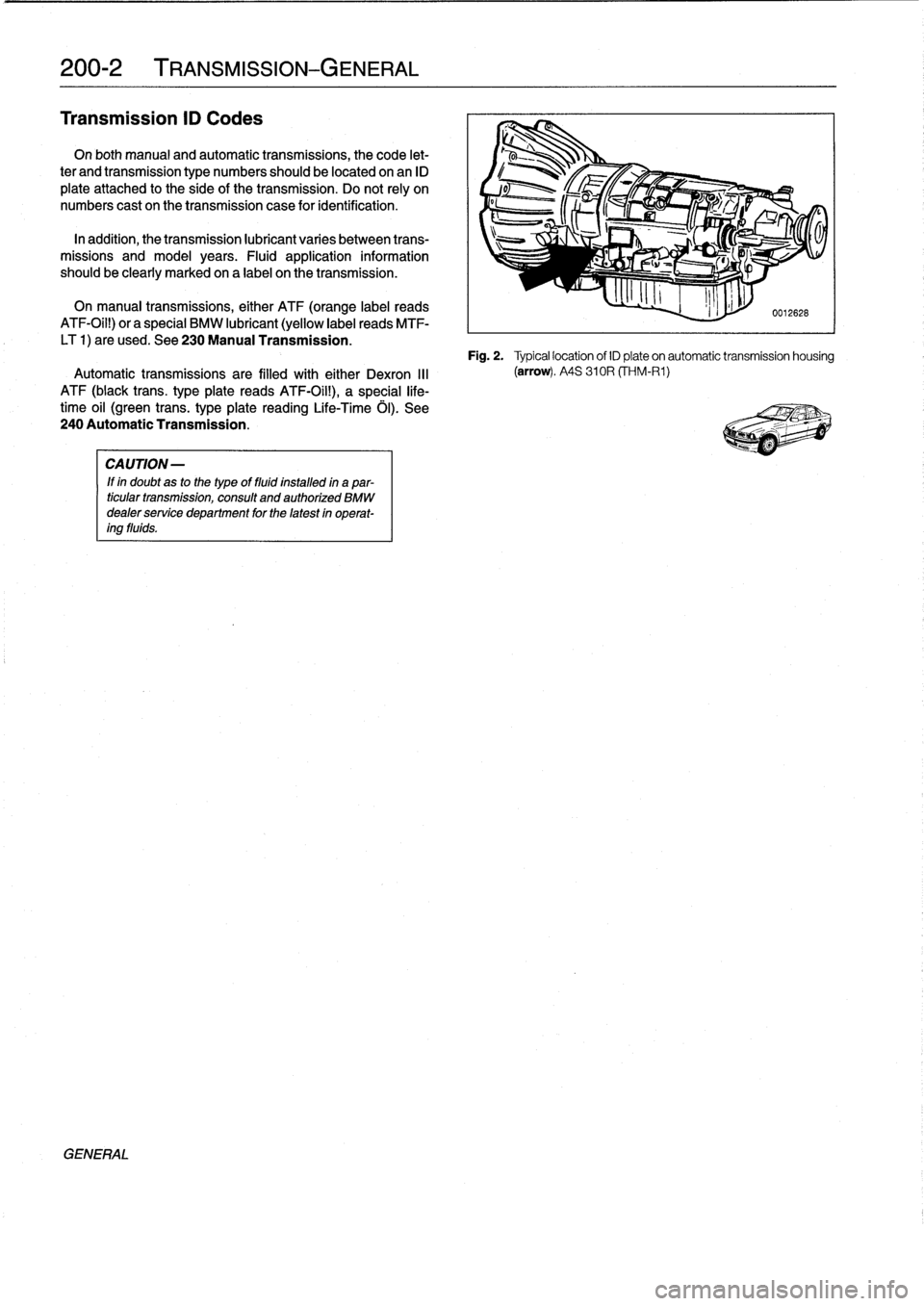
On
both
manual
and
automatic
transmissions,
the
code
let-
ter
and
transmission
type
numbers
should
be
located
onan
ID
plate
attached
to
the
síde
of
thetransmission
.
Do
not
rely
on
numbers
cast
on
the
transmission
case
for
identification
.
In
addition,
thetransmission
lubricant
varies
between
trans-
missions
and
model
years
.
Fluid
application
information
should
be
clearly
marked
on
a
label
on
thetransmission
.
On
manual
transmissions,
either
ATF
(orange
label
reads
ATF-Oil!)
or
a
special
BMW
lubricant
(yellow
label
reads
MTF-
LT
1)
are
used
.
See
230Manual
Transmission
.
Automatic
transmissions
are
filled
with
either
Dexron
III
ATF
(black
trans
.
type
plate
reads
ATF-Oil!),
a
special
ffe-
time
oil
(green
trans
.
type
plate
reading
Life-Time
ó1)
.
See
240AutomaticTransmission
.
GENERAL
CAUTION-
lf
in
doubtas
to
the
typeof
fluid
installed
in
a
par-
ticular
transmission,
consult
and
authorized
BMW
dealer
service
department
for
the
latest
in
operat-
ing
fluids
.
Fig
.
2
.
Typical
location
of
IDpíate
on
automatic
transmission
housing
(arrow)
.
A4S
310R
(THM-R1)
Page 217 of 759
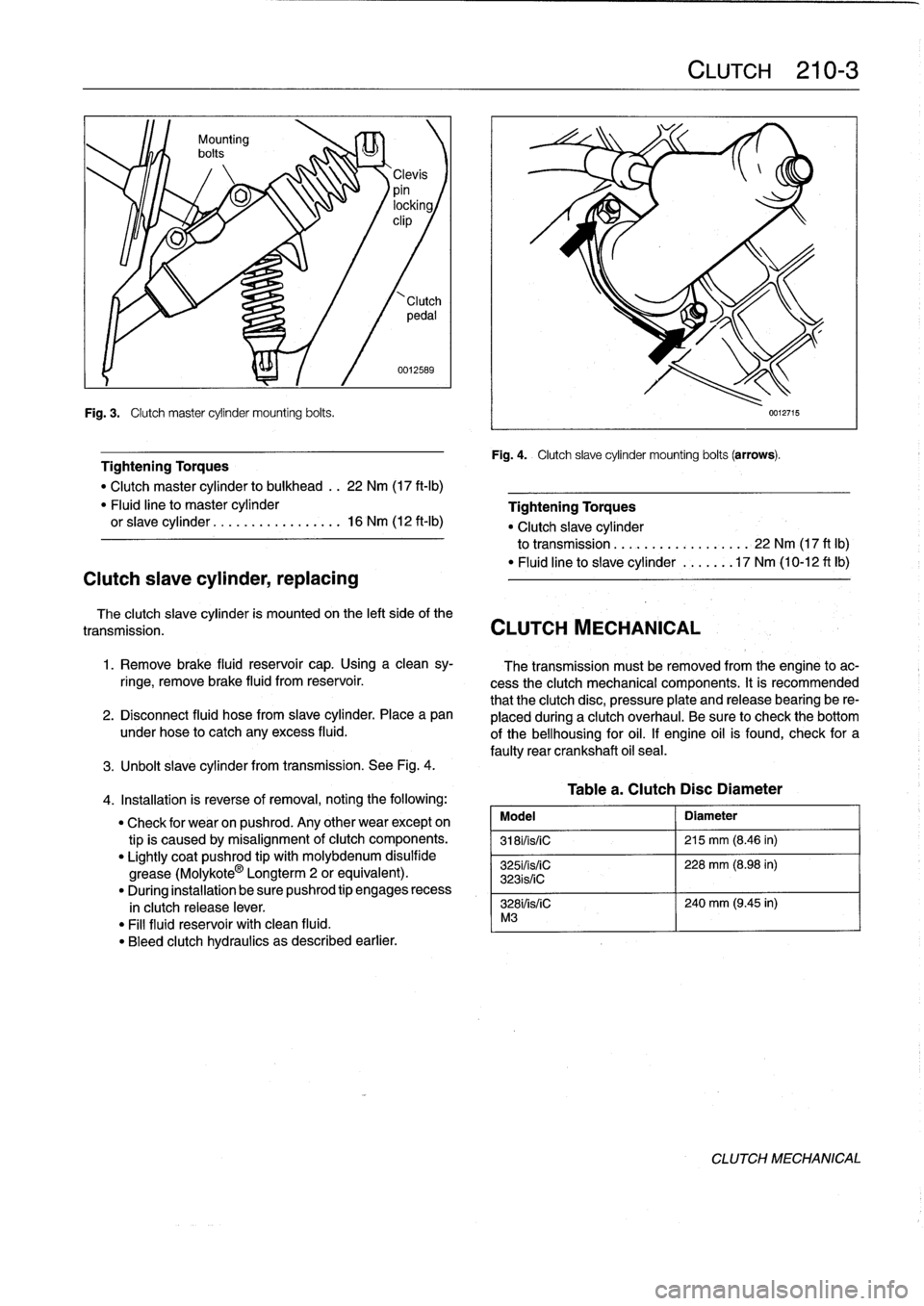
Fig
.
3
.
Clutch
master
cylinder
mounting
bolts
.
Clutch
slave
cylinder,
replacing
0012589
Tightening
Torques
"
Clutch
master
cylinder
to
bulkhead
..
22
Nm
(17
ft-Ib)
"
Fluid
line
to
master
cylinder
orslave
cylinder
.................
16
Nm
(12
ft-1b)
The
clutch
slave
cylinder
is
mounted
on
the
left
side
of
the
transmission
.
CLUTCH
MECHANICAL
1
.
Remove
brake
fluid
reservoir
cap
.
Using
a
clean
sy-
ringe,
remove
brake
fluid
from
reservoir
.
2
.
Disconnect
fluid
hose
from
slave
cylinder
.
Place
a
pan
under
hose
to
catch
any
excess
fluid
.
3
.
Unbolt
slave
cylinder
from
transmission
.
See
Fig
.
4
.
4
.
Installation
is
reverse
of
removal,
noting
the
following
:
"
Check
for
wear
on
pushrod
.
Any
other
wear
except
on
tipis
caused
by
misalignment
of
clutch
components
.
"
Lightly
coat
pushrod
tip
with
molybdenum
disulfide
grease
(Molykote
0
Longterm
2
or
equivalent)
.
"
During
installation
be
sure
pushrod
tip
engages
recess
in
clutch
release
lever
.
"
Fill
fluid
reservoir
with
clean
fluid
.
"
Bleed
clutch
hydraulics
as
described
earlier
.
CLUTCH
210-
3
Fig
.
4
.
Clutch
slave
cylinder
mounting
bolts
(arrows)
.
Tablea
.
ClutchDisc
Diameter
Model
Diameter
3181/is/iC
215
mm
(8
.46
in)
325i/is/iC
228
mm
(8
.98
in)
323is/iC
328i/is/iC
240
mm
(9
.45
in)
M3
0012715
Tightening
Torques
"
Clutch
slave
cylinder
to
transmission
.
.
................
22
Nm
(17
ft
lb)
"
Fluid
line
to
slave
cylinder
......
.17
Nm
(10-12
ft
lb)
The
transmission
must
be
removed
from
the
engine
to
ac-
cess
the
clutch
mechanical
components
.
It
is
recommended
that
the
clutch
disc,
pressure
plate
and
release
bearing
be
re-
placed
duringa
clutch
overhaul
.
Be
sure
to
check
the
bottom
of
the
bellhousing
for
oil
.
If
engine
oil
is
found,
check
for
a
faulty
rear
crankshaft
oil
seal
.
CLUTCH
MECHANICAL
Page 222 of 759
230-2
MANUAL
TRANSMISSION
Transmission
fluidleve¡,
checking
Checking
thetransmission
oil
level
involves
simply
remov-
ing
the
side
drain
plug
and
inserting
a
finger
into
the
holeto
check
the
fluid
leve¡
.
lf
the
fluid
leve¡
is
up
to
the
bottom
of
the
drain
hole
(finger
is
wetted
by
transmission
fluid),
the
leve¡
is
correct
.
Transmission
fluid,
replacing
NOTE-
Manual
transmission
fluid
type
should
be
printed
ona
label
on
the
side
of
the
transmission
.
If
in
doubt,
consult
an
authorized
BMW
dealer
for
the
up-to-dateinforma-
tion
on
operating
fluids
.
1
.
Drive
vehicle
for
afew
miles
to
warm
transmission
.
2
.
Raise
and
safely
support
vehicle
to
access
drain
plug
.
WARNING
-
"
When
raising
the
car
uslng
a
floor
jack
or
a
hy-
draulic
lift,
carefully
position
the
jack
pad
to
pre-
vent
damaging
the
car
body
.
A
suitable
liner
(wood,
rubber,
etc
.)
should
be
placed
between
the
jack
and
the
car
to
prevent
body
damage
.
"
Watch
the
jack
closely
.
Make
sure
it
stays
stable
and
does
not
shíít
or
tilt
.
As
the
car
is
raised,
the
car
may
roll
slightly
and
the
jack
may
shift
.
3
.
Place
a
drain
pan
under
transmission
andremove
drain
plug
at
bottom
of
transmission
.
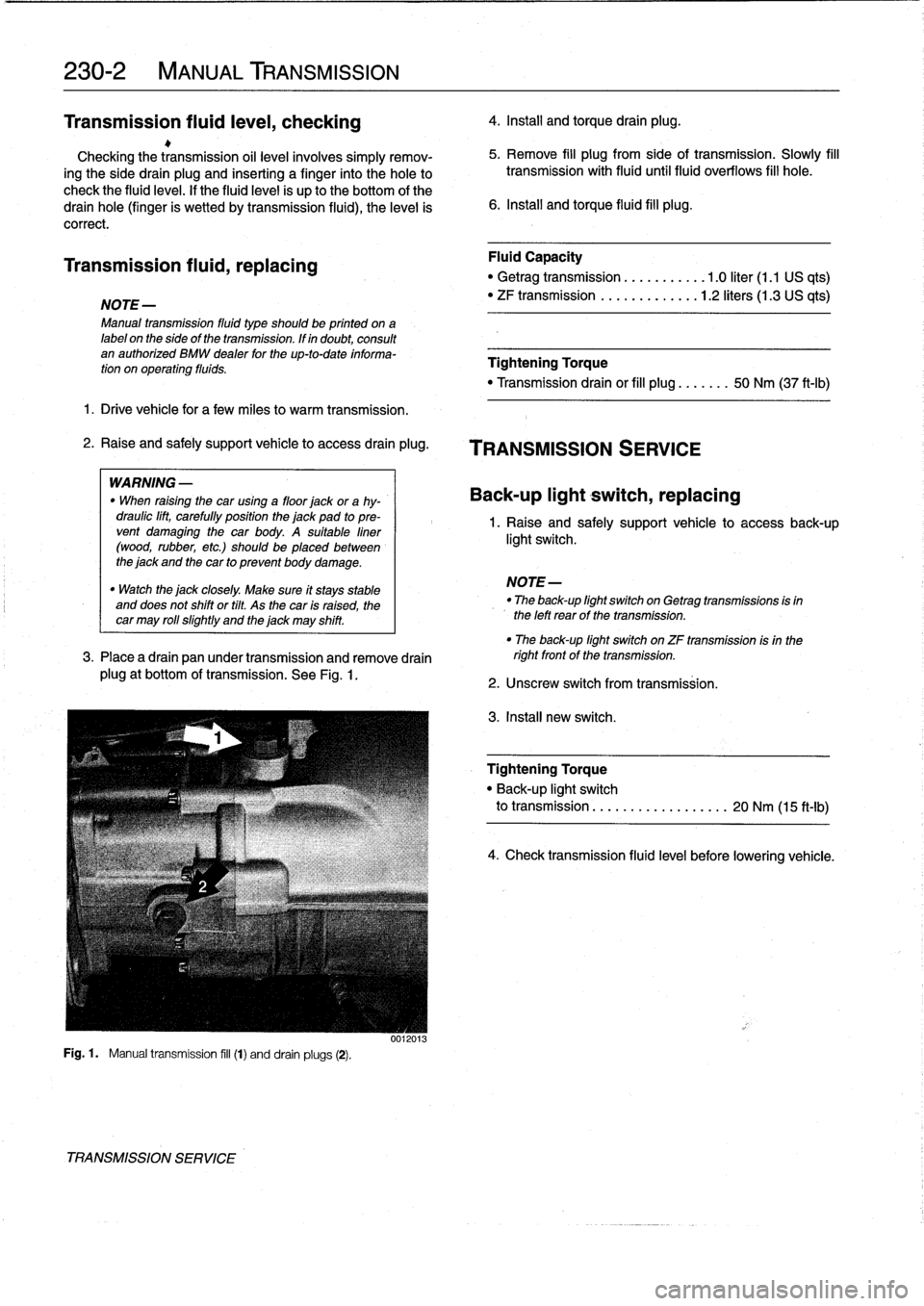
See
Fig
.
1
.
Fig
.
1
.
Manual
transmission
fill
(1)
and
drain
plugs
(2)
.
TRANSMISSION
SERVICE
4
.
Install
and
torque
drain
plug
.
5
.
Remove
fill
plug
from
side
of
transmission
.
Slowly
fill
transmission
with
fluiduntilfluid
overflows
fill
hole
.
6
.
Install
and
torque
fluid
fill
plug
.
Fluid
Capacity
"
Getrag
transmission
...........
1
.0
liter
(1.1
US
qts)
"
ZF
transmission
.............
1
.2
liters(1
.3
US
qts)
Tightening
Torque
"
Transmission
drain
or
fill
plug
.......
50
Nm
(37
ft-Ib)
TRANSMISSION
SERVICE
Back-up
light
switch,
replacing
1
.
Raise
and
safely
support
vehicle
to
accessback-up
light
switch
.
NOTE-
"
The
back-up
light
switch
on
Getrag
transmissions
is
in
the
left
rearof
the
transmission
.
"
Theback-up
light
switch
on
ZF
transmission
isin
the
rightfront
of
thetransmission
.
2
.
Unscrew
switch
from
transmission
.
3
.
Install
new
switch
.
Tightening
Torque
"
Back-up
light
switch
to
transmission
..
..
.
.....
.
..
.....
20
Nm
(15
ft-ib)
4
.
Check
transmission
fluid
leve¡
before
lowering
vehicle
.
Page 223 of 759
Selector
shaft
seal,
replacing
(transmission
instalied)
1
.
Raise
and
safely
support
vehicle
to
access
drain
plug
.
2
.
Support
transmission
with
transmission
jack
.
3
.
Remove
driveshaft
.
See
260
Driveshaft
.
4
.
Remove
transmission
crossmember
and
tilt
down
rear
of
transmission
.
CA
UTION--
Tilting
the
engine
to
lower
the
transmission
can
lead
to
damage
to
various
cgmponents
due
to
lack
of
clearance
.
-On
cars
with
AST
(traction
control)
remove
throt-
tle
body
before
tiltlng
engine
.
-Remove
brake
fluid
reservoir
lf
necessary
.
Locking
pin
á
Locking
clip
8
.
Reinstall
shift
linkage
to
selectorshaft
.
7
.
Coat
new
seal
with
transmission
fluid
.
Drive
new
seal
in
flush
with
housing
.
Use
BMW
special
seal
installation
tool
no
.
23
2
260
orequivalent
and
a
soft-faced
(plastic)
hammer
.
See
Fig
.
4
.
9
.
Fiaise
transmission
and
reinstall
crossmember
.
MANUAL
TRANSMISSION
230-
3
Seal
Selector
_
shaft
5
.
Working
at
rear
of
selector
shaft,
disconnect
shift
link-
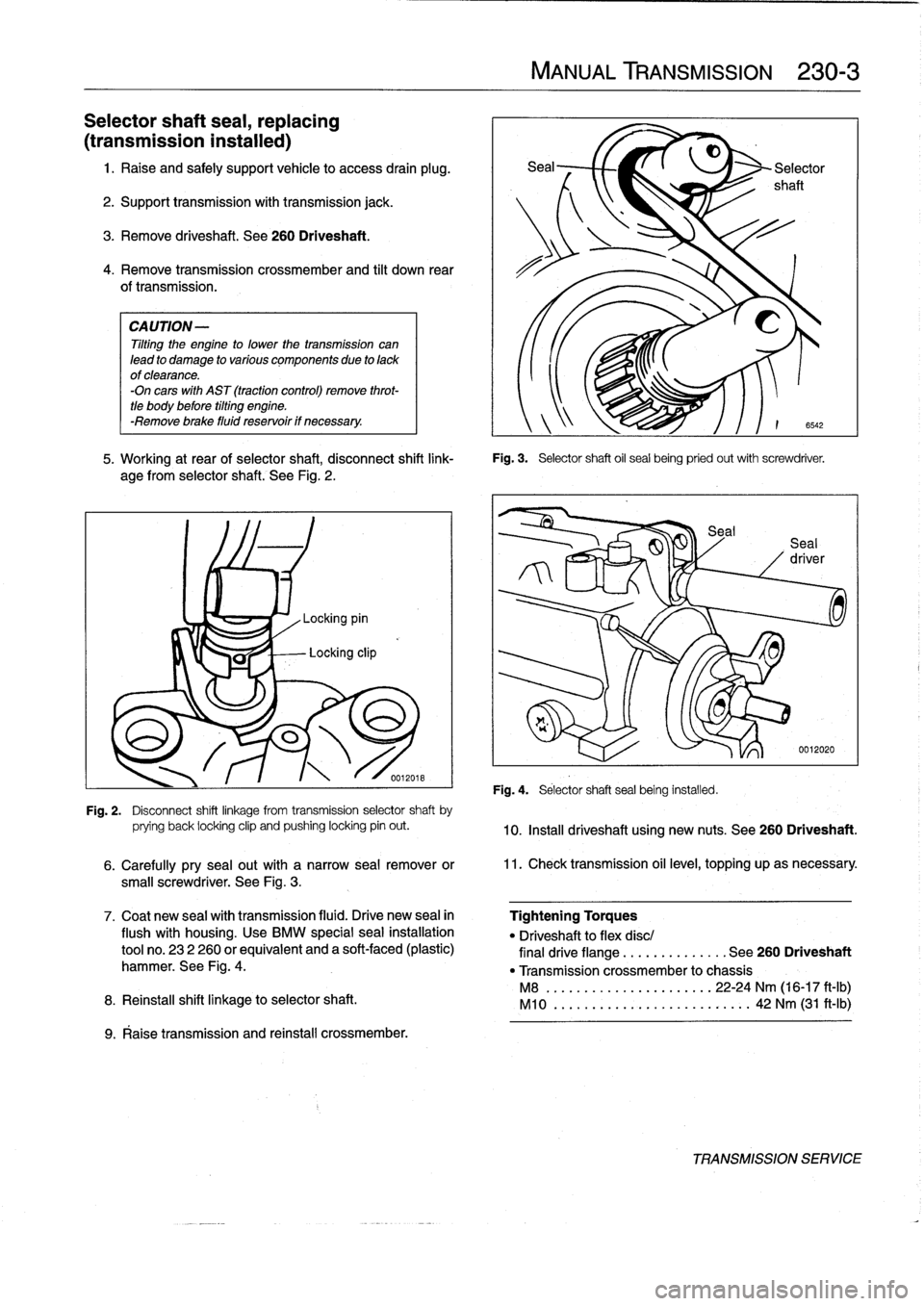
Fig
.
3
.
Selector
shaft
oil
sea¡
being
pried
out
with
screwdriver
.
age
from
selectorshaft
.
See
Fig
.
2
.
Fig
.
4
.
Selector
shaftseal
being
installed
.
6542
0012020
Fig
.
2
.
Disconnect
shift
linkage
from
transmission
selector
shaft
by
prying
back
locking
clip
and
pushing
locking
pin
out
.
10
.
Install
driveshaft
using
new
nuts
.
See260
Driveshaft
.
6
.
Carefully
pry
sea¡
out
with
a
narrow
seal
remover
or
11
.
Check
transmission
oil
level,
topping
upas
necessary
.
small
screwdriver
.
See
Fig
.
3
.
Tightening
Torques
"
Driveshaftto
flex
disc/
final
drive
flange
..............
See
260
Driveshaft
"
Transmission
crossmember
to
chassis
M8
........
..
.
...
........
22-24
Nm
(16-17
ft-1b)
M10
........
.
.
...
...
.
.........
42
Nm
(31
ft-Ib)
TRANSMISSIONSERVICE
Page 224 of 759
230-
4
MANUAL
TRANSMISSION
Output
shaft
sea¡,
replacing
(transmission
installed)
1
.
Raise
and
safely
support
vehicle
.
Support
transmission
with
transmission
jack
.
WARNING
-
"
When
raising
thecar
using
a
floor
jack
or
a
hy-
draulic
lift,
carefully
position
the
jack
pad
to
pre-vent
damaging
the
car
body
.
A
suitable
liner
(wood,
rubber,
etc
.)
should
be
placed
between
the
jack
and
the
car
to
prevent
body
damage
.
"
Watch
the
jack
closely
.
Make
sure
it
stays
stable
and
does
not
shift
or
tilt
.
As
the
car
is
raised,
the
car
may
roll
slightly
and
the
jack
may
shift
.
2
.
Remove
driveshaft
.
See
260
Driveshaft
.
3
.
Remove
transmission
crossmember
and
lower
trans-
mission
at
rear
.
CAUTION-
Tilting
the
engine
to
lower
thetransmissíon
can
lead
to
damage
to
various
componente
due
to
lackof
clearance
.
-On
cars
with
AST
(traction
control)
remove
throt-
tle
body
before
tilting
engine
.
-Remove
brake
fluid
reservoir
if
necessary
.
4
.
Bend
back
and
remove
collar
nut
lockplate
.
5
.
Hold
flange
steady
andremove
collar
lock
nut
(use
30mm
thin-walled
deep
socket
.)
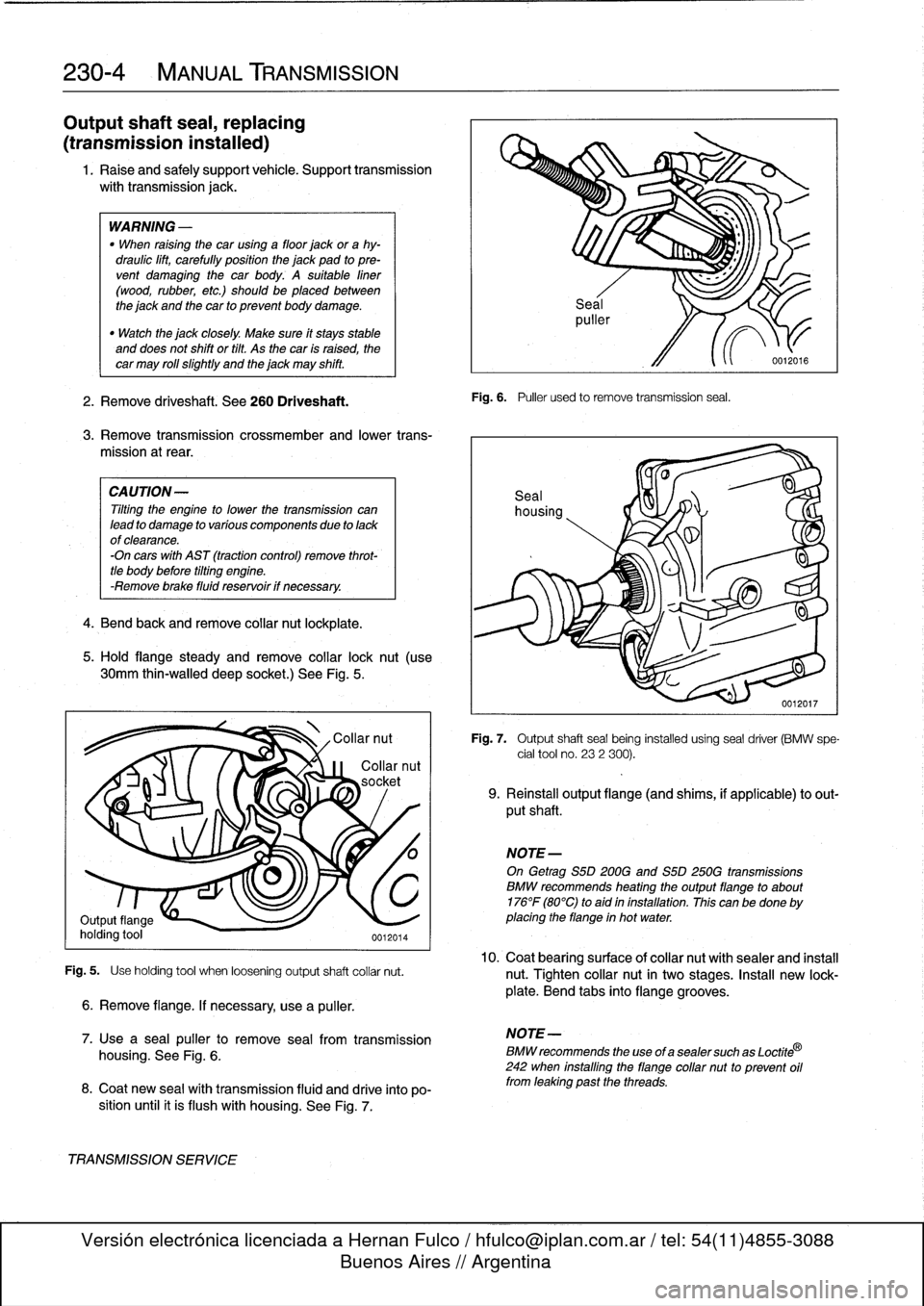
See
Fig
.
5
.
Fig
.
5
.
Use
holding
tool
when
loosening
output
shaft
collar
nut
.
6
.
Remove
flange
.
If
necessary,
use
a
puller
.
7
.
Use
a
sea¡
puller
to
remove
seal
from
transmission
housing
.
See
Fig
.
6
.
8
.
Coat
new
sea¡
wíth
transmission
fluid
and
drive
into
po-
sition
until
it
is
flush
with
housing
.
See
Fig
.
7
.
TRANSMISSIONSERVICE
Fig
.
6
.
Puller
used
to
remove
transmission
seal
.
Fig
.
7
.
Output
shaftseal
being
installed
using
seal
driver
(BMW
spe-
cial
tool
no
.
232
300)
.
9
.
Reinstall
output
flange
(and
shims,
if
applicable)
to
out-
put
shaft
.
NOTE-
On
Getrag
S5D200G
and
S5D
250G
transmissions
BMW
recommends
heating
theoutputflange
to
about
176°F
(80°C)
to
aid
in
installation
.
This
canbe
done
by
placing
the
flange
in
hot
water
.
10
.
Coat
bearingsurface
ofcollar
nut
withsealer
and
install
nut
.
Tighten
collar
nut
in
two
stages
.
Insta¡¡
new
lock-
plate
.
Bend
tabs
into
flange
grooves
.
NOTE-
BMW
recommends
the
use
of
a
sealer
such
as
Loctite
®
242
when
installing
the
flange
collar
nut
to
prevent
oil
from
leaking
past
the
threads
.
Page 225 of 759
11
.
Raise
transmission
and
reinstall
transmission
cross-
member
.
12
.
Install
driveshaft
using
new
nuts
.
See
260
Driveshaft
.
13
.
Check
transmission
oil
leve¡,
topping
up
asnecessary
.
Tightening
Torques
"
Transmission
crossmember
to
chassis
M8
...............
.
...
.
..
22-24
Nm
(16-17
ft-Ib)
M10
..............
.
..
...
..
.
...
42
Nm
(31
ft-Ib)
"
Transmission
outputflange
to
output
shaft
O
001202
2
Z
:Z
ZZZ~
%
_
j
Stage
I.................
..
.
..
190
Nm
(140
ft-Ib)
Stage
II
(after
loosening)
....
.
.
.
..
120
Nm
(89
ft-Ib)
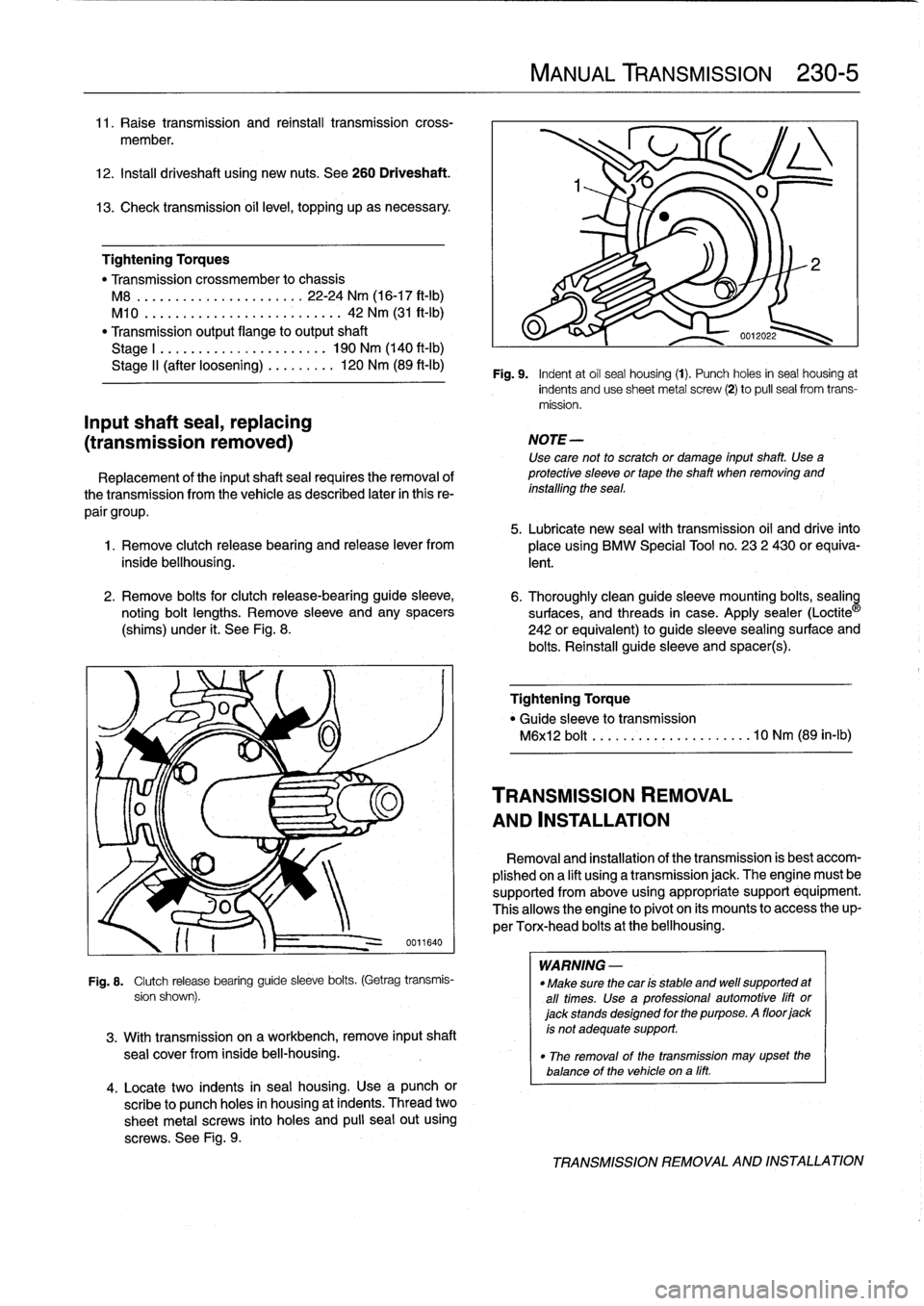
Fi
g
.
9
.
Indent
at
oil
seal
housing
(1)
.
Punch
holes
in
seal
housing
at
Inputshaft
sea¡,
replacing
(transmission
removed)
Replacement
of
the
inputshaft
sea¡
requires
the
removal
of
thetransmission
from
the
vehicle
as
described
later
in
this
re-
pair
group
.
5
.
Lubricate
new
sea¡with
transmission
oil
and
drive
into
1
.
Remove
clutch
release
bearing
and
release
lever
from
placeusing
BMW
Special
Tool
no
.
23
2
430
or
equiva-
inside
bellhousing
.
lent
.
2
.
Remove
bolts
for
clutch
release-bearing
guide
sleeve,
6
.
Thoroughly
cleanguide
sleeve
mounting
bolts,
sealin
noting
bolt
lengths
.
Remove
sleeve
and
any
spacers
surfaces,
and
threads
in
case
.
Apply
sealer
(Loctite
(shims)
under
¡t
.
See
Fig
.
8
.
242
or
equivalent)
to
guide
sleeve
sealingsurface
and
bolts
.
Reinstall
guide
sleeve
and
spacer(s)
.
0011640
Fig
.
8
.
Clutch
release
bearing
guide
sleeve
bolts
.
(Getrag
transmis-
sion
shown)
.
3
.
With
transmission
on
aworkbench,
remove
input
shaft
sea¡
cover
from
inside
bel¡-housing
.
4
.
Locate
two
indents
in
seal
housing
.
Use
a
punch
or
scribe
to
punch
holes
in
housing
at
indents
.
Thread
two
sheetmetal
screws
into
holes
and
pulí
seal
out
using
screws
.
See
Fig
.
9
.
MANUAL
TRANSMISSION
230-
5
indents
anduse
sheetmetal
screw
(2)
to
pul¡
sea¡
from
trans-
mission
.
NOTE-
Use
care
not
to
scratch
or
damage
input
shaft
.
Use
a
protective
sleeve
or
tape
the
shaft
when
removing
and
installing
the
sea¡
.
Tightening
Torque
"
Guide
sleeveto
transmission
M6xl2
bolt
.......
...
.
.
.........
10
Nm
(89
in-lb)
TRANSMISSION
REMOVAL
AND
INSTALLATION
Removal
and
installation
of
the
transmission
is
best
accom-
plished
ona
lift
using
a
transmission
jack
.
The
engine
must
be
supported
from
above
using
appropriate
support
equipment
.
Thisallows
the
engine
to
pivot
on
its
mounts
to
access
theup-
perTorx-head
bolts
at
the
bellhousing
.
WARNING
-
"
Make
sure
thecar
is
stable
and
well
supported
at
all
times
.
Use
a
professional
automotive
lift
or
jack
stands
designed
for
the
purpose
.
A
floor
jack
is
not
adequate
support
.
"
The
removal
of
the
transmission
may
upset
the
balance
of
the
vehicle
ona
líft
.
TRANSMISSION
REMOVAL
AND
INSTALLATION
Page 231 of 759
2
.
On
MS
270R/A4S
310R
transmissions
:
Remove
front
5
.
Installation
is
reverse
of
Rmoval
.
and
rear
oil
sump
mounting
bolts
andremove
sumps
"
Always
replace
sea¡
for
drain
plug
and
al¡
gasket(s)
andand
sump
gaskets
.
O-rings
.
"
Clean
sump
and
sump
magnet(s)
using
a
lint-free
NOTE-
cloth
.
The
MS
270
R/A4S
310
R
transmissions
may
be
fitted
"
On
MS
270R/A4S310R
transmissions
:
Use
new
bolts
with
ASE
(inch)
bolts
.
at
sump
and
tighten
bolts
in-line,
one
after
other
(do
nottighten
bolts
in
a
cross-wise
pattern)
.
3
.
On
A5S
310Z
transmission
:
Remove
oil
sump
mount-
"
On
MS
310Z
transmission,
be
sureto
instan
rounded
ing
bolts
and
brackets,
noting
position
of
brackets
.
Re-
sump
clamping
brackets
at
corners
of
sump
.
move
"
Fill
transmission
with
approved
fluid
.
sump
and
sump
gasket
.
"
Check
fluid
level
as
described
under
ATF
leve¡,
4
.
Remove
ATF
otra¡ner
mount¡ng
screws
and
remove
checking
.
strainer
together
with
gasket
orO-ring
.
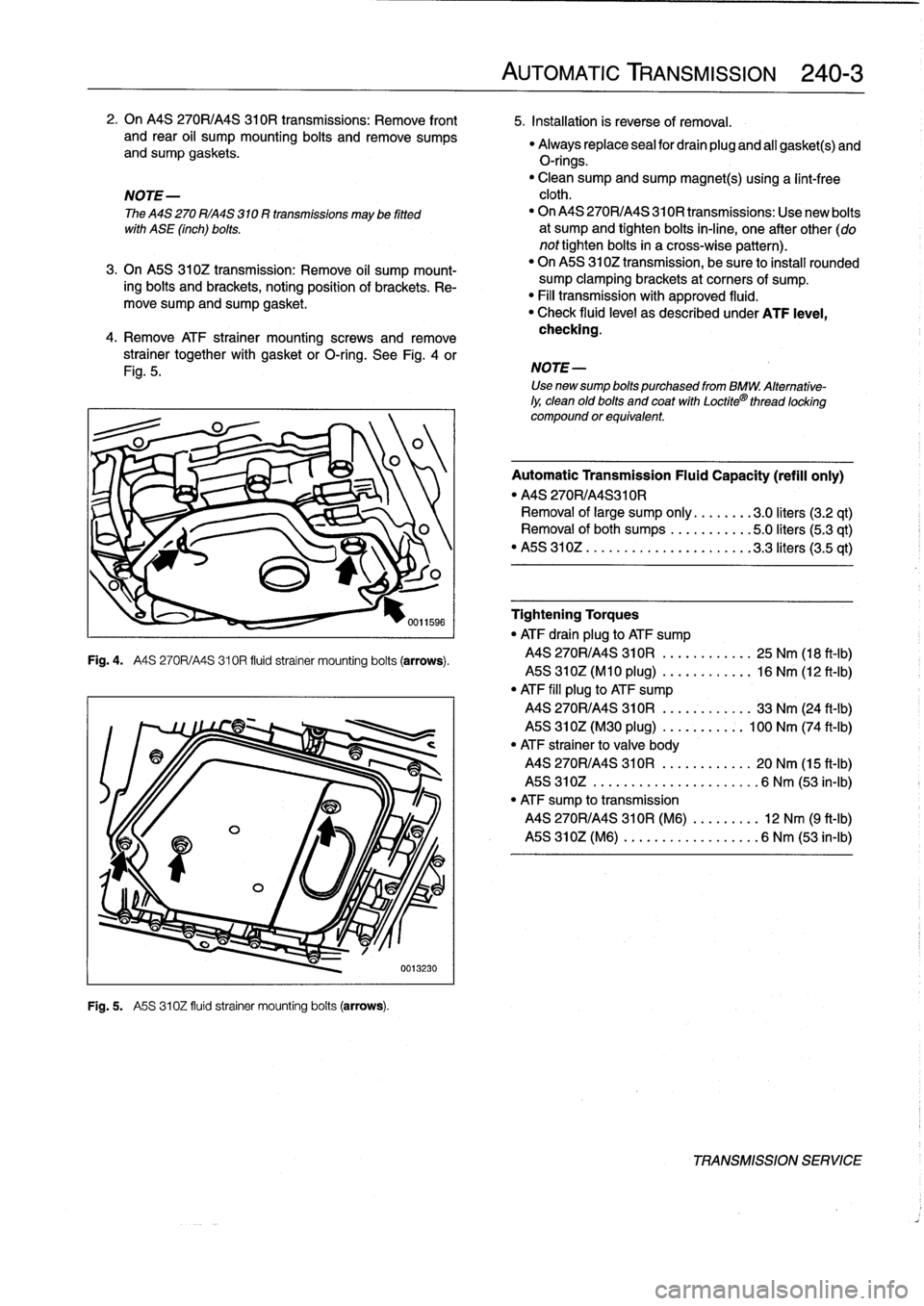
See
Fig
.
4
or
Fig
.
5
.
Fig
.
4
.
A4S
270R/A4S310R
fluid
strainer
mounting
boits
(arrows)
.
Fig
.
5
.
A5S
310Z
fluid
strainer
mounting
boits
(arrows)
.
0013230
AUTOMATIC
TRANSMISSION
240-
3
NOTE-
Use
newsump
bolts
purchased
from
BMW
.
Alternative-
ly,
clean
old
bolts
and
coat
with
Loctite®
thread
locking
compound
or
equivalent
Automatic
Transmission
Fluid
Capacity
(refill
only)
"
MS
270R/A4S310R
Removal
of
large
sump
only
........
3
.0liters
(3.2
qt)
Removal
ofboth
sumps
...........
5
.0liters(5
.3
qt)
"
MS
310Z
..
..
..................
3
.3liters
(3.5
qt)
Tightening
Torques
"
ATF
drain
plug
to
ATF
sump
MS
270R/A4S
310R
..........
..
25
Nm
(18
ft-Ib)
MS
310Z(M10
plug)
..........
..
16
Nm
(12
ft-Ib)
"
ATF
fill
plug
to
ATF
sump
MS
270R/A4S
310R
..........
..
33
Nm
(24
ft-Ib)
MS
310Z(M30
plug)
.....
..
..
:.
100
Nm
(74
ft-Ib)
"
ATF
strainer
to
valve
body
MS
270R/A4S
310R
.....
..
.
...
.
20
Nm
(15
ft-Ib)
MS
310Z
..............
..
.
...
..
6
Nm
(53
in-lb)
"
ATF
sump
to
transmission
MS
270R/A4S
310R
(M6)
.
..
.
..
...
12
Nm
(9
ft-¡b)
MS
310Z
(M6)
..........
..
.
..
...
6
Nm
(53
in-¡b)
TRANSMISSION
SERVICE
Page 234 of 759
240-
6
AUTOMATIC
TRANSMISSION
14
.
Remove
transmission
by
pulling
back
and
down
.
Lower
jack
to
allow
transmission
to
clear
vehicle
.
Tightening
Torques
"
ATF
drain
plug
to
ATF
sump
CA
UTION-
MS
270R/A4S
310R
....
..
....
.
..
25
Nm
(18
ft-Ib)
Do
not
allow
the
torque
converter
to
fati
off
the
ASS
310Z(M10
plug)
..
..
..
.
.
..
.
..
16
Nm
(12
ft-Ib)
transmission
inputshaft
.
"
ATF
fill
plug
to
ATF
sump
MS
270R/A4S
310R
..
..
....
..
..
.
33
Nm
(24
ft-Ib)
15
.
Installation
is
reverse
of
removal,
noting
the
following
:
MS
310Z(M30
plug)
......
.
.
..
.
.
100
Nm
(74
ft-Ib)
"Blowoutofcoolerlineswithlow-pressurecompressed
"
ATF
cooler
lines
(A4S
270R/A4S
310R)
air
and
flush
coolerwith
clean
ATF
twice
before
reat-
Coupling
nuts
............
.
.
..
..
.
20
Nm
(15
ft-Ib)
taching
lines
to
transmission
.
Hollow
bolts
.........
.
.....
..
..
.
37
Nm
(28
ft-Ib)
"
Reinforcing
cross
brace
CAUTION-
to
chassis
(M10)
.............
.
..
.
42
Nm
(31
ft-Ib)
"
Wear
safety
glasses
when
working
with
com-
"
Torque
converter
pressedair
.
to
driveplate
(M10)
.........
..
.
..
45
Nm
(33
ft-Ib)
"
Transmissionsupport
crossmember
to
chassis
"
Do
not
reuse
ATF
after
flushing
.
M8
......................
22-24
Nm
(16-17
ft-1b)
M10
................
.
....
..
.
..
42
Nm
(31
ft-Ib)
"
Install
new
sealing
washers
on
hollow
bolts
.
"
Transmissíon
to
engine
(Torx-head
with
washer)
"
Insta¡¡
new
O-rings
on
transmission
cooler
lines,
where
M8
......................
..
.
..
21
Nm
(15
ft-Ib)
applicable
.
M10
.....................
..
..
.
42
Nm
(31
ft-Ib)
"
Inspect
driveplate
for
cracks
or
elongatedholes
.
Re-
M12
................
.
....
..
.
..
72
Nm
(53ft-Ib)
place
if
necessary
.
"
Check
to
be
sure
torque
converter
is
seated
correctly
in
transmission
during
final
installation
.
"
When
mounting
transmission
to
engine,
the
three
mounting
tabs
on
torque
converter
must
be
aligned
with
indentations
on
driveplate
.
Use
an
alignment
dowel
to
line
up
bolt
holes,
if
necessary
.
"
Fill
transmission
with
clean
ATF
until
oil
leve¡
is
even
with
fill
hole
.
Then
check
fluid
leve¡
as
described
ear-
lier
.
"
Adjust
gearshift
mechanism
.
See
250
Gearshift
link-
age
.
NOTE-
Torx-head
mounting
bolts
shouldalwaysbe
used
with
washers
to
prevent
difficult
removal
.
TRANSMISSION
REMOVAL
AND
INSTALLATION