rack BMW 328i 1997 E36 Repair Manual
[x] Cancel search | Manufacturer: BMW, Model Year: 1997, Model line: 328i, Model: BMW 328i 1997 E36Pages: 759
Page 266 of 759
310-
1
0
FRONT
SUSPENSION
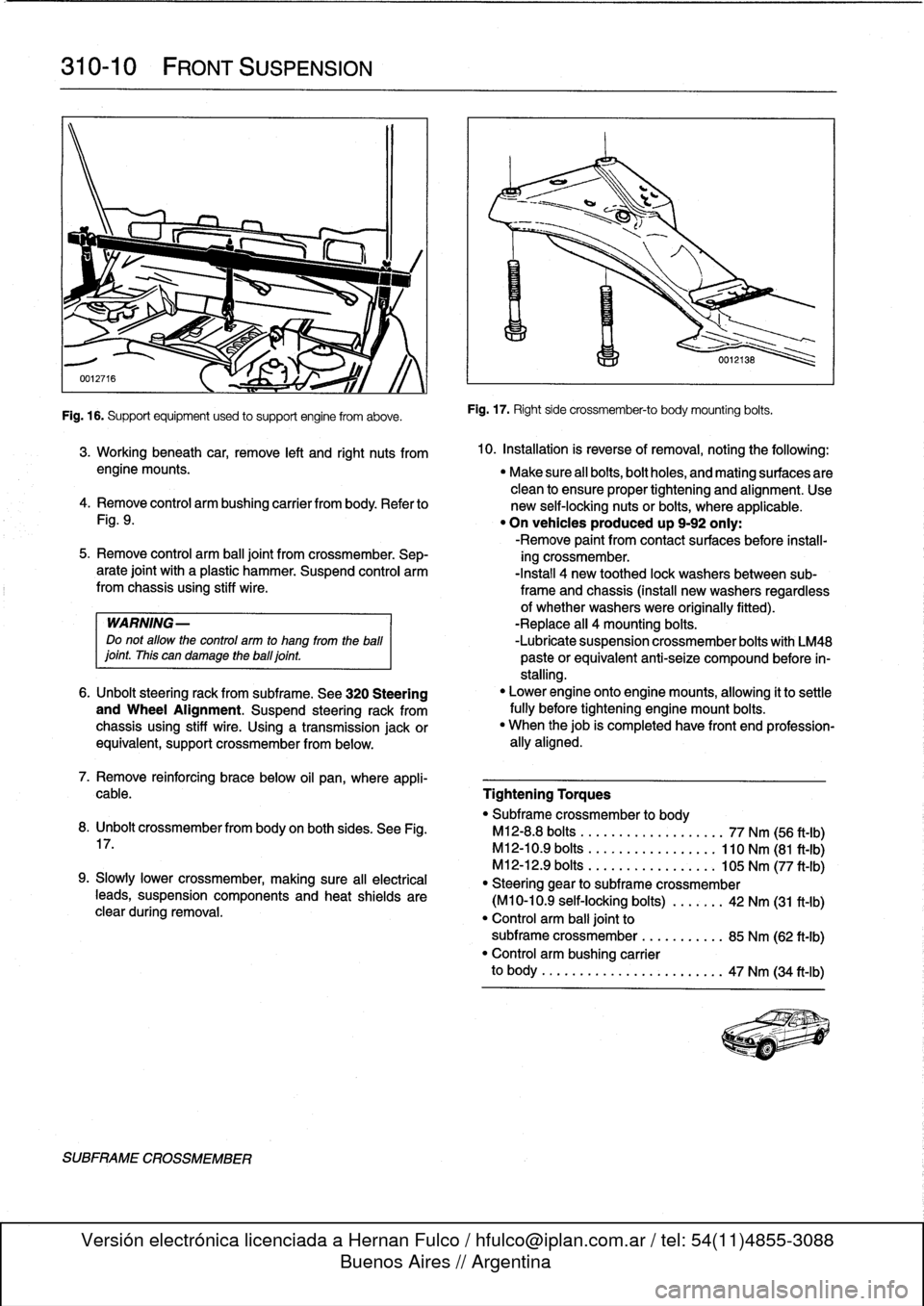
Fig
.
16
.
Supportequipment
used
to
support
engine
from
aboye
.
SUBFRAME
CROSSMEMBER
Fig
.
17
.
Right
side
crossmember-to
body
mounting
bolts
.
3
.
Working
beneath
car,
remove
left
and
right
nuts
from
10
.
Installation
is
reverse
ofremoval,
noting
the
followíng
:
engine
mounts
.
"
Make
sure
all
bolts,bolt
holes,
and
mating
surfaces
are
clean
to
ensure
proper
tightening
and
alignment
.
Use
4
.
Remove
control
arm
bushing
carrier
from
body
.
Refer
to
new
self-locking
nuts
or
bolts,
where
applicable
.
Fig
.
9
.
"
On
vehicles
produced
up
9-92
only
:
-Remove
paint
from
contact
surfaces
before
ínstall-
5
.
Remove
control
arm
ball
joint
from
crossmember
.
Sep-
ing
crossmember
.
arate
joint
with
a
plastic
hammer
.
Suspend
control
arm
-Install
4
new
toothed
lock
washersbetween
sub-from
chassis
using
stiff
wire
.
frame
and
chassis
(install
new
washers
regardless
of
whether
washers
were
originally
fitted)
.
WARNING-
-Replace
all
4
mounting
bolts
.
Do
not
allow
the
control
arm
to
hang
from
the
ball
-Lubrícate
suspension
crossmember
bolts
with
LM48
¡oint
.
This
can
damage
theball¡oint
.
paste
orequivalent
anti-seize
compound
before
ín-
stalling
.
6
.
Unbolt
steering
rack
from
subframe
.
See
320
Steering
"
Lower
engine
onto
enginemounts,
allowing
it
to
settle
and
Wheel
Alignment
.
Suspend
steering
rack
from
fully
before
tightening
engine
mount
bolts
.
chassis
using
stiff
wire
.
Using
a
transmission
jackor
"
When
thejob
is
completed
have
front
end
profession-
equivalent,
support
crossmember
from
below
.
ally
aligned
.
7
.
Remove
reinforcing
brace
below
oil
pan,
where
appli-
cable
.
Tightening
Torques
"
Subframe
crossmember
to
body
8
.
Unbolt
crossmemberfrom
body
on
both
sides
.
See
Fig
.
M12-8
.8
bolts
..................
.
77
Nm
(56
ft-Ib)
17
.
M12-10
.9
bolts
.................
110
Nm
(81
ft-Ib)
M12-12
.9
bolts
............
.
...
.
105
Nm
(77
ft-Ib)
9
.
Slowly
Lower
crossmember,
making
sure
all
electrical
"
Steering
gear
to
subframe
crossmember
teads,
suspension
components
and
heat
shields
are
(M10-10
.9
self-locking
bolts)
..
.
.
.
.
.
42
Nm
(31
ft-Ib)
clear
during
removal
.
"
Control
arm
balljoint
to
subframe
crossmember
...
.......
.
85
Nm
(62
ft-Ib)
"
Control
arm
bushing
carrier
to
body
..........
...
.
.....
.
..
..
47
Nm
(34
ft-Ib)
Page 267 of 759
320
Steering
and
Wheel
Alignment
GENERAL
...
.
.
.
...
.
....
.
.
.
.
.
.
.
.
.
...
.
.
320-1
Outer
tie
rod
end,
replacing
.
...
.
.
.
.
.
.
.
...
.
320-4
Tie
rod,
replacing
.
.
.
.
.
.
.
.......
.
.
.
.
.
...
.
320-5
STEERING
WHEEL
320-1
Steering
wheel,
removing
and
installing
.....
320-1
WHEEL
ALIGNMENT
.
.
.
.........
.
.....
.320-5
POWER
STEERING
SYSTEM
.
.
.
.
.
.
.....
320-2
Front
Toe-in
and
Toe
Difference
Angle
.
.
...
.
320-6
Power
steering
pump,
Rear
Toe-in
.
.
.
.
.
.
.
...
.
................
320-6
removing
and
installing
..
.
.
.
.
.
.
.
.
.
.....
320-2
Wheel
Alignment
Specifications
.....
.
......
320-6
Power
steering
system,
bleeding
and
filling
.
.
320-3
STEERING
GEAR
.
.
.
.
...
.
.
.
.
.
.
.
.
.
.....
320-3
Steering
gear
rack,
removing
and
installing
.
...
.
..
.
..
..
..
.
..
.
320-3
GENERAL
STEERING
WHEEL
This
repair
group
covers
servicing
of
the
mechanical
and
The
BMW
E36
is
equipped
with
an
SRS
airbag
mounted
in
hydraulic
components
of
the
steering
system,
including
wheel
the
steering
wheel
.
Improper
handling
of
the
airbag
could
alignment
information
.
cause
serious
injury
.
The
airbag
is
an
explosivedevice
and
should
be
treated
with
extreme
caution
.
Always
follow
the
air-
The
variable-assist
power
steering
system
consistsof
an
bag
removal
procedure
as
outlined
in
721
Airbag
System
engine-driven
hydraulic
pump,
a
rack-and-pinion
steering
(SRS)
.
gear
assembly
with
an
integral
hydraulic
control
valve,
and
connecting
linkage
to
the
road
wheels
.
WARNING-
"
The
BMW
Supplemental
Restraint
System
(SRS)
At
lowspeeds,
maximum
power
assist
is
provided
to
ease
is
complex
and
special
precautions
must
be
ob-
parking
and
city
driving
.
At
high
speeds,
assist
is
reduced
to
served
when
servicing
.
Serious
injury
may
result
ensure
stability
.
The
power
steering
system
varies
assist
if
system
service
is
attempted
by
persons
unfa-
based
on
engine
speed
.
miliar
with
the
BMW
SRS
and
its
approved
ser-
vice
procedures
.
BMW
specifies
that
all
ING-
inspection
and
service
shouldbe
performed
by
WARN
an
authorized
BMW
dealer
.
"
Do
not
reuse
self-locking
nuts
.
They
are
de-signed
to
beused
only
once
and
may
failif
re-
"
BMW
Supplemental
Restraint
Systems
(SRS)
used
.
Always
replace
them
with
new
locking
nuts
.
are
equipped
with
a
back-up
power
supply
inside
the
SRS
control
module
.
A
10minute
waiting
"
Do
not
ínstall
bolts
and
nuts
coated
with
under-
shouldbe
observed
after
the
battery
cable
has
coating
wax,
as
correct
tightening
torque
cannot
been
disconnected
.
This
will
allow
the
reserve
be
assured
.
Always
clean
the
threads
with
sol-
power
supply
to
discharge
.
vent
before
installation,
or
install
new
parts
.
"
Do
not
attempt
to
weldor
straighten
any
steering
components
.
Always
replace
damaged
parts
.
NOTE-
For
information
on
steering
column-mounted
switches
and
the
ignition
lock,
see
612
Switches
and
Electrical
Accessories
.
STEERING
AND
WHEEL
ALIGNMENT
320-1
Caster
and
Camber
.
.
.
.
.
...........
.
....
320-5
TABLES
a
.
Front
Wheel
Alignment
Specifications
.
...
.......
320-6
b
.
Rear
Wheel
Alignment
Specifications
.
...
.......
320-6
Steering
wheel,
removing
and
installing
1
.
Center
steering
wheel
.
Make
sure
front
wheelsare
pointed
straight
ahead
.
2
.
Disconnect
negative
(-)
cable
from
battery
and
cover
terminal
with
insulating
material
.
CAUTION-
Prior
to
disconnectiog
the
battery,
read
the
battery
disconnection
cautions
given
at
the
front
of
this
manual
on
page
viii
.
STEERING
WHEEL
Page 269 of 759
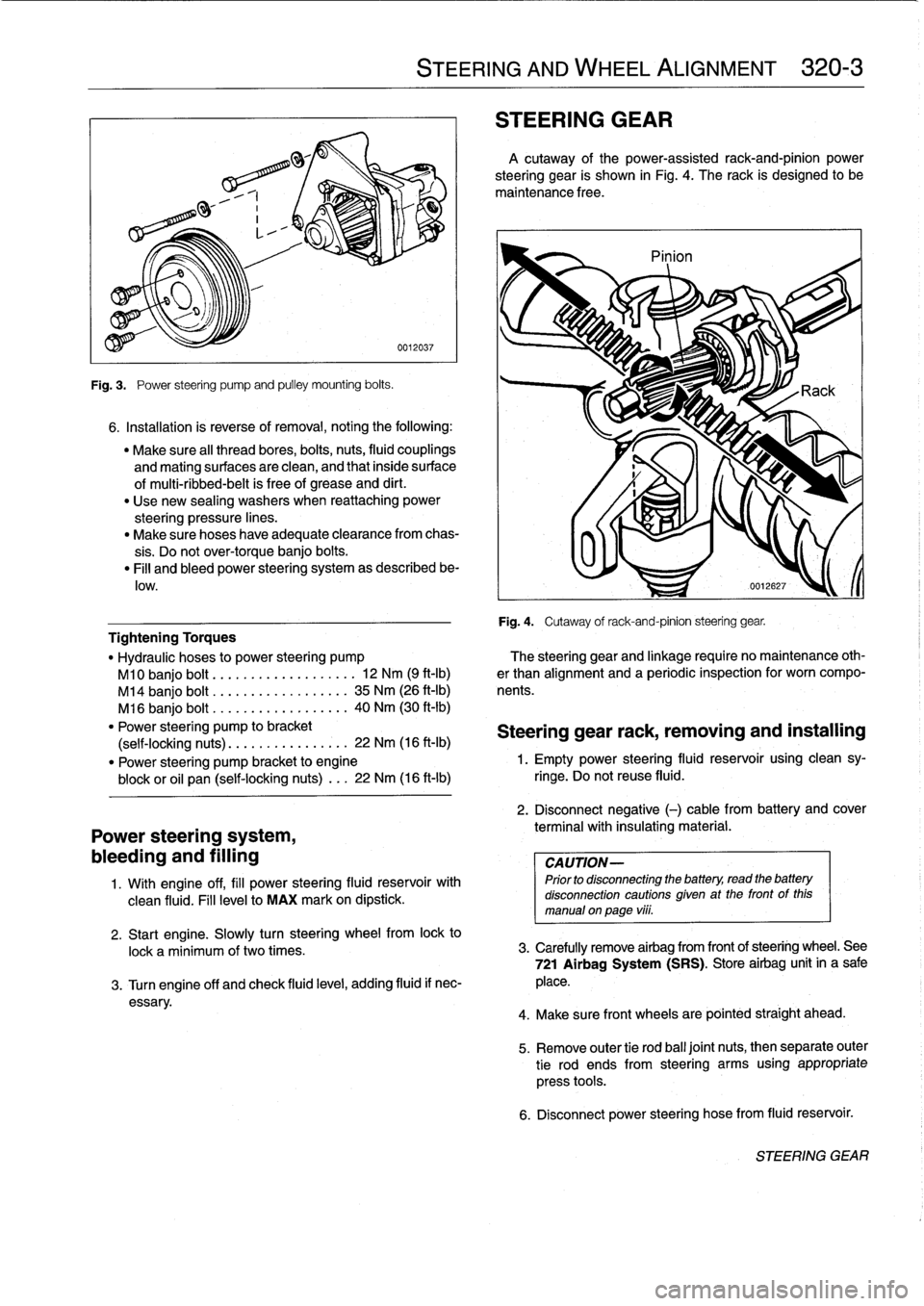
Fig
.
3
.
Power
steering
pump
and
pulley
mounting
bolts
.
6
.
Installation
is
reverse
of
removal,
noting
the
following
:
"
Make
sure
al¡
thread
bores,
bolts,
nuts,
fluid
couplings
and
mating
surfaces
are
clean,
and
that
inside
surface
of
multi-ribbed-belt
is
free
of
grease
and
dirt
.
"
Use
new
sealing
washers
when
reattaching
power
steering
pressure
lines
.
"
Make
sure
hoses
have
adequate
clearance
from
chas-
sis
.
Do
not
over-torque
banjo
bolts
.
"
Fill
and
bleed
power
steering
system
as
described
be-
low
.
Power
steering
system,
bleeding
and
filling
1
.
Wíth
engine
off,
fill
power
steering
fluid
reservoir
with
clean
fluid
.
Fill
levelto
MAX
mark
on
dipstick
.
STEERING
AND
WHEEL
ALIGNMENT
320-
3
STEERING
GEAR
A
cutaway
of
the
power-assisted
rack-and-pinion
power
steering
gear
is
shown
in
Fig
.
4
.
The
rack
is
designed
to
be
maintenance
free
.
Pinion
Fig
.
4
.
Cutaway
of
rack-and-pinion
steering
gear
.
Tightening
Torques
"
Hydraulic
hoses
to
power
steering
pump
?he
steering
gear
and
linkage
require
no
maintenance
oth-
M10
banjo
bolt
.........
..
.
...
...
.
12
Nm
(9
ft-Ib)
er
than
alignment
and
a
periodic
inspection
for
worn
compo
M14
banjo
bolt
..............
..
..
35
Nm
(26
ft-Ib)
nents
.
M16
banjo
bolt
..............
...
.
40
Nm
(30
ft-Ib)
"
Power
steering
pump
to
bracket
Steering
gear
rack,
removing
and
installing
(self-locking
nuts)
.............
..
.
22
Nm
(16
ft-Ib)
"
Power
steering
pump
bracket
to
engine
1
.
Empty
power
steering
fluid
reservoir
using
clean
sy-
block
or
oil
pan
(self-locking
nuts)
...
22
Nm
(16
ft-lb)
ringe
.
Do
not
reuse
fluid
.
2
.
Disconnect
negative
(-)
cable
from
battery
and
cover
terminal
with
insulating
material
.
CAUTION-
Prior
to
disconnectiog
the
battery,
read
the
battery
disconnection
cautions
given
at
the
front
of
this
manual
on
page
viii
.
2
.
Start
engine
.
Slowly
turn
steering
wheelfrom
lock
to
lock
a
minimum
of
two
times
.
3
.
Carefully
remove
airbag
from
frontof
steering
wheel
.
See
721
Airbag
System
(SRS)
.
Store
airbag
unit
in
a
sale
3
.
Turn
engine
off
and
check
fluid
leve¡,
adding
fluid
if
nec-
place
.
essary
.
4
.
Make
sure
front
wheelsare
pointed
straight
ahead
.
5
.
Remove
outer
tie
rod
ball
joínt
nuts,
thenseparate
outer
tie
rod
ends
from
steering
arms
using
appropriate
press
tools
.
6
.
Disconnect
power
steering
hose
from
fluid
reservoir
.
STEERING
GEAR
Page 271 of 759
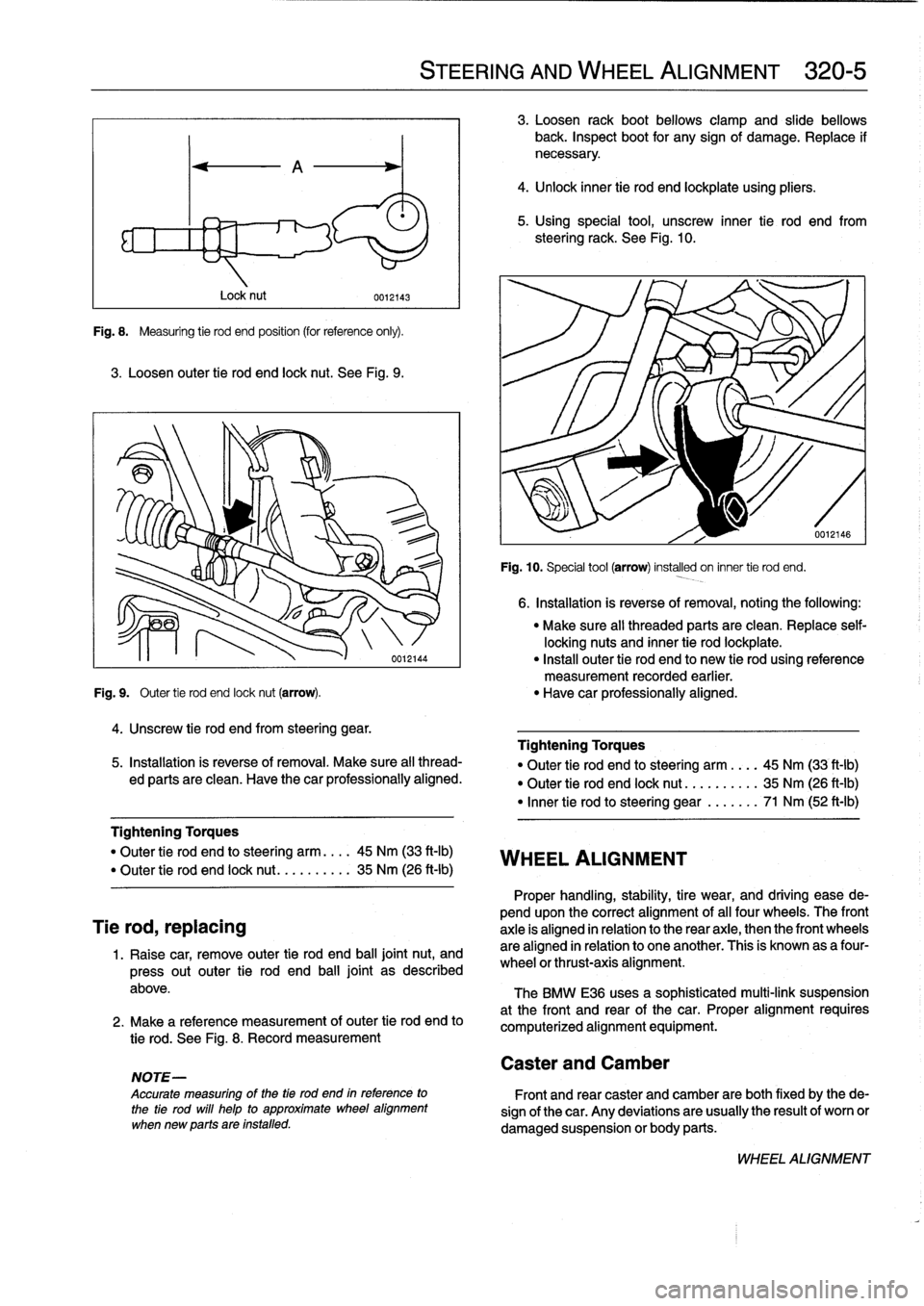
Fig
.
8
.
Measuring
tie
rod
end
position
(for
reference
only)
.
3
.
Loosen
outer
tie
rod
end
lock
nut
.
See
Fig
.
9
.
Lock
nut
4
.
Unscrew
tie
rod
end
from
steering
gear
.
0012143
"
Make
sure
all
threaded
parts
are
clean
.
Replace
self-
locking
nuts
and
inner
tie
rod
lockplate
.
"
Install
outer
tie
rod
end
to
new
tie
rod
using
reference
measurement
recorded
earlier
.
Fig
.
9
.
Outer
tie
rod
end
lock
nut
(arrow)
.
"
Have
car
professionally
aligned
.
5
.
Installation
is
reverse
of
removal
.
Make
sure
all
thread-
ed
parts
are
clean
.
Have
thecar
professionally
aligned
.
Tightening
Torques
"
Outer
tie
rod
end
losteering
arm
....
45
Nm
(33
ft-Ib)
"
Outer
tie
rod
end
lock
nut
..
.......
.
35
Nm
(26
ft-Ib)
Tie
rod,
replacing
1
.
Raise
car,
remove
outer
tie
rod
end
ball
jointnut,
and
press
out
outer
tie
rod
end
ball
joint
as
described
above
.
2
.
Make
a
reference
measurement
of
outer
tie
rod
end
to
tie
rod
.
See
Fig
.
8
.
Record
measurement
NOTE-
Accurate
measuring
of
the
tía
rod
end
in
reference
to
the
tie
rod
will
help
to
approximate
wheel
alignment
when
new
parts
are
installed
.
STEERING
AND
WHEEL
ALIGNMENT
320-
5
3
.
Loosen
rack
boot
bellows
clamp
and
slide
bellows
back
.
Inspect
boot
for
any
signof
damage
.
Replace
if
necessary
.
4
.
Unlock
inner
tie
rod
end
lockplate
using
pliers
.
5
.
Using
special
tool,
unscrew
inner
tie
rod
end
from
steeringrack
.
See
Fig
.
10
.
WHEEL
ALIGNMENT
Caster
and
Camber
Fig
.
10
.
Special
tool
(arrow)
installed
on
inner
tie
rod
end
.
6
.
Installation
is
reverse
of
removal,
noting
the
following
:
Tightening
Torques
"
Outer
tie
rod
end
to
steering
arm
..
.
.
45
Nm
(33
ft-Ib)
"
Outer
tie
rod
end
lock
nut
..........
35
Nm
(26
ft-Ib)
"
Inner
tie
rod
to
steering
gear
.......
71
Nm
(52
ft-Ib)
Proper
handling,
stability,
tire
wear,
and
driving
ease
de-
pendupon
the
correct
alignment
of
al¡
four
wheels
.
The
front
axle
is
aligned
in
relation
to
the
rear
axie,
then
the
front
wheels
are
aligned
in
relation
to
one
another
.
This
is
known
as
a
four-
wheel
or
thrust-axis
alignment
.
The
BMW
E36
uses
a
sophisticated
multi-link
suspension
at
the
front
and
rear
of
the
car
.
Proper
alignment
requires
computerized
alignment
equipment
.
Front
and
rear
caster
and
Camber
are
both
fixed
by
the
de-
sign
of
the
car
.
Any
deviations
are
usually
the
result
of
worn
or
damaged
suspension
or
body
parts
.
WHEEL
ALIGNMENT
Page 274 of 759
330-2
REAR
SUSPENSION
Table
a
.
Rear
RideHeight
Specifications
Wheel
size
318,323,
325,
M3
modeis
328
modeis
17inch
std
.
suspension
546
mm
(21.69
in)
sport
suspension
~
535
mm
(21.06
in)
1
540
mm
(21
.26
in)
Maximum
variation
between
sides
:
10
mm
(0
.4in)
Maximum
deviation
from
specifications
:
10
mm
(0
.4in)
SHOCK
ABSORBERS
AND
SPRINGS
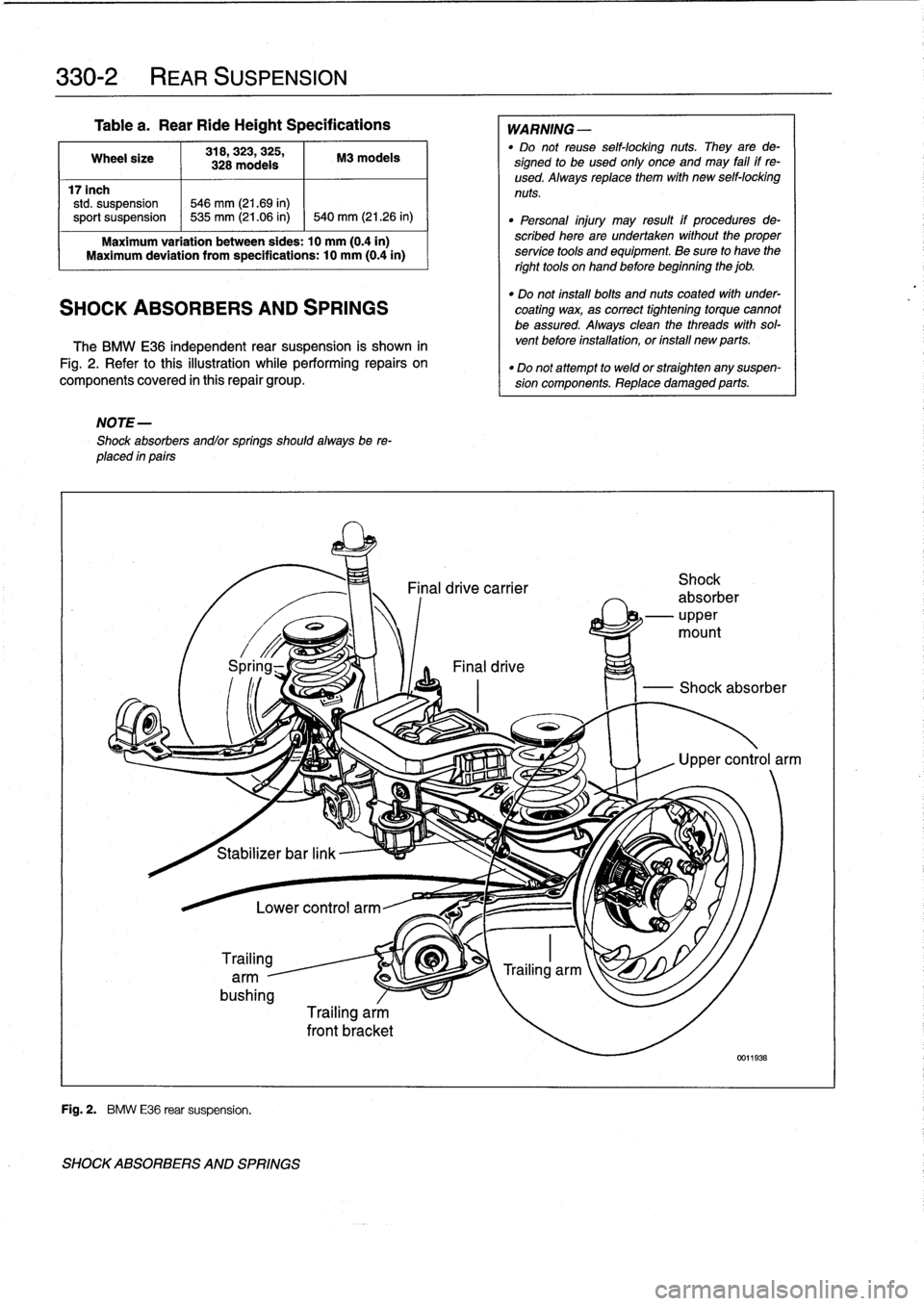
The
BMW
E36
independent
rear
suspension
is
shown
in
Fig
.
2
.
Refer
tothis
illustration
while
performing
repairs
on
components
covered
in
this
repair
group
.
NOTE-
Shock
absorbers
andlor
springs
shouldalways
be
re-
placed
in
pairs
i
Stabilizer
bar
link
Trailing
arm
-
bushing
Fig
.
2
.
BMW
E36
rear
suspension
.
SHOCK
ABSORBERS
AND
SPRINGS
Lower
control
arm
Trailing
arm
front
bracket
WARNING
-
"
Do
not
reuse
self-locking
nuts
.
They
arede-
signed
to
beused
only
once
and
may
fail
if
re-
used
.
Always
replace
them
with
new
self-locking
nuts
.
"
Personal
injury
may
result
if
procedures
de-
scribed
here
are
undertaken
without
the
proper
service
tools
and
equipment
.
Be
sure
to
have
the
right
tools
onhand
before
beginning
the
job
.
"
Do
not
install
bolts
and
nuts
coated
with
under-
coating
wax,
as
correct
tightening
torque
cannot
be
assured
.
Always
clean
the
threads
with
sol-
vent
before
installation,
or
ínstall
new
parts
.
"
Do
not
attempt
to
weld
or
straighten
any
suspen-
sion
components
.
Replace
damaged
parts
.
Page 280 of 759
330-
8
REAR
SUSPENSION
CV
boot,
replacing
NOTE-
"
The
outer
CV
joint
cannot
be
removed
from
the
axle
shaft
.
In
order
to
replace
the
outer
CV
boot,
it
is
nec-
essary
to
remove
the
inner
joint
and
boot
first
.
"
If
the
CV
joints
are
worn
or
defective,
acomplete
re-
built
axle
shaft
is
available
from
an
authorized
BMW
dealerparts
department
.
1
.
Remove
drive
axle
from
car
as
described
above
.
2
.
Remove
inner
and
outer
CV
boot
clamping
bands
and
cut
old
boots
off
joints
and
shaft
.
Clean
grease
from
joints
.
3
.
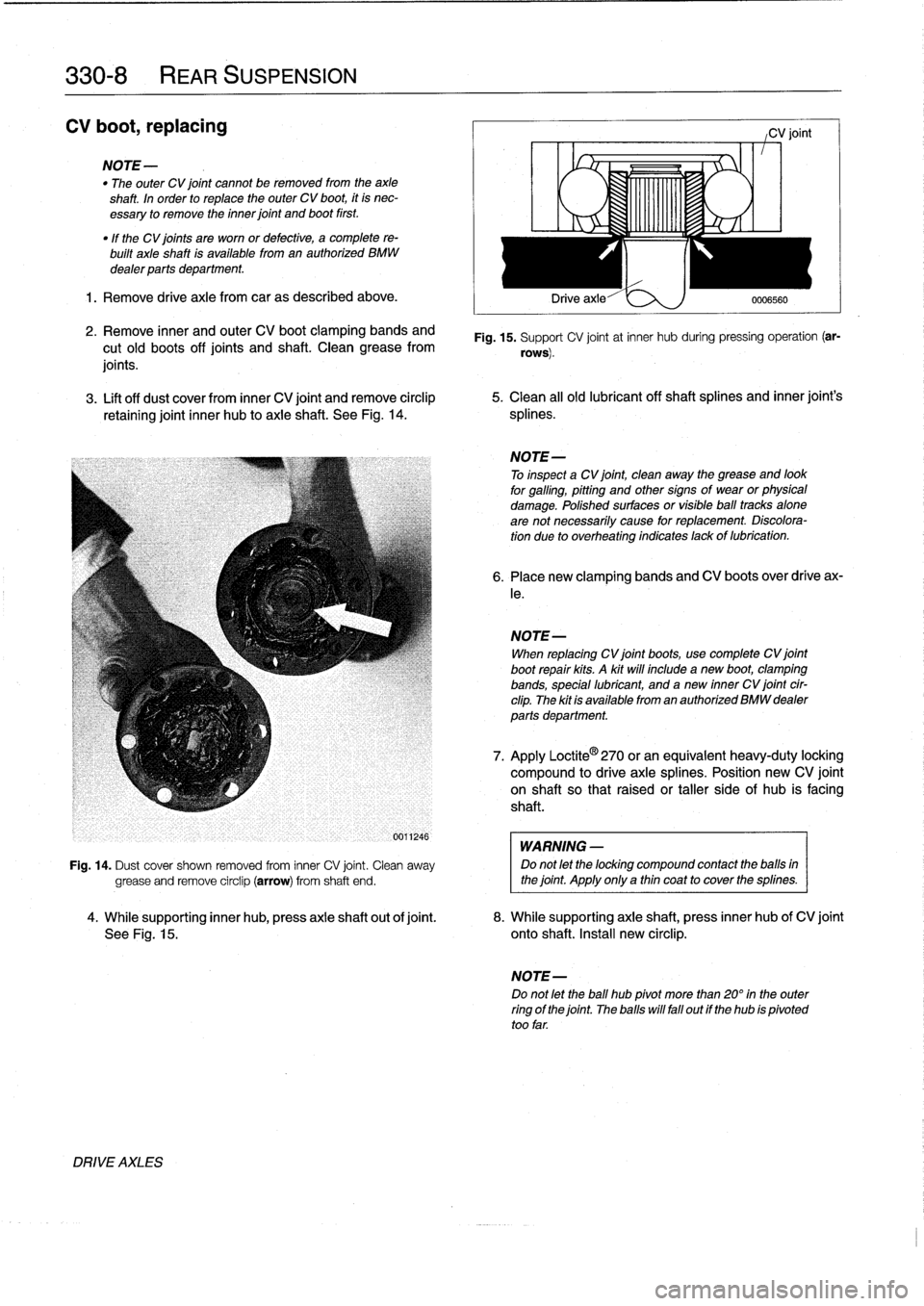
Lift
off
dust
cover
from
inner
CV
joint
and
remove
circlip
5
.
Clean
all
old
lubricantoff
shaftsplines
and
inner
joint's
retaining
joint
inner
hub
to
axle
shaft
.
See
Fig
.
14
.
splines
.
DRIVE
AXLES
-0
1
,
1
1,1
1
L
"I
C
OYA
Drive
axle-"
e
:>,
)
0006560
CV
joint
Fig
.
15
.
Support
CV
joint
at
inner
hub
duringpressing
operation
(ar-
rows)
.
NOTE-
To
inspect
a
CV
joint,
clean
away
the
grease
and
look
for
galling,pittihg
and
othersigns
of
wear
or
physical
damage
.
Polished
surfaces
or
visible
ball
tracks
alone
are
not
necessarily
cause
for
replacement
.
Discolora-
tion
due
to
overheating
indicates
lackof
lubrication
.
6
.
Place
new
clamping
bands
and
CV
boots
over
drive
ax-
le
.
NOTE-
When
replacing
CV
joint
boots,
usecomplete
CV
joint
boot
repair
kits
.
A
kit
will
include
a
new
boot,
clamping
bands,
special
lubricant,
and
anew
inner
CV
joint
cir-
clip
.
The
kit
is
available
from
an
authorized
BMW
dealer
parts
department
.
7
.
Apply
Loctite
®
270
or
an
equívalent
heavy-duty
lockíng
compound
to
drive
axlesplines
.
Position
new
CV
joint
on
shaft
so
that
raisedor
taller
side
of
hub
is
facing
shaft
.
WARNING
-
Fig
.
14
.
Dust
cover
shown
removed
from
inner
CV
joint
.
Clean
away
Do
not
let
the
locking
compound
contact
the
balls
in
grease
and
remove
circlip
(arrow)
from
shaft
end
.
the
joint
.
Apply
only
a
thin
coat
to
cover
the
splines
.
4
.
While
supporting
inner
hub,
press
axle
shaft
out
of
joint
.
8
.
While
supporting
axle
shaft,
press
inner
hub
of
CV
joint
See
Fig
.
15
.
onto
shaft
.
Install
new
circlip
.
NOTE-
Do
not
let
the
ball
hub
pivot
more
than
20°
in
the
outer
ring
of
the
joint
.
The
halls
will
fall
out
if
the
hub
ís
pivoted
too
far
.
Page 281 of 759
9
.
Packeach
CV
joint
and
rubber
boot
with
specified
REAR
SUSPENSION
ARMS
amount
of
lubricant
supplied
.
Apply
adhesive
to
large
end
of
boot
and
mount
it
on
joint
.
Secure
boot
with
clamps
.
The
trailing
arms,
control
arms
and
their
mountingbushings
Apply
sealer
to
inner
CV
joint
dust
cover
and
instan
.
control
the
position
of
the
rear
wheels
.
A
damaged
suspen-
sion
arm
or
worn
bushings
will
change
the
rear
wheel
align
NOTE-
ment
and
may
adversely
affect
handling
and
stability
.
"
Before
installing
each
small
boot
clamp
be
sure
to
"burp"
the
boot
by
flexing
the
CV
joint
as
far
overas
it
WARNING
will
go
.
A
small
screw-driver
inserted
between
the
Do
notattempt
to
straighten
a
damaged
suspension
boot
and
the
axle-shaft
will
help
the
process
.
arm
.
Bending
or
heating
may
weaken
the
original
"
BMW
recommends
Bostil101513
or
EppleC4851
ad-
part
.
If
the
suspension
arm
shows
any
signs
of
hesive,
and
Epple®39
or
Curil©T
sealer
damage
or
excessive
corrosion,
it
must
be
re-
placed
.
CV
Joint
Lubricant
Capacity
"
Wheel
hub
end
ex
.
M3
..
..
.
....
.
.............
80
gram
(2.8
oz
.)
M3
..
...
.
..
.................
100
gram
(3
.5
oz
.)
"
Finaldrive
end
.................
85
gram
(3
.0
oz
.)
10
.
Install
drive
axle
as
described
earlier
.
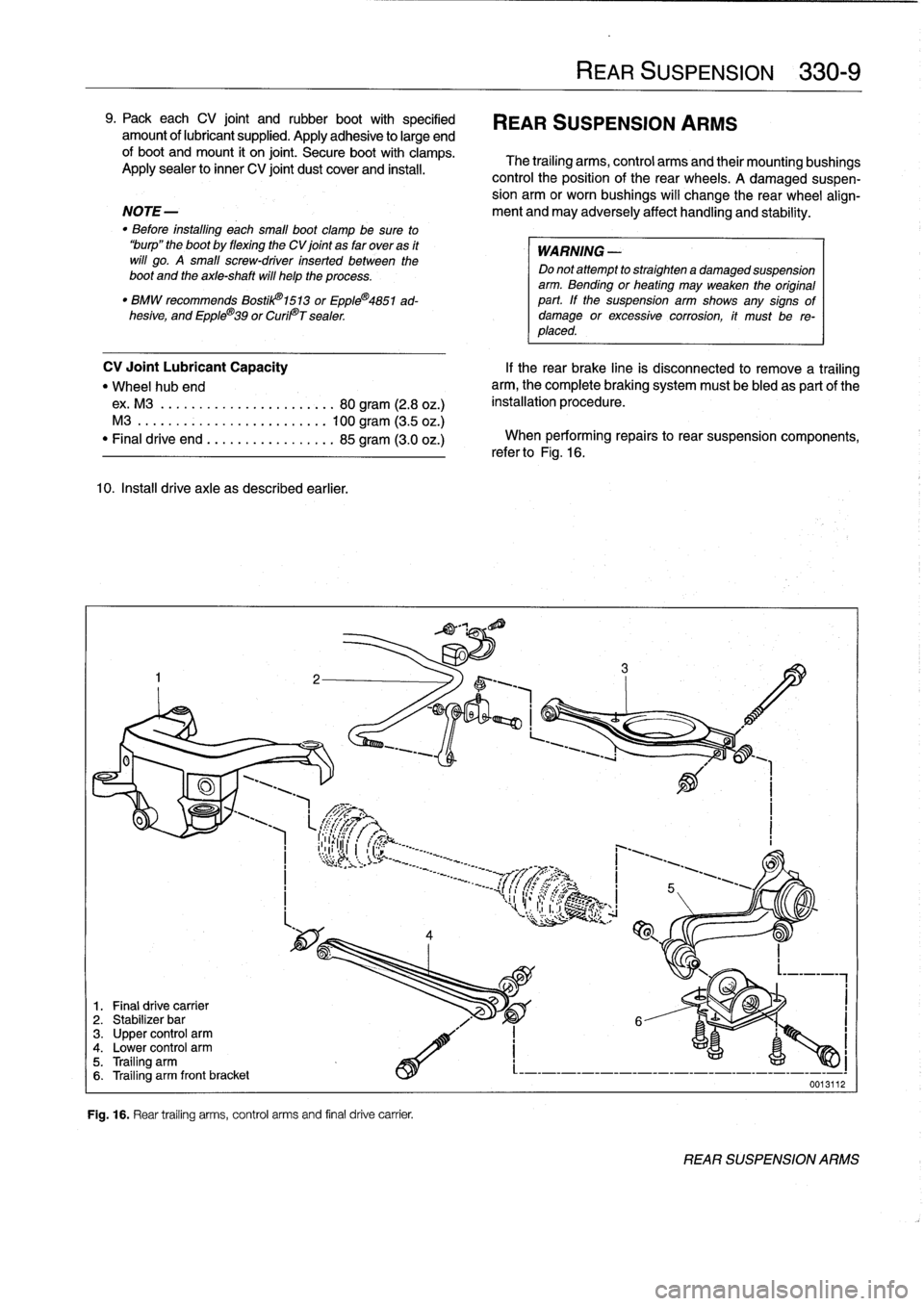
1
.
Final
drive
carrier
2
.
Stabilizer
bar
3
.
Upper
control
arm4
.
Lower
control
arm5
.
Trailing
arm6
.
Trailing
arm
front
bracket
Fig
.
16
.
Rear
trailing
arms,
control
arms
and
final
drive
carrier
.
If
the
rear
brake
cine
is
disconnected
to
remove
a
trailing
arm,
the
complete
braking
system
must
be
bled
as
partof
the
installation
procedure
.
When
performing
repairs
to
rear
suspension
components,
refer
to
Fig
.
16
.
REAR
SUSPENSION
330-
9
0013112
REAR
SUSPENSION
ARMS
Page 282 of 759
330-
1
0
REAR
SUSPENSION
Trailing
arm,
removing
and
installing
1
.
Raise
rear
end
of
car
and
remove
wheel
.
WARNING
-
Make
sure
that
the
car
is
firmly
supported
on
jack
standsdesigned
for
the
purpose
.
Place
the
jack
standsbeneatha
structural
chassis
point
.
Do
not
place
jack
stands
under
suspension
parts
.
2
.
Remove
drive
axle
as
described
earlier
.
3
.
Remove
brake
rotor
and
caliper
as
described
in
340
Brakes
.
Do
not
remove
brake
line
from
caliper
.
Hang
caliper
from
body
with
wire
.
4
.
Remove
parking
brakecable
frombrake
shoe
expand-
er
.
See
340
Brakes
.
5
.
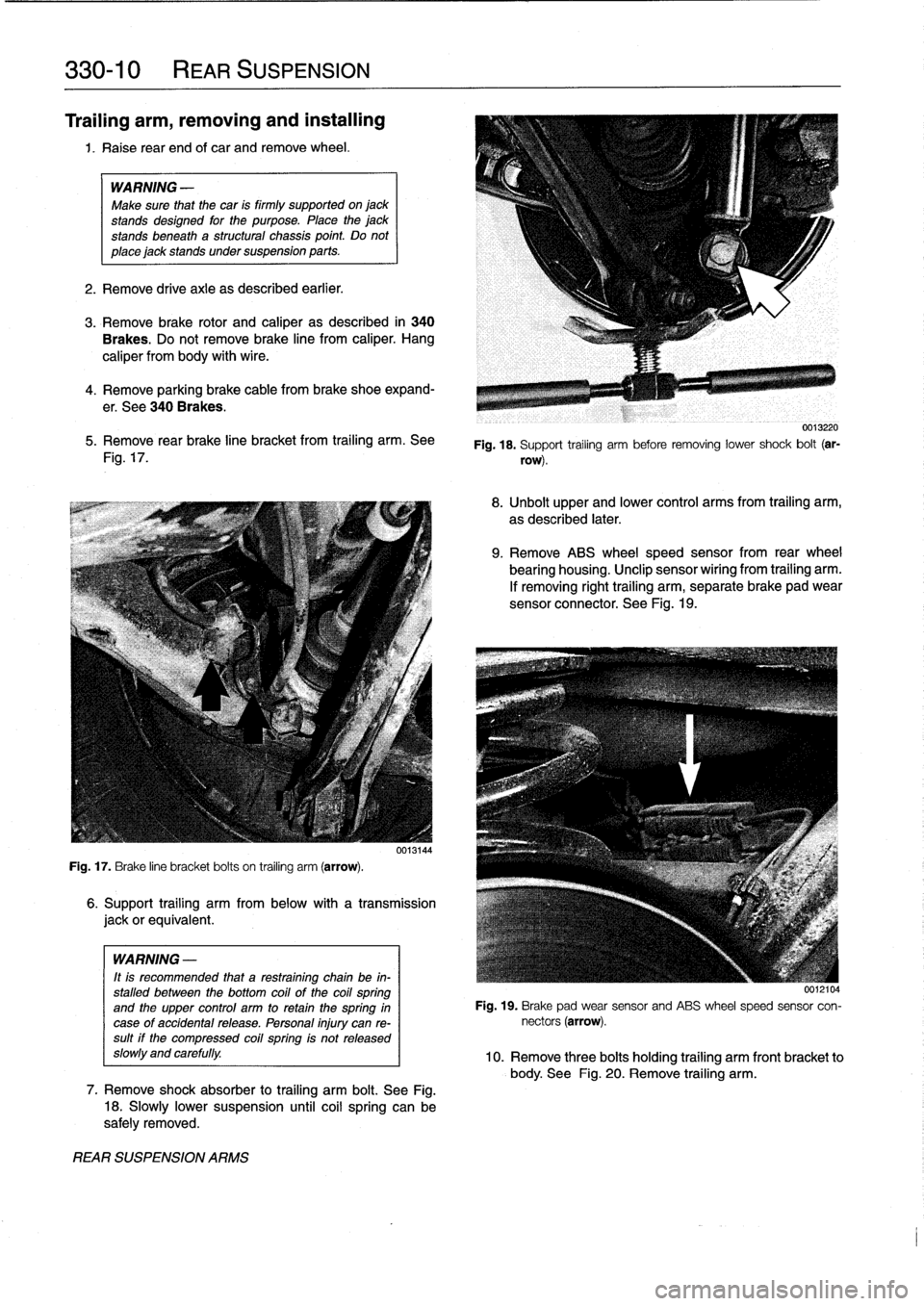
Remove
rear
brake
line
bracket
from
trailing
arm
.
See
Fig
.
17
.
Fig
.
17
.
Brake
line
bracket
bolts
on
trailing
arm
(arrow)
.
WARNING
-
It
is
recommended
that
a
restraining
chain
be
in-
stalled
between
the
bottom
coil
of
the
coil
spring
and
the
upper
control
arm
to
retainthe
spring
in
case
of
accidentalrelease
.
Personal
injury
can
re-sult
if
the
compressed
coil
spring
is
not
released
slow1y
and
carefully
.
REAR
SUSPENSION
ARMS
6
.
Support
trailing
arm
from
below
with
a
transmission
jackorequivalent
.
7
.
Remove
shock
absorber
to
trailing
arm
bolt
.
See
Fig
.
18
.
Slowly
lower
suspension
until
coil
spring
can
be
safely
removed
.
0013220
Fig
.
18
.
Support
trailing
arm
before
removing
lower
shock
bolt
(ar-
row)
.
8
.
Unbolt
upper
and
lower
control
arms
from
trailing
arm,
as
described
later
.
9
.
Remove
ABS
wheel
speed
sensor
from
rear
wheel
bearing
housing
.
Unclip
sensor
wiríng
from
trailing
arm
.
If
removing
right
trailing
arm,
separate
brake
pad
wear
sensor
connector
.
See
Fig
.
19
.
0012104
Fig
.
19
.
Brake
pad
wear
sensor
and
ABS
wheel
speed
sensor
con-
nectors
(arrow)
.
10
.
Remove
three
bolts
holding
trailing
arm
front
bracket
to
body
.
See
Fig
.
20
.
Remove
trailing
arm
.
Page 283 of 759
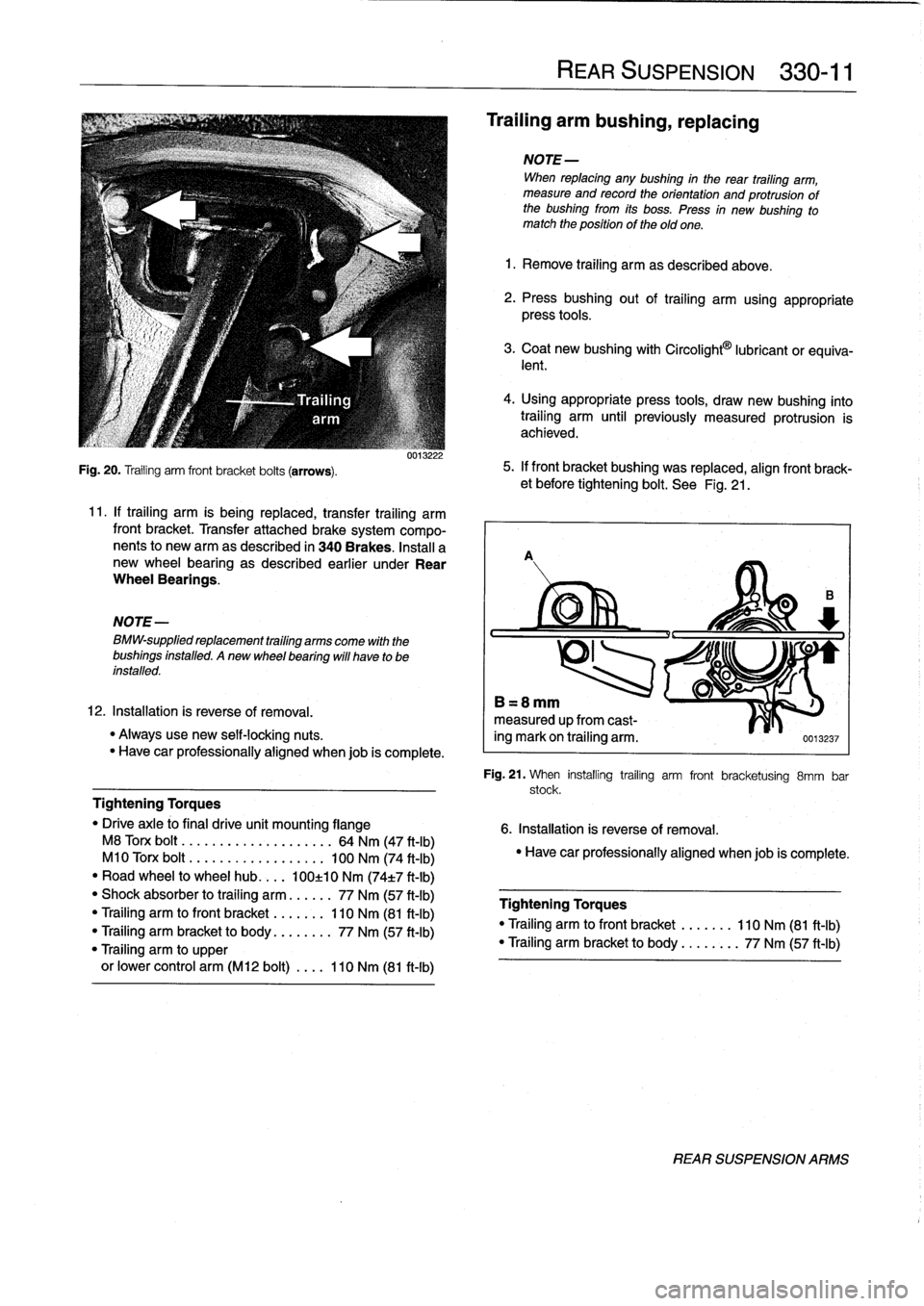
Fig
.
20
.
Trailing
arm
front
bracket
bolts
(arrows)
.
NOTE-
BMW-supplied
replacement
trailing
arms
come
with
the
bushings
installed
.
Anew
wheel
bearing
will
have
to
be
installed
.
0013222
11
.
If
trailing
arm
is
being
replaced,
transfer
trailing
arm
front
bracket
.
Transfer
attached
brake
system
compo-
nents
to
newarm
as
described
in
340Brakes
.
Insta¡¡
a
new
wheel
bearing
as
described
earlier
under
Rear
Wheel
Bearings
.
12
.
Installation
is
reverse
of
removal
.
"
Alwaysuse
new
self-locking
nuts
.
"
Have
car
professionally
aligned
when
job
is
complete
.
Tightening
Torques
"
Drive
axle
#o
final
drive
unit
mounting
flange
M8
Torx
bolt
......
.
...
.....
.
..
..
64
Nm
(47
ft-Ib)
M10
Torx
bolt
.....
...
.
....
.....
100
Nm
(74
ft-Ib)
"
Road
wheel
to
wheel
hub
.
...
100±10
Nm
(74t7
ft-Ib)
"
Shock
absorber
to
trailing
arm
......
77
Nm
(57
ft-Ib)
"
Trailing
arm
tofront
bracket
.......
110
Nm
(81
ft-Ib)
"
Trailing
arm
bracket
to
body
........
77
Nm
(57
ft-Ib)
"Trailing
arm
to
upper
or
lower
control
arm
(M12
bolt)
....
110
Nm
(81
ft-Ib)
REAR
SUSPENSION
330-
1
1
Trailing
arm
bushing,
replacing
NOTE-
When
replacing
any
bushing
in
the
rear
trailing
arm,
measure
and
recordthe
orientation
and
protrusion
of
the
bushing
from
its
boss
.
Press
in
new
bushing
to
match
the
positionof
theold
one
.
1
.
Remove
trailing
arm
as
described
above
.
2
.
Pressbushing
out
of
trailing
arm
using
appropriate
press
tools
.
3
.
Coat
new
bushing
with
Circolight
9
lubricant
or
equiva-
lent
.
4
.
Using
appropriate
press
tools,
draw
new
bushing
into
trailing
arm
until
previously
measured
protrusion
is
achieved
.
5
.
If
front
bracket
bushing
was
replaced,
alignfront
brack-
et
before
tightening
bolt
.
See
Fig
.
21
.
A
B=8mm
measured
upfrom
cast-
ing
mark
on
trailing
arm
.
0013237
Fig
.
21
.
When
installing
trailing
arm
front
bracketuising
8mm
bar
stock
.
6
.
Installation
is
reverse
of
removal
.
"
Have
car
professionally
aligned
when
job
is
complete
.
Tightening
Torques
"
Trailing
arm
tofront
bracket
.......
110
Nm
(81
ft-Ib)
"Trailing
arm
bracket
to
body
......
.
.
77
Nm
(57
ft-Ib)
REAR
SUSPENSION
ARMS
Page 295 of 759
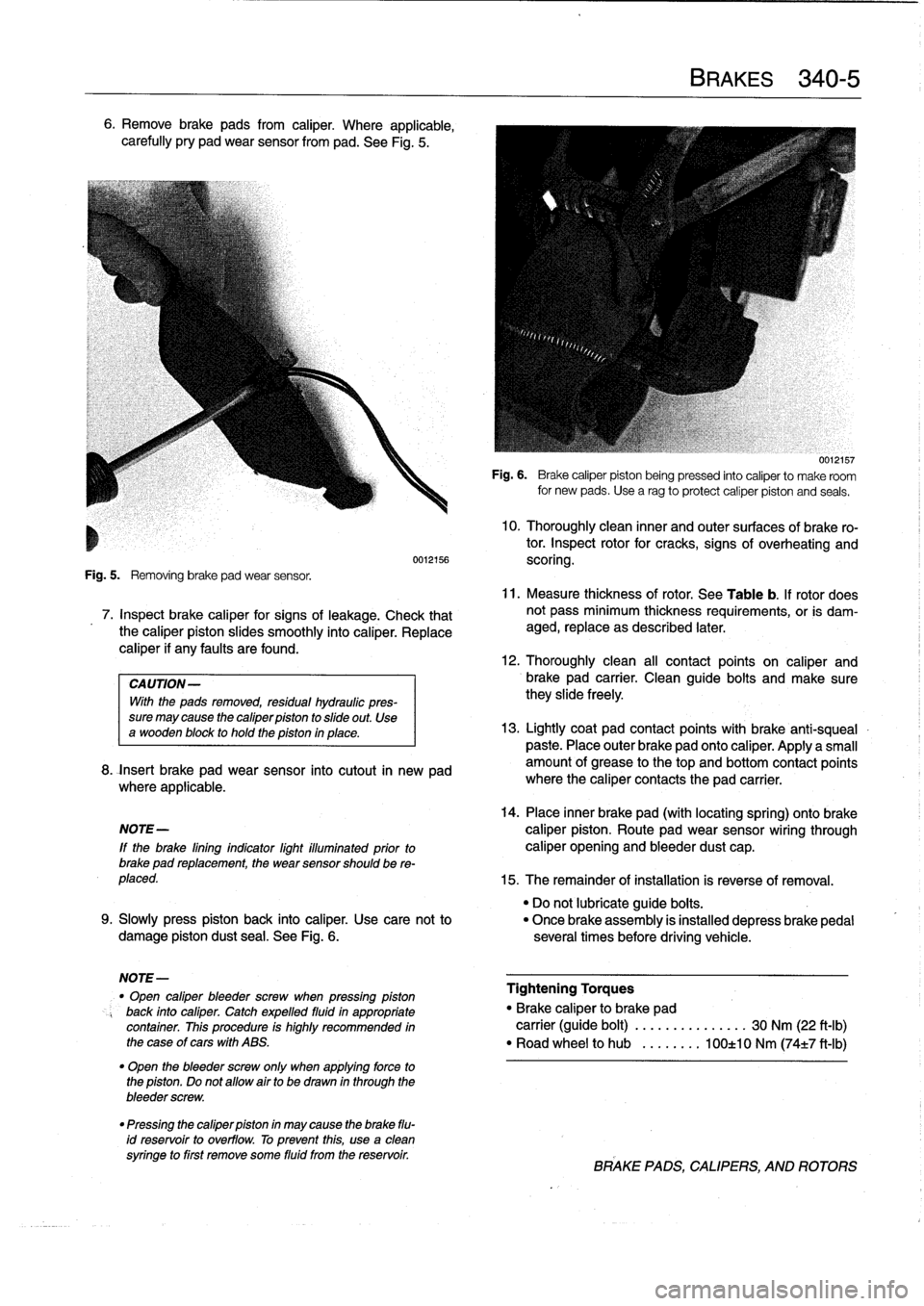
6
.
Remove
brake
pads
from
caliper
.
Where
applicable,
carefully
pry
pad
wear
sensor
from
pad
.
See
Fig
.
5
.
Fig
.
5
.
Removing
brake
pad
wear
sensor
.
7
.
Inspect
brake
caliper
for
signs
of
leakage
.
Check
that
the
caliper
piston
slides
smoothly
into
caliper
.
Replace
caliper
if
any
faults
are
found
.
CAUTION-
With
the
pads
removed,
residual
hydreulic
pres-
sure
may
cause
the
caliper
piston
to
slide
out
.
Use
a
wooden
block
to
hold
the
piston
in
place
.
8
.
fnsert
brake
pad
wear
sensor
into
cutout
in
new
pad
where
applicable
.
14
.
Place
inner
brake
pad
(with
locating
spring)
ontobrake
NOTE-
caliper
piston
.
Route
pad
wear
sensor
wiring
through
lf
the
brake
lining
indicator
light
illuminated
prior
to
caliper
opening
and
bleeder
dust
cap
.
brake
pad
replacement,
the
wear
sensor
should
be
re-
placed
.
15
.
The
remainder
of
installation
is
reverse
of
removal
.
"
Do
not
lubricate
guide
boits
.
9
.
Slowly
press
piston
back
into
caliper
.
Use
cace
not
to
"
Once
brake
assembly
is
installed
depress
brakepedal
damage
piston
dust
sea¡
.
See
Fig
.
6
.
severa¡
times
before
driving
vehicle
.
NOTE-
"
Open
caliper
bleeder
screw
when
pressing
piston
Tightening
Torques
back
into
caliper
.
Catch
expelled
fluidin
appropriate
"
Brake
caliper
to
brake
pad
container
.
This
procedure
is
highly
recommended
in
carrier
(guide
bolt)
..........
...
.
.
30
Nm
(22
ft-Ib)
the
case
of
cars
with
ABS
.
"
Road
wheel
to
hub
.....
.
..
100±10
Nm
(74±7
ft-Ib)
"
Open
the
bleeder
screw
only
when
applying
force
to
the
piston
.
Do
not
allow
airto
be
drawn
in
through
the
bleeder
screw
.
"
Pressing
the
caliper
piston
in
may
cause
the
brake
flu-
id
reservoir
to
overflow
.
To
prevent
this,
use
a
clean
syringe
to
first
remove
some
fluid
from
the
reservoir
.
BRAKES
340-
5
0012157
Fig
.
6
.
Brake
caliper
piston
being
pressed
into
caliper
to
make
room
for
new
pads
.
Usea
rag
toprotect
caliper
piston
and
seals
.
10
.
Thoroughly
clean
inner
and
outer
surfaces
of
brake
ro-
tor
.
Inspect
rotor
for
cracks,
signs
of
overheating
and
0012156
scoring
.
11
.
Measure
thickness
of
rotor
.
See
Table
b
.
If
rotor
does
not
pass
minimum
thickness
requirements,
or
is
dam-
aged,
replace
as
described
later
.
12
.
Thoroughly
clean
all
contact
points
on
caliper
and
brake
pad
carrier
.
Clean
guide
bolts
and
make
surethey
slide
freely
13
.
Lightly
coat
pad
contact
points
with
brake
anti-squeal
paste
.
Place
outer
brake
pad
onto
caliper
.
Applya
small
amount
of
grease
to
thetop
and
bottom
contact
points
where
the
caliper
contacts
the
pad
carrier
.
BRAKE
PADS,CALIPERS,
ANDROTORS