window BMW 740I 1998 User Guide
[x] Cancel search | Manufacturer: BMW, Model Year: 1998, Model line: 740I, Model: BMW 740I 1998Pages: 211, PDF Size: 1.68 MB
Page 71 of 211
70n
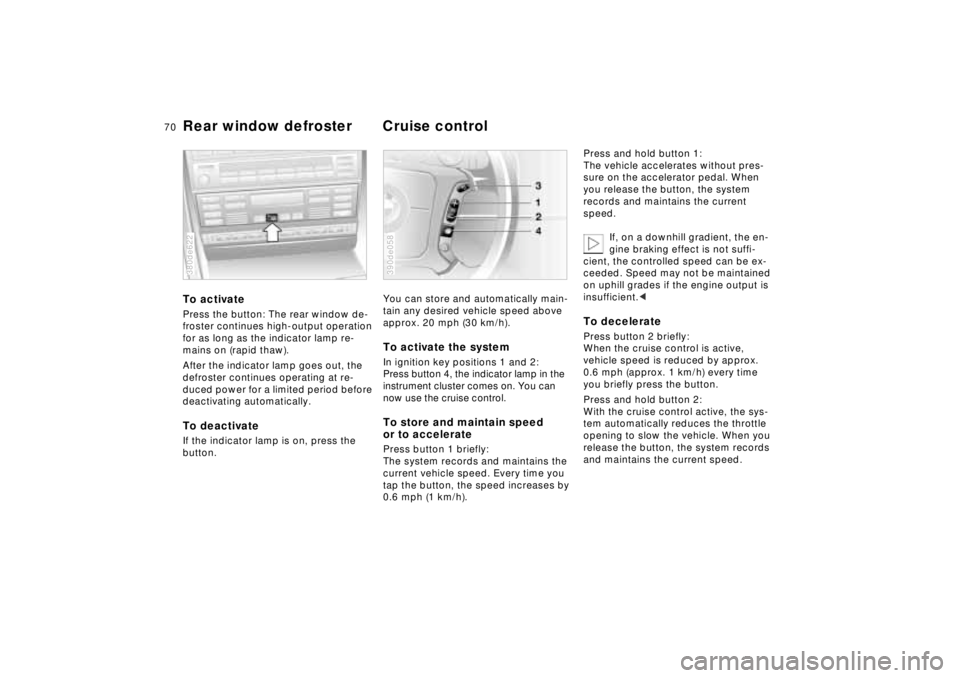
Rear window defroster Cruise controlTo activatePress the button: The rear window de-
froster continues high-output operation
for as long as the indicator lamp re-
mains on (rapid thaw).
After the indicator lamp goes out, the
defroster continues operating at re-
duced power for a limited period before
deactivating automatically.To deactivateIf the indicator lamp is on, press the
button.380de622
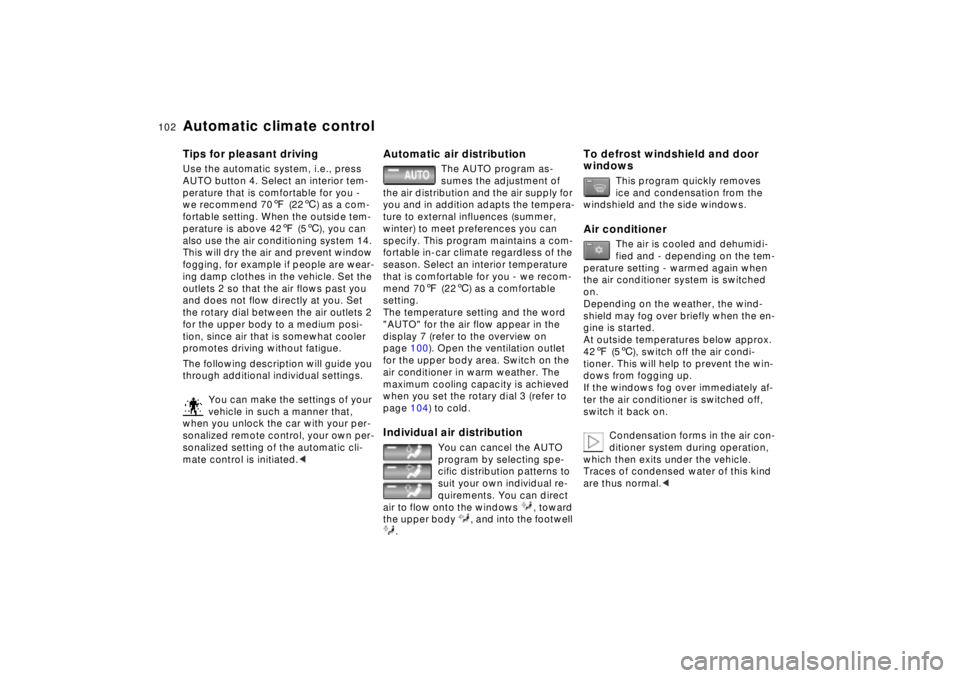
You can store and automatically main-
tain any desired vehicle speed above
approx. 20 mph (30 km/h).To activate the system In ignition key positions 1 and 2:
Press button 4, the indicator lamp in the
instrument cluster comes on. You can
now use the cruise control.To store and maintain speed
or to acceleratePress button 1 briefly:
The system records and maintains the
current vehicle speed. Every time you
tap the button, the speed increases by
0.6 mph (1 km/h).390de058
Press and hold button 1:
The vehicle accelerates without pres-
sure on the accelerator pedal. When
you release the button, the system
records and maintains the current
speed.
If, on a downhill gradient, the en-
gine braking effect is not suffi-
cient, the controlled speed can be ex-
ceeded. Speed may not be maintained
on uphill grades if the engine output is
insufficient.< To deceleratePress button 2 briefly:
When the cruise control is active,
vehicle speed is reduced by approx.
0.6 mph (approx. 1 km/h) every time
you briefly press the button.
Press and hold button 2:
With the cruise control active, the sys-
tem automatically reduces the throttle
opening to slow the vehicle. When you
release the button, the system records
and maintains the current speed.
Page 102 of 211

101n
RepairsIndexOverview Controls Car care Technology Data
Automatic climate control1 Air flow directed against windshield
and door windows
2 Air flow toward the upper body
The rotary dials allow infinitely-vari-
able regulation of the air supply,
changes in the air-flow direction,
and temperature regulation.
(Change air-flow direction in the
rear passenger area with the levers
in the center of the vent). In the
closed position, air flows out at the
upper center of the instrument
panel only104
3 Front footwell ventilation
There are corresponding air vents in
the rear footwell as well
4 Automatic air distribution –
left-hand side102
5 Individual air distribution –
left-hand side102
6 Temperature control –
left-hand side103
7 Temperature and air flow display,
left- and right-hand
sides103,104
8 Temperature control –
right-hand side103
9 Residual heat mode104
10 Individual air distribution –
right-hand side10211 Automatic air distribution –
right-hand side102
12 Air supply – right-hand side104
13 Recirculated-air mode/Automatic
recirculated-air control (AUC)103
14 Air conditioner103
15 Rear window defroster70, 103
16 Defrosting the windows and remove
condensation103
17 Air grill for interior temperature sen-
sor - please keep clear and unob-
structed
18 Air supply – left-hand side104
Page 103 of 211
102n
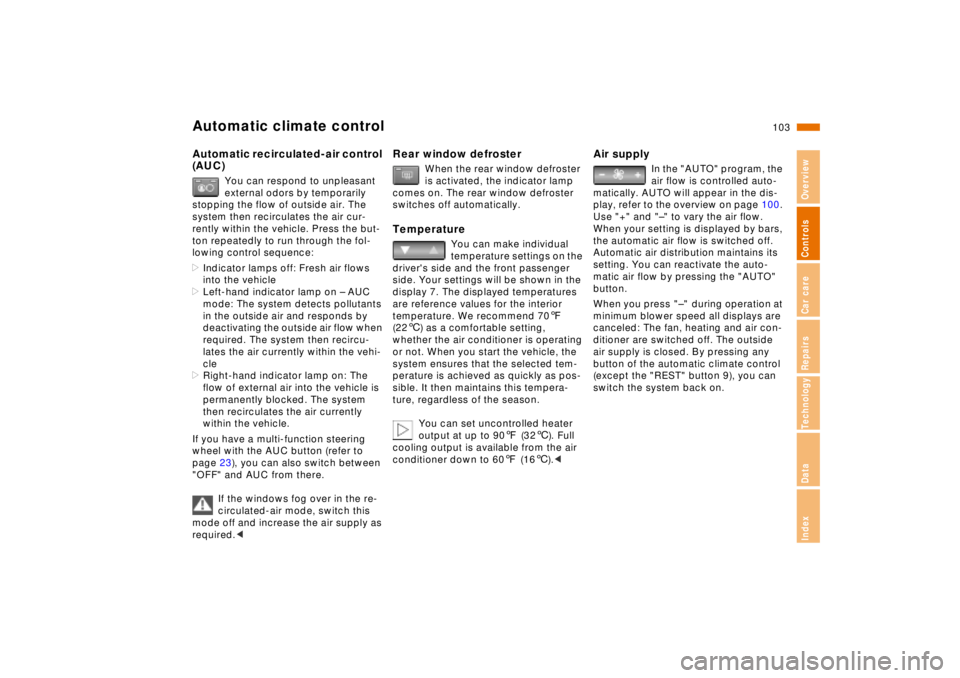
Automatic climate controlTips for pleasant drivingUse the automatic system, i.e., press
AUTO button 4. Select an interior tem-
perature that is comfortable for you -
we recommend 707 (226) as a com-
fortable setting. When the outside tem-
perature is above 427 (56), you can
also use the air conditioning system 14.
This will dry the air and prevent window
fogging, for example if people are wear-
ing damp clothes in the vehicle. Set the
outlets 2 so that the air flows past you
and does not flow directly at you. Set
the rotary dial between the air outlets 2
for the upper body to a medium posi-
tion, since air that is somewhat cooler
promotes driving without fatigue.
The following description will guide you
through additional individual settings.
You can make the settings of your
vehicle in such a manner that,
when you unlock the car with your per-
sonalized remote control, your own per-
sonalized setting of the automatic cli-
mate control is initiated.<
Automatic air distribution
The AUTO program as-
sumes the adjustment of
the air distribution and the air supply for
you and in addition adapts the tempera-
ture to external influences (summer,
winter) to meet preferences you can
specify. This program maintains a com-
fortable in-car climate regardless of the
season. Select an interior temperature
that is comfortable for you - we recom-
mend 707 (226) as a comfortable
setting.
The temperature setting and the word
"AUTO" for the air flow appear in the
display 7 (refer to the overview on
page 100). Open the ventilation outlet
for the upper body area. Switch on the
air conditioner in warm weather. The
maximum cooling capacity is achieved
when you set the rotary dial 3 (refer to
page 104) to cold.
Individual air distribution
You can cancel the AUTO
program by selecting spe-
cific distribution patterns to
suit your own individual re-
quirements. You can direct
air to flow onto the windows , toward
the upper body , and into the footwell
.
To defrost windshield and door
windows
This program quickly removes
ice and condensation from the
windshield and the side windows.
Air conditioner
The air is cooled and dehumidi-
fied and - depending on the tem-
perature setting - warmed again when
the air conditioner system is switched
on.
Depending on the weather, the wind-
shield may fog over briefly when the en-
gine is started.
At outside temperatures below approx.
427 (56), switch off the air condi-
tioner. This will help to prevent the win-
dows from fogging up.
If the windows fog over immediately af-
ter the air conditioner is switched off,
switch it back on.
Condensation forms in the air con-
ditioner system during operation,
which then exits under the vehicle.
Traces of condensed water of this kind
are thus normal.<
Page 104 of 211
103n
RepairsIndexOverview Controls Car care Technology Data
Automatic climate controlAutomatic recirculated-air control
(AUC)
You can respond to unpleasant
external odors by temporarily
stopping the flow of outside air. The
system then recirculates the air cur-
rently within the vehicle. Press the but-
ton repeatedly to run through the fol-
lowing control sequence:
>Indicator lamps off: Fresh air flows
into the vehicle
>Left-hand indicator lamp on – AUC
mode: The system detects pollutants
in the outside air and responds by
deactivating the outside air flow when
required. The system then recircu-
lates the air currently within the vehi-
cle
>Right-hand indicator lamp on: The
flow of external air into the vehicle is
permanently blocked. The system
then recirculates the air currently
within the vehicle.
If you have a multi-function steering
wheel with the AUC button (refer to
page 23), you can also switch between
"OFF" and AUC from there.
If the windows fog over in the re-
circulated-air mode, switch this
mode off and increase the air supply as
required.<
Rear window defroster
When the rear window defroster
is activated, the indicator lamp
comes on. The rear window defroster
switches off automatically.
Temperature
You can make individual
temperature settings on the
driver's side and the front passenger
side. Your settings will be shown in the
display 7. The displayed temperatures
are reference values for the interior
temperature. We recommend 707
(226) as a comfortable setting,
whether the air conditioner is operating
or not. When you start the vehicle, the
system ensures that the selected tem-
perature is achieved as quickly as pos-
sible. It then maintains this tempera-
ture, regardless of the season.
You can set uncontrolled heater
output at up to 907 (326). Full
cooling output is available from the air
conditioner down to 607 (166).<
Air supply
In the "AUTO" program, the
air flow is controlled auto-
matically. AUTO will appear in the dis-
play, refer to the overview on page 100.
Use "+" and "–" to vary the air flow.
When your setting is displayed by bars,
the automatic air flow is switched off.
Automatic air distribution maintains its
setting. You can reactivate the auto-
matic air flow by pressing the "AUTO"
button.
When you press "– " during operation at
minimum blower speed all displays are
canceled: The fan, heating and air con-
ditioner are switched off. The outside
air supply is closed. By pressing any
button of the automatic climate control
(except the "REST" button 9), you can
switch the system back on.
Page 105 of 211
104n
Automatic climate controlResidual heat mode
The heat which is stored in
the engine is utilized for
heating of the interior when the engine
has been switched off (while waiting at
a railroad crossing, for instance).
In ignition key position 1, you can alter
the settings of the automatic climate
control. In ignition key position 0, the
system automatically directs heated air
to the windshield, side windows and
footwells.
This function may be activated
when the outside temperature is
below approx. 597 (156), the engine
is at operating temperature, and the
battery is adequately charged.<
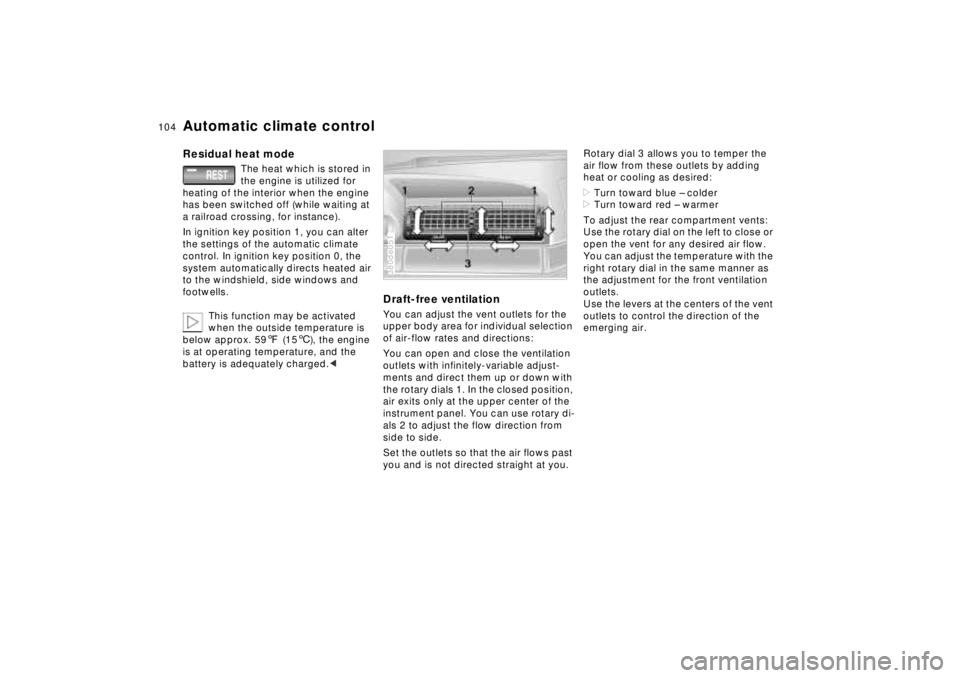
Draft-free ventilationYou can adjust the vent outlets for the
upper body area for individual selection
of air-flow rates and directions:
You can open and close the ventilation
outlets with infinitely-variable adjust-
ments and direct them up or down with
the rotary dials 1. In the closed position,
air exits only at the upper center of the
instrument panel. You can use rotary di-
als 2 to adjust the flow direction from
side to side.
Set the outlets so that the air flows past
you and is not directed straight at you.380de051
Rotary dial 3 allows you to temper the
air flow from these outlets by adding
heat or cooling as desired:
>Turn toward blue – colder
>Turn toward red – warmer
To adjust the rear compartment vents:
Use the rotary dial on the left to close or
open the vent for any desired air flow.
You can adjust the temperature with the
right rotary dial in the same manner as
the adjustment for the front ventilation
outlets.
Use the levers at the centers of the vent
outlets to control the direction of the
emerging air.
Page 108 of 211
107n
RepairsIndexOverview Controls Car care Technology Data
Roller sun blind
*
Independent ventilation system
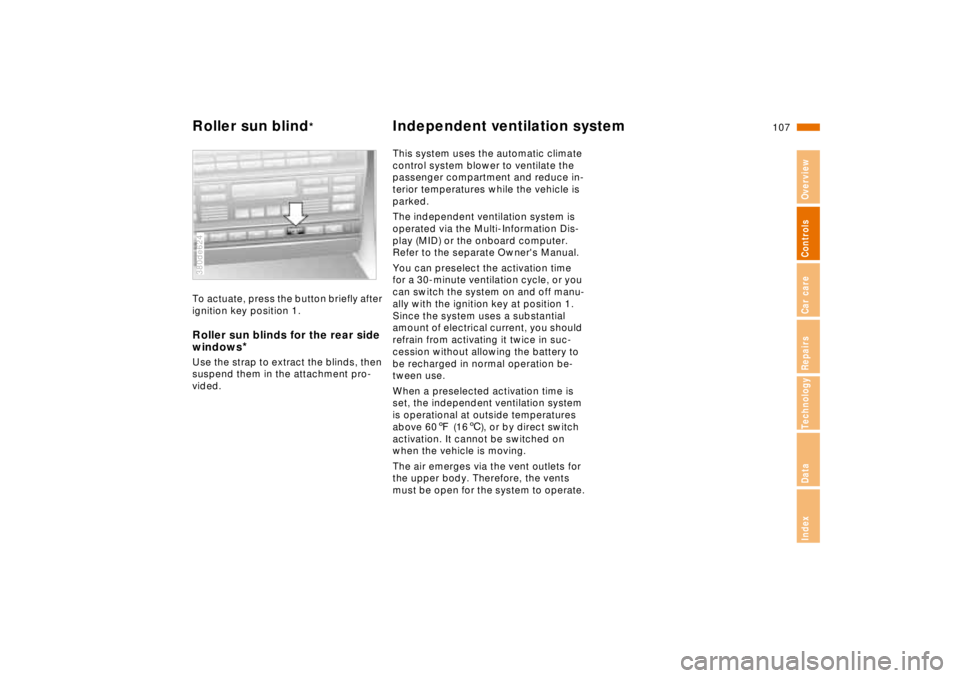
To actuate, press the button briefly after
ignition key position 1.Roller sun blinds for the rear side
windows
*
Use the strap to extract the blinds, then
suspend them in the attachment pro-
vided.380de624
This system uses the automatic climate
control system blower to ventilate the
passenger compartment and reduce in-
terior temperatures while the vehicle is
parked.
The independent ventilation system is
operated via the Multi-Information Dis-
play (MID) or the onboard computer.
Refer to the separate Owner's Manual.
You can preselect the activation time
for a 30-minute ventilation cycle, or you
can switch the system on and off manu-
ally with the ignition key at position 1.
Since the system uses a substantial
amount of electrical current, you should
refrain from activating it twice in suc-
cession without allowing the battery to
be recharged in normal operation be-
tween use.
When a preselected activation time is
set, the independent ventilation system
is operational at outside temperatures
above 607 (166), or by direct switch
activation. It cannot be switched on
when the vehicle is moving.
The air emerges via the vent outlets for
the upper body. Therefore, the vents
must be open for the system to operate.
Page 113 of 211
112n
Center armrestsMulti-function armrest, rear
*
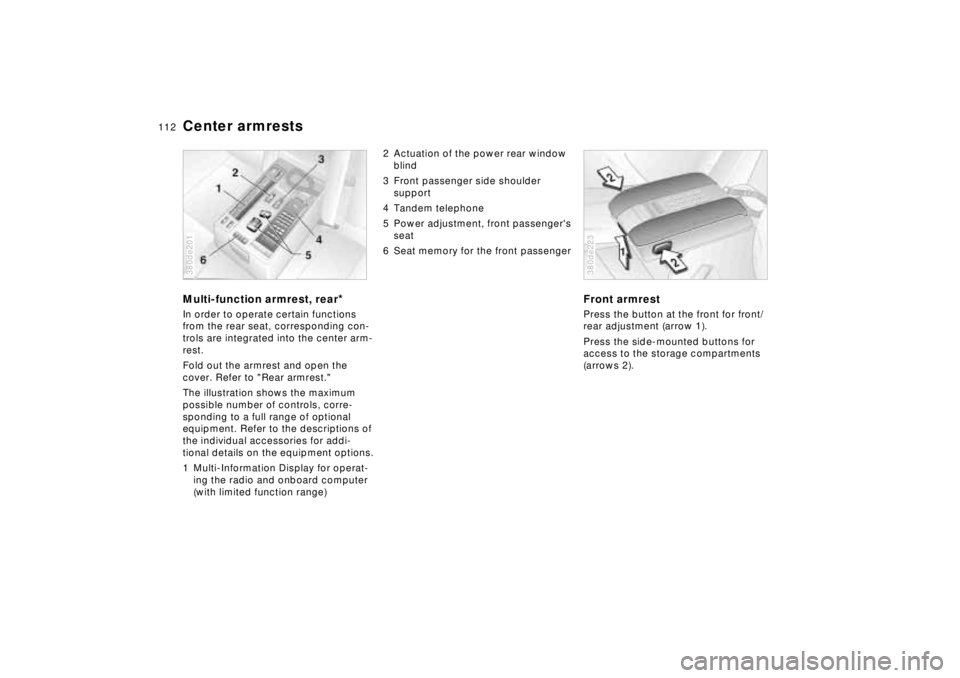
In order to operate certain functions
from the rear seat, corresponding con-
trols are integrated into the center arm-
rest.
Fold out the armrest and open the
cover. Refer to "Rear armrest."
The illustration shows the maximum
possible number of controls, corre-
sponding to a full range of optional
equipment. Refer to the descriptions of
the individual accessories for addi-
tional details on the equipment options.
1 Multi-Information Display for operat-
ing the radio and onboard computer
(with limited function range)380de201
2 Actuation of the power rear window
blind
3 Front passenger side shoulder
support
4 Tandem telephone
5 Power adjustment, front passenger's
seat
6 Seat memory for the front passenger
Front armrestPress the button at the front for front/
rear adjustment (arrow 1).
Press the side-mounted buttons for
access to the storage compartments
(arrows 2).380de223
Page 153 of 211

152n
Caring for your carCaring for the vehicle finishRegular washing is a preventive mea-
sure against long-term effects from
substances that are harmful to the vehi-
cle's finish, especially if you drive your
vehicle in areas with high levels of air
pollution or aggressive natural sub-
stances (tree resins, pollen).
Nevertheless, you should immediately
remove especially aggressive sub-
stances. Failure to do so can lead to
changes in the paint's chemical struc-
ture or to discoloration. Gasoline spilled
during refueling, oil, grease and brake
fluid should always be cleaned away
immediately, as should bird droppings.
All of these substances cause damage
to the finish.
Any contamination remaining on the
surface of the vehicle will be especially
conspicuous after washing. Use clean-
ing fluid or alcohol with a clean cloth or
cotton pad to remove. Remove tar
spots with tar remover. After cleaning,
the affected areas should be waxed to
ensure continued protection.
A full range of car-care products is
available from your BMW center.<
Waxing your carProtect the finish using carnauba or
synthetic-based waxes only.
The best way to determine when the
finish needs to be waxed is by noting
when water stops beading on the sur-
face.
You can use a glass cleaner to remove
any wax or silicone that may have been
left on the windows during waxing.
A full range of car-care products is
available from your BMW center.<
Paint damageYou can touch up small areas of dam-
age with BMW spray paint or a BMW
touch-up stick.
The color code of your vehicle is lo-
cated on a tag near the vehicle's data
plate and on the first page of the Ser-
vice and Warranty Information Booklet
(US models) or of the Warranty and Ser-
vice Guide Booklet (Canadian models).
Damage caused by flying stones,
scratches, etc., must be touched up
without delay to prevent rust from form-
ing.
If corrosion has started to form in an
area with paint damage, remove all rust
and clean the area. Then prime the area
with a BMW Primer Stick. Finally, apply
the finish coat. Wait a few days, then
polish the repaired area. Finish by ap-
plying a wax preservative.
More extensive paint damage should be
repaired professionally in accordance
with the manufacturer's instructions.
Your BMW center uses original BMW
finish materials in accordance with ap-
proved repair procedures.
Page 154 of 211

153n
RepairsIndexOverview Controls Car care Technology Data
Caring for your carWindow careWater and dirt-repelling windshield (re-
fer also to page 191).
The effectiveness of the coating is not
impaired by the wax used in car washes
or by windshield-washer additives.
Depending on the frequency of use of
the windshield wipers as well as on en-
vironmental factors, the coating of the
windshield is subject to natural wear.
As a result, the beneficial characteris-
tics of the coating gradually diminish.
After approx. 12,400 to 15,500 miles
(approx. 20,000 to 25,000 km), the
windshield begins to resemble more
and more a standard windshield.
The coating can be renewed by your
BMW center.
You can use window and glass cleaner
to clean interior window surfaces and
mirrors without streaking. Never use
polishing pastes or abrasive (quartz)
cleansers on mirror lenses.
Break-resistant security glassThe glass used for the side windows is
designed to provide resistance to
breakage and protection against van-
dalism. These break-resistant windows
contain several layers of a transparent
plastic film which is sandwiched be-
tween the inner and outer glass panes.
There is also one additional plastic film
on the inside of the glass pane (facing
the passenger compartment). This film
prevents shards of glass from spread-
ing into the passenger compartment if
the window is shattered.
Please observe the following pre-
cautions pertaining to this film
when caring for the interior glass sur-
faces:
>The film is not scratch-resistant. For
this reason, do not touch the glass
with sharp objects which could dam-
age the film
>Clean the glass with clean water. If
necessary, you may also use regular
household window cleaners. Wipe
the cleaner off immediately.
Do not use window cleaners contain-
ing solvents or abrasives. These
cleaners can mar the film
>Do not apply any self-adhering de-
cals, adhesive labels or other stickers
with tape to the inner window surface
>Do not apply colored films to the in-
side surfaces of the side windows
>If the windows are fogged or iced
over in cold or humid climates, do not
use an ice scraper or ice-removing
sprays to clean them. Start the en-
gine and refer to the instructions for
defrosting the door windows.<
Page 155 of 211

154n
Caring for your carCaring for other vehicle
components and materialsLight-alloy wheels should be treated
with alloy wheel cleaner, especially dur-
ing the winter months. However, do not
use aggressive products containing ac-
ids, strong alkalis or abrasives. Do not
use steam cleaners operating at tem-
peratures above 1407 (606). Follow
the manufacturer's instructions.
If your vehicle has chromed parts
* such
as window moldings, door handles or
other parts, clean these parts especially
carefully with ample clean water, espe-
cially if they have an accumulation of
road salt. You may wish to add a car
shampoo supplement to the water. Use
a chrome polish for an additional treat-
ment.
Plastic components, vinyl upholstery,
headliners, lamp lenses, the clear cover
of the instrument panel and compo-
nents with a sprayed dull black surface
can be cleaned with water (add plastic
cleaner as required). Do not allow mois-
ture to soak through the seats or head-
liner. Never use solvents such as lac-
quer thinner, heavy-duty grease
remover, fuels, etc.
Rubber components should be cleaned
with water only; a rubber treatment or
silicone spray may also be applied.Clean the wiper blades with soapy wa-
ter. The wiper blades should be re-
placed twice a year, before and after
the cold season.
Use only wiper blades approved
by BMW.<
The safety belts should be cleaned with
a mild soap and water solution without
being removed from the car. Never at-
tempt chemical or dry cleaning, as
damage to the belt fabric could result.
After cleaning, never allow the inertia
reel to retract the belts until they are
completely dry. Dirty safety belts pre-
vent the inertia reel mechanism from re-
tracting the strap properly, and thus
constitute a safety hazard.
Heavily soiled floor carpets and mats
*
can be cleaned with an interior cleaner.
The floor mats can be removed from the
vehicle for cleaning.
Please use only a damp cloth to clean
wooden fascia panels and components.
Follow up by drying with a soft cloth.
A full range of car-care products is
available from your BMW center.<
Leather careThe leather upholstery used by BMW is
a natural product of the highest quality,
processed using state-of-the-art meth-
ods to ensure that it will maintain its
high quality for years to come, provided
that it is properly cared for.
Because this product is manufactured
using natural materials, you must make
allowance for its special characteristics
as well as for the peculiarities of its use
and care.
Regular periodic cleaning and care are
essential, as dust and road dirt act as
abrasives in the pores and creases of
the material. This leads to wear spots
and premature brittleness on the sur-
face of the leather. We therefore sug-
gest that you clean the leather with a
vacuum cleaner or dust cloth at fre-
quent intervals.
For cleaning, use BMW leather cleaning
foam.