traction control BMW X5 4.4I 2000 Owners Manual
[x] Cancel search | Manufacturer: BMW, Model Year: 2000, Model line: X5 4.4I, Model: BMW X5 4.4I 2000Pages: 201, PDF Size: 1.93 MB
Page 24 of 201

24n
Indicator and warning lamps Yellow: check as soon as possible
Engine oil level
Comes on after the engine has
been shut off: check the engine
oil level.
For additional information: refer to
page 137.
Automatic transmission
*
Because of a malfunction, the
automatic transmission shifts
only in the emergency program. Please
consult the nearest authorized BMW
center.
For additional information: refer to
page 68.
Brake pads
* l
Have the brake pads checked.
For additional information: refer
to page 123.
Dynamic Brake Control (DBC) l
Fault in the DBC system. Please
have the system inspected by
your authorized BMW center.
For additional information: refer to
page 120.
Warning lamp, Dynamic Brake
Control (DBC) for Canadian
models
Level control system
* l
The level control system is inac-
tive. Please consult the nearest
authorized BMW center.
For additional information: refer to
page 125.
Dynamic Stability Control
(DSC) l
DSC has been switched off with
the button; the traction intervention
system is still active.
In the event of a malfunction the indica-
tor lamp comes on continiuosly and
can't be swiched off with the button:
DSC and HDC are inactive. Please have
the system checked by the nearest
BMW center.
For additional information: refer to
pages 83 and 85.
Engine Power Control*
There is a malfunction in the
Engine Power Control. When
braking, higher brake application pres-
sure may be necessary and brake pedal
travel may be significantly longer.
Please have the system inspected by
your authorized BMW center.
Service Engine Soon l
If the indicator lamp comes on
either continuously or intermit-
tently, this indicates a fault in the
emissions-related electronic systems.
Although the vehicle remains opera-
tional, you should have the systems
checked by your BMW center at the
earliest possible opportunity.
For additional information: refer to
page 150.
Warning lamp, Service Engine
Soon for Canadian models
Page 61 of 201
IndexDataTechnologyRepairsCar careControlsOverview
61n
Child restraints
*
Child seat security
Before installing any child restraint
device or child seat, please read
the following:
Never install a rear-facing child restraint
system in the front passenger seat of
this vehicle.
Your vehicle is equipped with an airbag
supplemental restraint system for the
front passenger. Because the backrest
on any rear-facing child restraint sys-
tem (of the kind designed for infants
under 1 year and 20 Ibs./9 kg) would be
within the airbag's deployment range,
you should never mount such a device
in the front passenger seat, since the
impact of the airbag against the child
restraint's backrest could lead to seri-
ous or fatal injuries.
If it is necessary for a child (not an in-
fant) to ride in the front seat, certain
precautions should be taken. First,
move the passenger seat as far away
from the dashboard as possible. This
important precaution is intended to
maximize the distance between the
airbag and the child. Older children
should be tightly secured with a safety
belt. Younger children should be se-
cured in an appropriate forward-facing
child restraint system that has first been
properly secured with a safety belt.
Never install a rear-facing child restraint
system in the front passenger seat.
We strongly urge you to carefully read
and comply with the instructions for in-
stallation and use provided by the child
restraint's manufacturer whenever you
use such a device.
Be sure that all occupants (of all ages)
remain properly and securely restrained
at all times.<
All rear seating positions in your vehicle
meet the recommendations of SAE
J1819, an industry-recommended prac-
tice for securing child restraint systems
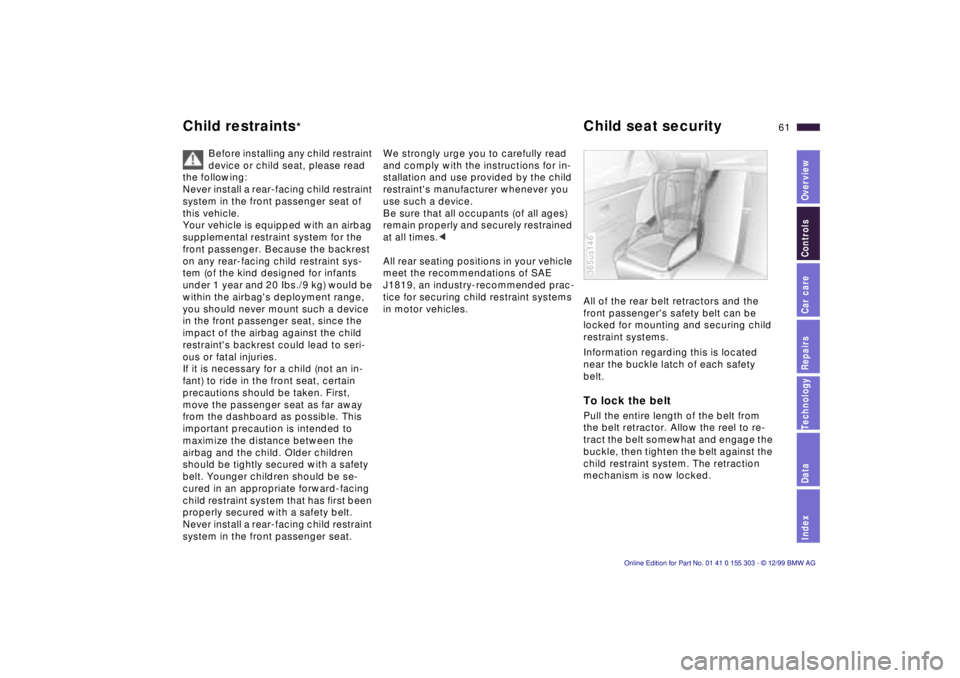
in motor vehicles. All of the rear belt retractors and the
front passenger's safety belt can be
locked for mounting and securing child
restraint systems.
Information regarding this is located
near the buckle latch of each safety
belt.
To lock the belt Pull the entire length of the belt from
the belt retractor. Allow the reel to re-
tract the belt somewhat and engage the
buckle, then tighten the belt against the
child restraint system. The retraction
mechanism is now locked. 365us146
Page 65 of 201
IndexDataTechnologyRepairsCar careControlsOverview
65n
Switching off the engine Parking brake Turn the ignition key to position 1 or 0.
Never remove the ignition key
while the vehicle is rolling. If you
did so, the ignition lock would engage
when the steering wheel is turned.
Always remove the ignition key and en-
gage the steering lock before leaving
the vehicle.
Always engage the parking brake and
place the selector lever in "Park" when
parking on slopes and inclined sur-
faces.<
The vehicle must be stationary and the
selector lever in "Park" before you can
remove the ignition key.
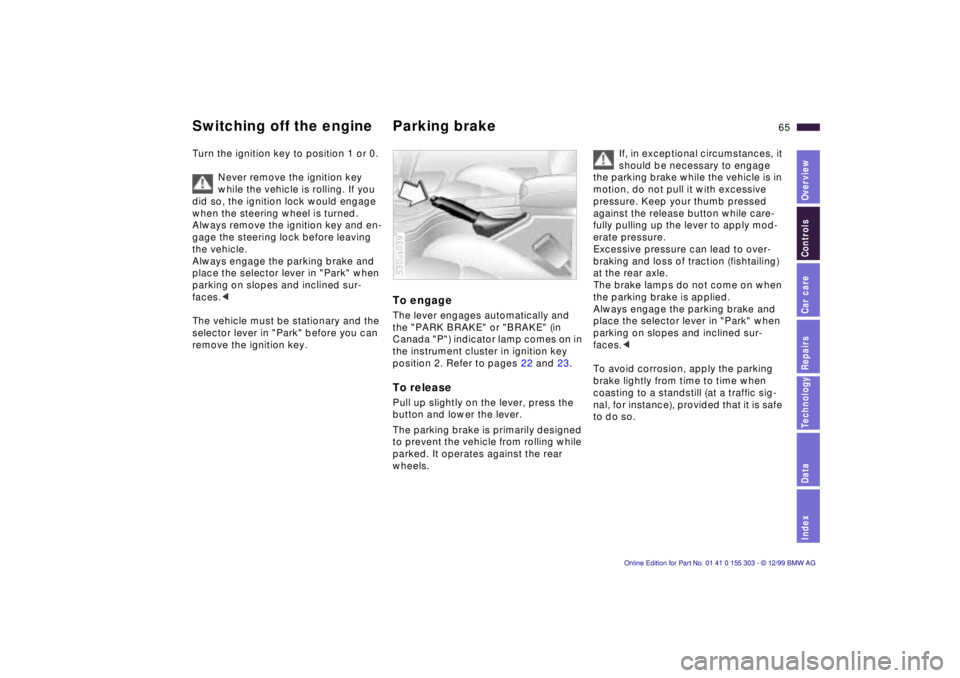
To engage The lever engages automatically and
the "PARK BRAKE" or "BRAKE" (in
Canada "P") indicator lamp comes on in
the instrument cluster in ignition key
position 2. Refer to pages 22 and 23. To release Pull up slightly on the lever, press the
button and lower the lever.
The parking brake is primarily designed
to prevent the vehicle from rolling while
parked. It operates against the rear
wheels. 530us039
If, in exceptional circumstances, it
should be necessary to engage
the parking brake while the vehicle is in
motion, do not pull it with excessive
pressure. Keep your thumb pressed
against the release button while care-
fully pulling up the lever to apply mod-
erate pressure.
Excessive pressure can lead to over-
braking and loss of traction (fishtailing)
at the rear axle.
The brake lamps do not come on when
the parking brake is applied.
Always engage the parking brake and
place the selector lever in "Park" when
parking on slopes and inclined sur-
faces.<
To avoid corrosion, apply the parking
brake lightly from time to time when
coasting to a standstill (at a traffic sig-
nal, for instance), provided that it is safe
to do so.
Page 83 of 201
IndexDataTechnologyRepairsCar careControlsOverview
83n
PDC
*
Dynamic Stability Control (DSC)
The PDC system does not remove
the driver's personal responsibility
for evaluating the distance between the
vehicle and any obstacles. Even when
sensors are involved, there is a blind
spot in which objects cannot be de-
tected. This applies especially in those
cases where the system approaches
the physical constraints of ultrasonic
measurement, as occurs with tow bars
and trailer couplings, and in the vicinity
of thin and painted objects.
Certain sources of sound, such as a
loud radio, could drown out the PDC
signal tone.<
Keep the sensors clean and free
of ice or snow in order to ensure
that they continue to operate effectively.
Do not apply high pressure spray to the
sensors for a prolonged period of time.
Maintain an adequate distance of more
than 4 inches (10 cm).<
The concept DSC maintains vehicle stability, even in
critical driving situations.
The system optimizes vehicle stability
during acceleration and when starting
from a full stop, as well as optimizing
traction. In addition, the system recog-
nizes unstable vehicle conditions (un-
dersteering or oversteering, for exam-
ple) and helps to keep the vehicle on a
sure course by intervening via the en-
gine and by braking intervention at the
individual wheels.
The system starts up automatically
each time you start the engine. Indicator lamp
The indicator lamp in the instru-
ment cluster goes out shortly
after you switch on the ignition.
Refer to page 24.
Indicator lamp ßashes:
The system is active and governs drive
force and braking force.
If the indicator lamp fails to go out after
the engine is started, or comes on dur-
ing normal driving and stays on:
There is a system malfunction or the
system was deactivated with the but-
ton. You can continue to drive the vehi-
cle normally, but without DSC. Consult
your authorized BMW center to have
the system repaired.
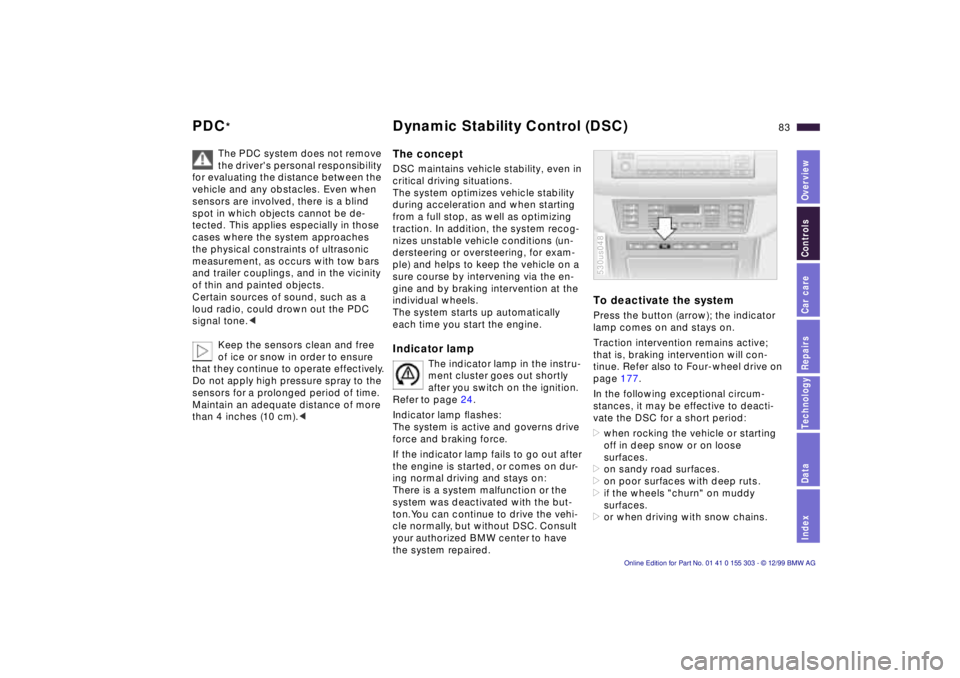
To deactivate the system Press the button (arrow); the indicator
lamp comes on and stays on.
Traction intervention remains active;
that is, braking intervention will con-
tinue. Refer also to Four-wheel drive on
page 177.
In the following exceptional circum-
stances, it may be effective to deacti-
vate the DSC for a short period:
>when rocking the vehicle or starting
off in deep snow or on loose
surfaces.
>on sandy road surfaces.
>on poor surfaces with deep ruts.
>if the wheels "churn" on muddy
surfaces.
>or when driving with snow chains. 530us048
Page 84 of 201
84n
DSC Hill Descent Control (HDC)
As a result of the traction interven-
tion, the brakes may be subjected
to additional loads when the system is
deactivated. For this reason, it is possi-
ble that the braking intervention will be
disabled automatically for a brief period
in order to limit brake temperature.
To maintain vehicle stability, always
drive with the system switched on when
possible.<
To reactivate the systemPress the button again; the indicator
lamp goes out.
The laws of physics cannot be re-
pealed, even with DSC. An appro-
priate driving style always remains the
responsibility of the driver. We there-
fore urge you to avoid using the addi-
tional safety margin of the system as an
excuse for taking risks.<
For additional details concerning DSC,
please refer to the chapter describing
"Advanced technology" on page 177.
The concept HDC is a system for driving downhill on
steep roads. This system reduces
vehicle speed on steep downgrades,
thus allowing you to maintain control of
your BMW under these conditions.
The vehicle moves at slightly more than
walking speed without active interven-
tion from the driver.
You can activate HDC below approx.
20 mph (35 km/h). When driving down
steep roads, the vehicle reduces speed
automatically down to slightly more
than walking speed (approx. 5 mph/
8 km/h) and then maintains this speed
at a constant.
By applications of the brakes or accel-
erator, you can alter this speed in the
range of approx. 3 mph (5 km/h) to ap-
prox. 20 mph (35 km/h).
HDC is deactivated automatically if you
exceed approx. 35 mph (60 km/h).
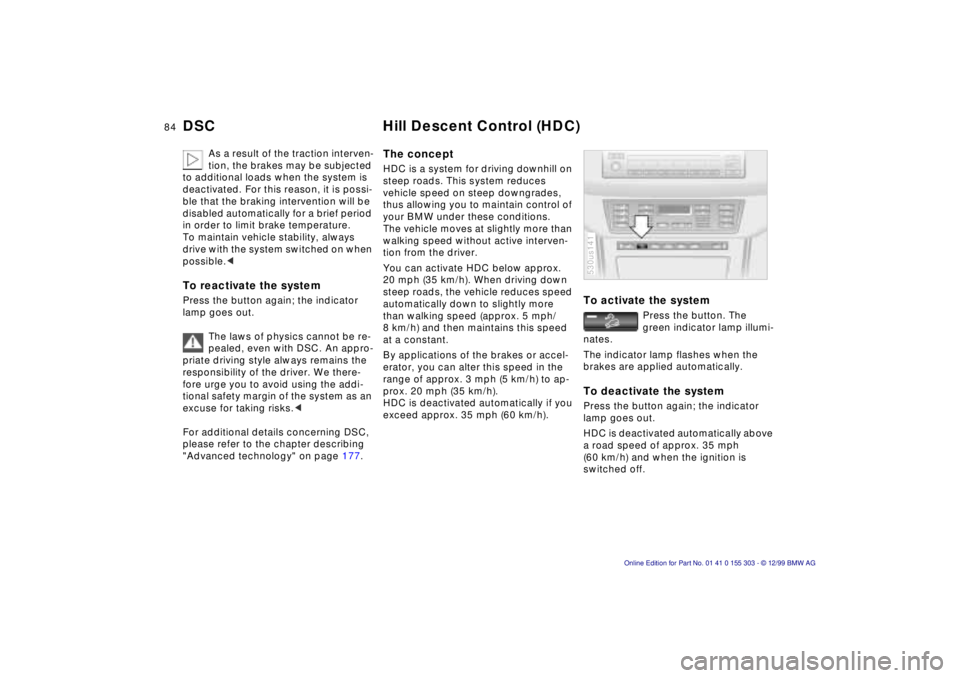
To activate the system
Press the button. The
green indicator lamp illumi-
nates.
The indicator lamp flashes when the
brakes are applied automatically.
To deactivate the system Press the button again; the indicator
lamp goes out.
HDC is deactivated automatically above
a road speed of approx. 35 mph
(60 km/h) and when the ignition is
switched off. 530us141
Page 116 of 201

116n
Break-in procedures To ensure that your vehicle provides
maximum economy throughout a long
service life, we request that you ob-
serve the following suggestions: Engine and axle drive Up to 1,200 miles (2,000 km):
Drive at varying engine speeds and
road speeds, but do not exceed
4,500 rpm and a road speed of
106 mph (170 km/h) during this initial
period:
Obey your local and state maximum
speed limits.
Refrain from using full throttle and avoid
pressing the accelerator beyond the
kickdown point.
Once you have driven 1,200 miles
(2,000 km), engine and vehicle speeds
can gradually be increased.
You should also comply with these
break-in procedures if the engine or
one of the axle drives is replaced later
in the course of the vehicle service life.
Tires Due to technical factors associated
with their manufacture, tires do not
achieve their full traction potential until
an initial break-in period has elapsed.
For this reason, drive with extra care
during the initial 200 miles (300 km).
Obey your local and state maximum
speed limits.
When the vehicle is operated on
wet or slushy roads, a wedge of
water may form between the tire and
the road surface. This phenomenon is
referred to as aquaplaning, or hydro-
planing, and can lead to partial or com-
plete loss of traction, vehicle control
and braking effectiveness. Reduce your
speed on wet roads.<
Brake system Approximately 300 miles (500 km) must
elapse before the brake pads and ro-
tors achieve the optimal pad-surface
and wear patterns required for trouble-
free operation and long service life later
on.
To break in the separate parking brake
drums, apply the parking brake lightly
when coasting to a standstill (at a traffic
signal, for instance), provided that traf-
fic conditions allow you to do so.
To avoid corrosion, repeat this proce-
dure from time to time.
The brake lamps do not light up
when the parking brake is applied.
Vacuum for the brake system servo unit
on your BMW is available only when the
engine is running. When you move the
vehicle with the engine shut off Ð when
towing, for instance Ð substantially
higher levels of pedal force will be re-
quired to brake the vehicle.<
Page 119 of 201

IndexDataTechnologyRepairsCar careControlsOverview
119n
Catalytic converter Antilock Brake System (ABS)
Be sure to comply with the in-
structions above to prevent un-
burned fuel from reaching the catalytic
converter. Otherwise, the catalytic con-
verter could respond by overheating,
leading to serious damage.
Extreme temperatures occur at the cat-
alytic converter on this and every cata-
lyst-equipped vehicle. Heat shields are
installed adjacent to some sections of
the exhaust system. Never remove
these shields; do not apply undercoat-
ing to their surfaces. When driving,
standing at idle, and parking the vehi-
cle, take care to avoid contact between
the exhaust system and flammable ma-
terials (grass, hay, leaves, etc.). Such
contact could lead to a fire, resulting in
serious personal injury and property
damage.<
The concept ABS enhances active safety by helping
to prevent the wheels from locking un-
der braking. This is because: locked
wheels are dangerous. When the front
wheels slide, the driver loses steering
control over the vehicle. Traction loss at
the rear wheels can cause the rear end
to break into an uncontrolled skid.
With ABS, you will achieve the shortest-
possible braking distances under all
given conditions (braking while driving
straight ahead or in curves, different
road surfaces).
ABS is designed to meet two essential
requirements during every brake appli-
cation:
>To help provide vehicle stability.
>To help retain steering and maneu-
vering capability on all types of road
surfaces (asphalt, cement, dirt, wet
surfaces, snow and ice).
Braking with ABS The system becomes operative once
the vehicle exceeds a speed of approx.
6 mph (10 km/h). The ABS is deactivated
whenever the vehicle's speed drops
back below approx. 4 mph
(6 km/h).
To shorten the braking distance Ñ espe-
cially on steep, poor road surfaces when
driving slowly straight ahead Ñ the sys-
tem allows one or both front wheels to
lock for a short time. Nevertheless, the
vehicle still retains steering response
since this "poor road logic" is deacti-
vated again automatically as you steer.
If you are in a situation that requires full
braking, you will exploit the full beneÞts
of the ABS system if you apply maxi-
mum brake pressure ("panic stop").
Since the vehicle maintains steering
responsiveness, you can avoid possible
obstacles with a minimum of steering
effort, despite the full brake application.
The ABS system's closed-loop control
circuit cycles in fractions of a second.
A pulsation at the brake pedal, together
with the sounds associated with the
hydraulic controls, tells you that the
brake system is within its maximum
limit range and reminds you that you
Page 120 of 201

120n
Antilock Brake System (ABS) should adapt road speed to the road
conditions.
On road surfaces that have a loose sur-
face layer on a firm base with good
traction (on gravel, deep sand or snow,
for example), braking distances may be
longer than with locked wheels.This is
also true if snow chains are mounted.
However, ABS continues to provide en-
hanced vehicle stability and steering re-
sponse under these conditions. Information for your safety Not even ABS can suspend the laws of
physics. ABS alone cannot prevent
accidents when the brakes are applied
without an adequate safety distance
between vehicles, if the vehicle is
driven with excessive speed, or if aqua-
planing occurs. Responsibility for these
types of situations remains in the hands
(and at the feet) of the driver. You
should never allow the added safety of
ABS to lull you into a false sense of
security, or mislead you into taking
increased risks that could affect your
own safety and that of others.
Do not make any modifications to
the ABS system.
Service procedures on ABS are to be
performed by authorized technicians
only.<
Cornering Brake Control (CBC) CBC is an advanced engineering de-
sign of the ABS. When braking during
cornering with high lateral accelera-
tion, or when braking during a lane
change, vehicle stability is further im-
proved and the steering response is
enhanced. Electronic Brake Force Distribu-
tion (EBV) EBV governs brake application pres-
sure at the rear wheels to achieve sta-
ble brake response.
If the EBV fails (refer to the next
page), avoid full or "panic" brake
applications. Full or panic brake appli-
cations can result in overbraking at the
rear axle, and braking stability is no
longer ensured.<
Dynamic Brake Control (DBC)
If you apply the brakes rapidly, this sys-
tem automatically produces the maxi-
mum braking force boost and thus
helps to achieve the shortest possible
braking distance during "panic stops."
All of the benefits of the ABS system
are exploited under these circum-
stances.
Do not reduce the pressure on the
brake pedal for the duration of the
brake application. When the brake
pedal is released, the DBC is deacti-
vated.
In the event of a malfunction,
the yellow warning lamp comes
on. Have the system checked
and repaired at your BMW cen-
ter as soon as possible.
Refer to the "Information for your
safety" covering the ABS system.
This information also applies in general
for DBC.<
Page 124 of 201

124n
Winter operation Rubber seals and components In order to prevent the weather-strip-
ping from freezing, apply BMW rubber
treatment or silicone spray to the seals
on the doors, hood and tailgate.
A full range of car care products is
available from your BMW center.< Snow chains Mount BMW snow chains
* only on tire
size 235/65 R 17. Always mount chains
in pairs and on the rear wheels only.
Read and comply with the chain manu-
facturer's safety precautions. Do not
exceed a maximum speed of 30 mph
(50 km/h).
Starting offWhen starting in deep snow or "rock-
ing" the vehicle free, it may be advis-
able to deactivate the DSC system
briefly. Refer to page 83.
Driving on low-traction road
surfaces Use smooth, gentle pressure to control
the accelerator pedal and avoid exces-
sive engine speeds. Maintain an ade-
quate distance between yourself and
the car ahead. BrakingWinter road conditions substantially re-
duce the amount of traction available
between the tires and the road surface.
The resulting increases in braking dis-
tance are considerable and should be
kept in mind at all times.
ABS is intended to prevent the wheels
from locking during brake applications,
thus helping to maintain vehicle stability
and steering response. If the ABS does not respond in a critical
braking situation and the wheels lock:
Reduce the pressure on the brake
pedal until the wheels just start to roll
again while still maintaining enough
force to continue braking. Following
that, increase pedal pressure again.
Reduce the pressure as the wheels
lock, then reapply pressure. Repeat this
braking sequence.
This type of staggered braking will re-
duce the braking distance, and the ve-
hicle still remains responsive to steer-
ing.
You can then attempt to steer around
hazards after you have reduced pres-
sure on the brake pedal.
Do not shift down on slick road
surfaces if you want to decelerate.
Doing so could cause the wheels to
lose traction and skid, thus resulting in
the loss of vehicle control.<
Page 128 of 201

128n
Tire replacement To maintain good handling and vehicle
response, use only tires of a single
tread configuration from a single manu-
facturer. BMW tests and approves
wheel/tire combinations. Refer to
page 130. DOT Quality Grades Treadwear
Traction AA A B C
Temperature A B C
All passenger car tires must con-
form to Federal Safety Require-
ments in addition to these grades.< Treadwear The treadwear grade is a comparative
rating based on the wear rate of the tire
when tested under controlled condi-
tions on a specified government test
course.
For example, a tire graded 150 would
wear one and one-half (1 1/2) times as
well on the government course as a tire
graded 100. The relative performance
of tires depends upon the actual condi-
tions of their use, however, and may
depart significantly from the norm due
to variations in driving habits, service
practices and differences in road char-
acteristics and climate.
Traction The traction grades, from highest to
lowest, are AA, A, B, and C.
Those grades represent the tire's ability
to stop on wet pavement as measured
under controlled conditions on speci-
fied government test surfaces of as-
phalt and concrete. A tire marked C
may have poor traction performance.
The traction grade assigned to
this tire is based on straight-
ahead braking traction tests, and does
not include acceleration, cornering, hy-
droplaning, or peak traction character-
istics.< Temperature The temperature grades are A (the
highest), B, and C, representing the
tire's resistance to the generation of
heat and its ability to dissipate heat
when tested under controlled condi-
tions on a specified indoor laboratory
test wheel.
Sustained high temperature can cause
the material of the tire to degenerate
and reduce tire life, and excessive tem-
perature can lead to sudden tire failure.
The grade C corresponds to a level of
performance which all passenger car
tires must meet under the Federal Mo-
tor Vehicle Safety Standard No. 109.
Grades B and A represent higher levels
of performance on the laboratory test
wheel than the minimum required by
law.
The temperature grade for this tire
is established for a tire that is
properly inflated and not overloaded.
Excessive speed, underinflation, or ex-
cessive loading, either separately or in
combination, can cause heat buildup
and possible tire failure.< Uniform Tire Quality Grading Quality grades can be found where ap-
plicable on the tire sidewall between
tread shoulder and maximum section
width. For example:
Treadwear 200 Traction AA
Temperature A
Do not use retreaded tires, since
driving safety may be impaired by
their use. This is due to the possible
variations in casing structures and, in
some cases, to their extreme age,
which can lead to a decrease in their
durability.<