light BMW Z8 2000 Owner's Manual
[x] Cancel search | Manufacturer: BMW, Model Year: 2000, Model line: Z8, Model: BMW Z8 2000Pages: 172, PDF Size: 1.9 MB
Page 78 of 172
77n
IndexDataTechnologyRepairsCar careControlsOverview
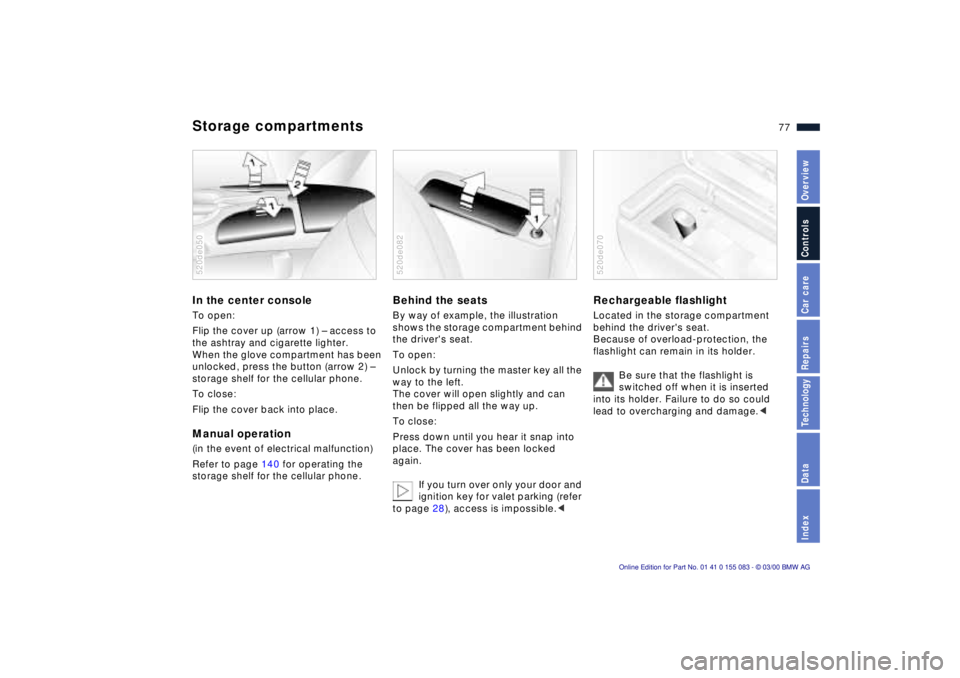
Storage compartmentsIn the center consoleTo open:
Flip the cover up (arrow 1) Ð access to
the ashtray and cigarette lighter.
When the glove compartment has been
unlocked, press the button (arrow 2) Ð storage shelf for
the cellular phone.
To close:
Flip the cover back into place.
Manual operation(in the event of electrical malfunction)
Refer to page 140 for operating
the
storage shelf for the cellular phone.
520de050
Behind the seatsBy way of example, the illustration
shows the storage compartment behind
the driver's seat.
To open:
Unlock by turning the master key all the
way to the left.
The cover will open slightly and can
then be flipped all the way up.
To close:
Press down until you hear it snap into
place. The cover has been locked
again.
If you turn over only your door and
ignition key for valet parking (refer
to page 28), access is impossible.<520de082
Rechargeable flashlight Located in the storage compartment
behind the driver's seat.
Because of overload-protection, the
flashlight can remain in its holder.
Be sure that the flashlight is
switched off when it is inserted
into its holder. Failure to do so could
lead to overcharging and damage.<520de070
Page 81 of 172
80n
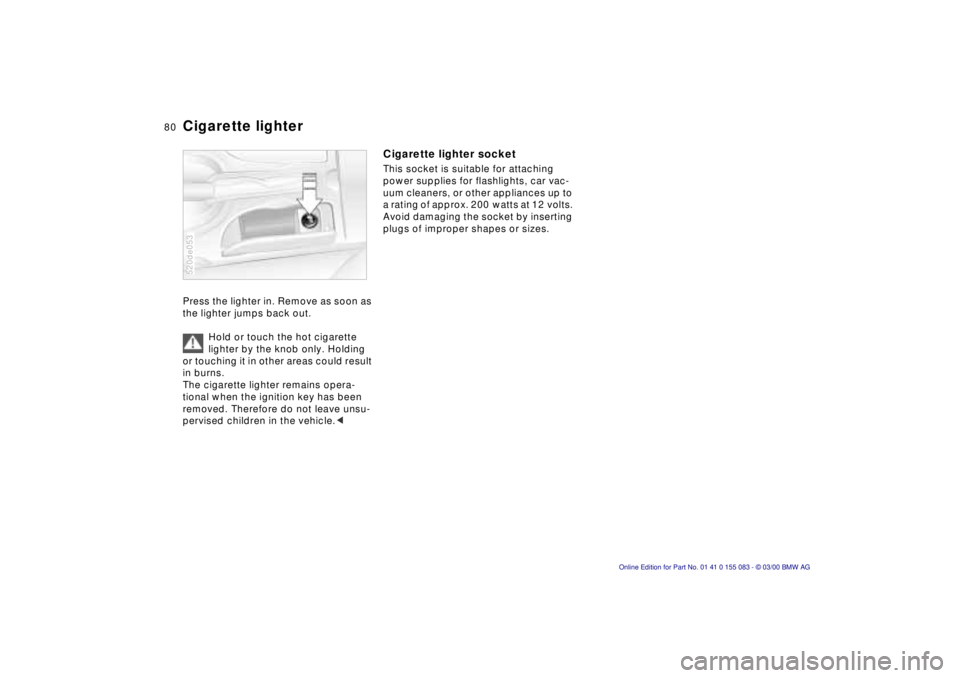
Cigarette lighterPress the lighter in. Remove as soon as
the lighter jumps back out.
Hold or touch the hot cigarette
lighter by the knob only. Holding
or touching it in other areas could result
in burns.
The cigarette lighter remains opera-
tional when the ignition key has been
removed. Therefore do not leave unsu-
pervised children in the vehicle.<520de053
Cigarette lighter socketThis socket is suitable for attaching
power supplies for flashlights, car vac-
uum cleaners, or other appliances up to
a rating of approx. 200 watts at 12 volts.
Avoid damaging the socket by inserting
plugs of improper shapes or sizes.
Page 82 of 172

81n
IndexDataTechnologyRepairsCar careControlsOverview
Cargo loadingStowing cargo If you are carrying cargo in the luggage
compartment of your BMW Z8 roadster:
>Load heavy cargo as far forward as
possible, directly behind the luggage
compartment partition
>Cover sharp edges and corners.
If you are stowing cargo behind the
seats in your BMW Z8 roadster:
>Stow only lightweight objects, such
as clothing items
>Do not pile objects higher than the
top edge of the backrest.
Do not stow either heavy cargo or
cargo with sharp edges and cor-
ners behind the seats, or else they
could damage the back of the seat or
the rear trim panel.
Cargo that is too big or unwieldy and
stowed behind the seats can also pre-
vent the seat from locking properly into
position. Therefore, check to make sure
that the seat is properly locked into
place, moving the seat forward if nec-
essary. Refer to page 43.
Always position and secure the load
correctly. If you do not, it can endanger
the passengers during braking or eva-
sive maneuvers.
Do not exceed the permissible gross
weight and axle load (refer to page 156),
otherwise the vehicle's operating safety
is no longer assured and you are in
violation of the law.
Make sure to secure heavy or hard
objects you stow in the passenger area,
otherwise, these objects could be flung
about during braking or evasive
maneuvers and possibly injure vehicle
occupants.<
Page 85 of 172

84n
To ensure that your vehicle provides
maximum economy throughout a long
service life, we request that you
observe the following instructions:
Your BMW Z8 roadster is an espe-
cially high-quality vehicle. It is in
your best interest to follow the break-in
instructions very closely. Doing this will
create the basis for a long, optimum
service life.<
Engine and differentialUp to 1,200 miles (2,000 km):
Drive at varying engine and road
speeds, but do not exceed 4,500 rpm
(4,500/min), or a road speed of 106 mph
(170 km/h).
Obey your local and state maximum
speed limits.
Absolutely refrain from the full-throttle
position with the accelerator.
Once you have driven 1,200 miles
(2,000 km), you can begin to gradually
increase both the engine speed and
road speed.
You should also comply with these
break-in procedures if the engine or
differential is replaced later in the
course of the vehicle service life.TiresDue to technical factors associated
with their manufacture, tires do not
achieve their full traction potential until
an initial break-in period has elapsed.
Thus, drive with extra care during the
initial 200 miles (300 km).
Obey your local and state maximum
speed limits.
When the vehicle is being driven
on wet or slushy roads, a wedge
of water may form between the tire and
the road surface. This phenomenon is
referred to as "aquaplaning," or "hydro-
planing," and can lead to partial or
complete loss of traction, vehicle con-
trol and braking effectiveness. Reduce
your speed on wet roads.<
Brake systemApproximately 300 miles (500 km) must
elapse before the brake pads and
rotors achieve the optimal pad-surface
and wear patterns required for trouble-
free operation and long service life.
To break in the separate parking brake
drums, apply the parking brake lightly
when coasting to a standstill (at a traffic
signal, for instance), provided that traf-
fic conditions allow you to do so.
To avoid corrosion, repeat this proce-
dure from time to time.
The brake lamps do not come
on when the parking brake is en-
gaged.
Vacuum for the brake system servo unit
on your BMW is available only when the
engine is running. When you move the
vehicle with the engine shut off Ð when
towing, for instance Ð substantially
higher levels of pedal force will be
required to brake the vehicle.
Engage the gears carefully and without
high engine speeds during this break-in
period.
Break-in procedures
Page 86 of 172

85n
IndexDataTechnologyRepairsCar careControlsOverview
Brakes:
Do not rest your foot on the brake
pedal while driving. Even light but con-
sistent pressure on the brake pedal
could lead to high temperatures, brake
wear, and possibly, to brake system
failure.
Aquaplaning:
Reduce speed while driving on wet or
slushy roads, otherwise, a wedge of
water can form between the tires and
the road surface. This phenomenon is
referred to as "aquaplaning" or "hydro-
planing." It is characterized by a partial
or complete loss of contact between
the tires and the road surface. The ulti-
mate results are loss of steering and
braking control.
Driving through water:
When there is water on the roads, do
not drive in it if it is deeper than 1 ft
(30 cm), and even then, only at walking
speed, otherwise the vehicle can sus-
tain damage to the engine, the electri-
cal systems and the transmission.<
The catalytic converter reduces harmful
exhaust emissions, and is designed for
use with unleaded fuel only. Even
minute quantities of lead would be
enough to permanently damage both
the catalytic converter and the system
oxygen sensor.To ensure efficient, trouble-free engine
operation and to avoid potential damage:>Be sure to comply with the scheduled
maintenance requirements
>Fill the fuel tank well before it is empty
>Tow-start only when the engine is
cold. If you attempt to tow-start with
a warm engine, unburned residual
fuel in the catalytic converter could
ignite and cause damage. It is better
to start the vehicle with an outside
starting aid
>Avoid other situations where the fuel
is either not burned or burns incom-
pletely, such as engaging the starter
frequently or for extended periods, or
repeated start attempts in which the
engine does not start (stopping and
restarting an engine which is running
properly does not present a prob-
lem). Never allow the engine to run
with any of the spark plug cables dis-
connected.Be sure to comply with the in-
structions above to prevent un-
burned fuel from reaching the catalytic
converter. Otherwise, there is the dan-
ger of overheating and damage to the
catalytic converter.
Extreme temperatures are present with
the catalytic converter both on this and
every catalytic converter-equipped ve-
hicle. Heat shields are installed adja-
cent to some sections of the exhaust
system. Never remove these shields;
do not apply undercoating to their sur-
faces. When driving, standing at idle,
and parking the vehicle, take care to
avoid contact between the exhaust sys-
tem and flammable materials (grass,
hay, leaves etc.). Such contact could
start a fire, resulting in serious personal
injury and property damage.<
Driving notes Catalytic converter
Page 90 of 172
89n
IndexDataTechnologyRepairsCar careControlsOverview
Disc brakes Brake systemDriving notesWhen driving in wet conditions and in
heavy rain, it is effective to apply light
pressure to the brakes every few miles
or kilometers. Watch traffic conditions
to ensure that this maneuver does not
endanger other road users. The heat
which is generated by the brake appli-
cations helps to dry the brake pads and
rotors.
Maximum braking force is obtained
while the wheels are not locked, but
rather when they are still barely turning
immediately prior to locking. ABS main-
tains this state automatically. If the ABS
fails, you should revert to the staggered
braking technique (refer to page 91).
Long or steep mountain descents do
not necessarily lead to reduced braking
efficiency if you drive downhill with the
transmission in a gear requiring minimal
brake applications.
Braking effect on the engine can be
further increased by downshifting, into
first gear, if necessary.If engine braking should prove to be
inadequate, you should still avoid ex-
tended, continuous braking. Instead of
maintaining low to moderate pressure
over an extended period of time, you
should decelerate by applying more
substantial pressure to the brake pedal
(watch for following traffic), releasing
the pedal, and then repeating the appli-
cation (staggered braking). The cooling
phases between active braking inter-
vals prevent the brakes from overheat-
ing and retain full braking capacity.
Do not coast with the clutch de-
pressed, the gear-shift lever in
neutral, or, above all, with the engine
shutt off; otherwise, the engine will pro-
vide no braking effect if the transmis-
sion is in neutral, and there is no brak-
ing or steering power assist if the
engine is not running. Do not allow floor
mats, carpets or any other objects to
protrude into the area around the brake
pedal, the clutch or the accelerator
which could obstruct their freedom of
movement.<
Brake fluid level
The brake warning lamp comes
on with the parking brake
released:
The brake fluid level is too low in
the reservoir (refer to page 112).
If the brake fluid level is too low
and brake pedal travel has become no-
ticeably longer, there may be a defect
in one of the brake system's hydraulic
circuits.
Proceed to the nearest BMW cen-
ter. Higher brake application pres-
sure may be necessary under these con-
ditions, and brake pedal travel may be
significantly longer. Please remember to
adapt your driving style accordingly.<
Page 102 of 172

101n
IndexDataTechnologyRepairsCar careControlsOverview
Wheel and tire combinations The right choice Use only BMW-approved tires with
emergency driving characteristics.
Refer to page 103.
Due to the maximum speeds this vehi-
cle can reach, the use of specific brands
and sizes is mandatory. Consult any
BMW center for details. Comply with
local/national regulations.
The correct wheel/tire combinaton
affects different sytems, such as
ABS, ATC, DSC and RDW. The function
of these systems is impaired if improper
wheel/tire combinations are used.
For this reason, use only tires made by
the same manufacturer that have the
same tread configuration and possess
emergency driving characteristics. And
after a flat tire, for instance, restore the
approved wheel-tire combination as
soon as possible.<
Codes on tires and wheels The tire codes will aid you in selecting
the correct tire.
Codes on radial tires:
The speed rating indicates the approved
maximum speed for the tire.
Summer tires:
S = up to 112 mph (180 km/h)
T = up to 118 mph (190 km/h)
H = up to 130 mph (210 km/h)
V = up to 150 mph (240 km/h)
W = up to 167 mph (270 km/h)
Y = up to 186 mph (300 km/h)
ZR = over 150 mph (240 km/h) For example:
Nominal width
in mm
Aspect ratio in X
Radial tire code
Rim diameter in inches
Load rating
(not on ZR tires)
Speed rating
(before R on ZR tires)
245/45 R 18 96 W
Winter tires:
Q M+S = up to 100 mph (160 km/h)
T M+S = up to 118 mph (190 km/h)
H M+S = up to 130 mph (210 km/h)
Codes stamped on light-alloy wheels:
Protect tire valves from dirt by using
screw-on valve stem caps. Dirt in the
valves frequently leads to slow leaks.
Tires with emergency driving character-
istics also possess an additional identi-
fication mark that varies by manufac-
turer, e. g.:
Bridgestone RFT
Dunlop DSST
Goodyear EMT
Michelin ZP For example:
Rim width
in inches
Code letter for
flange type
Symbol for full-drop
center rim
Rim diameter in inches
Hump on the 2 rim shoulders
8 x 18 H 2
J
Page 103 of 172

102n
Winter tires Snow chains
*
Choosing the right tireFor winter road driving, BMW recom-
mends winter tires (M+S radial belt
tires). Although all-season M+S tires
provide better winter traction than stan-
dard summer tires with H, V, W and ZR
speed ratings, they generally fail to pro-
vide the same levels of performance as
standard snow tires in winter driving.
In the interests of safe tracking and
steering response, install radial tires
made by the same manufacturer and
with the same tread configuration on all
four wheels if you elect to mount winter
tires.
Mount only winter tires that have been
approved by BMW. Any BMW center
will be glad to provide you with informa-
tion on the best winter tires for your
particular driving conditions.
Use only winter tires with emer-
gency driving characteristics as
there is no spare tire available if you get
a flat.
For further information, refer to
page 135.<
Do not exceed specified
maximum speeds
Never exceed the maximum speed
for which winter tires are rated.
Unprofessional attempts by laymen to
service tires can lead to damage and
accidents.
Have this work performed by skilled
professionals only. Your BMW center
will be glad to assist you with both their
expertise and the proper equipment for
your vehicle.<
Tire condition, tire pressureOnce the tread depth on winter tires is
less than 0.16 in (4 mm), they are no
longer suitable for winter road driving,
and in the interest of safety should be
replaced.
Comply with the specified tire inflation
pressures Ð and be sure to have the
wheel and tire assemblies balanced
every time you change the tires.StorageAlways store tires in a cool, dry place.
Store them away from light whenever
possible. Protect the tires against con-
tact with oil, grease and fuel.
The use of narrow-link BMW snow
chains is permissible in pairs only on
the rear wheels with winter tires with
tire size 245/45 R 18 96 H. Comply with
all manufacturer's safety precautions
when mounting the chains.
Do not activate the RDW system
while using snow chains.
Malfunction warnings and undetected
losses in pressure are possible when
driving with snow chains.
For further information, refer to
page 65.<
Page 104 of 172

103n
IndexDataTechnologyRepairsCar careControlsOverview
Approved wheel and tire specifications Comply with the specifications for tires
and wheels in the vehicle's documents.
If sizes not approved by the manufac-
turer are mounted, an entry in the vehi-
cle's documents may be necessary. Tire specifications Light-alloy wheel
BMW Z8
Summer tires
Front: 245/45 R 18 96 W 8Jx18 EH2
Rear: 275/40 R 18 99 W 9Jx18 EH2
Winter tires
245/45 R 18 96 H M+S 8Jx18 EH2
Snow chains
*
It is impossible to install snow chains
when using summer tires 275/40 R 18
99 W.
Do not activate the RDW system
while using snow chains.
Malfunction warnings and undetected
losses in pressure are possible when
driving with snow chains.
For further information, refer to
page 65.<
The use of rims and wheel bolts
that do not meet the specifications
of the original factory-installed equip-
ment will affect the safe operation of
your vehicle and may cause an accident
and personal injury.
Never mix tires of different design, such
as steel-belted radials with radial bias
belted or bias-ply tires, etc. Mixing tire
types will adversely affect roadholding
and can lead to loss of vehicle control.<
Page 113 of 172
112n
Coolant Brake fluidAdding coolant Wait until the engine cools before
removing the cap from the expansion
tank. The needle of the coolant gauge
in the instrument cluster must fall within
the blue zone. If it is not, there is a
danger of scalding.
1 Turn the cap slightly counterclock-
wise in order to allow accumulated
pressure to escape. Then open
2 If the coolant is low, slowly add cool-
ant until the correct level is reached Ð
do not overfill.
The coolant is a mixture of water and
extended-duty antifreeze with corrosion
inhibitor. Always maintain the pre-
scribed all-season 50:50 mixture ratio
for year-round protection against inter-
nal corrosion. No other additives are
required.
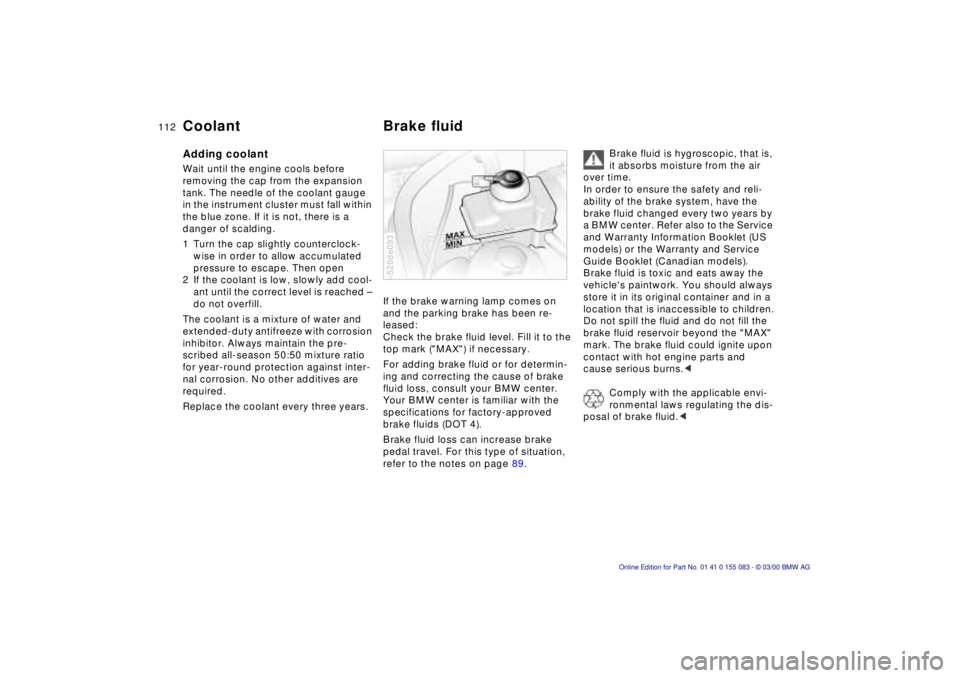
Replace the coolant every three years.If the brake warning lamp comes on
and the parking brake has been re-
leased:
Check the brake fluid level. Fill it to the
top mark ("MAX") if necessary.
For adding brake fluid or for determin-
ing and correcting the cause of brake
fluid loss, consult your BMW center.
Your BMW center is familiar with the
specifications for factory-approved
brake fluids (DOT 4).
Brake fluid loss can increase brake
pedal travel. For this type of situation,
refer to the notes on page 89.
520de093
Brake fluid is hygroscopic, that is,
it absorbs moisture from the air
over time.
In order to ensure the safety and reli-
ability of the brake system, have the
brake fluid changed every two years by
a BMW center. Refer also to the Service
and Warranty Information Booklet (US
models) or the Warranty and Service
Guide Booklet (Canadian models).
Brake fluid is toxic and eats away the
vehicle's paintwork. You should always
store it in its original container and in a
location that is inaccessible to children.
Do not spill the fluid and do not fill the
brake fluid reservoir beyond the "MAX"
mark. The brake fluid could ignite upon
contact with hot engine parts and
cause serious burns.<
Comply with the applicable envi-
ronmental laws regulating the dis-
posal of brake fluid.<